The Berg Lake Trail is one of the most iconic backpacking trails in the Canadian Rockies. It’s been on my bucket list for a long time, but it was closed for 3 years due to flooding that washed out portions of the trail in 2021. It finally re-opened in 2025 and I was super keen to visit the same summer. I spent 6 days hiking along the trail and it was easily the highlight of my summer! I’ve already published a 3-part trail report about my experience, which you can read starting here, but I had a lot of other learnings about the trail that I’d love to share. Reservations for the 2026 season are releasing at 7am on December 2, 2025. so here’s everything you need to know about the Berg Lake Trail!
The Trail
The Berg Lake Trail is a 42km there-and-back trail located in Mount Robson Provincial Park in BC. The trail starts at the parking lot north of the visitor centre and continues for 21km to the beach at the back of Berg Lake. There are 7 campgrounds in the park, with the most popular being the Berg Lake Campground.
There are a few options for how to hike this trail. If you’re not a backpacker, it is possible to day hike the entire thing, but you should give serious consideration to your fitness ability and previous hiking experience if you decide to attempt it. While the trail itself is not technical, it is a considerable distance and it covers almost 1000m in elevation gain. Approximately 500m of the gain is done in a 3km span, so it is a challenging and tiring hike. If you are not used to hiking long distance or you don’t have experience hiking in the mountains with significant elevation gain, I strongly recommend against attempting this as a day hike. If you do plan to day hike, I recommend starting before sunrise to give yourself lots of time, or consider biking as far as Kinney Lake. I found that the day hikers were primarily tourists who either don’t camp, or weren’t aware of the lead time required to secure permits.
If you are able to backpack it, I think this is a more enjoyable way to experience the trail. I did the trail over 5 nights, splitting the trail into 2 parts on the way up and down, and then camping 3 nights at Berg Lake to do day hikes. If you have more time to spend in the park, there’s lots to explore, but you can also enjoy this trail over a shorter period. I’d recommend a minimum of 2 nights. Most likely your itinerary will be limited by what permits you are able to obtain.
Time of Year
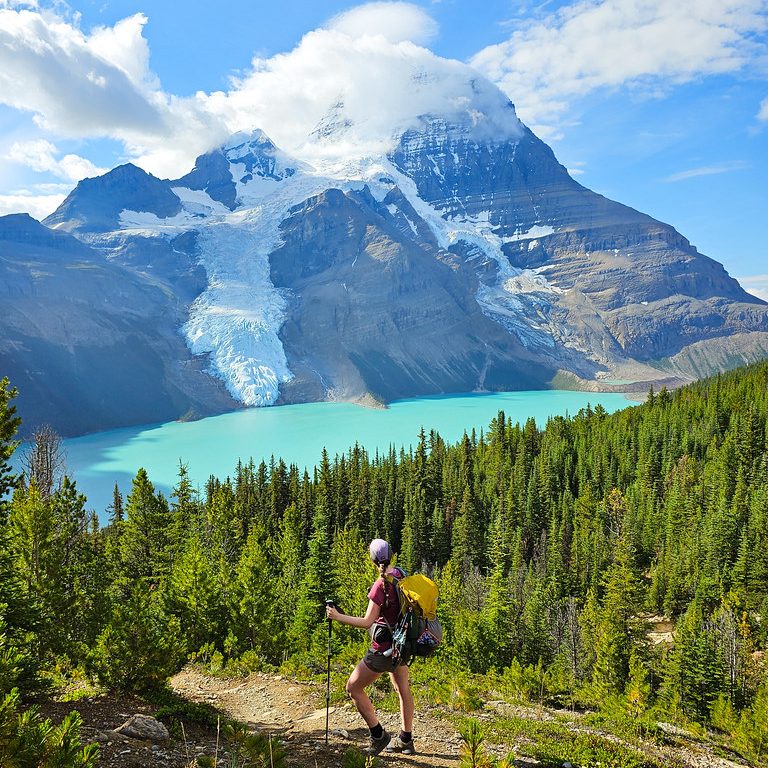
The best time of year to visit the Berg Lake Trail is pretty straight-forward. Mount Robson is the tallest mountain in the Canadian Rockies, so the trail is covered in snow for most of the year, limiting the core hiking season from late-June to mid-to-late September. You can visit year round, but you must be prepared for winter conditions and be aware of avalanche risk, which I won’t be discussing in this post.
I think there is slightly less traffic in September, as it gets cold quickly in the Rockies, but otherwise, avoiding the crowds isn’t really possible. If you go in late-June, be aware that there may still be snow on some of the trails; and if you go later in the summer, it’s more likely that your trip might be impacted by wildfires. Mid-to-late July might be the sweet spot, but I visited during the first week of August and lucked into great conditions. The mountains are always susceptible to storms, so be prepared for that.
Getting There
I think it may be possible to take a bus to Mount Robson Provincial Park from either Jasper or Kamloops in the summer, but it’s not a common route and I don’t know how reliably buses run. Similar to other popular Canadian parks, the easiest way to access is by driving. The park is located on Highway 16, which is a 5 hour drive from Edmonton, 7 hours from Calgary, and 7.5 hours from Vancouver (all without breaks). It’s not an easy park to access, but I promise it is worth your time. There is a very large parking lot at the trailhead, which is relatively secure, but never leave valuables in your vehicle.
Permits
Without a doubt, getting permits will be the hardest part of your trip to Berg Lake. This is a world-renowned hiking trail and attracts crowds of visitors every year. If you don’t get camping permits, then day hiking may be your only option to visit the park. If you want to try and get camping permits, then it’s important to mark your calendar with the permit release date. The permit release date for 2026 is Dec. 2, 2025. Unlike other BC parks, the permits for the Berg Lake Trail are released all on one day. The date is usually announced on the Mount Robson Provincial Park page, as well as on BC Park’s instagram. They usually don’t give a lot of notice (1-2 weeks), so you should be prepared to check in regularly at the end of the year until it is announced. The easiest way is to follow their social media.
Once released, you will have to book your permits on camping.bcparks.ca. Unlike Parks Canada, there is no random queue generator and you will have to login to your account, so there is no benefit to using multiple devices to try and get higher up the queue. However, if you have multiple people going on the trip, it is advantageous if you all login to your respective accounts to try for reservations (effectively giving you multiple chances to get your desired itinerary). I recommend creating an account in advance of release day (when the website will likely be slow due to traffic) and logging in before the sites release.
Once booking opens, select “backcountry reservations” and search for your start date. You will be forced to build your itinerary day by day, which can be a little frustrating. Once you get a date in your cart, you don’t need to worry about losing it, but it will become more challenging as the dates book up to continue building the itinerary. For example, by the time you get Whitehorn in your cart for your first night, Berg Lake may no longer be available for your second night. People are constantly adding and changing dates and campsites in the rush to get their itinerary, especially if you have multiple people from the same party trying to make 1 booking. So the trick is to frequently refresh. Just because you don’t see Berg Lake available right away, doesn’t mean it won’t show up if you keep refreshing.
My recommendation for booking a longer itinerary is to take what you can get and make changes later. If Berg Lake is not available, book Marmot or Rearguard and move on to the next day before those dates book up too. Once you have secured a booking for each of the dates in your itinerary, go back and look for cancellations. Keep refreshing until you see one, and then make a change to your booking to add it. This does cost more money as the change fee is $6, but I was able to get bookings for Berg Lake after the fact using this hack. When I made my first booking, I had 3 nights split between Marmot and Robson Pass campsites. I was able to change my reservation from Robson Pass to Berg Lake within the hour from people dropping sites, and I was able to get a cancellation later in the season and change my booking from Marmot to Berg Lake. So in the end, my starting itinerary (which had no nights at Berg Lake) ended up with 3 nights. You can track cancellations on Schnerp, which will notify you when a site opens up.
Campsites
There are 7 backcountry campsites in the park, so there are lots of options for where to stay and opportunities to customize your trip. The first 3 campsites are located along the trail to the lake, while the last 4 campsites are all located within 3.5km of one another around the lake. I’ll discuss itineraries below, but here’s an overview of the 7 campsites along the trail. All campsites include outhouses and bear lockers and as discussed above, require valid permits for the duration of your visit.
Kinney Lake – This is the first campground, located right on Kinney Lake at the 7km trail marker. It has 18 tent sites and a large open-air shelter. It’s a beautiful campground with several lakefront tent pads and a lovely view from the shelter. The trail to Kinney Lake is a gentle uphill, so this campsite is often overlooked because it is less than halfway to Berg Lake. But it’s a great option if you have a late start on your first day, as well as for families or those who want to experience Mount Robson’s backcountry, but have concerns about the strenuous hike up to Berg Lake. There are bike racks located at the back of Kinney Lake for those who bike up.
Whitehorn – This campground is located along the Robson River at the 11km trail marker. It has 22 tent sites and a large open-air shelter. This campground is ideal if you’re looking to split the hike to Berg Lake in half. It splits the elevation gain in half as well, though day 2 is slightly more strenuous. Some of the tent pads are along the river, while others are in the woods, but there’s a beautiful view of the valley and the backside of Mount Robson from the campground.
Emperor Falls – This campground is located just past the viewpoint for Emperor Falls at the 16km trail marker. It has 9 tent sites and some picnic tables, but it does not have a shelter. While the tent pads are located right next to the river, making for a nice view, the main downside to this campsite is that it’s located at the top of all of the elevation gain, so it leaves you with a big day if you’re hiking from the parking lot. I would probably avoid it on the way up, but it’s a good option to shorten your hike on the last day.
Marmot – This is the first of the upper campgrounds, any of which can be used as a base for day hikes. It’s located at the foot of Berg Lake at the 19km trail marker. It has 7 tent sites and a recently constructed semi-enclosed shelter (this one has windows, unlike the shelters at Kinney Lake and Whitehorn). Most of the tent pads are located in the woods, but 1-2 have a direct view of Mount Robson. While the view from Marmot is not quite as good as from Berg Lake, it is located right on the lake and would be my first choice if I couldn’t get a site at the Berg Lake Campground. Some people really like this campground because of how small it is, so you can avoid the crowds.
Berg Lake – This is the most popular campground on the trail. If you can score a permit for this campground, do not hesitate to book it. It’s located at the head of Berg Lake at the 21km trail marker. It has 26 tent sites and a fully enclosed cooking shelter with a large porch and view of the Berg Glacier. This is the most beautiful campsite on the trail, but it will be very busy as a result. Most of the tent sites are in the woods, though there is one premium tent pad with a lake view. A few of the sites at the back of the campground also have mountain views.
Rearguard – This campsite is located just past the Berg Lake Campground at the 22km trail marker. It has 6 tent sites and is a good option if you weren’t able to get a campsite at Berg Lake. It’s not located on the lake, but it does have nice views of Mount Robson and the river delta. The main downside is that there is no shelter, so if it rained, I’d prefer to be at Marmot.
Robson Pass – This is the last campsite in the park, located at the 23km trail marker. It has 15 tent sites. It’s located a little bit further away, but it can still be a great base if you’re planning to do some day hikes. You can access Snowbird Pass from this campsite, as well as you can hike up the backside of the Mumm Basin Trail – although be aware that this trail no longer connects to the Toboggan Falls trail due to a rockslide in recent years – but I’ve heard it still has a great view. Similar to Rearguard, the main downside of this campsite is that it doesn’t have a shelter.
Robson Hut – Another option to be aware of in the future is that the ACC is currently constructing a brand new mountain hut at Robson Pass, which should be open for the 2026 season. You will be able to book this hut through the ACC and it will be the swankiest accommodation available in the park. Please note that this is separate from the BC Parks booking system and it is not an open hut that you can visit. A booking will be required to use the hut.
Robson Meadows – Just to cover my bases, I want to mention that there is a frontcountry campground located off the highway near the visitor centre, which is a great option for camping the night before or after your backpacking trip.

Itineraries
I’ll keep this fairly simple. It’s not easy to get permits, so it’s really a take what you can get scenario, but there are a few strategies you can employ.
Strategy 1: Hike all the way to Berg Lake in a day. The idea with this strategy is that you book as many nights as you want at the lake, prioritizing day hikes from the lake. The benefit is that you can immediately concentrate on getting bookings for Berg Lake before they fill up and maximize your time at the lake. The downside is that you need to be prepared to do the full 21km in a day, which is challenging, but allows you to spend more time at the lake if time is limited.
Strategy 2: Break up your hike to Berg Lake into 2 days, staying at one of the middle campgrounds on the way up, but planning to hike all the way back to the parking lot in a single day. Again, book as many nights as you want at Berg Lake after you arrive. This makes your hike in easier than strategy 1, but still gives you extra time at the lake, as the hike down is much easier than the hike up.
Strategy 3: Break up your hike to Berg Lake into 2 days on both the way up and down. If you have more time available, you can still book multiple nights at Berg Lake in the middle to do day hikes, but the benefit is it gives you a more relaxed hiking timeline, especially if you are worried about the challenging terrain.
Personally, I would only do strategy 1 if I only had 1 night. I used strategy 3 for my visit because I had lots of time, but I would have been comfortable with strategy 2 as well. It is more manageable to do the hike down in a single day. Here’s a couple of options based on the number of nights you have. (D=day, N=night)
| Number of Nights | First Choice Campground | Alternate Campgrounds |
| 2 days, 1 night (strategy 1) | D1: Hike to Berg Lake D2: Hike out | Marmot, Rearguard |
| 3 days, 2 nights (strategy 1) | D1: Hike to Berg Lake D2: Day hike, stay at Berg Lake D3: Hike out | Marmot, Rearguard |
| 3 days, 2 nights (strategy 2) | D1: Hike to Whitehorn D2: Hike to Berg Lake D3: Hike out | N1: Emperor, Kinney Lake N2: Marmot, Rearguard |
| 4 days, 3 nights (strategy 2) | D1: Hike to Whitehorn D2: Hike to Berg Lake D3: Day hike, stay at Berg Lake D4: Hike out | N1: Kinney Lake N2: Marmot, Rearguard N3: Marmot, Rearguard |
| 4 days, 3 nights (strategy 3) | D1: Hike to Whitehorn D2: Hike to Berg Lake D3: Hike to Whitehorn D4: Hike out | N1: Kinney Lake N2: Marmot, Rearguard N3: Kinney Lake, Emperor |
| 5 days or more | Same as 4 day options, but add multiple nights at Berg Lake |
Day Hikes
There are several great options for day hiking along the Berg Lake Trail. I really think it’s worth it to try and fit in at least one day hike if you can get multiple nights at campsites near the lake, but if you can’t, it’s not the end of the world either. Berg Lake is a world-class trail on it’s own and the entire trail is stunning, whether you have time for side quests or not. If you do have time, here’s the trails I would recommend.

Snowbird Pass – In my opinion, this is the best trail in the park. People like to prioritize the Berg Lake Viewpoint on the Toboggan Falls Trail, but this trail is the real gem. It’s a 20-km round trip hike from the Berg Lake Campground, so you definitely need a full day for it, but it features views of both the Robson Glacier and the Reef Icefield. It’s stunning from start to finish. If you don’t have enough time to do the whole trail, it’s still worth it to hike the 3km from Berg Lake to the lake at the base of Robson Glacier. I’ve written an entire blog post about this trail.
Toboggan Falls to Berg Lake Viewpoint – This is the most popular side trail in the park. From the Berg Lake Campsite, you can hike 1km up along the Toboggan Falls trail (enjoying the view of Toboggan Falls along the way), to a junction that takes you another ~1km up to the Berg Lake Viewpoint. From here, you can get the iconic photo of Berg Lake, the delta, and Berg Glacier. You don’t need a full day to do this hike, so if you’re short on time, you can probably knock it out in ~2 hours after you arrive at camp.
Hargreaves Lake Loop – If you have a full day, expand your hike up to the Berg Lake Viewpoint to also include the loop around to Hargreaves Lake via Marmot Campground. It’s approximately 7km round trip and in my opinion, Hargreaves Lake is really underrated. There’s a small viewpoint off the trail that takes you up to a lookout of Hargreaves Glacier and the Marmot branch of the Berg Glacier at the same time. I’d recommend a day if you’re doing the whole loop, but if you’re staying at Marmot, you could easily hike up to Hargreaves Viewpoint and back in an evening, as it’s only ~3km round trip.
Adolphus Lake – I haven’t done this trail myself, but if you have the time, you can hike out from Berg Lake to Robson Pass and then continue on to see Adolphus Lake. It’s ~2.5km from the Berg Lake Campground, but along completely flat ground. It’s a great option if you’re staying at Robson Pass.

 The Road Goes Ever On
Hello,
Do you know if you can show up early in the morning of the day you want to hike and wait for no-shows?
Thanks!
Hello,
No, you can’t. You have to have permits from the visitor centre if you are staying overnight. Your best bet is to watch for cancellations using Schnerp.
Best of luck!
Maria
Pingback: Guide to Lake O’Hara | The Road Goes Ever On
Me and a friend are heading there in July, wondering Will 2 tents fit on the tent pads ?
Hi Tara, that’s awesome you got permits!
Most of the sites don’t actually have raised wooden pads, they just have a wood border around the ground site, so they are a lot more flexible as you could have the vestibules of the tents hanging over the edge. I think you could make it work with two 1p tents or a 1p and a 2p tent, but it might be a challenge with 2 tents larger than that.
Best of luck!
Maria
Pingback: 100 Unique Experiences in British Columbia | The Road Goes Ever On
Hi Maria! A friend and I are looking at doing Berg the very end of April. Any idea where we can look for avalanche information?
Hi Faith,
You can find lots of information about avalanches on avalanche.ca, including for Mount Robson Provincial Park. They will stop publishing avalanche info later into the Spring and you may need to do additional research about the conditions during that time of year. I’m not familiar with the conditions at Robson, but I do know that Spring can be one of the most dangerous times in the mountains because everything is melting and there may be additional hazards like wet/loose snow, snow bridges, hidden streams, etc. I’ve also heard it’s common for slides to happen in Jasper into May.
Stay safe!
Maria