Golden Ears Peak Backpacking Trip

It’s hard to believe that I’ve lived in BC for 12 years now and I’ve never hiked to the top of Golden Ears Peak. Golden Ears Park is one of the closest BC Parks to Metro Vancouver – it’s only a 30 minute drive from my house – and Golden Ears Peak is an iconic hike near the city. Due to its proximity to town and the epic views available from the summit, it’s a very popular destination. However, it also has 1500m of elevation gain and is a 24km round trip hike to the summit, so it is extremely challenging.

Golden Ears Peak has been on my bucket list for a long time, but due to the length and elevation gain, I knew I wanted to backpack it. There are two campsites along the trail. Alder Flats is located at the 6km mark, and Panorama is located at the 11km mark, 1km below the summit. There are only 7 tent pads at the Panorama Campsite, so it is important to get an early start if you want to snag one. Knowing I would have to hike fast in challenging terrain to get a tent pad, I’ve avoided this hike for a long time. I don’t like rushing up a mountain and I hate the feeling of competing for campsites. 

20250720_131958
20250719_080107

I put all that aside this summer to finally hike this iconic trail. Carolyn is preparing to move back east in the Fall (I am devastated), so she’s been working on completing some of the bigger trails on her bucket list. We decided to make an attempt of this trail in mid-July. We didn’t get ideal weather, but we planned the perfect itinerary for this trip and had great success in executing it (something that always makes me happy I work as a project manager)!

You need a permit to camp on this trail from camping.bcparks.ca, but there is no reservation system, so anyone can hike it on any given day. There are only 7 tent pads, but there’s regularly 30+ tents set up at Panorama on any Saturday night. I’m surprised BC Parks hasn’t brought in a reservation system for camping in this park yet, but my theory is that they don’t want to promote the campsite without investing considerable resources into the trail, which is very technical and in very rough shape. Either way, we wanted to get a tent pad so that we weren’t further contributing to damage to the alpine meadows around the campsite.

20250720_091616
20250719_102435

Our plan was to drive to Golden Ears right after work on Friday and hike the first 6km to Alder Flats, camping there for the first night. We were able to get away from work a little early and pulled into the West Canyon Trail parking lot at 5pm. The first half of the trail to Alder Flats is super easy. It’s completely flat and well graded, so we finished that section in under an hour and then stopped for a quick supper. The next 3km are more challenging, with some uphill sections and lots of loose rock. But it’s still a relatively easy trail and we completed the full 6km in 2 hours, arriving at Alder Flats around 7pm.

Alder Flats was completely empty when we arrived, which didn’t surprise me because we started pretty early in the evening, but I was expecting it to get a lot busier. Two more groups did show up, and a third group of noisy bros rolled in at 2am (I’ve never hated anyone so much), but overall, I was expecting there to be a lot more people at the campsite. The weather for the weekend was looking a little bit mixed, with some clouds and rain in the forecast, so we thought that might keep some people away (spoiler, it didn’t). Maybe Alder Flats gets busier on other weekends, but it wasn’t busy on the weekend that we went.

20250719_170349
20250719_165425

The bros got up at 5am to continue their hike, which made me hate them even more because they woke us up twice, and me and Carolyn got up at 6am. The bros ended up being the first ones to the campsite and took two pads, but me and Carolyn were next after that. The tent pads didn’t all get taken until a solid 2 hours after we arrived, so we could have had a bit later start, but no regrets. Lots of people get up early to hike the full distance from the parking lot, so I’m sure conditions change on any given weekend. But for us, camping at Alder Flats and getting an early start from there was very successful.

But I’m getting a little ahead of myself. Alder Flats is a nice campsite in the forest with a bear cache and outhouse, and has the benefit of being located close to a really nice river water source. There is no consistent water source at Panorama, but there’s a lot of snow up there and there’s usually run-off that you can drink until later in the summer, or you can melt snow. We’re both water snobs, so we opted to carry all our water up for the weekend. This is probably a little extreme and resulted in us each carrying 10lbs of water up the trail, but we’re both lightweight hikers and I honestly didn’t regret it. We could have treated the run-off at the top, but it was also nice to get up there and not have to worry about it. 

20250719_173653

After filling up our bladders, we left Alder Flats shortly after 7:30am. After Alder Flats, the trail gets substantially more challenging. It’s definitely doable to hike from the parking lot, but it was nice to rest overnight and only have to tackle 5km in the morning. Once you leave Alder Flats, the trail immediately heads uphill over loose cobble. This is some of my least favourite type of terrain. I call it “ankle rollers” because the loose cobble makes it really easy to roll your ankle and the rock is really tiring on your feet. The trail is like this for ~2km before you hit the next obstacle. 

Following the loose cobble, you hit dense forest and have a very technical and sleep climb through the trees. There’s a viewpoint towards Golden Ears just before you hit your first set of stairs. There are several staircases at the start of this section and the first step is missing for almost all of them, so it feels very steep. The trail winds back and forth through the woods and you have to climb up and around a lot of tree wells and tree roots. There are lots of handholds on the trees, but you definitely need to use your hands to get around some of the obstacles. I don’t know exactly how long this section is, but I’d estimate around 1.5km. It goes very slowly because you cover a lot of elevation gain. 

20250719_195102
20250719_200336

Eventually the forest thins and the trail levels out when you reach the sub-alpine. You’re still in the forest, but the trees are very short, so it feels more exposed and you can get good views. Definitely remember to apply sunscreen once you reach this section. Fortunately, it was cloudy on the day we hiked up. It still felt extremely damp and humid and we were sweating so much from climbing, but I think the hike would have been a lot more challenging on a hot day. We were both gross, but feeling pretty strong. 

Once we reached the sub-alpine, the trail felt easier as you follow the ridge, but you do have to do a little bit of up and down as you cross over some bumps along the trail. We started seeing more people as everyone who had camped at the summit on Friday night was heading back down. Unfortunately, we couldn’t see any of the view because we hiked right into the clouds. This section is also ~1.5km in length, but it gets more challenging the closer you get to the campsite. There is one ladder and the last section is definitely a scramble and you should be prepared to use your hands as you climb up over the rock to the campsite.

20250719_193759
20250719_192714

Carolyn opted to bring Jasper with her and he did really great. Overall, I wouldn’t recommend this hike for dogs unless they do a lot of hiking, because it is a long trail and you will have to be prepared to help them through a few sections. The only tricky section along the trail to Panorama is the ladder, and maybe a few parts of the scramble right before camp. But if you plan on going to the summit, there’s a rope section where your dog may also need help. Plus you need to keep an eye on them near steep drop-offs.

Eventually, you get your first view of the emergency shelter and we confirmed that we were early enough to snag a tent pad! It took us just over 3 hours to hike from Alder Flats and we arrived pretty much right at 11am. We selected our tent pad, but rather than set up the tent, we set up our chairs and sat down to have a snack and a drink. Like I said, you couldn’t see any of the view yet, but we were optimistic that it would clear in the afternoon. Because there was no sun and we were at an elevation of 1350m, it was quite cold. We quickly layered up and after a nice break, we set up the tent and then ate our lunch in the shelter of the emergency cabin. 

20250719_201122

We had planned to eat in the cabin, but I’m sad to say, the emergency cabin is disgusting. It has not been treated well. Half of the cabin is a loft space for emergency use and storing your food, and the other half of the cabin is a urine-diverting outhouse that gets flown in at the start of the season. The cabin is dark with some abandoned gear, but the outhouse is absolutely gross. It’s a real shame because it’s actually a nice toilet and it had the potential to be nice. But people have left soooo much garbage on the floor of the outhouse that it stinks and is really disgusting. There are entire garbage bags of food waste, and then other people have left used pads and poopy toilet paper all over the floor. I’m glad people didn’t put their food waste and feminine products in the outhouse, but users at this site really need some basic education about leave no trace. 

Like I said, the trail is super popular and looking at some of the groups, it’s clear that a lot of the visitors are beginner backpackers and a few people we talked to were first-timers. I find this a bit crazy because Golden Ears is such a challenging trail, it’s not an easy choice for your first trip. There’s nothing inherently wrong with it and I don’t judge people for it (if anything, I feel they were misled by social media). Backpacking is a learning experience and I don’t believe in gatekeeping it. We all start somewhere and we will all learn how to be better at it. But honestly, this campsite is just too overcrowded. I’m glad it has the outhouse, even if people don’t treat it well, because otherwise I can’t imagine the state of the meadows. 

20250719_192716
20250719_210622

After lunch, it was still very foggy, so we decided to take a nap. Our sleep had been interrupted by the bros the previous night and we ended up passing out for the better part of 3 hours. When we left the tent, the campsite had been transformed. It was still cloudy, but there were now an additional 25 tents spread out everywhere throughout the meadow and there were people everywhere. We were just praying that it would eventually clear so that we could see the view, because neither of us wanted to ever return to this campsite. 

The thing about Panorama Campsite is that it’s still located 1.1km from the summit of Golden Ears. One of the benefits of arriving early in the morning was that it left us with lots of time to explore the summit. But neither of us wanted to climb the mountain until the view cleared up. Finally, at 5pm, we got our chance. The clouds lifted and we were able to see the surrounding backcountry! If you look east, you’ll be able to see down towards Alder Flats. I thought we’d be able to see Alouette Lake, but it’s hidden behind other mountains. However, if you look west, you get the most incredible view of Pitt Lake! 

20250719_210653
PSX_20250721_204602

Most of the people at the campsite had arrived later and were still sorting out their tents and water. But because we’d arrived so early, we decided to set off for the summit right away when the view cleared. Another group did the same, but few others bothered. Lucky for us though, the other group were frequent visitors and they were able to give us a few pointers about the route to the summit, which is still pretty technical. 

We climbed out of the campsite, which is all exposed rock, but then there was a section of snow field that still hadn’t melted. We brought our microspikes for this section and I definitely wouldn’t recommend going up without them. It was easier than the ascent I did over snow the previous weekend at Brandywine Mountain, but it was still pretty steep in some sections. I’ve heard that early in the season the whole route to the summit can be covered in snow, in which case, you shouldn’t attempt it. The more technical parts of the route didn’t have any snow, so we felt reasonably comfortable. 

PSX_20250720_190515

After the snow field, there are 3 scramble sections. The first is the least technical and goes up over some rock and a few trees. Then you hit the second section, which has a rope going up the rock face. This spot was a little dicey and we debated not doing it because it looked intimidating. But up close it was a bit easier, so we continued on, Carolyn just had to help Jasper. At the top of the rope section, there’s a little plateau, which is a nice place for a break before starting the final ascent to the summit. The other group continued on, but we’d hiked back into the clouds and me and Carolyn had gotten very hungry, so we decided to stop and have our supper instead. We decided that if it cleared during our break, we would keep going, and if not, we’d stop there.

We had a really nice meal and break and then did some tiktok dancing while waiting for it to clear. It didn’t seem like it was going to, so eventually we decided it was time to head down. About a minute after we started hiking back, the clouds completely lifted and we finally got a view, so we ran back to our supper spot to take more photos. In the end, we still opted not to finish the last couple hundred metres to the summit. It was getting later in the evening and the very top of the summit never actually ended up clearing, so I’m content with our decision to just enjoy the view below the summit. 

20250719_205529
PSX_20250720_190821

We ended up doing a bit more exploring on the way down to catch some of the views in other directions. We got back to the campsite just in time for sunset and Carolyn made us popcorn as a little treat. We ended up getting a beautiful cloud inversion as darkness set in. We’d climbed another 200m of elevation up to the summit, so we were pretty exhausted and fell asleep easily. We planned to get up for sunrise at 5:30am, but we were relieved to see that it had clouded back in overnight, which gave us the excuse to sleep in.

We had a pretty chill morning, but we were still packed and ready to head down by 9am. It’s 1200m of elevation loss to return to the parking lot, so I was really worried about my knees. They were definitely twinging, but overall did pretty good and I was relieved I didn’t have to hobble out the trail. We stopped for lunch at the helipad at Alder Flats, and then arrived in the parking lot at 2pm. So it took us 5 hours with a break to hike the whole way back down. We rewarded ourselves with burgers and beer at The Patch in Maple Ridge before returning home.

20250719_210418

So overall, I’m thrilled that I can finally cross this trail off my bucket list, but also relieved that I won’t ever have to hike it again. I know some people do this as a day hike, but it would be a very big day (although I’m sure it’s easier with a smaller pack). I get why everyone wants to do this hike, the views are great, but the crowds are a lot to contend with and honestly, there are lots of other trails that are just as nice. I definitely wouldn’t recommend this hike to beginners and honestly, I probably wouldn’t recommend it at all because of the crowds. If you’re local and want to cross it off your list, absolutely, but if you’re just visiting, I would prioritize something else. But I can’t deny it is a pretty iconic hike.

9 Spring Hikes near Vancouver

Spring is one of the most challenging seasons in the backcountry. It gets really nice in the city, which can trick hikers into thinking that it’s a good time to return to the mountains. Any time is a good time to be in the mountains, but you have to manage the risk accordingly. Snow will not melt at high elevations and in the alpine until the end of June and sometimes even as late as mid July. Spring is particularly dangerous because the rapid melt can create unseen hazards under the snow. What looks like a flat snowy trail may have creeks hidden under thin layers of snow that can easily collapse under your weight. So the safest approach is generally to stick to lower elevation hikes. Fortunately, there’s lots of those available in BC as well! Here’s a few of my favourites within close driving distance of the lower mainland.

Jug Island/Admiralty Point Trail

A photo of a yellow kayak resting on the beach in front of Jug Island on a sunny, blue sky day in Belcarra, BC.

Belcarra is a gorgeous coastal location for Spring hiking. If you park at the lot in Belcarra Regional Park, you can do a short, but scenic hike along either end of the peninsula. If you head south from the parking lot, you’ll follow the Admiralty Point Trail along the water, with lots of little viewpoints along the way. If you head north, you’ll hike inland along the Jug Island trail to a beach viewpoint. Both trails are approximately 5.5km long round trip, but Jug Island is more challenging because it hikes up over the headland and then down to the beach. Both trails can usually be hiked year-round.

Hunter Road

Three hikers and their dog pose at a viewpoint with the snow capped mountains and Stave Lake in the background at Hunter Road, near Mission, BC.

Hunter Road is an easy trail in Mission that can be done during most of the year. The trail starts from the end of Roach Street and is an easy hike along an old forestry road (Hunter Road). Eventually the trail loops back around on itself to climb up to the summit of a small overlook where you can enjoy views of Stave Lake and the surrounding backcountry. It’s a there and back trail, approximately 7.5km in length, 250m in elevation gain.

High Falls Creek

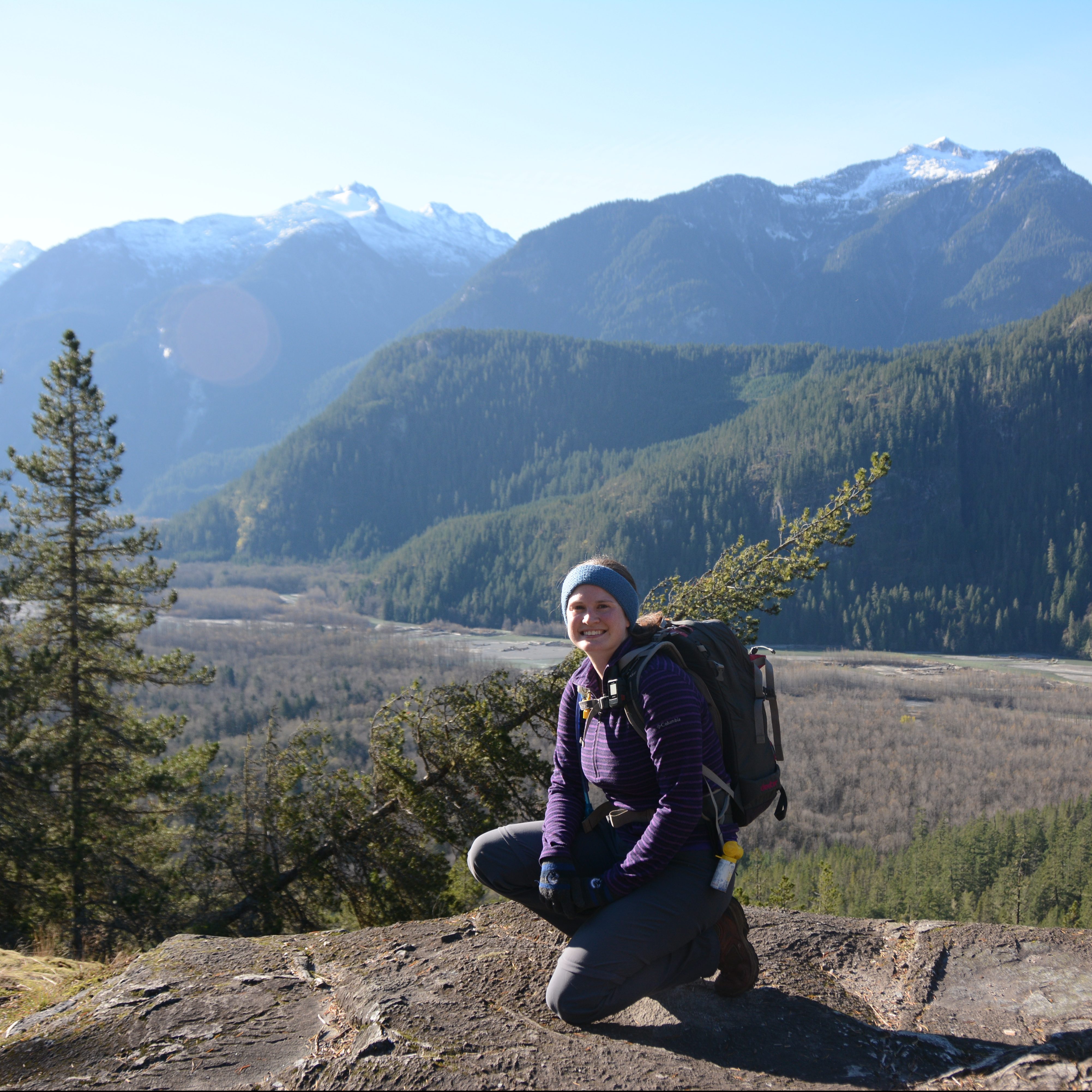
A female hiker nears and smiles at the camera from the High Creek Falls Trail with a view of the snow capped mountain peaks and forest of the Squamish Valley in the background, near Squamish, BC.

High Falls Creek is one of two hikes on this list that can be found along the Squamish River. It’s a more challenging hike than some of the others, but is great for Spring when the rivers are flowing at high capacity. The trailhead is located approximately 26km up Squamish Valley Road. The hike can be done as an out and back, but if you want to make it a bit longer, you can turn it into a loop hike by continuing up to Branch 200 FSR and hiking back along the road. The trail to High Falls is a bit technical, with some scrambling over rocky sections, so make sure to go on a dry day. It’s 1km each way to High Falls Creek, but if you do the loop, it’s 9km with 500m of elevation gain.

Crooked Falls

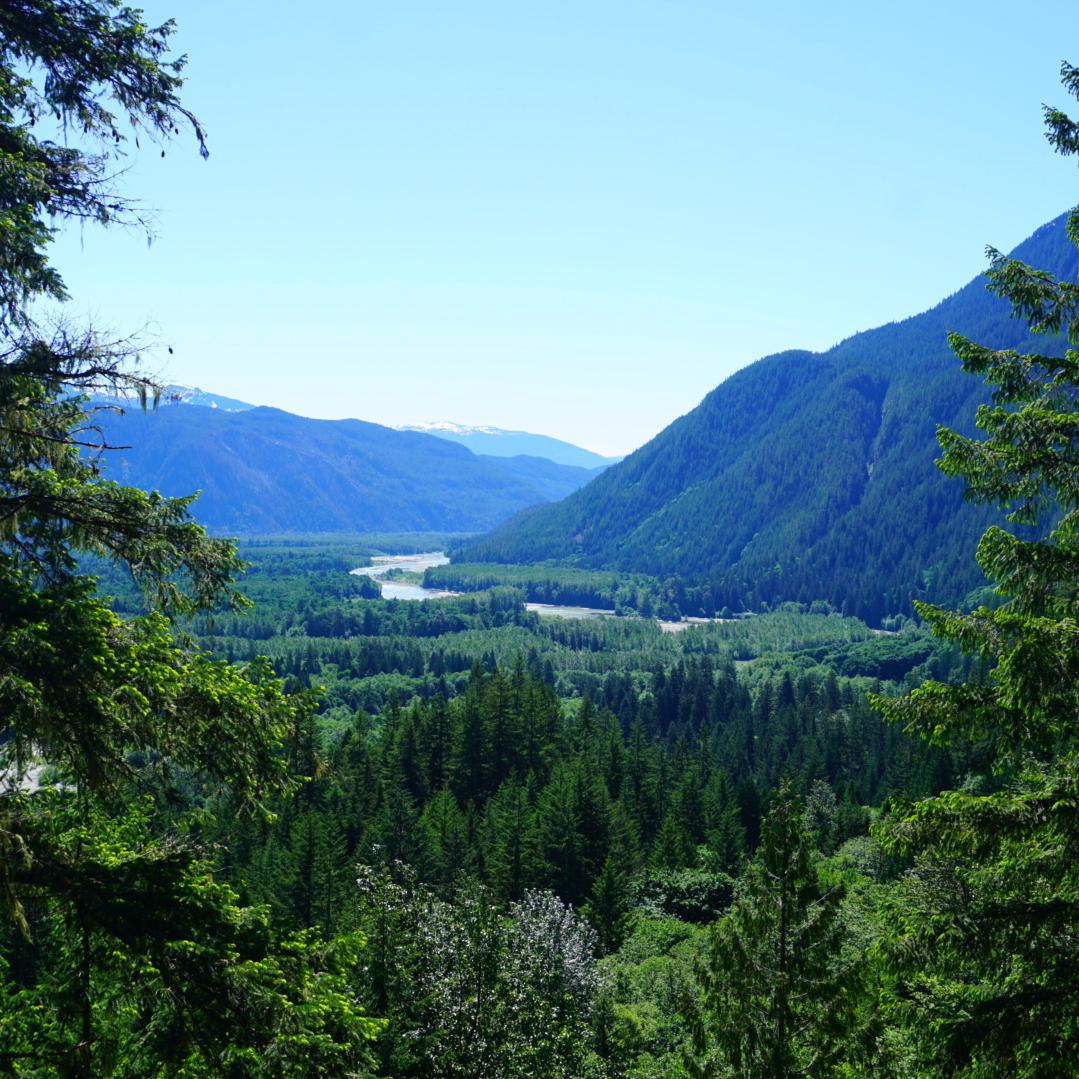
The view of Squamish Valley from a viewpoint on the trail to Crooked Falls that shows the forest, Squamish River, and mountains in the background on a beautiful blue sky day outside of Squamish, BC

Crooked Falls is the second hike along the Squamish River. It’s a similar distance from Squamish, but you take a left turn over the bridge off Squamish Valley Road and onto the Ashlu River FSR to get to the trailhead. The hike to Crooked Falls is approximately 5km round trip, with 400m of elevation rain. The waterfall is especially impressive in the Spring and makes for a fun day trip. If you want to extend the hike, you can continue along the Sigurd Creek trail to a small outcrop with a gorgeous view of the area. This hike is much harder and is approximately 12km round trip, with 900m of elevation gain. It may not be totally snow free in the Spring.

Woodland Walk/Sawblade Falls

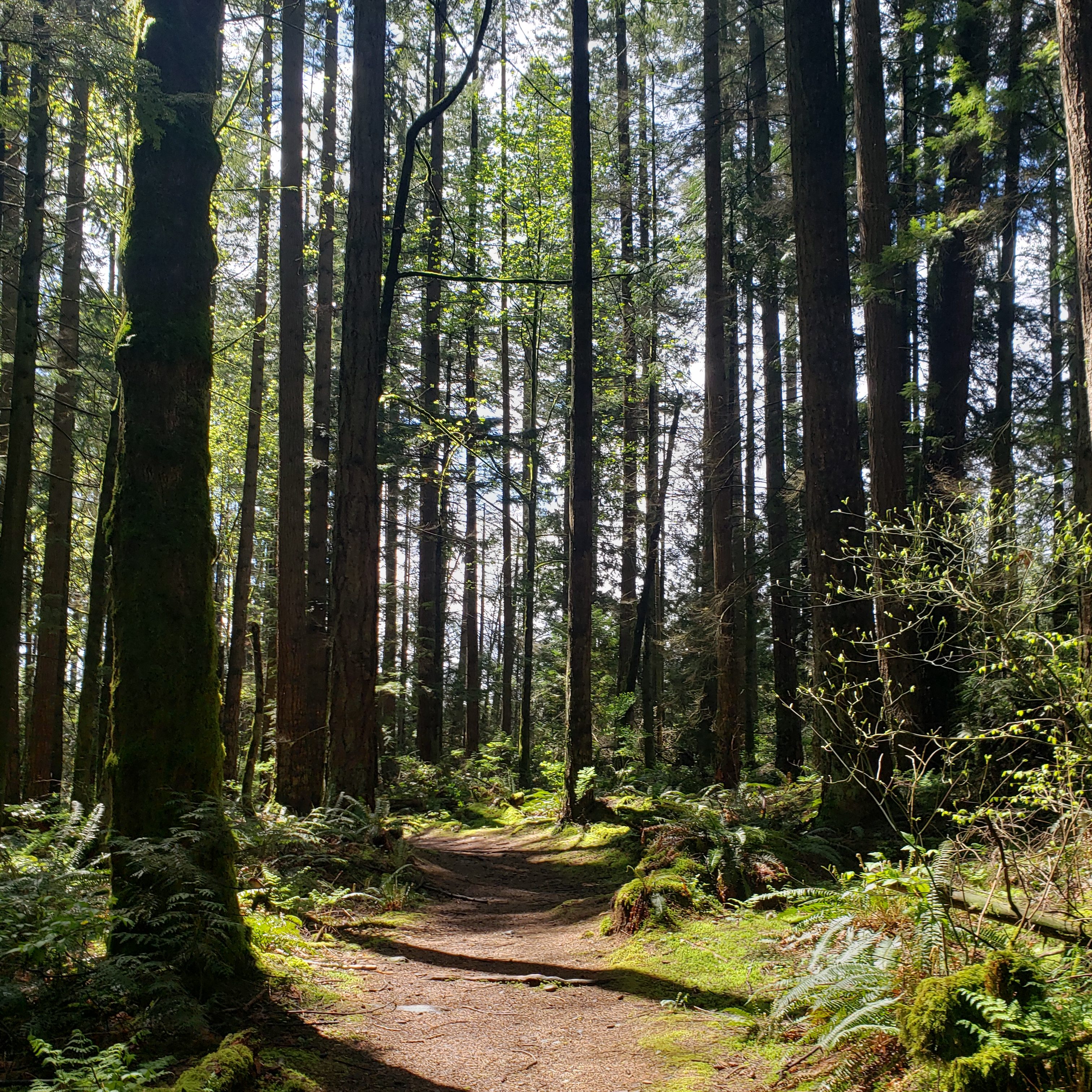
A photo of a forested trail in Pinecone Burke Provincial Park on a sunny day near Coquitlam, BC.

Woodland Walk and Sawblade Falls are two lesser known hikes in Pinecone Burke Provincial Park. They’re super easy to access from Harper Road in Coquitlam and I think they’re very underrated for how close they are to the city. Woodland Walk is a leisurely 7km loop walk through the woods and is great for a rainy day. It only has 200m of elevation gain and makes for a fun forest adventure. It’s easy to extend the loop to also include Sawblade Falls, which is approximately 9km in length. My advice is to be familiar with using GPS maps if you explore this park. There are so many trails through the forest, I usually go and just make my own adventure.

Big Cedar and Kennedy Falls

Two hikers flex their muscles in front of the big cedar tree on the Kennedy Falls trail in North Vancouver, BC.

It’s been a long time since I did this hike, but it sticks out in my mind as a great Spring hike on the North Shore. It’s a bit on the longer side at 10km, and it climbs up and down, so it has a surprising amount of elevation gain (500m). The trail leaves from the Mount Fromme trailhead and is great for variety as it hikes through the forest to a large big cedar tree, and then on to scenic Kennedy Falls. The trail is more technical, with lots of climbing over tree roots, so it’s a good option for more advanced hikers. 

Norvan Falls

Another option on the North Shore – Norvan Falls is a classic Vancouver hike. The trail leaves from the end of Lynn Valley Road and is the longest trail on the list at 15km round trip. The trail hikes along Lynn Creek and then through the forest along the Hanes Valley Trail to Norvan Falls. There’s 600m of elevation gain along the trail, but there is an option to do a little loop through the forest along the way to make the hike more interesting. This is a great option in the Spring when the rivers are running full. The waterfall drops to a trickle in the summer and can be less impressive after the Spring snowmelt.

Stawamus Chief

Two female hikers lie back and relax and smile from the top of the bare rock of The Chief's second peak, with Howe Sound and the Tantalus Mountain Range in the background near Squamish, British Columbia, Canada.

I’d be remiss if I left the Stawamus Chief off this list. The Chief was the first trail I ever hiked after moving to Vancouver and it draws crowds at any time of year. It’s a challenging trail, as it’s mostly a stairmaster to the top, with lots of sketchy sections with ropes, ladders, and scrambling. The full trail is 11km, but it consists of 3 peaks, so people rarely hike all 3 at once. I’ve done the first and second peak, but I still have yet to return for the third peak. I recommend the first peak, because it’s the easier option and has incredible views of Howe Sound. This is a real bucket list hike that is worth the hype, but don’t do it on a rainy day or if you’re afraid of heights.

Widgeon Falls

A hiker stands on the edge of a rock next to Widgeon Creek with the forest and mountains in the background on a sunny day

This hike is a little trickier because it includes paddling, but it’s such a fun adventure, I wanted to include it! In the Spring and Summer, you can rent canoes or kayaks to cross the Pitt River and paddle up Widgeon Creek to the Widgeon Falls trailhead. It takes approximately 1.5 hours each way to paddle to the trailhead at the Widgeon Creek Campsite. From there, you can do a 5km loop trail through the forest up to Widgeon Falls. It’s a beautiful trail and makes for a really unique experience. That said, navigating the Pitt River can be a challenge depending on wind and current conditions, so don’t attempt this adventure without the proper research and experience. I have a full blog post on my experience if you’re looking for more information.

Overnight Hikes for Beginners Near Vancouver

Last week, I shared a Beginner’s Guide to Backpacking for those looking to make the transition from hiking to backpacking. A large part of trip planning is selecting a good trail, especially as a beginner, so I’ve put together a list of trails near Vancouver that I think are appropriate for new backpackers.

There are literally hundreds of trails within a 3-hour drive of Vancouver and it can be difficult to know where to start. My biggest recommendation is to keep it simple by choosing easy trails and campsites with access to basic facilities. It can be an adjustment getting used to carrying a large backpack, so pick shorter trails with less elevation gain, and a first-time trip can be made a lot simpler with access to an outhouse, bear cache, and cooking shelter. See my Guide for more information on how to select and book campsites.

Here are some of my preferred hikes for beginners, in order of level of difficulty (easiest trips first):

3 Brothers Mountain (Buckhorn Campsite)

Region: E.C. Manning Provincial Park
Distance: 4km each way
Elevation: 200m
Reservation: yes ($10pp, per night)
Amenities: outhouse, bear cache, tent pads, cooking shelter, picnic tables
Season: July-September
Drive time from Vancouver: 2.5 hours
Trip Report: found here

Buckhorn Campsite is my pick for best experience for beginners. Manning Park is my favourite park near Vancouver and I think this hike is ideal because it’s short, has a lot of amenities, and is absolutely beautiful. You have to drive up all the way up Blackwall Road to get to the trailhead, so most of the elevation gain is done in the car. You get to enjoy brand new tent pads and a gorgeous cooking shelter, surrounded by alpine wildflowers. The reservation system for this site is new in 2024. This campsite is ideal for 1 or 2 nights and is a great base if you want to day hike to 3 Brothers Mountain on your second day.

Cheakamus Lake

Region: Garibaldi Provincial Park
Distance: 4-7km each way
Elevation: 250m
Reservation: yes ($10pp, per night)
Amenities: outhouse, bear cache
Season: June-October
Drive time from Vancouver: 2 hours
Trip Report: found here

There are two options for Cheakamus Lake, the first campground is called Cheakamus Lake and is located 4km from the parking lot along mostly flat terrain. The second campground is called Singing Creek and is located 7km from the parking lot, and is still mostly flat terrain. Either campground is a great option for a 1 night hike. If you’d like to do 2 nights, camp at Cheakamus Lake and do a day hike to Singing Creek and back on your second day. Be diligent with bear safety on this hike as there is a history of bears in this area.

Viewpoint Beach

Region: Golden Ears Provincial Park
Distance: 4.5km each way
Elevation: 200m
Reservation: no (permit is $5pp, per night)
Amenities: outhouse, bear cache
Season: May-October
Drive time from Vancouver: 1 hour
Trip Report: found here

Viewpoint Beach was the first place I ever took my girl guides and it’s a great option for beginners. It’s a short and easy walk from the parking lot to the campground and there is an outhouse and a bear cache available. However, because there are no reservations, I recommend to leave earlier in the day to secure a campsite. You can camp on either side of the river, but don’t attempt to cross the river. The bear cache and outhouse are located at Viewpoint Beach. The other side of the river is called Hikers Beach and can be accessed by crossing the large wooden bridge 500m before Viewpoint Beach. You can extend this trip to 2 nights if you’d like to do a day hike up to Alder Flats.

Tetrahedron Park

Region: Tetrahedron Provincial Park
Distance: 3-6km each way
Elevation: 250m
Reservation: yes ($15pp, per night, paid to the Tet Outdoor Club)
Amenities: sleeping hut, outhouse
Season: June-October
Drive time from Vancouver: 1 hour + ferry
Trip Report: found here

Tetrahedron Park is a really unique experience and is a great option if you don’t have a tent yet. Tenting is not allowed in this park and all users must stay in one of the huts. There are 4 huts, but I recommend either Bachelor Cabin or Edwards Cabin for beginners (though Bachelor Cabin is often used by families, so please be respectful of children). These sites are managed by the Tetrahedron Outdoor Club. First, join the Tetrahedron Outdoor group on facebook and do a search for your dates to see how many other people are already going then (the cabin sleeps ~12), then post your booking on facebook and pay on the website. This location is great for multi-day trips, as you can do a day hike up to Mount Steele from Edwards Cabin, but the mountain may have snow until July.

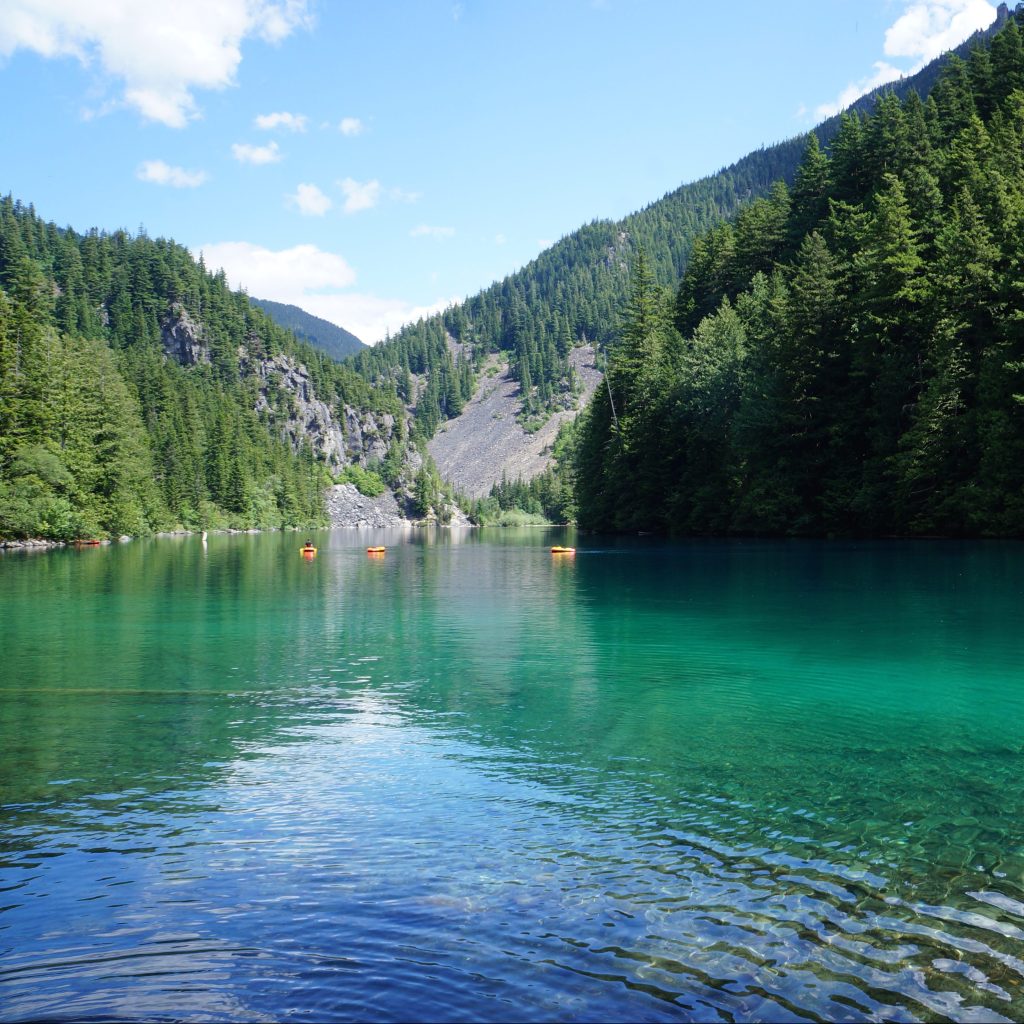
Lindeman Lake

Region: Chilliwack Provincial Park
Distance: 1.5km each way
Elevation: 225m
Reservation: no (permit is $5pp, per night)
Amenities: outhouse, bear cache, tent pads
Season: May-October
Drive time from Vancouver: 2 hours
Trip Report: found here

Lindeman Lake is a very popular trail, so if you opt to camp here, I recommend going very early or visiting on a week day. There are a small amount of tent pads and room for tents, but it can get very crowded. It’s an attractive hike because it is very short, but there is significant elevation gain over a short distance, so be prepared for a steep hike. Sites are not reservable, but you do need a backcountry permit, which can be obtained 2 weeks before your trip. This is a great option for a two night trip if you want to do a day hike up to Greendrop Lake, but you may encounter snow past Lindeman Lake until July.


In my opinion, the first 5 hikes on this list are the most ideal for true beginners planning their first ever overnight hike. They are shorter and have less elevation gain. The rest of the hikes on the list are starting to get more advanced in that they are longer and have more elevation gain, but are still good options for newer backpackers and second trips. I recommend these trips to people who are are already experienced hikers; those new to both hiking and backpacking should stick with the hikes listed above.

Joffre Lakes

Region: Joffre Lakes Provincial Park
Distance: 5.5km each way
Elevation: 400m
Reservation: yes ($10pp, per night)
Amenities: outhouse, bear cache
Season: July-September
Drive time from Vancouver: 3 hours
Trip Report: found here

Joffre Lakes is another insanely popular hike and you will have to be diligent in booking exactly 4 months ahead of your planned dates to secure a permit. However, it’s popular for a reason and is actually a relatively straightforward trip for the incredible views. Be prepared for a climb, but it’s not too steep, so it just requires a little bit more effort for a great reward.

Fairview Loop Trail

Region: Upper Sunshine Coast
Distance: 6-12km (customizable)
Elevation: 250-400m
Reservation: no (recommend a donation to qPAWS)
Amenities: sleeping hut, outhouse, bear cache, picnic tables
Season: May-October
Drive time from Vancouver: 2 hours + 2 ferries
Trip Report: found here

We’re definitely starting to get a little more technical with this trail. The Fairview/Rainy Day loop is located in Saltery Bay, directly after you get off the ferry. To save money, park at Earl’s Cove and walk on the ferry as you don’t need your car on the other side. This loop trail is part of the Sunshine Coast Trail and has two huts on it, Fairview Hut and Rainy Day Lake Hut. It’s 6km (250m gain) to Fairview hut (counterclockwise) and 4km (350m gain) to Rainy Day Lake hut along the road (road is recommended as it’s significantly longer and steeper to take the trail). You can do the trail as a loop to visit both huts (12km total), but this is a more challenging option as there’s 700m of climbing to do both huts. The huts can get very busy, so you should bring a tent in case they get full.

Elfin Lakes

Region: Garibaldi Provincial Park
Distance: 11km each way
Elevation: 600m
Reservation: yes ($10pp, per night)
Amenities: sleeping hut, tent pads, outhouse, cooking shelter, bear cache, picnic tables
Season: July-September
Drive time from Vancouver: 1.5 hours
Trip Report: found here

Elfin Lakes is the longest trail on the list, so you should be prepared for ~4 hours of hiking with your backpack. However, I include it because the elevation gain is spread out over the distance, so it’s never too steep and it’s a very wide and easy trail. This is another hike that books up fast, but you can stay either on a tent pad or in the hut, but they have separate bookings, so make sure you book the correct one. The views from the campsite are some of the best of any hike. Watch out for bears on this hike, especially in the Fall.

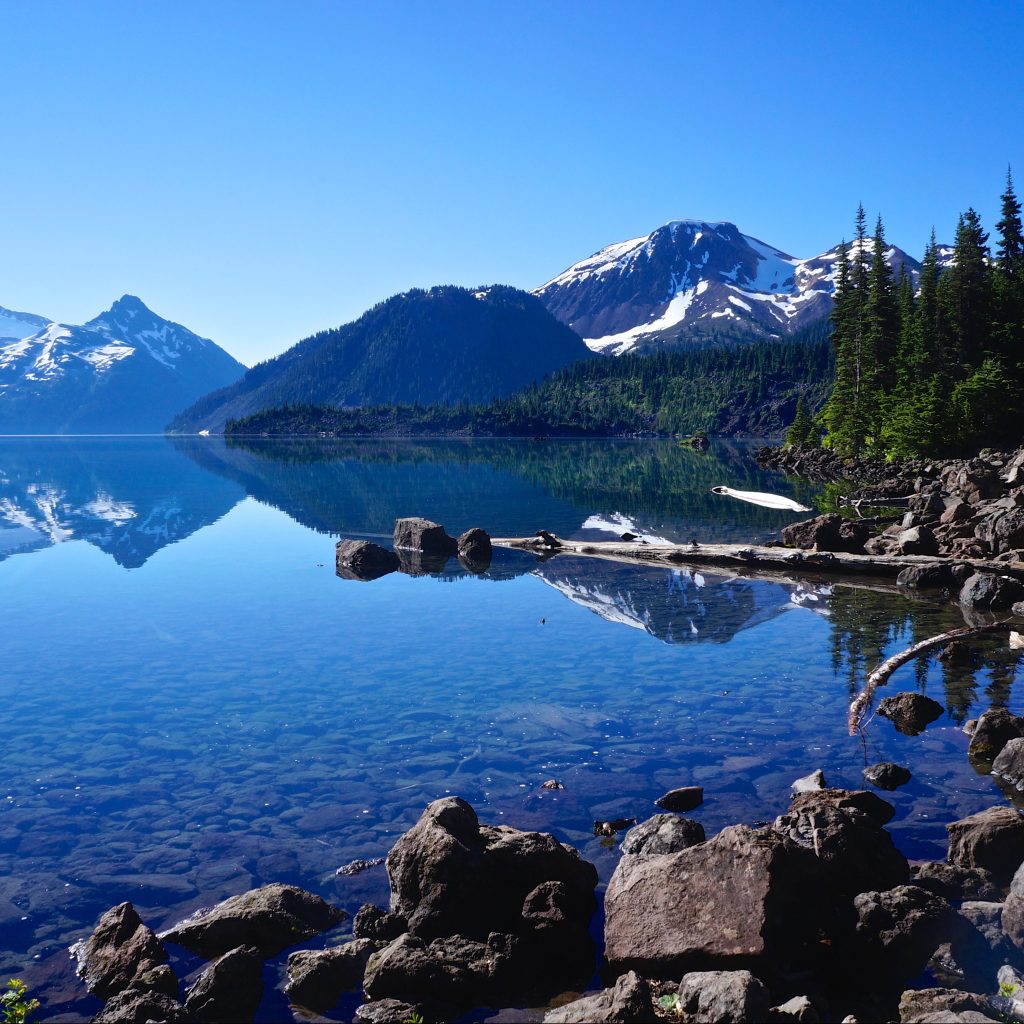
Garibaldi Lake

Region: Garibaldi Provincial Park
Distance: 9km each way
Elevation: 800m
Reservation: yes ($10pp, per night)
Amenities: outhouse, bear cache, cooking shelters, picnic tables
Season: July-September
Drive time from Vancouver: 2 hours
Trip Report: found here

This is the final hike on the list. It has the most elevation gain and you should be prepared for 3 hours of hiking up switchbacks in the first 7km. The trail is not technical, but it is very boring until you reach the lake. However, if you like amenities, it’s a great option. You can camp at either Garibaldi Lake or Taylor Meadows, which have composting toilets, cooking shelters, and picnic tables. I recommend this trip only for those who are already experienced hikers.


There are 3 more trails I want to note because they are easy trails, but I didn’t include them in my main list because they don’t have outhouses or bear caches. There are enough other challenges to contend with on your first hike, so I don’t recommend these. But once you get comfortable with digging a cathole and making your own bear caches, these are good options. However, please note, these are all on crown land, so while there’s no permit required, the sites also don’t receive any maintenance, so please respect the natural environment, leave no trace and pack out everything, including your toilet paper!

Falls Lake – a 1.5km hike on the Coquihalla Summit Rec Area. It’s totally flat and is a great option for a beginner snow camp as well.

Levette/Hut Lake – you can drive up to Levette Lake (which can get very busy), and it’s only another 4km to Hut Lake, which doesn’t get many visitors.

Semaphore Lakes – a 2.5km hike, but this one is a bit steeper (300m gain). There are limited trees for a bear cache here, so a bear canister is recommended.

If you’re looking for more advanced trips, check out my posts on Thru Hikes and Loop Hikes.