12 Fall Hikes on the West Coast

As someone who grew up on the East Coast, Fall was a very beautiful season. I love living in Vancouver and I would say that seasonally, the west coast is nicer than the east coast in almost every season (winter and spring for sure, summer less so with the forest fires), but Fall is conclusively better on the East Coast. At least, compared to Southwestern BC. If you want sweeping forests of red, yellow, and orange, you likely won’t find it here – there’s too many Douglas Firs and Cedars, but there are still some gorgeous views to explore, especially with a mountain backdrop. Here’s a few of the trails I’ve discovered over the years that really shine in the Fall:

Fall Colours near Vancouver

Mount Strachan – 8.5km, 600m gain

DSC07783

I wouldn’t say Mount Strachan has the most outstanding fall foliage, but it’s the closest hike to the city on this list, which makes it very accessible! The colours on this trail mostly come from the changing colours of the shrubs and it’s a great hike on a crisp Fall day. Get on the Baden-Powell Trail from Cypress Resort and hike parallel to Collins ski run. Then follow the sky chair up to the top of Mount Strachan to enjoy beautiful views of Howe Sound. From here, you can continue back the way you came, or you can make it a loop and hike down through Christmas Gully to catch up with the Howe Sound Crest Trail, checking out the views from Bowen Island Lookout on your way back. Make sure you pick up a free backcountry pass from the BC Parks lodge (at the back of the parking lot) before starting your hike. Take care on Christmas Gully when descending from Mount Strachan, it is easy to get lost or injured here. (photo taken in mid-November)

Flatiron – 11km, 800m gain

DSC07386

The Flatiron hike is located in the Coquihalla Summit Rec Area and shares 80% of the trail with Needle Peak. Both trails could be done in a day if you’re ambitious, but I’d avoid Needle Peak if there’s any snow or ice. It’s a very steep hike up the side of the mountain from the highway, but once you reach the branch to Needle Peak, it levels off. There’s a nice lake below the flatiron and in the Fall the shrubs all turn bright red along the mountainside. It’s relatively bare at the top, but the view of the surrounding mountains is amazing! (photo taken in early October)

Elk/Thurston Mountain – 9-15km, 1000m+ gain

DSC07483

This is a more traditional Fall trail and there are deciduous trees that will be changing colour as you walk through the forest toward the summit. Most of the hike is in the trees, but you eventually pop out along the ridge. It’s a steep hike near the end, but you can see all the way to Mount Baker, with bursts of colour in the forest below. I really like continuing a few kilometres along the ridge towards Thurston Mountain, but the peak itself is pretty uninspiring, so I usually turn around when I hit the forest. The hike is 9km to Elk Mountain and back, and 15km to Thurston. There’s over 1000m of elevation gain, so it’s a good workout! (photo taken in mid-October)

Illal Meadows – 16km, 750m gain

20240929_124448

This trail is a bit of a drive and makes for a long day as a day hike, so start early! Illal Meadows is located off the highway along the Coquihalla Summit Rec Area and involves an extra half hour of driving along the Tulameen FSR. The trail starts with a 3km hike up a decommissioned road, and then it’s a steep ascent through the meadows to the alpine. There are lots of small trees and shrubs changing colour and the meadows turn yellow and red. Continue to the base of Jim Kelly Peak, where you have the option to do an additional ascent (it’s a scramble!) or head back the way you came. (photo taken in late September)

Snow Camp Mountain – 17.5km, 900m gain

IMG_4265

This is a beautiful hike any time of year. In the summer, the meadows are filled with wildflowers, and in the Fall, the meadows turn yellow and have gorgeous views looking out over the Manning Park backcountry. The trail starts from Strawberry Flats and hikes steadily uphill for 5km. There’s a fantastic viewpoint at the top of Despair Pass, but continue on through the trees to reach the ridge going up to Snow Camp Mountain. I find this trail doesn’t get crowds in the Fall and is a really gorgeous hike. (photo taken in mid-September)

Larch Tree Hikes

If BC isn’t known for it’s Fall colours, it’s definitely known for the larch trees! Larch trees have needles like a pine or fir tree, but these needles turn yellow in the Fall and fall off. There are some really beautiful larch tree hikes on the West Coast. Most of them are located in the Rockies or Washington State, but if you’re willing to drive a little distance, you’ll be rewarded! In the interest of transparency, the only hike in this section I’ve actually done in the Fall is Mount Frosty, the other trail descriptions are based on trips I took in the summer. That’s why my photos don’t show any Fall foliage.

Frosty Mountain – 18-22km, 1000m+ gain

DSC08106

This is probably the most well known larch hike in the province, mostly by virtue of the fact that it’s close to Vancouver, so it attracts very large crowds. Definitely arrive early in the morning to get parking and get ahead of the mass of people (or go on a week day). The larch trees generally only turn yellow over the span of 2-3 weeks, so you can expect it to be busy during that time. Frosty Mountain itself is a really big hike, but you don’t have to go all the way to the summit to see the larch trees. After a big climb up to the campsite, you’ll eventually pop out in the larch meadow. But continue to the top of Mount Frosty for some really epic views! (photo taken in late September)

Sentinel Pass – 8-12km, 500-700m gain

DSC07252

The Sentinel Pass trail is a really popular trail in Banff National Park and requires a bit of advance planning to visit. The hike starts from Moraine Lake, which is one of the most popular locations in Banff. You can no longer drive to the lake, so you need to arrange to take the Parks Canada shuttle. From the lake, hike up a set of switchbacks to reach the larch meadows and continue on towards Minnestima Lakes. You don’t have to hike to the top of Sentinel Pass, but it’s a nice add on to enjoy the views looking back towards the lake and the surrounding Mount Temple area. It’s roughly 3.5km to reach the meadows, or 12km round trip if you go to the top of the pass and back. (photo taken in early August)

Floe Lake – 28km, 1000m gain

IMG_5360

I would say that Floe Lake is the Moraine Lake of Kootenay National Park. It’s extremely popular, though much less accessible as you can’t drive all the way to the lake. This is a big hike for a single day, so I’d recommend camping one night at Floe Lake if you’re able. That said, it’s a big uphill to the lake and would likely be considerably faster with only a day pack. The larches are actually located above Floe Lake, so you’ll be rewarded with the beautiful view at the lake, but need to push another 3km uphill after the lake to be rewarded with a view of both the larch trees and Floe Lake. In total, be prepared for an almost 30km day, so leave before sunrise. (photo taken in late August)

Lake O’Hara – 7km, 200m gain

20230904_164856

Of all the hikes on this list, Lake O’Hara is probably the most exclusive. There’s a permit lottery for bus shuttle passes up and down the 11km access road. You can hike all the way from the base if you’re prepared for an almost 30km day (like Floe Lake), otherwise, the shuttle saves you a lot of time. From the bus stop, you can do a 7km loop around the lake and up to the Opabin Prospect Lookout, which is the most renown view in the park. If there’s no ice, you could also consider hiking the famous alpine circuit, but I wouldn’t attempt it on a slippery day and you might prefer to have more time to enjoy the larches around the lake. (photo taken in early September)

Hiking Near the North Cascades

One of my favourite things to do in the Fall is cross the border and go hiking in the Mount Baker Wilderness area of Washington State. If you drive a little further into the cascades, there’s some really awesome larch hikes like Maple Pass, Blue Lake and Easy Pass. I haven’t done any of these yet, because there are so many colourful hikes to explore closer to Vancouver by Mount Baker.

As a disclaimer: I wrote this blog post at the end of last Fall season. I personally have decided not to travel to the US right now (but I really hope to feel safe doing so in the future). It’s out of my personal comfort zone right now, but no judgement either way, here are some of my favourite Fall hikes south of the border.

Chain Lakes/Ptarmigan Ridge – 12-19km, 600m gain

PSX_20241108_084356

These two trails share a trailhead from the ski parking lot at Mount Baker. Grab a parking pass online before crossing the border, or pick one up from the visitor centre. If the road is open all the way to Artist Point, park at the top and do the Ptarmigan Ridge hike. If the road is already closed for the season, park at the base and do the Chain Lakes Trail. Both hikes go up towards Artist Point and cross a ridgeline into the backcountry. The Ptarmigan Ridge trail heads out towards the base of Mount Baker, while the Chain Lakes trail goes behind Table Mountain and climbs to the top of a saddle before heading back down to the base. Both hikes are incredibly scenic and colourful in the Fall. Chain Lakes is a 12km loop trail, while Ptarmigan Ridge is 19km out and back to the Portals viewpoint. (photo taken in mid-October)

Yellow Aster Butte – 13-15km, 700m gain

IMG_4381

Yellow Aster Butte has gotten incredibly popular in the past few years. Pick up a parking pass online or at the visitor centre, and then drive up a gravel road to get to the trailhead. There’s limited parking, so get there early to avoid the crowds. The trail climbs up through the trees for 3km before you reach the alpine and the beautiful yellow aster meadows. It’s 3km further to get to the sub-peak, and another 1km from there to the true peak. This area can get snow early, so plan accordingly. (photo taken in early October)

Winchester Mountain – 5km, 400m gain

PSX_20231022_103414

Winchester Mountain is the final hike on the list, and the only trail that requires 4×4 to reach the trailhead. This trail starts at the campsite for Twin Lakes and hikes up to the peak of Winchester Mountain, where there’s an old fire lookout. The trail is only 5.5km round trip and is located past the parking lot for Yellow Aster Butte. So if you don’t have 4×4, you could add on 3.5km to hike up the road each way (or try and hitch a ride on the way up). The entire trail hikes through colourful meadows while the trees change colour. It’s an easier hiking option with a huge payout. (photo taken in early October)

10 Epic Loop Hikes in BC

I recently did a post featuring some of the most epic thru hikes available in BC. Thru hikes are great if you have a bigger group or access to 2 vehicles, so I wanted to complement that post with a blog about some of the best loop backpacking trails! These are great if you only have access to one vehicle, or want to limit your driving/coordination time. 

If you’re a beginner, check out my Guide to Backpacking and Overnight Trips for Beginners posts, as well as my safety resources instead.

Gold Creek Trail

Photo of two small backpackers on a rocky beach with a clear river flowing alongside them and a large green forest and mountain in the background, shrouded in fog. Taken from Viewpoint Beach in Golden Ears Provincial Park, on the Gold Creek Trail, in British Columbia, Canada.

This is the closest trail to Vancouver on the list (by a long shot) and the most beginner friendly. There are a ton of backcountry sites located along the Gold Creek Trail in Golden Ears Park, and it’s easy to do them as standalones or as a loop. Park at the north lot at Gold Creek and start your hike to Viewpoint Beach, taking either the East Canyon Trail (for the most direct route) or the Lower Falls Trail (for a more scenic route). Camp at Viewpoint Beach and consider doing a day hike up and back to Half Moon Beach

Then you can head up to Alder Flats for a second night and loop back to the parking lot on the West Canyon Trail. There’s another option to day hike up to the Golden Ears Summit, but this is a steep hike and definitely not beginner friendly, so plan accordingly. You can customize the trip to whatever length you want, with lots of opportunities for side trails! Without side trips, it’s ~13km total to hike the loop to Viewpoint Beach and Alder Flats. A backcountry permit is needed for these campsites and can be obtained 2 weeks prior to your trip at camping.bcparks.ca

Flora Lake Loop

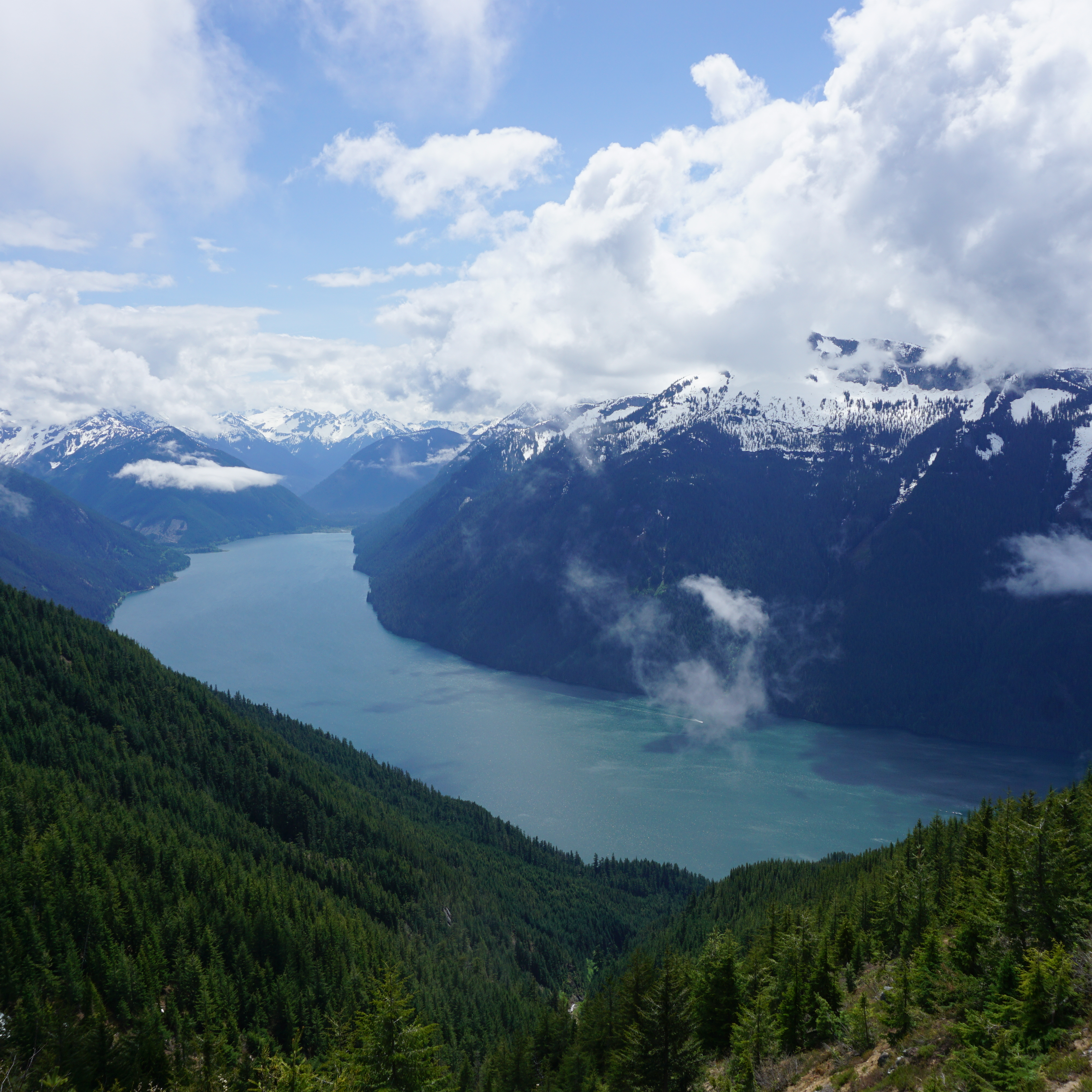
The view of Chilliwack Lake from Flora Peak on a sunny cloudy day, with the snow capped mountains in the background in Chilliwack Lake Provincial Park on the Flora Lake Loop Trail in British Columbia, Canada.

The Flora Lake Loop trail is a 20km trail in Chilliwack Lake Provincial Park that hits 3 alpine lakes and Flora Peak. I’ve never actually hiked the entire trail, but have done large sections of it in both directions. The trail climbs up to Lindeman Lake, which is a very popular trail, and then continues to the back of the lake and up to Greendrop Lake. From there, you continue climbing uphill until you reach Flora Lake. All 3 lakes have campgrounds, but Lindeman Lake is the most frequented.

From Flora, you continue up to the top of Flora Pass, where you have the option to do a side trail up to the Flora Lake Lookout. After the pass, it’s a giant downhill back to the trailhead. There’s 1000m of elevation gain along the hike, so you can either spread it out between campsites when circling the lakes, or reverse the trip and do it all in one go on the way up the Pass. With so many campsites, you can take anywhere from 1-3 nights to complete the trail. A backcountry permit is needed for these campsites and can be obtained 2 weeks prior to your trip at camping.bcparks.ca

Frosty Mountain

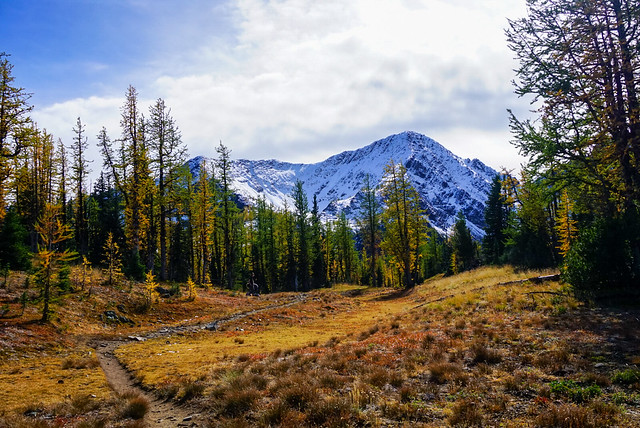
A landscape photo of the larch trees turning yellow during Autumn, with a snow covered Frosty Mountain in the background on a cloudy day. Taken in E.C. Manning Park, British Columbia, Canada.

Frosty Mountain is one of the most popular Fall hikes near Vancouver, but it makes for a great backpacking trip any time of year. Most people go up and back on the same trail, but there’s actually a 27km loop option that goes around the back of the mountain. There’s a campsite on either side of the summit, so you can do it as a 1 or 2 night trip. There’s also the option to add on a side trip to the PCT monument, Windy Joe, or Lightning Lakes. 

This hike has a lot of elevation gain, more than 1200m, so it’s good to do over multiple days. If you go in the Fall, it will be really busy when the larches turn yellow, but the view from the summit is great year-round. The only downside is having to carry a large backpack over the pass to the summit. A backcountry permit is needed for these campsites and can be obtained 2 weeks prior to your trip at camping.bcparks.ca.   

Tricouni Meadows

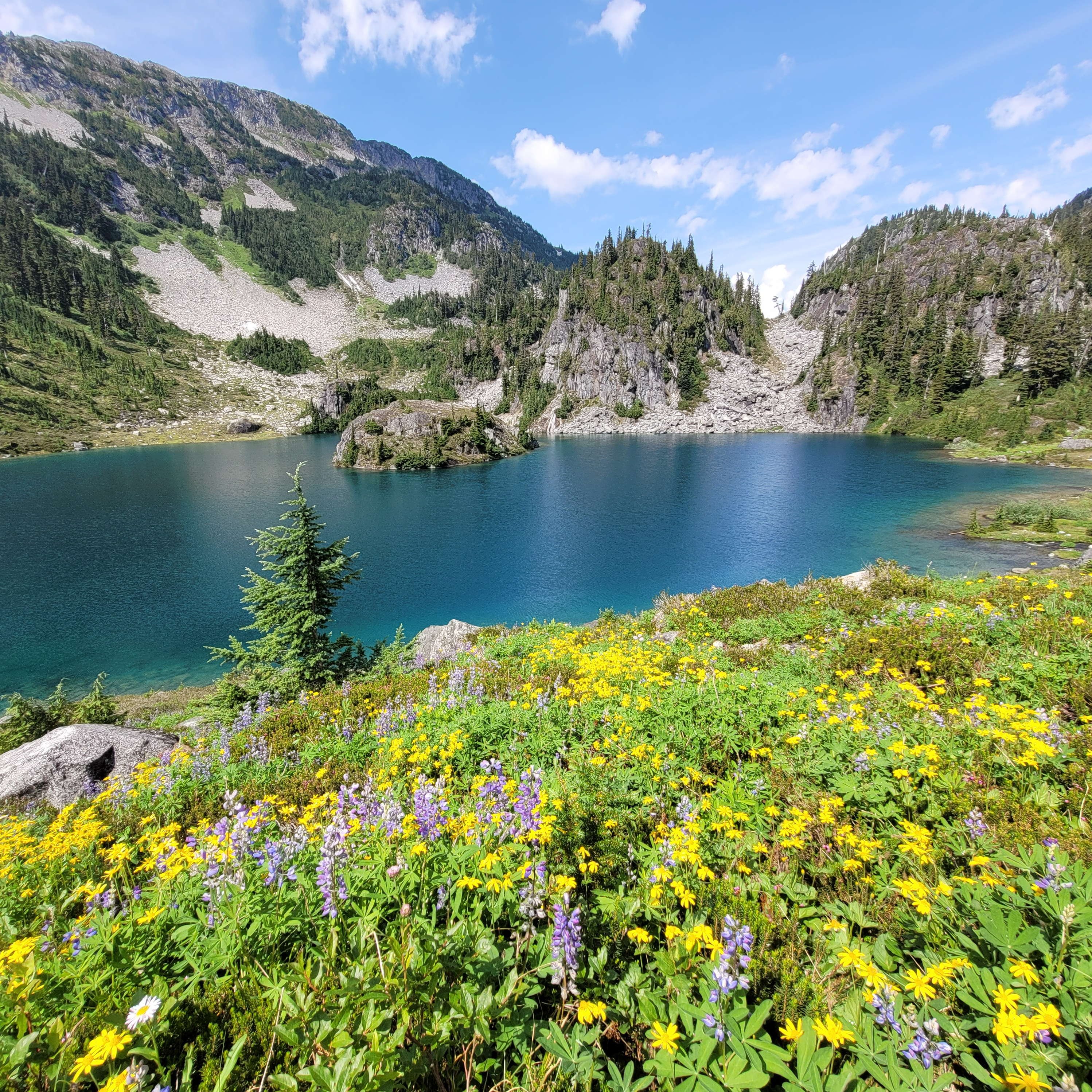
A photo of Pendant Lake on the way to Tricouni Meadows, with yellow and purple wildflowers in the foreground and a blue alpine lake and mountains in the background on a sunny, blue sky day. West of Squamish in British Columbia, Canada.

Tricouni Meadows is a bit of a stretch for a loop hike, but it is a gorgeous trail! It’s located southwest of Squamish and requires driving up Squamish Valley Road, before merging onto Branch 200. 4×4 and high clearance are recommended to access this hike. The climb up Branch 200 is quite steep and there is a pretty big washout a few kilometres before the trailhead. I’ve heard the washout has gotten worse since I visited, so it might be necessary to add on a few extra kilometres walking on the road. The hike up to the meadows is only 4km from the trailhead, so it’s easy to add a few extra kms of road walking without overdoing it.

The loop part of this trail is because you can actually hike up to the meadows on either side of the river to Pendant Lake. The terrain isn’t that different, but it does make for a nice change of scenery. From Pendant Lake, there’s a bunch of camping available, but there are no facilities (bear cache or outhouse). You can do the trip in one night, but there are several lakes to explore and if you add a second night, you could use the extra time to climb up Tricouni Mountain!

Russet Lake

A photo of Russet Lake with the grassy meadows and the mountains in the background on a smoky summer day in Garibaldi Provincial Park near Whistler, British Columbia, Canada.

Russet Lake seems to be one of the lesser frequented trails in Garibaldi Park, but it’s no less scenic than its neighbours. The challenge with Russet Lake is that most people take the Whistler gondola to the top, which costs $100. Fortunately, there are several options available for this hike. For a true loop hike, you can enter or exit from Whistler base by climbing up the Singing Pass Trail, which follows the valley between Whistler and Blackcomb Mountains (and saves you the cost of the gondola). The challenge with this option is that there is over 1200m of elevation gain spread over 15km. Alternatively, you can take the gondola up the mountain and follow either the High Note Trail (from Peak Chair), or the Musical Bumps Trail (from Roundhouse). This route is easier, but still has over 500m of elevation gain spread over 12km, as you summit several small peaks (but is much more scenic)

You only really need one night at Russet Lake, but if you stay a second night, you can explore some of the surrounding peaks. On the way back, you can take any of the 3 trails mentioned above. At the time of writing, Whistler doesn’t ticket on the way down, so even if you hiked up, you can still take the gondola back down at no charge. This hike does require camping reservations, which release 4 months in advance of your date from camping.bcparks.ca.  

Chilcotin Loop

A photo of the hiking trail in South Chilcotin Provincial Park that runs to Lorna Pass. The trail is covered in yellow wildflowers in the middle of the forest, with the mountains peaking out in the background on a cloudy day in British Columbia.

South Chilcotin Mountains Provincial Park is mostly frequented by mountain bikers, but even in peak season, the park is relatively empty. It’s a beautiful park with lots of options for loop trails. If you only have a few days, there’s a nice loop trail around Taylor Creek that is ~26km long and can be explored over 2 nights, with side trips to the High Trail or Camel Pass. If you have more time, there’s a 5-6 night loop in the core area of the park that can be accessed from Tyaughton Creek, which goes over Deer Pass and along the valley to Spruce Lake. It’s ~70km long, but can be extended with side trails up to Lorna Pass, Warner Lake, or Lizard Creek. 

Many of the campsites in the core area are serviced by BC Parks and have bear caches and outhouses, but wild camping is also permitted and there are a few nice sites without facilities if you want to slow down your pace. There are grizzly bears in the park, but since there are so few visitors, they haven’t been known to bother hikers. It’s a remote part of BC that I really enjoyed getting to see.

Tetrahedron Park

A landscape photo of the trees, mountains, and ponds, from the top of Mount Steele in Tetrahedron Provincial Park on the Sunshine Coast of British Columbia, Canada.

Tetrahedron Park is located north of Sechelt on the Lower Sunshine Coast and is another great trail for beginners. The park has 4 huts that are managed by the Tetrahedron Outdoor Club and they are the only option for camping in the park (tenting isn’t allowed, neither is swimming because it’s in the watershed). 

With 4 huts, it’s easy to customize your trip to however many nights you’d like. The loop part of the trail comes from the trail from Edwards Cabin to Mayne Lake and back to Batchelor Cabin, but there are some great side trails to the Mount Steele and McNair Cabins. The hiking is pretty easy, though it can be muddy at certain times of year. The distance is customizable based on your route and could extend from 12-30km. Reservations are made through the Tetrahedron Outdoor Club facebook page and are $15 per person, per night.

Assiniboine

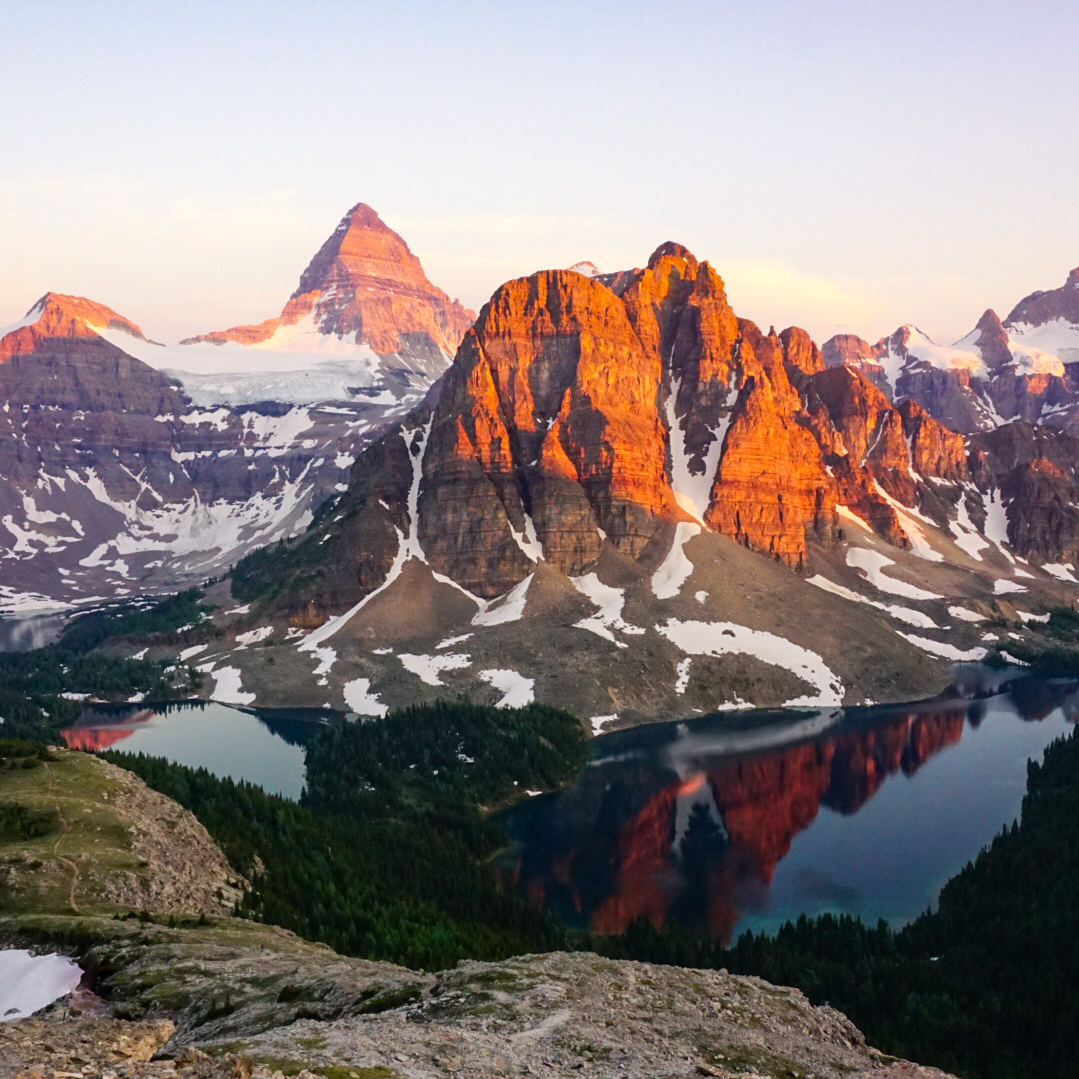
A photo of Mount Assiniboine and Sunburst Mountain and Cerulean Lake at sunset from the Nub in Assiniboine Provincial Park in British Columbia, Canada.

Assiniboine was also on my list of thru hikes, but it’s such a versatile hike, it can also be done as a loop trail! When you enter the park via the Mount Shark trailhead in Kananaskis, you can access Assiniboine through either Assiniboine Pass or Wonder Pass. They share a common trail to Marvel Lake, but then they branch. I’d recommend doing Assiniboine Pass on the way in and Wonder Pass on the way out because it is a steep trail to climb up. There are some restrictions on Assiniboine Pass at certain times of year, so make sure you check for any trail closures.

Once you get to the core area, you can spend a few days exploring the highlights of Assiniboine Park before you return. Not including side trails, the loop is ~52km, so I’d recommend 4-5 nights. It’s a long hike into the park and I personally prefer to do it over the span of 2 days, followed by 2-3 nights in the core area. Both of the entry trails are in Banff National Park and camping permits can be booked through Parks Canada, which release sometime in March for the entire season. Backcountry reservations for Assiniboine are available 4 months in advance at camping.bcparks.ca.

Iceline Trail

A female hiker walks with her hiking poles and hood up, facing away from the background view of large mountains and glaciers on the Iceline Trail in Yoho National Park in British Columbia, Canada.

The Iceline Trail is an incredibly scenic trail in Yoho National Park. The loop trail is 22km and can be done as a big day hike, but it is also nice to enjoy over 2-3 days. The trail leaves from the valley at Takakkaw Falls and climbs up to the alpine for ~6km of exposed trail before going back down to the valley. There are tons of options for camping at Yoho Lake, Little Yoho, Laughing Falls, Takakkaw Falls, or if you’re an ACC member, Stanley Mitchell Hut. 

There are also tons of options for side trails and day hikes, such as Twin Falls, Whaleback Mountain, and the Highline Trail. Reservations are made for the Yoho Backcountry on Parks Canada, and all of the reservations release for the season sometime in March. This is a great alternative trail for those not lucky enough to get permits for Lake O’Hara. 

Lake O’Hara

A photo of red canoes on the bright blue lake water of Lake O'Hara, with the mountains in the background on a cloudy day in Yoho National Park, in British Columbia, Canada.

Lake O’Hara is one of the most popular hikes in the Canadian Rockies. It’s located in Yoho National Park and it is no small feat to secure permits for it. I’ve written an entire blog post on the challenge. You can visit as a backpacker, for which you need camping permits that include a bus ride along the 11km access road. Or you can visit as a day hiker, for which you either need a bus pass, or plan to hike an extra 11km each way. All permits are available from Parks Canada and release some time in March for the entire season.

Once you get to the base, the core trail is the Alpine Circuit, which is approximately 13km if you do the entire circuit. It sounds short, but it climbs through 3 key parts of the trail and shouldn’t be underestimated because of the considerable elevation gain. Fortunately, you can customize the trail to include either the Wiwaxy Gap, the Yukness Ledges, Opabin Prospect, and/or All Souls. The entire hike is in the alpine and one of the most scenic trails I’ve ever done. There’s also lots of options for side trails to Lake McArthur, Linda Lake, or Odaray Grandview.

Hiking Frosty Mountain

Disclaimer: I wrote this blog a year ago and hiked the trail on September 27, 2020. I delayed posting out of respect for hiker Jordan Naterer, who went missing on this trail on October 10, 2020 and whose remains were not found until July 2021. Manning Park can get snow early in the Fall, which can make the trail difficult to follow and be exacerbated by freezing temperatures and limited daylight hours. It can be a beautiful trail, but it is also a strenuous hike and an unforgiving environment, so please don’t underestimate it in your zeal to photograph the larches. Don’t go unprepared; take the essentials and leave a trip plan. Check out my blog post on Personal Safety for more info.


The Heather Trail is the most trafficked trail in Manning Park in the summer, but by fall, everyone flocks to Frosty Mountain. It’s hard to see Mount Frosty in most of the park as it’s hidden behind other mountains and can’t be seen from the highway. But if you drive up Blackwell Road and stop at the first viewpoint, you can get a great view of it. I’d heard some talk about Frosty Mountain when I first started hiking and though I was intrigued by it, decided Frosty was probably a little too challenging for me.

In 2018, I decided I was finally ready to give it a try and I hiked the longer route up past Windy Joe Mountain, day hiking up to Frosty Peak from the PCT campsite. Even in summer, this is a challenging and strenuous trail, but boy is it rewarding. So earlier this Fall, Brandon and I decided to hike up the other (more trafficked) half of the trail from Lightning Lakes to try and catch a glimpse of the larches turning yellow.

DSC08005

There’s so many different ways to explore Frosty Mountain. It’s located near the midpoint of a loop trail with campsites located on either side. One side of the loop trail is shorter than the other, so you can either hike 21.5km up and back from Lightning Lakes (what we did this year), or hike 27km as a loop (exiting on the Windy Joe trail). Alternatively, you can camp at one or both of the campsites, either day hiking up to the top (what I did on my first visit) or if you’re determined, hiking your big pack up over the top.

Like I said, our key interest in hiking Frosty on this occasion was to explore the larch meadow below the peak and snap some pictures of the needles turning from green to yellow. We were a little too early in the season to get the really gold hues, but we still got some truly beautiful views of the trees changing colour and had great weather for it. Plus with the fresh dusting of snow the yellow larches really popped! There were a lot of people around, but we were still a bit early in the season, so it never felt that crowded. If you’re a novice but want to see the larches, consider just hiking to the meadow and skipping the peak.

DSC08022

It rained the day before and was still foggy when we set out early on Sunday morning to drive the 2 hours out to Manning Park. With the shorter daylight hours, it’s essential to give yourself lots of time for this hike in the Fall. Me and Brandon left my house around 6:45am and were on the trail by 9am. We had the privilege of watching the sun rise from the highway and watched as it started to burn off the fog. There were still lots of low clouds hanging around when we got to Manning, but the sun was shining through and we were optimistic they would lift off by the time we reached the top.

DSC08133

Our plan had been to do the entire loop trail starting from Lightning Lakes. It’s a big climb, 1150m from the bottom to the top, but it’s spread over 11km, so I didn’t find it too bad. It’s steeper for the first 6km, but it levels off before you reach Frosty Creek Campsite. When I visited before, I camped at the PCT campsite on the other side. Both are located in the trees and have really small creeks as water sources, so I’d recommend bringing a water filter with you for both, but overall I’d give the edge to the Frosty Creek Campsite. It’s a bit more spacious. There’s two viewpoints before you hit the campsite; the first looks down towards lightning lakes and out to Hozameen Mountain, while the other is the first glimpse of Frosty through the trees. At the time we passed it, it was super cloudy at the top and there was a fresh layer of snow sitting on the peak. It looked super foreboding, as if it was the middle of a storm, but fortunately it cleared up in no time.

We continued along the trail until we finally hit the larch trees! Like I said, they weren’t quite at their peak, some were full yellow, others lighter green changing to yellow, but still very gorgeous. The trail exits the woods into the meadow and has the most beautiful view of snowy Mount Frosty peaking out behind the yellow needles of the larch trees. I’d been getting targeted adds on facebook for a few weeks before with this gorgeous picture of the larch meadows, with the mountain covered in snow behind them. It’s a beautiful picture and a rare time when what I saw before me looked exactly like what had been advertised in the photo! Except of course more unreal because I was there to experience it with my own eyes.

DSC08127

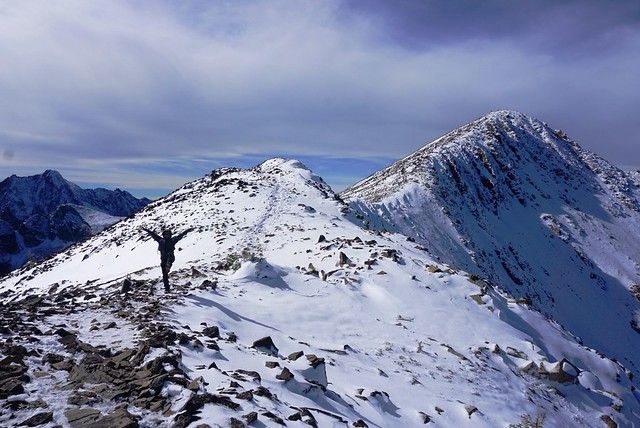
The trail winds through the meadows and then you pop out on the ridge, with a steep climb ahead to the trail junction for the loop trail, and then a final ascent along the ridge to the summit of Frosty Mountain. It’s very steep, but not that long to the junction. The problem in this instance was the snow. There was only a couple of centimetres of snow on the trail, but it had become very packed down and icy. It was perfect conditions for microspikes and I was kicking myself for not having them. I carry my microspikes all winter and spring and rarely get the opportunity to use them, but of course, the one time I really would have benefitted from them, I didn’t have them with me. It was still September and I hadn’t really thought there would be snow yet. So we slowly trudged our way up the slope, taking care with each step, arriving without incident.

DSC08086

The first milestone is reaching the junction sign. It’s really not obvious with the snow, but there is a trail going down the other side. There seemed to be a few people using it that were coming from the camp on the other side, but overall, most people seemed to be going up and back from Lightning Lakes. The second and final milestone is reached only by continuing across the ridge and climbing up to the final peak. It’s only about a kilometre (maybe a bit less), but both times I’ve found it annoying being so close to the top and still having to push to the end. The final ascent isn’t as steep as the climb up to the junction though, so it was easier in the snow.

DSC08039

The parking lot was packed when we arrived, but given the length of the trail it felt pretty empty as we were hiking. We passed one or two groups right at the beginning and got passed by a group of trail runners about halfway up. So by the time we got to the top, the peak was looking a little crowded. Fortunately, the trail runners didn’t stay too long and after a few minutes it was just us and 2 other guys at the top. It was REALLY cold and windy up there, so I don’t think people were sticking around for too long. The cold is definitely another thing to be prepared for; Manning is always chilly – it was about 3 degrees when we started hiking and was only supposed to go up to 11 degrees (at the bottom).

DSC08048

We layered up and had only intended to stay at the very top for a short while, planning to eat our lunch a little further down where it was more sheltered, but the view is just so damn spectacular I couldn’t bring myself to leave! It was pretty overcast when we arrived, but the sun came out and cleared away a lot of the clouds while we were up there, resulting in me having to take all my pictures twice with the changing weather conditions. I ended up eating my lunch standing up and walking around because I didn’t want to climb down yet and it was too cold to sit still. We stayed up there for about a half an hour or more and when we’d had our fill, started to trek back down. It’s definitely worse going down without spikes, but it was manageable along the ridge.

PSFix_20200927_203732

I had to rethink our plan to do the whole loop trail though. I thought the whole thing was 22km, but we’d already done 11km and looking at the map in retrospect, it was clearly going to be longer going the other way down, 6km longer to be precise. I have bad knees and at 22km, this hike was already much longer than any other day hikes I’d done all year, so we decided to just head back the way we’d come. Fortunately I’d already done the other side, so I didn’t really feel like I was missing much.

Going down the steep section was definitely a lot harder than going up. I had brought gloves with me for the cold and they were invaluable climbing back down. I did a lot of the trail in a kind of crouching position so that I could reach down and grab the rocks to steady myself. But no question, microspikes would have made it a whole lot easier. Looking back now, I’m a little embarrassed to admit I did it without spikes; it’s really important to know your limits and turn back if you’re unprepared. It was probably a bad judgement call for me to keep going without spikes and I’m working on getting better at making these tough choices. In the past year I have passed on summiting several scrambles (Needle Peak and all the summits on the HSCT) out of abundance of caution, so I am getting better at it.

PSFix_20200928_221704

There were still a good number of people coming up when we were going down and the summit was starting to look pretty crowded again. The meadows were more or less empty as we made our way back through them and I had to take all my photos again, this time with blue sky in the background! Otherwise it was a pretty uneventful hike back. My knee was bothering me, so I wrapped it up about halfway down and we stopped at the campsite for a snack break. When we sat down at the campsite, 6 hours into our hike, I realized that was the first time I’d sat down all day. We hadn’t taken any breaks on the way up, other than to snap a few photos, and while we’d taken a hiking break at the top, it’d been too cold to sit down. So it felt good to take a little rest before knocking out the last 6km of the hike.

Overall the whole thing took us 8 hours, which I think is pretty impressive for a 22km hike with 1150m of elevation gain! It was cold, but I loved all the varying weather conditions we experienced on the trail and really think we couldn’t have picked a better day!

DSC08106