12 Fall Hikes on the West Coast

As someone who grew up on the East Coast, Fall was a very beautiful season. I love living in Vancouver and I would say that seasonally, the west coast is nicer than the east coast in almost every season (winter and spring for sure, summer less so with the forest fires), but Fall is conclusively better on the East Coast. At least, compared to Southwestern BC. If you want sweeping forests of red, yellow, and orange, you likely won’t find it here – there’s too many Douglas Firs and Cedars, but there are still some gorgeous views to explore, especially with a mountain backdrop. Here’s a few of the trails I’ve discovered over the years that really shine in the Fall:

Fall Colours near Vancouver

Mount Strachan – 8.5km, 600m gain

DSC07783

I wouldn’t say Mount Strachan has the most outstanding fall foliage, but it’s the closest hike to the city on this list, which makes it very accessible! The colours on this trail mostly come from the changing colours of the shrubs and it’s a great hike on a crisp Fall day. Get on the Baden-Powell Trail from Cypress Resort and hike parallel to Collins ski run. Then follow the sky chair up to the top of Mount Strachan to enjoy beautiful views of Howe Sound. From here, you can continue back the way you came, or you can make it a loop and hike down through Christmas Gully to catch up with the Howe Sound Crest Trail, checking out the views from Bowen Island Lookout on your way back. Make sure you pick up a free backcountry pass from the BC Parks lodge (at the back of the parking lot) before starting your hike. Take care on Christmas Gully when descending from Mount Strachan, it is easy to get lost or injured here. (photo taken in mid-November)

Flatiron – 11km, 800m gain

DSC07386

The Flatiron hike is located in the Coquihalla Summit Rec Area and shares 80% of the trail with Needle Peak. Both trails could be done in a day if you’re ambitious, but I’d avoid Needle Peak if there’s any snow or ice. It’s a very steep hike up the side of the mountain from the highway, but once you reach the branch to Needle Peak, it levels off. There’s a nice lake below the flatiron and in the Fall the shrubs all turn bright red along the mountainside. It’s relatively bare at the top, but the view of the surrounding mountains is amazing! (photo taken in early October)

Elk/Thurston Mountain – 9-15km, 1000m+ gain

DSC07483

This is a more traditional Fall trail and there are deciduous trees that will be changing colour as you walk through the forest toward the summit. Most of the hike is in the trees, but you eventually pop out along the ridge. It’s a steep hike near the end, but you can see all the way to Mount Baker, with bursts of colour in the forest below. I really like continuing a few kilometres along the ridge towards Thurston Mountain, but the peak itself is pretty uninspiring, so I usually turn around when I hit the forest. The hike is 9km to Elk Mountain and back, and 15km to Thurston. There’s over 1000m of elevation gain, so it’s a good workout! (photo taken in mid-October)

Illal Meadows – 16km, 750m gain

20240929_124448

This trail is a bit of a drive and makes for a long day as a day hike, so start early! Illal Meadows is located off the highway along the Coquihalla Summit Rec Area and involves an extra half hour of driving along the Tulameen FSR. The trail starts with a 3km hike up a decommissioned road, and then it’s a steep ascent through the meadows to the alpine. There are lots of small trees and shrubs changing colour and the meadows turn yellow and red. Continue to the base of Jim Kelly Peak, where you have the option to do an additional ascent (it’s a scramble!) or head back the way you came. (photo taken in late September)

Snow Camp Mountain – 17.5km, 900m gain

IMG_4265

This is a beautiful hike any time of year. In the summer, the meadows are filled with wildflowers, and in the Fall, the meadows turn yellow and have gorgeous views looking out over the Manning Park backcountry. The trail starts from Strawberry Flats and hikes steadily uphill for 5km. There’s a fantastic viewpoint at the top of Despair Pass, but continue on through the trees to reach the ridge going up to Snow Camp Mountain. I find this trail doesn’t get crowds in the Fall and is a really gorgeous hike. (photo taken in mid-September)

Larch Tree Hikes

If BC isn’t known for it’s Fall colours, it’s definitely known for the larch trees! Larch trees have needles like a pine or fir tree, but these needles turn yellow in the Fall and fall off. There are some really beautiful larch tree hikes on the West Coast. Most of them are located in the Rockies or Washington State, but if you’re willing to drive a little distance, you’ll be rewarded! In the interest of transparency, the only hike in this section I’ve actually done in the Fall is Mount Frosty, the other trail descriptions are based on trips I took in the summer. That’s why my photos don’t show any Fall foliage.

Frosty Mountain – 18-22km, 1000m+ gain

DSC08106

This is probably the most well known larch hike in the province, mostly by virtue of the fact that it’s close to Vancouver, so it attracts very large crowds. Definitely arrive early in the morning to get parking and get ahead of the mass of people (or go on a week day). The larch trees generally only turn yellow over the span of 2-3 weeks, so you can expect it to be busy during that time. Frosty Mountain itself is a really big hike, but you don’t have to go all the way to the summit to see the larch trees. After a big climb up to the campsite, you’ll eventually pop out in the larch meadow. But continue to the top of Mount Frosty for some really epic views! (photo taken in late September)

Sentinel Pass – 8-12km, 500-700m gain

DSC07252

The Sentinel Pass trail is a really popular trail in Banff National Park and requires a bit of advance planning to visit. The hike starts from Moraine Lake, which is one of the most popular locations in Banff. You can no longer drive to the lake, so you need to arrange to take the Parks Canada shuttle. From the lake, hike up a set of switchbacks to reach the larch meadows and continue on towards Minnestima Lakes. You don’t have to hike to the top of Sentinel Pass, but it’s a nice add on to enjoy the views looking back towards the lake and the surrounding Mount Temple area. It’s roughly 3.5km to reach the meadows, or 12km round trip if you go to the top of the pass and back. (photo taken in early August)

Floe Lake – 28km, 1000m gain

IMG_5360

I would say that Floe Lake is the Moraine Lake of Kootenay National Park. It’s extremely popular, though much less accessible as you can’t drive all the way to the lake. This is a big hike for a single day, so I’d recommend camping one night at Floe Lake if you’re able. That said, it’s a big uphill to the lake and would likely be considerably faster with only a day pack. The larches are actually located above Floe Lake, so you’ll be rewarded with the beautiful view at the lake, but need to push another 3km uphill after the lake to be rewarded with a view of both the larch trees and Floe Lake. In total, be prepared for an almost 30km day, so leave before sunrise. (photo taken in late August)

Lake O’Hara – 7km, 200m gain

20230904_164856

Of all the hikes on this list, Lake O’Hara is probably the most exclusive. There’s a permit lottery for bus shuttle passes up and down the 11km access road. You can hike all the way from the base if you’re prepared for an almost 30km day (like Floe Lake), otherwise, the shuttle saves you a lot of time. From the bus stop, you can do a 7km loop around the lake and up to the Opabin Prospect Lookout, which is the most renown view in the park. If there’s no ice, you could also consider hiking the famous alpine circuit, but I wouldn’t attempt it on a slippery day and you might prefer to have more time to enjoy the larches around the lake. (photo taken in early September)

Hiking Near the North Cascades

One of my favourite things to do in the Fall is cross the border and go hiking in the Mount Baker Wilderness area of Washington State. If you drive a little further into the cascades, there’s some really awesome larch hikes like Maple Pass, Blue Lake and Easy Pass. I haven’t done any of these yet, because there are so many colourful hikes to explore closer to Vancouver by Mount Baker.

As a disclaimer: I wrote this blog post at the end of last Fall season. I personally have decided not to travel to the US right now (but I really hope to feel safe doing so in the future). It’s out of my personal comfort zone right now, but no judgement either way, here are some of my favourite Fall hikes south of the border.

Chain Lakes/Ptarmigan Ridge – 12-19km, 600m gain

PSX_20241108_084356

These two trails share a trailhead from the ski parking lot at Mount Baker. Grab a parking pass online before crossing the border, or pick one up from the visitor centre. If the road is open all the way to Artist Point, park at the top and do the Ptarmigan Ridge hike. If the road is already closed for the season, park at the base and do the Chain Lakes Trail. Both hikes go up towards Artist Point and cross a ridgeline into the backcountry. The Ptarmigan Ridge trail heads out towards the base of Mount Baker, while the Chain Lakes trail goes behind Table Mountain and climbs to the top of a saddle before heading back down to the base. Both hikes are incredibly scenic and colourful in the Fall. Chain Lakes is a 12km loop trail, while Ptarmigan Ridge is 19km out and back to the Portals viewpoint. (photo taken in mid-October)

Yellow Aster Butte – 13-15km, 700m gain

IMG_4381

Yellow Aster Butte has gotten incredibly popular in the past few years. Pick up a parking pass online or at the visitor centre, and then drive up a gravel road to get to the trailhead. There’s limited parking, so get there early to avoid the crowds. The trail climbs up through the trees for 3km before you reach the alpine and the beautiful yellow aster meadows. It’s 3km further to get to the sub-peak, and another 1km from there to the true peak. This area can get snow early, so plan accordingly. (photo taken in early October)

Winchester Mountain – 5km, 400m gain

PSX_20231022_103414

Winchester Mountain is the final hike on the list, and the only trail that requires 4×4 to reach the trailhead. This trail starts at the campsite for Twin Lakes and hikes up to the peak of Winchester Mountain, where there’s an old fire lookout. The trail is only 5.5km round trip and is located past the parking lot for Yellow Aster Butte. So if you don’t have 4×4, you could add on 3.5km to hike up the road each way (or try and hitch a ride on the way up). The entire trail hikes through colourful meadows while the trees change colour. It’s an easier hiking option with a huge payout. (photo taken in early October)

14 Free Backcountry Campsites in BC

Welcome back to the second part of my 2-part series to help you get camping with minimal advance planning, in any season! Part 1 focused on permitted campsites (that don’t require reservations) and Part 2 focuses on unpermitted (free) campsites! 

Camping is incredibly popular in BC, especially near Vancouver. The popular campsites require reservations that release 4 months out and being coordinated to plan so far in advance can be a real challenge for people. It might seem like all the good campsites are booked, but there are lots of great options that don’t require advance bookings!

HOP_4999

Why do some campsites require a permit and others are free?

The simple answer is that a lot of free campsites are located on crown land or in BC recreation sites (also considered crown land). The land doesn’t have park status, so it generally receives limited maintenance or it is maintained by users and volunteers. As a result, free campsites are often more rustic than traditional permitted campsites. There are lots of campsites located on crown land that are privately managed, either by for-profit or non-profit groups, and those campsites will usually have a campsite fee to go towards ongoing maintenance, though some non-profits will fundraise for the upkeep of facilities, like on the Sunshine Coast Trail.

That said, there are still some free campsites located in provincial parks, especially the further you get from the lower mainland. I don’t know the exact reason why some campsites have permits and others don’t, but I think it’s likely related to the popularity of a park and how much maintenance the park gets. For example, I visited South Chilcotin Provincial Park last year for 6 nights and didn’t pay any camping fees, but the park is very remote, has limited infrastructure, and several of the places we camped were considered wild camping (no outhouse or bear cache). When sites become more popular, permits will often be introduced.

If you are visiting a free campsite that does not have bear cache facilities or an outhouse, it is absolutely essential to practice bear safety and leave no trace practices. You must hang your food or bring a bear bin. In addition, you must be prepared to dig catholes or use a wag-bag, and pack out your toilet paper, pads, and tampons. It is not acceptable to poop in the woods without burying it, or to leave your toilet paper around the backcountry. We are so lucky to have access to incredible backcountry in Canada and we need to respect it.

Campsites Near Vancouver

Hanging Lake

DSC09695

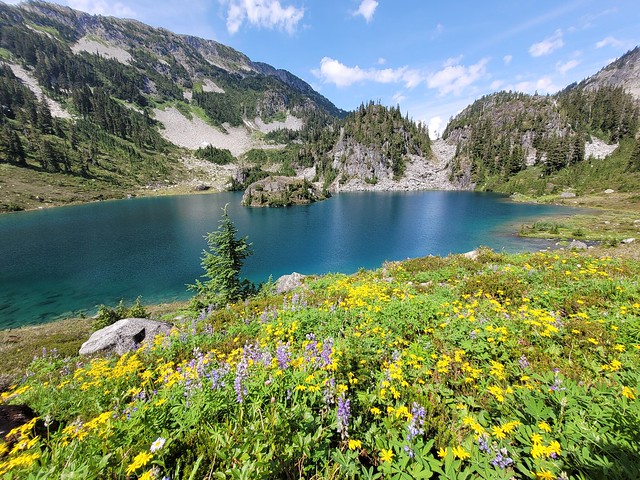
Hanging Lake is located in Whistler, sharing a trailhead with the Rainbow Lake trail on Alta Lake Road. Rainbow Lake is Whistler’s water supply, and as such, it’s a protected watershed area, so you’re not allowed to camp there. But if you hike a few more kilometres over Rainbow Pass to Hanging Lake, you can enjoy a nice view from the pass and a relaxing night at the lake. It’s a 10km trail to the lake, but the real challenge comes from climbing 800m of elevation along the way. There’s a fair bit of space for tents at Hanging Lake and there is an outhouse and a bear cache. You can also access this trail from the Rainbow Madeley trailhead near Madeley Lake.

Tikwalus

20220528_140213

In my opinion, Tikwalus Heritage Trail is an underrated trail along the Fraser Canyon. To access it, you take Highway 1 past Hope until you pass Alexandria Bridge Provincial Park. The Tikwalus Heritage Trail has been used by indigenous peoples for generations, and in more recent history, it was used by fur traders. It’s only 6km along a semi-loop trail to the campsite, but you’ll climb almost 800m in elevation, so it’s steeper than Hanging Lake. Most of the trail is in the trees, but there are some beautiful mountain views from the campsite. There’s lots of space for tents, as well as an outhouse and a bear cache. There’s no water source directly at the campsite, so fill up at the creeks on the way up to save yourself having to backtrack.

Brunswick Lake / Deeks Lake

DSC07712

Deeks Lake and Brunswick Lake are both located on the Howe Sound Crest Trail, but are accessible from the northern trailhead at Porteau Cove if you’re not doing the 30km thru hike from Cypress Mountain. Both lakes are beautiful and offer an easier alternative to the strenuous Howe Sound Crest Trail. It’s 6.5km to Deeks Lake (which is the smaller site) and 10km to Brunswick Lake, however there’s almost 1200m of elevation gain along the way. Most of the elevation gain is in the first 6.5km to Deeks Lake, making this part of the trail the steepest on my list. Of the two lakes, Brunswick is the most scenic and has more room for camping. It’s also important to note there are no facilities at either site, so be prepared to hang your food and dig catholes.

Flatiron

DSC06682

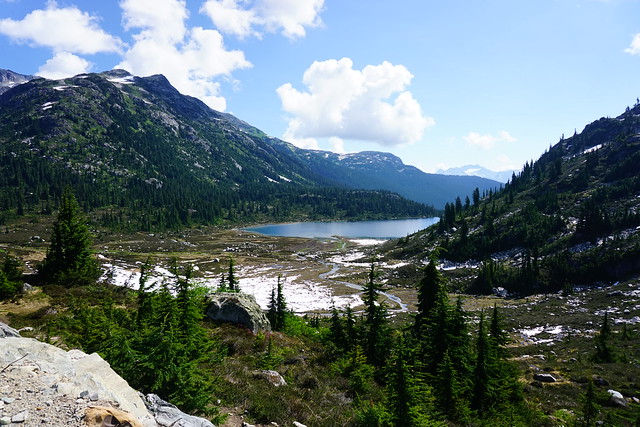
Keeping in theme with the previous trails, the trail to Flatiron is just as steep, climbing over 800m in ~5.5km, with most of the elevation gain in the first 3.5km. It’s located in the Coquihalla Summit Recreation Area off Highway 5 and shares a trailhead with Needle Peak. The first section of the trail is a huge slog through the forest, but the views are incredibly rewarding. Once you pass the junction for Needle Peak, there’s a small lake where you can camp. You can also camp at the summit of Flatiron, but there’s no water source up there. There are no facilities at either site, so be prepared to hang your food and dig catholes.

Brew Lake

PSFix_20201005_141152

Brew Lake is less steep than some of the other trails on this list, but still a big hike, covering 900m of elevation gain over 8.5km. However, if you have access to a 4×4 vehicle, you can reduce some of that distance along forestry roads. We parked along Brew Creek FSR, at the entrance to Branch 50, and hiked the entire trail from there, including 3.5km along other FSRs. This isn’t a very popular site, so it’s a nice place to go to escape the crowds. There are no facilities, so be prepared to hang your food and dig catholes.

Fairview Bay / Manzanita Bluffs

20220804_200318

We have finally arrived at some options that are not super steep! Both of these sites are located on the Sunshine Coast Trail, which has lots of possibilities for backpacking trips. The whole trail is 180km long, but there are lots of sections that can be done over a day or two. The campsite at Manzanita Bluffs, located on the north end of the trail, is especially beautiful. I also really like the campsites at Fairview Bay and Rainy Day Lake, located on the south end of the trail. All campsites along the trail have outhouses and most of them have bear caches or huts. They do not all have water sources, so plan accordingly. While these sites are free, I do recommend a donation to qPAWS if you opt to stay in one of the huts.

Campsites Accessible by 4×4 Vehicle

Tricouni Meadows

20220820_132359

Tricouni Meadows is a popular campsite located northwest of Squamish. The trailhead is located on Branch 200, off of Squamish River FSR. If you can make it all the way to the trailhead, the hike to the campsite is just over 3km, with 250m of elevation. However, there was a large wash-out on Branch 200 when I did this hike in 2022. If you park at the wash-out, it adds 3km to the trail. In 2022, some vehicles could get through, but I’ve heard it’s gotten worse, so play it safe. There are 3 lakes near the meadows, with the campsite located at the middle lake: Spearhead Lake. It’s not a large campsite, so I recommend getting there early. There are no facilities, so be prepared to hang your food and dig catholes.

Blanca Lake

20240721_074347

Blanca Lake is another campsite located northwest of Squamish. In general, I would say this road is in better shape than the road to Tricouni, but it’s further away. The trailhead is located off E300 on the Elaho Mainline. The trail is 4.5km, with almost 500m of elevation gain. It starts off pretty steep, but then levels out along the middle. The view from Blanca Lake is incredible and there is tons of space for camping. Give yourself extra time to explore around the alpine once you get to the lake. There are no facilities, so be prepared to hang your food and dig catholes.

Conglomerate Flats / Manson Ridge

PSX_20230807_175855

Both of these campsites are located on the HBC Heritage Trail that runs 70km between Hope and Tulameen. Manson’s Campsite is located on the Hope end of the trail (off Peers Creek Road), so you don’t need 4×4 to access this site, but if you want to access Conglomerate Flats for a night, then you need 4×4 to get the trailhead at Jacobson Lake Rec Site (off Tulameen FSR). Both sites are beautiful, though Conglomerate Flats is the more stunning of the two. It’s 6.5km and 600m of elevation gain to Manson’s Camp from the southern trailhead, and 2.5km and 150m of elevation gain to Conglomerate Flats from Jacobson Lake. Both campsites have outhouses and bear caches.

Winter Campsites

Falls Lake / Zoa Subpeak

PSX_20210314_215122

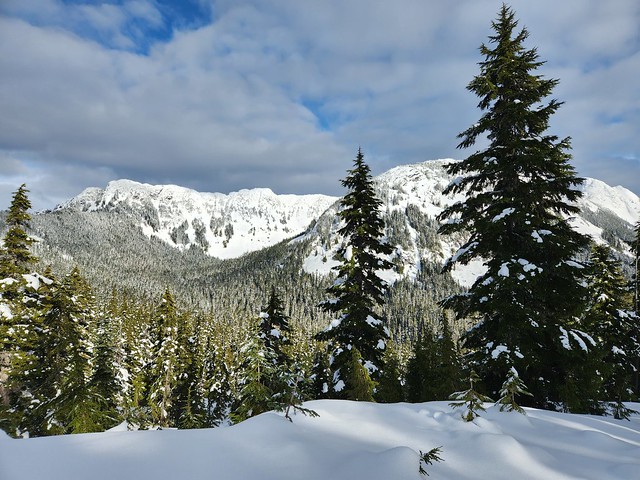
Both of these sites are located in the Coquihalla Summit Rec Area off highway 5. Falls Lake is a great site for beginners because you only have to snowshoe 1km along the road (which isn’t plowed in the winter) and 1km to the lake. Zoa subpeak is a bit more challenging as it’s 550m of elevation gain over 4km. Both trails are located in simple terrain, but make sure to stop at Zoa Subpeak – if you try and snowshoe all the way to the true peak, you will be entering challenging avalanche terrain. I’ve never actually been to Falls Lake, but I believe there is an outhouse. There are no facilities at Zoa Subpeak.

Ottomite Peak

20230204_135419

Ottomite Peak is also located in the Coquihalla Summit Rec Area off highway 5. The trailhead is at the Zopkios Rest Area. It’s a 4.5km trail with 300m of elevation gain to get to the summit. It was completely empty when I camped there, but the general area is popular among ski tourers, so you may see people along the trails for the day. The trail is in simple terrain, but always exercise caution – in general, I always recommend taking an AST1 course. It’s not a challenging trail, but there are no facilities.

Water Access Campsites

Widgeon Creek

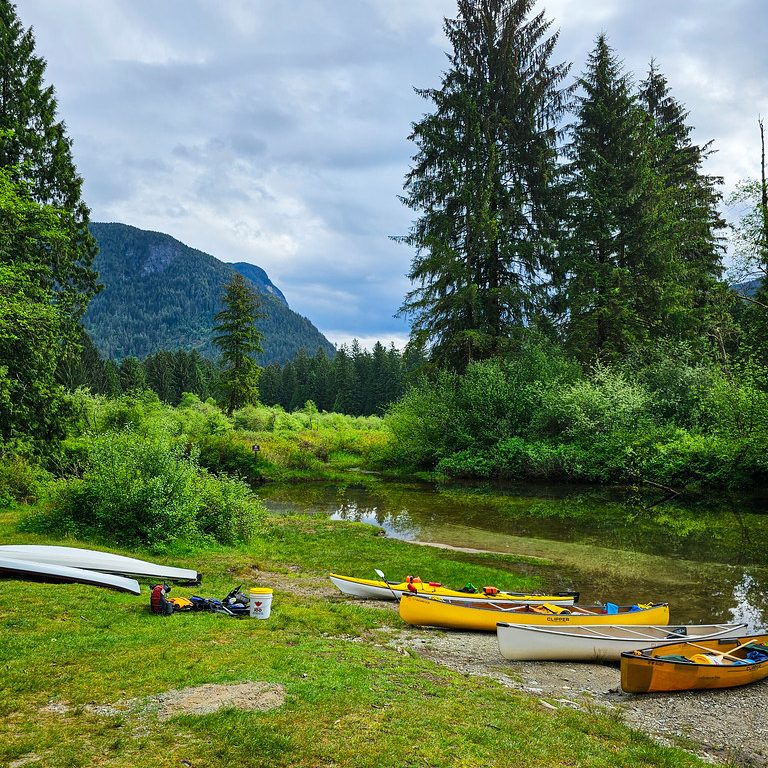
A photo of a line of canoes on the shore of Widgeon Creek at the Widgeon Campsite in Pinecone Burke Provincial Park, with the mountains and trees in the background on a cloudy day in BC.

Widgeon Creek is located near the lower mainland and is extremely popular on summer weekends. It’s a ~5 paddle across the Pitt River and up Widgeon Creek to get to the campsite. You can rent canoes or kayaks at Pitt Lake. There are lots of campsites and great facilities, including a large bear cache and 2 outhouses. But I recommend getting their early on a nice weekend to beat the crowds. From the campsite, you can do a day hike to Widgeon Falls.

Twin Islands / Granite Falls

20240810_114057

Twin Islands and Granite Falls are two campsites located in Indian Arm, so they are very accessible from the lower mainland. As a result, they are very popular on summer weekends, attracting paddle boats and motorized boats. You can rent kayaks from Deep Cove. It’s only 5km to paddle to Twin Islands, so this is the easier campsite to access. You’re only allowed to camp on the north island, but it has an outhouse (no bear cache since it’s an island). Granite Falls is at the far end of Indian Arm and is an 18km paddle from Deep Cove, so you should be an experienced paddler if you want to do this trip. It has 2 outhouses and a bear cache, but it’s severely undersized. Be prepared for northern afternoon winds.

Nine Mile Point / Kunechin Point

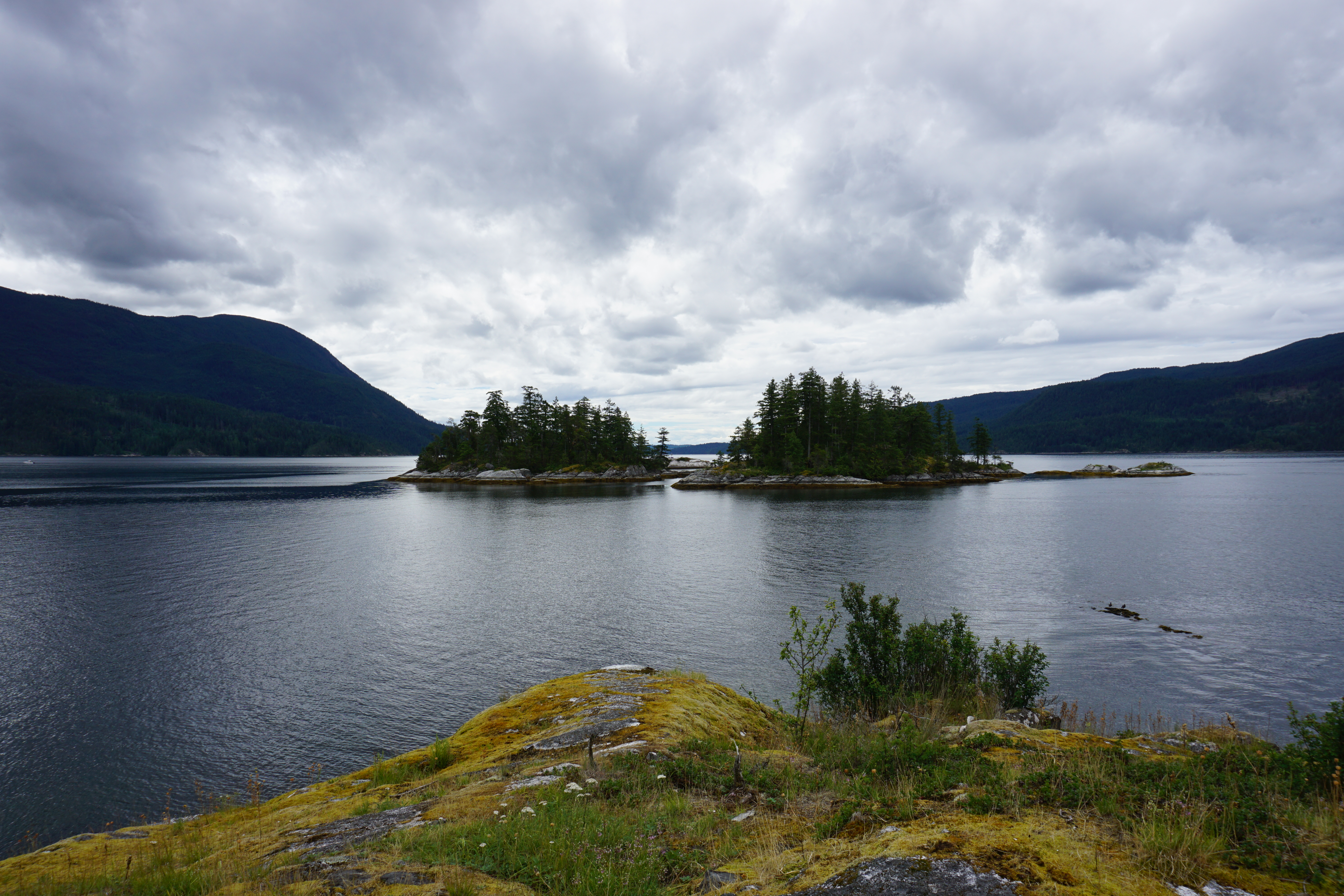
A photo from Kunechin Point in Sechelt Inlet on a kayaking trip, with the water and mountains in the background on the Sunshine Coast in BC.

Nine Mile Point Beach and Kunechin Point Campsite are both located in Sechelt Inlet on the Sunshine Coast. There’s a kayak rental place at the end of Sechelt Inlet Road, where you can launch from. It’s ~6km to paddle to Nine Mile Beach and ~10km to paddle to Kunechin Point, but the latter involves crossing the arm of the inlet, which can get windy. Both are beautiful sites and have outhouses, but no bear caches.

Hiking Flatiron

For mine and Brandon’s third annual Thanksgiving weekend hike, we did Flatiron for the first time in 2018. Now while I think Elfin Lakes and Watersprite were a bit of a stretch to be considered “Fall hikes”, I thought that Flatiron was a great Fall hike, but not in the traditional sense.

20181006_113929

We’d intended to do the Needle Peak trail, which shares the same trailhead as Flatiron, but once we got up to the branch and saw the layer of snow sitting atop this steep climb, we decided to leave it for another day and do the Flatiron trail instead. Flatiron continues on past the Needle Peak branch and hikes down through a pass and back up again to a small glacial lake. I’ve since learned this a popular location for camping in the summer, but in October it was pretty empty.

DSC07390

The lake is what I think makes this a great non-traditional Fall hike. The trail continues over a steep slope to the top, which is a giant flat plateau (hence the name Flatiron). At just the right time of year, all the shrubbery against the slope turns this beautiful shade of deep red. Pair it with a fresh coat of snow, which is how it looked when we visited, and it really gives you lots of changing season vibes. I think your timing probably does have to be just right, but even if you missed it, it’s still a great hike.

DSC07371

There were very people on the trail when we visited and most of them seemed to be attempting Needle Peak. There were just two other guys going the same way as us. We passed them on the way up because they had big backpacks on. We asked if they were planning to camp and they informed us they were actually hoping to fly down!

This was my first experience with paragliding and I have to say it’s a hard pass from me. Even Brandon, who is much more adventurous than me said you’d never get him paragliding. We were pretty much the only two groups on top of the Flatiron, so we watched them setting up their flight suits as we ate our lunch. I admit we definitely lingered over our lunch because we really wanted to watch them fly off.

DSC07386

From the start, it was clear one guy was more experienced than the other and they chatted a lot as they got set up. Eventually, after much checking, they finally got ready to take a run. The more experienced guy had no problem and the wind caught him and took him right off the side and up. We watched as he sailed off and circled up and up in the wind currents for about 20 minutes before finally landing back at the car park.

DSC07360

Unfortunately the second guy didn’t have quite as much luck. He took off just after the first guy, but he terrified me and Brandon with a fall right at the start. It almost looked like he was going to get up, but the wind took his chute funny and he ended up crashing to the ground. It wasn’t a far fall, but it didn’t look comfy and it made us really nervous to watch him. I can see why Flatiron is a great place to practice though, there’s lot of wide open space in which to run from and relative safety from which to fall until you head out over the edge.

DSC07376

We watched him make 2 more unsuccessful attempts and then Brandon decided it was time to get out of there or we were going to be watching this guy fall to his death. After that he decided to give up and ended up packing up and hiking back down to meet his friend at the car. So fortunately no one was injured, though I’m sure he was disappointed.

DSC07391

As usual, it was freezing at the top of the trail for October, but this time we’d come prepared with warm jackets so that we could stay out and watch the view. Unlike our other two trips though, this year we got clear blue skies and lots of sun, so it made for an incredibly scenic trip! It’s a steep trail, with 800m of elevation gain spread over 11km round trip, but so worth it for the 360 degree views at the top!

If you’d like to hear more about Flatiron or see more photos, I have published another blog post on an overnight trip I took in July 2020.