If you’re thinking, “didn’t she just post her 10 favourite hikes last week?” You are correct, I did. But I have a severe backlog of trails to post about, so Part III featured my favourite trails from 2019-2020, while this post focuses on my 2021-2022 era. Part III was my “covid era”, so it featured a lot of trails closer to Vancouver. In my opinion, Part IV has some really scenic hikes because post-covid, all I wanted to do was hike and I discovered some real gems! Check out Part I, Part II, and Part III.
#10 Hut Lake – Let’s start off with a really obscure hike. The snow pack was insanely high in 2022, which postponed my alpine hiking season. In our desperation to find somewhere low elevation to camp, we stumbled upon Levette and Hut Lake outside Squamish. Levette is well known by the locals, but if you continue past Levette, you’ll eventually come to the much less popular Hut Lake Rec Site. It seems to be mostly used by the 4×4 community, but we had it to ourselves on a weekend in mid-July. The hike is entirely in the forest and it’s not the most memorable lake, but I still had the best time swimming in the insanely warm water and recommend it as a good Spring hike or rainy day trail. (8km, 500m elevation gain, 4 hours)
#9 Bedwell Lake – Bedwell Lake is a popular trail in Strathcona Provincial Park. It’s located at the back of the park and ease of access can depend on the current state of the road. When we visited, a normal AWD SUV would access it fine, but I’ve heard sometimes you need 4WD or high clearance. Parts of the trail are a bit technical, with some ladder sections, but you’re rewarded with beautiful views of the lake and surrounding mountains. We wanted to continue on to Cream Lake, but unfortunately we got rained out on our visit. I’m keen to return to see it in the sun! (10km, 600m elevation gain, 6 hours)
#8 Slesse Memorial Trail – There are some real gems in Chilliwack Valley. Slesse is a challenging one to get to as you definitely need 4WD and high clearance. It’s a bit of a somber hike because it’s the location of a plane crash, but it also has gorgeous views of Chilliwack Provincial Park and across the border. With over 1000m of elevation gain, it is a slog to get to the top and the views are relatively limited until the summit. But once you hit the ridgeline, there’s a glacier in front of you and a wall of mountains behind you, so you really get a pay-off. (15km, 1100m elevation gain, 9 hours)
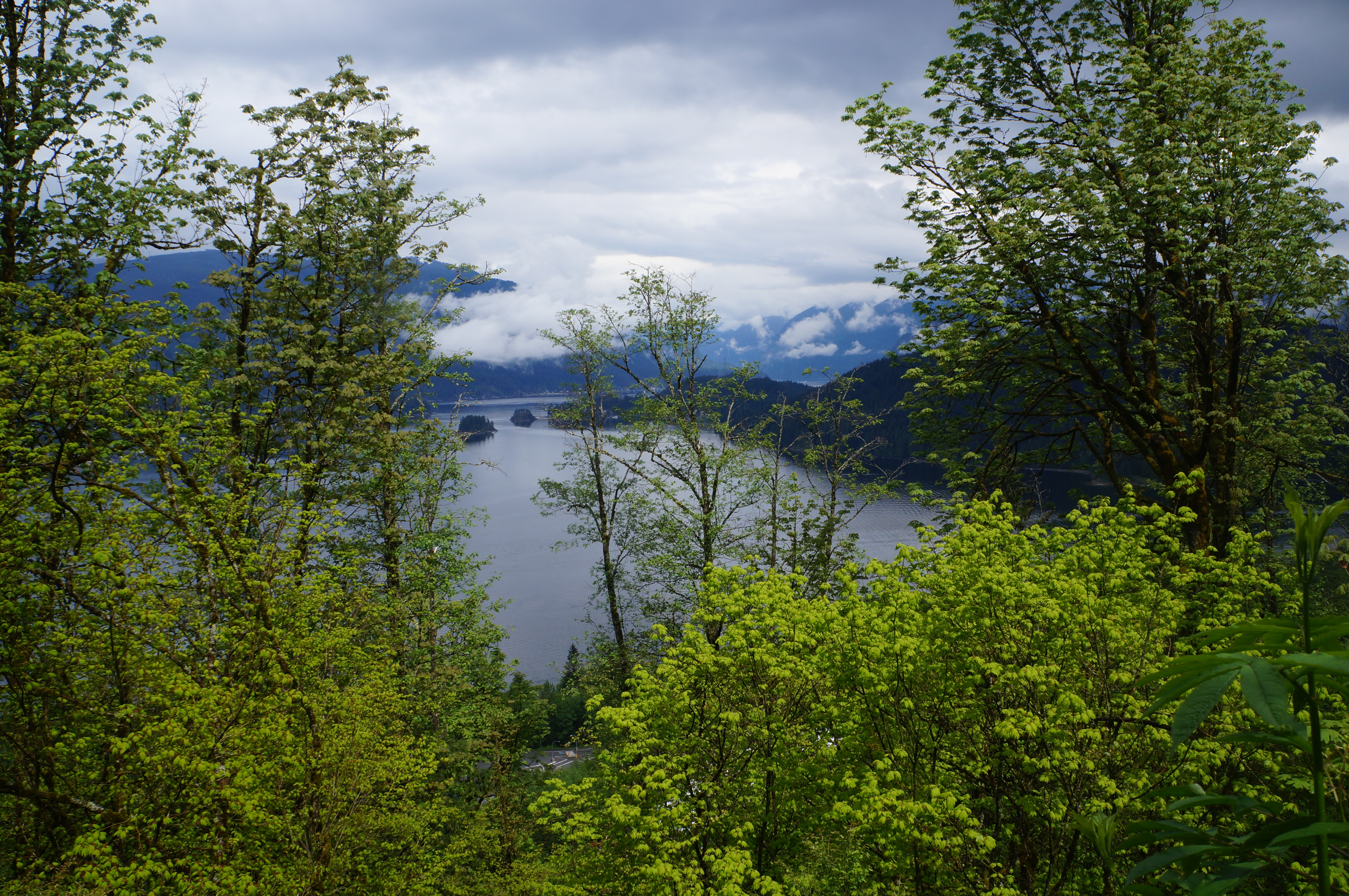
#7 Barnet Trail – One of the things I love about living near Vancouver is that you don’t have to go way into the wilderness to hike and the Barnet Trail on Burnaby Mountain has become one of my favourite semi-urban hikes. We hike here regularly with Sadie and I love the views from Burnaby Mountain Park and through the forest. We always start at Burnaby Mountain Park, and I have to admit, the best view of the hike is at the trailhead, but it’s the perfect hike to get your body moving when you don’t want to drive anywhere or have limited time. (9km, 300m elevation, 3 hours)
#6 Myra Falls – I debated for a long time about whether to put this on this list or not. At 1.5km, it barely qualifies as a hike and is definitely more of a walk, but it’s such a beautiful waterfall! It’s also located in Strathcona Provincial Park and it’s so beautiful Brandon and I had to visit it twice! It’s an easy walk down to the Falls from the parking lot and then you can explore around the area. Definitely exercise caution as there are some steep sections, but after swimming in the waterfall, Brandon and I hiked down over the rocks to also swim in Buttle Lake. (1.5km, 50m elevation gain, 1 hour)
#5 Seed Peak – I did this trail in the late Fall of 2021 and even before I finished, I knew I’d have to return some day. There was already snow on the ground when we visited and I was having a rough day physically, so we didn’t even finish the hike, but I was still astounded by the views. Access is a bit tricky for this one as it’s way off the beaten track outside Squamish and I’d recommend 4WD and high clearance. Part of the trail is actually located in the far north end of Pinecone Burke Park (which starts in Coquitlam) and there are gorgeous views of the backcountry everywhere you look. We only made it to the base of Seed Peak, but I definitely need to return for the rest of the hike! (13km, 800m elevation gain, 8 hours)
#4 Tricouni Meadows – My apologies for including so many 4WD access hikes on this list, this is the last one, but I couldn’t leave it off! Tricouni Meadows is located way up in the wilderness north of Squamish Valley. It’s a slog to get to the trailhead and another slog to get to the lake, but you are rewarded once you get there. There are several lakes at the base of Tricouni Peak and it’s a bit technical travelling between them, but there’s space for several campsites. We visited Pendant Lake (my favourite), Spearpoint Lake, and Reflection Lake. From reflection Lake, you can continue up to the top of Tricouni Peak, which I didn’t do, but would like to return and complete as a backpacking trip. It’s a surprisingly busy campsite for such challenging access, so get there early! (8km, 500m elevation gain, 8 hours)
#3 Skywalk North – This hike is north of Whistler and better known as Iceberg Lake. It’s a popular hike, but most people only hike to the lake and back. It’s a bit longer, but I recommend turning it into a loop hike by doing with the Skywalk North or South trail. We chose the North Trail, it’s longer, but more scenic. It’s a long hike through the trees, but once you hit the lake, you continue hiking up to another summit above the lake with incredible views looking back. From there you continue through several meadows before arriving at Screaming Cat Lake and returning through the trees. Pay special attention to the trail stats though, this is a rewarding, but challenging hike. (22km, 1200m elevation gain, 10 hours)
#2 Opal Cone/Mamquam Lake– If you go back to my previous posts, you’ll find Elfin Lakes on my first list. Elfin Lakes remains one of my favourite hikes to this day, but I can finally add Opal Cone and Mamquam Lake to the list! This are both continuation hikes from Elfin Lakes and are not intended to be done in a day. Camp at the lake and do either one or both of these as a day hike. Personally, I like Opal Cone better, which is in peak alpine terrain, but it was rewarding to finally make it to Mamquam Lake after a failed attempt back in 2018. (14-22km, 1000m elevation gain, 9 hours)
#1 Sunshine Coast Trail – No other trail had any chance of the number one spot with the Sunshine Coast Trail in the mix. I hiked this entire 180km trail in 2022 and I’m in love with every inch of it! You don’t need to hike the whole thing, there are so many highlights on this trail and lots of them are accessible as day hikes or 2-3 day trips. The backcountry huts are what make this trail so special, but my favourite sections include Tin Hat, Walt Hill, Manzanita Bluff, Sarah Point, Appleton Canyon, Inland Lake, Rainy Day Lake, and Fairview Bay – basically the entire trail. (180km, 7-12 days)
The Sunshine Coast Trail has been on my bucket list for several years and I finally hiked it in its entirety this past summer. You can read my trail blogs starting with Part I, but I also wanted to create a guide to accompany those posts for anyone thinking of doing the trail. I think this is a great trail for thru hikers because while it is long (180km), it’s not life-altering long (like the PCT). But it is still long enough to require considerable advance planning, so here are some things I learned while planning the trek:
Experience/Fitness Level
The first question to ask yourself is whether you have the experience and ability to hike a trail this long. My longest trail prior to the SCT was 85km, but I’d hiked that distance on 3 separate occasions, so I felt confident that I could attempt 180km. Compared to other popular thru hikes in BC, I would say that the SCT is actually a bit easier (comparing to hikes like the West Coast Trail), but that it shouldn’t be underestimated. I was able to hike at a much faster pace on the SCT than other coastal trails I’ve done, but there is a lot of elevation gain throughout the course of the trail, so you definitely want to be used to climbing mountains before you attempt. However, there are lots of exit points on the trail if it becomes too challenging and the huts can make things more comfortable for newer hikers. That said, if you’ve never backpacked before, get some experience on shorter trails first, or plan to section hike part of the trail instead of the whole thing, because there is a big difference in difficulty when you have to carry all your gear with you, especially on a long trip with heavy quantities of food!
The Trail
The Sunshine Coast Trail is 178km long on paper, but a bit longer in practice. There have been many re-routes and trail changes throughout the years, so while there’s 178 trail markers on the trail, they’re not all actually 1km apart from each other. I clocked 190km on my GPS when I did the trail. The most notable section is from Tin Hat to Lewis Lake, which is 2-3km longer than indicated, so prepare for slightly longer days than anticipated. In addition, I tracked a cumulative elevation gain of 7500 metres over the course of the trail, so be prepared for a lot of uphill (and downhill if you have bad knees like me).
The trail starts at the far north end of the Upper Sunshine Coast, known as Sarah Point. It’s approximately 50km down the Malaspina Peninsula to Powell River and then the trail meanders through the mountains for another 130km to the trail end at Saltery Bay. The half point of the trail is at Tin Hat Mountain, which is largely regarded as the best viewpoint on the entire trail. There are lots of access points along the trail, but the two easiest are in Powell River (km 50) and Lang Bay (km 150). If you’re section hiking, I’d plan to hike one of these 3 sections, and if you’re thru hiking, these make good resupply points (more on that later).
While you can hike the trail in either direction, the majority of people go from North to South. The trail is set up for people hiking this direction so the trail markers will all be in order. Sarah Point is considerably harder to access than Saltery Bay, so it’s recommended to start at Sarah Point so that you can walk on the ferry when you get to Saltery Bay at the end of your hike and not have to coordinate transportation. For more detailed information about the entire 178km trail, pick up a copy of Eagle Walz’s book, or check out the SCT website.
Time of Year
Time of year can also play a large role in determining when to hike the trail. If you don’t like crowds, then you may want to avoid the summer months and hike in the Spring or Fall. Summer can also be extremely hot and a lot of the streams can run dry in August, making it more desirable to hike in the shoulder seasons. The benefit of hiking in the summer is that you’re likely to have the driest weather, so if you don’t like hiking in the rain, this might be the best option for you, though the heat can be exhausting.
The challenges with Spring hiking are that if you go too early, there may still be snow on parts of the trail and you’re more likely to encounter rain along the trek. Whereas in Fall, you won’t encounter snow unless you go really late, but the streams are more likely to be dry in early Fall and you’re more likely to get rained on in late Fall. I wanted to do the trail in June, but I ended up doing it in August (when it was very hot) and early September (when the streams were mostly dry). But I didn’t encounter crowds during either time.
Getting There
Getting to the Sunshine Coast was probably the biggest challenge for me and was the most considerable cost of the trip. If you’re going with a group and have more than 1 car, it’s relatively easy, but if you’re alone or don’t have a car, it’s a bit more challenging. You’ll have to either drive or walk on two different ferries (Horseshoe Bay to Langdale and Earls Cove to Saltery Bay) and prepare to shell out $100+pp to take the shuttle to the trailhead. Saltery Bay and Powell River are accessible by transit, but the trailhead at Sarah Point requires 4WD to access. If you have 4WD, that’s great, if not, make a booking with the Sunshine Coast Shuttle. Here’s the options I’ve identified for getting to the trailhead:
Drive yourself (1 car). Park your car at Earl’s Cove and walk on the ferry, then get the SCT shuttle from Saltery Bay to the Sarah Point Trailhead. If you want to drop off resupplies, then drive on the ferry instead and park at Saltery Bay once you’ve dropped the resupplies and catch the shuttle. Once you finish the trail at Saltery Bay, your car will be waiting for you!
Drive yourself (2 cars). If you have a rugged 4WD with high clearance, you can park one car at Saltery Bay, drop off your resupplies, and drive your second car all the way to the trailhead. If not, drop off your resupplies and catch the shuttle from Powell River to the trailhead. Collect your car at Saltery Bay at the end of your hike and pick up the other car.
Take transit. You can walk on both ferries and there is a connector shuttle that runs between the two ferries in the summer. It runs every day except Thursday, but it only goes once per day. Once you get the second ferry to Saltery Bay, you can get the shuttle to pick you up and transport you to the trailhead, or you can take the city bus to Powell River, drop off your resupply, and then get the shuttle to the trailhead. This was what I did on my first attempt.
Fly. There are several airlines that fly direct to Powell River, but I recommend Harbour Air because it flies directly to the Shingle Mill Pub, which is one of the resupply locations. So you can drop off your resupply when you arrive and then arrange the shuttle to the trailhead. The downside is you can’t fly with fuel or bear spray, but you can purchase both from the shuttle company. This was what I did on my second attempt.
All of these options assume starting at Sarah Point. You can walk off the ferry at Saltery Bay and start from there, but it’s better to take the shuttle for drop off rather than coordinate a pick-up time when you might not know how fast you’ll be hiking. Unless you plan to camp at Sarah Point on your last night and get picked up in the morning.
Itinerary
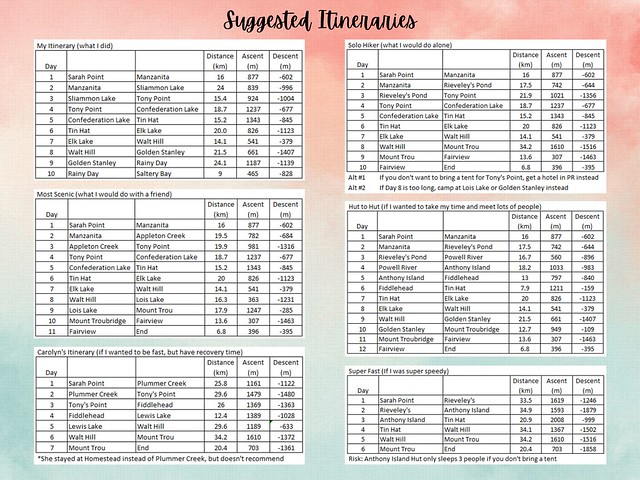
Once you’ve established you’re ready to attempt the trail, itinerary becomes an important consideration. You can hike the entire trail in one go, or you can make a couple of trips to complete in section hikes, or even day hikes if you’re ambitious and comfortable with trail running. I decided on one big thru-hike, but circumstance forced me to complete it as two section hikes. You want to be realistic about your abilities when deciding how many days to allot for the trip. Because it’s a long trail, there’s a tendency to want to do a lot of kilometres, but consider whether this will be enjoyable over an extended period of time. If you’re hiking solo, it may be easier to hike longer distances, but if you’re in a group, you will naturally need a slower pace. If you don’t have lightweight gear, also consider that packing 3-8 days of food will present a considerable challenge.
Campsite choice is also an important consideration in determining your itinerary. Are you flexible in where you camp? Are you comfortable staying at tent sites, or do you only want to stay in the huts? Either way, plan to bring a tent because the huts can fill up on summer weekends, though users are supposed to prioritize space in the huts for thru-hikers. Determining how many days you have available for the trip can help you determine your itinerary, just make sure to leave enough time for travel to and from the Sunshine Coast as getting to the trailheads can be somewhat tedious.
Campsites
You don’t necessarily need to pick exactly where you’re going to camp in advance when you draft your itinerary, but it’s good to set some goals so that you can assess whether you’re ahead or behind your targeted pace while on trail. I decided on 10 nights on the trail and planned my itinerary around that. I generally had a target that I wanted to reach every second night and I was flexible on the opposite nights based on how I was feeling. I wanted to stay at Tin Hat Hut and Walt Hill Hut because I heard they were the most scenic, so I set goals for when I wanted to arrive at those locations. It’s also good to know if there’s any sites you want to avoid, so you can plan around that. For example, I really didn’t like Homestead Rec Site or Lewis Point Rec Site.
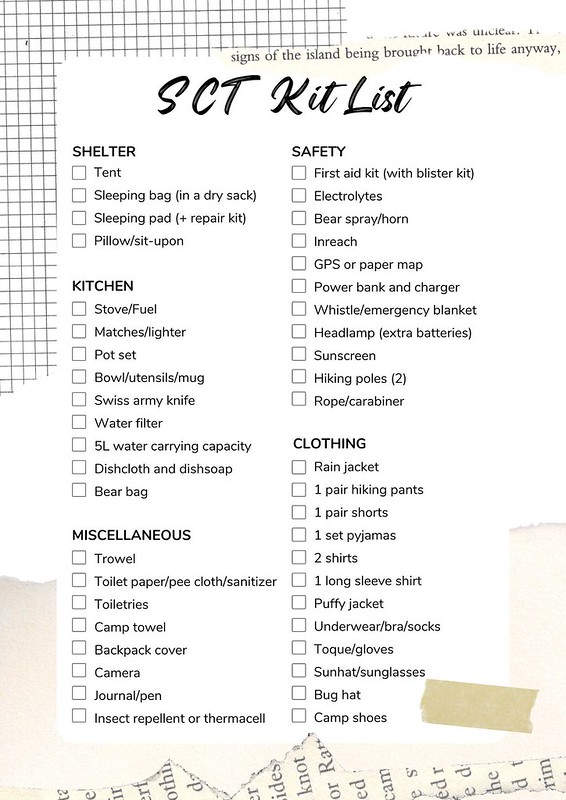
Definitely pick up a copy of the SCT guide when assessing where you want to stay. Some campsites are more rugged than others and they don’t all have bathrooms, water sources, or bear caches. Water sources are important because if you stay at a campsite without one, you will have to hike with extra water. Likewise, if you’re staying at sites without bear caches, you’ll need to put extra consideration into how you’ll protect your food. See below for more information on both of these items. Even if you plan to stay only in huts, I still recommend bringing a tent with you because the huts can fill up on popular summer weekends. However, if you’re hiking in the off season, generally you’ll be okay. I’m told the huts were extremely busy in 2021, but when I hiked the trail in 2022, they were virtually empty, both in August and September.
Gear
Gear is a favourite topic of any hiker. You don’t need expensive gear to go backpacking – I hiked with cheap gear for years and did just fine. But prepare yourself for the weight of it. I’ve invested in some really lightweight gear over the years and it really paid off for me on this thru hike. I was able to hike longer and faster than if I was using cheaper, heavier gear. In some instances I sacrificed comfort for this (a smaller sleeping pad, only the essentials for clothing, a non-freestanding tent), but the comfort of the lighter pack was more than worth it for me.
Fortunately, the SCT is not an alpine hike, so generally you can get away with cooler gear. I always bring a lot of warm gear when I’m going to the alpine, but this wasn’t needed on the SCT, especially in the middle of summer and with the huts. Plus, if you’re doing the hike with a friend, you can share gear to lighten the load. A few things I would definitely still bring include trekking poles, bear spray, and all of the 10 essentials, especially an inreach (or satellite device) and a GPS (or a large power bank for your phone).
Food
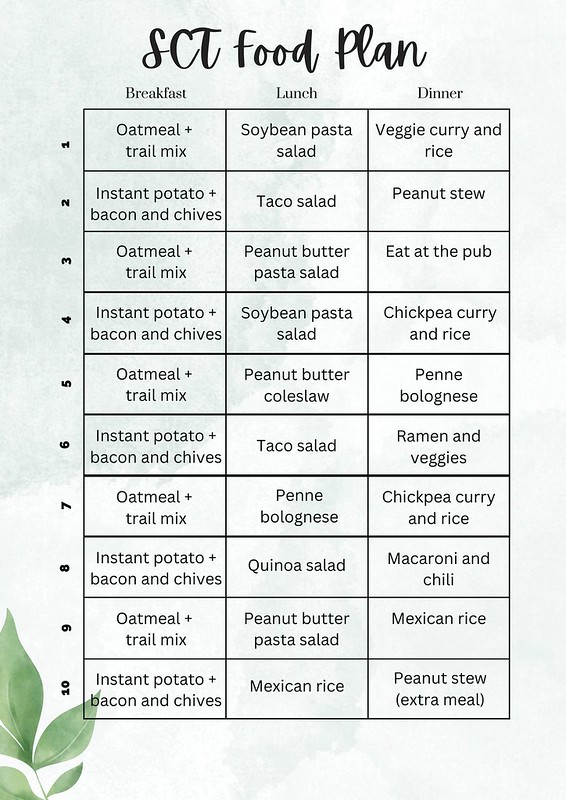
Food is one of my favourite topics when it comes to thru-hiking. Some people get really into calorie counting for a big hike, but I’ve personally never found this was accurate for me and resulted in carrying way more food then I needed. If you’ve done some practice hikes, they should give you a good idea of how much you will generally eat and then plan for slightly larger portions sizes or extra snacks since it’s a long hike. Personally I prefer to bring larger meals in lieu of extra snacks. Generally you will get hungrier the longer you hike, so plan for a bit extra towards the end of the trip. Always bring an extra day of food on a trip of this scale in case of emergency.
I’ve been getting really into dehydrating and I prepped my entire menu for 11 days using my dehydrator. You don’t need a dehydrator to do a multi-day trek, but it can significantly lighten your load. The average person carries 2lbs of food per day, but I was able to get my weight down to just over 1lb per day (12lbs for my 11 days on trail). The easiest way to shed weight is through dehydrated/freeze dried meals. I dehydrated my own, but you can also purchase them from a large suite of options at places like MEC, though these are often a little bulkier and very pricey. Before I got into dehydrating, my preference was to stock up on simple grocery store items like knorr sidekicks, of which there are lots of rice and pasta options, or easy dinners like ramen. The trick is finding some way to add protein. Tuna packets are a good option, but a little heavier than dehydrated proteins. Famous foods carries lots of freeze-dried options.
Resupplies
Resupplies go hand in hand with food. If you’re fast, you can probably carry all your food from the start, though carrying so much food weight may slow you down. The two easiest resupply points are the Shingle Mill pub in Powell River and the general store in Lang Bay. Shingle Mill is right on the trail, but Lang Bay involves a 2.5km road walk each way. Because of this, I opted for just 1 resupply at the pub. I carried 4 days of food at the start and then picked up 7 days of food from the pub. Another option is to pre-arrange a drop-off from the SCT shuttle company at any point where the trail crosses a road, but this is a pricey option, so I didn’t meet anyone who utilized it. Both the pub and the general store will hold your resupplies free of charge.
Other Considerations
Water Supply – No matter when you hike the trail, water supply requires constant thought. Not every campsite has a water source, so you may need to carry extra water with you if you plan to camp at one of these sites and you need to know where your last reliable source of water is before you get to the campsite. When I hiked in early August, the majority of streams were still flowing, but when I hiked in early September, almost every stream was dry. This meant that I had to get almost all my water from lakes and ponds, meaning I often had to carry extra water and that a water filter was extremely necessary to purify my water. Streams are a higher quality source of drinking water than lakes or ponds, so plan accordingly when choosing your water treatment system. At times I carried 4-5L of water with me depending on my campsite and last reliable water source – 5L of water weighs 11lbs, so it’s a significant addition to your pack!
Bear Caches – Not every campsite has a bear cache. Most of the huts have them (but not all) and most of the tenting sites don’t have them. Pending on location, it may be very difficult to create a bear hang, so it’s recommended to bring either a bear bin or bear bag on the trail. Everyone has different opinions on bins vs. bags. Personally, I think a bin is the safest option, though I opted for the bear bag for weight reasons. It’s almost impossible for a bear to walk off with your bear bin, but it can walk off or crush your food with a bear bag, so I still tied mine to a tree even though it’s made of kevlar and supposedly bear proof. It was never tested.
Mount Troubridge was the last section on my SCT thru-hike. After camping at Golden Stanley Hut, I had a big hike over the top of the mountain and then down to Saltery Bay. As usual, I got up early at Golden Stanley Hut to start my hike – I was hoping to hike 22-25km, so I was on the trail by 7:30am. It’s a long slog up to the top and I had 12km and 1000m in elevation gain to the next hut near the top. I wasn’t looking forward to the climb after how strenuous Tin Hat was, but it ended up being a lot easier than anticipated.
It starts with a short steep climb, but then it levels out and most of it is just a leisurely gentle uphill through the forest. The trail switchbacks for awhile, but it’s never difficult and I hiked a lot faster than I thought I would. There’s one cute forest campsite near a stream on the way up, and then a second site at Elephant Lake, but I wouldn’t recommend this one. Elephant Lake isn’t the nicest and there’s absolutely no facilities, not even a picnic table. I only saw one flat spot big enough for one tent, otherwise, I don’t really think there’s room here for camping. You’re better off at the forest site or just continuing on to Troubridge Hut.
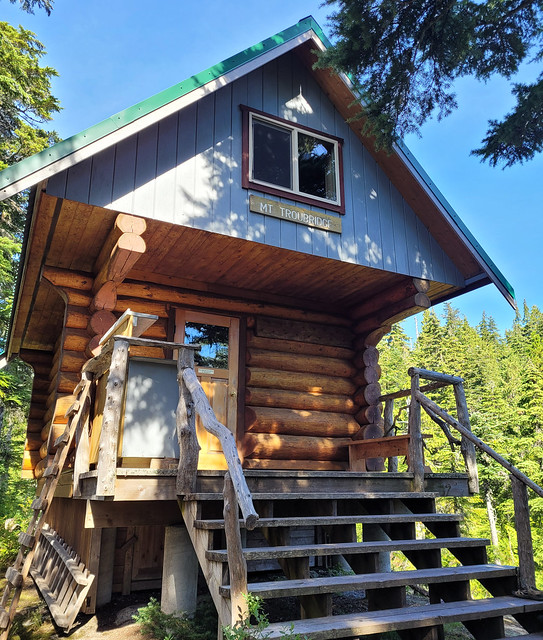
It’s ~10km to Elephant Lake and it was all pretty easy hiking, though the brush was dense in a few places. After Elephant Lake it gets steeper, but it’s only 2km of trail to the hut, which is about a half hour below the summit. The hut is really cute. It’s a similar design to the other A-frame huts, but it’s more of a traditional log style cabin and it is a bit smaller. I would definitely have preferred it to Golden Stanley, but it was quite chilly up there since it’s at the top. There’s not really a view from the hut, but there is a small pond where you can swim.
It’s ~1.5km to the summit of Mount Troubridge from the hut. Unfortunately the summit wasn’t quite what I was expecting. Unlike Tin Hat and Walt Hill, Troubridge is completely forested, so while you can catch a few glimpses through the trees of the view, it’s not completely open. It’s a little disappointing considering it’s the highest point on the trail, but I still felt very accomplished getting to the top in time for lunch.
Unfortunately, Troubridge was the only place on the trail where I encountered mosquitoes, but I had my thermacell, so I set it up while I ate lunch and enjoyed a view through the trees. I had service and was able to check in with my family. I was planning for one more night on the trail since I had to catch the bus home, but I wasn’t sure if I would camp at Rainy Day Lake Hut or Fairview Hut, which are about 3.5km apart. I was hoping to maybe push all the way to Fairview to shorten my hike out, but as I started the downhill, it was obvious my knees had finally had enough.
I don’t have great knees, so I’m shocked they held up as well as they did over 130km. I thought I was going to wreck them on Tin Hat, but because I camped on top of a lot of mountains, it meant I did the downhills in the morning when my legs were fresh, and that made a big difference! In contrast, on Troubridge, I’d hiked the entire 1200m of elevation gain to the top, only to have to hike back down the same day. It was hard on the knees and the longer I did it, the slower I got.
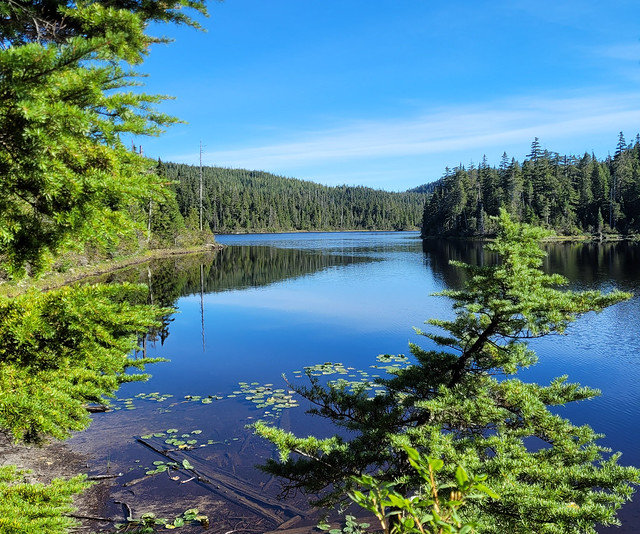
There’s a few really nice views along the old forest roads on the way down to Rainy Day Lake (like better than the summit), but I really stumbled my way down to Rainy Day. I wanted to check out the hut whether I would stay overnight or not, but Carolyn had told me it was one of her favourites, and with my bad knees, I decided not to push any further. Rainy Day Lake is exceptionally beautiful! I was alone again, but it didn’t bother me as much in the beautiful setting, especially knowing it was my last night on the trail. I’d seen one other solo hiker going in the opposite direction and she was the only person I saw all day.
Rainy Day Lake is a semi enclosed hut located above a big circular lake. You can climb down to the lake and someone has constructed a floating dock tied on to the rocks. The dock is amazing. It was a perfectly sunny day and I stripped down to go for a swim and take a bath and then just hung out on the dock for the better part of the afternoon. Eventually I returned to the hut to take care of my chores, but then I went back to the dock to watch the sun go down. The sun shimmered off the water and being alone there, I really felt like I had a little piece of paradise to myself. I think it ought to be renamed because “Rainy Day” Lake doesn’t do it justice!
I got up even earlier on my last day because I had to catch the noon ferry and I was worried about my knees. I still had to descend another 400m to get to Fairview Hut, but the rest had paid off and my knees were feeling a lot better, so I needn’t have rushed. I knew Fairview Hut was more popular than Rainy Day Hut, but honestly, they are both amazing and I wish I could have stayed in both of them. I was hiking as soon as the light cracked through the trees and Fairview Hut was bathed in sun when I arrived. It’s located right on the coast and it is really something special. I hung around for a bit, but it wasn’t enough time and I would really love to return. The nice thing about Fairview is that it has beach access, so I’m thinking it would make for a good kayaking trip for me and Seth sometime in the future.
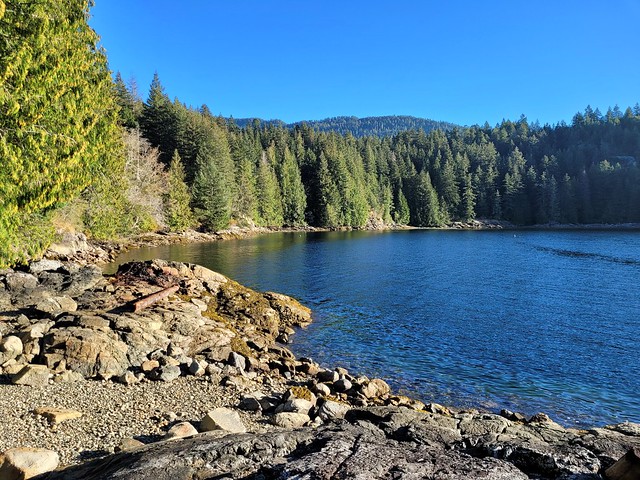
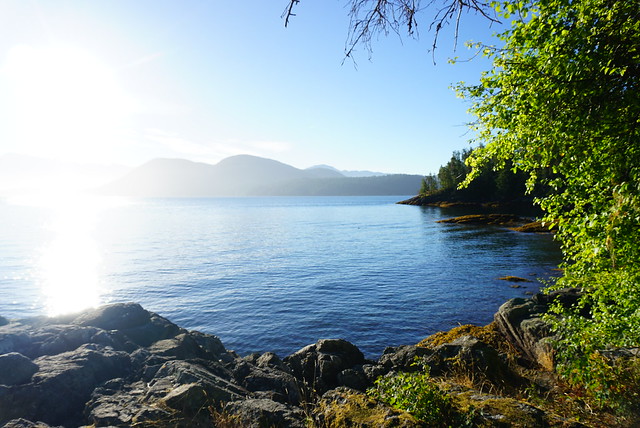
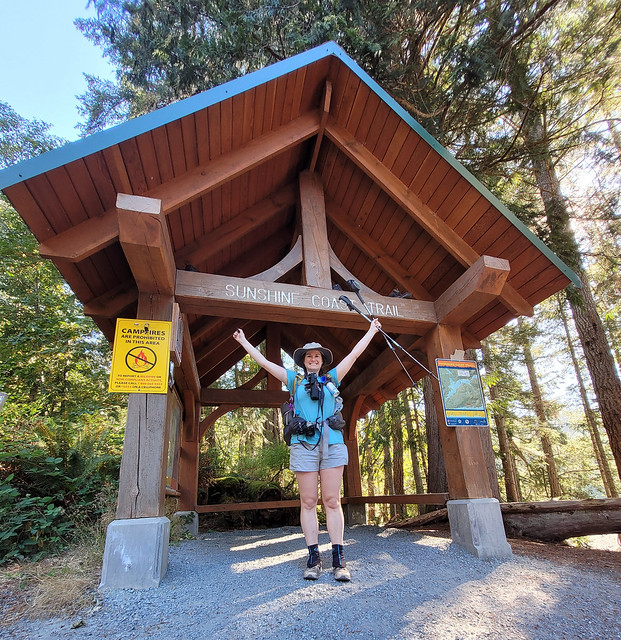
The last 6km from Fairview to Saltery Bay have a lot of ups and downs, but it was also nice to return to coastal hiking and I when I saw the Arbutus trees I felt like I had come full circle. I particularly loved Pirates cove, which also has beach access and a little campsite. Once I hit Rose Beach (the last landmark), I really slowed down my pace and enjoyed the last kilometre. There’s a big sign and storyboard about the trail at the end and I had a nice photoshoot with it before walking to the ferry terminal at Saltery Bay.
The ferry employee was very excited when I told him I had hiked the whole trail and he happily offered me to use the staff bathroom to freshen up. I had done the sniff test on everything in my bag the night before and put all my cleanest items aside for the ferry. I had a little sink shower and I have to say, I felt pretty clean all things considered. I brought 2 merino shirts on the trail, one from Smartwool and one from Mons Royale. The Smartwool was completely trashed, but the Mons Royale shirt held up really well and still didn’t smell very much, so I would definitely recommend. It was higher percentage merino than the Smartwool though, so that might be why it did so well. And for full disclosure, when I reached out to Smartwool about it, they refunded me for the shirt, so that is still some great customer service, even though the shirt didn’t hold up like I wanted it to.
Anyways, it felt a bit surreal to actually finish the hike. It’s bittersweet because after a full week on your own, you’re glad to be done, but you also know that you’re going to miss it later. I said in my last post that the trail was more emotional than physical for me. I had a lot of time with my thoughts and the solitude did make me question why I was out there hiking by myself. In some ways it feels like a bigger achievement because I did it on my own, but in other ways it feels like less of an achievement without someone to share it with. I think I would have had a much better time earlier in the summer when the trail wasn’t so empty, but I think the solitude did give me the opportunity to learn some things about myself and face some truths that I wouldn’t have with a companion. I’m not in any rush to do another solo hike, nor would I be deterred from it on the right trail. I needed to finish the trail this year, mostly for mental reasons so that I could move on from it. The trail was hanging over me from the moment I got off it in early August and I needed to go back and finish it for closure.
It is a very beautiful trail. PRPAWS has created something really special with all the huts and connecting the entire upper sunshine coast. I don’t think this trail would appeal to everyone – there is a lot of forest hiking for minimal big views – but there is something really special about this forest (some of which is old growth) and I was sad to see so much of it being logged. I’ve come to appreciate forest walks a lot more in recent years and I would say the SCT has now made me love them. I’m naturally drawn to the alpine, but there is something to be said for low elevation hikes as well. In my opinion, the SCT has a little bit of everything and is really the perfect blend of nature over 180km. I got to enjoy the salt air and arbutus trees along the coast, hike through the bright green forests, swim in warm summer lakes, and climb steep mountains overlooking it all. It was my first thru hike over 100km and my first time solo hiking. I feel strong and confident after hiking so many kilometres through all types of terrain and after spending so much time alone with myself.
















 The Road Goes Ever On