Hiking Brandywine Mountain – Camping no longer permitted

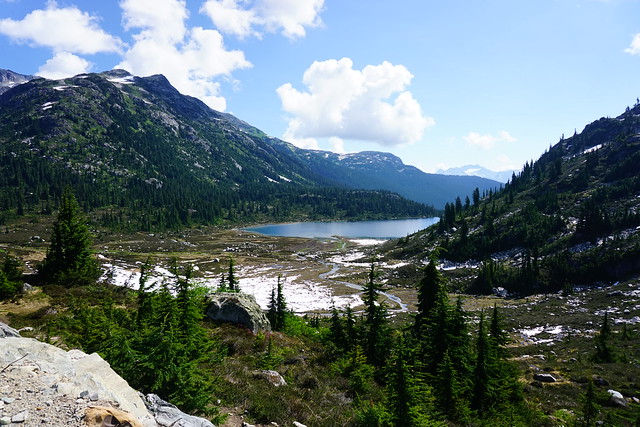
I first visited Brandywine Meadows with Seth and Brandon in 2015 when I was a very new hiker. We visited in October and the meadows were completely empty of people. It’s only a short hike to get to the back of the meadow, so on our visit, we continued hiking up through the boulder field at the back of the meadow to get a better view. I returned to this trail for the first time in 10 years in July 2025 to learn that since my last visit, the trail has become a lot more popular! 

There’s two access points to the trail. The lower lot is accessible for any vehicle, but involves an extra 400m of elevation gain in less than 2km, so it’s a very steep trail. If you’re lucky enough to have access to a 4×4, high clearance vehicle, you can cut out most of the elevation gain and park at the upper lot. This is what I’ve done both times I visited. From the upper lot, it’s only a 2km hike to the meadows, whereas it’s 4km (plus the elevation gain) from the lower lot. I think this easy access to the backcountry has really blown up the popularity of the trail. 

PSX_20250721_113533
PSX_20250721_113903

Brandywine Meadows is not on park land, but the trail to the meadows is managed by BC Recreation Sites and Trails. Until last summer, you could camp in the meadow, but from what I understand, people were not very respectful of the delicate alpine environment. There’s no outhouse or bear cache and overcrowding was damaging the meadows. So we were surprised, but not unhappy, to see a new “no camping” sign installed in the meadow when we arrived. 

While I do think this change is good for the area, it hasn’t been well communicated. It seems the sign was added this summer, but there’s been no online roll-out of the closure. We had hiked in with our backcountry gear with the intention of camping, but definitely did not want to camp in the meadows after seeing the sign. 

20250713_114442

After the trip, I reached out to BC Rec Sites and Trails for further clarification and they did get back to me. We assumed that camping was not permitted in order to protect the meadows, but actually it’s because this is in a designated Wildlife Habitat Area for grizzly bears. BC Rec Sites did not provide me with a map of the area, but indicated they would be posting one at the trailhead soon. To save you the trouble, I did some digging online and was able to find a shapefile of the area to upload to my GPS. The “no camping” area is shown in red, which represents the Wildlife Habitat Are. We were disappointed about the change, but it’s still a beautiful area for day hiking and that is how I will be using the area in the future. 

Brandywine boundary

Whether you want to hike the mountain or just visit the meadows, it is an incredibly beautiful area and I would be satisfied with either trip. I don’t think I would want to attempt a full mountain summit in a day from the lower parking lot, but it’s definitely achievable from the upper lot. If you’re hiking from the lower lot, hiking to the end of the meadows is still a very satisfying objective. Just make sure you stick to the trail so as not to further impact the sensitive wildflower habitat. 

The real highlight of the meadows is the wildflowers. We visited in early to mid July, so there weren’t many wildflowers in bloom yet, primarily just pink mountain heather. But if you visit in late July and early August, you’ll likely see the meadows completely covered in beautiful wildflowers! There’s 50m of elevation gain from the upper parking lot to the meadows, and then another 50m of gain to the back of the meadows, so it feels more or less like a flat hike through the meadows. I recommend hiking to the back of the meadows, enjoying the views along the way.

20250712_190720

If you want to hike to Brandywine Mountain, prepare for some serious elevation gain. I like to challenge myself and explore lots of different hikes, but I wouldn’t consider myself a peak bagger. We didn’t end up actually summiting Brandywine Mountain, but we had a great time exploring the alpine nonetheless. If you want to head to the summit, I recommend an early start so that you have lots of daylight, but also so that you can avoid climbing uphill at the hottest part of the day. The climb up the mountain starts at the end of the meadow and there’s absolutely no shade anywhere. So if the summit is your objective, you might be better off visiting in the Fall when the days are cooler (although you give up some of your daylight hours).

20250713_114006
20250712_175713

It’s a steep climb out of the meadow. The trail turns to the left at the back of the meadow and after this point, you’re relying on your own way-finding skills. There is a small trail going up through the lower part of the mountain, so stick to that as much as possible to avoid further damage to the terrain. Early in the season, it will be muddy from snow run-off. Eventually (for us anyways), the trail disappears and it’s up to you to navigate the alpine. The next objective is getting to the top of the ridgeline. It’s obvious where you want to end up, but not necessarily obvious the best way to get there.

Because we visited in early July, there was still a lot of snow. The lower part of the mountain was bare, but most of the upper half still had a consistent layer of snow. Microspikes were definitely a requirement, and I would have felt more comfortable with an ice axe as well. The snow was pretty stable and we weren’t postholing at all (even with a late afternoon ascent). If you want to avoid the snow, I’d advise hiking later in the season.

20250712_184417
20250712_181910

However, I think I preferred the snow. It’s a very steep scree slope to get up to the ridge and I think the snow significantly increased our pace. We didn’t have to navigate any loose rock and could just go straight up the snow without worrying so much about footholds. I had to cross some scree at one point and it was quite scary because the rock is really loose and unstable. My friend Victoria had hiked it the previous summer when there was no snow, and she said it was much worse on the scree. That said, I was still nervous hiking up the snow. It gets steeper the closer you get to the ridge and I was feeling pretty uncomfortable near the top. I had to just look at my feet and push for the top rather than focus on the height. If you’re new to hiking or afraid of heights, I wouldn’t recommend this hike. 

Once you reach the ridge, you’re rewarded with the most incredible views of the surrounding backcountry! We hit the ridge later in the day, so we decided that was the extent of the hiking we would be doing and didn’t attempt to summit the mountain, but it was still a very rewarding experience. The rest of the trail seemed to be snow-free after that because it gets a lot more direct sunlight than the trail to the ridge. If you keep hiking up the ridge, you should be able to get views of the glacier, and then from there, you can continue to the summit of Brandywine Mountain, but I can’t comment on how challenging that summit is. I doubt I’ll ever summit, but I would return to see the glacier. 

PSX_20250714_204229

Of course, if you hike a lot, you know that if you have a challenging uphill, it’s going to be even worse on the return trip. I was pretty nervous about hiking back down the steep snowy slope and it was a little scary. This is where I wish I’d had an ice axe, so I relied heavily on my poles instead. A lot of people had been up and down the trail over the course of the day, so there were some “snow steps” along sections of the descent. We tried to stick to these as much as possible. Some people had clearly slid down on their butts, and we really avoided those tracks because they make the snow really slick. There’s a time and place for glissading, but this area was way too steep and long for me to attempt it. I wouldn’t recommend sliding down because you will pick up too much speed and it will be hard to control. Instead, we hiked sideways step-by-step back down the slope and all made it safely to the bottom.

Screenshot_20250722_121304_Gallery
20250712_191528

Normally, there’s a small pond off the trail mid-way up the mountain that makes for a nice place for a quick swim, but it was still completely frozen when we visited, so we didn’t get to avail. Otherwise, we enjoyed a very nice day hiking the mountain, except that I made one terrible mistake. I’m very fair skinned, so I always apply sunscreen, but I usually skip my legs since they don’t normally get a lot of sun. This was a mistake hiking up over the snow for 2 hours. There’s no trees to provide shade and the sun is stronger at high elevations, so it reflected off the snow onto my legs and I got a really bad sunburn. I didn’t notice until nighttime, but it was pretty painful after that. 

So overall, Brandywine Meadows and Mountain make for great objectives for a day hike and I want to do my part in getting the word out that camping is no longer permitted in the meadows, which is why I did my best to rush this post out.

PSX_20250714_204405

14 Free Backcountry Campsites in BC

Welcome back to the second part of my 2-part series to help you get camping with minimal advance planning, in any season! Part 1 focused on permitted campsites (that don’t require reservations) and Part 2 focuses on unpermitted (free) campsites! 

Camping is incredibly popular in BC, especially near Vancouver. The popular campsites require reservations that release 4 months out and being coordinated to plan so far in advance can be a real challenge for people. It might seem like all the good campsites are booked, but there are lots of great options that don’t require advance bookings!

HOP_4999

Why do some campsites require a permit and others are free?

The simple answer is that a lot of free campsites are located on crown land or in BC recreation sites (also considered crown land). The land doesn’t have park status, so it generally receives limited maintenance or it is maintained by users and volunteers. As a result, free campsites are often more rustic than traditional permitted campsites. There are lots of campsites located on crown land that are privately managed, either by for-profit or non-profit groups, and those campsites will usually have a campsite fee to go towards ongoing maintenance, though some non-profits will fundraise for the upkeep of facilities, like on the Sunshine Coast Trail.

That said, there are still some free campsites located in provincial parks, especially the further you get from the lower mainland. I don’t know the exact reason why some campsites have permits and others don’t, but I think it’s likely related to the popularity of a park and how much maintenance the park gets. For example, I visited South Chilcotin Provincial Park last year for 6 nights and didn’t pay any camping fees, but the park is very remote, has limited infrastructure, and several of the places we camped were considered wild camping (no outhouse or bear cache). When sites become more popular, permits will often be introduced.

If you are visiting a free campsite that does not have bear cache facilities or an outhouse, it is absolutely essential to practice bear safety and leave no trace practices. You must hang your food or bring a bear bin. In addition, you must be prepared to dig catholes or use a wag-bag, and pack out your toilet paper, pads, and tampons. It is not acceptable to poop in the woods without burying it, or to leave your toilet paper around the backcountry. We are so lucky to have access to incredible backcountry in Canada and we need to respect it.

Campsites Near Vancouver

Hanging Lake

DSC09695

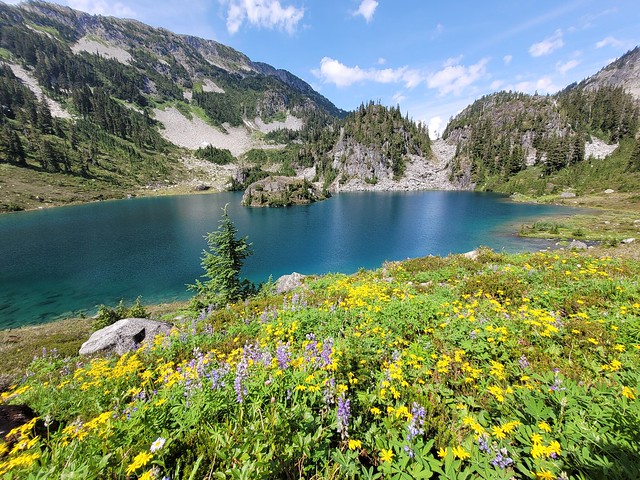
Hanging Lake is located in Whistler, sharing a trailhead with the Rainbow Lake trail on Alta Lake Road. Rainbow Lake is Whistler’s water supply, and as such, it’s a protected watershed area, so you’re not allowed to camp there. But if you hike a few more kilometres over Rainbow Pass to Hanging Lake, you can enjoy a nice view from the pass and a relaxing night at the lake. It’s a 10km trail to the lake, but the real challenge comes from climbing 800m of elevation along the way. There’s a fair bit of space for tents at Hanging Lake and there is an outhouse and a bear cache. You can also access this trail from the Rainbow Madeley trailhead near Madeley Lake.

Tikwalus

20220528_140213

In my opinion, Tikwalus Heritage Trail is an underrated trail along the Fraser Canyon. To access it, you take Highway 1 past Hope until you pass Alexandria Bridge Provincial Park. The Tikwalus Heritage Trail has been used by indigenous peoples for generations, and in more recent history, it was used by fur traders. It’s only 6km along a semi-loop trail to the campsite, but you’ll climb almost 800m in elevation, so it’s steeper than Hanging Lake. Most of the trail is in the trees, but there are some beautiful mountain views from the campsite. There’s lots of space for tents, as well as an outhouse and a bear cache. There’s no water source directly at the campsite, so fill up at the creeks on the way up to save yourself having to backtrack.

Brunswick Lake / Deeks Lake

DSC07712

Deeks Lake and Brunswick Lake are both located on the Howe Sound Crest Trail, but are accessible from the northern trailhead at Porteau Cove if you’re not doing the 30km thru hike from Cypress Mountain. Both lakes are beautiful and offer an easier alternative to the strenuous Howe Sound Crest Trail. It’s 6.5km to Deeks Lake (which is the smaller site) and 10km to Brunswick Lake, however there’s almost 1200m of elevation gain along the way. Most of the elevation gain is in the first 6.5km to Deeks Lake, making this part of the trail the steepest on my list. Of the two lakes, Brunswick is the most scenic and has more room for camping. It’s also important to note there are no facilities at either site, so be prepared to hang your food and dig catholes.

Flatiron

DSC06682

Keeping in theme with the previous trails, the trail to Flatiron is just as steep, climbing over 800m in ~5.5km, with most of the elevation gain in the first 3.5km. It’s located in the Coquihalla Summit Recreation Area off Highway 5 and shares a trailhead with Needle Peak. The first section of the trail is a huge slog through the forest, but the views are incredibly rewarding. Once you pass the junction for Needle Peak, there’s a small lake where you can camp. You can also camp at the summit of Flatiron, but there’s no water source up there. There are no facilities at either site, so be prepared to hang your food and dig catholes.

Brew Lake

PSFix_20201005_141152

Brew Lake is less steep than some of the other trails on this list, but still a big hike, covering 900m of elevation gain over 8.5km. However, if you have access to a 4×4 vehicle, you can reduce some of that distance along forestry roads. We parked along Brew Creek FSR, at the entrance to Branch 50, and hiked the entire trail from there, including 3.5km along other FSRs. This isn’t a very popular site, so it’s a nice place to go to escape the crowds. There are no facilities, so be prepared to hang your food and dig catholes.

Fairview Bay / Manzanita Bluffs

20220804_200318

We have finally arrived at some options that are not super steep! Both of these sites are located on the Sunshine Coast Trail, which has lots of possibilities for backpacking trips. The whole trail is 180km long, but there are lots of sections that can be done over a day or two. The campsite at Manzanita Bluffs, located on the north end of the trail, is especially beautiful. I also really like the campsites at Fairview Bay and Rainy Day Lake, located on the south end of the trail. All campsites along the trail have outhouses and most of them have bear caches or huts. They do not all have water sources, so plan accordingly. While these sites are free, I do recommend a donation to qPAWS if you opt to stay in one of the huts.

Campsites Accessible by 4×4 Vehicle

Tricouni Meadows

20220820_132359

Tricouni Meadows is a popular campsite located northwest of Squamish. The trailhead is located on Branch 200, off of Squamish River FSR. If you can make it all the way to the trailhead, the hike to the campsite is just over 3km, with 250m of elevation. However, there was a large wash-out on Branch 200 when I did this hike in 2022. If you park at the wash-out, it adds 3km to the trail. In 2022, some vehicles could get through, but I’ve heard it’s gotten worse, so play it safe. There are 3 lakes near the meadows, with the campsite located at the middle lake: Spearhead Lake. It’s not a large campsite, so I recommend getting there early. There are no facilities, so be prepared to hang your food and dig catholes.

Blanca Lake

20240721_074347

Blanca Lake is another campsite located northwest of Squamish. In general, I would say this road is in better shape than the road to Tricouni, but it’s further away. The trailhead is located off E300 on the Elaho Mainline. The trail is 4.5km, with almost 500m of elevation gain. It starts off pretty steep, but then levels out along the middle. The view from Blanca Lake is incredible and there is tons of space for camping. Give yourself extra time to explore around the alpine once you get to the lake. There are no facilities, so be prepared to hang your food and dig catholes.

Conglomerate Flats / Manson Ridge

PSX_20230807_175855

Both of these campsites are located on the HBC Heritage Trail that runs 70km between Hope and Tulameen. Manson’s Campsite is located on the Hope end of the trail (off Peers Creek Road), so you don’t need 4×4 to access this site, but if you want to access Conglomerate Flats for a night, then you need 4×4 to get the trailhead at Jacobson Lake Rec Site (off Tulameen FSR). Both sites are beautiful, though Conglomerate Flats is the more stunning of the two. It’s 6.5km and 600m of elevation gain to Manson’s Camp from the southern trailhead, and 2.5km and 150m of elevation gain to Conglomerate Flats from Jacobson Lake. Both campsites have outhouses and bear caches.

Winter Campsites

Falls Lake / Zoa Subpeak

PSX_20210314_215122

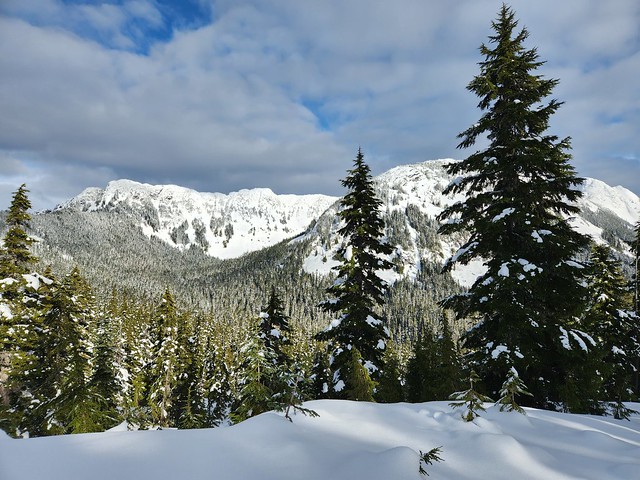
Both of these sites are located in the Coquihalla Summit Rec Area off highway 5. Falls Lake is a great site for beginners because you only have to snowshoe 1km along the road (which isn’t plowed in the winter) and 1km to the lake. Zoa subpeak is a bit more challenging as it’s 550m of elevation gain over 4km. Both trails are located in simple terrain, but make sure to stop at Zoa Subpeak – if you try and snowshoe all the way to the true peak, you will be entering challenging avalanche terrain. I’ve never actually been to Falls Lake, but I believe there is an outhouse. There are no facilities at Zoa Subpeak.

Ottomite Peak

20230204_135419

Ottomite Peak is also located in the Coquihalla Summit Rec Area off highway 5. The trailhead is at the Zopkios Rest Area. It’s a 4.5km trail with 300m of elevation gain to get to the summit. It was completely empty when I camped there, but the general area is popular among ski tourers, so you may see people along the trails for the day. The trail is in simple terrain, but always exercise caution – in general, I always recommend taking an AST1 course. It’s not a challenging trail, but there are no facilities.

Water Access Campsites

Widgeon Creek

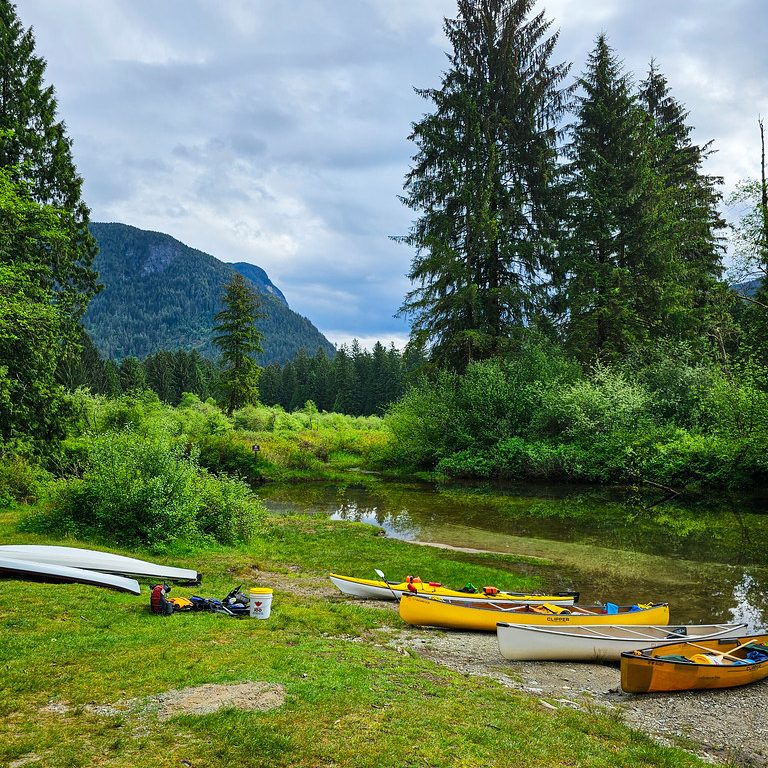
A photo of a line of canoes on the shore of Widgeon Creek at the Widgeon Campsite in Pinecone Burke Provincial Park, with the mountains and trees in the background on a cloudy day in BC.

Widgeon Creek is located near the lower mainland and is extremely popular on summer weekends. It’s a ~5 paddle across the Pitt River and up Widgeon Creek to get to the campsite. You can rent canoes or kayaks at Pitt Lake. There are lots of campsites and great facilities, including a large bear cache and 2 outhouses. But I recommend getting their early on a nice weekend to beat the crowds. From the campsite, you can do a day hike to Widgeon Falls.

Twin Islands / Granite Falls

20240810_114057

Twin Islands and Granite Falls are two campsites located in Indian Arm, so they are very accessible from the lower mainland. As a result, they are very popular on summer weekends, attracting paddle boats and motorized boats. You can rent kayaks from Deep Cove. It’s only 5km to paddle to Twin Islands, so this is the easier campsite to access. You’re only allowed to camp on the north island, but it has an outhouse (no bear cache since it’s an island). Granite Falls is at the far end of Indian Arm and is an 18km paddle from Deep Cove, so you should be an experienced paddler if you want to do this trip. It has 2 outhouses and a bear cache, but it’s severely undersized. Be prepared for northern afternoon winds.

Nine Mile Point / Kunechin Point

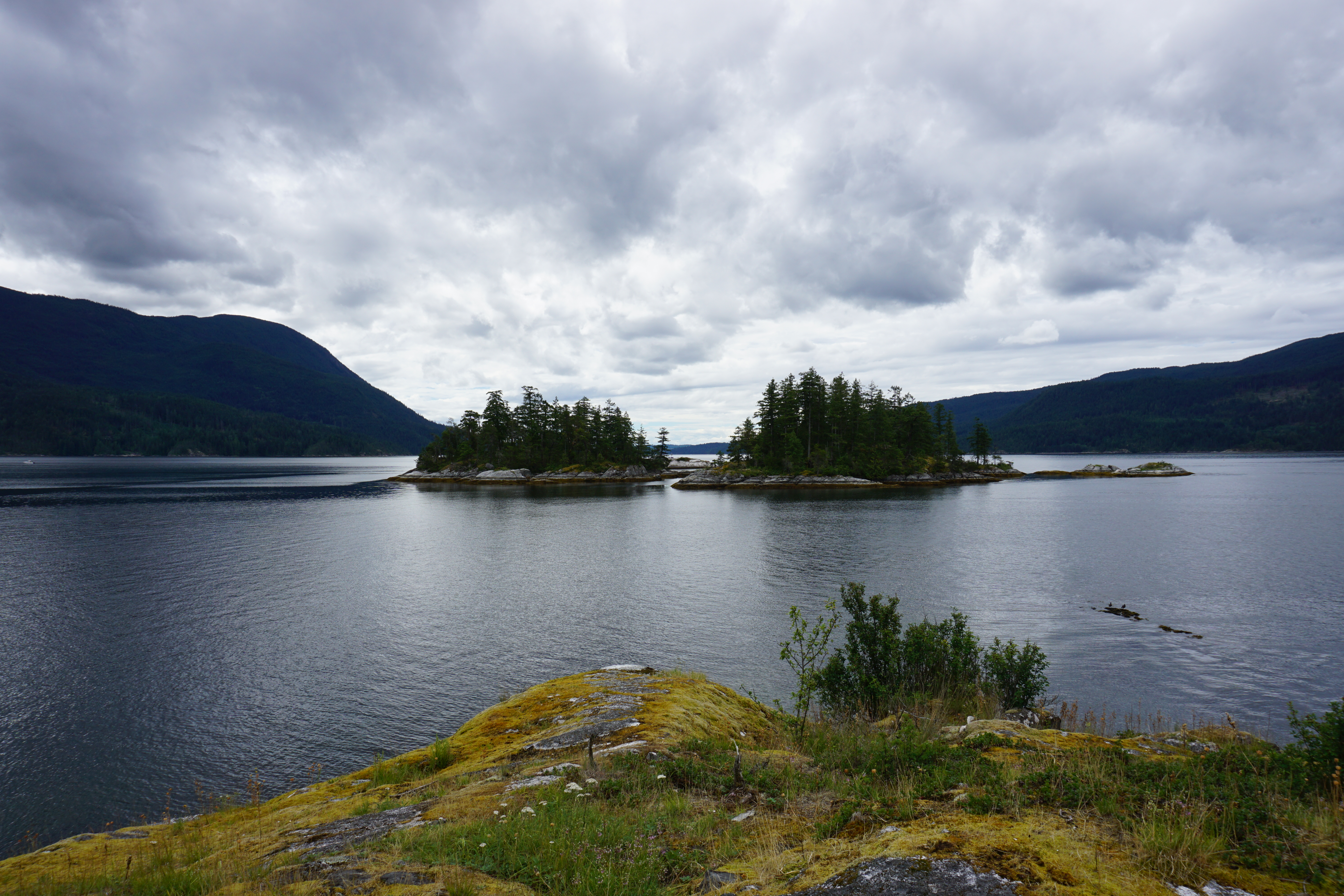
A photo from Kunechin Point in Sechelt Inlet on a kayaking trip, with the water and mountains in the background on the Sunshine Coast in BC.

Nine Mile Point Beach and Kunechin Point Campsite are both located in Sechelt Inlet on the Sunshine Coast. There’s a kayak rental place at the end of Sechelt Inlet Road, where you can launch from. It’s ~6km to paddle to Nine Mile Beach and ~10km to paddle to Kunechin Point, but the latter involves crossing the arm of the inlet, which can get windy. Both are beautiful sites and have outhouses, but no bear caches.

Bowron Circuit Kayak Trip: The West Side

If you’re just joining, this is my final post on my experience on the Bowron Circuit in May 2025. Start with Part 1, Part 2, and Part 3, to read about the full trip. This post focuses on the West Circuit if you’re just planning a partial trip.

Leaving Unna Lake definitely felt a little like the beginning of the end of the trip. We still had a decent amount of distance to cover, but the end was in sight. We didn’t regret our decision to wait to do the hike to Cariboo Falls because the water was completely flat in the morning and we had a very leisurely paddle across the lake. It’s a nice trail to the waterfall. It’s not too long and it’s definitely worth it to do the hike, especially in the Spring!

There was A LOT of water cascading over the falls in May. The river had a very high flow and to some degree, most of what we could see of the waterfall was mist! Definitely exercise caution in this area because there are a few footpaths branching off that people have created that are not formal trails. It is possible to hike down towards the river, but we only went part way because the rock was really wet and slippery and a slip on the rocks could easily knock you into the raging river. We took a few photos before returning to our boats. What was particularly surprising was how dry the forest was. There were a lot of dead trees (probably from pine beetles) and they were looking really dry, so I won’t be surprised when this part of the province gets a fire ban.

PSX_20250611_224452
PSX_20250611_224224

Leaving Unna Lake, you have to paddle back upstream for a short distance to get to the portage to Babstock Lake. There’s a fancy ranger cabin and a short paddle along Babstock Creek. It seems that you used to be allowed to line your boat in the creek all the way to the lake, but this is no longer allowed in order to protect the environment, so you have to portage. We had 3 portages ahead of us, but fortunately, they were all pretty short.

The first portage is the longest one of the day to connect to Babstock Lake. It’s 1.3km long, but it’s along fairly flat terrain. It’s just annoying to have to unpack and repack the kayaks multiple times in a day. Fortunately, we had a really exciting encounter at the end of the portage. We finally saw our first moose! Growing up in Newfoundland, we’re definitely not strangers to moose, but it is still fun to see them, especially in wilderness settings (half the moose I’ve seen back home have just accidentally wandered into the city). It was a female moose and she was having a nice snack along the edge of the lake, so we were able to watch her while packing our kayaks and once launching into the lake. 

PSX_20250611_223243
PSX_20250611_223322

We got some photos, but tried to keep our distance so as not to bother her. Sadly, the wind came up shortly after launching, but it was a nice tailwind, so we had an extra push to help us across the lake! It was only a 3km paddle and then we were back to another portage. This portage was much shorter, measuring only 300m. I was tempted to pull the kayak heavy loaded, but Seth convinced me to unload it to protect my boat from unnecessary flex… I’m not sure it was worth it. 

Unloading the boats took much longer than the actual portage and in no time we had arrived at the inflow for the next lake, Skoi Lake. Skoi is by far the smallest lake on the circuit. You have to launch into the creek, which is pretty narrow, in some parts I could barely paddle because flow between the reeds was actually narrower than the length of my paddle! It’s 800m across the lake and then you arrive at your final portage. We were greeted by a family out for a day trip as we packed up our boats to do the final 200m portage. 

PSX_20250611_223421
PSX_20250611_224005

The portage ends at the south end of Spectacle Lakes. There’s a campsite there (Camp #44), which is actually quite nice. The family took off to return to their campsite and we decided to hang around, eat lunch, and go for another swim. The water felt a little colder, but the weather was properly warming up over the last 2-3 days, so it was still enjoyable. I will admit to putting this swimsuit on just for the photo 😉

On a map, Spectacle Lakes looks like one big lake, but I can understand why it’s called Spectacle Lakes. There are several sand bars at the narrower parts of the channel and at least twice I had to get out of my boat and pull it over the sandbar in order to keep paddling. So I’m assuming it gets shallower in the middle of summer. The sandbars do help in keeping the wind down though. It picked up once we got about a quarter of the way up the lake, but again, we had a tailwind, so we sailed up to the campsite at the end of the lake quite quickly. 

This is another large campsite called Pat Point (Camp #48). Our plan had been to spend the night at Pat Point and paddle the remaining 19km in the morning. The only people camping at Pat Point were the family and it was a really nice campsite with another big shelter and sandy beaches. It looks down Spectacle Lakes on the south side and up Swan Lake on the north side. We stopped for a snack break while debating our options.

PSX_20250611_223653
PSX_20250617_111017

The wind was definitely picking up, but it wasn’t unmanageable. We had already paddled quite a distance, but there was a fair amount of time left in the day. Part of me wanted to stay and enjoy the beautiful campsite, but another part of me wanted to shorten the journey the following day so that we could get a solid start on the drive home. We were booked into the frontcountry campsite the following night, but that meant having to do the entire 10-hour drive on Sunday, and I really wanted to get home a bit earlier.

So we decided to keep going and get closer to the end of the circuit. Swan Lake is 8km long, then there’s 4km on the Bowron River and 7km on Bowron Lake. The final campsite is at the end of Swan Lake, so I figured it was worth reducing our distance for the following day. I’m still not sure if we made the right decision or not. In some ways, it felt like the wrong decision because the campsites at the end of Swan Lake were extremely crowded. But it also felt like the right decision because it was so windy the following day that I was glad to have saved the time! But I’m getting ahead of myself.

PSX_20250617_111042

We opted to keep paddling, racking up a total of 26km for the day! We had a substantial tailwind, so we made good time coming down the lake. It was also really nice because we saw a lot of wildlife! All birds, but with Seth being an ornithologist, we get pretty excited about birds. There’s lots of marshland around the west edge of the lake, which is great habitat for them. 

There are 4 campsites at the end of the lake. We knew the Canoe Bros would be at one, but we thought they were the only ones. We did not take into account how busy the west side of the circuit could get on a Friday night. We wanted to stay at campsite #51, but when we arrived, it was full with a group of paddlers who had started a day ahead of us. Then we continued on to campsite #52 and that looked full too. We probably should have checked, but we’d been warned by the paddlers at Camp #51 that the people at #52 were not friendly and did not want to share, so we decided to continue on.

Campsite #53 and #54 are right at the end of the lake, before you start paddling the Bowron River. The Canoe Bros were at Camp #53, so that site was also full. It is connected to Camp #54, which fortunately had 1 tent pad left! Unfortunately, the people at Camp #54 weren’t very friendly either. They had taken over the shared shelter and left it a total mess, so we opted to eat our dinner on the other side of the campsite.

20250523_153506
20250523_160402

I can’t complain about it too much though because it was a really beautiful site. It looks over the Bowron River, which is supposed to be the best place for wildlife on the entire circuit, so we were able to do some spotting while we ate. There’s also this heritage cabin there. It’s 100 years old, so you’re not allowed to go inside, but it’s still a very cool relic of the park. It was constructed the same year that the park was established, so it felt special to get to paddle the circuit on its 100th birthday. 

The campsites all have only 1 shared campfire, so we opted to join the Canoe Bros at their campfire in the evening. I felt that we got a really good mix throughout the circuit of what the Bowron Circuit is meant to be. It’s a very remote and wild location, so it was nice to have so much time to ourselves to enjoy that. But it’s also very much a social activity. It’s fun to get to know the other paddlers on the circuit and I did enjoy the nights that we got to hang out with 5 Guys and the Canoe Bros. They definitely had some characters in their groups, but everyone really loved being out on the water and in the wilderness. I’m glad I got to experience a little bit of both. Although preferably with more women next time!

PSX_20250613_081758
PSX_20250613_082037

Our last day on the circuit did not disappoint. Our timing wasn’t that great because the weather improved a lot at the end of the trip and it was looking really nice for the next group of paddlers. But you win some, you lose some! We got up early in hopes of seeing some interesting wildlife along the river. At breakfast, we could see some kind of large animal along the shoreline that we thought might be a deer, but closer inspection with Seth’s binoculars revealed that it was actually a sandhill crane! They are really huge birds, so that was an exciting discovery.

The crane had moved on once we started paddling the river, but we did catch up with it later on the circuit. We saw lots of birds along the route and were excited to see a beaver swimming in the river as well. The river is really meandering. It’s not fast moving, but it could be easy to get lost among the channels. We did go down a few branches just for fun to see what we could find. What we really wanted to see was another moose and we were rewarded right at the end of the river! It was another female and she was also having a snack along the edge of the river. 

PSX_20250613_081907
PSX_20250613_081825

Considering it was only 9am when we exited the river, it was already pretty windy on Bowron Lake. Seth and I got along really well all week, but had a bit of a breakdown in communication at the edge of the lake. The way the wind was blowing, it would be a tailwind for the first half of the paddle, but then there’s a turn in the lake, and after that we would be getting hit broadside. I wanted to paddle down the east side of the lake so that the headland would protect us from some of the wind when we turned the corner. Seth didn’t look at the map and made his decision based on vibes, so he thought it would be better to go down the west side of the lake.

Ladies, you know when you take on the emotional labour of trip planning and decision making, sometimes you get decision fatigue and you want someone, anyone, to take on a little bit of that? I think that’s what I was feeling when I agreed to paddle down the west side of the lake, even though my gut was screaming at me to go down the east side. It’s a bit more of a paddle to get to the east side, which is why I think I gave in, but it was a mistake.

PSX_20250617_112300

It was fairly windy paddling down the first half, but manageable with the wind coming from behind us. Before the lake turned we did pull into the side of the lake to take a little break, which was definitely a good idea because we got fully assaulted by the wind after that. As we started to make the turn, we still had a tailwind, but it coming at us from a side angle that made the waves a bit scary. As we started getting hit broadside, I’m pretty sure I had a rage blackout and some inner monster took over my body and just brute-force paddled its way down the rest of the lake. I was super mad, but it was the kind of stew-in-it anger and we just paddled against the crashing waves in silence.

Honestly, the right thing to do would probably have been to pull over to the lakeshore and wait it out like we had done on Isaac Lake, but we were so close to the end and I was so cranky, I didn’t want to stop paddling. So I kept rage paddling with Seth hot on my tail. The anger took me almost to the end of the lake, then I got a little bit pummeled by waves and there was a moment of real fear that this might be the time I capsize. I think that’s when the rage finally left my body and I pushed through the last section of lake, taking the first opportunity to exit the water, which is the public boat launch. We pulled the boats up on the shore and jumped out of the kayaks for a big hug while both crying “I’m sorry!!”. And that was how our epic 7 day trip ended.

PSX_20250613_081946
PSX_20250613_082203

Technically, we weren’t at the end yet. The public boat launch is 2kms from the park centre, but neither of us had the desire to brave the waves for another 2km. We were just relieved to be back on shore. Instead, Seth unpacked the kayaks and I walked the last bit of the circuit along the road to sign out at the park centre and pick up the car. In total, we tracked 14km for the day, finishing before noon. Intuitively, I know we should have waited out the wind, but it was still racing up the lake when I returned with the car, so it was hard to regret the decision to keep going. There were a few paddlers trying to launch their canoes to start their paddle on the West Circuit, so I mostly felt relief to be done.

It felt like an anti-climactic end to the trip, but it was a really incredible experience. I feel like we went up against a lot of challenges due to the time of year that we paddled, but I also felt like we gained a lot. The reason I keep going on long multi-day backpacking trips is because I love the feeling of accomplishment – of really challenging myself – and the Bowron Circuit definitely delivered on that feeling. It was also really special because I did it with Seth. He doesn’t like backpacking that much, so a lot of my backpacking trips are with friends, which is also nice, but it’s special to have that kind of experience with my husband too. Within hours I’d already forgotten about all the challenges of the trip and would 100% do this circuit again in the future.