Howe Sound Crest Trail: Part II

Though we went to bed pretty early on Day 1, we didn’t get the best night’s sleep. It was definitely not cold, but Emily woke up with heartburn in the middle of the night and had to go for a little midnight stroll to ward it off. Then she proceeded to read her book in the middle of the tent with the light on, so I went and made some unsuccessful attempts at star photography. All while Carolyn slept on oblivious. She doesn’t usually sleep very well, so we were all surprised by this, but she’s also generally pretty cold at night, so maybe it had something to do with actually being warm for once. Either way, when me and Emily finally drifted off to sleep in the early morning, Carolyn was awake and ready to go at 5:45am. Yay.
DSC07616

It was a pretty dismal breakfast. While we weren’t running super low on water, we were definitely conserving, so we boiled the bare minimum for our oatmeal and then packed up camp for the day. On the plus side, it was another gorgeous day and it was already hot enough for shorts at 8am, so it was probably a good idea to get an earlier start. We departed the campsite at 8:30am with somewhere between 1-1.5L of water each and 3.5km to go to the first water source.

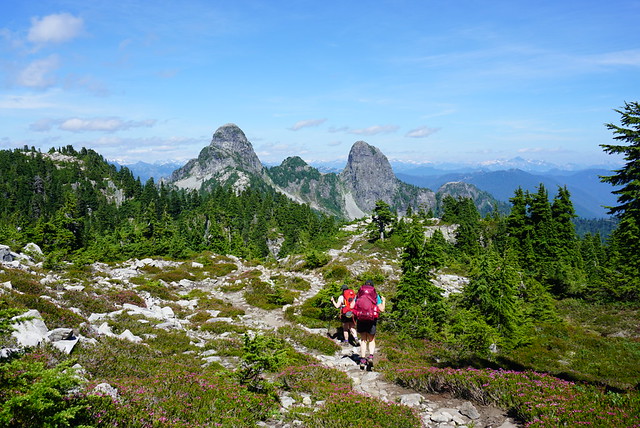
Unfortunately, it was some of the hardest 3.5km. Between the Lions and Magnesia Meadows, the trail follows peak after peak after peak. It was gorgeous and breath-taking, but a little stressful when you’re sweating buckets, thirsty, and running low on water. If it hadn’t been so hot, I think our water would have gone a lot further and we would have been a lot less tired, but there’s very little shade along the trail and it’s still very technical, so it makes for a slow go. I had sussed out the topography before we left camp and we could pretty much see our end goal when we started, but it didn’t make the morning go any faster. The hours dragged on as we lugged our packs up and down peak after peak. Carolyn was feeling strong, but me and Emily were definitely struggling, mostly I think because of our anxiety about the water situation, but the heat certainly didn’t help.

DSC07622

Finally, we started the last climb up the pass to Magnesia Meadows. We could see Mount Harvey looming over the meadow and we were just hoping the water source wasn’t located very far off the trail. We’d intended to summit Mount Harvey since we only had about 10km of hiking to do that day, but after 3.5km took us 3.5 hours of hiking, water was our main priority. We could see the red roof of the emergency hut as we crested the slope and from there we all but ran to the water source, relieved to see a small, but pretty clean water hole off the side of the trail.

We all finished off the dregs of our platypuses and then set to filtering enough water for the rest of the day. Since it was now noon and we were all in need of a break, we decided to have lunch in the meadow and made the pretty much unanimous decision to skip Mount Harvey. It was a little bit of a bummer to skip it, because we were so close to it, but it also looked really steep and we were all tired, so it’s important to know your limits. Plus you know, it’s always worth leaving something to come back for.

DSC07646

The hiking improved a lot after lunch. It wasn’t as scenic as the morning, but the trail was a lot easier and mostly hiked around the bowl of Magnesia Meadow. We were thrilled to discover there were still some wildflowers in bloom and had a pretty nice hike up to the branch for Brunswick Mountain. Again, we had planned to summit Brunswick Mountain, but we decided that, given the heat, we’d rather spend our time swimming in Brunswick Lake than hiking up another mountain. So Brunswick Mountain will also have to wait for another day.

I don’t regret the decision though. We ended up arriving at Brunswick Lake around 3pm and we were all zonked. We hadn’t decided in advance exactly where we were going to camp, but we’d originally been thinking Deeks Lake, which was a few kilometres further along the trail, but we’d heard from many people that Brunswick Lake was nicer. We could see the beautiful blue hues of the lake poking through the trees and as we exited the woods next to the lake, I truly could believe we were in a tropical paradise. The water was so clear and blue and looking super inviting. We knew it was freezing of course, but it still looked inviting.

DSC07712

So we decided to stay there. We dropped our bags in an empty clearing and made a beeline straight for the water. As expected, it was cold, but honestly we were expecting it to be worse, so we were pleasantly surprised. We didn’t want to stay in the water too long, but it wasn’t the run-in-and-out-as-fast-as-you-can kind of cold… if you know what I mean.

The rest of the afternoon was lovely and lazy. We lounged in the sun and did a whole lot of nothing. There was definitely a lot more traffic at Brunswick Lake, especially since it was a Saturday. There were probably 4 or 5 tents when we showed up and more backpackers kept showing up throughout the day, all the way until 9pm. The last people that I was aware of were 2 girls who had hiked all the way from Cypress that morning. They said they’d been hiking for 12 hours, which I admire, but definitely don’t envy.

DSC07692

Carolyn made us chili for dinner and we enjoyed watching the sun go down over the mountains. Even though there were tons of people at the lake, we were some of the only ones who hung out on the beach into the evening. It was pretty buggy and most people were taking refuge from the mosquitoes in their tents. As beautiful as Brunswick Lake is, the real downside to the Howe Sound Crest Trail is that there are no outhouses anywhere on the trail. I’m fine with peeing in the woods and digging catholes, but there were a lot of people camping at Brunswick Lake and there are few private places to use the washroom. With so many people, I do think it’s time for BC Parks to invest in an outhouse at each of the campsites, if only to protect the landscape. Check out my recent post on Backcountry Bathrooms if you looking for some tips for when there are no facilities.

It was another warm night in the tent and I think we all slept better on the second night and actually slept in until almost 8am the next morning. We took our time with breakfast, so it was a bit of a later start, but it was nice and chill. It’s about an hour hike to Deeks Lake, passing by Hanover Lake and some beautiful waterfalls. We were pretty much done with the views for the trek, but it was nice to hike in the shade of the forest for a change. Deeks Lake is bigger than Brunswick Lake and also very beautiful, but there’s not very many campsites and they’re all in the trees, so I definitely don’t regret staying at Brunswick Lake – in my opinion it’s the better of the two lakes.

DSC07744

We decided to finish off the trek with a swim in Deeks Lake. It was also very cold, but we thought it was slightly less cold than Brunswick and stayed in the water for a while. After that it was ~8-9km hike down to the parking lot. There’s not a lot to see along the trail and you undo a lot of elevation gain. In total we did about 1500 metres in elevation gain over the entire trail, but we also had almost 2400 metres in elevation loss, half of which was on the last day, so it was mostly a climb down on Day 3. It’s pretty steep for the first section after you leave Deeks Lake, but it eventually levels out a bit into a steady downhill. The last section of trail is outside of the park and mostly along old forestry roads. The very end of the trail now has a detour because of mining work happening on private land at the end of the trail. We were pretty fast coming down the trail, but I could see it being a bit of a slog if you were hiking the other direction. Though there were a lot of people at the Lake, I think the majority of them had hiked up from Porteau Cove. A handful of us had done the whole trail from Cypress, but I think we were the minority.

And that concludes our adventure on the Howe Sound Crest Trail! We didn’t summit any of the mountains we’d planned to summit, but we did still climb a lot of peaks and saw a lot of amazing views. I would do it differently in future (mostly with the water), but I wouldn’t be deterred from coming back. I think if I was to return, I’d maybe hike up from the Mount Harvey or Brunswick trailheads and camp either in the meadows or at the Lake. There’s lots of different ways to customize the trip and still lots left to explore on the trail!

 

Howe Sound Crest Trail: Part I

I finally hiked the Howe Sound Crest Trail!

Seriously, I’ve been trying to hike this trail since 2017. We couldn’t do it as planned in 2017 because there was too much snow on the trail, in 2018 it was too smoky, and in 2019 there was an issue with re-routing the trail. But the stars finally aligned and I hiked it in mid August with Carolyn and Emily. It was not at all what I expected – I knew it would be a tough trail, but the topography was so much more challenging than I anticipated. That said, we had amazing weather for it and still had a great time!

DSC07480

The Howe Sound Crest Trail is a 29km trail that runs from Cypress Mountain to Porteau Cove. It passes by several iconic peaks and is popular among trail runners. The window for hiking the trail is short, which is why we had so much trouble with it – there’s generally still snow up there in June, which is very dangerous because of snow bridges and snow wells. But what makes the hike so challenging is water access. Once you leave Cypress, there’s no water access for 14km, so you either have to bring a lot of water with you, or hike the most challenging part of the trail in a single day. 14km doesn’t really sound like that much, but there’s a lot of elevation gain and it involves crossing many challenging peaks. It can definitely be done, but I think it would make the trail less enjoyable as there’d be less time to appreciate the views. Plus the most challenging part of the 14km is the last 4km, so it’s easy to think you’re making a good pace and then get hung up at the end.

So long story short, we opted to bring extra water. I think this was definitely the right choice for us, but it was a 30 degree weekend and we drank more than we thought and ended up having to conserve at the end, so in future I would bring even more. But let’s start at the beginning. Because we were planning to do the trail over 3 days, we took Friday off work to get a head start on the trail. Generally there is no pass needed to hike the HSCT, but BC Parks has the new day pass system, so I got up at 6am to get passes for us. I managed to snag 3 passes, but they sold out by 6:01am, so you definitely have to be on the ball.

DSC07503

We arrived at Cypress around 9am and there were a ton of people hanging out in the parking lot. The first stop on the HSCT is St. Mark’s Summit, which is super popular among day hikers, so we think that’s who was taking up most of the day passes. After St. Mark’s the traffic on the trail was drastically reduced. Seth dropped us off and I believe we started hiking sometime around 9:30am. I figured this would give us lots of time, but it was still almost 6pm by the time we rolled into our campsite at the 11km mark, so definitely give yourself lots of time.

Thanks to the early start we were able to hike at a pretty leisurely pace. It didn’t take long at all to get to St. Mark’s, mostly I think because me and Carolyn hadn’t seen each other in a while and we were gabbing the whole way there. We stopped at St. Mark’s for a snack break and then got lost trying to get back on the trail. Overall the trail isn’t too hard to follow, but there were definitely several sections where we ended up off course, so I was glad me and Carolyn both had GPS as we used it more than once to find the trail.

DSC07499

The second stop on the trail is Unnecessary Mountain – I found this one a little confusing because there were two unnecessary mountains showing up on my GPS, the first of which was marked South. We were getting pretty hungry for lunch, so we stopped to eat when we hit the ridge, before reaching Unnecessary Mountains. Like I said, it was a hot day. We thought it would be cooler up in the mountains, but most of the trail is exposed, so it was definitely hot the whole weekend. I had a large iced tea before starting the trail to hydrate, but Emily forgot and was pretty dehydrated starting out, so she drank her water a lot faster.

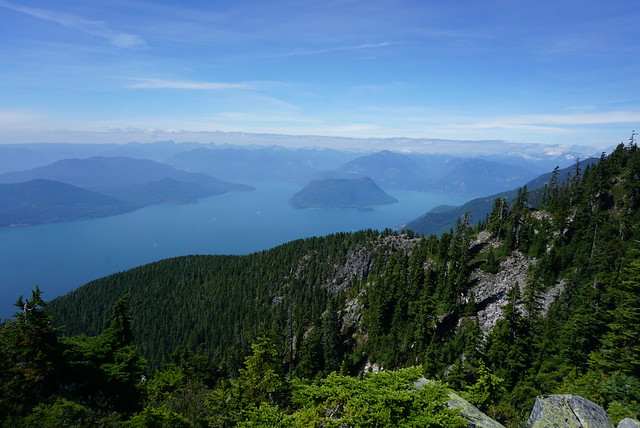
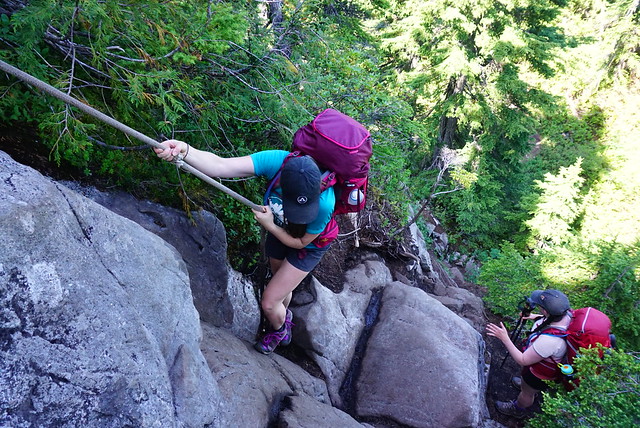
The view of Howe Sound and the Lions from Unnecessary Mountain is gorgeous, but after that the trail gets a lot harder. It’s a pretty technical trail, with lots of rope sections, climbing, and steep ascents and descents. It’s a through trail (rather than a loop), so you can hike from either direction, but almost everyone goes from Cypress to Porteau Cove because you’re basically hiking from Cypress Mountain down to the highway and people want to avoid all the elevation gain.

DSC07506

It may be challenging, but the section of trail leading up and past the Lions is one of the most beautiful parts of the trail. We hiked along the ridge up towards the West Lion. It was a bit of a climb, so we continued to drink lots of water with the sun bearing down on us. You can summit the West Lion along the trail – we hadn’t decided whether we were going to attempt it or not – but once we got a look at it, me and Emily were firmly in the ‘no’ category. Carolyn is much more intrepid than us and I know she would have hiked it in a heartbeat, but it was now after 4pm and the trail started with two steep rope sections, so we all agreed it wasn’t really a wise choice.

Instead we had a break under the West Lion and then started the descent down and around it. For those not familiar with the Lions, they are two iconic mountains located just outside Vancouver. The familiar looking humps can easily be seen from the city and have become a bit of a symbol of Vancouver. I’ve seen them tons of times, from the city, from other trails, and even from helicopter, but I’ve definitely never been so close to them – it felt a little unreal. Both Lions are incredibly steep, I’m not sure if you can physically hike the East Lion or not, but either way, you’re not allowed to because it’s located in the watershed. Metro Vancouver has one of the best protected watersheds and absolutely no recreation is permitted inside it. The HSCT skirts right along the watershed and the trail unbelievably enough, goes right between the two Lions.

DSC07541

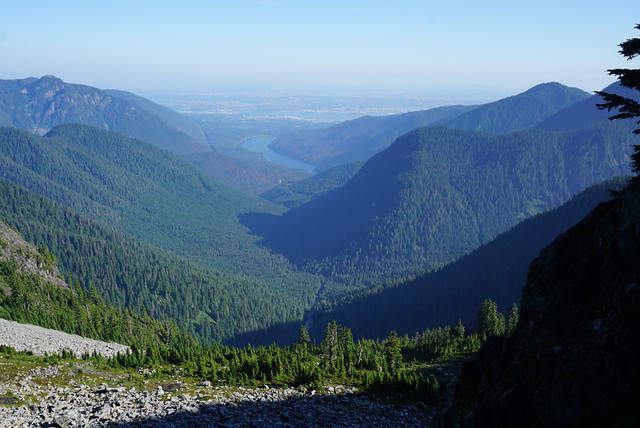
Between the two lions there is another smaller peak called Thomas’ Peak. The scariest section of the trail was definitely traversing down the side of the West Lion to Thomas Peak. You go down a steep section, which isn’t too bad, but then you have to navigate a small ledge around the edge of the Lion and up to Thomas Peak. It’s not terrifying, but you definitely proceed with caution. From there though there’s an amazing view down into the watershed and Capilano Lake. Some of the best city views of the Lions are from Cap Lake, so the same can be said when you’re looking back the other way too.

As we went over Thomas Peak, we were starting to get pretty done with hiking. There’s 3 official campsites on the trail, and one unofficial, which is the one we were aiming for. I couldn’t find its location on any maps and had just seen it listed as “the ridge above Enchantment Lake”. I knew it was located around 11km, so we were planning to just look for anywhere good to camp along the trail once we passed the Lions (which are located around 10km). From Thomas Peak, you can see the trail as it winds over peak after peak, but we couldn’t really see anywhere that looked great to pitch a tent.

DSC07545

As we started to come down, I noticed a ridge branching off the main trail that looked promising. Fortunately, it wasn’t too far away (less than a km, as we’ve established) and when we reached the branch, it quickly became evident this was the place. We were just confused because we assumed “the ridge” was on the trail, but it’s just off to the right of the trail as you come down Thomas Peak. There’s no easily accessible water source from the trail, but there are some flat spots to pitch a tent. If you’re desperate, you can hike down to Enchantment Lake, but it’s a bit of a trek. There’s also a small pond on the other side, but it’s located in the watershed, so this should not be part of your plan.

We had to do a bit of water assessment after we set up our tent. Emily had drained her 2 litre platypus around the West Lion, but me and Carolyn were still on our initial supply. We had each brought 4litres. It was enough, but only because we put a lot of effort into conserving towards the end. My logic had been 2L for the first day, 1L for overnight, and 1L for the 3km the next day. We had brought sandwiches for lunch to avoid needing water for cooking, but had forgotten to take into account water for our oatmeal (only 150ml a person, so not the end of the world), but we hadn’t taken enough for how hot it was. Also, the 3km the following day was SUPER challenging and ended up taking us 3 hours, so we really could have used more water for that as well. It’s not a great feeling having to conserve water, so if I did it again I would bring 5-6L. We might have had a different experience on a cool day, but always plan for the worst.

DSC07562

Our campsite was amazing though! We shared it with one other group of 2 women, who we’d been passing back and forth on the trail all day. We were located right under the Lions and it was dreamy to watch the sun set over the Sound and then watch the stars come out around the Lions. I thought there would be too much ambient light for stars, but the stargazing was actually great – though there was still too much ambient light for star photography (at least for a notice like me). So overall, it was a challenging, but fun first day on the trail and we were thrilled with the location of our campsite! You definitely need nice weather to hike this trail though, I can only image how slippery and dangerous it would be in the rain – plus camping would be very exposed in any adverse conditions. But luckily for us, all we had to worry about was heat management.

I’ll end the post there for now – check back in for my next post on the second half of the trail!

DSC07571

Cape Scott and North Coast Trail: Part IV

Check out Part 1, Part 2, and Part 3 to read about our full adventure on the trail.

We were both optimistic and apprehensive about Day 4. We’d had a great evening, but it was probably the worst night sleeping on the trail. The wind did eventually die down but it was super damp at Laura Creek. Everything in the tent that wasn’t in my sleeping bag with me felt somewhat damp and I had a hard time falling asleep because even my pillow felt wet and it kept sticking to my face. Eventually I did drift off, but I think Emily was up for most of the night. We got up to pee at one point and it was absolutely freezing out.

It warmed up around sunrise and it wasn’t too bad when we got up and walked back to the forest to retrieve our stuff from the bear cache. But it started raining lightly and we were feeling a little weary, so we decided to have a tent breakfast. We boiled water leaning out through the vestibule and had our oatmeal in the tent. I’m sure this isn’t the best practice and I wouldn’t do it for a fragrant dinner, but since we were just boiling water, we took the risk. Since we were carrying the tent on the outside of our packs anyways, we packed up from inside the tent and Emily tended to her feet. They were definitely getting worse – her pinky toes looked awful – she’d gotten blisters on both and they’d since popped, leaving an open wound between her toes and a lot of dead skin on the outside of her toe. She also had several other blisters and hot spots so we taped and moleskined as much as we could. She’s a real trooper, I never could have hiked so far with my feet looking like hers did.

HOP_4017

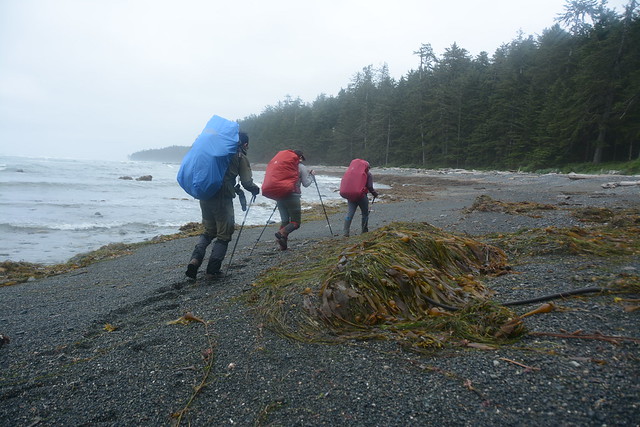
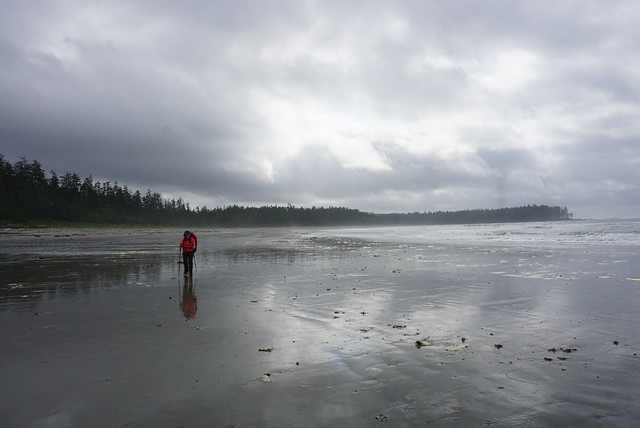
Fortunately the rain moved on when we were finally ready to go. Day 4 was going to be all about beach walking. You’d think that would be easier, but Emily in particular was dreading it because walking along the beach for extended periods of time really wears your feet down, especially if you have to do it for 12km. Walking along the fine sand is difficult because it’s such a hard surface and it’s rough on the soles of your feet, same with big boulders where you have to jump from rock to rock. Cobble has it’s own challenges too, the worst being the medium sized cobble that’s too small to walk from rock to rock, but too large to sink into it. The rocks create a lot of awkward angles on your feet and it gets really tiring. My preferred medium was black sand – it’s not as fine as the golden sand, so it’s a little easier on the feet. I think we encountered pretty much every type of beach surface on Day 4!

I did enjoy the start to the day. My feet were feeling refreshed and we saw lots of wolf tracks running along the beach. We hiked all morning up towards Christiansen Point. The whole time you’re able to look back towards the entire coastline to Cape Scott, which is rewarding when you’ve had the achievement of having hiked that entire distance. But Christiansen Point is the last view of Cape Scott and once you round the bend it’s a new landscape. I did find this to be a bit of a turning point with the waves as well. I guess the currents and winds are different on the other half of the trail and I found, with the exception maybe of Shuttleworth Bight, the waves were softer, particularly on Day 5.

DSC06245

We decided to stop at what we thought was Wolftrack Beach for lunch. Afterwards we realized it wasn’t actually Wolftrack Beach when we went one beach further and found the real Wolftrack Beach, so I guess we just stopped at some beach we didn’t know the name of. I do wish we’d stopped at the actual Wolftrack Beach, which was lovely and sheltered; where we did stop was a bit of a poor choice as we couldn’t find much respite from the wind and it was cold as we sheltered behind some logs at the back of the beach. We were treated to a little show though when a black bear wandered out on to the beach about halfway through our meal. Fortunately it was a positive bear experience. We could tell it was aware of us further down the beach and that it didn’t want to interact with us, so we just chilled and watched on the other side of the beach as we ate. Eventually it finished up on the beach and wandered back into the woods and we continued on our journey.

The weather improved as the day went on, but we started to hit a bit of a wall. As much as Emily thrived on Day 3, she suffered on Day 4. Our feet were all throbbing and our pace slowed down as we trudged across beach after beach. Between beaches we’d pop into the woods for 100 metres or so, but it was never for long and we always found ourselves at the start of a new beach. Emily slowed down as we continued and I found myself starting to become lethargic as well. Emily complained of being nauseous and I was starting to feel a bit lightheaded, which triggered the alarm bells in my head from many years of lifeguarding and first aid training that we were dehydrated. Though we’d been drinking lots of water, we had been hiking exposed on the beach for the entire day. The sun was mostly hiding behind the clouds, but the exposure had finally worn us down. I made us all stop and I mixed up a litre of electrolytes and forced me and Emily to drink a half litre each and we both ate some salty snacks.

DSC06259

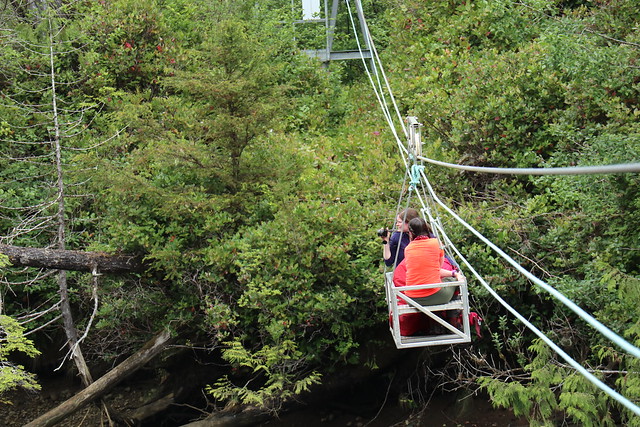
I did feel my energy start to bounce back pretty quickly after that. It took a bit longer for Emily, but fortunately we had finally reached a legitimate inland section. We didn’t know if it would be as challenging as the inland section from the day before, but it was only short, so we figured it would be a nice change. Fortunately it wasn’t as bad and we soon found ourselves at our first cable car. The North Coast Trail has 2 cable car crossings located at rivers that are too deep to ford. It’s a pretty simple design – the cable car is attached to a steel cable that it can roll back and forth across and it has a second simple rope pulley system running under that to pull yourself across the river. We had to climb up a big metal structure to get to the first one and then we pulled the cable car across from the other side.

Brandon was the only one with experience using a cable car before, so he instructed me and Emily to load up our backpacks and each take a seat in the car while he held it steady for us. It’s a tiny little metal frame box with two seats facing each other and just enough space for your bags in the middle (barely, say goodbye to any leg room). Brandon warned us to make sure our hands were inside the car when he left go and to always pull away from the pulley to avoid pinching any of our fingers. When he let go we rode off at a good clip to the center of the river and then had to pull ourselves to the other side. It wasn’t too challenging because Lien and Brandon were also pulling from their side, so there was 4 of us to share the load. We offloaded and sent the car back to the guys, holding it from our end while they loaded into the car. We did the same thing for them and helped pull them across once the car lost momentum. I just wish I’d taken the time to dig out my gloves because it is hard on the hands pulling the rope.

IMG_0498

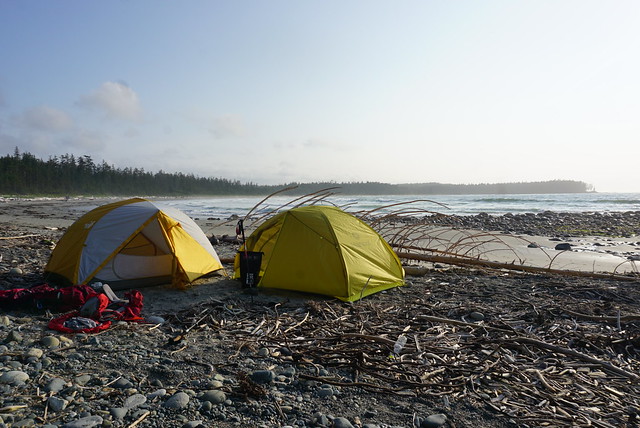
With everyone safety across the river we had about 500 metres left to the beach. It was a pretty muddy section and we all collapsed in the sand when we finally reached Shuttleworth Bight (okay maybe just me). Of course the campsite was located on the total opposite side of the beach, so we had 1 more kilometre to walk across the beach. We’d passed a few people throughout the day that had camped at Irony Creek the previous night and were now heading all the way back to the San Jo parking lot. One family informed us to be careful where we camped because they’d been hit by the high tide the previous night and had gotten wet! We could see lots of campsites along the edge of the beach when we arrived, but we could also see that the high tide line went almost right up to them. I checked the tide charts and high tide was going to be at 10:30pm and would be higher than the previous night, so it didn’t look like a good place to camp.

Brandon went in search of another site and found a small bit of beach right next to the forest tent pads that looked just big enough to fit our tents. There was another camper who had been there the previous night and she came over to chat with us. There’d been 6 groups the previous night and they’d all camped on the beach. While only the one family had gotten wet, the tide had come up super close to all of them and she’d moved her tent to a forest pad for the night. She informed us the spot we were looking at tenting was probably the only beach site left that wouldn’t get wet, so we decided to take our chances since we would be up late enough to keep an eye on the tide and wait for it to change. The 5 guys from Laura Creek showed up a little after us and started setting up on the beach, but after talking to the same camper, decided to move to the forest tent pads as well. So every tent pad ended up being filled and we had the one beach site. Fortunately no one else showed up looking for a site because the rest of the beach sites did indeed get inundated by the tide.

DSC06277

Shuttleworth Bight is a huge white sand beach – Irony Creek is located on the very end and as the only water source, it’s obvious why the campsite was located there. I really liked Irony Creek – it wasn’t as windy and we had arrived before 5pm for once, so we had time to enjoy it properly. Again, we set up the tents and Brandon got a campfire going while I worked on dinner. It was my night and I had made and dehydrated a coconut curry. It didn’t rehydrate as well as I would have liked, but the flavour was really good and it was super filling. We finished dinner by 7pm, which was super early for us, so we had a really low key evening chilling by the fire. One of the guys came to talk to us because he was having nausea and heart pain and he didn’t know what to do about it, so we offered him some peptobismal because we thought it sounded like heartburn and he didn’t know what pepto was! Me and Emily sang him the symptom song and gave him some pepto chews and he said they did make him feel better. I literally never go anywhere without pepto (one time I got it confiscated by a bouncer at a Vegas club because “no pills allowed” lol), but it helps for so many symptoms, so it’s a great one to bring with you.

DSC06268

The main source of entertainment for the evening was watching the tide. It kept sneaking its way closer and closer to us. We were both on the same patch of sand, but Brandon’s tent was the one more at risk, so we built up a little barrier wall out of logs to protect against any rogue waves. There was more than 1 wave that splashed against the barrier, but fortunately the tent never did get hit. By the time the tide finally turned the wet sand line was only a foot away from the vestibule to the tent, so it was definitely the closest I’ve ever camped to a changing tide! We felt really lucky to be able to camp on the beach, but the one downside was the sea ticks. At Guise Beach we’d noticed that along the tide line at night all these gross little sea ticks come out to feast on sea debris. They look like little shrimps but they jump around on the sand. The closer the tide got to us, the closer the sea ticks moved. They were all over Brandon’s tent and they were creeping around in front of mine and Emily’s tent too. Fortunately none got inside the tent, but every time we would open the door we’d give the tent a big shake to dislodge any and then we’d jump in or out as fast as we could to avoid any ticks making their way inside. Once the tide moved back out they went with it, but it was peak tick time when we finally climbed inside the tents for bed.

So overall, despite the challenges with so much beach walking, it was still a good day. We really enjoyed our time at Irony Creek and we were still looking forward to the next two days. Little did we know the trail was about to get even more challenging – but more about that in Part V!

DSC06284