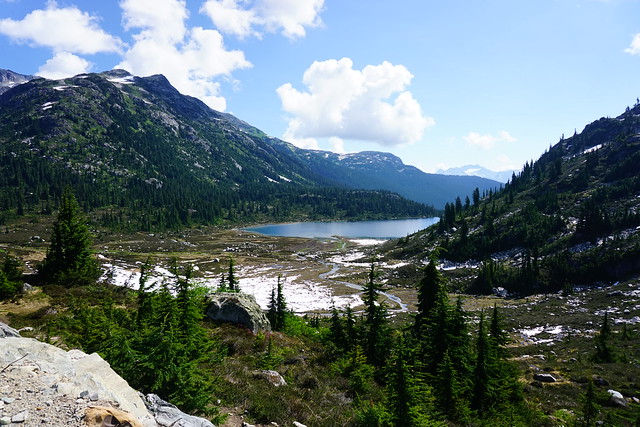
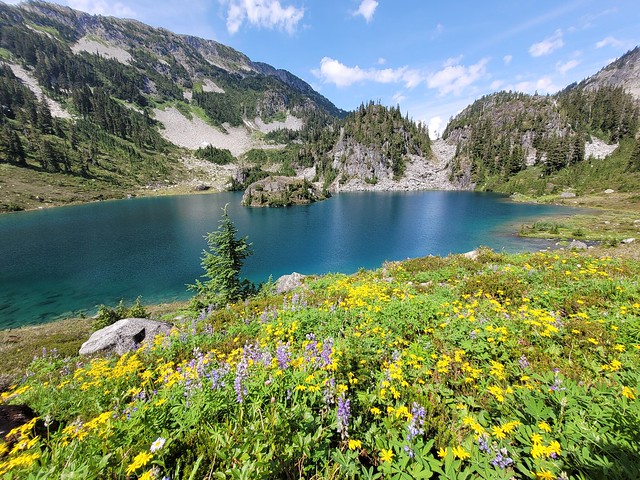
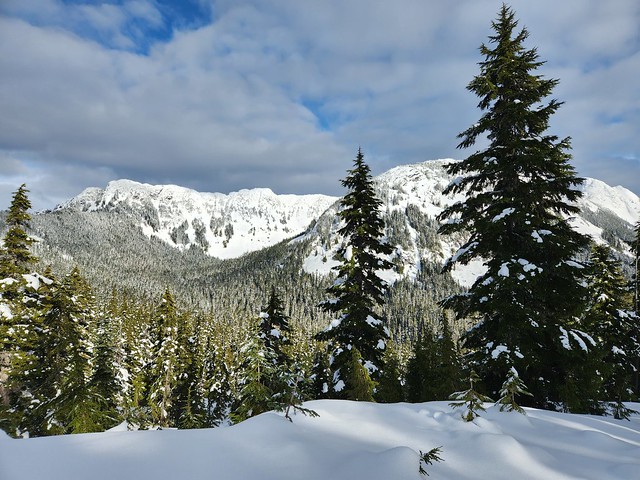
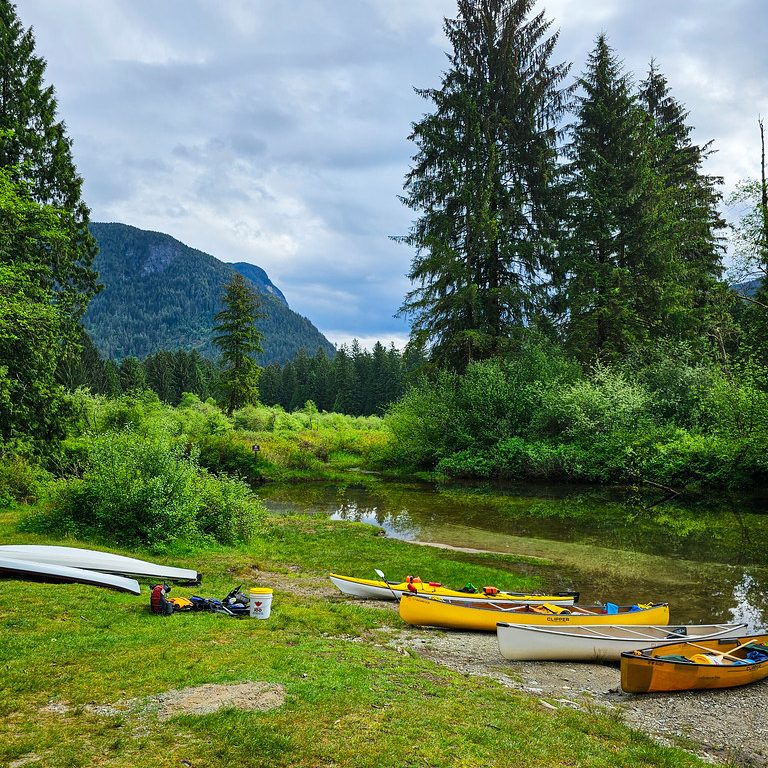
I visited Mount Revelstoke National Park for the first time in 2024 and had a great time exploring the park. Revelstoke is one of 6 National Park in close proximity in BC and Alberta. It’s one of the smaller National Parks in this area, but it offers some beautiful sights. I’ve also created guides for Yoho, Kootenay, and Banff National Parks, if you want to check out any of those.
Getting There
Mount Revelstoke National Park is located just outside of the town of Revelstoke (very popular for skiing and mountain biking) along Highway 1. If you’ve ever made the drive from Vancouver to the Rockies, you’ve likely driven right past it. If you’re like me, you never made the time to stop in the park along the way. While it’s a large park, it’s not hugely accessible. From the town of Revelstoke, you can take the winding Meadows in the Sky Parkway up to the top of the mountain, exploring trails and viewpoints along the way. It’s the only road in the park, so it’s pretty straight-forward.
Where to Stay
There are 3 main options for where to stay and they really depend on what type of experience you’re looking for. The easiest option is to get a hotel in the town of Revelstoke. There’s lots of cute shops and restaurants in town, so it’s a good option if you don’t want to camp or forget to plan in advance.
The other options are camping, either frontcountry or backcountry, both of which are discussed below. Camping reservations are released by Parks Canada on reservation.pc.gc.ca. These can be somewhat challenging because the entire season releases at once early in the year, often between January and March, depending on the park. It’s easier to get reservations on weekdays, but if you want to camp on a weekend, be prepared to book when the sites release.
Frontcountry Camping
There’s only one frontcountry campground in the National Park: Snowforest Campground. Frontcountry camping is essentially drive-in camping, so you can take everything that you can fit in your car and the sites are easily accessible. Snowforest Campground is located at the base of Revelstoke Mountain, so it’s very close to Revelstoke town. There’s 62 campsites available for booking, so it is a pretty small campground in comparison to Banff and Jasper National Parks. There are flush toilets and hot showers available.
Backcountry Camping
Backcountry camping is my favourite way to visit a park, but it’s very different than frontcountry. It requires hiking and carrying a backpack with everything you need for your trip. If you decide to backpack in Mount Revelstoke National Park, you will be in remote wilderness terrain and must be prepared to be self-sufficient. If that sounds like your cup of tea, there are 2 beautiful backcountry campsites to explore and both can be visited on the same trip.
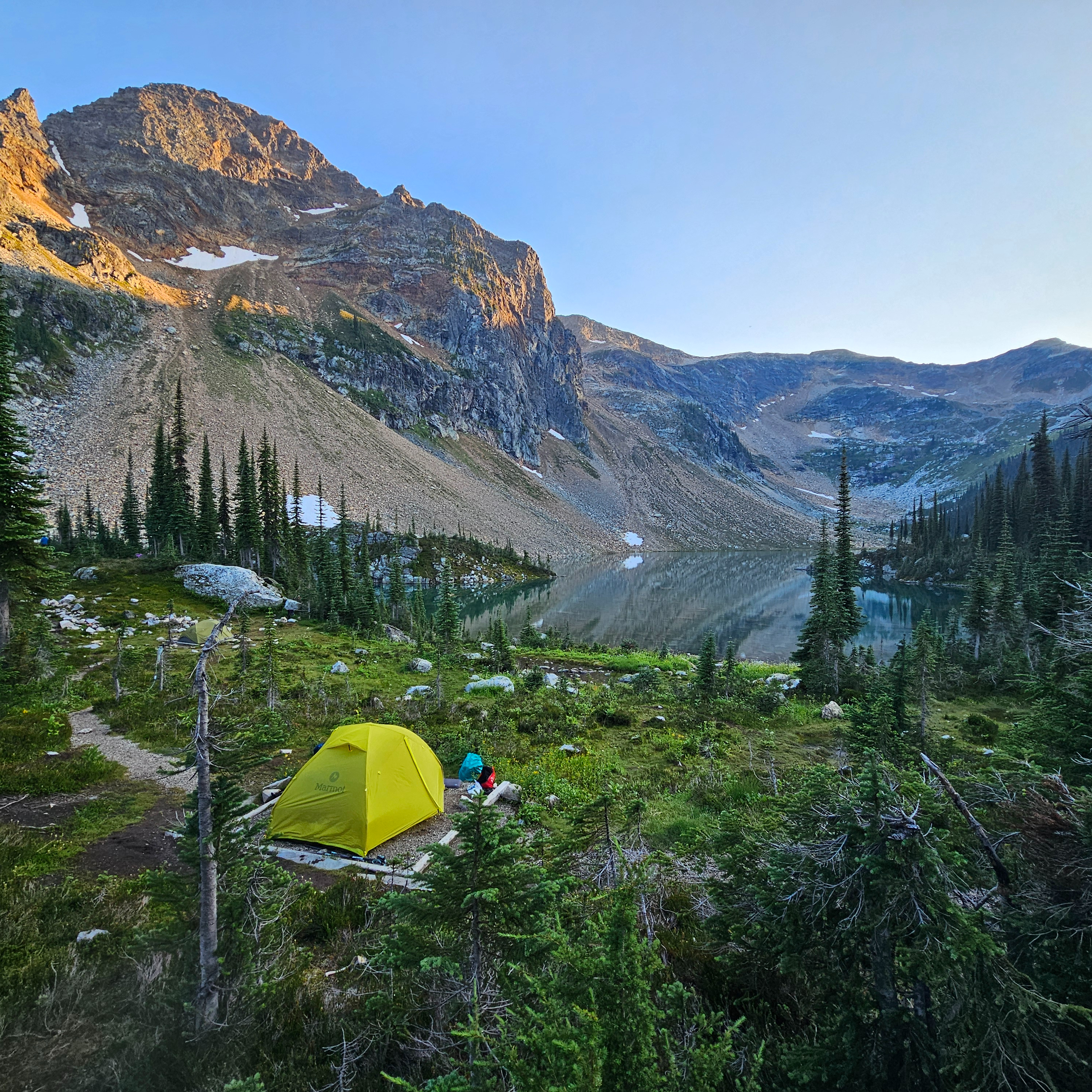
Eva Lake – Eva Lake is the first of two campsites connecting trails along the top of Mount Revelstoke. It’s an 8km hike each way from the Balsam Lake parking lot to the campsite at Eva Lake. There are 4 tent pads and a 100 year old ranger cabin that can provide shelter for eating.
Jade Lake – Jade Lake is the second of two campsites connecting trails along the top of Mount Revelstoke. It’s a 10km hike each way from the Balsam Lake parking lot to the campsite at Jade Lake. Alternatively, if you’re hiking from Eva Lake, it’s a 5.5km trail. There are 4 tent pads. This campsite is located on the other side of a mountain pass, so it is the more challenging trail.
Backcountry Huts
In researching for this guide, I discovered that there is one backcountry cabin available for camping at Mount Revelstoke. It’s called Caribou Cabin and is only in use in the winter, from December to April. It’s a 9km hike up the mountain along the summit trail, or a 20km hike along the Meadows in the Sky Parkway, which is closed in the winter. It’s definitely a bit of work to access this one, but potentially an incredible experience!
Hiking
Compared to the larger National Parks, hiking is more limited in Mount Revelstoke, but there are still lots of good trail options around the park. Parks Canada has produced a comprehensive guide to the trails around the mountain, which you can view here. I’ve shared some of the highlights below.
Short Summit Trails – If you have limited time in the park, my recommendation is to drive to the Balsam Lake parking lot at the top of Meadows in the Sky Parkway and explore some of the shorter trails. There are two short hikes from the parking lot around Balsam Lake and to Eagle lake. But the best trails are 1km further at the top of Upper Summit Road. You can either hike 1km to the top, or you can take the summit shuttle. From there, you can access the Fire Lookout, Koo Koo Sint, Heather Lake, and First Footsteps trails. These are great for viewing alpine wildflowers in late July/early August.
Short Lower Mountain Trails – If you don’t want to drive to the top of the mountain, there are lots of hiking trails along the lower part of the mountain that can be accessed from Snowforest Campground. This includes Inspiration Woods, Sorenson, and Nels Nelson, among other trails.
Eva/Jade Lakes – If you’re looking for more of a challenge and to really experience the alpine environment, you can day hike or backpack to Eva, Miller, and Jade Lakes. They are all located along the same trail, totaling ~24km if you want to do all three. If you are visiting for a day, I recommend hiking to Eva Lake and Miller Lake, but just hike to the top of the pass, saving ~5km of hiking to and from Jade Lake.
Mountain Trails – Another option for a challenging hike is to hike up the mountain from bottom to top along the Lindmark or Summit Trails.
Boardwalks – If you’re just passing through or are looking for an accessible trail, there are two boardwalk trails located along the highway: Giant Cedars and Skunk Cabbage boardwalks.
National Park Pass
Before visiting, make sure you get your National Park Pass. If you’re visiting in Summer 2025, these passes are free as part of the Canada Strong Pass. Traditionally, they are $10 per person, per day, or you can get the family pass for the whole year for $145, which is applicable to all National Parks. Park passes are needed to park your car and can be picked up from the Rogers Pass Discovery Centre, or from the Parks Canada Administration Office in Revelstoke (which has an automated machine for after-hours).
It’s hard to believe that I’ve lived in BC for 12 years now and I’ve never hiked to the top of Golden Ears Peak. Golden Ears Park is one of the closest BC Parks to Metro Vancouver – it’s only a 30 minute drive from my house – and Golden Ears Peak is an iconic hike near the city. Due to its proximity to town and the epic views available from the summit, it’s a very popular destination. However, it also has 1500m of elevation gain and is a 24km round trip hike to the summit, so it is extremely challenging.
Golden Ears Peak has been on my bucket list for a long time, but due to the length and elevation gain, I knew I wanted to backpack it. There are two campsites along the trail. Alder Flats is located at the 6km mark, and Panorama is located at the 11km mark, 1km below the summit. There are only 7 tent pads at the Panorama Campsite, so it is important to get an early start if you want to snag one. Knowing I would have to hike fast in challenging terrain to get a tent pad, I’ve avoided this hike for a long time. I don’t like rushing up a mountain and I hate the feeling of competing for campsites.
I put all that aside this summer to finally hike this iconic trail. Carolyn is preparing to move back east in the Fall (I am devastated), so she’s been working on completing some of the bigger trails on her bucket list. We decided to make an attempt of this trail in mid-July. We didn’t get ideal weather, but we planned the perfect itinerary for this trip and had great success in executing it (something that always makes me happy I work as a project manager)!
You need a permit to camp on this trail from camping.bcparks.ca, but there is no reservation system, so anyone can hike it on any given day. There are only 7 tent pads, but there’s regularly 30+ tents set up at Panorama on any Saturday night. I’m surprised BC Parks hasn’t brought in a reservation system for camping in this park yet, but my theory is that they don’t want to promote the campsite without investing considerable resources into the trail, which is very technical and in very rough shape. Either way, we wanted to get a tent pad so that we weren’t further contributing to damage to the alpine meadows around the campsite.
Our plan was to drive to Golden Ears right after work on Friday and hike the first 6km to Alder Flats, camping there for the first night. We were able to get away from work a little early and pulled into the West Canyon Trail parking lot at 5pm. The first half of the trail to Alder Flats is super easy. It’s completely flat and well graded, so we finished that section in under an hour and then stopped for a quick supper. The next 3km are more challenging, with some uphill sections and lots of loose rock. But it’s still a relatively easy trail and we completed the full 6km in 2 hours, arriving at Alder Flats around 7pm.
Alder Flats was completely empty when we arrived, which didn’t surprise me because we started pretty early in the evening, but I was expecting it to get a lot busier. Two more groups did show up, and a third group of noisy bros rolled in at 2am (I’ve never hated anyone so much), but overall, I was expecting there to be a lot more people at the campsite. The weather for the weekend was looking a little bit mixed, with some clouds and rain in the forecast, so we thought that might keep some people away (spoiler, it didn’t). Maybe Alder Flats gets busier on other weekends, but it wasn’t busy on the weekend that we went.
The bros got up at 5am to continue their hike, which made me hate them even more because they woke us up twice, and me and Carolyn got up at 6am. The bros ended up being the first ones to the campsite and took two pads, but me and Carolyn were next after that. The tent pads didn’t all get taken until a solid 2 hours after we arrived, so we could have had a bit later start, but no regrets. Lots of people get up early to hike the full distance from the parking lot, so I’m sure conditions change on any given weekend. But for us, camping at Alder Flats and getting an early start from there was very successful.
But I’m getting a little ahead of myself. Alder Flats is a nice campsite in the forest with a bear cache and outhouse, and has the benefit of being located close to a really nice river water source. There is no consistent water source at Panorama, but there’s a lot of snow up there and there’s usually run-off that you can drink until later in the summer, or you can melt snow. We’re both water snobs, so we opted to carry all our water up for the weekend. This is probably a little extreme and resulted in us each carrying 10lbs of water up the trail, but we’re both lightweight hikers and I honestly didn’t regret it. We could have treated the run-off at the top, but it was also nice to get up there and not have to worry about it.
After filling up our bladders, we left Alder Flats shortly after 7:30am. After Alder Flats, the trail gets substantially more challenging. It’s definitely doable to hike from the parking lot, but it was nice to rest overnight and only have to tackle 5km in the morning. Once you leave Alder Flats, the trail immediately heads uphill over loose cobble. This is some of my least favourite type of terrain. I call it “ankle rollers” because the loose cobble makes it really easy to roll your ankle and the rock is really tiring on your feet. The trail is like this for ~2km before you hit the next obstacle.
Following the loose cobble, you hit dense forest and have a very technical and sleep climb through the trees. There’s a viewpoint towards Golden Ears just before you hit your first set of stairs. There are several staircases at the start of this section and the first step is missing for almost all of them, so it feels very steep. The trail winds back and forth through the woods and you have to climb up and around a lot of tree wells and tree roots. There are lots of handholds on the trees, but you definitely need to use your hands to get around some of the obstacles. I don’t know exactly how long this section is, but I’d estimate around 1.5km. It goes very slowly because you cover a lot of elevation gain.
Eventually the forest thins and the trail levels out when you reach the sub-alpine. You’re still in the forest, but the trees are very short, so it feels more exposed and you can get good views. Definitely remember to apply sunscreen once you reach this section. Fortunately, it was cloudy on the day we hiked up. It still felt extremely damp and humid and we were sweating so much from climbing, but I think the hike would have been a lot more challenging on a hot day. We were both gross, but feeling pretty strong.
Once we reached the sub-alpine, the trail felt easier as you follow the ridge, but you do have to do a little bit of up and down as you cross over some bumps along the trail. We started seeing more people as everyone who had camped at the summit on Friday night was heading back down. Unfortunately, we couldn’t see any of the view because we hiked right into the clouds. This section is also ~1.5km in length, but it gets more challenging the closer you get to the campsite. There is one ladder and the last section is definitely a scramble and you should be prepared to use your hands as you climb up over the rock to the campsite.
Carolyn opted to bring Jasper with her and he did really great. Overall, I wouldn’t recommend this hike for dogs unless they do a lot of hiking, because it is a long trail and you will have to be prepared to help them through a few sections. The only tricky section along the trail to Panorama is the ladder, and maybe a few parts of the scramble right before camp. But if you plan on going to the summit, there’s a rope section where your dog may also need help. Plus you need to keep an eye on them near steep drop-offs.
Eventually, you get your first view of the emergency shelter and we confirmed that we were early enough to snag a tent pad! It took us just over 3 hours to hike from Alder Flats and we arrived pretty much right at 11am. We selected our tent pad, but rather than set up the tent, we set up our chairs and sat down to have a snack and a drink. Like I said, you couldn’t see any of the view yet, but we were optimistic that it would clear in the afternoon. Because there was no sun and we were at an elevation of 1350m, it was quite cold. We quickly layered up and after a nice break, we set up the tent and then ate our lunch in the shelter of the emergency cabin.
We had planned to eat in the cabin, but I’m sad to say, the emergency cabin is disgusting. It has not been treated well. Half of the cabin is a loft space for emergency use and storing your food, and the other half of the cabin is a urine-diverting outhouse that gets flown in at the start of the season. The cabin is dark with some abandoned gear, but the outhouse is absolutely gross. It’s a real shame because it’s actually a nice toilet and it had the potential to be nice. But people have left soooo much garbage on the floor of the outhouse that it stinks and is really disgusting. There are entire garbage bags of food waste, and then other people have left used pads and poopy toilet paper all over the floor. I’m glad people didn’t put their food waste and feminine products in the outhouse, but users at this site really need some basic education about leave no trace.
Like I said, the trail is super popular and looking at some of the groups, it’s clear that a lot of the visitors are beginner backpackers and a few people we talked to were first-timers. I find this a bit crazy because Golden Ears is such a challenging trail, it’s not an easy choice for your first trip. There’s nothing inherently wrong with it and I don’t judge people for it (if anything, I feel they were misled by social media). Backpacking is a learning experience and I don’t believe in gatekeeping it. We all start somewhere and we will all learn how to be better at it. But honestly, this campsite is just too overcrowded. I’m glad it has the outhouse, even if people don’t treat it well, because otherwise I can’t imagine the state of the meadows.
After lunch, it was still very foggy, so we decided to take a nap. Our sleep had been interrupted by the bros the previous night and we ended up passing out for the better part of 3 hours. When we left the tent, the campsite had been transformed. It was still cloudy, but there were now an additional 25 tents spread out everywhere throughout the meadow and there were people everywhere. We were just praying that it would eventually clear so that we could see the view, because neither of us wanted to ever return to this campsite.
The thing about Panorama Campsite is that it’s still located 1.1km from the summit of Golden Ears. One of the benefits of arriving early in the morning was that it left us with lots of time to explore the summit. But neither of us wanted to climb the mountain until the view cleared up. Finally, at 5pm, we got our chance. The clouds lifted and we were able to see the surrounding backcountry! If you look east, you’ll be able to see down towards Alder Flats. I thought we’d be able to see Alouette Lake, but it’s hidden behind other mountains. However, if you look west, you get the most incredible view of Pitt Lake!
Most of the people at the campsite had arrived later and were still sorting out their tents and water. But because we’d arrived so early, we decided to set off for the summit right away when the view cleared. Another group did the same, but few others bothered. Lucky for us though, the other group were frequent visitors and they were able to give us a few pointers about the route to the summit, which is still pretty technical.
We climbed out of the campsite, which is all exposed rock, but then there was a section of snow field that still hadn’t melted. We brought our microspikes for this section and I definitely wouldn’t recommend going up without them. It was easier than the ascent I did over snow the previous weekend at Brandywine Mountain, but it was still pretty steep in some sections. I’ve heard that early in the season the whole route to the summit can be covered in snow, in which case, you shouldn’t attempt it. The more technical parts of the route didn’t have any snow, so we felt reasonably comfortable.
After the snow field, there are 3 scramble sections. The first is the least technical and goes up over some rock and a few trees. Then you hit the second section, which has a rope going up the rock face. This spot was a little dicey and we debated not doing it because it looked intimidating. But up close it was a bit easier, so we continued on, Carolyn just had to help Jasper. At the top of the rope section, there’s a little plateau, which is a nice place for a break before starting the final ascent to the summit. The other group continued on, but we’d hiked back into the clouds and me and Carolyn had gotten very hungry, so we decided to stop and have our supper instead. We decided that if it cleared during our break, we would keep going, and if not, we’d stop there.
We had a really nice meal and break and then did some tiktok dancing while waiting for it to clear. It didn’t seem like it was going to, so eventually we decided it was time to head down. About a minute after we started hiking back, the clouds completely lifted and we finally got a view, so we ran back to our supper spot to take more photos. In the end, we still opted not to finish the last couple hundred metres to the summit. It was getting later in the evening and the very top of the summit never actually ended up clearing, so I’m content with our decision to just enjoy the view below the summit.
We ended up doing a bit more exploring on the way down to catch some of the views in other directions. We got back to the campsite just in time for sunset and Carolyn made us popcorn as a little treat. We ended up getting a beautiful cloud inversion as darkness set in. We’d climbed another 200m of elevation up to the summit, so we were pretty exhausted and fell asleep easily. We planned to get up for sunrise at 5:30am, but we were relieved to see that it had clouded back in overnight, which gave us the excuse to sleep in.
We had a pretty chill morning, but we were still packed and ready to head down by 9am. It’s 1200m of elevation loss to return to the parking lot, so I was really worried about my knees. They were definitely twinging, but overall did pretty good and I was relieved I didn’t have to hobble out the trail. We stopped for lunch at the helipad at Alder Flats, and then arrived in the parking lot at 2pm. So it took us 5 hours with a break to hike the whole way back down. We rewarded ourselves with burgers and beer at The Patch in Maple Ridge before returning home.
So overall, I’m thrilled that I can finally cross this trail off my bucket list, but also relieved that I won’t ever have to hike it again. I know some people do this as a day hike, but it would be a very big day (although I’m sure it’s easier with a smaller pack). I get why everyone wants to do this hike, the views are great, but the crowds are a lot to contend with and honestly, there are lots of other trails that are just as nice. I definitely wouldn’t recommend this hike to beginners and honestly, I probably wouldn’t recommend it at all because of the crowds. If you’re local and want to cross it off your list, absolutely, but if you’re just visiting, I would prioritize something else. But I can’t deny it is a pretty iconic hike.
Welcome back to the second part of my 2-part series to help you get camping with minimal advance planning, in any season! Part 1 focused on permitted campsites (that don’t require reservations) and Part 2 focuses on unpermitted (free) campsites!
Camping is incredibly popular in BC, especially near Vancouver. The popular campsites require reservations that release 4 months out and being coordinated to plan so far in advance can be a real challenge for people. It might seem like all the good campsites are booked, but there are lots of great options that don’t require advance bookings!
Why do some campsites require a permit and others are free?
The simple answer is that a lot of free campsites are located on crown land or in BC recreation sites (also considered crown land). The land doesn’t have park status, so it generally receives limited maintenance or it is maintained by users and volunteers. As a result, free campsites are often more rustic than traditional permitted campsites. There are lots of campsites located on crown land that are privately managed, either by for-profit or non-profit groups, and those campsites will usually have a campsite fee to go towards ongoing maintenance, though some non-profits will fundraise for the upkeep of facilities, like on the Sunshine Coast Trail.
That said, there are still some free campsites located in provincial parks, especially the further you get from the lower mainland. I don’t know the exact reason why some campsites have permits and others don’t, but I think it’s likely related to the popularity of a park and how much maintenance the park gets. For example, I visited South Chilcotin Provincial Park last year for 6 nights and didn’t pay any camping fees, but the park is very remote, has limited infrastructure, and several of the places we camped were considered wild camping (no outhouse or bear cache). When sites become more popular, permits will often be introduced.
If you are visiting a free campsite that does not have bear cache facilities or an outhouse, it is absolutely essential to practice bear safety and leave no trace practices. You must hang your food or bring a bear bin. In addition, you must be prepared to dig catholes or use a wag-bag, and pack out your toilet paper, pads, and tampons. It is not acceptable to poop in the woods without burying it, or to leave your toilet paper around the backcountry. We are so lucky to have access to incredible backcountry in Canada and we need to respect it.
Hanging Lake is located in Whistler, sharing a trailhead with the Rainbow Lake trail on Alta Lake Road. Rainbow Lake is Whistler’s water supply, and as such, it’s a protected watershed area, so you’re not allowed to camp there. But if you hike a few more kilometres over Rainbow Pass to Hanging Lake, you can enjoy a nice view from the pass and a relaxing night at the lake. It’s a 10km trail to the lake, but the real challenge comes from climbing 800m of elevation along the way. There’s a fair bit of space for tents at Hanging Lake and there is an outhouse and a bear cache. You can also access this trail from the Rainbow Madeley trailhead near Madeley Lake.
In my opinion, Tikwalus Heritage Trail is an underrated trail along the Fraser Canyon. To access it, you take Highway 1 past Hope until you pass Alexandria Bridge Provincial Park. The Tikwalus Heritage Trail has been used by indigenous peoples for generations, and in more recent history, it was used by fur traders. It’s only 6km along a semi-loop trail to the campsite, but you’ll climb almost 800m in elevation, so it’s steeper than Hanging Lake. Most of the trail is in the trees, but there are some beautiful mountain views from the campsite. There’s lots of space for tents, as well as an outhouse and a bear cache. There’s no water source directly at the campsite, so fill up at the creeks on the way up to save yourself having to backtrack.
Deeks Lake and Brunswick Lake are both located on the Howe Sound Crest Trail, but are accessible from the northern trailhead at Porteau Cove if you’re not doing the 30km thru hike from Cypress Mountain. Both lakes are beautiful and offer an easier alternative to the strenuous Howe Sound Crest Trail. It’s 6.5km to Deeks Lake (which is the smaller site) and 10km to Brunswick Lake, however there’s almost 1200m of elevation gain along the way. Most of the elevation gain is in the first 6.5km to Deeks Lake, making this part of the trail the steepest on my list. Of the two lakes, Brunswick is the most scenic and has more room for camping. It’s also important to note there are no facilities at either site, so be prepared to hang your food and dig catholes.
Keeping in theme with the previous trails, the trail to Flatiron is just as steep, climbing over 800m in ~5.5km, with most of the elevation gain in the first 3.5km. It’s located in the Coquihalla Summit Recreation Area off Highway 5 and shares a trailhead with Needle Peak. The first section of the trail is a huge slog through the forest, but the views are incredibly rewarding. Once you pass the junction for Needle Peak, there’s a small lake where you can camp. You can also camp at the summit of Flatiron, but there’s no water source up there. There are no facilities at either site, so be prepared to hang your food and dig catholes.
Brew Lake is less steep than some of the other trails on this list, but still a big hike, covering 900m of elevation gain over 8.5km. However, if you have access to a 4×4 vehicle, you can reduce some of that distance along forestry roads. We parked along Brew Creek FSR, at the entrance to Branch 50, and hiked the entire trail from there, including 3.5km along other FSRs. This isn’t a very popular site, so it’s a nice place to go to escape the crowds. There are no facilities, so be prepared to hang your food and dig catholes.
We have finally arrived at some options that are not super steep! Both of these sites are located on the Sunshine Coast Trail, which has lots of possibilities for backpacking trips. The whole trail is 180km long, but there are lots of sections that can be done over a day or two. The campsite at Manzanita Bluffs, located on the north end of the trail, is especially beautiful. I also really like the campsites at Fairview Bay and Rainy Day Lake, located on the south end of the trail. All campsites along the trail have outhouses and most of them have bear caches or huts. They do not all have water sources, so plan accordingly. While these sites are free, I do recommend a donation to qPAWS if you opt to stay in one of the huts.
Tricouni Meadows is a popular campsite located northwest of Squamish. The trailhead is located on Branch 200, off of Squamish River FSR. If you can make it all the way to the trailhead, the hike to the campsite is just over 3km, with 250m of elevation. However, there was a large wash-out on Branch 200 when I did this hike in 2022. If you park at the wash-out, it adds 3km to the trail. In 2022, some vehicles could get through, but I’ve heard it’s gotten worse, so play it safe. There are 3 lakes near the meadows, with the campsite located at the middle lake: Spearhead Lake. It’s not a large campsite, so I recommend getting there early. There are no facilities, so be prepared to hang your food and dig catholes.
Blanca Lake is another campsite located northwest of Squamish. In general, I would say this road is in better shape than the road to Tricouni, but it’s further away. The trailhead is located off E300 on the Elaho Mainline. The trail is 4.5km, with almost 500m of elevation gain. It starts off pretty steep, but then levels out along the middle. The view from Blanca Lake is incredible and there is tons of space for camping. Give yourself extra time to explore around the alpine once you get to the lake. There are no facilities, so be prepared to hang your food and dig catholes.
Both of these campsites are located on the HBC Heritage Trail that runs 70km between Hope and Tulameen. Manson’s Campsite is located on the Hope end of the trail (off Peers Creek Road), so you don’t need 4×4 to access this site, but if you want to access Conglomerate Flats for a night, then you need 4×4 to get the trailhead at Jacobson Lake Rec Site (off Tulameen FSR). Both sites are beautiful, though Conglomerate Flats is the more stunning of the two. It’s 6.5km and 600m of elevation gain to Manson’s Camp from the southern trailhead, and 2.5km and 150m of elevation gain to Conglomerate Flats from Jacobson Lake. Both campsites have outhouses and bear caches.
Both of these sites are located in the Coquihalla Summit Rec Area off highway 5. Falls Lake is a great site for beginners because you only have to snowshoe 1km along the road (which isn’t plowed in the winter) and 1km to the lake. Zoa subpeak is a bit more challenging as it’s 550m of elevation gain over 4km. Both trails are located in simple terrain, but make sure to stop at Zoa Subpeak – if you try and snowshoe all the way to the true peak, you will be entering challenging avalanche terrain. I’ve never actually been to Falls Lake, but I believe there is an outhouse. There are no facilities at Zoa Subpeak.
Ottomite Peak is also located in the Coquihalla Summit Rec Area off highway 5. The trailhead is at the Zopkios Rest Area. It’s a 4.5km trail with 300m of elevation gain to get to the summit. It was completely empty when I camped there, but the general area is popular among ski tourers, so you may see people along the trails for the day. The trail is in simple terrain, but always exercise caution – in general, I always recommend taking an AST1 course. It’s not a challenging trail, but there are no facilities.
Widgeon Creek is located near the lower mainland and is extremely popular on summer weekends. It’s a ~5 paddle across the Pitt River and up Widgeon Creek to get to the campsite. You can rent canoes or kayaks at Pitt Lake. There are lots of campsites and great facilities, including a large bear cache and 2 outhouses. But I recommend getting their early on a nice weekend to beat the crowds. From the campsite, you can do a day hike to Widgeon Falls.
Twin Islands and Granite Falls are two campsites located in Indian Arm, so they are very accessible from the lower mainland. As a result, they are very popular on summer weekends, attracting paddle boats and motorized boats. You can rent kayaks from Deep Cove. It’s only 5km to paddle to Twin Islands, so this is the easier campsite to access. You’re only allowed to camp on the north island, but it has an outhouse (no bear cache since it’s an island). Granite Falls is at the far end of Indian Arm and is an 18km paddle from Deep Cove, so you should be an experienced paddler if you want to do this trip. It has 2 outhouses and a bear cache, but it’s severely undersized. Be prepared for northern afternoon winds.
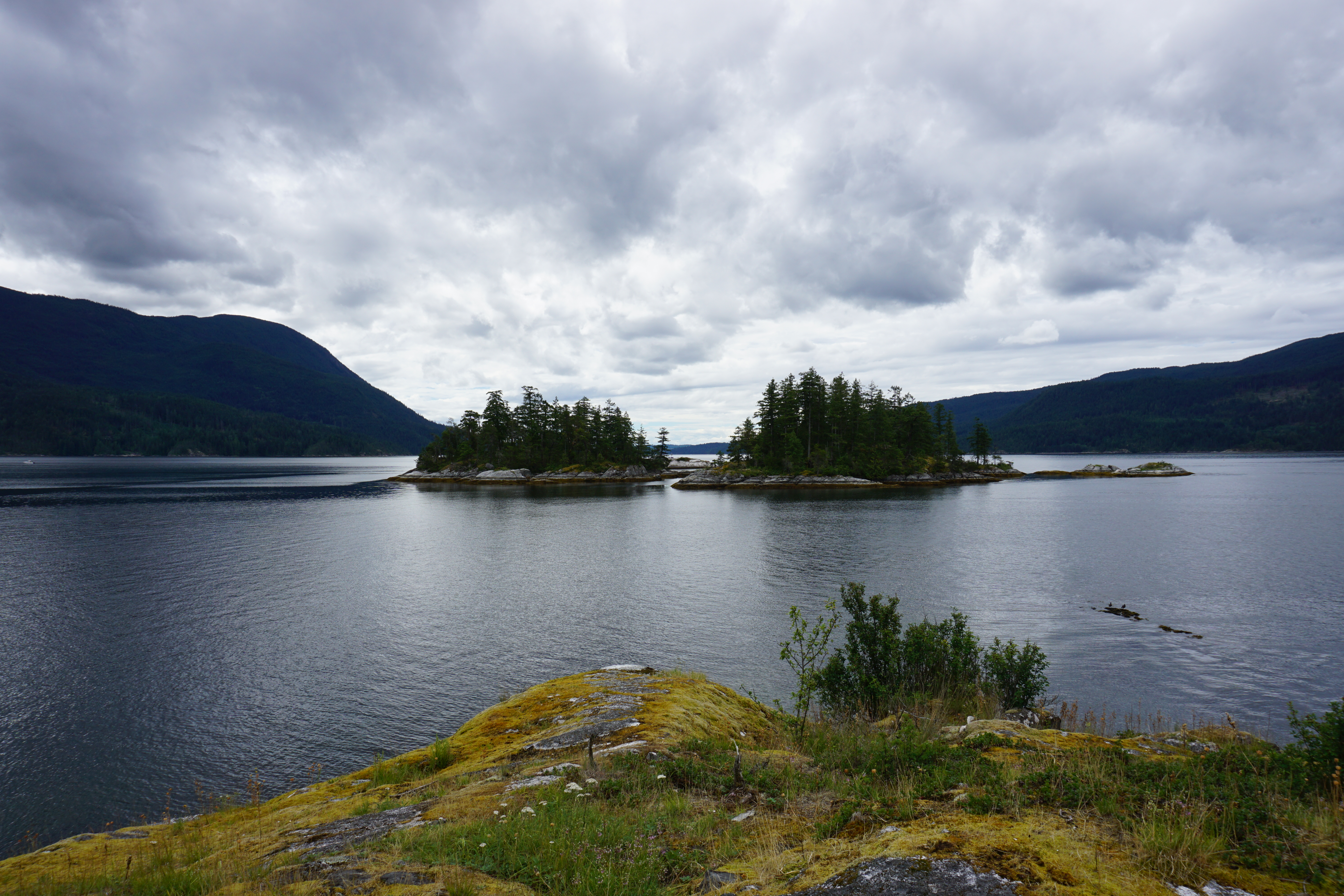
Nine Mile Point Beach and Kunechin Point Campsite are both located in Sechelt Inlet on the Sunshine Coast. There’s a kayak rental place at the end of Sechelt Inlet Road, where you can launch from. It’s ~6km to paddle to Nine Mile Beach and ~10km to paddle to Kunechin Point, but the latter involves crossing the arm of the inlet, which can get windy. Both are beautiful sites and have outhouses, but no bear caches.