Taylor Creek Backpacking Trip: Ridge-o-rama

Following up on my post from last week, our last day in the Taylor Basin area of South Chilcotin was incredibly scenic but really challenging. We could have hiked out the same way we came in along the old forestry road, which would have been an easy hike back to the car, but I really wanted to hike up to Camel Pass and check out the Ridge-o-rama trail. Our campsite was very close to Camel Pass, so I kind of wish we’d gone up the previous evening to explore it a bit more, but we hiked up in the shade of the early morning instead. The whole way up I was like, “the rocks really don’t look like a camel”, but when you get to the actual pass, the angles line up and it is easy to see the camel. But as soon as you continue further, it disappears again, so hang around the pass for a little while to enjoy the views and the camel, it’s a cool feature!

PSX_20251025_182803
PSX_20251025_183500

If you continue down the other side of the Pass, you rejoin the High Trail, which connects with Windy Pass on the west and back down to the Gun Creek Trailhead on the east. I think this is the most common way to visit Camel Pass and I know some people do it as a day hike. We didn’t want to do this trail because it would take us too far away from our parked car. Instead, I wanted to attempt the Ridge-o-rama trail. It’s shown on the Chilcotin paper map, but I still had a hard time finding any information about it. It’s primarily a mountain bike trail and bikers only use it to go down. 

I did find one trip report online from someone who had backpacked it, and I was happy to see part of the trail included in Stephen Hui’s new 105 Hikes book that came out not long before we did the trail. Stephen calls it the North Cinnabar Trail. Both trip reports note that the trail is very steep and has eroded tracks in it from extensive mountain bike use. I’m pretty sure it was constructed as a mountain bike trail, so I tried not to be too mad about it. We had to hike ~14km, about half of which was along exposed alpine ridges. I love ridge walking and was sad when we skipped the ridge walk the previous day, so I was keen to do this trail, even though I was concerned about the exposure.

PSX_20251025_181738
PSX_20251025_184048

It’s only a short hike up from our campsite to Camel Pass, but we had to continue up to the top of another sub-peak beneath Taylor Peak. This was one of my favourite parts of the day because the views were phenomenal! You can see all around the park and all the little meadows, it’s very idyllic. It wasn’t too hot when we reached the sub-peak, which at 2250m, was our highest elevation of the day. After that, we had a nice downhill along the ridge. What really makes ridge hiking challenging is the variation in terrain. You’re constantly going up and down small peaks. They don’t look like too much on the map but repeating it over and over is tiring. It didn’t take long for the temperature to heat up, and Seth was having a rough time. 

My biggest word of caution if you’re doing this trail is that it doesn’t have any water sources. Or at least, they were all dried up when we hiked it in August. We would have had enough water for just me and Seth, but there were no creeks for Sadie to drink out of (unlike the previous 2 days), so we had to share our water with her too. Seth and Sadie both drank a lot, and we had to conserve water for our last 3-4km of hiking, which I hate having to do. So, err on the side of caution if you’re doing this trail and bring lots of water. Although, if you take the North Cinnabar branch instead of the Ridge-o-rama East branch, there is a lake down in the basin (more on that later).

PSX_20250902_082908
PSX_20251026_214522

We slogged our way along the ridge, taking breaks in the shade when we could find it. I think my other error with this trail was that I tried to do the ridge too quickly. I wanted to get off the ridge before it got really hot in the early afternoon, so I did rush our breaks, which ultimately wasn’t the right decision. We were slow and ended up being out in the heat anyways, so it would have been better to rest more. After ~3.5km, we reached the Cinnabar Basin, which has a branch heading down the valley called the North Cinnabar Trail. Ridge-o-rama eventually connects with that trail further down, but there’s several more kms of ridge walking first.

The basin looks beautiful too and I think it would be a really nice place to wild camp since it has a little lake. It was tempting to hike down to the meadow, which has more shade, but overall, the trail is slightly longer than the ridge. I figured I was unlikely to ever come back to the ridge but might hike up through the basin someday to connect to the High Trail, so I opted to stick with the ridge. Unfortunately, Ridge-o-rama did end up getting more challenging after this point. We got some truly fantastic views looking down towards Carpenter Lake, and I could see on the map that we had one more sub-peak to climb. It was very steep and while it had a fantastic view, it was a rough trail to hike down. 

PSX_20251025_184613
PSX_20251025_184655

After the sub-peak by camel pass that we’d done in the morning, this was probably my favourite view of the day. If you do the hike in Stephen’s book, this is where the day hike ends, after which you turn around. This hike would be an absolute SLOG to hike up and down, so my recommendation would be to do the whole North Cinnabar loop, either as a long day hike, or as an overnight. We had to take our time coming down the final sub-peak, but there’s a very cool part of the ridge walk after that where it slopes down on either side of the trail. It reminded me a lot of the 3 Brothers Trail in Manning Park.

Overall, this part of the ridge was the most tiring for us. It’s the most exposed section of the trail, so we kept Sadie close and leashed. It was past lunchtime, and we were both really hungry, but we wanted to get off the ridge and into the shade before taking a break, so it felt like the trail dragged on forever. You eventually come to what looks like the end of the ridge and you can see the forest directly below you, but it’s the steepest section of the trail to get from the ridge back to the woods. Plus, it’s where the bike tracks have completely eroded the trail, so it’s super hard to go down it without slipping on the loose rock. It’s a pretty brutal scramble. 

PSX_20251025_184237
PSX_20251025_185350

Once you finally hit the trees, the trail is still very steep and rutted. I wanted to go a little bit further to get to a flatter part near the junction with North Cinnabar, but Seth was completely done, so we stopped in the shade along the steep slope to eat our lunch. We didn’t see a single person all day, but I would be careful in this section in case there are mountain bikers on the trail. It would be very hard to control your speed coming down a section like this. 

The main benefit of getting off the ridge was to take advantage of the shade, but even in the trees, the sun was still exhausting. It was midday, so the sun was directly overhead; the trees were short, meaning we were often exposed either way. The lower we got in elevation, the hotter the air temperature became. We entered back into blueberry country, which pleased Seth and Sadie, but my feet were screaming at me and I desperately wanted to finish the hike so that I didn’t have to be standing anymore. This was when we realized that we were running out of water. We prioritized Sadie getting as much to drink as she wanted, but Seth tends to chug his water, so I had to share mine with both of them and he had to pace himself. 

PSX_20250902_083424
PSX_20251025_184751

The forest walk was still steep, which is why I say it would be a slog to go up and down this trail in a day. Eventually you reach another junction. The main trail continues down towards Tyaughton Lake, but because our car was parked further up, we had to take the north branch to walk along an FSR. I thought this would probably be easier hiking, but I was worried about it being exposed with the wider road. I was right on both fronts. We had 2.5km on the FSR, followed by 1km on Tyaughton Lake Road, and we only had about 500ml of water left. It was very hot, but fortunately, it was easier walking, and we were able to hike down what was left of the trail pretty quickly. We chugged the last of the water when we got to Tyaughton Lake Road and hiked back to the car from there. 

It was such a relief to get back to the car and have more water from our bladder in the trunk. It was quite warm from sitting in the car for 3 days, but water is water! Usually, I do a full outfit change when I get back to the car, but we were sweaty and gross, so we put towels down on the seat and drove straight to the Friberg Rec Site on Tyaughton Lake to go for a swim. We were the only ones there, so I set up my new pocket shower on the shore and had a nice shower with shampoo and soap! I always thought backcountry showers were a bit stupid, but now that I’ve bought one, I do love it.

We felt so much better after our swim and decided to head back to Lillooet for supper. We hit up the brewery again, for pizza this time, and then found a FCFS frontcountry campsite at BC Hydro’s Seton Lake Dam Rec Site for the night. The trip was not without challenges, but it only furthered my love for South Chilcotin Park. I’m sure I’ll be back again!

20250826_171349

Taylor Creek Backpacking Trip: Windy Pass

I took 4 weeks of holidays in August and September this year, so I still have so many trips to write about! I know the fair-weather backpacking season is over now, but I still want to share about the cool trails and adventures I had over the summer. Please indulge me as I continue to write about August well into the Fall season.

If you’ve been following my blog for a while, you may recall that I visited South Chilcotin Provincial Park for the first time last year. It had been on my bucket list for a long time, and I ended up doing an impromptu 6-day hike in the park last August. It’s not a very popular park, but I absolutely loved my time exploring around the core area and it’s quickly become one of my favourites. After 6 days of exploring, I left with 3 more trips on my bucket list than when I started! 

20250826_180248

Given that this isn’t a crowded park, I thought it was a great option to visit with my husband, Seth, and our dog, Sadie, who doesn’t like other dogs. Seth and I went on holiday in late August this year and decided to do a shorter, 2-night trip around the Taylor Creek area. Technically, most of this trail is outside the park boundary, but it’s still in the same general area with the same kind of terrain. There’s a cut-out in the park where Eldorado Mountain is located (north of Tyaughton Lake, but south of Tyaugton Creek) – it’s called the Taylor Creek Basin, and that’s the area we decided to explore.

Similar to when I visited the park last summer, I spent the first day of my trip driving. It’s ~5 hours from Vancouver to Tyaughton Lake if you don’t hit any traffic, but we spent the better part of 8 hours getting there. The fastest way is to drive north out of North Vancouver to Pemberton and then take the Hurley FSR up to Gold Bridge. The Hurley is all gravel road, so it does slow you down, but was speedy in Brandon’s 4Runner last year. Alternatively, you can take Highway 99 to Lillooet, followed by Carpenter Lake Road. Carpenter Lake Road is also gravel, but in better condition than the Hurley. The last option is to drive to Lillooet via Highway 1 and Highway 12. I think this is probably the least popular option, but on the day we left, there was a major accident on the bridge to North Van, followed by slowdowns on Highway 99. Because I live in Coquitlam, the fastest route was to go via Highway 1, so that’s what we did.

PSX_20250907_231321
20250824_124447

It did seem like a particularly long drive, but I’ve never driven Highway 1 past Lytton, so it was exciting for us to try a new route. It’s a pretty drive and we did most of the route to Lillooet with minimal stops. We had supper at Lillooet Brewery, since it was the only dog-friendly place in town, and it has the Sowilo food truck on site. It was a great choice because the views from the patio are fantastic, and the food truck does delicious vegan bowls. I’d definitely recommend!

But we still had the final part of our journey, which involved driving Bridge River Road onto Carpenter Lake Road. I don’t think this is a popular drive and is a mix of old asphalt and gravel roads, but it should be more popular because it is breathtakingly stunning! It’s way faster to drive on the Hurley, but Carpenter Lake Road drives through a narrow canyon to the dam at the end of Carpenter Lake (see first photo) and I was in awe during the entire drive. Once you pass the dam, you drive along the lakeside for a long time. It’s strange because you expect such a beautiful lake to revolve around recreation, but there’s really nothing happening and no rec sites until you get to the end. We did the drive around sunset, so we had beautiful views of the lake and saw a lot of deer (so watch your speed). We spent the night camping at Mowson Lake Rec Site so that we could get an early start on the trail the following morning. 

20250824_135804
PSX_20251025_182430

The biggest challenge we had on this trip was the weather forecast. After a mild summer, with minimal forest fires, we were heading into a heat wave during the last week of August. Seth doesn’t handle the heat very well, so we knew we’d have to focus on early mornings to avoid hiking in the middle of the day. We were up and away to the trailhead before the rest of the Rec Site had woken up in the morning. 

Like I said, our plan was to explore around the Taylor Basin area. Seth prefers day hiking to backpacking, so we wanted to camp in the same spot for two nights, doing a day hike on our middle day. Chilcotin is a pretty rustic area. It does have designated campsites in some parts of the park, with outhouses and bear caches, but wild camping is also permitted. There are some areas (like Siwash Meadows) where people wild camp repeatedly, and other areas where people just random camp. There’s an old cabin located just next to Taylor Creek, below Taylor Mountain, where people will often wild camp. The cabin itself is completely dilapidated, so you can’t camp in it, but it’s a nice area. Our plan was to camp for 2 nights next to the cabin, or potentially wild camp somewhere in the alpine nearby. 

PSX_20250905_180308

We decided to park on Tyaughton Lake Road and do a loop trail to the cabin and back. There’s a road junction near North Cinnabar Creek and that’s where we parked the car. The first part of our day was hiking up another gravel road that eventually transitioned to trail. I think this was probably an old logging road at some point, but now it’s a nice, forested trail with a gentle incline. We had to hike uphill for ~12km, covering 750m of elevation gain. The trail is never too steep and it’s mostly forested, so it was nice to spend the day hiking in the shade. Seth and Sadie both liked it as there were a lot of blueberries and huckleberries on the trail, so we were able to stop frequently for snacks. We were very cognizant of bear safety (there are grizzlies in the park), so we kept Sadie on leash all day and made lots of noise. 

PSX_20251025_181645
PSX_20251025_182638

The trail mostly follows Taylor Creek and around the 6km mark, you have to cross the creek. It looks like there was a bridge at one point, but it’s been washed out, so we had to ford the river. Fortunately, it was an easy crossing, but pretty cold. It didn’t stop Seth from doing a quick dunk to escape the heat! After that the trail gets a bit steeper and we stopped a few times for lunch and a break. We got to Taylor Cabin in the early afternoon, and we were the only people there. There’s no outhouse or bear cache, but it’s still mostly in the trees, so there is shade.

At some point before the trip, I got it in my head that I wanted to camp in the alpine (rather then at the cabin). I knew the weather would be clear and that it wouldn’t be windy, so I was keen to do a bit of stargazing. But I was very concerned about having access to shade. We decided to spend a few hours relaxing in the shade at the Taylor Creek Cabin, but ultimately ended up hiking another ~1.5km along the trail to look for somewhere to camp with a better view. I think I pushed Seth too far on this part because it was still very hot and it was a major slog to get up to the alpine.

PSX_20250905_180445

Once you arrive, it’s not that simple to find somewhere to camp. There are limited water sources and despite it being very barren, there’s not that many flat places to camp. You want to avoid camping on any meadows or flowers and stick to bare rock or gravel, so it can be a challenge to find somewhere that’s flat, bare, and near a creek. 

We identified a few potential locations, but none of them were great. There is a decent-sized creek that we thought would be perfect, but once we got close to it, we realized it was incredibly silty. Eventually we found spot next to a very small clear-flowing creek – it wasn’t ideal, but there were a handful of trees around to provide some shade, and we found a bare spot where we could avoid damaging any wildflowers. We had a few marmot neighbours located further upslope and they were pretty vocal in their dislike of Sadie. We kept her under control so that she couldn’t bother them and they eventually ignored us.

PSX_20251016_223607
PSX_20251016_223844

Seth was a bit annoyed about the extra mileage, but once we got settled, everyone was happy with the location. It was nestled under Taylor Mountain, south of Camel Pass, and we had a beautiful view as the mountain turned orange at sunset. We set up our camp kitchen very far away from our tent so as not to leave food smells on it while cooking, and we dug catholes further from the trail. We’d seen two mountain bikers when we started our hike in the early morning, but we hadn’t seen a single other person since then. It was one of the most remote places I’ve ever camped, and I felt very aware of the fact that we were truly in the wilderness. We had a nice supper and then spent time securing our food from bears. 

PSX_20251016_222328
PSX_20251016_221739

For this trip, Seth and I each used a bear bag. A bear vault would be ideal, but all we had were bear bags, so we each bagged our food in dry bags to contain the smell and then put the dry bag in the bear bag. We couldn’t hang the bags, so we tied each bear bag to a tree, apart from each other. I don’t mean we just looped a rope to the tree, I mean we held the bag up to the trunk and wrapped the rope around the entire tree trunk and bear bag multiple times to secure it to the tree. We didn’t want a bear to walk off with the bag or make it too easy to get it off the tree. Fortunately, no bears came along to test it.

It was a beautiful night, and I did do a little bit of stargazing. I really wanted to do astrophotography with Taylor Mountain, but the milky way was on the opposite side of the sky from the mountain, and the moon was quite bright. I didn’t get any nice photos, but I did enjoy watching for shooting stars. 

PSX_20251016_223228
PSX_20251016_222044

In the morning, we got up early again to try and beat the heat. It still found us mid-way through breakfast, but the air temperature stayed cool for a bit longer. The challenging thing about South Chilcotin is that the park is very exposed. We had the benefit of the shade from the trees the previous day, but we were going to be in the sun for most of the next two days. Our plan for the day was to take the Pearson Trail over to the Taylor Creek Trail, so that we could hike the High Trail up to Windy Pass for lunch. If you continue on the High Trail for a little bit longer, you end up at the base of Spruce Lake, which is the circuit I did last year, so I didn’t have any overlapping of trails, but sort of felt like I was connecting the two trips.

You can find a few places to wild camp along the Pearson Trail too, but they’re not any more ideal than where we were already camped (and a bit more exposed overall). But it’s a beautiful area! Pearson Trail hikes up to a little Pass, which I’m not sure of the name, and then you start hiking down the Taylor Creek Trail, parallel to Harris Ridge. Harris Ridge doesn’t have a trail, but people do like to hike along it. I was curious to explore it but given that it’s not a marked or named trail, I figured it was better to stick with the named trail, since I haven’t actually done either. 

PSX_20251016_222816
PSX_20251016_221638

The Taylor Creek Trail goes in and out of the woods, providing beautiful views of Harris Ridge, and eventually of the meadows along the High Trail. Given that it was early and we were going downhill through the trees, that park of the hike was enjoyable. Eventually you hit a trail junction for High Trail, which is the official start of South Chilcotin Park. You can hike down through the Meadows towards Eldorado Cabin, or you can hike up towards the alpine and Windy Pass. This part of the trail is a steady uphill and it is exposed the entire way. I didn’t find it too bad because it was still morning, but Seth struggled with the heat and uphill. We were really hoping that “Windy Pass” would live up to its name, but it was only lightly breezy at best. All the trail blogs I’d read mentioned that it is usually quite windy up there, so I guess we just had bad luck.

PSX_20251016_221913
PSX_20251016_222647

The trail to Windy Pass reminded me a lot of the Lorna Pass Trail. We did it last year and it’s all exposed, but instead of being completely barren rock, there are lots of green patches and wildflowers around. I loved Lorna Pass and I loved Windy Pass too. It’s challenging because it’s all uphill, but I think I get an adrenaline boost hiking in the alpine meadows because they’re so beautiful, so I never remember the painful part! Sadie seemed to enjoy it too, though we were careful to keep her hydrated. The were a few creeks along the way, so it was possible to fill up our water when needed, but overall the creeks shown on the map aren’t reliable and are often dry, so don’t assume you will be able to fill up along the way.

We didn’t see any people all morning. When you get to the top of the pass, you do need to hike a little bit further if you want to get the view of the park. From the top of the pass, you can only see back down the High Trail, you need to continue to the viewpoint if you want to be able to see the rest of the park. I liked the viewpoint a lot because we were looking out towards the route that I’d done last year and I could see the Castles, which is another trail route in the northern part of the park that I have yet to visit. We encountered 1 couple on our way to the viewpoint that had hiked up from Spruce Lake and were heading back towards Gun Creek on the Lick Creek Trail. We had a nice conversation, and they were the last people we saw on the trip. So, over the course of our entire trip (3 days), we saw 2 groups (4 people). 2 backpackers and 2 bikers.

PSX_20251016_224324
PSX_20251016_223146

We found a single tree providing shade at the viewpoint and ended up hanging out for an hour. I’d been keen to do a bit more ridge hiking up from Windy Pass on the way back, but it was not in the cards for Seth and given the heat, I had to agree that it wasn’t a good idea. Instead, we went back the way we’d come and ended up clocking 12.5km and 550m of elevation on my GPS for the day. I enjoyed the hike back down Windy Pass, which had a nice headwind to cool us down. But it was a slog to hike back up the other side to the pass at Taylor Creek. Sadie was slowing down, so I ended up carrying her backpack. We crawled our way up the pass, taking another break in the shade along the way. 

Eventually we made it back to our tent. It was still in the sun as it only got shade in the evenings, but we were able to hide among some of the trees to get a bit of shelter while we both took creek baths. While relaxing, I noticed that we could see a herd of ~8 mountain goats exploring around the side of Taylor Peak. They climbed around the mountain side, eventually making their way up to the meadows on top of the mountain. We were able to watch them all night, and they eventually returned to the mountainside to bed down for the night. We enjoyed a very chill evening, and I made an apple crisp for dessert before heading to bed. Tune back in next week for part 2!

PSX_20250905_180911

Hiking the Plain of 6 Glaciers

Our second hike in Banff National Park in August was The Plain of 6 Glaciers (our first hike was Sentinel Pass). Both hikes are located in the Lake Louise area and I feel like maybe I should have branched out a little more, but they were both so incredibly scenic it’s hard to regret.

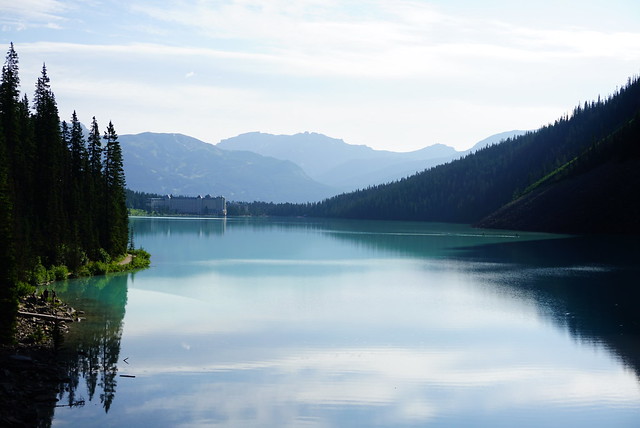
As I explained in my last post, with Lake Louise being so popular, it’s best to get there early if you want to be assured parking. I’ve heard the lot generally fills up by 8am, but I think that’s only on weekends because there was still lots of space when we got there at 8am on a Thursday. The Plain of 6 Glaciers starts right at the lake and hikes the length of the lake and up into the backcountry. I’d been to Lake Louise once before as a teenager with my parents and the lake was just as scenic as I remembered, but there were so many people so we didn’t want to linger.

DSC07357

There are tons of trails from the lake; you can hike up immediately to the Big Agnes Teahouse and a ton of hiking options, or you can hike up the near side of the lake to some viewpoints, but of course, we opted to hike towards the back of the lake. Despite the early hour, there were still a lot of people on the lake trail, though the traffic thinned out considerably once we reached the back of the lake. I think a lot of tourists just hike to the back of the lake and then return to the chateau – also on the day we went, there were a lot of climbers, and they all quit at the back of the lake to climb the sheer cliff wall. So we felt much more at home once we left the lake, as beautiful as it was.

DSC07367

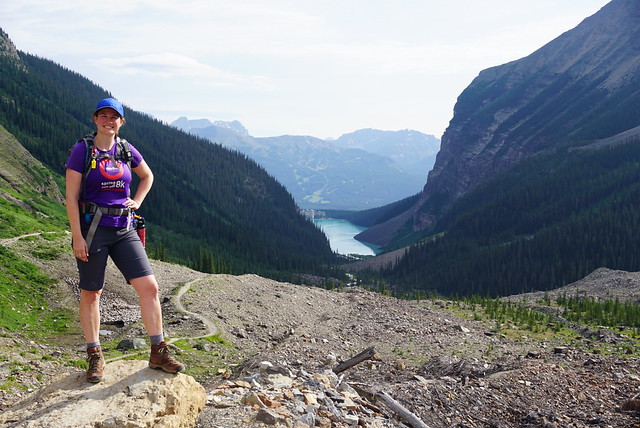
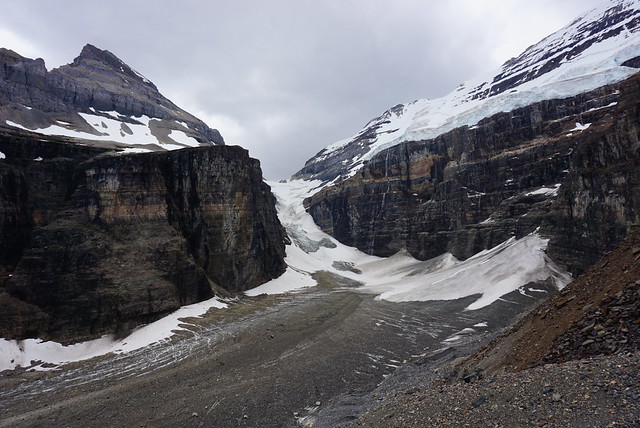
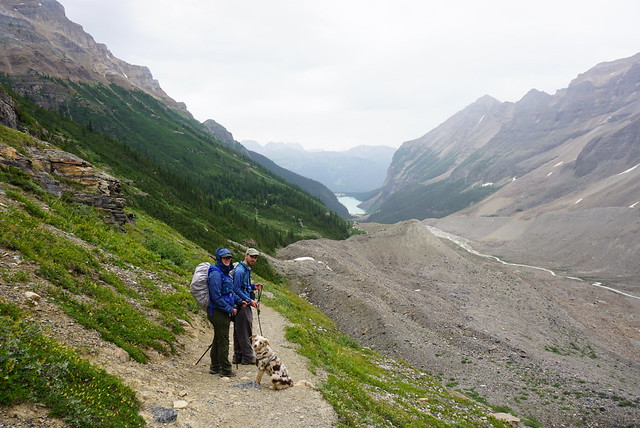
The weather was really nice. It was chilly, but the sun was out, so we slowly started ditching layers after leaving the lake. From there the trail is mostly uphill and continues through the woods and then into what I like to call the barren alpine. The entire valley was once covered in glaciers, so there’s not a whole lot growing there and it’s mostly rock left behind from the glaciers. There are beautiful views looking back at the lake as you ascend, as well as equally beautiful views looking ahead at the glaciers. It’s hard to count them to confirm if there actually are 6 glaciers, but they’re each slowly revealed to you as you hike up the valley.

DSC07379

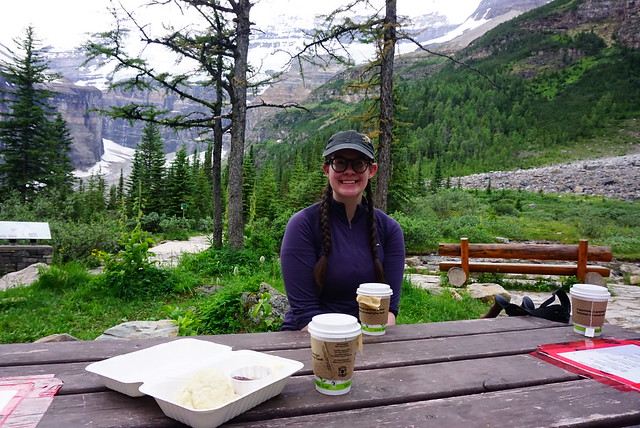
My favourite part of the hike is that there’s a cute little tea house located about a kilometre before the viewpoint. There’s a flatish area and they’ve constructed the teahouse and put some picnic tables along the river. We hadn’t really planned ahead properly for the teahouse because I thought I’d read somewhere that it was closed because of Covid, but it was open and fortunately Seth had $20 cash on hand. So we each had a cup of tea and shared a delicious jammy scone. We were thrilled to discover all the teas are from Banff Tea Co, which we had visited the day before, so me and Emily both had the “Plain of 6 Glaciers” tea in honour of the occasion. It’s an herbal tea with a little bit of mint and it was very yummy!

DSC07383

The weather started to change a bit while we were enjoying our teas. It had clouded in and while it wasn’t raining, the sky was starting to look a little foreboding, so we decided to continue on. It’s just 1 more kilometre, the last part of which goes along the ridgeline and reveals the final glacier right at the back of the valley. It’s not really obvious where the trail ends, eventually it comes to a scree slope and I think you can continue on a little further, but we opted to stop there for our lunch. It did start to drizzle a little as we were eating, but nothing too bad. It just made us glad we had left early again because the weather did get worse and the crowds got larger, but for the most part we had enjoyed a scenic and empty hike up to the top.

DSC07386

The rain picked up on the way down, making it colder, and the clouds quickly moved in to obscure some of the glaciers. I always find it amazing how quickly the weather can change in the backcountry and its a good reminder to always be prepared. Fortunately we had our rain jackets and merino wool sweaters, but we saw a lot of hikers coming up looking pretty wet and ill-prepared.

DSC07404

We beelined down the trail pretty fast because of the rain and made pretty good time coming down. It rained on and off for the rest of the hike, stopping for periods of time, but often starting up again. You can go back to Lake Louise via a different route that would take you to Agnes Lake and the other hiking trails, but similar to Sentinel Pass, Sadie was tired and we weren’t really interested in exploring too much more in the rain, so we opted to skip it. It was even more busy at the bottom of the lake as it was now mid afternoon, so we hightailed it out of there and back to our campsite to relax for the rest of the day. So overall, I didn’t like the hike as much as Sentinel Pass, but still very beautiful and I’d definitely go back and explore some of the many other hiking options in the area!

DSC07430