In the spirit of helping more people get hiking on some of western Canada’s most iconic trails, I decided to create a backpacking guide for the Rockwall Trail in Kootenay National Park. I hiked this trail over 3 nights in 2023 and had a fantastic time. I attribute most of the fun to my phenomenal hiking partners, but the beautiful scenery on the trail also made the experience unforgettable. I’ve already published a 2-part trail report, which you can read starting here, as well as a guide to Kootenay National Park. I’ve consolidated all of my Rockwall-specific knowledge here for those planning to hike the trail. Reservations for the 2026 season release at 7am PST on January 26, 2026 (8am MST).
The Trail
The Rockwall Trail is a 54km thru-hike located in Kootenay National Park in BC. You can hike the trail in either direction and there are several exit points that connect to the highway if you want to shorten your hike. The two main trailheads are located off Highway 93 at the Floe Lake and Paint Pots Trailheads. There are 5 campgrounds on the trail, with the most popular campsite at Floe Lake. Most people hike the trail over 3-5 days, depending on fitness level.
At 54km in length, the Rockwall Trail is not the longest trail in the Rockies, but there is a significant amount of elevation gain, so don’t underestimate it. The hike starts in the forest on both ends of the trail, climbing up towards the alpine, which runs between Helmet Falls and Floe Lake with 3 steep passes along the way. While Floe Lake is very popular, the trail takes its namesake from the large rock wall that runs between Helmet Falls and Tumbling Creek, which in my opinion, is the real highlight!
If you don’t like backpacking, you can visit Floe Lake as a day hike, but it is a 22km round trip hike, with 750m of elevation, so it’s a big day. I don’t recommend day hikes from any of the other trail entrances – unless you’re a trail runner – but the alternative trail entrances from Numa Creek and Tumbling Creek Trails offer the opportunity to shorten your backpacking trip.

Time of Year
The best time of year to hike the Rockwall Trail is in the Summer or early Fall. If you go in late-June or early-July, be aware that there may still be snow on some of the trails. If you go later in the summer, it’s more likely that your trip might be impacted by wildfires. While most people prefer to backpack in the summer, late September is also popular due to the colourful larch trees near Floe Lake. However, you should be prepared for snow and cold conditions at this time of year. I hiked the trail at the very end of August and had great conditions.
Getting There
Unfortunately, this park is not accessible by public transit. Similar to other popular Canadian parks, the easiest way to access is by driving. The park is located on Highway 93, which is a 50 minute drive to the Floe Lake Trailhead from either Banff or Radium. The added challenge with the Rockwall Trail is that, because it’s a thru-hike, you will either need 2 cars, 1 at each trailhead, or plan to hitchhike between the two parking lots. I parked a car at each trailhead, which is the easiest option, but hitchhiking is not uncommon along this route and is relatively safe. I recommend making friends along the trail and looking for a ride from another hiker.
There is a large parking lot at the Paint Pots trailhead, but the Floe Lake trailhead is much smaller, so you may have to wait for a parking space to open up. I’ve also heard that break-ins are not uncommon at the Floe Lake trailhead, so make sure not to leave valuables in your vehicle.

Permits
Like most popular hikes in the Rockies, securing your camping permits will likely be the hardest part of your trip. This is a popular trail and it attracts crowds every year. If you’re doing a day hike, you don’t need a permit for the trail, just the National Park Pass (discussed below). But if you want to try and get camping permits, then it’s important to mark your calendar with the permit release date.
The permit release date for 2026 is January 26, 2026 at 7am PST. Permits are $10 per person, per night (plus a booking fee) and they will disappear fast, so you need to be ready to book right when they release. I will try and update the release dates for permits every year, but they are usually announced by Parks Canada in late November or early December for the following year – so keep an eye on their page of release dates in future years. To make your bookings, visit https://reservation.pc.gc.ca/.
Once booking opens, select “backcountry” in the tabs along the top of the booking page, and then select “backcountry zone”. Next, select “Banff, Kootenay, and Yoho Backcountry” as your park and select your start date and access point. There are 3 options for access points along the Rockwall Trail: Floe Lake, Numa Falls, and Paint Pots. Numa Falls is only used if you’re doing a shorter version of the trail. If you want to hike south, select Paint Pots; if you want to hike north, select Floe Lake. If you have trouble getting your preferred itinerary, you can always try reversing direction or using different start dates.
Once you start your search, you will be forced to build your itinerary day by day. At the top of the page, you’ll see a dropdown menu where you can select your campsite and “add to stay”. Instead of building your itinerary this way, you can scroll down to the map and click on the “calendar” tab in the left sidebar to see a list of all available campsites per night. This is an easier way to see what’s available and build your itinerary. If you don’t see what you want, try refreshing or reversing your itinerary by updating your access point. People are constantly adding and changing dates and campsites in a rush to get their preferred itinerary, so the trick is to frequently refresh. Just because you don’t see a site available right away, doesn’t mean it won’t show up later if you keep refreshing.
My recommendation is to take what you can get and make changes later. If Floe Lake is not available, book Numa Creek and move on to the next day before those dates book up too. Once you have secured a booking for each of the dates in your itinerary, go back and look for cancellations. Keep refreshing until you see one, and then make a change to your booking to add it. This does cost more as you have to pay a small change fee, but it offers more flexibility in ensuring you at least get something. I wasn’t able to book Floe Lake when I made my original booking, but I was able to get a cancellation for it afterwards. You can track cancellations on Schnerp, which will notify you when a site opens up.
Here’s a few tips for getting your camping permits:
- Get on the booking website 15 minutes early using as many devices as possible (computers, phones, ipads, etc). At release time, everyone on the website is entered into a random generator that assigns you a position in the queue. All of your devices will be assigned a place in line, then proceed to book your permits on whatever device has the shortest queue.
- Once you get access, be flexible with both your starting date and itinerary. Use the “calendar” option to see available dates at each campsite. Consider shortening your itinerary by exiting on the Numa Creek or Tumbling Falls Trails.
- If you don’t see any availability, keep refreshing for at least 15 minutes. With so many people trying to book campsites, dates are always disappearing and then becoming available again, so if you don’t see anything, keep refreshing.
- Be prepared that you might not get what you want. Book alternative sites and sign up for cancellation notifications on Schnerp.

National Park Pass
In addition to backpacking permits, which are specific to your campsite, you must also have a National Park Pass. These are much easier to obtain – there is no booking period and the number of passes are not restricted. The most common option is to purchase the discovery pass, which is available for $150 for a family, or $75 per person. It’s essentially an annual pass that covers everyone in your car. You leave it hanging in the car while you’re on the trail and it acts as a parking pass. If you have two cars, then you would need two passes. Alternatively, you can buy single adult day passes for everyone, which are $11 per person, per day. However, in 2025 and 2026, Canadians can obtain the Canada Strong Pass for free, which includes a free discovery pass and 25% off bookings! You can purchase passes online, in advance, or in person at the Kootenay and Banff park entrances.
Campsites
There are 5 backcountry campsites located along the trail, so there are multiple options for where to stay, which provides some flexibility when planning your itinerary and securing bookings. The campsites are pretty equally spaced along the trail, so it is easy to plan for a more relaxed itinerary, or you can plan your sites further apart if your itinerary is more aggressive. I’ll discuss itineraries below, but here’s an overview of the campsites running from north to south. They all include outhouses and bear lockers, and require valid permits for overnight use.

Helmet-Ochre Junction – This is the most accessible campground on the trail, located 6km from the Paint Pots trailhead. It’s located along the river at a trail junction and has 6 tent sites. It’s a nice enough campground, but it’s often overlooked in favour of the more popular/scenic campsites. If you can’t get permits for Helmet Falls, this is a good alternative. It’s also a great option if you’re starting late in the day and don’t want to hike too far.
Helmet Falls – This is a beautiful campground located at the base of Helmet Falls, which cascades down the valley from Helmet Mountain. There are 18 tent sites and you can enjoy the view from the picnic area at the back of the campground. This is a great option to camp before or after you’ve hiked along the Rockwall.
Tumbling Creek – This campground is located at the bottom of the valley between Rockwall Pass and Tumbling Pass. There’s 18 tent sites and easy access to the river with nice views. This is a great option to camp before or after you’ve hiked along the Rockwall. You can also come direct to the campground along the Tumbling Creek Trail, which starts at the Paint Pots trailhead.
Numa Creek – This is the lowest elevation campground on the trail and is located between Tumbling Pass and Numa Pass. There’s 18 tent sites and easy river access. This is a great place to camp on your way to or from Floe Lake. You can also come direct to the campgound along the Numa Creek Trail, which starts at the Numa Falls trailhead.
Floe Lake – This is the most popular campground on the trail. If you can score a permit for this campground, do not hesitate to book it. The entire trail is very scenic, but Floe Lake is definitely the most scenic campground. It has 18 tent sites and is located 11km from the Floe Lake trailhead.
Itineraries
Planning this trail is pretty straight forward because it is a linear thru-hike. Your main decisions will be what direction to hike and over how many days. Here are a few recommendations based on how many nights you plan to spend on the trail. And here’s a useful trail graphic from Parks Canada, noting the distance between each campsite.
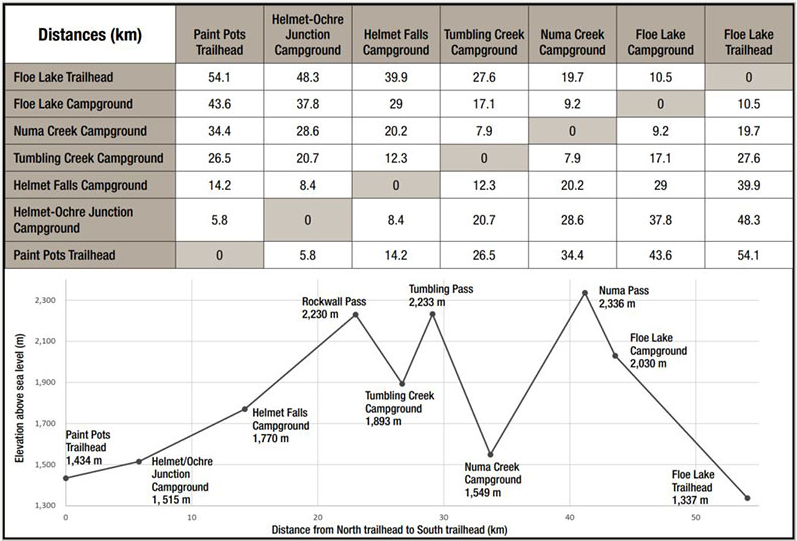
1-Night: Your best option if you only have 1 night is to camp at Floe Lake, hiking in and out from that trailhead. Add on 2km each way to hike up to the top of the nearby pass for a fantastic birds-eye view of Floe Lake. Alternatively, if you really want to see the Rockwall, you could spend 1 night at Helmet Falls and hike out via the Rockwall and Tumbling Creek Trail. You just have to be prepared for a big 20km day on day 2.
2-Night: 2 nights is probably the most awkward itinerary, because you can hike most of the trail, but it’s ambitious to do the whole thing. If you want to do the whole trail, I’d recommend camping at Helmet Falls and Numa Creek, which requires you to hike two 20km days back to back. If you don’t want to do the whole trail, hike north, camping at Floe Lake, followed by Tumbling Creek, and exit on the Tumbling Creek Trail. Or hike south, camping at Helmet Falls, followed by Numa Creek, and exit on the Numa Creek Trail. Hiking north allows you to visit Floe Lake, while hiking south allows you to hike the Rockwall. If you want to hit both, you have to do the whole trail.
3-Night: I did the trail in 3-nights, which I thought was a good length. Plan for your first and third nights at either Floe Lake or Helmet Falls (doesn’t matter which direction you go), and then your second night at either Tumbling Creek or Numa Creek. You will have one long day with this itinerary, but you can plan it around whether you’d like to have extra time at Floe Lake or on the Rockwall. I hiked south and camped at Numa Creek, meaning I had lots of time to relax at Floe Lake on my last night.
4-Night: This is the most relaxed itinerary. Do the trail in either direction and camp at Floe Lake, Numa Creek, Tumbling Creek, and Helmet Falls. You’ll have lots of time to enjoy Floe Lake, the Rockwall, and Helmet Falls.

 The Road Goes Ever On