10 Epic Loop Hikes in BC

I recently did a post featuring some of the most epic thru hikes available in BC. Thru hikes are great if you have a bigger group or access to 2 vehicles, so I wanted to complement that post with a blog about some of the best loop backpacking trails! These are great if you only have access to one vehicle, or want to limit your driving/coordination time. 

If you’re a beginner, check out my Guide to Backpacking and Overnight Trips for Beginners posts, as well as my safety resources instead.

Gold Creek Trail

Photo of two small backpackers on a rocky beach with a clear river flowing alongside them and a large green forest and mountain in the background, shrouded in fog. Taken from Viewpoint Beach in Golden Ears Provincial Park, on the Gold Creek Trail, in British Columbia, Canada.

This is the closest trail to Vancouver on the list (by a long shot) and the most beginner friendly. There are a ton of backcountry sites located along the Gold Creek Trail in Golden Ears Park, and it’s easy to do them as standalones or as a loop. Park at the north lot at Gold Creek and start your hike to Viewpoint Beach, taking either the East Canyon Trail (for the most direct route) or the Lower Falls Trail (for a more scenic route). Camp at Viewpoint Beach and consider doing a day hike up and back to Half Moon Beach

Then you can head up to Alder Flats for a second night and loop back to the parking lot on the West Canyon Trail. There’s another option to day hike up to the Golden Ears Summit, but this is a steep hike and definitely not beginner friendly, so plan accordingly. You can customize the trip to whatever length you want, with lots of opportunities for side trails! Without side trips, it’s ~13km total to hike the loop to Viewpoint Beach and Alder Flats. A backcountry permit is needed for these campsites and can be obtained 2 weeks prior to your trip at camping.bcparks.ca

Flora Lake Loop

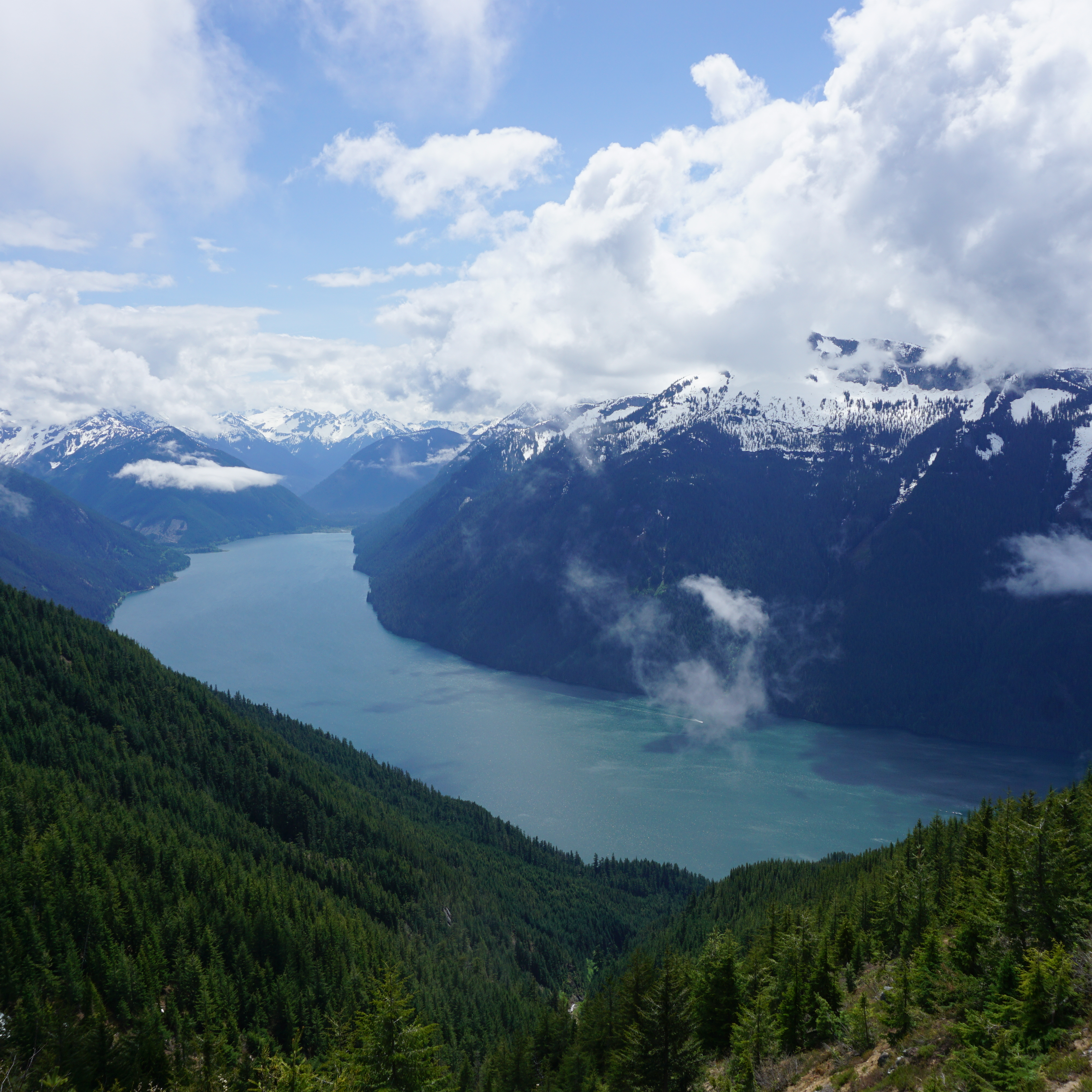
The view of Chilliwack Lake from Flora Peak on a sunny cloudy day, with the snow capped mountains in the background in Chilliwack Lake Provincial Park on the Flora Lake Loop Trail in British Columbia, Canada.

The Flora Lake Loop trail is a 20km trail in Chilliwack Lake Provincial Park that hits 3 alpine lakes and Flora Peak. I’ve never actually hiked the entire trail, but have done large sections of it in both directions. The trail climbs up to Lindeman Lake, which is a very popular trail, and then continues to the back of the lake and up to Greendrop Lake. From there, you continue climbing uphill until you reach Flora Lake. All 3 lakes have campgrounds, but Lindeman Lake is the most frequented.

From Flora, you continue up to the top of Flora Pass, where you have the option to do a side trail up to the Flora Lake Lookout. After the pass, it’s a giant downhill back to the trailhead. There’s 1000m of elevation gain along the hike, so you can either spread it out between campsites when circling the lakes, or reverse the trip and do it all in one go on the way up the Pass. With so many campsites, you can take anywhere from 1-3 nights to complete the trail. A backcountry permit is needed for these campsites and can be obtained 2 weeks prior to your trip at camping.bcparks.ca

Frosty Mountain

A landscape photo of the larch trees turning yellow during Autumn, with a snow covered Frosty Mountain in the background on a cloudy day. Taken in E.C. Manning Park, British Columbia, Canada.

Frosty Mountain is one of the most popular Fall hikes near Vancouver, but it makes for a great backpacking trip any time of year. Most people go up and back on the same trail, but there’s actually a 27km loop option that goes around the back of the mountain. There’s a campsite on either side of the summit, so you can do it as a 1 or 2 night trip. There’s also the option to add on a side trip to the PCT monument, Windy Joe, or Lightning Lakes. 

This hike has a lot of elevation gain, more than 1200m, so it’s good to do over multiple days. If you go in the Fall, it will be really busy when the larches turn yellow, but the view from the summit is great year-round. The only downside is having to carry a large backpack over the pass to the summit. A backcountry permit is needed for these campsites and can be obtained 2 weeks prior to your trip at camping.bcparks.ca.   
Tricouni Meadows

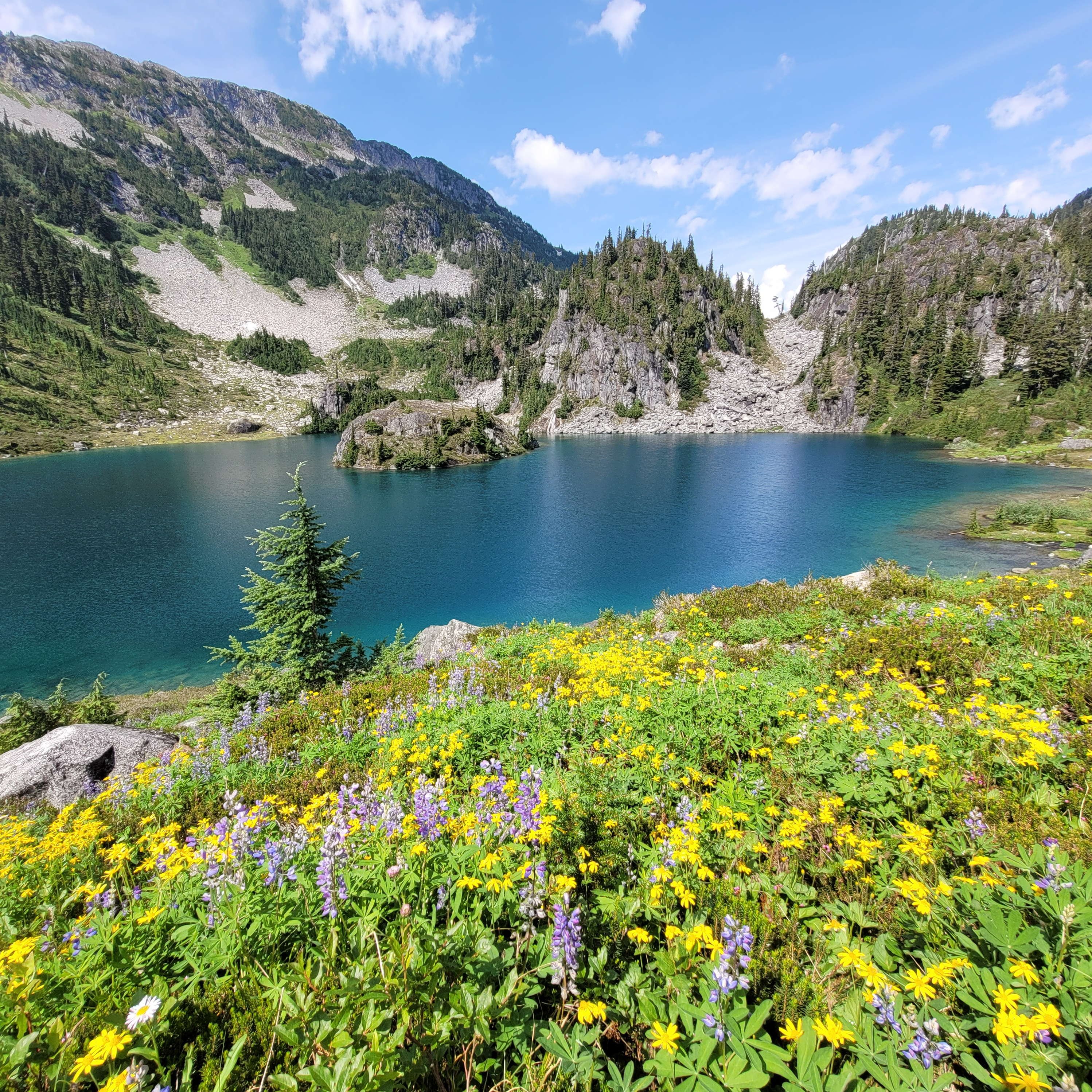
A photo of Pendant Lake on the way to Tricouni Meadows, with yellow and purple wildflowers in the foreground and a blue alpine lake and mountains in the background on a sunny, blue sky day. West of Squamish in British Columbia, Canada.

Tricouni Meadows is a bit of a stretch for a loop hike, but it is a gorgeous trail! It’s located southwest of Squamish and requires driving up Squamish Valley Road, before merging onto Branch 200. 4×4 and high clearance are recommended to access this hike. The climb up Branch 200 is quite steep and there is a pretty big washout a few kilometres before the trailhead. I’ve heard the washout has gotten worse since I visited, so it might be necessary to add on a few extra kilometres walking on the road. The hike up to the meadows is only 4km from the trailhead, so it’s easy to add a few extra kms of road walking without overdoing it.

The loop part of this trail is because you can actually hike up to the meadows on either side of the river to Pendant Lake. The terrain isn’t that different, but it does make for a nice change of scenery. From Pendant Lake, there’s a bunch of camping available, but there are no facilities (bear cache or outhouse). You can do the trip in one night, but there are several lakes to explore and if you add a second night, you could use the extra time to climb up Tricouni Mountain!

Russet Lake

A photo of Russet Lake with the grassy meadows and the mountains in the background on a smoky summer day in Garibaldi Provincial Park near Whistler, British Columbia, Canada.

Russet Lake seems to be one of the lesser frequented trails in Garibaldi Park, but it’s no less scenic than its neighbours. The challenge with Russet Lake is that most people take the Whistler gondola to the top, which costs $100. Fortunately, there are several options available for this hike. For a true loop hike, you can enter or exit from Whistler base by climbing up the Singing Pass Trail, which follows the valley between Whistler and Blackcomb Mountains (and saves you the cost of the gondola). The challenge with this option is that there is over 1200m of elevation gain spread over 15km. Alternatively, you can take the gondola up the mountain and follow either the High Note Trail (from Peak Chair), or the Musical Bumps Trail (from Roundhouse). This route is easier, but still has over 500m of elevation gain spread over 12km, as you summit several small peaks (but is much more scenic)

You only really need one night at Russet Lake, but if you stay a second night, you can explore some of the surrounding peaks. On the way back, you can take any of the 3 trails mentioned above. At the time of writing, Whistler doesn’t ticket on the way down, so even if you hiked up, you can still take the gondola back down at no charge. This hike does require camping reservations, which release 4 months in advance of your date from camping.bcparks.ca.  

Chilcotin Loop

A photo of the hiking trail in South Chilcotin Provincial Park that runs to Lorna Pass. The trail is covered in yellow wildflowers in the middle of the forest, with the mountains peaking out in the background on a cloudy day in British Columbia.

South Chilcotin Mountains Provincial Park is mostly frequented by mountain bikers, but even in peak season, the park is relatively empty. It’s a beautiful park with lots of options for loop trails. If you only have a few days, there’s a nice loop trail around Taylor Creek that is ~26km long and can be explored over 2 nights, with side trips to the High Trail or Camel Pass. If you have more time, there’s a 5-6 night loop in the core area of the park that can be accessed from Tyaughton Creek, which goes over Deer Pass and along the valley to Spruce Lake. It’s ~70km long, but can be extended with side trails up to Lorna Pass, Warner Lake, or Lizard Creek. 

Many of the campsites in the core area are serviced by BC Parks and have bear caches and outhouses, but wild camping is also permitted and there are a few nice sites without facilities if you want to slow down your pace. There are grizzly bears in the park, but since there are so few visitors, they haven’t been known to bother hikers. It’s a remote part of BC that I really enjoyed getting to see.

Tetrahedron Park

A landscape photo of the trees, mountains, and ponds, from the top of Mount Steele in Tetrahedron Provincial Park on the Sunshine Coast of British Columbia, Canada.

Tetrahedron Park is located north of Sechelt on the Lower Sunshine Coast and is another great trail for beginners. The park has 4 huts that are managed by the Tetrahedron Outdoor Club and they are the only option for camping in the park (tenting isn’t allowed, neither is swimming because it’s in the watershed). 

With 4 huts, it’s easy to customize your trip to however many nights you’d like. The loop part of the trail comes from the trail from Edwards Cabin to Mayne Lake and back to Batchelor Cabin, but there are some great side trails to the Mount Steele and McNair Cabins. The hiking is pretty easy, though it can be muddy at certain times of year. The distance is customizable based on your route and could extend from 12-30km. Reservations are made through the Tetrahedron Outdoor Club facebook page and are $15 per person, per night.

Assiniboine

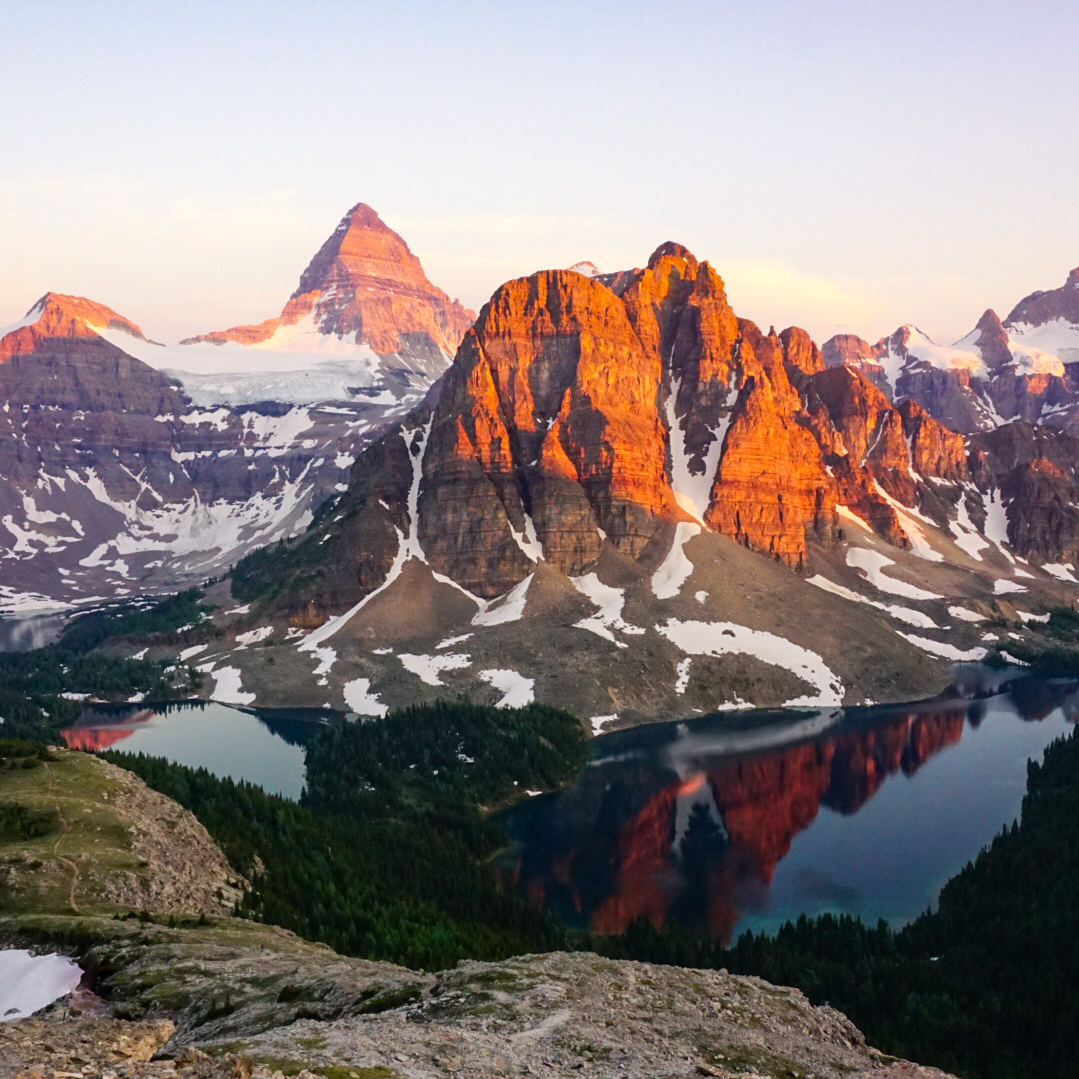
A photo of Mount Assiniboine and Sunburst Mountain and Cerulean Lake at sunset from the Nub in Assiniboine Provincial Park in British Columbia, Canada.

Assiniboine was also on my list of thru hikes, but it’s such a versatile hike, it can also be done as a loop trail! When you enter the park via the Mount Shark trailhead in Kananaskis, you can access Assiniboine through either Assiniboine Pass or Wonder Pass. They share a common trail to Marvel Lake, but then they branch. I’d recommend doing Assiniboine Pass on the way in and Wonder Pass on the way out because it is a steep trail to climb up. There are some restrictions on Assiniboine Pass at certain times of year, so make sure you check for any trail closures.

Once you get to the core area, you can spend a few days exploring the highlights of Assiniboine Park before you return. Not including side trails, the loop is ~52km, so I’d recommend 4-5 nights. It’s a long hike into the park and I personally prefer to do it over the span of 2 days, followed by 2-3 nights in the core area. Both of the entry trails are in Banff National Park and camping permits can be booked through Parks Canada, which release sometime in March for the entire season. Backcountry reservations for Assiniboine are available 4 months in advance at camping.bcparks.ca.

Iceline Trail

A female hiker walks with her hiking poles and hood up, facing away from the background view of large mountains and glaciers on the Iceline Trail in Yoho National Park in British Columbia, Canada.

The Iceline Trail is an incredibly scenic trail in Yoho National Park. The loop trail is 22km and can be done as a big day hike, but it is also nice to enjoy over 2-3 days. The trail leaves from the valley at Takakkaw Falls and climbs up to the alpine for ~6km of exposed trail before going back down to the valley. There are tons of options for camping at Yoho Lake, Little Yoho, Laughing Falls, Takakkaw Falls, or if you’re an ACC member, Stanley Mitchell Hut. 

There are also tons of options for side trails and day hikes, such as Twin Falls, Whaleback Mountain, and the Highline Trail. Reservations are made for the Yoho Backcountry on Parks Canada, and all of the reservations release for the season sometime in March. This is a great alternative trail for those not lucky enough to get permits for Lake O’Hara. 

Lake O’Hara

A photo of red canoes on the bright blue lake water of Lake O'Hara, with the mountains in the background on a cloudy day in Yoho National Park, in British Columbia, Canada.

Lake O’Hara is one of the most popular hikes in the Canadian Rockies. It’s located in Yoho National Park and it is no small feat to secure permits for it. I’ve written an entire blog post on the challenge. You can visit as a backpacker, for which you need camping permits that include a bus ride along the 11km access road. Or you can visit as a day hiker, for which you either need a bus pass, or plan to hike an extra 11km each way. All permits are available from Parks Canada and release some time in March for the entire season.

Once you get to the base, the core trail is the Alpine Circuit, which is approximately 13km if you do the entire circuit. It sounds short, but it climbs through 3 key parts of the trail and shouldn’t be underestimated because of the considerable elevation gain. Fortunately, you can customize the trail to include either the Wiwaxy Gap, the Yukness Ledges, Opabin Prospect, and/or All Souls. The entire hike is in the alpine and one of the most scenic trails I’ve ever done. There’s also lots of options for side trails to Lake McArthur, Linda Lake, or Odaray Grandview.

Blanca Lake Backpacking Trip

I hiked to Blanca Lake around the third week in July and it was the first weekend where it really started to feel like summer. The snow melt was very late in the mountains and I’d been tracking the hike via satellite all week. 5 days before we went, the entire lake was still frozen, but it was melting fast and by the time we hiked up there, it was almost entirely gone. 

Blanca Lake is not a well known hike, but it is starting to get more popular. It’s located pretty far up Squamish Valley Road and it does require 4×4 to get to the trailhead. The hike is only 4.5km, but the road to the trailhead is long and exposed, so I wouldn’t recommend hiking the extra distance on a hot day. We ended up picking up a few hikers along the road and they were about to give up and turn around before we drove by because it was so hot. 

IMG_4755

We had a great crew for this trip. Seth and Sadie both joined me for their second hike of the summer, and of course Brandon was ready with his 4runner. We were also joined by our friend Adriana, who we hiked Tetrahedron with last year, and a new friend, Victoria, who we met when hiking Hozomeen Lake several weeks earlier. I downed a lot of gatorade along the drive as we convoyed up to the trailhead in two cars. It’s a pretty long drive on Squamish Valley Road, as well as on the FSR. The road isn’t in that bad shape, but there are several water bars along the way and a sketchy washout before the top. A few cars parked before the washout as it’s not a long walk from that section.

To make the occasion more special, it was Brandon’s birthday! We ate sandwiches at the car and then started the hike up to the lake. The trail is flat for a short distance, but then you immediately do a big climb up through the trees. It was challenging because it was so hot, but at least we were in the shade. After the climb, the trail stays in the trees and is pretty flat again. You traverse through some small meadows and eventually come to a stream crossing before starting to climb again.

PSX_20240723_212149
20240720_154816

Some of the group was able to get across the stream crossing with their boots on, but I opted to just put on my sandals and wade through it. It was much easier and we all did it on the return trip. We encountered a few groups who were day hiking on their way down, but otherwise we didn’t see a lot of people. You continue through the trees again and then eventually come out on a boulder field that follows the river to the top. Seth really struggled from the heat on this section and the hike took longer than we expected it would, but eventually we all made it to the beautiful wide open view at the top.

20240720_162604

The final section of the trail and the lake are all in the alpine. Blanca Lake is really at the start of the alpine and if you have 2 nights to spare, it’s definitely worth it to stay up there for an extra day and explore around on your own. There aren’t any trails, but the terrain is easy to navigate and you can do a scramble to some of the other lakes and peaks.

Blanca Lake is the biggest lake, but there are several other lakes nearby, as well as a lot of tarns. I decided to swim in Blanca as soon as we arrived and it was so hot even Seth joined me! It was freezing cold (it had literally only finished melting 2 days ago), but it was refreshing. Adriana and Victoria opted to swim in the small lake just below Blanca, which was warmer, and Brandon scoped out a secluded place to pitch our tents by an even smaller tarn. 

PSX_20240722_184903
IMG_4680

There were quite a few people camping on Saturday night. Most of them camped right next to Blanca Lake, but there’s lots of room to spread out. I liked our spot over by the tarn because then Sadie wasn’t distracted by or a nuisance to the other campers. I swam in the smaller lake and 2 tarns, but not the other 2 large lakes. I can’t see any names for them on Gaia, but there’s a big circular lake west of Blanca, and another lake to the South. I hiked over to view both, but they were a bit farther away, so I didn’t swim in either.

We sent up the tents and proceeded to have an excellent evening hanging out in the alpine! We brought party hats for Brandon and celebrated his birthday with some cherry liqueur that I’d brought home from Portugal. We had Brandon’s infamous thai chicken curry for dinner and had a great time hanging out and enjoying the view during golden hour. 

20240720_184458
20240720_200051

There’s no facilities at Blanca Lake, so be prepared to dig catholes for your bathroom. There are some trees around, but it’s pretty barren, so we brought bear vaults and bear bags rather than hanging our food. It should be possible to find somewhere to hang your food, but it was definitely a lot easier using Carolyn’s bear vault, which I borrowed for the trip.

It was an absolutely gorgeous evening and we spent most of the night taking photos of each other. The sunset turned everything orange around us and we shared snacks to celebrate Brandon’s birthday. I made everyone worms and dirt (a girl guide classic!), but I guess our sugar tolerance is lower than my girl guides because we all ate way too much!

PSX_20240809_232610
PSX_1721796972974

I was the first one up in the morning thanks to Sadie. It gets bright so early and she wants out of the tent, so I decided to let everyone else sleep in and take her for a walk. She was my little dog sherpa and carried our essentials in her bag. Like I said, there’s a lot to explore, so we did a short hike up to some of the ridges to view the other lakes and have our breakfast. Blanca is cool, but in my opinion, the lake to the west has the most beautiful view. I wish we’d had more time to explore, but I’ll have to add it to my long list for a return trip.

20240721_074347

We took our time having breakfast and packing up and as a result, we were the last to leave. The campsite was completely empty, so I think it’s really only busy on the weekends. The hike back down the valley was nice and there were a lot of wildflowers around. We stopped for lunch shortly after crossing the river and then continued back to the cars. We stopped at the Water Shed in Squamish for dinner and then closed the books on a really nice weekend in the mountains! I took way too many photos on this trip, so here’s a few more!

PSX_20240809_233207
20240720_192804
20240720_203652
PSX_20240721_210601
20240720_191252(0)
PSX_20240723_071614

A Day in Sintra

It would have been nice to sleep in after our Taylor Swift concert, but our travel time was too limited and we had too much to see! We didn’t get up super early, but we wanted to go to Sintra before leaving Lisbon, so we had a hotel breakfast and then went to the train station to try and catch a train to Sintra.

Sintra is only 45 minutes outside of Lisbon and it is a popular tourist destination. There are a few options for how to get there and we just relied on Google to select the best one. Getting the train ticket was a little confusing and we were tight on time – the automated machines are very outdated, so I recommend just lining up to get a paper ticket. By the time we caught the train and got to the main station in Sintra, it was around 11am. 

Sintra is an interesting place – there’s a small town with a very quaint historic centre, but it felt more like a collection of historic sites scattered around the surrounding mountainside. The roads to each site are very narrow and winding, so the traffic can get quite bad. Sintra is a full day excursion, so I definitely recommend getting there earlier than we did. I’d aim for 9am rather than 11am. 

PSX_20240529_223632
PSX_20240529_223249

An earlier arrival would have allowed us to get at least one historic site in before the crowds, but no such luck. There are 5 key sites people like to see: the National Palace, Regaleira Park, Monserrate Park, Pena Palace, and the Moorish Castle. If you include the historic centre, then I guess there’s actually 6 sites. The cheapest way to get around is to buy a day pass for the two tourist buses (one pass). One bus goes to the National Palace/City Centre, Pena Palace, and Moorish Castle, while the other bus also goes to the National Palace/City Centre, and the two parks. The first bus runs really frequently (every 10-15 minutes), while the second bus runs every 30 minutes.

Given that there are so many sites, it’s recommended to get timed entries online. We booked the Regaleira Park online, but it’s just general admission all day and there was no line, so it didn’t save us much time. But we also had timed entry to Pena Palace and I don’t think we would have been able to go into the palace without pre-purchasing that ticket.

Because our timed entry to Pena Palace was at 2:30pm, we decided to do Quinta da Regaleira first. This was a bit annoying because we just missed the bus and the next one was late coming, but we made it to the park shortly before noon. The park is really nice and we liked exploring it, but one thing I found was missing in Sintra was large scale context. There was information about the interesting features in the park, but the signage failed to answer the general question “why is all this here?”

PSX_20240529_224618
20240526_122205

Quinta da Regaleira is basically a huge park with all kinds of unique engineering and architectural features spread out around the park. We later asked our tuktuk driver about it and he explained that the land has had various wealthy owners over the years who have built up the infrastructure, particularly when it went through the ownership of the freemasons. At some point, it was designated as a park and is part of the greater Sintra UNESCO world heritage site, which was established in 1995.

There is a lot to explore in the park, but I would say the two most striking pieces of architecture are the Regaleira Palace and the Initiation Well. The Palace is an ornate building that I believe was constructed as a country home in the 1800’s. The Palace is cool, but the Initiation Well was a much more compelling piece of engineering for me. The rest of the tourists seemed to agree and we had to queue for about 30 minutes just to walk into the well. 

It is a large circular structure with an ornate design and staircase that descends into the earth. It feels very deep when you are going down into the well, but it is built on the hillside, so the perspective of entering from the top of the well contributes to this sense of scale. Once you reach the bottom, you can explore a series of tunnels through the hillside and then you eventually pop out further down the mountain without ever climbing back up any steps. It’s a bit disorientating, but a very cool experience.

20240526_122219
20240526_123412

When we finished with the park, we decided to give ourselves a lot of time to get to Pena Palace. There’s no overlap in the two bus lines, so to avoid taking 2 buses, we opted to take a tuktuk instead. We thought this would be the faster option, but I’m not really sure. Likely it was faster than waiting for 2 separate buses, but it still took quite a long time because the traffic around the mountain is one way, which means it takes a considerable amount of time to get from the Regaleira to the Palace at midday. 

That said, we had a lot of fun in the tuktuk. It was mildly terrifying, but our driver was very enthusiastic and brought us to a few lookouts along the way before dropping us at the entrance. From there, it’s a 10 minute walk up the mountain to get to Pena Palace. The Palace is extravagant! It’s set atop a rocky outcrop and is painted in bright yellow and red. It’s a striking building and 100% worth visiting. Anyone can walk up to the palace and walk around the grounds, but you have to have an entry ticket to go into the palace. 

20240526_150227
20240526_153214

We got there just in time for our 2:30pm entry. To be honest, it’s cool to walk inside the castle, but the outside of the palace was visually more interesting to me. The building itself is striking, and you can do a circular walk along the battlements of the palace, which is very cool. I’m glad I got to do both, but if you miss out on the timed entry, I still think it’s worth walking around the outside of the Palace. The building was originally a monastery, but at some point it was taken over by the Portuguese Monarchy as one of their homes. It was incredibly busy. I think it’s always busy, but I’m sure the inordinate number of Swifties visiting the city probably made it worse. 

Our last stop of the day was the Moorish Castle. You can see Pena Palace and the Moorish Castle from all over Sintra and I’m glad we decided to do both. It’s just a 10-minute walk along the road to get to the Moorish Castle from Pena Palace. It was a lot later in the day by the time we got there, so we had no trouble just buying a ticket at the gate and it was relatively empty inside (in comparison to Pena Palace at least).

PSX_20240530_091033
20240526_152615

I think the Moorish Castle was probably my favourite of all the sites we visited. Unlike Pena Palace, which had been converted from monastery to Palace, the Moorish Castle still retained most of its history. It’s the oldest site in Sintra and was constructed in the 12th century. It was primarily a military establishment, but over time it was abandoned as people moved down the mountain to live in what’s now the historic centre. 

The Moorish Castle was my favourite because it felt very old. There’s an ancient chapel and it’s encircled by tall, stone walls and battlements. You can walk around the perimeter of the castle and it felt like very classic castle architecture. The views were amazing and I felt like I was walking around something much more grand. While Pena Palace wouldn’t have existed when the Moorish Castle was built, today there’s a fantastic view of it from the walls. 

PSX_20240530_211748
PSX_20240530_211552

We finished the day by taking the bus back to the historic centre. We did a little bit of exploring and sampled Ginja, a local cherry liqueur that’s sold in the street in an edible chocolate cup. It was sweet and we purchased some to take home. I definitely think the historic centre is an attraction on it’s own. It has a lot of beautiful buildings packed onto the hillside and there are tons of little shops and restaurants to explore. So I definitely recommend making time for it if possible.

20240526_175500
20240526_175927

We found a restaurant for dinner and dined on Feijoada stew and salt cod. During our walking tour in Lisbon, we learned that Newfoundland has actually been borrowing a lot of its cuisine from the Portuguese. Salt cod is very popular in Portugal and we had to listen while our guide explained the process of salt drying cod in the sun and told us that most of Portugal’s fish comes from Norway or Canada, which we are well aware of. So Emily had the cod in Sintra and I had Feijoada, a dish I last had in Brazil. It’s basically a meat stew, but I was intrigued to find a lot of salt meat in it, something also frequently used in Newfoundland cuisine! 

We also sampled the Vino Verde, which is “green wine” and is unique to Portugal. The wine is not actually green of course, it’s a white wine, but the grapes are picked earlier, which is where it takes its name from. After gorging on food and wine, we caught the train back to Lisbon and got back to our hotel around 8pm. So it’s definitely a big day to go to Sintra, but it was a very eventful one! Next up is our trip to the Azores!

20240526_182756