10 Epic Thru-Hikes in BC

If you’re an avid backpacker already and looking for an epic adventure, there are lots of multi-day trips in British Columbia to whet your appetite. I’ve only done a small sample of what BC has to offer, but these are some of my favourite thru hikes! If you’re a beginner, check out my Guide to Backpacking and Overnight Trips for Beginners posts, as well as my safety resources.

A thru-hike is basically a trip that starts and ends at different locations, allowing you not to repeat any trail. They can be somewhat harder to coordinate and plan because 2 vehicles are often needed and the trailheads may be several hours apart from one another. I don’t recommend any of these trails for true beginners as they are all multi-night trips, several of which are in more challenging or technical terrain. But if you’re an intermediate or experienced backpacker and looking to get outside for extended periods of time, check out some of these trails!

Howe Sound Crest Trail 

The Howe Sound Crest Trail (or HSCT), is the closest trail to Vancouver on this list, as well as one of the shortest. That might lead you to believe that it’s one of the easier trails, but that is not the case. I think a lot of people stumble onto this trail who are not quite prepared for the steep and technical terrain, so definitely proceed with caution. The trail is 30km long and runs from Cypress Mountain to Porteau Cove. It can be done as a 1 or 2 night hike and most people start from Cypress because then it’s a net downhill trail. There are no facilities, so be prepared to do a bear hang and dig cat holes for your waste.

I prefer to do this trail as a 2-nighter and camp at the Enchantments and Brunswick Lake, but there is no water on trail until the halfway point, so if you camp at the Enchantments, you need to do a large water carry. The trail crosses between the Lions and up and down through several small summits. The start and end to the trail are pretty straight forward, but the trail gets very technical in the middle. If you’d like to extend the trip, you can consider summiting Mount Harvey and Mount Brunswick along the way. It’s a gorgeous trail with unparalleled views of Howe Sound. 
Helm Creek Trail

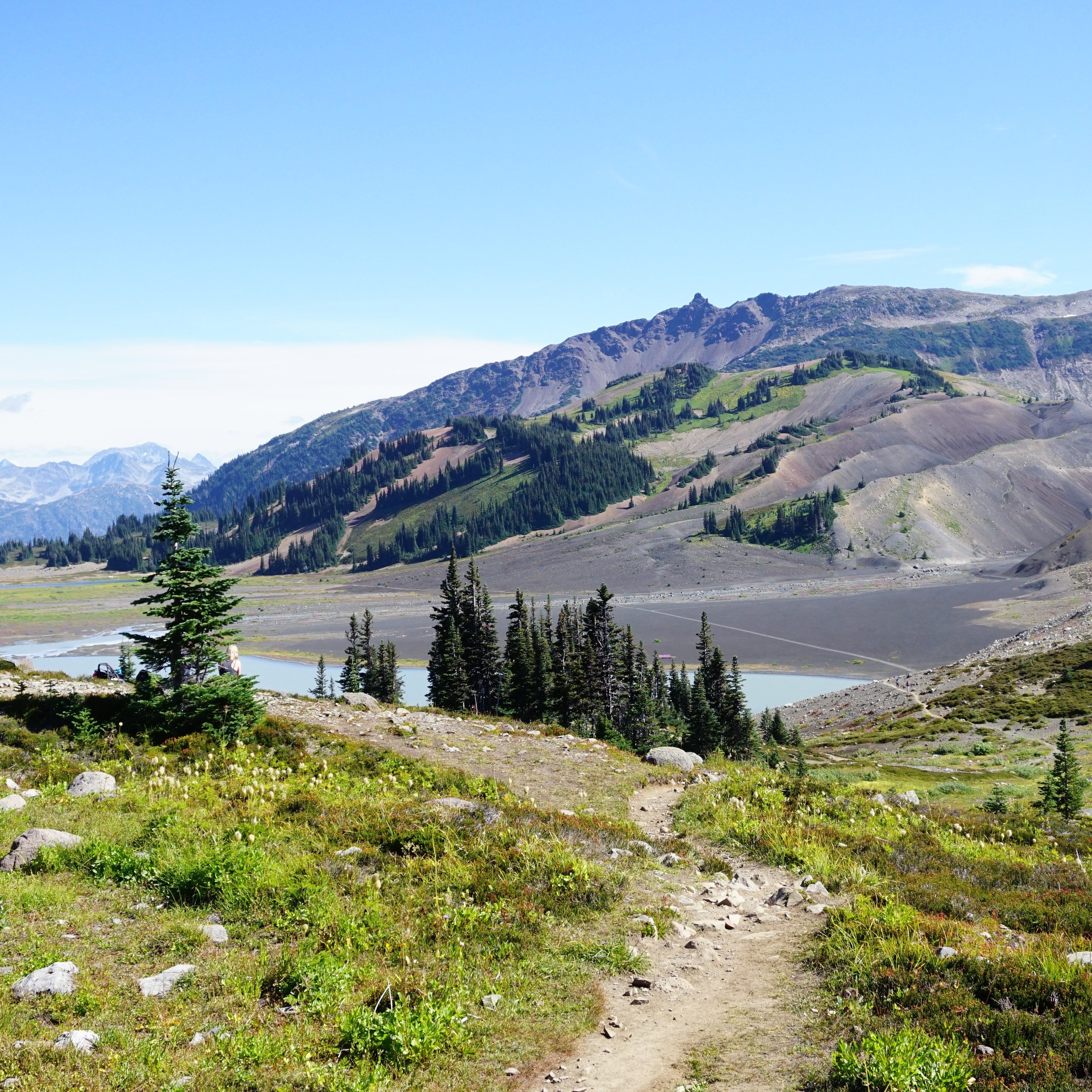
A hiking trail extends through the alpine of Garibaldi Provincial Park towards Helm Lake, with the forest and mountains in the background on a sunny day in British Columbia, Canada

This route doesn’t have a formal name, but extends from Rubble Creek to Cheakamus Lake in Garibaldi Provincial Park, near Whistler. If you’re on my website, most likely you’re familiar with this trail because of the popular trips to Garibaldi Lake, Black Tusk, and the iconic Panorama Ridge. Lots of people explore these trails as a day hike or a 1-nighter from Garibaldi Lake or Taylor Meadows. But I always recommend turning it into a multi-day trip by continuing on to Helm Creek. This trail is more appropriate for newer backpackers because of its substantial facilities. 

This hike can be customized to whatever length you prefer. Start at Rubble Creek and spend a few nights at Taylor Meadows or Garibaldi Lake and explore Black Tusk or Mount Price. When you’re ready to go to Panorama Ridge, pack up your camp and stop at the ridge on the way to the Helm Creek Campsite, which takes you through the gorgeous Helm Lake area. From there, you hike down towards the Cheakamus Lake parking lot. If you want to extend the trip further, make a detour to Cheakamus Lake or Singing Creek campsites. This hike requires camping reservations, which release 4 months in advance of your date from camping.bcparks.ca.

HBC Heritage Trail

A photo of Palmers Pond on a summer day, with the green meadows, forest, and mountains in the background, on the Hudson's Bay Company (HBC Trail) near Hope in British Columbia, Canada.

In my opinion, this is one of the most challenging trails on the list (except for maybe the North Coast Trail). HBC stands for Hudson Bay Company and is a historic trail that was originally used by the First Nations and later by the fur trade. The trail is 74km long and extends through the mountains from Hope to Tulameen. A lot of the trail is through the forest, but it has some gorgeous campsites and views along the way. It’s not an overly popular trail and you likely won’t see many people on it if you like solitude. 

What makes this trail challenging right now is the state of the trail. The trail has been revitalized in recent years and has a dedicated volunteer maintenance group, but the 2021 flood was particularly hard on this area. Volunteers have been working to clear the trail, but there is still quite a lot of blowdown in some sections and the trail does require fording at least 3 rivers. All of the campsites have nice facilities, so if you give yourself enough time to navigate the technical terrain, it is a beautiful trail.
Heather Trail

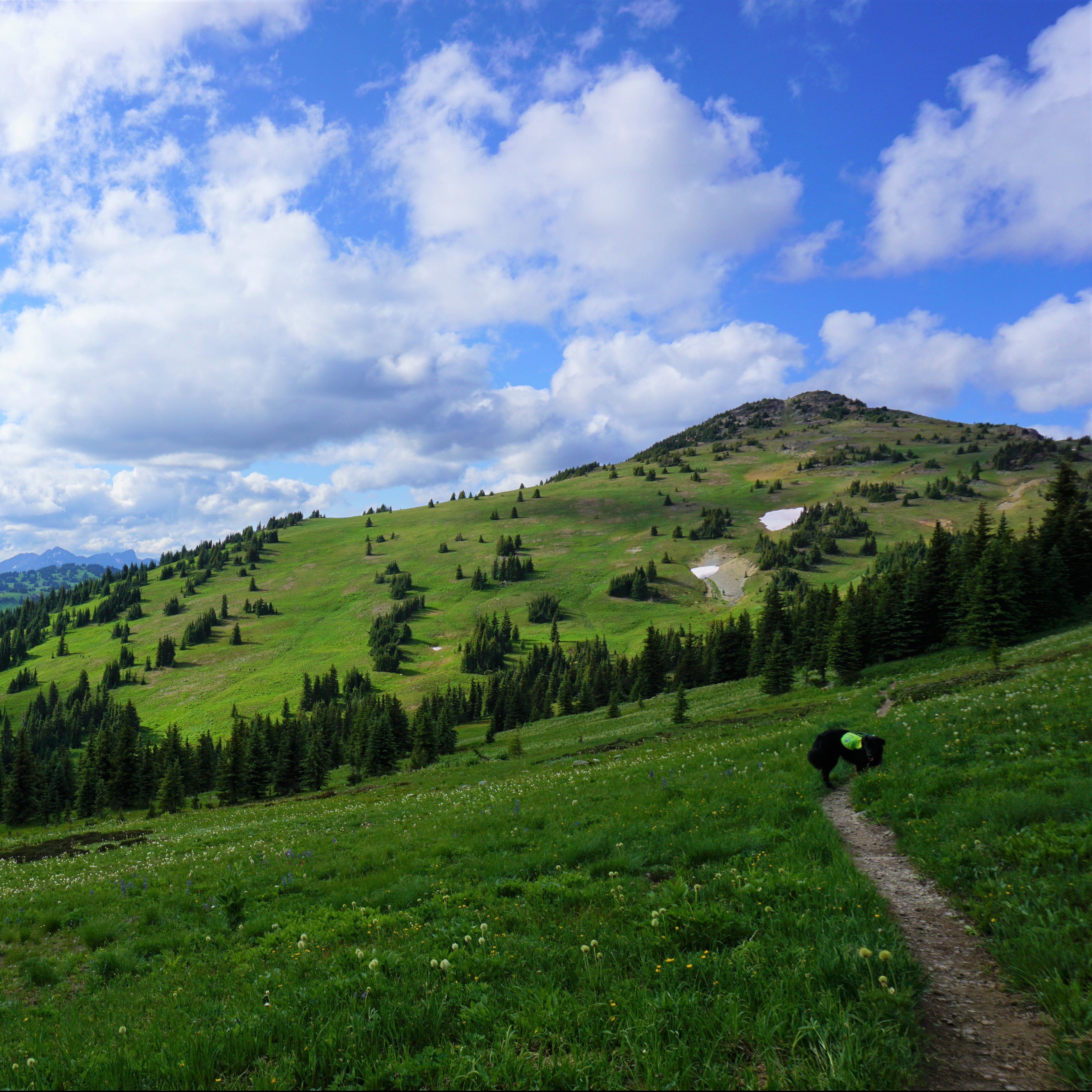
If you’re new to thru-hiking, the Heather Trail would be my recommendation. This is a relatively easy trail, with gorgeous views and brand new facilities. It’s located in E.C. Manning Park and can be done over 2-3 days. The trail starts at the top of Blackwall Road, which means most of the challenging elevation gain is done in the car. Technically, the Heather Trail is 21km, ending at Nicomen Lake and requiring an out-and-back trip. However, if you connect to the Grainger Creek and Hope Pass Trails from Nicomen Lake, you can turn this into a ~40km thru-hike, ending at Cayuse Flats.

Over 2 nights, I would camp at Kicking Horse and Nicomen Lake, or you could add a night at Buckhorn Campsite at the start of the trip and take your time. The trail is all in the trees after Nicomen Lake, and even though it’s 17km from Nicomen to Cayuse Flats, it’s a very easy trail, though there is another campsite option at Grainger Creek. You do need backcountry reservations to stay at these sites as of 2024, which can be obtained 4 months ahead of your trip at camping.bcparks.ca.

Skyline II Trail

I love Manning Park and the Skyline II Trail is one of my all time favourites. This trail is more difficult than the Heather Trail, but still a relatively easy trip. The trail is approximately 25 kilometres from Strawberry Flats in Manning Park to Whitworth Meadow in Skagit Valley Park. There is one campsite at the halfway mark, Mowich Camp. 

While this hike can be done in one night, I highly recommend doing 2 nights at Mowich Camp and making a detour to hike the 15km round trip trail along Hozomeen Ridge and back. This trail will take you to the border monument and a fantastic view of Hozomeen Mountain in the US. The trail itself is easy to follow and takes you through gorgeous alpine meadows. The campsite is pretty basic and the water source can run dry later in the summer. A backcountry permit is needed and can be obtained 2 weeks prior to your trip at camping.bcparks.ca.

Sunshine Coast Trail

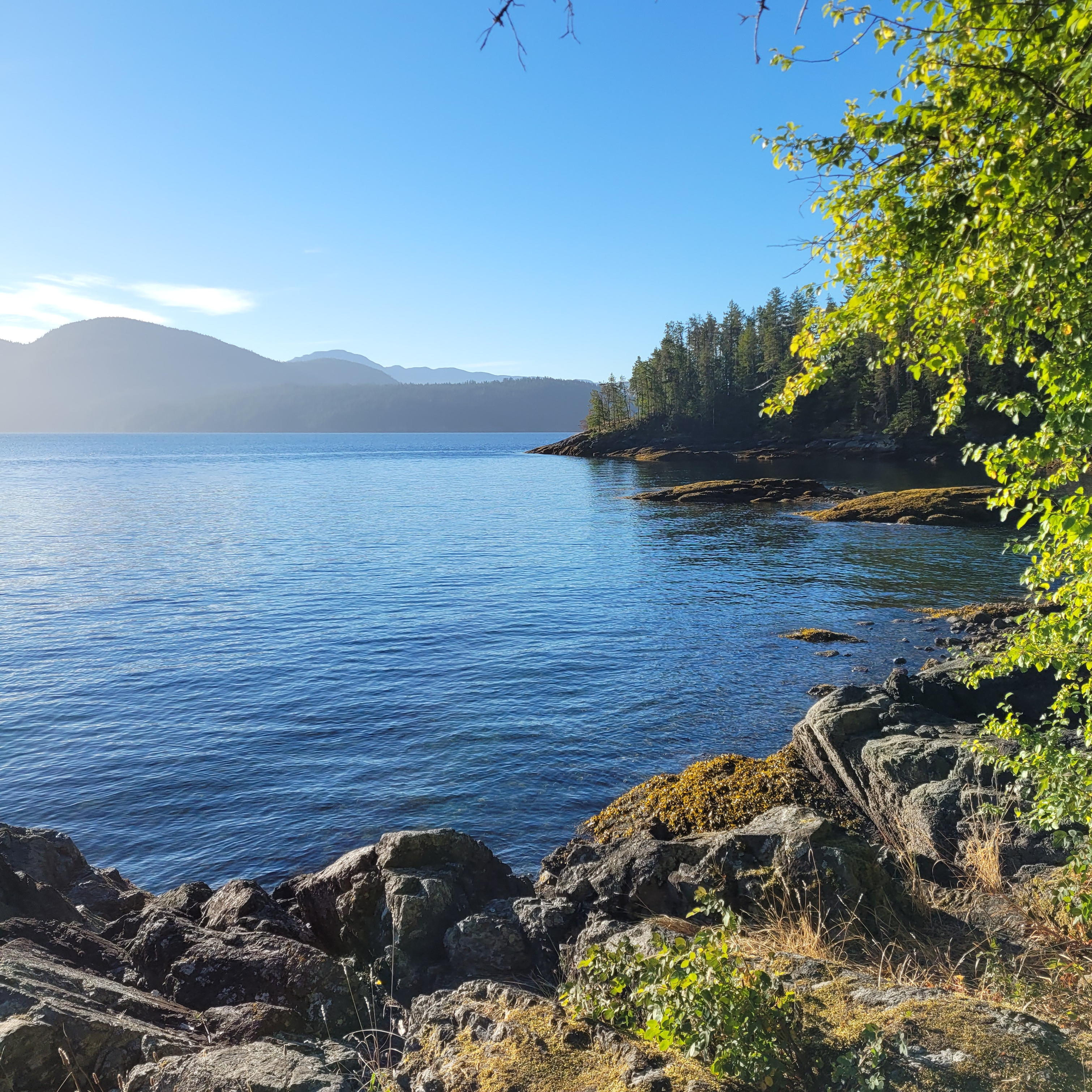
Sunny view of the ocean and beach at Fairview Bay on the Sunshine Coast Trail in British Columbia, Canada

This is the longest trail on my list, but is hands down my favourite thru-hike ever! The Sunshine Coast Trail (or SCT) is 180km and extends through the entire upper Sunshine Coast, from Sarah Point on the Malaspina peninsula, to Powell River, and down to the ferry at Saltery Bay. The SCT is unique because it is a hut-to-hut hiking route, which means you can do the entire trail, staying in free mountain huts along the way. 

The trail can be a challenge to coordinate in terms of transportation and food carries, but it is incredibly well maintained by volunteers, with gorgeous facilities. You can do a section of the trail, or commit to the entire thing. The trail is primarily in the forest and tackles a lot of cumulative elevation gain. There are tons of lakes to enjoy a cool swim and some amazing viewpoints along the way. The trail can get busy, so if you plan to stay in the huts, you should still bring a tent with you as a back-up.

Juan de Fuca

The Juan de Fuca trail is often touted as a great beginner coastal trail. It is good in that it’s a lot easier than its more popular sister trail, the West Coast Trail, but it is still challenging in its own right. It’s a 47km trail on Vancouver Island between Port Renfrew and China Beach. There are several nice campsites located both in the forest and along the beaches, but like all the coastal trails on the island, it can be very technical and muddy.

It’s been several years since I did this trail and I have heard that some parts have received much needed maintenance since I did it, but it will still be quite muddy in early summer and there are several tidal points on the trail that require advance planning to cross. The nice thing about this trail is that there are several bailout points that connect to the highway if the trail is too challenging. Backcountry permits are required and can be obtained 2 weeks in advance from camping.bcparks.ca.
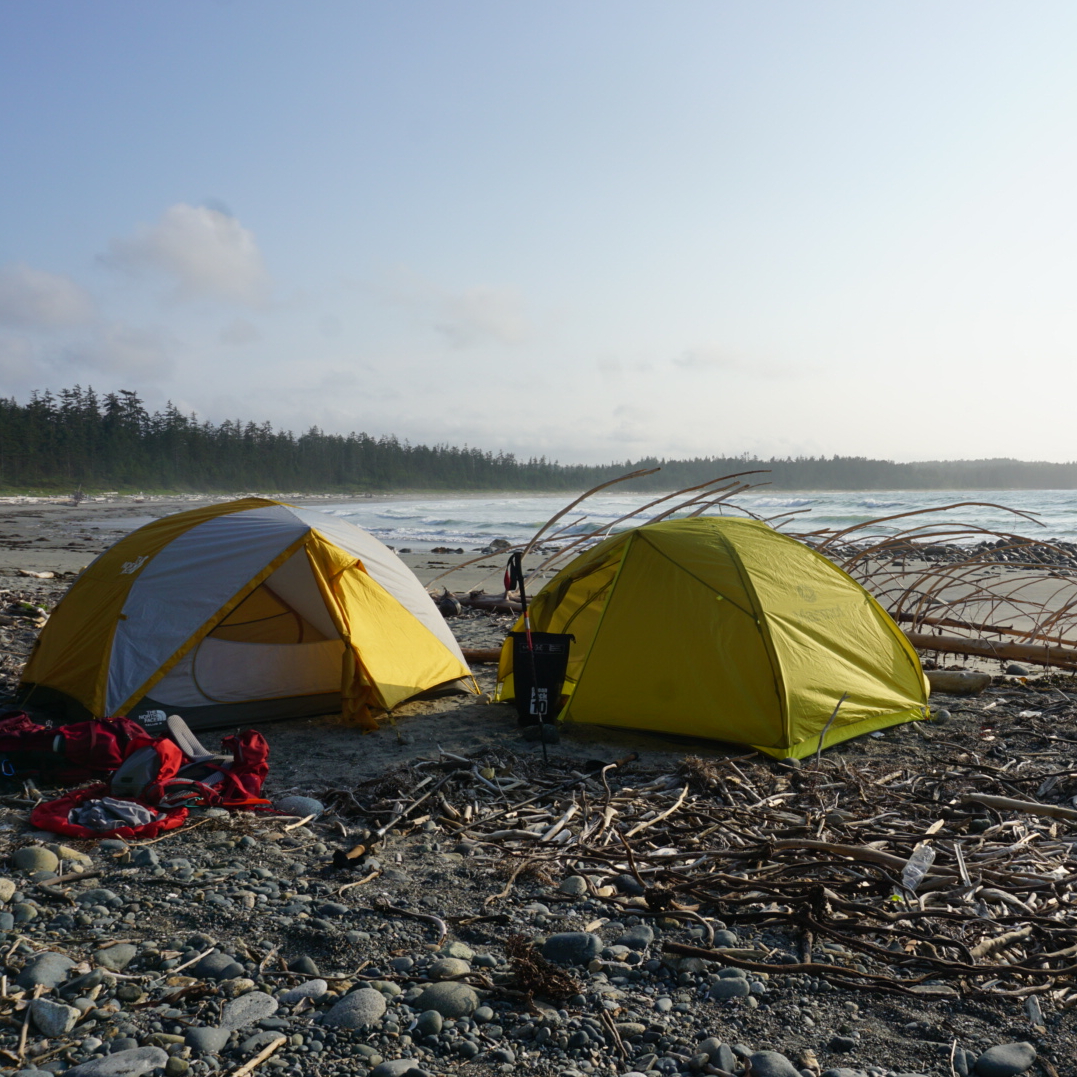
North Coast Trail

Two tents camping on a golden sand beach with drift wood and the forest and waves of the pacific ocean in the background at sunset on Irony Creek Beach in Shuttleworth Bight on the North Coast Trail on Vancouver Island in British Columbia, Canada.

The North Coast Trail (or NCT) is probably the hardest hike on this list. It’s much less popular than the West Coast Trail, but the traffic to this hike has definitely been growing. The NCT is a ~60km hike on the far north coast of Vancouver Island. It has a reputation for being extremely muddy and it doesn’t get very much maintenance. The NCT is only accessible by water taxi, so most people add on another ~25km of hiking to Cape Scott to finish this trail.

The Cape Scott Trail is accessible by dirt road and is better maintained than the NCT. The highlights of both trails are the gorgeous, remote beach campsites. There are several tidal points on the trail and you should be prepared for a very slow hiking pace through extremely technical terrain. But you’ll also likely get to view bears, eagles, and if you’re lucky, maybe even a wolf. Backcountry permits are required for this hike and can be obtained 2 weeks ahead of your trip at camping.bcparks.ca.

Mount Assiniboine

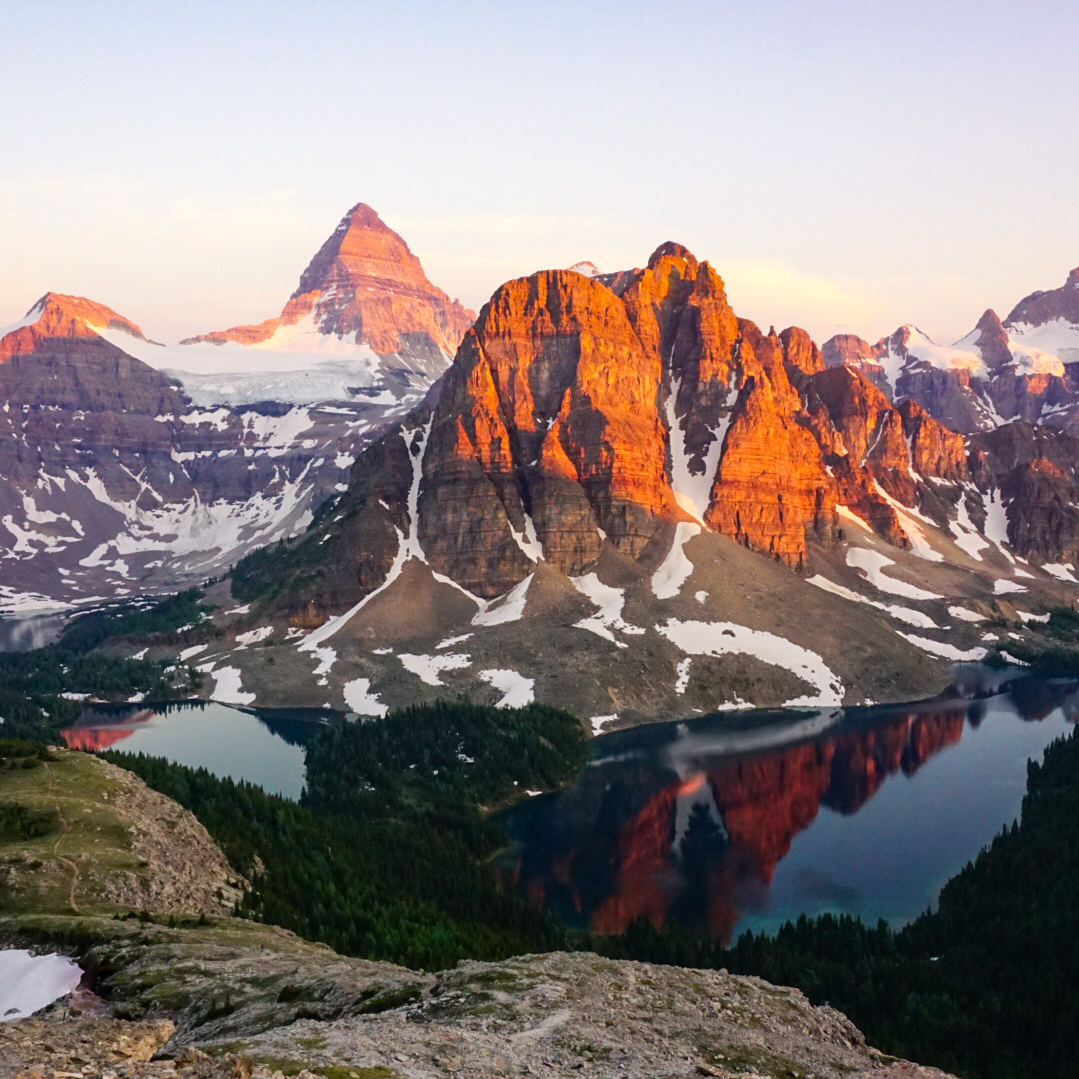
A photo of Mount Assiniboine and Sunburst Mountain and Cerulean Lake at sunset from the Nub in Assiniboine Provincial Park in British Columbia, Canada.

Mount Assiniboine can be accessed as a loop trail, thru hike, or by helicopter. Of course, I did the thru hike option. Mount Assiniboine is one of BC’s premier mountain campsites and there is a lot to explore from the core area of the park. We planned for 3 nights in the Magog Lake Campground, and 1 night on either end of the trip to hike in and out. While Assiniboine Park is located in BC, the hike is accessed through Banff National Park in Alberta.

Take the gondola up to Sunshine Village and hike through the alpine meadows to Porcupine Camp on night one, then continue to Assiniboine for several days in the park. Explore Magog Lake, Cerulean lake, and Sunburst Lake, as well as the iconic hike up to the Nub for sunset. On your way out, hike through beautiful Wonder Pass and camp at Wonder Lake before ending your hike at Mount Shark. You will need to coordinate 2 vehicles and book backcountry reservations for Assiniboine 4 months in advance at camping.bcparks.ca, as well as backcountry reservations for Wonder Lake at reservation.pc.gc.ca, which release sometime in March for the entire season. 

Rockwall Trail

The Rockwall on a sunny day with the mountains in the background and the forest in the foreground with blue sky in Kootenay National Park in British Columbia, Canada.

The Rockwall Trail is another extremely popular trail located in Kootenay National Park. It’s a 55km trail from Paint Pots to the trailhead for Floe Lake that is incredibly scenic. There are a number of campsites along the trail and it can be done in 3-4 nights. Floe Lake is the most popular campsite on the trail, but I also highly recommend staying at the Helmet Falls campsite. Along the way, you can stay at Tumbling Creek, Numa Creek, or both, they’re pretty similar sites. 

The trail is very well maintained and has lots of facilities. Campsites release for the entire season in March at reservation.pc.gc.ca, so make sure you watch for the release date, because the sites will sell out immediately. If you’re lucky enough to score permits, enjoy this beautiful trail through the Rocky Mountains and past the iconic Rockwall. 
SCT Part V: Confederation Lake to Elk Lake Hut

Click here to start reading Part I.

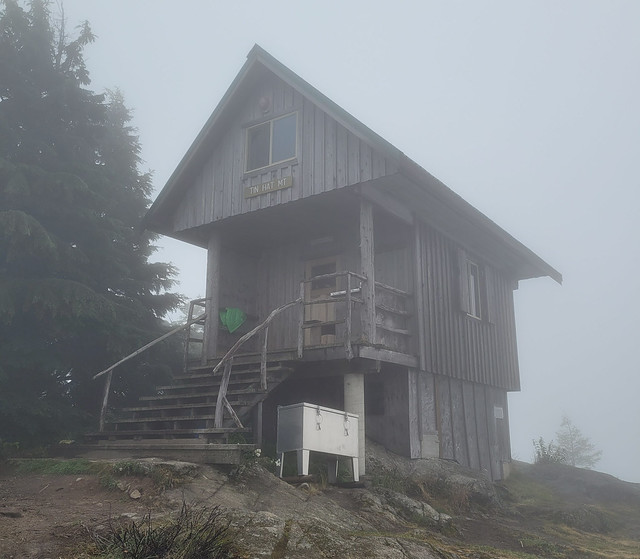
I was really lucky to have great weather while on the Sunshine Coast Trail. It was hot when me and Emily visited, but clear and sunny. Likewise, when I returned in September, it was cooler, but still nice and sunny. There was one day of rain in the forecast that coordinated with my day hiking from Confederation Lake to Tin Hat Hut. Tin Hat is the highlight of the SCT, so I was a little disappointed initially, but the forecast was looking good for the following day, so I figured that even if I didn’t get the view on the way up, I would still likely get to enjoy it.

It started raining overnight while I was at Confederation Lake, so I was glad to be in the hut. I got up early again to start hiking and was on the trail by 8am, despite the rain. Fortunately I was in the forest, so while it rained my whole hike down from the lake, I never got wet through any of my layers. The annoying thing about Confederation Lake is that after you leave the hut, you immediately undo the 600m of elevation gain from the previous day as the trail continues back down to Fiddlehead Hut on Powell Lake.

20220904_111718

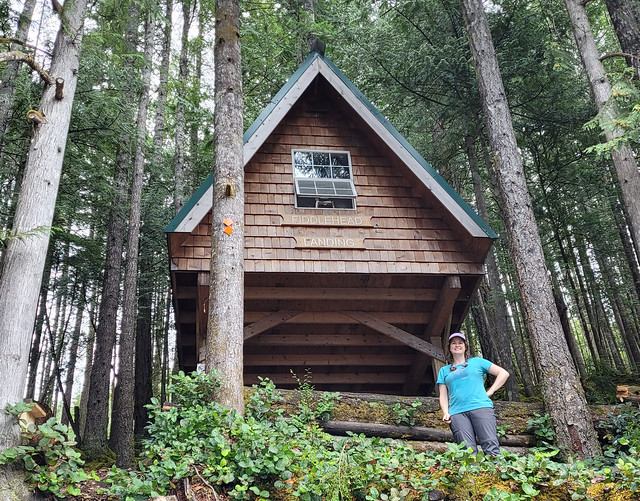
It got dryer as I hiked down and by the time I reached the bottom, it had stopped raining altogether! It’s about 500m off trail to hike down to the hut at Fiddlehead Landing, but of course I made the detour to see the hut. There was a small crowd at Fiddlehead (4 people). The friend from the previous night was there, along with a couple from Vancouver, and a mountain biker. The 3 hikers were also hiking up to Tin Hat for the night, so I had a quick conversation with them before they departed and then chatted with the mountain biker while having a snack and some lunch.

Fiddlehead Hut is really nice and I think it’s more popular than Confederation Lake because of its close proximity to Tin Hat, but I think the Confederation Lake Hut is better overall. The Fiddlehead Hut still has an enclosed sleeping loft, but it’s totally open on the bottom and because of it’s location in the trees, it’s cooler and darker.

20220904_143404

After Fiddlehead, I had 8km to the top of Tin Hat Mountain, but it was almost 1200m in elevation gain, so I had my work cut out for me! As far as climbing goes, I would say Tin Hat is definitely the hardest climb on the whole trail. There are several other climbs, but the climb to Tin Hat feels the steepest and longest (technically Troubridge is longer, but it’s not as steep). I’m actually really thankful for the weather that day because even though the rain had stopped, it was still overcast. It was muggy climbing up the mountain, but not as hot as it would have been with the sun out. Blue sky did poke through a few times and I got one really nice view down into the valley, but the higher I went, the foggier it got.

20220904_154109

The challenging thing about Tin Hat Mountain is that there is no water source at the top. Most of the streams were still running in August, but when I returned in September, almost every creek listed in the guidebook was dry. When the campsite has water it isn’t a problem, but when your campsite doesn’t have water, it makes for large water carries. There’s a stream about 5km before the top, which is the last place to fill up, but even that stream was almost dry. As a precaution, I got most of my water from Powell Lake and then filled up my last bottle at the stream. I carried 5L of water up, which weighs a whopping 11lbs! 5L was definitely overkill, I think I would have been okay with 4L, but I don’t like having to conserve water and be thirsty, so I lugged it all up there for comfort. I wasn’t sure where my next water source would be the next day and I wanted enough water to get me down the mountain to Lewis Lake.

20220905_065823

When I got to the top of the mountain, it was totally fogged in, but the hut is fully enclosed and it was so cozy in there I didn’t even care! Plus, it was the middle of the labour day weekend and I was thrilled to have other people around. The solo hiker was there, along with the couple from Vancouver, as well as a couple from Prague and their cute dog, so 6 of us in total. These 5 other hikers totally gave me life! I was still getting used to solo hiking at this point and it was so much fun to hang out with other people who have similar interests at the end of a long day. Everyone was really nice and talkative and I thought we had a lovely evening sharing about our lives. It really energized me. I didn’t know it at the time, but it was my last night camping with other people and it helped to motivate me over the next few days. Tin Hat Mountain is a really special place and I’m so glad I got to share it with such fine folks!

20220905_063658

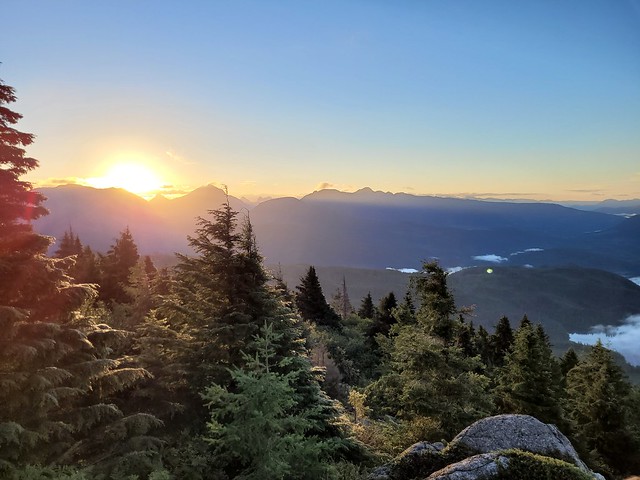
It was cold at the top with all the clouds, but they did start to clear out and around sunset we got a few glimpses of the view surrounding the hut. Even the limited view was incredible and I was excited for the following morning when it was forecasted to be clear. We decided to go to bed early and then we all got up to catch the sunrise at 6:30am (another benefit of September hiking – later sunrise).

It was totally clear when we woke and we enjoyed our breakfast out on the rocks while the sun came up. After breakfast I packed all my gear, but I opted to hike up to the top of Tin Hat Mountain before continuing on. The hut isn’t located right at the peak, but it’s only another 10-15 minutes to go up to the radio tower at the top. I’m so glad I did this because the view at the top is really out of this world! A definite highlight of the trip for me. The upper Sunshine Coast has so many lakes and mountains, it really makes for the most scenic view and I loved looking out over the backcountry with a 360 degree view. I had a little solo photoshoot at the top before saying goodbye to everyone and continuing on.

20220905_082625

I didn’t see the solo hiker anymore after this as she only had 3 days left in which to finish the entire second half of the trail, and the other couples were heading back to Vancouver. Tin Hat is located at km89, so it’s pretty much exactly at the halfway point. I had 5 days to go before I planned to finish the trail and I hoped I would meet more hikers before then!

I had two options for that night. I could go a short distance (9km) and tent at Lewis Lake, which Carolyn told me was one of her favourites, or I could go a long distance (23km) and camp at the Elk Lake Hut. I would have loved to linger at Tin Hat, but I knew that by nightfall, I’d prefer to be at the hut, so I departed for Elk Lake, which was definitely the right decision distance-wise.

20220905_111210

It was a bit of slog down to Lewis Lake with all the downhill, but the campsite was really lovely! I got there just in time for lunch and took a lake bath and washed some of my clothes before continuing on. I had 14km to go from there, which I wasn’t looking forward to, but it ended up being much easier hiking than anticipated. It was quite flat and I ended up powering through 7km in 90 minutes! That was probably a pace record for me, but it came at a cost and I noticed I had 2 small blisters when I stopped for a snack, so I forced myself to slow down to protect my feet.

20220905_121438

I saw a couple exploring Lewis Lake and 1 solo male hiker going in the opposite direction, otherwise, I didn’t see anyone else all day. The topography was interesting between Tin Hat and Mount Troubridge because you’re pretty much hiking through or along clear cuts the entire way. You can’t see what’s been logged when you drive the sunshine coast along the main highway, but there’s a lot of it going on in the backcountry. I think that’s one reason I didn’t encounter much wildlife, because of the heavy machinery. Though I did have to go through a few detours where the logging had forced the trail elsewhere.

20220905_145009

It’s a pretty gentle uphill for most of the day, the only real challenging part is the last 1-2km, where there’s a steep climb up to the lake. I pushed through, arriving around 4pm, but was immediately disappointed to be the only one at the hut. I expected it, but it was still disappointing. Elk Lake is a small lake with a big log wharf extending out into it. It’s a partially enclosed hut with an open front along the trail and windows looking down on the lake. Unfortunately there was no service at the hut, so it was probably my most anxious night on the trail, also not unexpected seeing how it would be my first night alone.

20220905_175232

I played some music while I cooked dinner and did my nighttime chores. The worst part about camping solo is the monotony before bedtime. I hadn’t brought a book with me, so there was really nothing to do. I had an audiobook, but I was trying to conserve battery, so every minute listening to my audiobook or music was a treat. I killed time until sunset and then opted to go to bed early. I was nervous about bears, but felt reasonably safe in the sleeping loft and was honestly more nervous about mice. I’d heard they could be pretty bad in the huts, but shoutout to everyone keeping the huts clean this season because I didn’t see a single mouse in any of the huts I stayed in! So fortunately, I ended up sleeping better than anticipated my first night alone on the trail and it did get easier after that. Continue reading Part VI.

20220905_165104

SCT Part IV: Powell River to Confederation Lake

Click here to start reading Part I.

When I got off the trail on August 6th, I felt like the disappointment of not finishing was going to swallow me whole. I’ve had to be pretty fluid with a lot of my trip planning through Covid (like everyone else); when my trip to Assiniboine was cancelled in 2020, I did the North Coast Trail; when Seth got a new job in 2021, we postponed our kayak trip to Desolation Sound; and when Jasper caught fire in 2022, Brandon and I relocated to Strathcona Park. But the SCT had been on my bucket list for several years and I had trained for it and prepared all my gear for this year and I really wanted to finish it.

So I did. Carolyn had been forced to do the entire thing solo when me and Emily got off the trail, so I’d like to think she gave me some confidence to return and finish the rest of the trail solo too. I already had time off in early September, so I finished work a little early on the Friday before the Labour Day long weekend and flew back to Powell River for another attempt. Seeing as I got off the trail at the Shingle Mill Pub, the float plane was the perfect way to return. The shuttle company dropped off some of the supplies I couldn’t fly with (bear spray and fuel) and I arrived at the pub around 5pm and was back on the trail within minutes of arriving!

20220902_165310

After leaving the pub, you cross the bridge towards Powell River and then you can immediately jump back on the trail. Emily and I had been planning to camp at Tony Point the night we got off trail, which is 5km from the pub (seen from the float plane in the photo above), so I just picked up my old itinerary and started walking. It’s about an hour to Mowat Bay, which is a popular recreation site on Powell Lake where I stopped for a quick snack, and then another hour to Tony Point, also located on the lake. I did modify my itinerary when I decided to go solo to stay mostly at huts, but given my late start time, I knew I would have to camp the first night.

20220902_180244

Tony Point is a lovely little site next to the water. It has a picnic table, a monument, flat space for ~2 tents, and not much else. I assumed I would be alone, but fortunately, there was another solo female hiker there as well! I was prepared to sleep alone, but was also thrilled to have someone to help ease into solo camping. We ended up crossing paths for several days and it was nice to trade stories.

I went for a quick swim when I arrived and then had supper before setting up my tent. I was feeling pretty confident, but the forest definitely changes when you’re alone at night. On this evening, it was windy, which created a lot of ominous sounds in the woods and the trees kept dropping leaves on my tent, so I was glad for a companion. I kept thinking a bear was walking into the site, so eventually I got up to have a look around. It was clear there was nothing there and that helped ease my mind and eventually I was able to fall asleep. I ended up sleeping in the huts every night after that, so it was a little annoying to carry my tent for another 130km for no reason, but still a good safety precaution.

PSX_20220929_122048

It was nice and sunny the following morning, so I set off before 8am. The other hiker was hoping to go all the way to Fiddlehead Hut, but I was only aiming for Confederation Lake Hut. It’s still a lofty 19km of hiking, but I really wanted to go the long route around Inland Lake, so I ended up clocking 24km. I was a little on edge hiking the first morning because I was very weary of bears. The trail continues around Powell Lake before going through the Haywire Bay Car Camping park. Shortly after Haywire Bay, I scared something large in the woods – I never saw it, only heard it running away from me – it was either a bear or a deer, so I was very diligent with my bear calls after that. I saw lots of evidence of bears (poop), but I never actually saw a bear, so I got a lot more comfortable walking around alone in the woods after a few days.

The trail continues around Lost Lake, which is pretty overgrown, before you come to Inland Lake, which I was really looking forward to. Inland Lake is a provincial park with some frontcountry sites, huts, and a huge loop around the lake. If you do the whole loop, it’s 12km, but on the SCT, you can either do the south end (4km) or the north end (8km). I was looking forward to this section because it follows the shoreline around the entire lake and as a result, it’s completely flat. I was determined to do the longer route because there’s a hut on the west side of the lake that can only be accessed on this route.

PSX_20220929_122808

I really wanted to visit every hut and take a selfie at each one, so I decided the extra kms were worth it. But I ended up really messing it up. I was having a great time walking around the lake – the kilometers were going by quickly and it was a gorgeous sunny day. I hadn’t yet seen any people, but I was enjoying walking along the lakeside. Such was my enjoyment, that I ended up walking right past the hut without realizing it!! I passed a small log building and picnic shelter that I thought was lovely, but I didn’t stop because according to my GPS (Gaia), the hut was still 2kms away. The paper map shows “Pier Hut” in this location, so I assumed that’s what it was and continued on towards “West Hut” as it’s called on the SCT website. As it turns out, Gaia is wrong about the hut location and West Hut and Pier Hut are in fact the same thing! I didn’t realize my error until 2kms later, so I ended up completely missing it.

PSX_20220929_122643

There are 2 huts on Inland Lake: “West/Pier Hut” and “Anthony Island Hut”. My guess is that these two huts were built and designed by BC Parks since they’re in the provincial park and are completely different than all the other huts on the trail. These huts were 1 story and could sleep ~3 people, whereas the rest are all 2 stories with a sleeping loft, so I’m not surprised I didn’t recognize it. I don’t have a photo with Pier Hut, but I don’t regret going the long way around the lake because it was a very beautiful trail that passed quickly. Plus I later learned that the south trail has a detour along most of it, so I was glad I got to spend so much time on the lake, as the south route mostly bypasses it with the detour.

I took a short break at the end of the lake to go for a swim and then continued to Anthony Island Hut for lunch. I finally saw a few people around the lake, but it was pretty empty. I passed a group of day hikers, a family bike riding, and a couple on their paddleboards. Otherwise I didn’t see anyone else on the trail all day! When I stopped for lunch before 1pm, I had already hiked 17km, so it was a big start for me and I was feeling good!

PSX_20220929_122941

I was able to maintain this pace since it was mostly flat, but after lunch it was all uphill to Confederation Lake. The trail does 600m of elevation gain in 5km through the forest, so I listened to my audiobook while I trekked up through the woods. It’s a pretty boring and steep trail up to the lake – I’d briefly flirted with the idea of going all the way to Fiddlehead to catch my companion from the night before, but 24km of hiking was definitely enough for me. The most annoying part of Confederation Lake is that when you finally get there, there’s still another 2km through the woods around the lake before you finally get to the hut. But I loved the hut!

20220903_162755

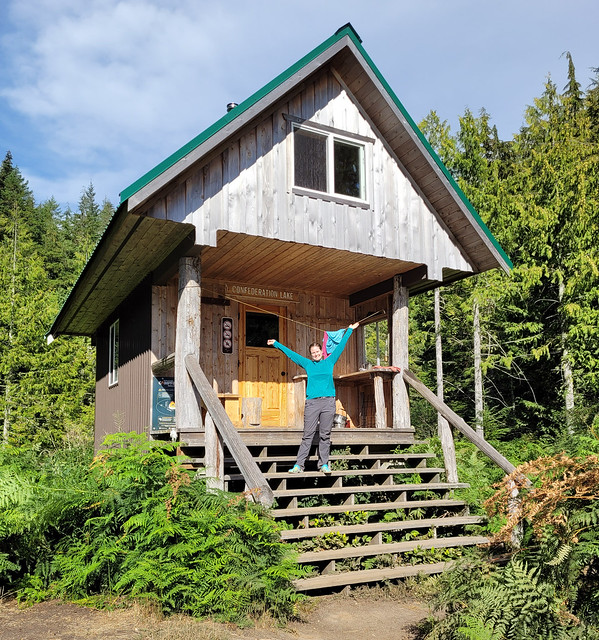
I haven’t heard a lot about Confederation Lake Hut, but it’s really nice! It’s located right on the lake and is fully enclosed, with enough room for a handful of tents. I arrived around 4pm and was the only person there. I took a bath in the lake and then settled in for a snack. I was expecting to be alone at the hut, but it felt nice and safe, so I was okay with it. So I was thrilled when I came back from filtering water and found a family of 4 had arrived for the night! It was an older couple with their grown daughter and her friend/partner. They were super nice and I enjoyed hanging out and chatting with them for the rest of the night after having been alone all day. I’m an extrovert, so I definitely relish the opportunity to chat with people after a day on my own. The theme of my trip was early nights and early mornings though, so I said goodnight as soon as the sun went down.

Continue reading Part V.

20220903_164244