The Ultimate Guide to Snowshoeing near Vancouver

Hiking in Vancouver is definitely becoming less and less of a fair-weather activity. People want to be outside all year round, not just in the summer, and snowshoeing is a great way to do that! While going into the backcountry has inherent risks in every season, they are definitely increased in the winter. It’s colder outside, you have less daylight, trails can be harder to follow, and depending where you’re going, there’s the added risk of an avalanche. I’ve written an entire post on avalanche safety and my biggest recommendation is that, if you don’t have avalanche safety training, don’t go into avalanche terrain. 

Even if you plan to stick to easy trails, without taking a course, it can be hard to know if you’re putting yourself in avalanche terrain or not, which is why I recommend for everyone to take an AST1 course. Did you know that popular winter trails like Pump Peak, Elfin Lakes, Hollyburn Mountain, St. Mark’s Summit, and Joffre Lakes all go through challenging avalanche terrain at some part of the trail? Just because a trail is popular, it doesn’t mean there is no risk.

The safest option is to take a course, but if that’s not in your budget right now, I’ve compiled a list of trails that are in simple terrain, so the risk is greatly reduced, though never removed! Always check the avalanche forecast and only go out if the avalanche rating is low or moderate.

Lower Mainland
DSC08284

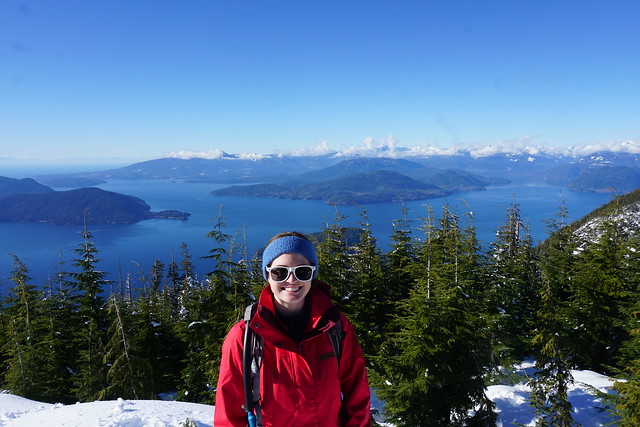
Bowen Island Lookout – Located in Cypress Provincial Park, this is a great option for beginners. The trail is 4km round trip, with 125m of elevation gain and follows a staked trail. It leaves from the resort, you just need to pick up a free backcountry pass from the BC Parks Black Mountain Lodge (not available online, only self-registration on site). The trail hikes through the woods to a beautiful viewpoint overlooking Bowen Island.
DSC03348

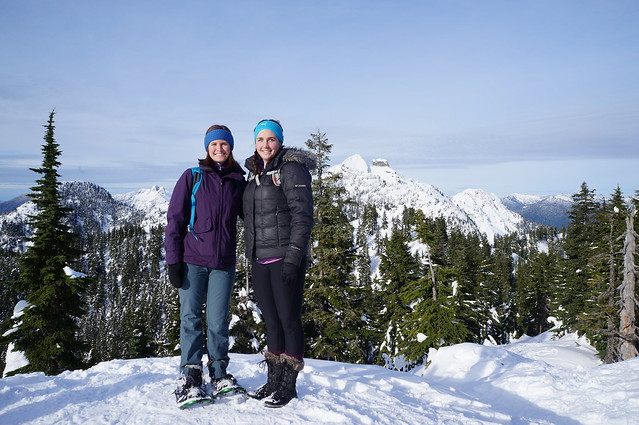
Dam Mountain and Thunderbird Ridge – Located on Grouse Mountain, take the gondola to the top and follow a 5km there and back trail up to the top of Dam Mountain. With over 300m of elevation gain, this is a more challenging trail, but it’s easy to add a walk along Thunderbird Ridge for another 1.5km once you make it to the top of Dam Mountain. Both trails boast incredible views of the city.
DSC03247

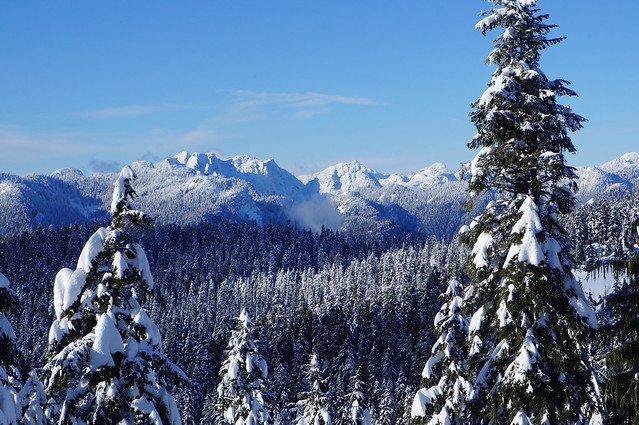
Dog Mountain and Dinkey Peak – Located in Mount Seymour Provincial Park, this trail is popular in all seasons. It’s a 5km there and back trail, with 150m of elevation gain to the Dog Mountain Lookout. The trail is in the forest, except for the city viewpoint at the end. Add another 1km if you want to add Dinkey Peak, which has fantastic views of the backcountry. In the winter, you will need a free day pass to visit the park, which can be obtained from BC Parks 2 days in advance of your visit. The walk from the parking lot to the trailhead adds an extra 1km each way.

PSX_20220118_204616

Brockton Point – Located in Mount Seymour Provincial Park, this is a more challenging hike than Dog Mountain. The overall length is 5km there and back, but there is 250m of elevation gain, making it a steeper hike. The views from the top of Brockton Peak are incredible as you’ll be able to see both the city and the backcountry. The same day pass rules apply as for Dog Mountain.

The view of Cypress Mountain ski resort from Black Mountain in the winter along the snowshoe trail near Vancouver, BC.

Black Mountain – Located in Cypress Provincial Park, this is a 5km there and back hike that covers 300m of elevation gain, making it one of the steeper hikes on this list. Trail access is from the resort and the trail hikes through the forest along the edge of a ski run. The same rules apply as for Bowen Island Lookout, you must obtain a free backcountry pass from Black Mountain Lodge.

North of Vancouver

Brandywine Falls or Alexander Falls – These are beginner trails that often don’t need snowshoes (just microspikes, or sometimes just boots). Brandywine Falls is located off the Sea to Sky Highway on the way to Whistler. It’s a 1km there and back trail to see the waterfall, but if the gate to the parking lot is closed or there are no parking signs along the highway, you won’t be able to visit. Alexander Falls is a good alternative, which is located in the Callaghan Valley, off Callaghan Valley Road. The trail is 500m there and back.
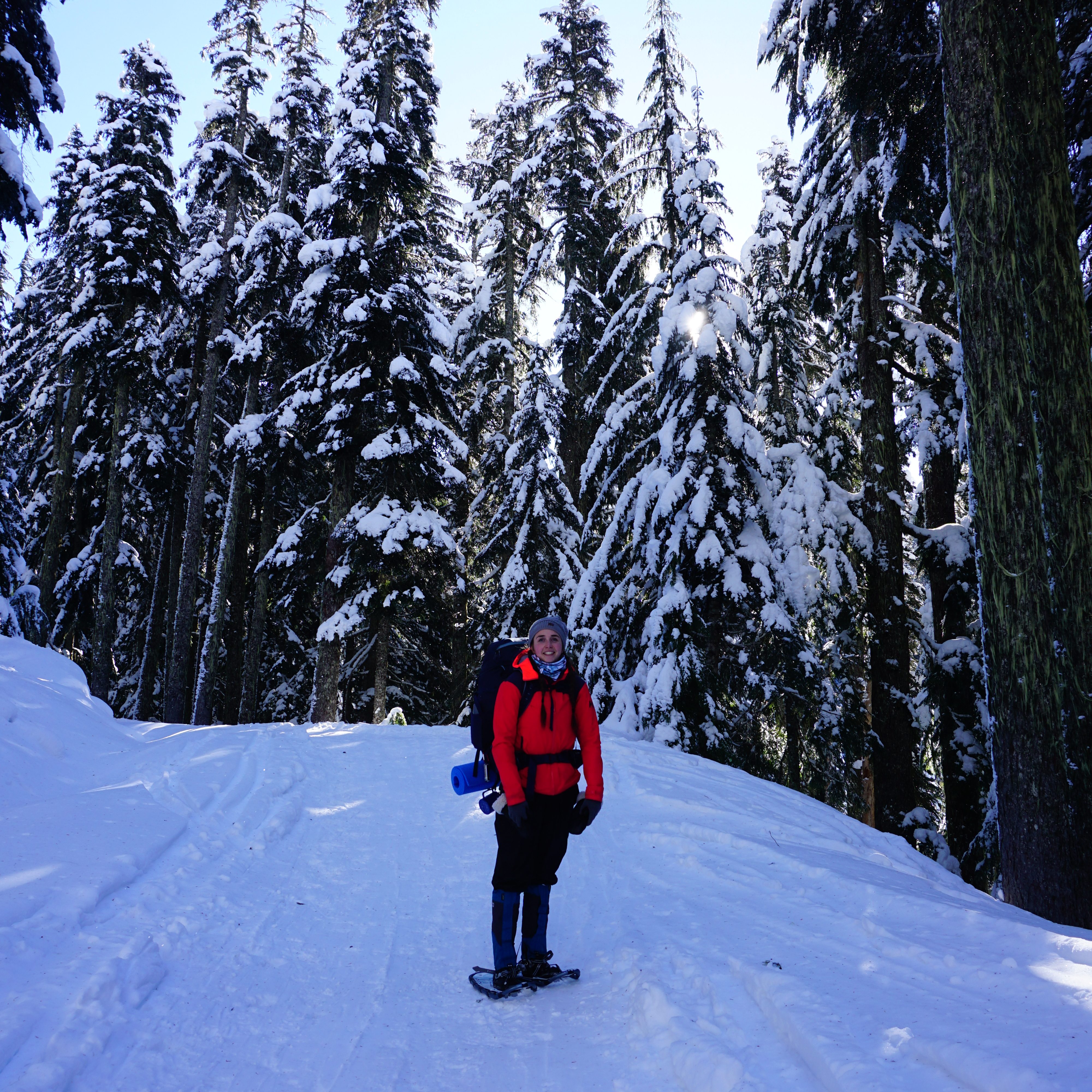
A female snowshoer backpacks on the snowy trail to Elfin Lakes with the snow covered forest in the background in Garibaldi Provincial Park in BC.

Red Heather – Located in Garibaldi Provincial Park, this is one of the more challenging hikes to access. Red Heather has the same trailhead as Elfin Lakes and is located at the end of Garibaldi Park Road outside of Squamish. In the winter, you must have chains to travel the last 2km along the road, so be prepared to hike an additional 2km each way without them. The trail follows an old forestry road for 5km to the Red Heather Hut, with 400m of elevation gain. It’s a steady uphill, but it’s not challenging. This is one of the longer trails on the list, a total of 10km from the main parking lot.

20231001_171501

Edwards Hut – Located in Tetrahedron Provincial Park on the Sunshine Coast, this is the hardest trail to access. Winter tires are a must along the forestry roads and chains may also be required pending the conditions. It may be necessary to park at the lower lot, which adds 1km to the trail in each direction. It’s 5km to the Edwards Hut, but under 100m of elevation gain. You can customize this trip, ending at Edwards Lake, or to do a loop trail around Batchelor Cabin. The total trail length is 10km from the upper lot. I have only done this one in the Fall.

Coquihalla Summit Rec Area
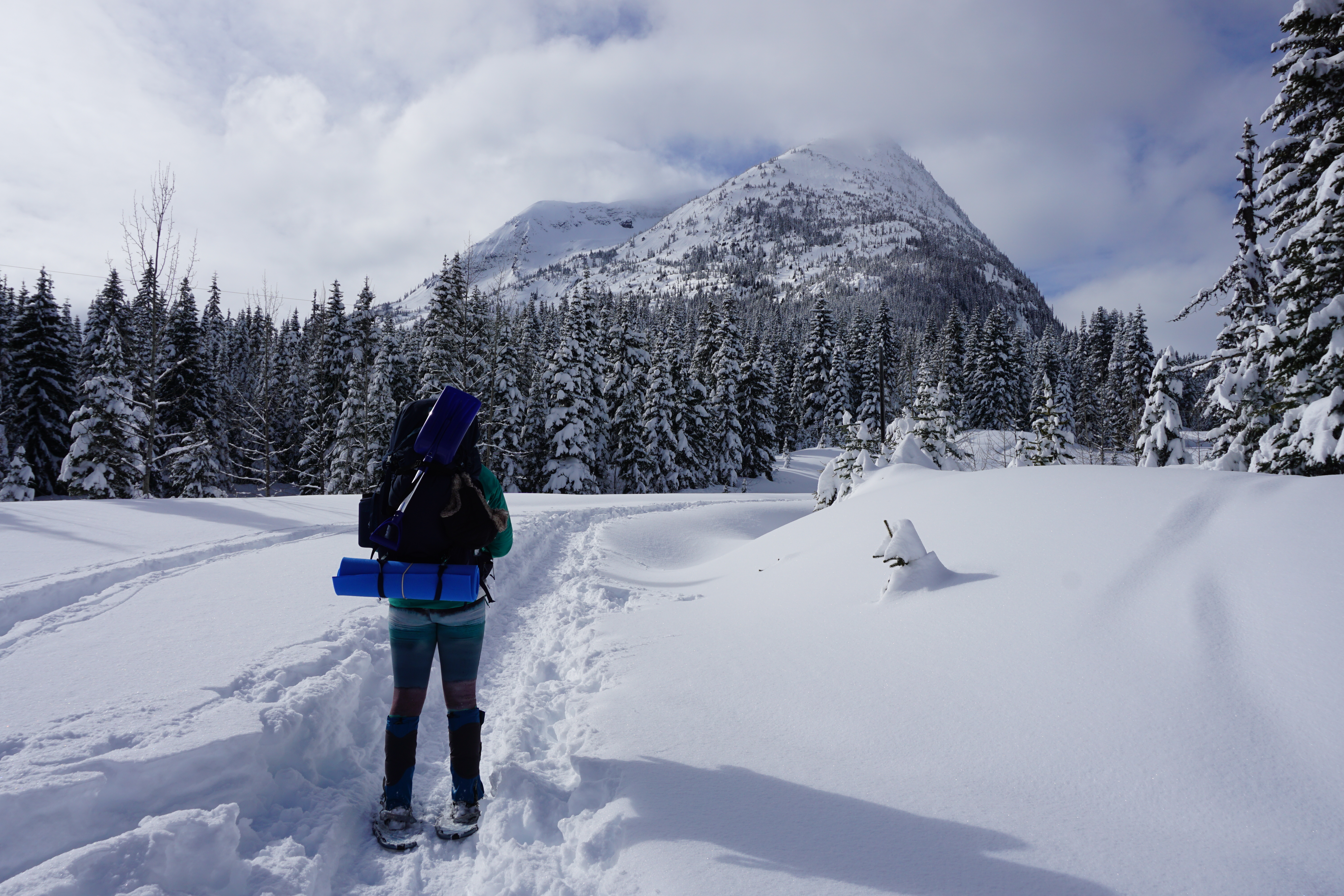
Falls Lake – This is a great beginner trail located just off the highway at the turnoff for Falls Lake Road. Falls Lake Road is not plowed in the winter, so you can park in the pull out and it’s a flat 4km there and back trail along the road to Falls Lake. 
PSX_20210314_215927

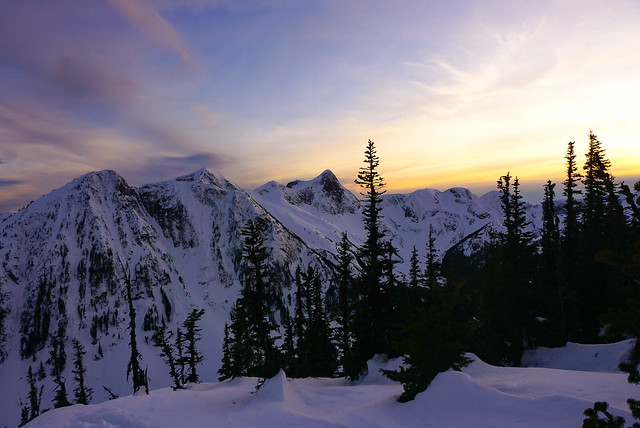
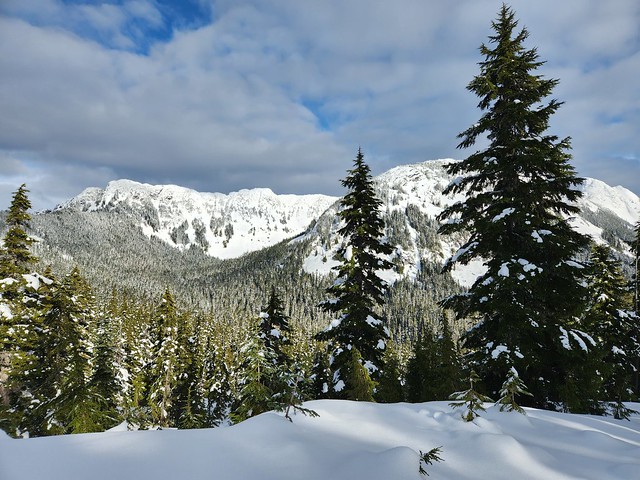
Zoa Subpeak – Located at the same turnoff to Falls Lake Road, this is an 8km there and back trail that covers 550m of elevation gain. The first 1 km of walking along the road is flat, but be prepared for a steep climb up Pipeline Road, followed by another steep hike through the forest. This trail isn’t staked, so be on the lookout for summer markers and be prepared with GPS. Don’t hike beyond the subpeak as the trail to the true peak passes through avalanche terrain. The best view is from the subpeak!
20230204_135419

Ottomite Peak – Located at the Zopkios Rest Stop, this is an 8km there and back trail with 300m of elevation gain. This is an easier and less busy alternative to Zoa Peak. However, this trail is not staked, so make sure you are prepared with GPS navigation. Do not continue on the trail to Iago Peak as this will take you into challenging avalanche terrain.

E.C. Manning Park

DSC08519

Shadow Lake – Located at the Strawberry Flats parking lot, this is a 4km there and back trail across flat terrain that is popular among beginners. It’s shown on the park snowshoe map and I’m pretty sure it’s a staked trail. Hike through the forest to the edge of Shadow Lake and take advantage of the strawberry flats warming hut on the way back. Some people continue on to the 3 Falls Trail, but I don’t recommend this as it passes through complex avalanche terrain.
DSC05423

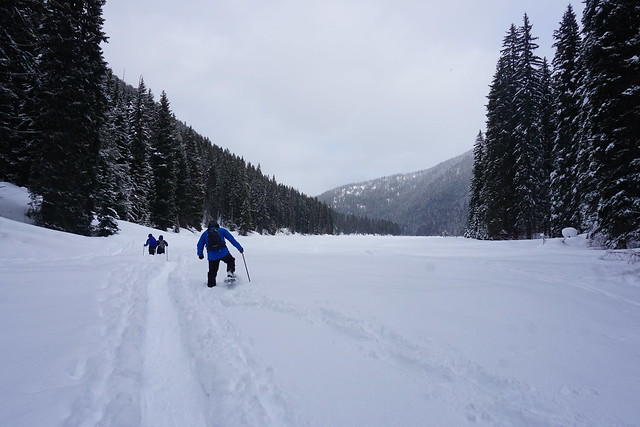
Lightning Lakes – Located at the Lightning Lakes parking lot, follow the trail around the first lake and/or the second lake. If the conditions are appropriate, you can even snowshoe across the lake itself, but make sure to return to the trail before the second lake as the river between the two lakes doesn’t normally freeze. You can customize the trail length to do one or both lakes and the trail is completely flat. 
DSC08551

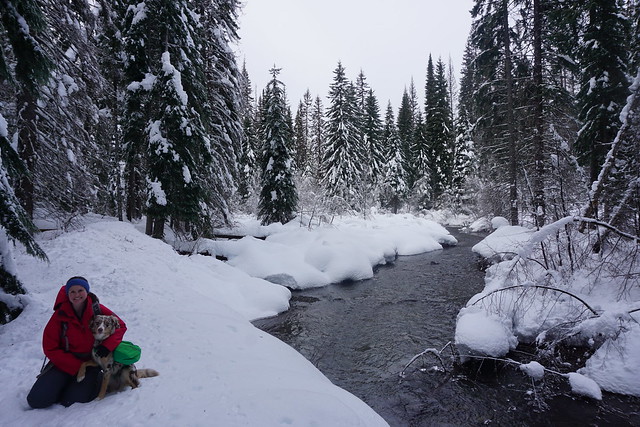
Similkameen River – Located at the Windy Joe parking lot, this is a there and back trail that hikes through the forest along the river. You can customize the length, hiking as far as you want and then turning around. There is a bridge 2.5km in that you can cross, but the trail on the other side of the river is cross-country ski only in the winter, so just return the way you came without crossing the bridge.

IMG-20220123-WA0032

Poland Lake – Located at the base of the ski resort, this is a more strenuous trail and not recommended for beginners. Park at the base of the resort and follow signs for uphill travel along the long green ski run for 2km. Once you reach the top, you’ll see a sign for backcountry access and you can follow the trail for another 4km to Poland Lake. If staying overnight, you have to park at Strawberry Flats and hike from there. As a day trip, it’s 12km with over 500m of elevation gain.
A Guide to Ski Resorts near Vancouver

I’ve been living in Vancouver for over 10 years now and I’ve been downhill skiing every single one of those years. Most of my time has been spent at Whistler Blackcomb, but I make a point to try and ski a new resort every year. I haven’t made it to every ski resort on this list, but I’m sure I’ll get to them all one day!

Cypress Mountain

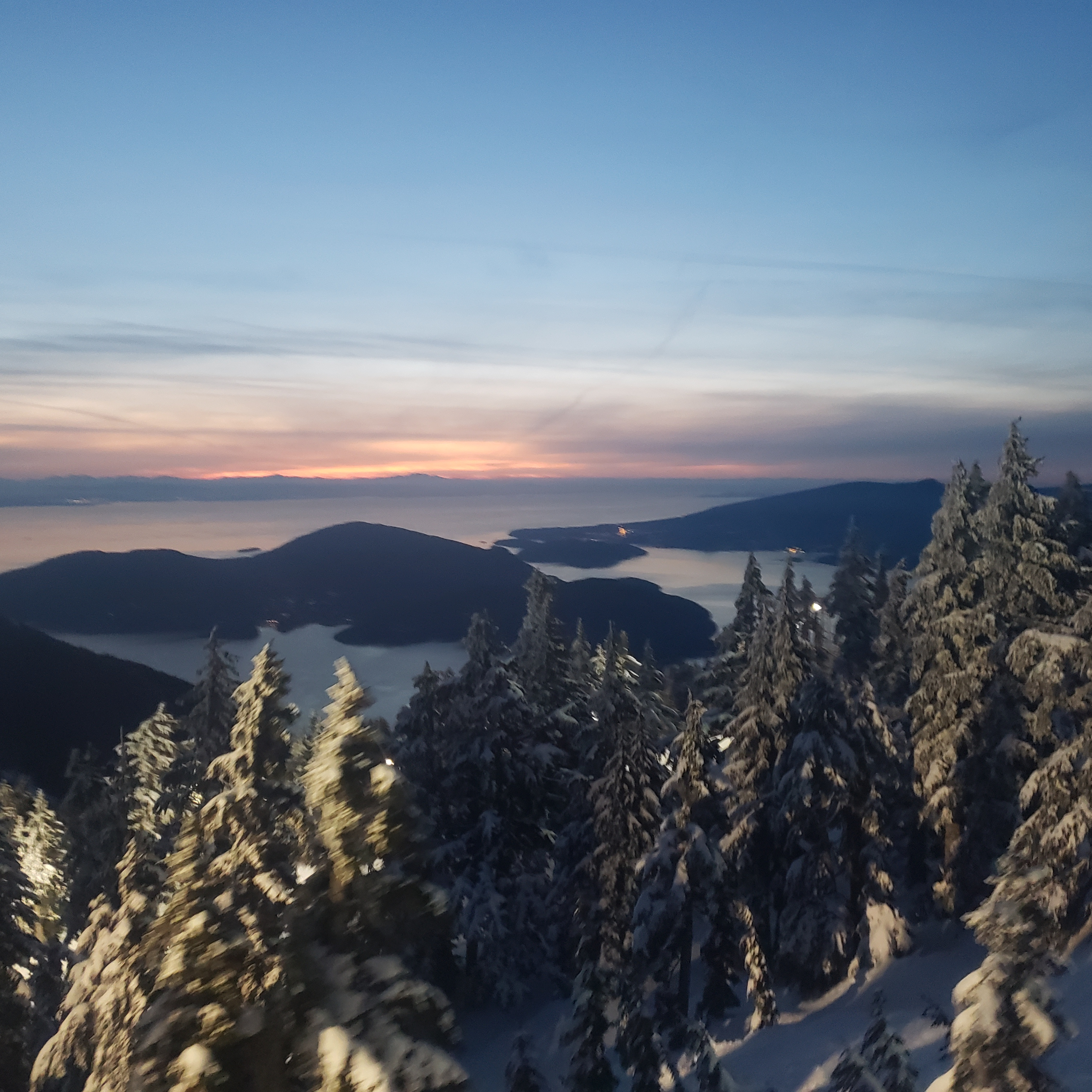
A view of the snowy forest and sunset over Howe Sound and Bowen Island from Sky Chair at Cypress Mountain Ski Resort near Vancouver, British Columbia, Canada.

Cypress is the biggest of the local mountains and the first resort I skied in BC. The resort is split between Black Mountain and Mount Strachan and has 4 major chair lifts. It’s a very busy mountain on weekends, so my preference is hitting up the mountain after work for night skiing! The highlight of this mountain is the view of Howe Sound from the Sky Chair.

Mount Seymour

A group of snowshoers head downhill in winter on a snowy mountain with snow covered trees and a view of Vancouver city in the background from Brockton Point in Seymour Mountain Provincial Park in British Columbia, Canada.

Seymour is a great family mountain. It has two lifts and is a great little mountain if you have kids or are learning to ski. It will be busy here as it’s a popular location for snowshoeing and touring as well. My favourite way to visit is to skin up to Brockton Point on my touring skis and then ski down through the resort. It’s a great place for night skiing and sunset views!

Grouse Mountain

A view of Crown Mountain from Grouse Mountain in the winter. The mountain is covered in snow in British Columbia.

Grouse is probably the most well known resort in the city as the ski slopes can be seen from all over the lower mainland, especially when they’re lit up for night skiing. Believe it or not, I have never actually skied Grouse, mostly because it’s the smallest resort and you have to take a gondola from the base to access anything, but I’ve heard the views are unparalleled!

Whistler Blackcomb

A photo of Peak Chair as seen from Roundhouse at Whistler. There is a Canadian flag in the foreground and snow covered mountain peaks on a blue sky day in the background, at Whistler, BC.

Whistler Blackcomb is by far the most well known ski resort on this list, and for good reason. It’s a premier ski resort and it has access to an incredible amount of terrain. I ski Whistler Blackcomb for 5-6 days every year and I never get tired of it. It will always be busy, so embrace the early morning rise to get in a few good runs before the crowds really pick up! My favourite areas to ski are 7th Heaven on Blackcomb and Symphony on Whistler.

Sasquatch Mountain

A female skier on the snowy slopes at Sasquatch Mountain Ski Resort on a sunny day in British Columbia.

Sasquatch is a small resort north of Harrison. It’s surprisingly close to the city, but difficult to access because it has a gravel road that requires snow tire chains. But it’s a really nice resort with 3 chairs and low crowds (even on weekends). It didn’t have much powder when I visited it, but I’ve heard it can get a nice amount of powder and the runs seem designed around this, with lots of gladed tracks down the mountain.

Manning Park

A view of lightning lakes covered in snow during the winter, with the trees and mountains in the background on a cloudy day in E.C. Manning Provincial Park in BC.

Manning Park is another small resort. It’s further than Sasquatch, but generally easier to access. The challenge with Manning is that there are very limited accommodations near the resort. So plan to either drive up and back in a day, or stay in Sunshine Valley or Hope. I adore Manning Park for its unlimited recreation activities and while its cross country trails are much more well known, it has a nice downhill resort as well.

Mount Baker

I have explored a lot around Mount Baker, but I haven’t had the opportunity to ski there yet (not for lack of trying, I had to cancel 2 trips). Odds are, most of the people skiing Mount Baker will be from BC to take advantage of the high amount of powder they get. The North Cascades are a beautiful place to visit and I love spending time in this area. There’s no where to stay on the mountain, but you can stay in Glacier, Bellingham, or drive there and back in a day. 

Sun Peaks

Sun Peaks is the next biggest resort after Whistler. It’s located just north of Kamloops and is a great ski destination! There are tons of accommodations and there is lots of terrain to explore. The runs span both sides of the highway and have a huge variety of alpine and glade runs. Some of the smaller resorts on this list can be visited in a day, but definitely give yourself at least 2 days at Sun Peaks!

Big White

Of all the resorts I’ve visited in the interior, Big White is probably my favourite. It gets great snow and it has some fabulous runs. It’s located east of Kelowna and has tons of chair lifts to keep you busy. I really liked the ski village in Big White – Sun Peaks felt really large, while other resort villages felt a bit small. I may have a soft spot for this resort because it was the location of my first group ski trip, but I definitely want to go back in the future.

Silver Star

Silver Star Resort is located north of Vernon and is smaller than Big White and Sun Peaks. It also attracts less crowds, but can feel busy due to the smaller number of chair lifts. I’ll admit, Silver Star wasn’t my favourite resort, but I think it’s mostly because it didn’t have great conditions when I visited. It has a really nice village and I’d definitely be willing to give it another try!

Apex

Apex is one of the lesser known resorts in the interior (or at least, it feels that way). It’s located further south, east of Princeton, but west of Penticton. It gets less crowds than the other resorts I visited, but it had some truly awesome powder! I’m not sure if this is a common theme, but I have heard it tends to get dumped on in the winter. It’s a small village, but my favourite part was the forest skate loop!

Mount Washington

Three skiers smile at the camera on a sunny day with the mountains in the background at Mount Washington Ski Resort on Vancouver Island, BC.

If you want to visit Vancouver Island, Mount Washington is pretty much your only option. Take the ferry to Nanaimo and then drive north to Courtenay. Mount Washington is on the boundary of Strathcona Provincial Park and while the road up the mountain isn’t it great shape, it is a really nice resort for skiing and snowshoeing!

Stevens Pass

A photo of snowy trees and ski slope, with the mountains emerging out of the fog and clouds in the background, taken from Stevens Pass Ski Resort in Washington State.

I discovered this resort because it’s included in my edge card/epic pass for Whistler. It’s located east of Seattle and is incredibly popular among the locals. There’s no ski village, so we stayed in Skykomish and drove into the resort in the morning. Be prepared for terrible traffic coming out of Seattle and aim for an early start. The lift passes will sell out and the parking lot will fill up, both of which will result in you being denied entrance. But it’s a great ski resort with some nice terrain if you plan accordingly!

Mount Seymour Snow Camping

This post will be a bit different from my usual snow camping trip, but there’s so many ways to enjoy the outdoors and I like highlighting all of them! It is on my bucket list to one day snow camp on Pump Peak, but if you’re nervous about the exposure (and avalanche terrain) and want to get out with a group, there’s an excellent alternative just below the base of the ski resort! 

This trip was done with my Trex unit, which is a special branch of Girl Guides of Canada that is focused on outdoor adventure for teenagers. It’s not part of the core guiding program, which is for all ages (Kindergarten to grade 12), and is more well rounded and focuses on art, STEM, physical and mental well-being, and activism, in addition to camping skills. Trex is for teens (including girls, trans-girls and non-binary individuals) who want to go to the next level with their outdoor skills.

20250111_112344

This winter we reserved the Mount Seymour Group Site to practice snow camping! The site is located next to the P1 Parking Lot and is closed to the public unless you have a booking. It’s a very economical option for non-profit groups, but a little more expensive for others (but still very reasonable). The site has a warming hut with 6 picnic tables and a large field to camp in. Unfortunately, our camp was at the end of a week of particularly warm weather, so there was very little snow on the ground. We weren’t able to practice making snow shelters, but it was still a good opportunity for Trex to camp outside in below zero conditions in a safe environment. 

We were able to hang out and eat all our meals in the shelter, which has a wood stove. So it was easy to keep warm before bed. As a precautionary measure, one of the guiders (in this case me) slept in the hut all night to keep the fire going in case of emergency, but all members did great overnight and everyone slept in their tents for the full night! 

PSX_20250113_175017
20250111_225808

Given the proximity to Seymour, we were able to take advantage of the nearby recreation activities. We walked up the road to the ski resort base and spent some time playing in the snow along the trails. We didn’t do a full hike, but nearby options include snowshoeing Dog Mountain or Brockton Point, or exploring within the Mount Seymour trails. We got some wet snow in the morning, followed by sunny breaks in the afternoon and an absolutely gorgeous morning on our second day.

There’s not too much else to share about the site. Like I said, you do need a booking to stay there. A day pass is required in the winter to visit Mount Seymour, but you can just use your permit for the group site to get up the mountain. It’s only a minute walk from the parking lot at P1 to the site and there is an outhouse. There’s also a tap, but it’s turned off in the winter, so make sure you bring all the water you need with you. We used snow melt for washing dishes, but didn’t want to drink it since there hadn’t been any fresh snow in at least a week.

20250111_151941
20250111_152818

The only downside is that people will continually walk through your site despite 3 signs instructing them not to and informing of a fine. Please don’t do this, especially when youth groups are using the site. I was there with minors, and while I know you just want to take a photo with the pretty snow on the trees, I have a responsibility for their care and can’t have randoms walking around the site where they sleep, taking photos. The site was closed for 2 years during COVID, so people seem to think it’s just fair game now. 

Overall, we had a great time. We’ve also stayed at the Lone Duck group site in Manning Park. I would say the Lone Duck site is nicer (it’s more private, gets more snow, and it’s right on the lake), but the real benefit of Mount Seymour is how close it is to the city. A great option if you’re looking for a safe way to try snow camping!