Desolation Sound Kayak Trip Part II

Despite the name change in the blog title, this post is a continuation of my last post about Copeland Islands Marine Park, as I visited both parks in the same trip. Read Part 1 here.

I will admit that the wind gave me a lot of anxiety on this trip. I’m definitely a fair weather paddler, and while I’ve been out in less-than-favourable conditions, I’ve never paddled in outright dangerous conditions. It was surprisingly windy overnight, which made me a bit nervous for our second day of paddling, but the wind forecast wasn’t that high and it did calm down throughout the day. I’m used to the wind being calm in the morning and coming up in the afternoon, so that was an interesting change to have it reversed.

20230520_103252

We still got up reasonably early (7am) because we wanted to launch the boats while the tide was still high. Once the tide starts to go down, you lose the channel exit from our campsite and it adds a bit of extra paddling, plus you have to load the boats and gear further down the beach.

Fortunately, our timing was right on and we paddled out through the channel around 9am with just enough clearance to get over the newly forming beach. We crossed back over to the Malaspina Peninsula and said good-bye to the Copeland Islands as we made our way to Desolation Sound. There were some cool cliff features along the way, just past Bliss Landing, and we quickly arrived at Sarah Point, which marks the beginning of both Desolation Sound Marine Park and the Sunshine Coast Trail. It was a bit of a bittersweet moment for me as I have very fond memories of hiking the SCT last year and I loved seeing the Sarah Point hut again.

20230520_093410
20230520_095516

We had a quick break further along the beach at Sarah Point before continuing around the headland to Feather Cove, which is also on the SCT. It got a little windier as we rounded Sarah Point, but nothing to be concerned about. We spotted our second sea lion and then took in our first glimpse of the jaw-dropping beauty of Desolation Sound. I wasn’t able to successfully identify the mountains, but there are some gorgeous snow capped peaks in the distance as you first enter the Sound.

20230520_135657

We took another short break at Feather Cove before crossing Okeover Inlet to Zephine Head. The Inlet crossing was fine and the tide was rapidly dropping, so we were able to pull out at a beach just around the Head. At high tide, you might have to continue into Galley Bay for a pull-out though. We had our lunch there and since the conditions were favourable, we decided to do a direct crossing to Mink Island.

It’s about a 3km paddle from Zephine Head to Mink Island in open water. We tried to stay close to one another on the crossing, but the wind definitely picks up the further out you get, so I finally dropped my rudder and that helped me maintain my course a lot easier. Seth is pretty opposed to his rudder and never uses it, so he had some trouble staying on track. We managed to correct this the following day (which was windier), by both dropping our rudders and having Seth paddle directly behind me (since I’m the slower paddler) instead of trying to paddle side by side. Whenever we go side by side we tend to get separated, so this system worked better for us.

20230520_100200
20230520_130756

That said, it was still a pretty good crossing. The wind was low and we didn’t have any trouble making it over to Mink Island. Once we got to Mink Island, we had the wind working with us, so that was nice. Unfortunately, there weren’t a lot of good looking places to stop along the island, so we powered around the corner of the little arm on Mink Island (sorry I don’t know the name) and had a nice rest in the sheltered bay.

From there it’s not much further to the Curme Islands, which are the most popular attraction in the park, at least as far as I can tell. At the end of Mink Island, there are 3 small islands: South Curme, East Curme, and West Curme. The water was super calm at the end of Mink and around the Curme Islands, so we did a little paddle around each island. It was Seth’s turn to pick our site and he opted for East Curme Island, which I think was an excellent choice!

20230520_101046
20230520_134603

West Curme Island was really busy when we arrived, so I think that one might be the most popular. There was just one group on both East and South Curme, though a lot of people showed up to South Curme by motor boat later in the evening. But no one else joined us on East Curme, so it was just us and the other group (which is surprising considering it is the biggest of the 3 islands). We had a lovely site looking out to South Curme and Bold Head, and climbing up to the top of the island, another nice view looking down at West Curme.

The tide was very low when we arrived again, but in contrast to North Copeland Island, it was a more challenging landing. It wasn’t hard at low tide, but it’s a bit of a climb up to the island and at high tide, there’s no beach at all. There was just enough room for 4 kayaks between us and the other group, so I’m not sure where everyone stores their boats when the campsite is full.

20230521_064232

Instead of dragging the boats up the rocks, we opted to tie them on and let the tide slowly float them up to the landing. It worked really well and when the water reached high tide around sunset, we popped them up on the bank.

After unloading the boats, we were really warm, so we opted to go for a swim almost immediately. Like Copeland, the water was incredibly warm, though there was a lot of seaweed floating around with the low tide. Even Seth went for a swim and we were in the water for the better part of a half hour. We had landed on the island around 2:30pm, and after our swim, I spent the rest of the day doing absolutely nothing. Seth had a nap and I just enjoyed drinking my ice tea and watching the seals play while the tide came up.

20230520_154453
20230520_205122

Seth wasn’t as excited about a sunset paddle on this day, but I convinced him to go out for a half hour since you can’t really see the sunset from East Curme. The water was calm again and it was approaching high tide, so we paddled in and around all the islands before calling it a night. We slept with the fly off again and set our alarms for 6am to get an earlier start on the following day.

This was on account of those winds I mentioned earlier that were making me anxious. The wind was supposed to come up a lot on our 3rd day and I was nervous about the big open water crossing. We discussed it in the evening and decided we would take the long route back to our next campsite. There’s two benefits to this. The first is that you get to explore new terrain by circling Desolation Sound from the other side instead of doing the same crossing back along Mink Island. The second is that you avoid the big 3km open crossing, instead doing a 0.5km crossing from East Curme to Otter Island, and then a second 1km crossing across Tenedos Bay. The other benefit is that these two crossings are done at the start of your paddle, which would be early morning for us, resulting in less wind.

Here’s a screenshot of our 2 paddling routes for some context. I’ll cover the rest of the trip in the Part III!

Desolation Sound screen

Ottomite Peak Snow Camp

I didn’t do much hiking in the Fall last year, but as soon as winter hit I’ve been out exploring in full force! I only did one snow camp last year and was really keen to try and fit 2 in this year. It’s always a challenge because I like to ski a lot too and the snow season is so short.

Fortunately, the weather aligned for us to make a trip out to the Coquihalla in early February. After a very snowy December, it’s been a pretty warm start to the year and all the local mountains were above zero degrees. The Coquihalla can get cold, but it reliably has snow, so it’s one of my favourite places to go in the winter. To date, we’ve been to Falls Lake and Zoa Peak.

PSX_20230205_201133

It rained most of our drive up the Coquihalla, but it switched to snow just before we got to the Summit Rec Area, which was very lucky. I’d never even heard of Ottomite Peak, but Carolyn came across it somewhere and it’s a pretty low risk trail, so we decided to check it out. You park in the lot at the base of Yak Peak (across the road from the Needle Peak parking lot) where there is a really nice rest stop bathroom. The trail starts around the edge of the bathroom and runs slightly parallel the highway as you ascend up towards the peak.

20230204_135419

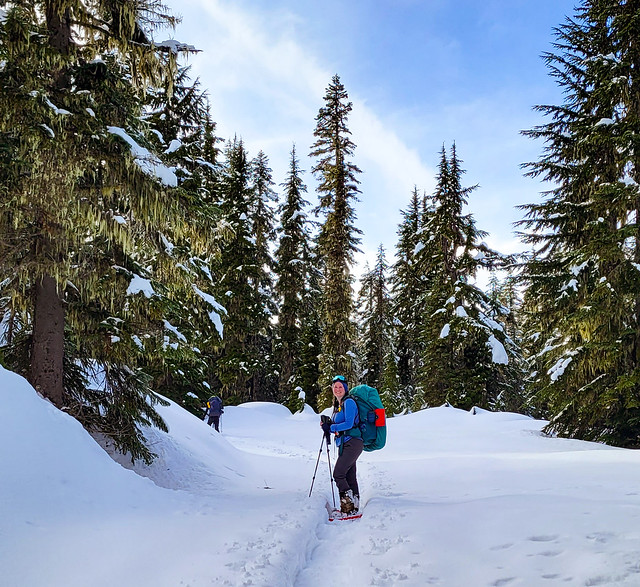
I tracked just over 4km from the parking lot to Ottomite Peak. The trail is mostly in the trees and is all simple avalanche terrain until Ottomite. It’s also popular for ski touring and most of the skiers were continuing past Ottomite to Iago Peak. We considered it, but the trails goes into challenging terrain near Iago Peak and the avalanche risk was considerable in the alpine at the time, so we opted not to. There was a beaten track until the branch to Ottomite Peak, which has a really beautiful view and would also be great for camping.

20230204_142234

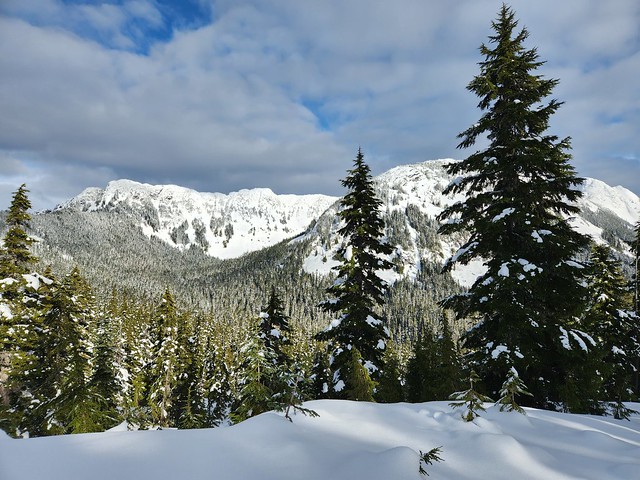
The trail continued on towards Iago, but we had to break the trail to Ottomite Peak. It’s pretty rare to have to break trail in Southwest BC, the only other time I’ve done it was when we snow camped at Poland Lake last winter. It’s a lot more work, but fortunately it’s not too far to the peak of Ottomite Peak. Overall it took us about 2 hours from bottom to top. There’s a great view of the north mountains from Ottomite Peak, so we decided to camp at the top.

20230204_145933

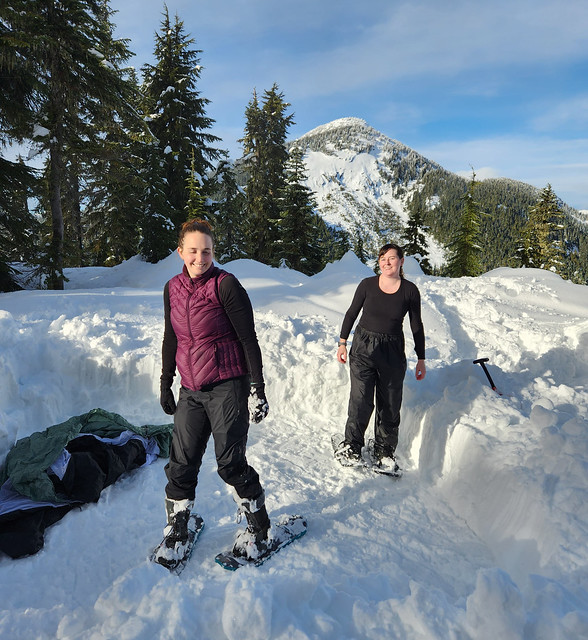
As usual, there were 4 of us on the trip, but Steve couldn’t make it, so our friend Marie accompanied Carolyn instead! Brandon and I shared his big 4 season orange tent as usual, and Carolyn experimented with her summer tent. She typically uses her 3 season MSR Elixir, but she has a non-freestanding 2p Durston tent that she wanted to try out. It took her a while to get it set up properly as it’s a bit tricky since it relies on using your hiking poles and tension to stand. But she managed to get a good pitch and said it worked fine for the night.

20230204_154708

The weather was surprisingly nice on Saturday. We were expecting it to be overcast and snowy, but it cleared up a lot while we were hiking in and we actually got some blue sky and sun while we were setting up. Eventually the clouds moved back it, but we got some really lovely views from the peak, which we easily could have missed.

20230204_172103

We built a nice big snow kitchen where we hung out for the better part of 4 hours while melting snow and preparing supper. Marie made hot lemon whisky and I made Kahlua hot chocolate bombs for happy hour and Brandon made our favourite thai chicken curry for supper. Then we had Marie’s apple crumble for dessert, so it was quite a spread! If you think me and Carolyn got off easy, I made lunch sandwiches and she made us homemade egg mcmuffins for breakfast!

20230204_172312

The temperature was really hovering around zero, so it was one of our warmer snow camps and we were lucky it didn’t rain to be honest. We stayed up until around 8:30pm, which is pretty late for snow camping, before hitting the sack for a long night’s sleep. I slept pretty good early in the night, but then I was treated to the symphony of Brandon’s snores later in the night. The moon came up overnight and I enjoyed a beautiful view when I got up to pee, with the moonlight reflecting off the snow, it was super bright and I didn’t even need my headlamp.

20230205_092132

Otherwise it was a low key morning and we packed up our gear and headed back to the parking lot. It was a lot faster hiking out and we stopped in Hope on the way back for the Blue Moose Café. Considering how little known this trail is – I really liked it! It is in avalanche terrain, but it’s pretty low risk terrain, so I think it’s good for beginners. I’d definitely like to go back some day and go all the way to Iago Peak, or maybe revisit in the summer, when you can hike several peaks back into the wilderness! Overall, another successful trip!

20230205_111557

Lone Duck II Snow Camp

This snow camp post is going to be a bit different than my usual posts. Most notably because it was a snow camp that I did with Girl Guides, but more interestingly because it’s a snow camp experience that doesn’t require backpacking!

I’ve done two snow camps with Girl Guides now. The first was at the Mount Seymour Group Site, and the second at the Lone Duck II Group Site in Manning. Both are located ~100 metres from the car and have warming huts, so it makes for a great experience for beginners because you can try snow camping with the safety of a warming hut and without needing lightweight backpacking gear.

20230115_090954

The challenge for the average person is that these are both group sites, so it’s hard to utilize them if you only have a small group. The good news is that, as the name suggests, Manning has a second site called Lone Duck I, which is a first come, first serve campground through the winter. So if you’d like to try snow camping for the first time, this site is a really great option because you can carry in whatever gear you need and there is a warming hut for this site too. It’s basically an open-campground, so you might even meet some cool new people!

PSX_20230115_182458

The site is located past the Lightning Lakes day use area, but before the summer campground and strawberry flats area. You pull off the main road and there’s a parking lot for both sites. Both are located next to the lake and the cross country ski track, so depending on your interests, you can go for a long ski or take your snowshoes out on the lake, which is generally frozen through the winter.

20230114_134340

We lugged our gear in along with a lot of firewood. We had lunch in the hut first and then got to work setting up our tents. Unfortunately there wasn’t a lot a snow, even in early January (and none of it was fresh), so we didn’t have to dig down very far, but it was also very crunchy conditions. Trex did really well setting up their tents, especially considering it was the first time snow camping for most of them.

20230114_124955

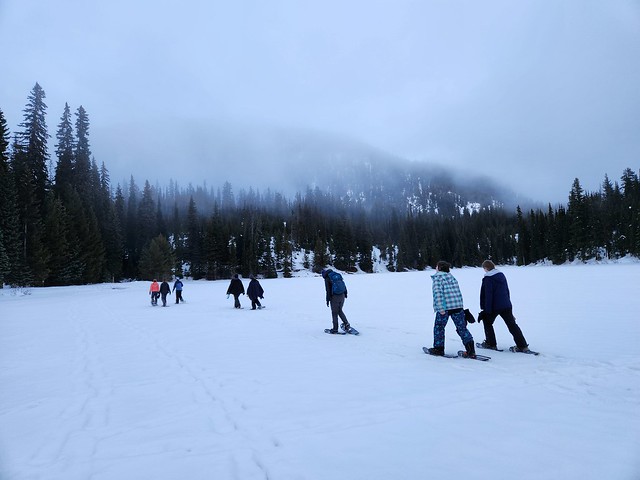
Once settled, we took our snowshoes out on the lake for an adventure. We stuck close to the shoreline as a precaution at first, but the lake was extremely frozen, so we eventually wandered a little bit further out. We snowshoed to the bridge that separates the two lakes (making sure to get back on the actual trail to avoid the river, which doesn’t usually freeze). We crossed the bridge before snowshoeing back across the lake to the campsite again. It was only ~3-4km, but it was good to do a bit of exploring. It had been pretty sunny when we arrived, but the clouds were doing really weird things, so we ended up with some interesting cloud formations on the lake.

PSX_20230115_203144

After returning, we decided to get the woodstove going for the rest of the night. The conditions were really mild and it was only just below zero, so quite warm for first timers. But we still planned to keep the hut warm all night as a precaution in case anyone was really cold in the tent. I have to say… I love backpacking, but I was definitely a fan of the woodstove! It made the hut so cozy and it’s so large we were also able to use it as a 4 burner stove. It had a hard time actually boiling water, but it was great for melting snow and we even used it to cook our chili for the evening.

PSX_20230117_174452

Our evening was pretty chill and we sang some campfire songs and played a lot of cards. Eventually we all crawled into our tents and one of the guiders kept the fire going overnight. Overnight reviews were a bit mixed. One tent stayed very warm, but another struggled. No one gave up and crawled into the hut, but there were definitely some improvements to be made.

20230114_184349

Overall it was a great first trip and no one was freezing, but I’m not super enthusiastic about trying snow camping backpacking with Girl Guides. Finding warm enough gear that can be carried is a real challenge. I hope Elfin Lakes re-opens the hut again soon because I think that would be a good option for Guides. Though we are lucky that Girl Guides owns their own hut on Hollyburn Mountain as well, so we hope to explore there next year.

In conclusion, Manning Park is a great place for beginners and I’d recommend the Lone Duck I site if it’s your first time. Me and Carolyn actually tried to do Lone Duck for our very first snow camp, but we missed the turn-off to the highway and were 40 minutes down the Coquihalla before we realized, so we ended up doing Falls Lakes instead!

20230114_161240