Hiking Mount Doom

I was so nervous about hiking the Tongariro Alpine Crossing. After the disaster that was Fox Glacier, I was really weary about hiking in less than ideal weather and I really wanted to enjoy the hike. The shuttles said they would be going ahead for our second attempt, but it was calling for a cloudy day with rain in the afternoon and temperatures as low as 0 degrees. I wasn’t sure if it was even worth doing the hike if we weren’t going to see any of the views, but I was incapable of walking away from a hike to Mordor.

In the end we decided to go for it and I went on the most over-prepared hike of my life. I must have been traumatized from my experience on the glacier because I packed SO MUCH extra clothing and food, it was a little out of hand. Even though I snowshoe all the time in Canada, everyone had me freaked about about the “cold” temperatures. One part of me was like, “wear two pairs of pants for the cold!” while the other part was saying, “you snowshoe in below zero temperatures all the time and you never wear two pairs of pants!” I did wear the extra pair of leggings, which was a mistake and I ended up ditching them at the first outhouse we came to, so needless to say I was desperately over-prepared.
DSC04359

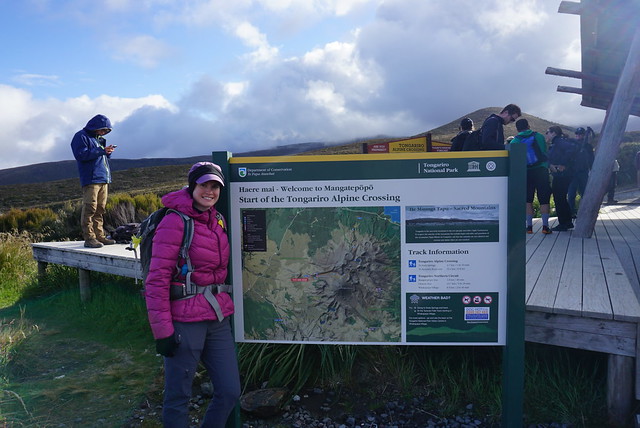
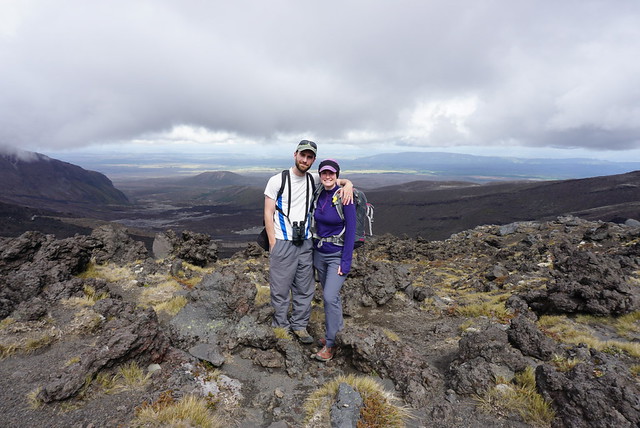
But none of that ended up mattering because we had the most awesome hike! The Tongariro Alpine Crossing is a 20km hike that goes right through the national park, crossing over Mount Ngauruhoe, past the red crater, and around Mount Tongariro back to the road. I hiked a volcano once before in Costa Rica, but this was totally unlike anything else I’ve ever done. It was super overcast when we started and we couldn’t see any of the 3 volcanoes in the park, so I wasn’t super optimistic. But the landscape is still pretty neat. We started hiking through some low shrub areas and as we got closer to Mount Ngauruhoe, the landscape started to become more barren and interspersed with volcanic rock that had been catapulted in all directions from a previous eruption.

We were really lucky and the clouds started to lift just as we were approaching our first view of Mount Ngauruhoe, also known as Mount Doom. It’s unreal because you can actually see the lava flows coming down the side of the mountain where they eventually became too viscous or cool to go any further. The volcano is still active and you do feel somewhat like you’re tempting fate by even attempting to hike through – especially so soon after the eruption at White Volcano, which occurred 2 days before we flew to New Zealand. All our friends and family told us to “have fun and maybe stay away from any active volcanoes”, to which we politely nodded and pretty much ignored since the whole center of the North Island is all active geothermal wonders.
DSC04456

The two islands are pretty interesting in that they’re located so close to one another and form 1 country, but geographically have nothing to do with one another. The South Island is all about mountains and plate tectonics, while the North Island is entirely volcanic. There were no shortage of warnings as you approach the volcano though. Apparently on average someone is airlifted out of the park by helicopter once a week, so it’s obviously a dangerous place. Though the risk seems to be from adverse and unpredictable weather conditions and people underestimating the difficulty of the hike (it’s 20km long!) versus any risk from volcanic activity. But the signs all warn to turn around if you’re struggling or if its so cloudy you can’t see the volcano (fortunately we could).

The trail loops around the base of the volcano to Soda Springs, the only freshwater source we saw for another 15km, before starting to climb up the side of the volcano. It’s an easy walk until that point, but then you finally start climbing, which most people hate but I was excited for. So many of the hikes we’d done had been valley hikes and I was excited to finally climb something! The views as you climb up Mount Ngauruhoe are awesome looking back at the trail you’ve come from. Eventually you branch off the volcano and hike over the ridge next to it and start down into the South Crater.

DSC04472

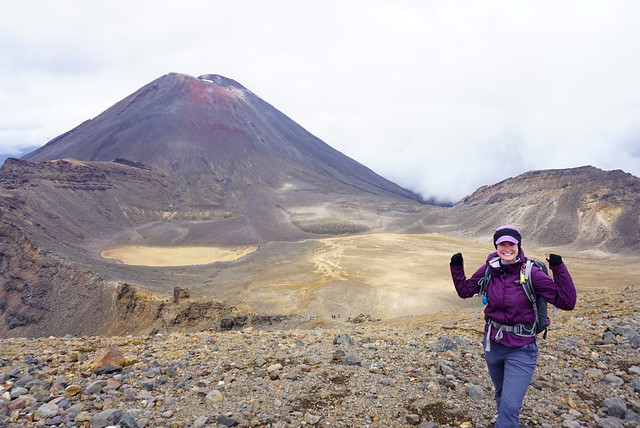
This is when the scenery really changes and I felt like I was hiking on Mars. There’s absolutely no vegetation and it’s just a straight shot across the red soil of the crater to the base of Red Crater. So you do get a respite from the climbing before starting up the side of the Red Crater to the highest point on the trail. This was probably my favourite part of the trail. Before you get to the Red Crater, you have to climb back out of the South Crater. From the South Crater ridgeline, we had an awesome view looking down into a very barren and mordor-like scene. Looking back we had a perfect view of Mount Doom, which the clouds had finally totally cleared off. Then you start hiking the Red Crater and have no idea where you should be looking because its so steep and the views are amazing on all sides.

The Red Crater was very different again. It’s hard to get an idea of the scope of the crater until you actually hike down the other side and look back at it, but it’s exactly as its name suggests, a giant red crater that’s still active and smells of sulphur with steam literally coming up out of the ground. The whole area is steaming from various vents and despite how cold it was up there, it was easy to find little hot spots.
DSC04536

Our timing really couldn’t have been better. We got to the top for one last view of Mount Doom before the clouds ate it up again, and then rushed over to get a look at the little alpine lakes on the other side. There’s several brilliant green lakes and giant blue lake in the distance. We added a layer and enjoyed our lunch looking down at the lakes from the top.

I can understand why they make everyone hike in the same direction on the track. it’s a steep hike down the other side of the crater on a scree slope that I would hate to have to hike up. We did some exploring around the little lakes before crossing the bottom of yet another crater to climb up to Blue Lake. This is where you get the best view looking back at Red Crater, which really puts into perspective what you just climbed. It clouded in pretty fast at Blue Lake and finally started to drizzle, so we didn’t spend much time there and started to move on as we were still only a little over halfway through the hike.

DSC04596

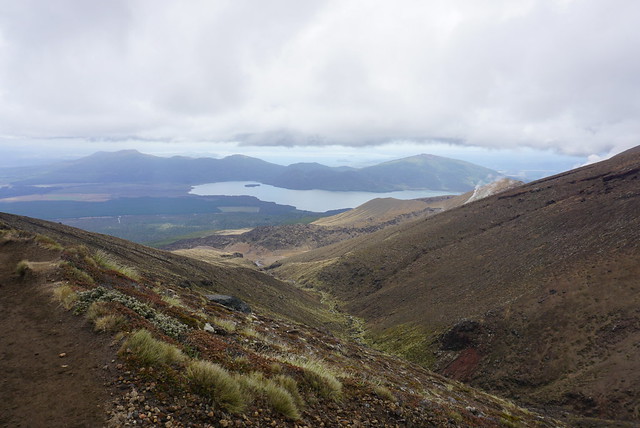
As soon as you leave Blue Lake though the landscapes change again entirely. Hiking the volcanoes and craters really felt like being in a wasteland, but as soon as we rounded the corner of the lake and started hiking down the other side, it was like coming back to Earth. I still wouldn’t exactly call the vegetation ‘lush’, but it sure felt that way after hiking across a volcanic desert. From there the last 8km are just winding back down the side of the mountain to the highway. There’s a great view of Lake Taupo and you can still see steam coming from the Te Mari Crater, which last erupted in 2012. There’s chunks of volcanic rock spewed across the landscape, which is a good reminder of the danger still associated with the park. The Te Mari Crater erupted in 2012, putting holes in one of the huts on the Tongariro Great Walk. Fortunately no one was injured, but only because the eruption took place in the middle of the night in winter. There was no prior warning, so had it been any other time of year, there almost certainly would have been fatalities.

DSC04651

It’s definitely a sobering reminder and it seems lucky they’ve avoided disaster in the park up until now. One of the placards by Mount Ngauruhoe told the story of a school group that was hiking the volcano in the 1970’s when it suddenly started erupting, cutting off the way back and forcing them to have to evacuate over to the Red Crater. Fortunately nothing of the sort occurred on our journey. The rain disappeared as quickly as it had started and we had an uneventful hike down to the end of the trail. We felt really accomplished when we finally reached the end and had our car waiting for us!

I’m so glad we weren’t too jaded from the glacier experience to try this hike as it ended up being one of my favourite parts of the trip! We had a lot of fun goofing around on the trail, re-enacting the Lord of the Rings and taking pictures of me pretending to me Frodo, Sam, and Gollum at various parts of the trail. It’s not a hike to underestimate, but it’s also not a hike to miss!
DSC04677

Wedgemount Lake Backpacking Trip

It’s been 3 years since I hiked Wedgemount Lake, but this trail still haunts me!

Wedgemount Lake is a 14km round trip hike with a whopping 1200 metres in elevation gain. All I can say is, don’t underestimate it. Wedgemount has recently been added to Garibaldi Park’s database of reservable sites, so you now have to book to go up there, which wasn’t the case when I visited. I suspect this may have actually increased the traffic up there though because people that aren’t able to get a spot at Garibaldi Lake or Elfin Lakes, see it on the map and decide to go there instead. I don’t actually know if this is true or not, but I did meet a group of 5 guys at the trailhead to Elfin once who were changing their plans to go to Wedgemount when they realized Elfin was full, but just a guess!

Wedgemount is incredibly scenic once you get to the top, but boy is it a long slog to get there. I went in late August with Brandon the first summer I started camping and I believe we started hiking sometime after noon. There’s very little to see but forest until you reach the halfway point across a short boulder field. After that, it’s back into the woods again until just before the end when you have to climb a steep boulder field to get up to the top. Don’t get me wrong, the whole trail is steep, but the boulder field is definitely tough with overnight packs as you’re basically climbing up over the rocks.

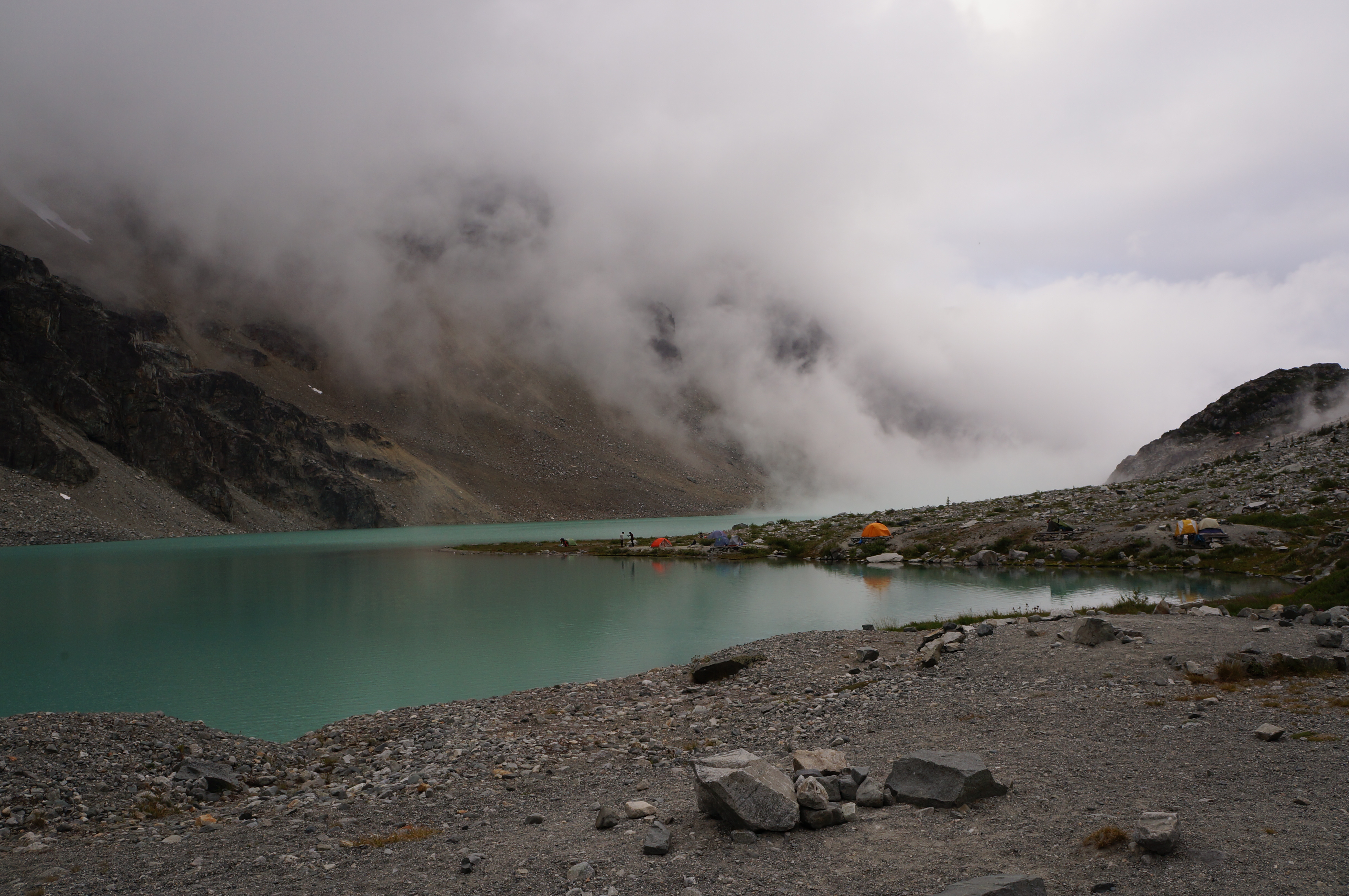
When you get to the top of the landslide, you’re in a valley of sorts, with Wedgemount lake at the bottom, surrounded by another set of peaks and the Wedgemount glacier. You hike down into the valley, which is completely wide open with very little shelter. Over the years, people have moved the rocks around to create little rock-walled campsites to protect from the wind that funnels in through the valley across the lake. There is a small hut up there as well, but I think most people opt to camp as there’s tons of space up there and lots of sites to choose from.

It was certainly windy when we went up there. Even though it was August, it’s one of the coldest camping trips I can remember. I was fine once I got in my sleeping bag and went to bed, but until then, it’s freezing sitting out on the ridge with nothing to shelter you from the wind. We set up our tent as fast as we could and tried to find the most sheltered place to quickly make and eat out supper. Then we hit the sack pretty early because it was just so cold outside.

It’s a beautiful location though. Wedgemount Lake itself is quite large, but the soils must be a lot siltier than other lakes in the park because it has a much paler blue hue to the water. The wind died down overnight and we got up early to do a little exploring around the lake. Like I said, it’s a wide open space surrounded by other mountain peaks, so there’s tons to explore up there. Our exploration was pretty limited, which kind of makes me what to go back, but that landslide still haunts me and I don’t want to have to haul my backpack up over it every again.

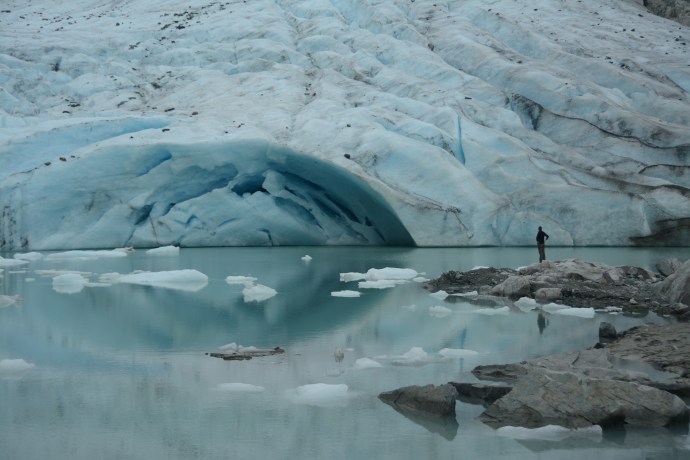
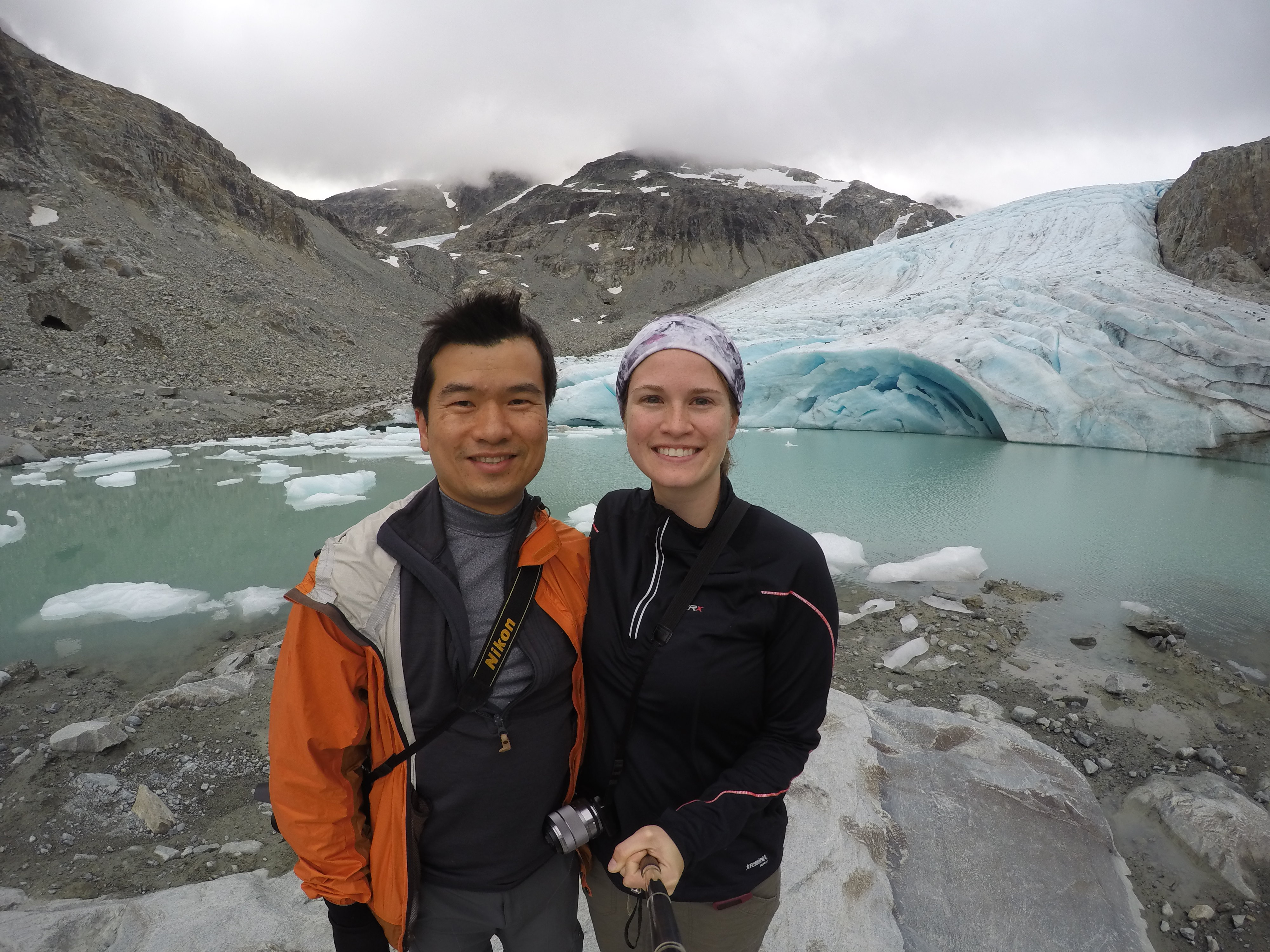
We did explore to the glacier though. If you walk around to the head of the lake, you can see the Wedgemount glacier. I’m sure it looks different every year depending on how the ice changes and melts, but the year we visited had left another lake at the base of the glacier with lots of bergy bits (real technical term – I’m a Newfoundlander, I would know) floating around. The glacier is huge and looks misleading in pictures, but Brandon got a few great photos of me standing at the base of the glacier that really put the size in perspective.

The lake is nice, but the glacier was definitely the highlight for me. The only other glacier I’ve hiked to is the glacier at the top of Brandywine Mountain, so it was a landscape quite unlike where I usually hike (the Brandywine Glacier was very different as the ice melt was flowing down the mountain instead of pooling).  I can’t decide whether Wedgemount makes for a better day hike or overnight though. A day hike seems like it might be rushed, but having just a day pack sounds a lot nicer, so it might be a judgement call based on your fitness level.

The clouds were looking pretty threatening though, so we didn’t stick around too long at Wedgemount. We packed up our things just before the rain hit and hiked back over the landslide and down again. Wedgemount is just as tough going down as it is going up. It’s a steep hike over the landslide and then the trail feels like it goes on forever after that, with nothing to look at and no respite for your knackered knees. It was a relief when we finally hit the parking lot.

Garibaldi Lake Backpacking Trip: First Timer

Garibaldi Park is hands down, one of the most beautiful provincial parks in the lower mainland. I’ve been to the lake on 3 separate occasions in the last 5 years and I really felt I experienced something new on every single trip. The first time I went to Garibaldi Lake was in 2015 as a day trip and it’s what inspired my desire to start backcountry camping. It was so beautiful at the lake that I really wanted the opportunity to stay there overnight. So the next year, I bought myself some backcountry gear and did a 3 day trip with Seth and Emily, who had just finished her bachelor’s degree and was visiting for the summer at the time.

Both times I’ve backpacked to the lake have been for 3 nights, which I think is a good length. I left work early on a Thursday and we drove out to the trailhead, aiming to be hiking by 5pm. I think we were a little bit behind, but we were certainly on the trail by 5:30pm and it took us about 3.5 hours to hike to the lake without any detours. 2016 was the first year that Garibaldi introduced the backcountry booking system, so we did have a campsite booked, but we decided to take Friday off to get ahead of the crowds and have one day with fewer people.

DSC01554

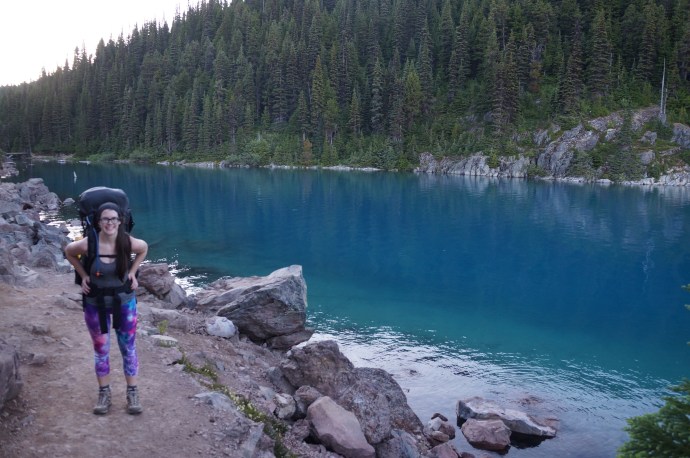
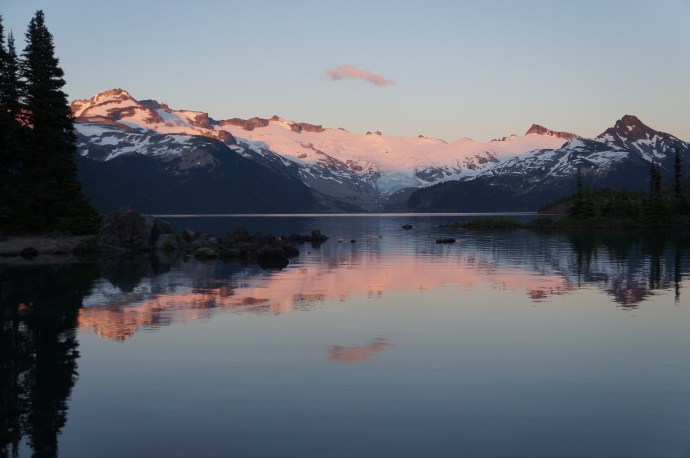
It’s a rough walk up to the lake for sure. It’s a pretty easy trail, but there is significant elevation gain (~800m) and the trail is pretty much constant switchbacks with no views for the first 6-7km. After that it gets a little more varied and less steep, before you finally reach the lake and hike in along the edge to the campsite. If you are hiking in a little later, like we were, be prepared to hike in the dark and have lights with you. Fortunately, we reached the campsite just around dusk and got to see the glacier at the back of the lake lit up pink with the alpen glow before night set in.

Hiking in Thursday night gave us two full days in the backcountry before we had to hike out again, so we planned to hit Garibaldi’s other two most popular attractions, Panorama Ridge and Black Tusk. I was most excited for Panorama Ridge because I’d seen so many amazing pictures of the bright blue waters of Garibaldi Lake as seen from the ridge looking down on it. So we decided to day hike to Panorama on Friday. We had each purchased a small daypack from Mountain Warehouse that we had stuffed into our big packs, so we crammed them full of all our day items.

DSC01739

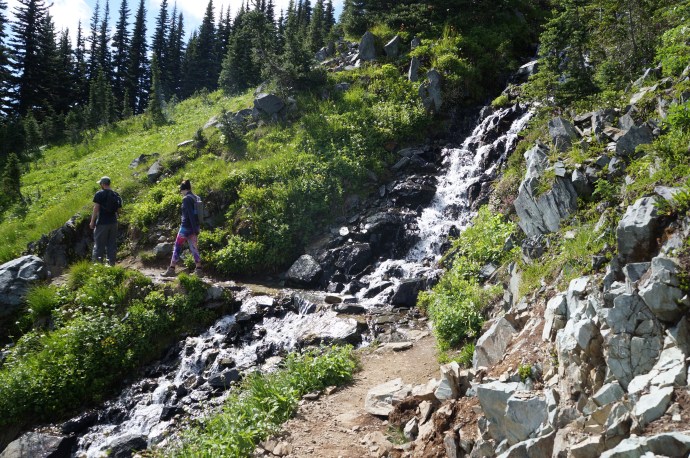
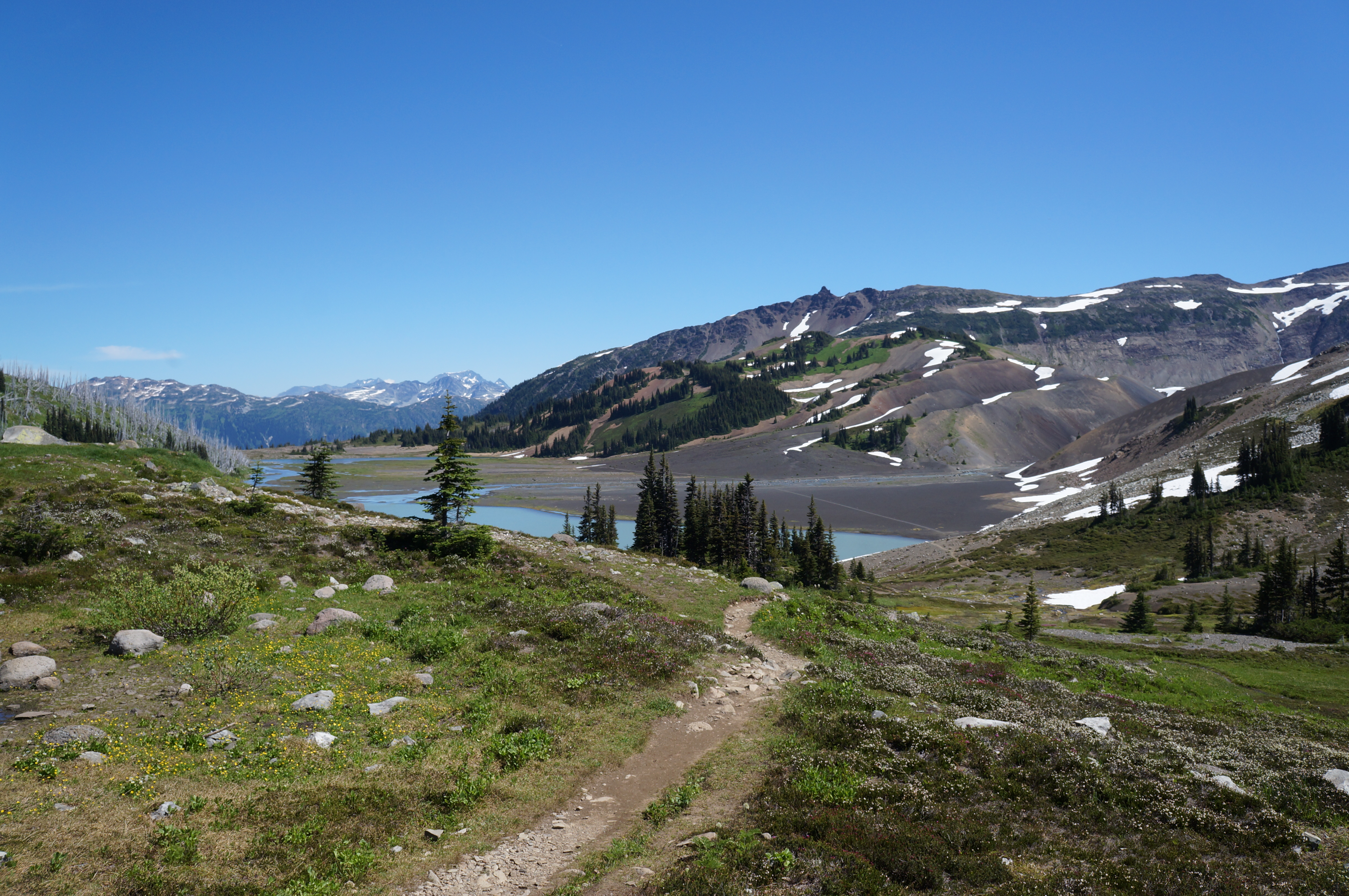
It’s a bit of a rough start to Panorama Ridge when you leave the lake and have to hike back up over the bank, but after that the trail levels out a lot and has beautiful views of the alpine meadows. Panorama Ridge is about a 15km round trip hike from the lake and definitely ranks as one of my top 5 hikes. At first you hike through alpine meadows until you reach the base of Black Tusk, and then the trails branch off and you loop right the edge of Black Tusk Mountain down towards helm creek. You can’t see Black Tusk from this part of the trail, or Garibaldi Lake, but you can see down into the Valley and up to your final destination at the top of the ridge. I went during the August long weekend, so there were lots of wildflowers in bloom along the trail.

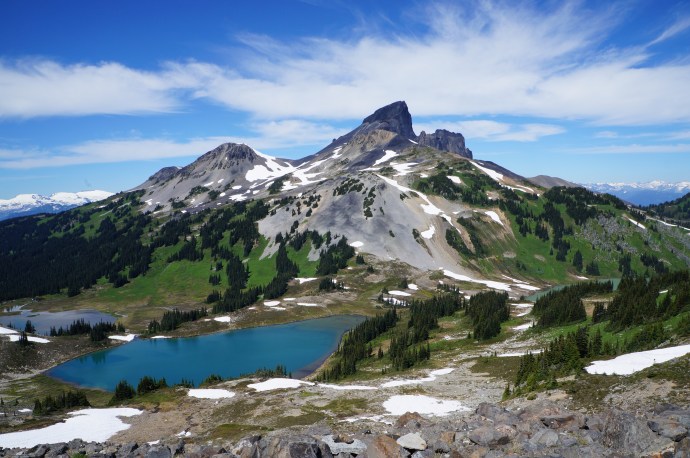
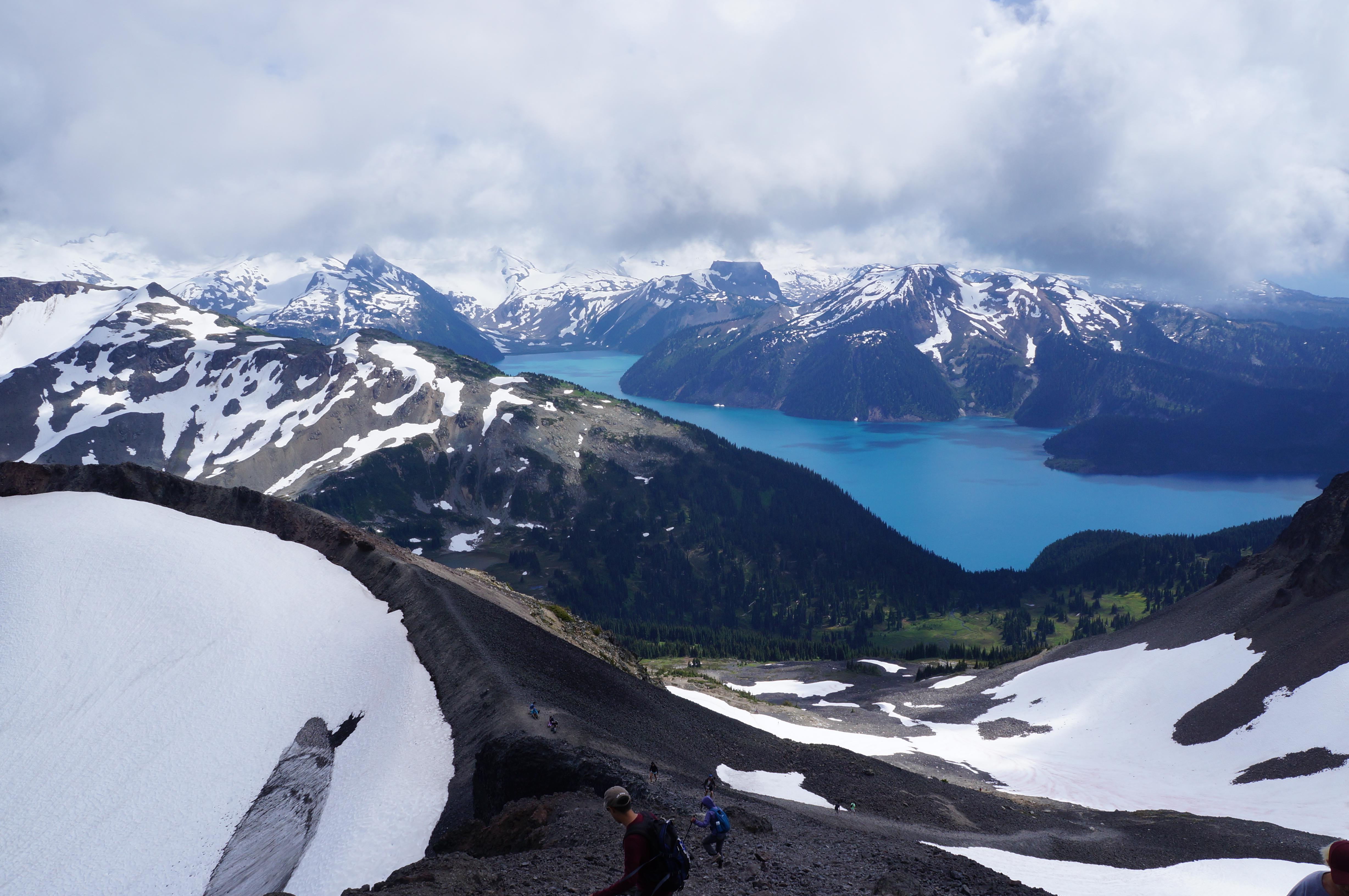
The last 2 kilometres of the trail are more difficult as you start climbing up towards the top of the ridge. It’s a steep trail and it can get quite crowded. Even though it was a Friday, it was still pretty busy, but I was glad we did it first. The view from the top is unbelievable and you should absolutely time your trip to eat up at the top so that you can hang out for a while. The view of Garibaldi and the surrounding mountains and glaciers is incredible, but it’s really the view back towards Black Tusk that took my breath away. I don’t think that view is showcased quite as much. I was anticipating and expecting the beautiful view of the lake, so I was surprised by the equally beautiful view looking back at Black Tusk and could never quite decide which direction to face!

I definitely think a day hike is the way to go for Panorama though. I know some people do Panorama as a 30km round trip, but I can’t imagine doing this unless you were a trail runner. It must be at least a 12 hour day to do the whole thing and that doesn’t leave much time to enjoy the views or the lake. Panorama Ridge was a whole day affair for us.

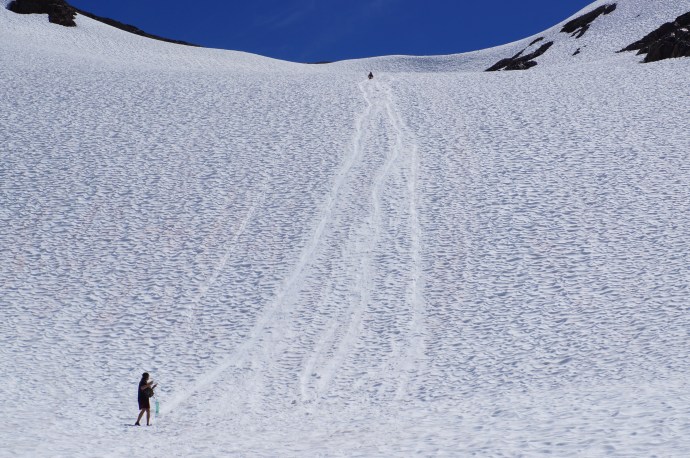
The year we went, there was still a lot of snow going up the side of the ridge towards the top. On the way up we could see some butt marks in the snow coming down from the top and Seth was really keen to slide down the snow on the way back. I think whether or not this is possible probably depends on the conditions when you visit, but I would absolutely recommend AGAINST it either way. Me and Emily were swayed by Seth’s enthusiasm about sliding down and decided to give it a try. But it’s a lot steeper than it looks and a lot longer. Once you start sliding down it’s really hard to control your speed and you’re pretty much committed to going the whole way. It is so cold to slide down a snowbank in your shorts and because we started picking up to much speed, we were forced to try and slow ourselves down with our hands, causing both our hands and butts to go totally numb for hours (yes. hours, I am not exaggerating). So yes, we did slide down, but I would not repeat the experience.

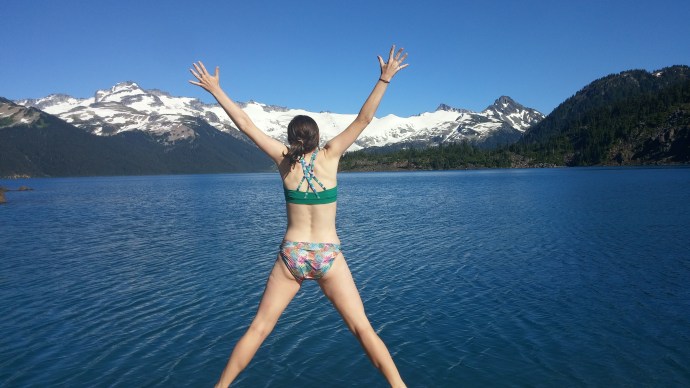
We finished the day with one of my favourite activities, a swim in the lake! If you don’t walk far enough in around the lake, you might never know that there’s a dock, but if you want to swim, this is absolutely where I’d recommend you go because then you can save yourself the torture of having to wade into the freezing, glacial water, and just jump in. I think I swam in the lake every time I’ve been up there and while it is freezing, it is one thing I would recommend! The cold water is so nice on your aching muscles and it makes for a great photo!

On Saturday we hit up Black Tusk. We would have preferred to stay at Garibaldi Lake all weekend, but unfortunately the campsite had been full for Saturday night by the time we booked, so we packed up everything and moved to Taylor Meadows on Saturday morning. Taylor Meadows is about 1.5km away from the lake and has traditionally been used for group and overflow camping back before the reservations were introduced. Now you can book all the campsites online and while it’s frustrating if you’re not fast enough to nab one, it does remove the stress of wondering whether you’ll find somewhere to pitch your tent for the night.

DSC01372

It was the BC Day weekend and as expected, it was a lot busier on Saturday. Taylor Meadows is nice, but it definitely can’t compare with the lake. The campsites have much less privacy and are all crammed together in the meadow. We decided to eat lunch in the hut and then started on the Black Tusk hike after lunch. Black tusk is a bit shorter than Panorama Ridge, but it has more elevation gain. The weather was cooler on the day we did Black Tusk as well. You hike in to the same junction, but instead of hiking around the mountain, this time, you hike up it. I wasn’t expecting to see the Lake from Black Tusk since you can’t see it from Panorama at all until the very top, but you can actually see the lake from a lot of the Black Tusk hike, which was really nice. There was still quite a bit of snow on Black Tusk though, even in August, so we did have to cross several snowy sections on the way up.

DSC01678

What I didn’t realize until the way down, was that the official Black Tusk hike actually ends about halfway up to the ridge (there’s a sign that marks the end of the hike – which I did see, but thought it was just an info board about the hike). So we kept going to the top of the ridge at the base of the tusk. It is definitely rough going in that last section. It is all scree going up to the ridge and every step you take you feel as if you’re sliding half a step back. Emily and Seth hated it and I didn’t particularly like it either. We pushed to the top of the ridge so that we could see the views on either side of the mountain, but Emily and Seth refused to go on from there. There is one last section that goes right to the base of the tusk and I really wanted to see it, so I braved the last 10-15 minutes up the slope on my own.

But that’s where I quit. I know there are people that climb Black Tusk, some of which bring actually safety and climbing gear, and others that just free hand it. I’m not one of those people. I’ve heard stories of how dangerous it is, so I opted to give it a pass. But, I did get beautiful views of the tusk and looking out around the surrounding area on both sides of the tusk. I have been back to Panorama Ridge since then, but that will probably be my one and only time up Black Tusk. It was a cool hike, but I’m not a huge fan of all the scree, so it’s one I’m happy to tick off my bucket list and move on from. But never say never I guess, I could probably be convinced to return on snowshoes.

And that was really it for our Garibaldi trip. We returned to Taylor Meadows and hiked out the next morning. It was Sunday when we hiked out, so there were still an insane number of people hiking in, and it’s kind of fun to watch all the day hikers sweating it on their way in while you hike all downhill with your pack and your sweater still on.

DSC01402

Overall, I do have a bit of a love-hate relationship with Garibaldi though. I definitely love it in that it is incredibly beautiful and awe inspiring, but it’s also mistreated by a lot of its visitors and that is really frustrating. I’ve had more than one “leave no trace” rant on this blog, but Garibaldi and Joffre are particularly bad for garbage. Please please please, respect the beautiful nature that we all share and pack out all your garbage! Do not leave garbage in outhouses as that attracts bears. If you can pack it in (uphill) full, then you can definitely pack it out empty.

DSC01481