9 Spring Hikes near Vancouver

Spring is one of the most challenging seasons in the backcountry. It gets really nice in the city, which can trick hikers into thinking that it’s a good time to return to the mountains. Any time is a good time to be in the mountains, but you have to manage the risk accordingly. Snow will not melt at high elevations and in the alpine until the end of June and sometimes even as late as mid July. Spring is particularly dangerous because the rapid melt can create unseen hazards under the snow. What looks like a flat snowy trail may have creeks hidden under thin layers of snow that can easily collapse under your weight. So the safest approach is generally to stick to lower elevation hikes. Fortunately, there’s lots of those available in BC as well! Here’s a few of my favourites within close driving distance of the lower mainland.

Jug Island/Admiralty Point Trail

A photo of a yellow kayak resting on the beach in front of Jug Island on a sunny, blue sky day in Belcarra, BC.

Belcarra is a gorgeous coastal location for Spring hiking. If you park at the lot in Belcarra Regional Park, you can do a short, but scenic hike along either end of the peninsula. If you head south from the parking lot, you’ll follow the Admiralty Point Trail along the water, with lots of little viewpoints along the way. If you head north, you’ll hike inland along the Jug Island trail to a beach viewpoint. Both trails are approximately 5.5km long round trip, but Jug Island is more challenging because it hikes up over the headland and then down to the beach. Both trails can usually be hiked year-round.

Hunter Road

Three hikers and their dog pose at a viewpoint with the snow capped mountains and Stave Lake in the background at Hunter Road, near Mission, BC.

Hunter Road is an easy trail in Mission that can be done during most of the year. The trail starts from the end of Roach Street and is an easy hike along an old forestry road (Hunter Road). Eventually the trail loops back around on itself to climb up to the summit of a small overlook where you can enjoy views of Stave Lake and the surrounding backcountry. It’s a there and back trail, approximately 7.5km in length, 250m in elevation gain.
High Falls Creek

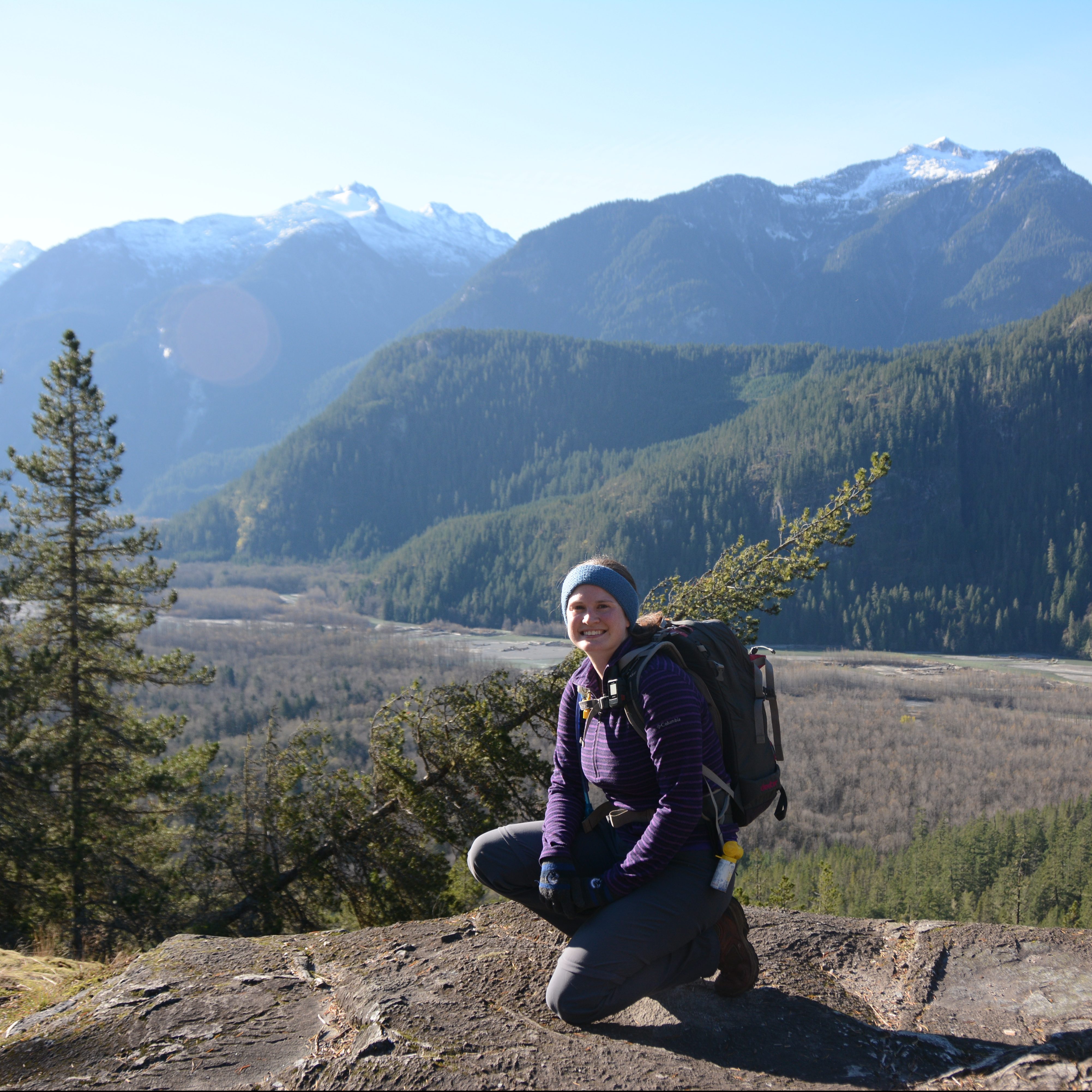
A female hiker nears and smiles at the camera from the High Creek Falls Trail with a view of the snow capped mountain peaks and forest of the Squamish Valley in the background, near Squamish, BC.

High Falls Creek is one of two hikes on this list that can be found along the Squamish River. It’s a more challenging hike than some of the others, but is great for Spring when the rivers are flowing at high capacity. The trailhead is located approximately 26km up Squamish Valley Road. The hike can be done as an out and back, but if you want to make it a bit longer, you can turn it into a loop hike by continuing up to Branch 200 FSR and hiking back along the road. The trail to High Falls is a bit technical, with some scrambling over rocky sections, so make sure to go on a dry day. It’s 1km each way to High Falls Creek, but if you do the loop, it’s 9km with 500m of elevation gain.
Crooked Falls

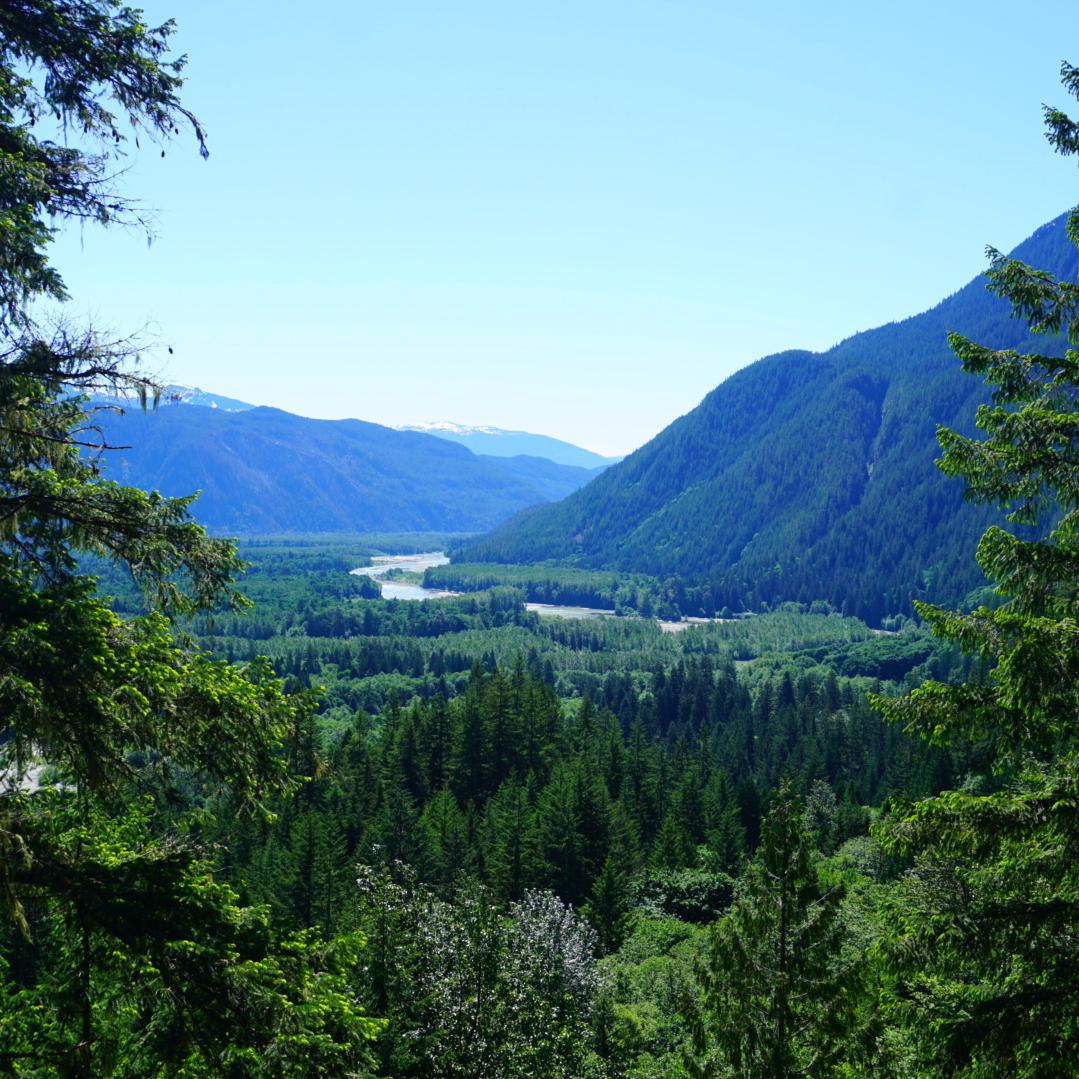
The view of Squamish Valley from a viewpoint on the trail to Crooked Falls that shows the forest, Squamish River, and mountains in the background on a beautiful blue sky day outside of Squamish, BC

Crooked Falls is the second hike along the Squamish River. It’s a similar distance from Squamish, but you take a left turn over the bridge off Squamish Valley Road and onto the Ashlu River FSR to get to the trailhead. The hike to Crooked Falls is approximately 5km round trip, with 400m of elevation rain. The waterfall is especially impressive in the Spring and makes for a fun day trip. If you want to extend the hike, you can continue along the Sigurd Creek trail to a small outcrop with a gorgeous view of the area. This hike is much harder and is approximately 12km round trip, with 900m of elevation gain. It may not be totally snow free in the Spring.

Woodland Walk/Sawblade Falls
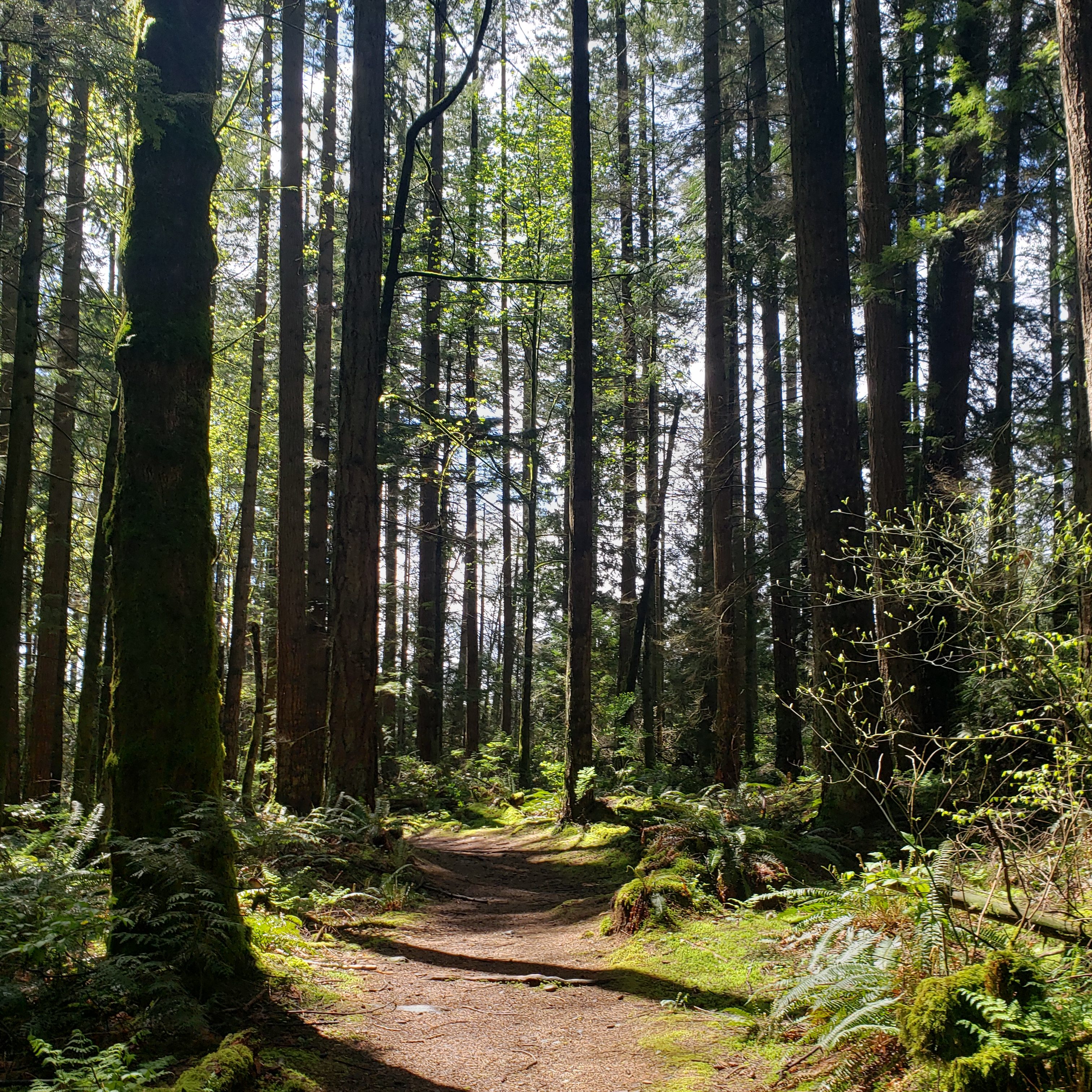
A photo of a forested trail in Pinecone Burke Provincial Park on a sunny day near Coquitlam, BC.

Woodland Walk and Sawblade Falls are two lesser known hikes in Pinecone Burke Provincial Park. They’re super easy to access from Harper Road in Coquitlam and I think they’re very underrated for how close they are to the city. Woodland Walk is a leisurely 7km loop walk through the woods and is great for a rainy day. It only has 200m of elevation gain and makes for a fun forest adventure. It’s easy to extend the loop to also include Sawblade Falls, which is approximately 9km in length. My advice is to be familiar with using GPS maps if you explore this park. There are so many trails through the forest, I usually go and just make my own adventure.

Big Cedar and Kennedy Falls

Two hikers flex their muscles in front of the big cedar tree on the Kennedy Falls trail in North Vancouver, BC.

It’s been a long time since I did this hike, but it sticks out in my mind as a great Spring hike on the North Shore. It’s a bit on the longer side at 10km, and it climbs up and down, so it has a surprising amount of elevation gain (500m). The trail leaves from the Mount Fromme trailhead and is great for variety as it hikes through the forest to a large big cedar tree, and then on to scenic Kennedy Falls. The trail is more technical, with lots of climbing over tree roots, so it’s a good option for more advanced hikers. 

Norvan Falls

Another option on the North Shore – Norvan Falls is a classic Vancouver hike. The trail leaves from the end of Lynn Valley Road and is the longest trail on the list at 15km round trip. The trail hikes along Lynn Creek and then through the forest along the Hanes Valley Trail to Norvan Falls. There’s 600m of elevation gain along the trail, but there is an option to do a little loop through the forest along the way to make the hike more interesting. This is a great option in the Spring when the rivers are running full. The waterfall drops to a trickle in the summer and can be less impressive after the Spring snowmelt.

Stawamus Chief

Two female hikers lie back and relax and smile from the top of the bare rock of The Chief's second peak, with Howe Sound and the Tantalus Mountain Range in the background near Squamish, British Columbia, Canada.

I’d be remiss if I left the Stawamus Chief off this list. The Chief was the first trail I ever hiked after moving to Vancouver and it draws crowds at any time of year. It’s a challenging trail, as it’s mostly a stairmaster to the top, with lots of sketchy sections with ropes, ladders, and scrambling. The full trail is 11km, but it consists of 3 peaks, so people rarely hike all 3 at once. I’ve done the first and second peak, but I still have yet to return for the third peak. I recommend the first peak, because it’s the easier option and has incredible views of Howe Sound. This is a real bucket list hike that is worth the hype, but don’t do it on a rainy day or if you’re afraid of heights.

Widgeon Falls

A hiker stands on the edge of a rock next to Widgeon Creek with the forest and mountains in the background on a sunny day

This hike is a little trickier because it includes paddling, but it’s such a fun adventure, I wanted to include it! In the Spring and Summer, you can rent canoes or kayaks to cross the Pitt River and paddle up Widgeon Creek to the Widgeon Falls trailhead. It takes approximately 1.5 hours each way to paddle to the trailhead at the Widgeon Creek Campsite. From there, you can do a 5km loop trail through the forest up to Widgeon Falls. It’s a beautiful trail and makes for a really unique experience. That said, navigating the Pitt River can be a challenge depending on wind and current conditions, so don’t attempt this adventure without the proper research and experience. I have a full blog post on my experience if you’re looking for more information.

8 Great Spring Hikes in the Lower Mainland

Growing up in Newfoundland, I never really liked Spring because it’s barely a season there (pretty sure we just get a second winter). But Spring in the Lower Mainland is fantastic! It actually warms up when it’s supposed to and pretty much the entire city has been in bloom this April. But as much as I love it, it also kills me a little bit because even though it warms up so much in the city, it still takes a long time for all the snow in the mountains to melt. Proper hiking season doesn’t really start until late June, early July, but there are lots of lower elevation hikes that you can do in the Spring that are located right in our backyard! Here’s a few of my favourite Spring hikes to tide you over to those warmer summer days:

Baden Powell Trail

The Baden Powell Trail is a whopping 42km long trail that runs all the way from Deep Cove to Horseshoe Bay. But don’t be intimidated by the length, the entire trail can be done in a series of day hikes, they’re just best done with two cars (one at the start and one at the end) so that you don’t have to backtrack. The four main trail sections include Deep Cove to Lynn Canyon, Lynn Canyon to Grouse Mountain base or Cleveland Dam, Cleveland Dam to Cypress parking lot, and Cypress to Horseshoe Bay. I’ll admit that I’ve only actually done the Deep Cove to Lynn Canyon section, but I’m hoping to hike a few more sections! I believe the more popular sections are between Deep Cove and Grouse, because there is significant elevation gain between the Cypress Mountain sections. Either way, there’s a lot to explore on this forested trail! Fun fact, the trail is named after Lord and Lady Baden-Powell, the founders of Girl Guides and Boy Scouts!

Big Cedar and Kennedy Falls Trail

This is a great trail located in North Vancouver that hikes through the forest to 2 main attractions, a really big cedar tree and Kennedy Falls. The hike is 10km long, with approximately 150 metres in elevation gain. We thought it would be a pretty quick hike with such limited elevation gain, but there is a lot of up and down through the woods, so the cumulative elevation gain is greater. It’s also a more technical trail than I was expecting, so if you’re looking for an easy walk in the woods, this isn’t the one for you. However, if you’re looking to warm up those legs in preparation for the summer hiking season, this is the perfect hike! There is a lot of spray coming off Kennedy Falls with the Spring run-off, so bring a rain jacket if you want to get close for photos. The trail is dog friendly, but small dogs might struggle with all the trees and roots across the trail.

Jug Island Trail

If you don’t want to travel to the North Shore, there’s some great hikes available in Belcarra Regional Park, located just past Anmore. Jug Island Trail is one of my personal favourites because it’s a short hike, but a good warm up. It’s only 5.5km long and has about 100 metres in elevation gain (it’s listed as having none, but that’s because it starts and ends at sea level). It’s a mostly forested hike, but there is a nice view about midway through the trail looking down at the backside of the peninsula, as well as a beautiful view of Jug Island and Indian Arm at the end of the trail. The beach at the end of the trail is also accessible by kayak from Deep Cove or Cates Park if you’re up for a boating adventure! This is the only trail I’ve done, but there are other short trails in the area such as Admiralty Point and Sasamat Lake.

Lower Seymour Conservation Reserve

The Lower Seymour Conservation Reserve is located between Grouse and Seymour and protects the ecosystem running up towards Seymour Lake, one of Metro Vancouver’s 3 water supply lakes. I worked in this area for about 8 months, so I had lots of time to explore some of the trails and there’s a ton of options to choose from! They’re all pretty similar in that they’re mostly forested trails (common theme for Spring hikes as it’s too early to get up in the mountains). Parking is available just off the end of Lillooet Road at the Rice Lake Gate, at the Lynn Canyon Ecology Centre, or off of Rice Lake Road at the entrance to Lynn Headwaters Regional Park. I’d personally recommend avoiding the Ecology Centre as it draws a lot of tourists for the suspension bridge, it’s only about 1km hike to the bridge from the other entrances if you still want to visit. Some of my preferred trails include Fisherman’s Trail (13km), which hikes up to a viewpoint overlooking the River, and Rice Lake (3km), which is great for fishing (if you’re into that). I also like the Lynn Headwaters Trail (6km), which follows Lynn Creek and can be extended to hike to Norvan Falls (14km). The falls are definitely best explored in the Spring when run-off is high, by Fall, the falls are just a trickle!

Lighthouse Park

I know, I know, all the locals are already super familiar with Lighthouse Park, but as an East Coaster I only visited the park for the first time last year! This is the place to go if you’re after ocean views! There’s still a ton of forested trails here, but they pop in and out of the woods along the coastline. I think of Lighthouse Park as a bit of a build-your-own-adventure trail because there’s tons of trails running through the park and you can pick which circuit you want to do. When I visited, we mostly followed the coastline, making a bit of a loop from the parking lot. There’s limited elevation gain in this park, but lots of great views!

Golden Ears Park

I’m a huge fan of Golden Ears Park. It gets crazy busy in the summer though, which is why Spring is great time to visit! Don’t even think about doing Golden Ears Peak, it’s way too early for that, but there are some nice trails located at the back of the park. Drive to the far end of Alouette Lake and park in the North Beach Campground lot (do not actually go into the campground, parking is not permitted there). There’s two trails, the Lower Falls Trail and the East Canyon Trail to Viewpoint Beach. At 5.5km, the Falls Trails is really more of a walk, but affords some nice views of the mountains from the river and a nice waterfall at the end of the trail. The trail to Viewpoint Beach is a little longer at 8km, and has a great view looking up at the mountains from the beach at the end. There’s about 200m elevation gain on the viewpoint beach trail and none on the falls trail. On maps, it looks like you can connect between these two trails, but I’ve done these hikes several times and I’ve never been able to find where the two connect.

Capilano Regional Park

This is another park I’ve explored as part of my work and it is a great urban trail in North Vancouver. If you’re feeling ambitious, you can hike all the way from Ambleside Park up to Cleveland Dam (~14km), but you can also access the trail from Cleveland Dam or from some of the local roads on the West side of the Park. The engineer in me loves Cleveland Dam and there’s a great view of the Lions looking out over Capilano Lake (another one of Metro Vancouver’s drinking water supply lakes). You can drive right up to the lake, but I’d recommend starting somewhere lower on the trail and making the dam and lake your lunch break in the middle of the hike. I like this trail because there’s tons of neat bridges to cross over with great views of the Capilano River and canyon. You can also stop in and visit the fish hatchery along the way!

Burnaby Mountain and Barnett Trail

There’s tons of great Spring trails located around Burnaby Mountain and it’s easy to take transit to them! I’ve personally done the Burnaby Mountain Summit Trail, which loops around the top of the mountain, and the Barnett Trail, which loops around the back of the mountain. The best views are probably from Burnaby Mountain Park. Both of the trails overlap each other and I would definitely consider them urban trails as they loop in around the SFU campus and the bike park, but there are a few views looking down over Indian Arm and you do get a nice workout climbing back up the mountain. Both hikes are under 10km.