A Beginner’s Guide to Backpacking

Would you like to get into backpacking, but don’t know where to start? Whether you’re new to hiking or an avid hiker, it can be challenging to make the transition to backpacking. It can be hard to know where to go, what to bring, and how to stay safe. This Guide is meant to be a high level support to link you to other resources, help you assess your skills, and safely plan for your first overnight hike.

The backcountry can be a dangerous place. It can be easy to become lost, injured, or susceptible to adverse weather, and without the proper preparedness, sometimes one mistake can unfortunately prove to be fatal. I don’t think we need to be afraid of the backcountry, but I do advocate for smart planning to mitigate as many risks as possible up front.

I am not an expert on backpacking. I have done a lot of backpacking near the lower mainland and I am a Outdoor Adventure Trip Lead with Girl Guides Canada, so I focus a lot of risk management and preparedness in the backcountry.

IMG_4814

Assessing Your Skills

Before heading into the backcountry, I think it’s important to understand what skills you have and what skills you may need to supplement. Are you an experienced hiker? Are you comfortable on more challenging terrain? Do you have any special training such as first aid or avalanche safety? Do you have access to all the essentials? Are you good at map and GPS reading? Do you know what to do if you run into trouble?

It’s important to have a good sense of awareness of your own body and to listen to it. It’s easy to get into trouble if you push your body too far or don’t recognize signs of stress. If you haven’t done much hiking, always start small to understand your limitations. Stop when you need a break, you are tired, the terrain looks dangerous, it’s too hot, etc. One of the most challenging decisions is accepting that you should turn around and not expose yourself to additional risk. Once you’ve started something, the inclination is always to push forward, because you’ve sunk time and energy into getting this far. But if the weather conditions are not right or your body is not feeling it, you should always feel empowered to stop for any reason.

Picking a Trail

Deciding where you want to go will help you plan appropriately for the rest of your trip. Once you’ve assessed your skills, you should have a better idea of what kind of trail you may want to do. Here’s some questions to ask yourself:

  • How far a distance do I want to hike?
  • Am I okay with hiking uphill, or do I prefer a flatter hike?
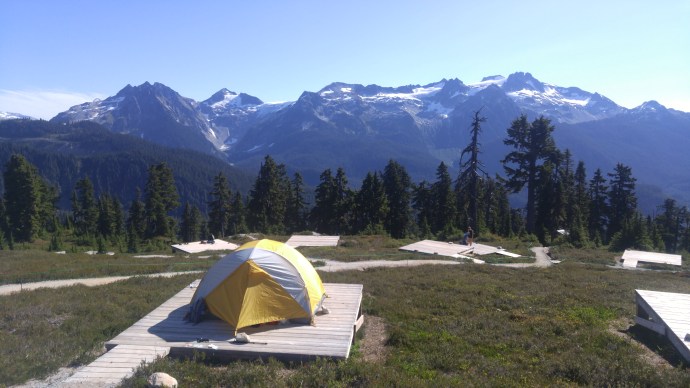
  • Do I want access to facilities like an outhouse, bear cache, tent pads, cooking shelter, etc?
  • How far am I willing to drive?
  • Can my vehicle safely access the trail?

For new backpackers, I recommend starting with shorter trails that aren’t too steep. AllTrails is a great resource to research hikes, so look for trails under ~6-10km and with elevation gain of no more than 200-400 metres. The shorter the hike and the greater the elevation gain, the steeper it will be. As a rule of thumb, keep the elevation gain under 10% grade (100m of gain over 1km). I also recommend selecting campgrounds that have outhouses and bear caches. Unless you already know how to dig a proper cathole, or you have a bear cannister, it’s much less stressful if you have access to these facilities. A cooking shelter can also be a great resource if the weather is not good because it will help you to stay dry without needing to set up a tarp. Do as much as possible to make your first trip easy because it can be overwhelming trying to learn too many new skills as once. Next week I’ll be posting some of my recommended hikes for beginners near Vancouver.

PSX_20220818_214003

Packing the Essentials

Backpacking is a balancing act between making sure you have everything you need to survive and trying to keep your pack light for physical comfort. It’s likely you will have a pretty heavy pack on your first trip because lightweight gear is expensive and you won’t have a good sense of what you really need versus what you can manage without. First time backpackers often bring way too much clothes, make sure you have warm and waterproof layers, but leave the extras at home. Embrace being smelly and just wear the same clothes for multiple days.

While there’s some things you can do without, you can’t compromise on your 10 essentials. I have a whole other blog post on Personal Safety and the 10 essentials and you can get more information from North Shore Rescue. Make sure you have all the essentials with you.

Safety

One of the most important things to do before heading into the wilderness is to leave a trip plan and have a plan for how you will manage problems on the trail. Your trip plan should include details on where you are going and when you are expected to return, and should be left with someone you trust to call 911 if you do not return. AdventureSmart is a great resource for creating a trip plan. Some other things to consider for safety:

  • Assess your first aid knowledge. Are you carrying a first aid kit and do you know what to do if you become injured?
  • Assess your navigation skills. Are you confident reading maps and GPS? Are you carrying an extra battery for your phone/GPS? Will your GPS app work offline?
  • Assess the ease of communication. Do you know if you will have service on this hike? Do you have a satellite device in case of emergency? If not, are you traveling with other people who can help in an emergency, or on a crowded trail where you can seek help from others?

If you become lost or injured, always stop right away and call 911. Don’t call a friend, partner, or parent. 911 calls will go through on any network available and are traceable. If cell service is unreliable, don’t waste what might be your only call on someone who can’t trace you or meaningfully help you. I have written extensively about trip plans, navigation, and communication in my blog post on Personal Safety, as well as I have a blog post dedicated to First Aid and preparation.
DSC09647

Camping Permits and Reservations

Now that we’ve talked about the scary safety preparedness implications, let’s talk about some of the more practical preparation you can do. Camping permits and reservations can be really confusing, but are necessary for most campsites. There is a lot of camping you can do on crown land, but I recommend parks where possible because they have more infrastructure dedicated to visitors. It’s important to respect the natural landscape in which we’re recreating. Everyone makes mistakes starting out, so it’s easier to limit your impact when camping in parks with access to toilets, grey water disposal, bear caches, etc.

If you’re camping in a provincial park, you will need a permit or reservation. Both can be booked online at camping.bcparks.ca. Reservations are only required in popular parks where they are trying to manage overcrowding. A reservation guarantees you a campsite, but not a specific site. For example, Elfin Lakes has 50 tent pads, so they release 50 reservations and you can pick any available tent pad when you arrive. Reservations are available for Garibaldi Park, Joffre Lakes, Manning Park, Berg Lake, and Assiniboine. They release 4 months in advance of your desired date, so if you want to camp on Aug. 15, you must reserve your campsite at 7am on Apr. 15. These typically cost $10 per person, per night, with a $6 reservation fee.

All other parks require only a backcountry permit. Permits are available 2 weeks before your desired date, but there is no limit on the number of permits sold, so you can wait until the evening before your trip to purchase it. There is no guarantee of a site with a backcountry permit, it’s simply first-come-first-serve at the campground when selecting a site. These typically cost $5 per person, per night.

Camping Equipment

Your essentials likely will only account for a portion of what you actually want to bring in your pack. Equipment can be really overwhelming when you first start backpacking because gear is really expensive. On your first trip, borrow as much as you can and accept that you’re not going to have all the best gear and that you will likely have a heavy pack. I have a gear guide dedicated to talking about camping equipment. My piece of advice would be to start with investing in a quality sleeping bag, something both warm and lightweight, and then move on to other gear later. I have also shared a packing list from the 10-day trip I did on the Sunshine Coast Trail.

HOP_6458

Food Planning

Food planning can be very stressful or very easy. If you want it to be easy on your first trip, just purchase backpacking meals at any outdoor store. They are expensive, but they are simple because they only require boiling water.

If you want to save money, I have written a 3-part series on cheap and easy meals to eat in the backcountry (no dehydration required):

If you want to get into the exciting world of dehydrating your own meals, of which I am a huge fan, I’ve written another 3-part series on easy dehydrated meals:

DSC08950

Leave No Trace

If you are recreating in the backcountry, you have a responsibility to leave it the same or better than you found it. This means, take all your garbage, including your toilet paper; stay on trails, even if it means walking through mud; filter your grey water to keep food waste out of the streams and lakes; don’t harm the natural environment scavenging for firewood or take anything natural back with you; respect wildlife and be considerate of other people. Check out Leave No Trace Canada for more information.

Other Considerations

A few other things to be aware of:

  • Practice bear safety. Cook away from your tent; keep everything that smells in a bear cache, including sunscreen and toiletries; pick up all crumbs; and make noise while hiking.
  • Protect your water sources. Filter or treat your drinking water and get water from moving sources, upstream of where people are swimming or washing dishes.
  • Always prepare for the weather. Mountain weather is unpredictable, always be prepared for rain and cold conditions. Turn back if necessary.

Check back next week for a list of recommended overnight hikes for beginners!
HOP_6069

The Best ‘Long Weekend’ Backpacking Trips

With the Labour Day long weekend coming up, I want to share some of my favourite long weekend backpacking trips! There’s lot of single night hikes in Southwestern BC, but long weekends are the best for backcountry hiking because the extra day enables you to explore further and to really escape from the hustle and bustle of the city. Whether you’re a first timer or a seasoned hiker, here’s 5 of my favourite backpacking trips near Vancouver:

For the Beginner: Lindeman Lake

Trail profile: Day 1 (2km, 300m gain), Day 2 (8km, 200m gain), Day 3 (2km, 200m loss)

Lindeman Lake is the perfect backpacking trip for beginners and one of my personal favourites for long weekend trips. I’ve been to Lindeman Lake twice for the May 24th long weekend and what makes it so great for beginners is that the campsite is only 2km from the parking lot, so it’s a great way to test out carrying a heavy pack for the first time. Once you set up camp, there are all kinds of options for what to explore over the rest of the weekend.

I wrote a post summarizing the different trails, but my recommendation for newbies would be to hike up to the campsite on Day 1 and then do a day hike to Greendrop Lake on Day 2. Greendrop Lake is approximately 8km roundtrip from Lindeman Lake, so it makes for a good day hike. Then on Day 3 you can hike back down to the parking lot and drive home. Lindeman Lake is located in Chilliwack Provincial Park, so you will need a backcountry permit, but there’s no reservation system and it’s only $5 per night, per person. Please remember that no campfires are permitted in this park at any time of year.


For the Bucket List Hiker: Garibaldi Lake

Trail profile: Garibaldi Lake Trail (18km, 820m gain), Panorama Ridge (15km, 610m gain), Black Tusk (11km, 820m gain), Mt. Price (11km, 620m gain)

I know, this hike is insanely popular and busy, but it’s popular for a reason! Garibaldi Park is only an hour and a half drive out of Vancouver and it boasts some of the most amazing views of the backcountry. I’ve only been in BC for 5 years and I’ve already done this iconic hike 3 times! There’s a lot to love about Garibaldi Lake, from the beautiful blue hues of the lake, to the breathtaking views of the glaciers and surrounding mountains, to swimming in the ice-cold lake and watching the sunset paint the mountains pink. But my favourite part of Garibaldi Lake is using it as a base from which to explore some of the surrounding trails. While Garibaldi Lake is gorgeous, the trail to the lake itself is a snooze-fest. It’s 9km of forested switchbacks, but has a huge payoff at the end. But from there, the rest of the trails in the park are breath-taking from start to finish!

There’s a few different ways to hike Garibaldi Park as a long weekend trip. I’ve done two long weekend trips to Garibaldi Lake and both times I left work a little early on Friday afternoon and hiked the 9km up to the lake on Friday night. From there, I stayed two nights at the lake and did day hikes on Saturday and Sunday, before hiking back out on Monday. However, if you’re a beginner I would recommend hiking up on Saturday morning instead and just doing one day hike on Sunday. Both times I hiked in Friday night, I started hiking around 5:30pm and got to the lake around dusk. If you’re a new hiker or not comfortable hiking or setting up in the dark, start your hike on Saturday morning instead.

Once you get to Garibaldi Lake though, there’s lots of options for day hikes. Panorama Ridge is my personal favourite and Black Tusk is also very popular. There’s also the lesser known Mount Price, which leaves the lake in the opposite direction of the other two hikes. Panorama and Black Tusk are both very popular and well marked trails, Mount Price is a bit more of a bush wack at times and isn’t well marked. So stick to the well marked trails if you aren’t familiar with way-finding.

However, if you’re making Garibaldi your destination for the long weekend, you’ll have to plan in advance. You must book a backcountry permit in advance for $10 per person, per night. The campsites release 4 months in advance of the date you book and they do book up fast. There is overflow camping at Taylor Meadows campsite, but it’s 1.5km away from the lake and definitely not as nice as the Garibaldi campsite. And as a final reminder, Garibaldi has been having problems with littering, so If you visit Garibaldi, make sure to pack out all of your garbage and leave no trace that you were there.


For the Through Hiker: Heather Trail

Trail profile: Day 1 (13.5km, 300m gain), Day 2 (9km, no gain), Day 3 (17.5km, 1000m loss)

Personally, I’m a big fan of through hiking. It’s great when you only have to set up camp once and don’t have to carry your heavy pack with you every day, but there’s something really fulfilling about through hiking and ending at a different location from where you started. It requires a bit more coordination as you’ll often need 2 vehicles, but it’s fun not to have to retrace your steps at any point.

Through hikes often require more time than just a long weekend, but one hike that can be done over 2 nights that I absolutely loved was the Heather Trail in Manning Park (it can also be done as a return hike, but I think it works best as a through hike). Manning Park is my favourite provincial park in southwestern BC and has some of the most scenic hikes. The Heather Trail is particularly well known for its wildflowers as the trail is mostly comprised of alpine meadows that burst into bloom in late July. The other highlights of the trail include walking the ridge along first brother mountain and camping at Nicomen Lake.

On Day 1, drive out to Manning Park and hike 13km to Kicking Horse Campsite. There is another camp called Buckthorn Campsite located at 5km, but it’s an easy walk to Buckthorn and not a scenic camp, so I’d recommend pushing all the way to Kicking Horse on the first day. Along the way, do the 1km summit up First Brother Mountain. On Day 2, it’s a more relaxing 9km hike to Nicomen Lake through meadow after meadow. Nicomen Lake is great for fishing if you’re so inclined, but bring your bug net because there’s a lot of flies. Nicomen Lake technically marks the end of the Heather Trail, but instead of turning around and hiking back 21km, I’d recommend hiking the Nicomen Lake Trail 17km back to the highway. 17km sounds like a lot, but the entire trail is downhill and we did it in just 5 hours. The benefit of hiking the trail this way is that there’s limited elevation gain. The hike starts at Blackwell Road, which is located 1000 metres up from the highway, so you do most of the elevation on the drive up. There’s no reservation system for this hike, but you do need a backcountry permit, which costs $5 per person, per night.


For the Long Distance Hiker: Elfin Lakes

Trail profile: Day 1 (11km, 600m gain), Day 2 (13-22km, 350-600m gain), Day 3 (11km, 600m loss)

I’m sensing a theme with this list because Elfin Lakes is another trail I’ve done 3 times! But my favourite was a 3 day trip that I did over the Labour Day long weekend in early September. Elfin Lakes is also located in Garibaldi Park and while it also gets a lot of visitors, it feels a lot less overwhelming than Garibaldi Lake. There’s a hut and tent pads at Elfin Lakes and you will have a similar problem as Garibaldi Lake in that you will need to book your reservation early if you want to be assured a site. The hut books up really fast in the winter and the tent pads book up really fast in the summer.

I say Elfin Lakes feels less overwhelming though because the campsite is much more wide open than Garibaldi and there’s a lot more area for people to disburse during the day, so it doesn’t feel quite as busy. You can swim in both lakes, but the Elfin Lakes are WAY smaller than Garibaldi Lake and therefore, much warmer and enjoyable for swimming. If it’s clear, you can also get an amazing view of the stars at night. My suggestion for Elfin Lakes would be to hike the 11km to the Lake on Day 1, then do a day hike to either Opal Cone or Mamquam Lake on Day 2, and hike out again on Day 3.

I call it the long distance hike because the options for your Day 2 hike are definitely nothing to scoff at. Opal Cone is a 13km round trip from the lakes, with about 350m in elevation gain and Mamquam Lake is a 22km round trip with 600m in elevation gain. I did the trip with my friend Brandon and we tried to get to Mamquam Lake on Day 2, but it was insanely hot and there’s a lot of elevation variation, so we never made it the whole way to Mamquam. We ended up turning back around 8km in, making for 16km in total. But the good news is, Opal Cone and Mamquam are the same trail, so even though we didn’t make it to Mamquam, we still got to do Opal Cone. There’s a lot of ground to cover on this hike, but with the exception of the first 5km from the parking lot, the entire hike is incredibly scenic!


For the Photographer: Skyline II Trail

Trail profile: Day 1 (12.5km, 610m gain), Day 2 (14km, minimal gain), Day 3 (12.5km, 610m loss)

Finally, the last hike on the list is not only my favourite hike on the list, but my favourite hike of all time! Like I said, I love Manning Park and for me, the Skyline Trail is the highlight of the park. It’s the most scenic hike I’ve ever done and it’s not even that crowded. Granted I didn’t do it on a long weekend, I took a Friday off to make it my own long weekend, so it might be busier on an actual long weekend. But that said, I did the same thing for the Heather Trail and it was definitely a lot busier.

I also hiked Skyline in peak wildflower season, which may have contributed to my love of the trail, but either way, I think I would have loved this trail because it has so many incredible views. The entire Skyline II Trail is 25km long and can be hiked with as a through hike or a return hike. The trail runs from Manning Park to Skagit Park, with Mowich camp smack-dab in the middle at 12.5km. I did the trail as a return hike from the Manning Side because the 2 trailheads are a 2 hour drive apart, so it’s logistically challenging (but not impossible) to coordinate. My recommendation is to start on the Manning side and hike to Mowich Camp on Day 1. From there, you can day hike along the Hozameen Ridge trail on Day 2, which branches off the main trail and continues towards Hozameen Mountain and the border.

Hozameen mountain is a very distinctive mountain and you’ll be staring at it all of Day 1, so it felt great to hike to the base of it. The trail continues on for a long time and actually ends on the American side of Skagit Valley. A good target for your day hike is to hike 7km to the Border monument. There’s a distinctive peak at the end of the ridge where you could end (because it is a steep downhill to the border monument), but I really wanted to see the monument, so we pushed through the last 500m to reach the monument – but the peak at the end of the ridge is a great place for lunch! We returned to Mowich Camp to sleep and then hiked back out the way we came on Day 3. But since the distance is the same on both sides of the Skyline Trail, you could hike out to the Skagit side instead if you wanted to make it a through hike. I’ve heard the Skagit side isn’t as scenic though and is mostly in the trees, so I didn’t mind hiking back along the same trail. The backcountry permit for this trail is the same as Heather Trail – no advance booking required, but the permit is $5 per day, per person.