10 Epic Thru-Hikes in BC

If you’re an avid backpacker already and looking for an epic adventure, there are lots of multi-day trips in British Columbia to whet your appetite. I’ve only done a small sample of what BC has to offer, but these are some of my favourite thru hikes! If you’re a beginner, check out my Guide to Backpacking and Overnight Trips for Beginners posts, as well as my safety resources.

A thru-hike is basically a trip that starts and ends at different locations, allowing you not to repeat any trail. They can be somewhat harder to coordinate and plan because 2 vehicles are often needed and the trailheads may be several hours apart from one another. I don’t recommend any of these trails for true beginners as they are all multi-night trips, several of which are in more challenging or technical terrain. But if you’re an intermediate or experienced backpacker and looking to get outside for extended periods of time, check out some of these trails!

Howe Sound Crest Trail 

The Howe Sound Crest Trail (or HSCT), is the closest trail to Vancouver on this list, as well as one of the shortest. That might lead you to believe that it’s one of the easier trails, but that is not the case. I think a lot of people stumble onto this trail who are not quite prepared for the steep and technical terrain, so definitely proceed with caution. The trail is 30km long and runs from Cypress Mountain to Porteau Cove. It can be done as a 1 or 2 night hike and most people start from Cypress because then it’s a net downhill trail. There are no facilities, so be prepared to do a bear hang and dig cat holes for your waste.

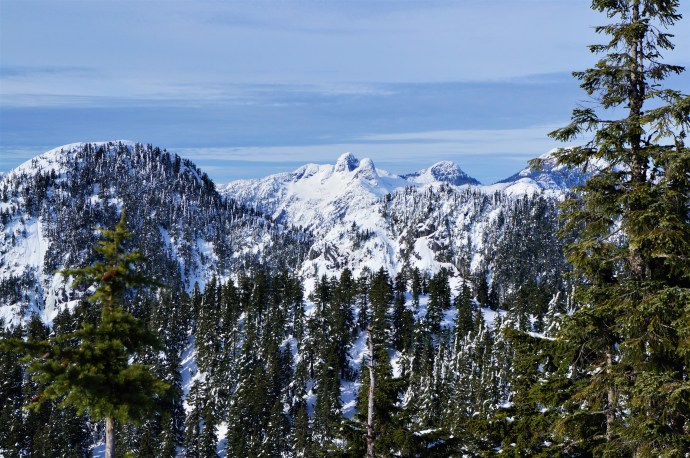
I prefer to do this trail as a 2-nighter and camp at the Enchantments and Brunswick Lake, but there is no water on trail until the halfway point, so if you camp at the Enchantments, you need to do a large water carry. The trail crosses between the Lions and up and down through several small summits. The start and end to the trail are pretty straight forward, but the trail gets very technical in the middle. If you’d like to extend the trip, you can consider summiting Mount Harvey and Mount Brunswick along the way. It’s a gorgeous trail with unparalleled views of Howe Sound. 
Helm Creek Trail

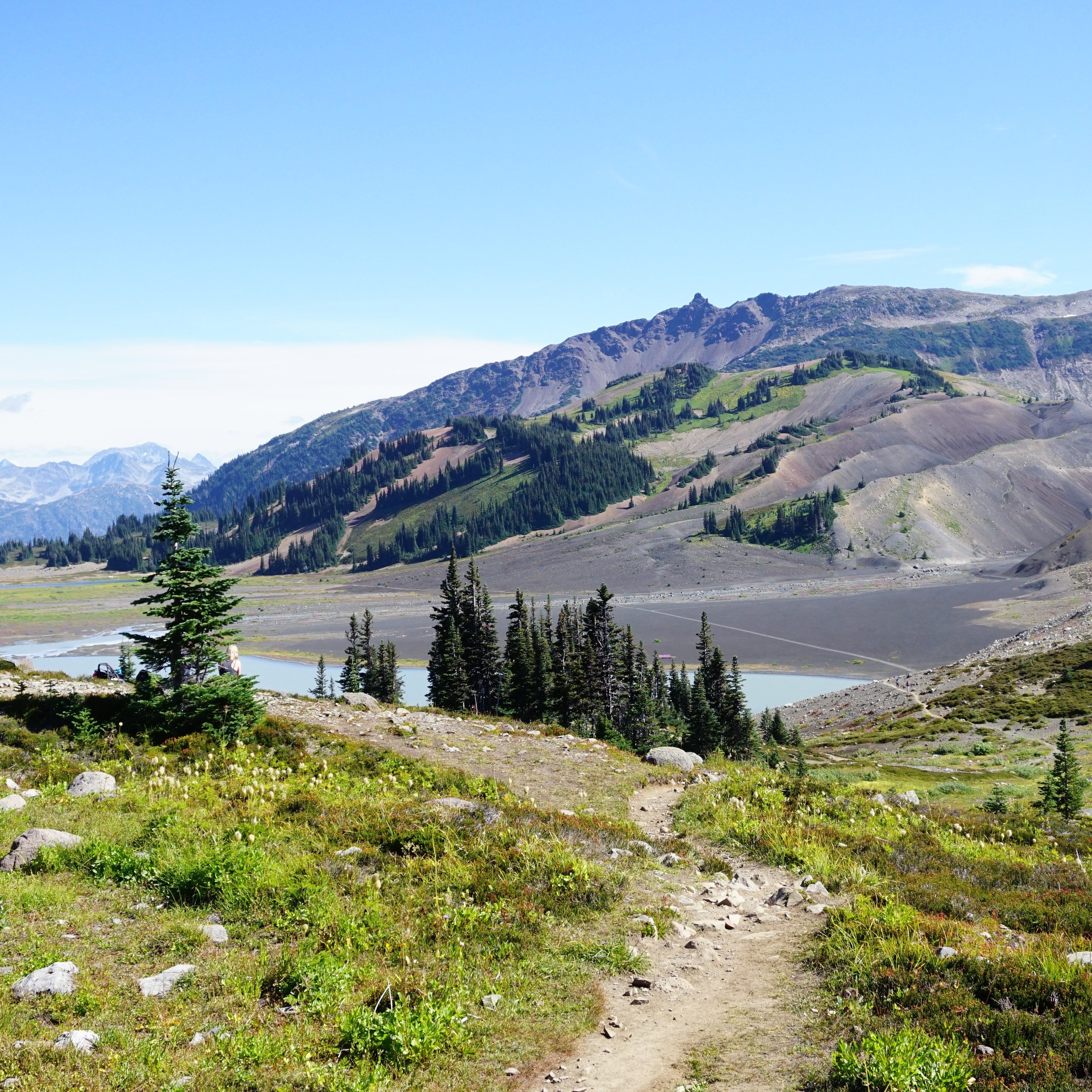
A hiking trail extends through the alpine of Garibaldi Provincial Park towards Helm Lake, with the forest and mountains in the background on a sunny day in British Columbia, Canada

This route doesn’t have a formal name, but extends from Rubble Creek to Cheakamus Lake in Garibaldi Provincial Park, near Whistler. If you’re on my website, most likely you’re familiar with this trail because of the popular trips to Garibaldi Lake, Black Tusk, and the iconic Panorama Ridge. Lots of people explore these trails as a day hike or a 1-nighter from Garibaldi Lake or Taylor Meadows. But I always recommend turning it into a multi-day trip by continuing on to Helm Creek. This trail is more appropriate for newer backpackers because of its substantial facilities. 

This hike can be customized to whatever length you prefer. Start at Rubble Creek and spend a few nights at Taylor Meadows or Garibaldi Lake and explore Black Tusk or Mount Price. When you’re ready to go to Panorama Ridge, pack up your camp and stop at the ridge on the way to the Helm Creek Campsite, which takes you through the gorgeous Helm Lake area. From there, you hike down towards the Cheakamus Lake parking lot. If you want to extend the trip further, make a detour to Cheakamus Lake or Singing Creek campsites. This hike requires camping reservations, which release 4 months in advance of your date from camping.bcparks.ca.

HBC Heritage Trail

A photo of Palmers Pond on a summer day, with the green meadows, forest, and mountains in the background, on the Hudson's Bay Company (HBC Trail) near Hope in British Columbia, Canada.

In my opinion, this is one of the most challenging trails on the list (except for maybe the North Coast Trail). HBC stands for Hudson Bay Company and is a historic trail that was originally used by the First Nations and later by the fur trade. The trail is 74km long and extends through the mountains from Hope to Tulameen. A lot of the trail is through the forest, but it has some gorgeous campsites and views along the way. It’s not an overly popular trail and you likely won’t see many people on it if you like solitude. 

What makes this trail challenging right now is the state of the trail. The trail has been revitalized in recent years and has a dedicated volunteer maintenance group, but the 2021 flood was particularly hard on this area. Volunteers have been working to clear the trail, but there is still quite a lot of blowdown in some sections and the trail does require fording at least 3 rivers. All of the campsites have nice facilities, so if you give yourself enough time to navigate the technical terrain, it is a beautiful trail.
Heather Trail

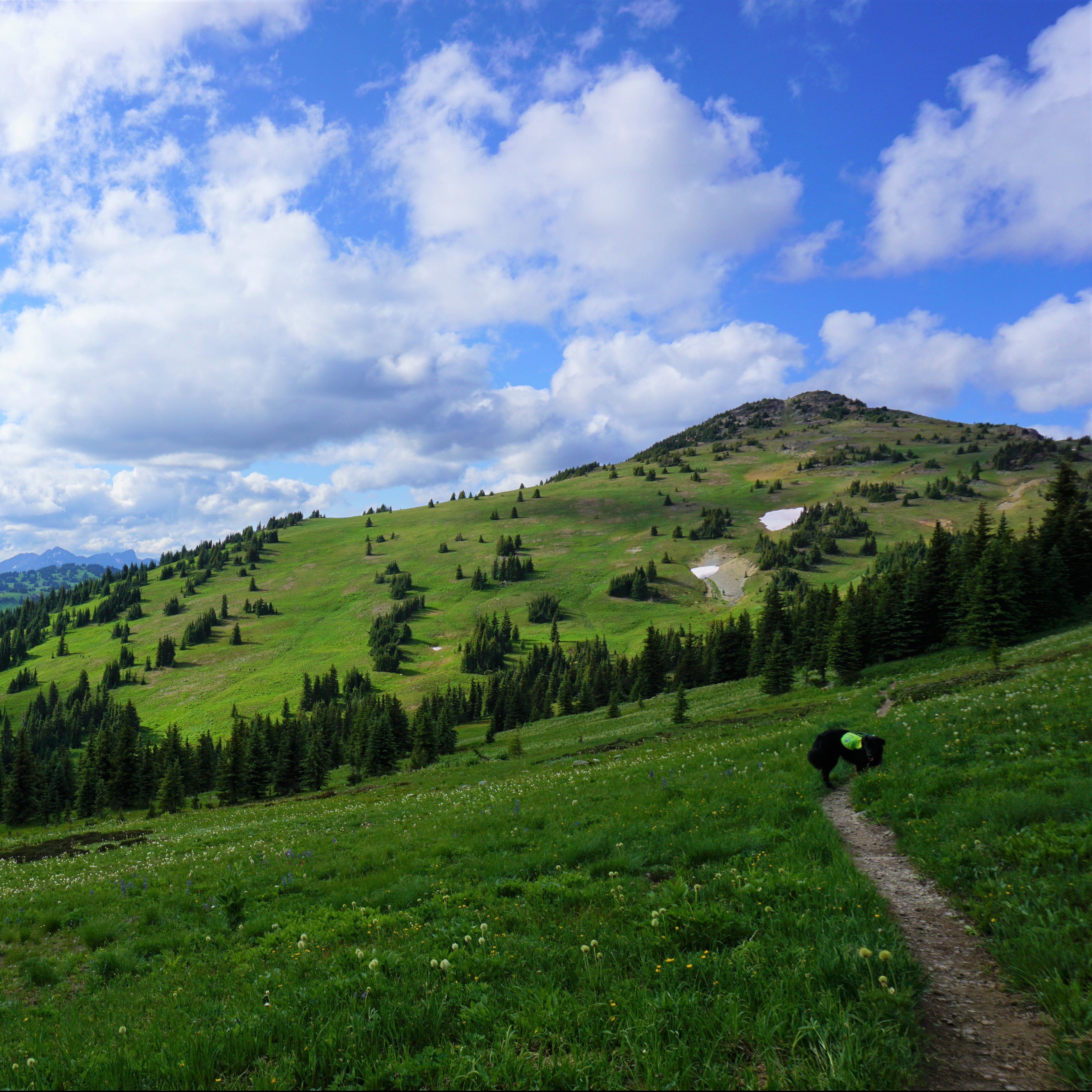
If you’re new to thru-hiking, the Heather Trail would be my recommendation. This is a relatively easy trail, with gorgeous views and brand new facilities. It’s located in E.C. Manning Park and can be done over 2-3 days. The trail starts at the top of Blackwall Road, which means most of the challenging elevation gain is done in the car. Technically, the Heather Trail is 21km, ending at Nicomen Lake and requiring an out-and-back trip. However, if you connect to the Grainger Creek and Hope Pass Trails from Nicomen Lake, you can turn this into a ~40km thru-hike, ending at Cayuse Flats.

Over 2 nights, I would camp at Kicking Horse and Nicomen Lake, or you could add a night at Buckhorn Campsite at the start of the trip and take your time. The trail is all in the trees after Nicomen Lake, and even though it’s 17km from Nicomen to Cayuse Flats, it’s a very easy trail, though there is another campsite option at Grainger Creek. You do need backcountry reservations to stay at these sites as of 2024, which can be obtained 4 months ahead of your trip at camping.bcparks.ca.

Skyline II Trail

I love Manning Park and the Skyline II Trail is one of my all time favourites. This trail is more difficult than the Heather Trail, but still a relatively easy trip. The trail is approximately 25 kilometres from Strawberry Flats in Manning Park to Whitworth Meadow in Skagit Valley Park. There is one campsite at the halfway mark, Mowich Camp. 

While this hike can be done in one night, I highly recommend doing 2 nights at Mowich Camp and making a detour to hike the 15km round trip trail along Hozomeen Ridge and back. This trail will take you to the border monument and a fantastic view of Hozomeen Mountain in the US. The trail itself is easy to follow and takes you through gorgeous alpine meadows. The campsite is pretty basic and the water source can run dry later in the summer. A backcountry permit is needed and can be obtained 2 weeks prior to your trip at camping.bcparks.ca.

Sunshine Coast Trail

Sunny view of the ocean and beach at Fairview Bay on the Sunshine Coast Trail in British Columbia, Canada

This is the longest trail on my list, but is hands down my favourite thru-hike ever! The Sunshine Coast Trail (or SCT) is 180km and extends through the entire upper Sunshine Coast, from Sarah Point on the Malaspina peninsula, to Powell River, and down to the ferry at Saltery Bay. The SCT is unique because it is a hut-to-hut hiking route, which means you can do the entire trail, staying in free mountain huts along the way. 

The trail can be a challenge to coordinate in terms of transportation and food carries, but it is incredibly well maintained by volunteers, with gorgeous facilities. You can do a section of the trail, or commit to the entire thing. The trail is primarily in the forest and tackles a lot of cumulative elevation gain. There are tons of lakes to enjoy a cool swim and some amazing viewpoints along the way. The trail can get busy, so if you plan to stay in the huts, you should still bring a tent with you as a back-up.

Juan de Fuca

The Juan de Fuca trail is often touted as a great beginner coastal trail. It is good in that it’s a lot easier than its more popular sister trail, the West Coast Trail, but it is still challenging in its own right. It’s a 47km trail on Vancouver Island between Port Renfrew and China Beach. There are several nice campsites located both in the forest and along the beaches, but like all the coastal trails on the island, it can be very technical and muddy.

It’s been several years since I did this trail and I have heard that some parts have received much needed maintenance since I did it, but it will still be quite muddy in early summer and there are several tidal points on the trail that require advance planning to cross. The nice thing about this trail is that there are several bailout points that connect to the highway if the trail is too challenging. Backcountry permits are required and can be obtained 2 weeks in advance from camping.bcparks.ca.
North Coast Trail

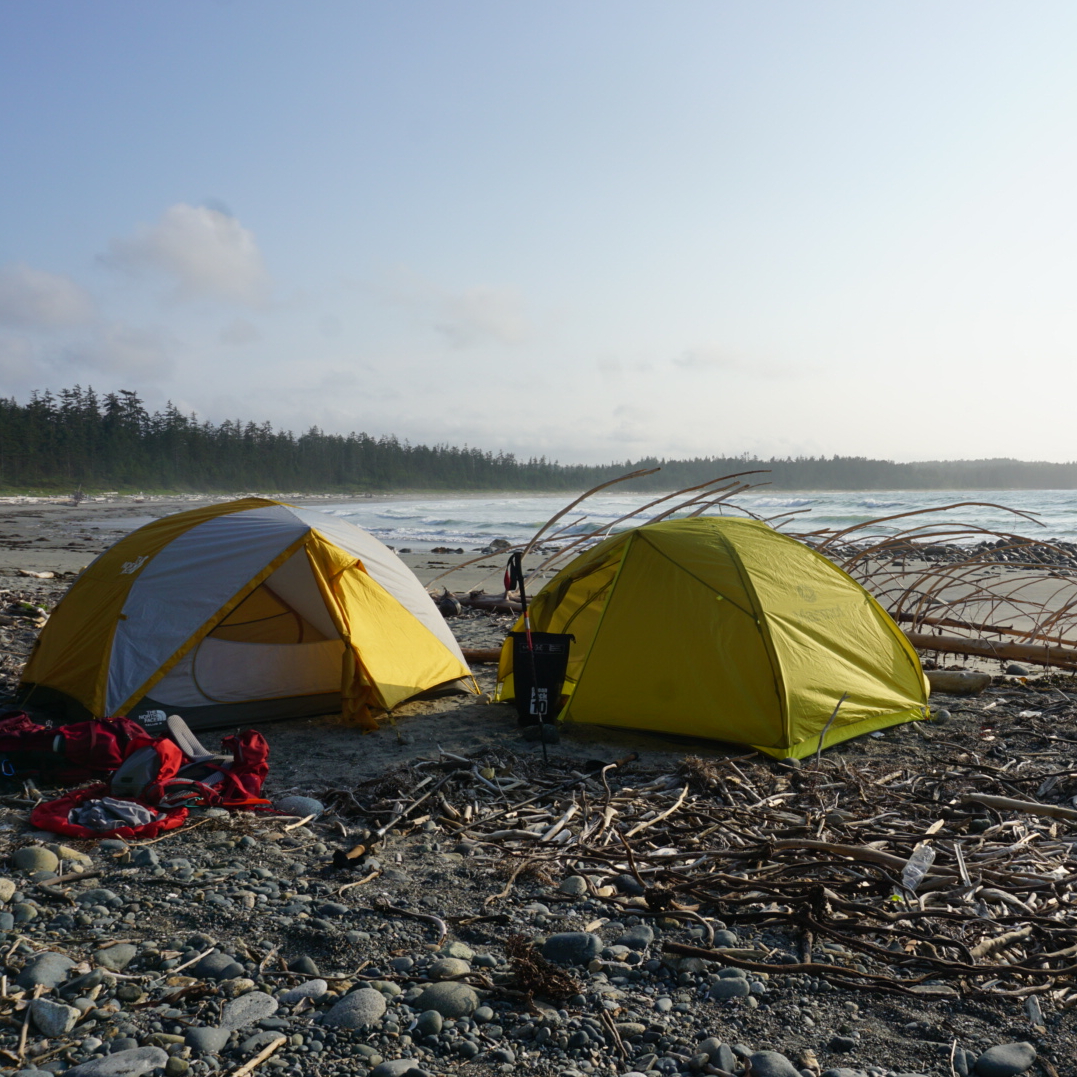
Two tents camping on a golden sand beach with drift wood and the forest and waves of the pacific ocean in the background at sunset on Irony Creek Beach in Shuttleworth Bight on the North Coast Trail on Vancouver Island in British Columbia, Canada.

The North Coast Trail (or NCT) is probably the hardest hike on this list. It’s much less popular than the West Coast Trail, but the traffic to this hike has definitely been growing. The NCT is a ~60km hike on the far north coast of Vancouver Island. It has a reputation for being extremely muddy and it doesn’t get very much maintenance. The NCT is only accessible by water taxi, so most people add on another ~25km of hiking to Cape Scott to finish this trail.

The Cape Scott Trail is accessible by dirt road and is better maintained than the NCT. The highlights of both trails are the gorgeous, remote beach campsites. There are several tidal points on the trail and you should be prepared for a very slow hiking pace through extremely technical terrain. But you’ll also likely get to view bears, eagles, and if you’re lucky, maybe even a wolf. Backcountry permits are required for this hike and can be obtained 2 weeks ahead of your trip at camping.bcparks.ca.

Mount Assiniboine

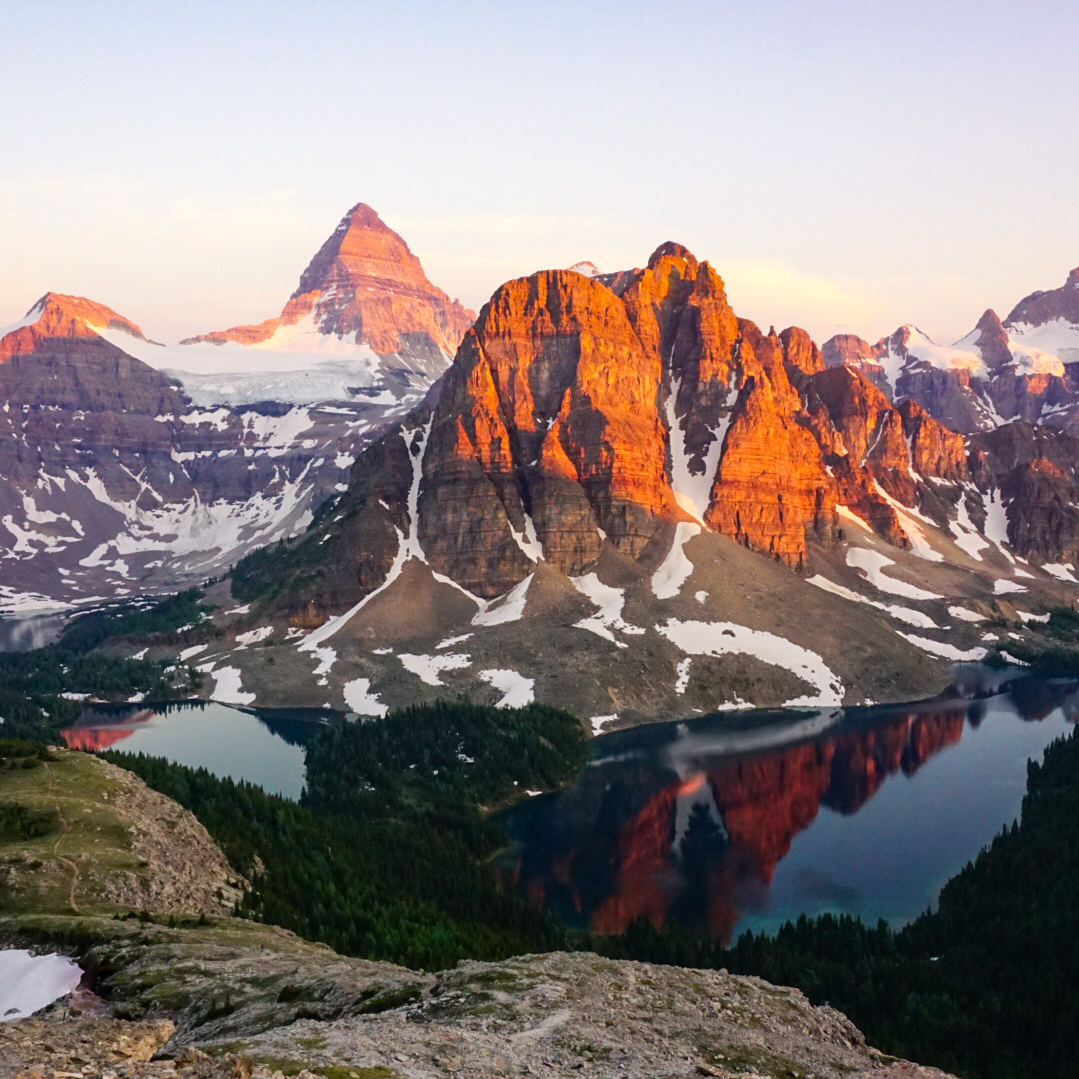
A photo of Mount Assiniboine and Sunburst Mountain and Cerulean Lake at sunset from the Nub in Assiniboine Provincial Park in British Columbia, Canada.

Mount Assiniboine can be accessed as a loop trail, thru hike, or by helicopter. Of course, I did the thru hike option. Mount Assiniboine is one of BC’s premier mountain campsites and there is a lot to explore from the core area of the park. We planned for 3 nights in the Magog Lake Campground, and 1 night on either end of the trip to hike in and out. While Assiniboine Park is located in BC, the hike is accessed through Banff National Park in Alberta.

Take the gondola up to Sunshine Village and hike through the alpine meadows to Porcupine Camp on night one, then continue to Assiniboine for several days in the park. Explore Magog Lake, Cerulean lake, and Sunburst Lake, as well as the iconic hike up to the Nub for sunset. On your way out, hike through beautiful Wonder Pass and camp at Wonder Lake before ending your hike at Mount Shark. You will need to coordinate 2 vehicles and book backcountry reservations for Assiniboine 4 months in advance at camping.bcparks.ca, as well as backcountry reservations for Wonder Lake at reservation.pc.gc.ca, which release sometime in March for the entire season. 

Rockwall Trail

The Rockwall on a sunny day with the mountains in the background and the forest in the foreground with blue sky in Kootenay National Park in British Columbia, Canada.

The Rockwall Trail is another extremely popular trail located in Kootenay National Park. It’s a 55km trail from Paint Pots to the trailhead for Floe Lake that is incredibly scenic. There are a number of campsites along the trail and it can be done in 3-4 nights. Floe Lake is the most popular campsite on the trail, but I also highly recommend staying at the Helmet Falls campsite. Along the way, you can stay at Tumbling Creek, Numa Creek, or both, they’re pretty similar sites. 

The trail is very well maintained and has lots of facilities. Campsites release for the entire season in March at reservation.pc.gc.ca, so make sure you watch for the release date, because the sites will sell out immediately. If you’re lucky enough to score permits, enjoy this beautiful trail through the Rocky Mountains and past the iconic Rockwall. 

Favourite Hikes in Southwestern BC: Part II

About 2 years ago I compiled a list of my Favourite Hikes in Southwestern BC. At the time I’d hiked about 40 trails and narrowed it down to my top 10 favourite trails. Some of those trails would definitely still be in my top 10 hikes, but since then, I’ve surpassed 100 trails and decided it was time to compile a new list! I haven’t included any of the hikes from the first list, so check out that post if you want to see my original list, but this list features even more awesome trails! All photos taken by yours truly.

#10 Lightning Lakes – I’m a little bit obsessed with EC Manning Provincial Park (as you’ll soon see from this post) and what I love about Lightning Lakes is that it’s got a little bit of something for everyone. The entire Lightning Lakes Chain Trail is actually 24km long and travels through the valley past 4 different lakes, but I’ve actually only done shorter loop around the first two lakes (but I’d love to do the whole trail someday). But I love this trail because it is pretty flat, so it makes for a great beginner trail and because there’s multiple lakes, you can customize it to whatever length you want. It has the most gorgeous views of the blue lakes and the surrounding mountains, as well as it’s a great place to swim and hang out in the summer. Me and my friends go every year to chill and BBQ at the first lake. (24km, no elevation gain, you decide the time and length!)

#9 Dam Mountain and Thunderbird Ridge – Located at the top of Grouse Mountain, I’ve never explored these trails in the summer, but I had a blast when I snowshoed them in the winter. It’s annoying to have to pay the gondola fee to get up Grouse Mountain, but on a clear day with a fresh snowfall, this hike has the most gorgeous views looking out into the Metro Vancouver watershed. It’s an easy enough trail – a lot of people just snowshoe up to Dam Mountain and then turn around, but I’d recommend going the extra 2km along Thunderbird Ridge. I also have to say that I ran into some equipment issues (personal equipment) and the Grouse Mountain staff were so helpful in resolving them! (7km, 250m elevation gain, 3 hours)

#8 Ring Lake – Ring Lake would probably rank even higher on this list had it not been right in the middle of wildfire season when I went there. But even with the insane amount of smoke in the area, I still loved this hike and am now dying to go back at a clearer time of year. Ring Lake is located in the Callaghan Valley and is a very low traffic trail. The gravel road to get to the trailhead is a little dicey (I’d recommend high clearance) and it is in grizzly country, but it’s a great area to explore if you want to escape the crowds. It is a steep trail up to the top because most of the elevation gain is in the second half of the trail, but the views at Ring lake are fantastic. The only issue right now is that one of the bridges is out right before the lake and you can’t cross it in high flows, so I would definitely recommend visiting in August or September. Even if you don’t make it to the top though, it’s worth visiting for the berries and alpine meadows located just past Conflict Lake. (20km, 500m elevation gain, 8 hours)

#7 Flatiron/Needle Peak – Flatiron and Needle Peak share most of the same trail, but split towards the end with Flatiron one way and Needle Peak the other. I think you could easily do them both in a day, but there was snow when I went a few weeks ago (early October). so we decided to skip steep Needle Peak. But this hike still blew me away! It does have significant elevation gain, but I liked it a lot because after an initial push through the forest (45-60 mins), the rest of the hike is along the ridge looking up at Needle Peak. Flatiron continues on to a lake that would probably be great for swimming in the summer and boasts great views looking down on the Coquihalla. Breathtaking on a clear day, but bring a sweater, it’s cold up there! (11km, 800m elevation gain, 6 hours)

#6 Frosty Mountain – The second hike from Manning Park on my list, I did a multi-day trip along the PCT and up Frosty Mountain (but you can do this one in a day). It’s definitely a steep hike, but the views are just amazing! my favourite part is the section running from what I call the “fake summit” to the actual summit, which goes right along the ridge up the peak with 360 degree views. I’ve heard awesome things about this trail in the Fall as well because the larch trees all turn bright yellow and make for some really vibrant pictures! (22km, 1150m elevation gain, 8 hours)

#5 Mount Price – A theme with my favourite hikes is that they tend to be some of the less crowded hikes. I did a 3 night trip through Garibaldi Park back in 2016 and hiked both Panorama Ridge and Black Tusk. My friend hadn’t been and asked me to join her for another 3 nighter, so I decided to switch things up and try out some new hikes while we were up there. While she was climbing Black Tusk (not a favourite of mine), I decided to hike the much less popular Mount Price. What a great decision because this hike is unreal! It’s basically Panorama Ridge, but on the other side of the lake and with hardly any people. It’s not a popular trail, so it’s not well maintained and does include a very dubious and steep hike up the side of Clanker Peak and then Mount Price, but the views from Mount Price are totally unreal! It has a very large summit, so I explored up there for over an hour without getting the least bit bored. It has great views across Garibaldi Lake of Black Tusk and Panorama Ridge, but it also has views looking back at the glacier and Mount Garibaldi. It was a tough hike, but ranks high on my list. (11km roundtrip from Garibaldi Lake, 600m elevation gain, 7 hours)

#4 Heather Trail – This one is a bit of a repeat from my last list since I included the Three Brothers Mountain in Manning Park, which is the first 11km of the Heather Trail. But I loved the Three Brothers hike so much that I had to go back and do the entire Heather Trail, and I definitely don’t regret it. If you love 360 degree views, the Heather Trail has it, but I personally love it for the alpine meadows. I’ve discovered I have a bit of thing for the alpine meadows (especially when wildflowers are in season) and I love hiking through meadow after meadow, there’s just so much open space and they make me feel like I’m living in the Sound of Music. I also really liked Nicomen Lake on this hike, but it was extremely buggy. The Heather Trail can be done as a through hike or return, we did it as a through hike by combining it with Hope Pass Trail from Nicomen Lake (38km through hike, 1000m elevation gain, 2 day hike)

#3 Cheam Peak – This one makes the list as well because of my recent obsession with meadows. It’s located in the Chilliwack Valley and you definitely need 4WD to get to the trailhead. But despite that, it was still a pretty busy trail because it boasts a great view looking out over the Fraser Valley. However, on the day we did it it was super foggy, so we didn’t actually see this view at all. But it really didn’t bother me and it still tops my list because the views looking back at the valley and the alpine meadows were breath-taking. In my opinion the fog made for some super interesting pictures and we had the most wonderful post hike swim in Spoon Lake, so the fog didn’t deter me at all. I felt like I was in middle earth for this hike, so I was content the whole time and would love to go back! (10km, 650m elevation gain, 5 hours)

#2 Juan de Fuca Trail – Okay, I know the Juan de Fuca is a bit of a stretch for this list, but it is still technically “Southwest BC”, it just involves a bit of travel time to get to the island if you live in the lower mainland. But it was seriously one of the highlights of my hiking experience over the past 5 years and I can’t not include it on this list. The Juan de Fuca is a 50km trail along the south-western coast of Vancouver Island and is known as the “West Coast Trail Lite”. I’ve devoted three whole blog posts to my experience on this trail and it was really unlike any other hike I’ve done before. The ocean speaks to that part of my soul that grew up in Newfoundland and this was my first multi-day through hike, so it felt like more of a journey than any other hike I’ve done before. I’d highly recommend this trail, I’d just say not to underestimate it. It is a very strenuous hike and it definitely kicked my ass, but it was the most rewarding hike I’ve ever done. (50km, 4-5 days)

#1 Skyline Trail/Hozameen Ridge – I had to end this list with one more trail from Manning Park. I really do love this park and I spent a lot of time exploring it over the last 2 years, and the Skyline Trail was definitely the highlight. With the exception of the first 5km, the entire hike runs along the “skyline”. You basically hike along the ridge from mountain to mountain with the most amazing views of the alpine meadows, wildflowers, and mountain range. You can do this trip in a single day if you’re ambitious, either as a through hike or return trip (25km), but we did it as a two night trip, base camping at Mowich Camp. On our second day, we day hiked along Hozameen Ridge to the border monument and the most incredible view looking out at the enormous Hozameen Mountain. I loved every second of this 3 day trip and would recommend to everyone. The first 5km are a pretty consistent incline, but after that, it’s not a difficult trail. (40km, 500m elevation gain, multi-day trip)

Continue to Part III.

Hiking the Juan de Fuca Trail – Part III

I haven’t been blogging here lately because I recently started a book blog and I’ve been doing a lot of blogging at The Paperback Princess instead. But I’m going travelling soon, so I logged back in to this blog to write a post and realized I wrote an entire post about my last day on the Juan de Fuca trail that I never posted. So if you’ve been waiting in anticipation for this for the last year, here’s some closure! I’ll follow up shortly with some information about the next trip I’m taking!

See my first 2 posts about the Juan de Fuca trail here: Part 1, Part 2


Day 3 had me feeling pretty nervous. The Juan de Fuca trail map marks this section as the “most strenuous” section of the trail. Most people do the trail the opposite direction as us to get the hard part out of the way first, but we wanted to get the longer distances done first, which is why we did the trail backwards.

About 20 minutes before we planned to get up we were woken by the pitter patter of rain drops on our tent. I have a good backpack and a good rain cover, but I still have irrational fears about hiking in the rain and having my sleeping bag get wet (even though the rain has never once seeped into my bag). I admit to a moment of weakness when I heard the rain on our tent. We had no way of knowing how long the rain would last and the idea of hiking through the “most strenuous” part of the trail in the rain was not appealing. I am now embarrassed to admit that I did float the idea of turning around and hiking back to Sombrio Beach to bail instead of finishing the 21km left of our journey.

We took our time getting ready in the morning – we boiled water for our oatmeal through the tent flap and tried to pack up everything inside the tent to keep our things from getting wet. While we packed we debated. Admittedly, the first two days of the trip had had some extremely challenging times and I struggled with the idea of two more days of wet and exhaustion. But I struggled more with the idea of giving up. I knew that if I gave up on the trail I would never come back and do it again.

Fortunately, the weather came back on our side and the rain started to clear out just when we got out of the tent to take it down. By the time we got the tent packed away, it had dissipated entirely and we decided to continue on our journey. I am so glad of that decision because it really was upwards from that point forward for the rest of the trip and we had a great time on the last 2 days of the trail!

It was definitely a wet start after the rain and we struggled to hoist ourselves up onto the rock at the end of the beach to get back on the trail. I believe we had to take our backpacks off 3 times in the first km to manoeuver around and over trees and boulders, but things shaped up after that.

It was still pretty muddy along the trail, but nothing we weren’t used to. The trail markers pretty much disappeared along this section, so we had no idea how far we’d gone, but we felt like we’d been making good time. We heard from other hikers that we would see a trail marker after 6km, which was our halfway point, so we made it our lunch goal again.

Day 3 was the first day where we finally actually made it to our lunch goal, which was huge cause for celebration! There was still some challenging, muddy sections along the way, but there were a lot of people passing us in the opposite direction and we were reassured by how remarkably clean they all were. We didn’t want to get our hopes up, but we were optimistic that the mud must clear up based on the state of everyone we passed.

Fortunately, it did about 5 km in, and though there were a lot of up and downs along this section, it was easily our best day on the trail to date! The hilly nature of this section is what gives it a “strenuous” rating, but me and Emily will take the hills over the mud any day! After the 5 km mark the mud all but disappeared, the sun came out, and we had a pretty great day ambling along the trail and silently mocking all the people we passed who were still trying to stay clean and avoid the mud. We knew they were in for a treat.

In retrospect, I’m even more glad we did the trail backwards because the last 15-ish km had pretty much no mud. I can’t imagine starting on the easy trail without mud and then having to deal with the trail getting progressively worse as we went (as well as the distance). So we were very assured in our decision to do the trail backwards and really enjoyed the last two days.

That’s not to say there weren’t still some challenging sections. There was a particularly awful river crossing where we had to haul ourselves up using a rope, but overall our spirits were much higher! We reached Bear Beach in record time for us, hitting the first campsite at about 4pm. Bear Beach is 2km long and has 3 campsites spread out along it. The first one didn’t look that great and we figured the furthest one would be filled with hikers who had been coming from the opposite direction, so we decided to head for the middle campsite.

There were only 3 other people at the campsite, so again, we had tons of space to ourselves and found a nice place to set up our tent. Since we’d arrived at camp 2.5 hours earlier than the other 2 days, we had more time to relax and we played a few games of cards. It was a little windier on Bear Beach, but we had a great view of the ocean and the clouds had cleared off entirely during the day, so we stayed up watching the tide slowly moves its way up the beach all evening.

Day 4, our final day on the trail, was easily the nicest. The sun came up early and there were blue skies all day. I’d been worried about Day 3 because Emily, who’s done more extended hiking than me, warned that from her experience Day 3 was the hardest on your body. Day 4 ended up being the toughest for me though. Fortunately, it was the easiest day on the trail by far (no mud and limited ups and downs), but without obstacles to distract me, my aching back was the only thing I could focus on. My body was definitely tired of carrying a pack and while it didn’t really slow down our pace, it was pretty uncomfortable.

The views along the trail were amazing though. We hiked mostly along the bluffs and with the clear skies, the ocean was the most fantastic shade of dark blue. We had 10km left to go on the final day, but we didn’t have a lunch packed, so we decided to push forward through 8km to Mystic Beach for our lunch stop. We snacked on the way there and planned to eat our way through all our remaining food for lunch when we reached Mystic Beach (for me this mostly consisted of the last of my jerky and trail mix and a mars bar).

We stopped for a few short breaks, but we made great time, arriving at Mystic Beach around 2pm. Mystic Beach was definitely one of the more beautiful beaches along the trail, mostly because it’s the only sandy beach. It was a bit jarring when we popped out on the beach though because it was like an immediate entry back into civilization.

Mystic Beach is only 2km from the trailhead, so it’s a popular destination for locals and tourists and was reasonably crowded with day-trippers. I was sad to leave the remoteness of the trail. When you’re on the trail, it’s just you and the trail and it’s easy to forget about the outside world. The trail feels like this living, breathing thing – it’s always changing, but you can’t change it. You can only adapt to it and push through. Sometimes it will reward you and sometimes it won’t. The trail really tested us throughout our trek, but I also feel like I learned from it and grew with it. It was my first through-trek, so it’s kind of hard to describe, but it felt so much more special to me, like I could now claim a piece of this trail for myself.

I know I don’t actually hold any claim to the trail, but I really felt like I could appreciate it more. Mystic Beach is beautiful and I understand why people flock to it – it’s a gorgeous place to spend the day and take pictures for your Instagram to make everyone else jealous. But it’s only a piece of the trail, arguably the most beautiful piece, but for me it made me appreciate all those other parts of the trail and the more subtle beauty. The rainy, rocky outcropping and tide-pools where we started our journey, the wet bridge crossing the river and falls at Payzant, when you first break through the forest onto the beach at Sombrio, rejoicing along the logging road, ambling up and down over the hills and through the sparse trees, the mink we saw running across the rocks on Bear Beach.

The trail really was more than the sum of its parts. Seth read my first blog and told me my account really didn’t make him want to do the trail. Yes, it was definitely a challenge, but I definitely don’t regret it. Through hiking is quite different from setting up a base camp and day-hiking, mostly it’s harder, but there’s the reward of really feeling like you’ve gone somewhere and accomplished something, physically and emotionally.

Arriving at Mystic Beach also felt very liberating. There were a ton of teenagers doing the whole dog and pony show in their little bikinis, running around the beach, posing under the waterfall, and playing in the water with their inflatables. So it was kind of freeing to walk onto the beach smelling and looking like actual death and just not giving a shit about any of it. You don’t care what you look like in the woods and when you’re on the trail your only concerns are your immediate needs. You eat when you’re hungry, you sleep when you’re tired – it’s simplistic. In that moment we wanted to lie on the beach and gorge ourselves on jerky and mars bars, so that’s what we did. We dumped our bags and kicked off our boots and didn’t care a bit what anyone else thought of us.

We lounged on the beach for quite a while – our reward at the end of the trail – before backing up our bags again for the final 2 km. We had a quite a laugh on the way out because the trail is, of course, pristine for the last 2 km. It’s all brand new fancy boardwalks, stairs, and bridges over the tiniest trickle of water or mud. So we were a little peeved all our trail fees were likely going into maintaining a 2 km section of trail for day-hikers who pay nothing, but hey, I’m glad it’s there for everyone to enjoy and I’m more often in the position of the day-hikers than the trekker.

I definitely was challenged by the experience, but I also learned from it. I’m a little addicted to backpacking now and I’m sure this will only lead to more and more adventures!