San Josef Bay Backpacking Trip

If you’ve been following my blog for awhile, you might be aware that I first attempted to visit San Josef Bay in 2020. I backpacked both the Cape Scott Trail and the North Coast Trail in June 2020, but thanks to a series of misadventures at the start of my trip, I had to cut San Josef Bay from the itinerary. A few years ago I saw San Josef Bay ranked on a list of the “most beautiful beaches in the world” and it’s been haunting me ever since that I still haven’t been there!

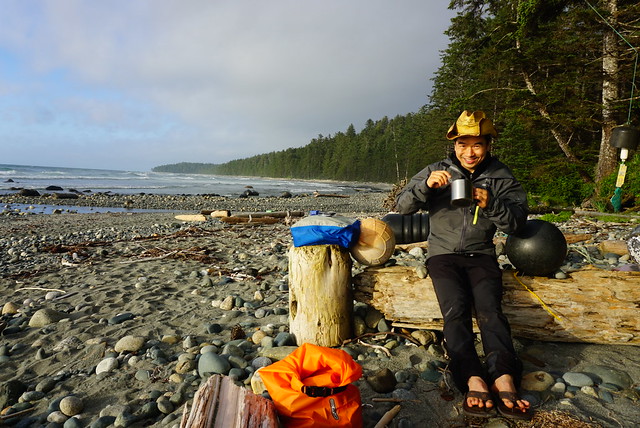
So this was a bit of a redemption trip for me. Over the Easter long weekend in April, I decided it was finally time to tackle San Josef Bay. It’s located on the far eastern coast of Vancouver Island and it is a journey to get there. I left Vancouver on Thursday after work with my husband, Seth, and our anxious Australian Shepherd, Sadie. We had a reservation on the 6:30pm ferry, which was absolutely necessary because the ferry sailings were already completely sold for the whole day by the time we arrived at the ferry terminal. Unfortunately, our sailing was delayed by almost 2 hours, meaning we didn’t get to Nanaimo until almost 10pm.

PSX_20250421_193512
PSX_20250428_190807

I’m a hyper-planner when it comes to trips, but this was one of the rare times where I didn’t have a booking for the night. I’ve been trying to embrace the unknown a little bit more and take advantage of FCFS and rec sites. We’d been hoping to drive to Campbell River before finding a place to sleep, but given the late hour, we drove ~30 minutes to Little Qualicum Provincial Park in search of a site instead. We were able to secure the second last campsite and quickly put up the tent to catch some sleep before continuing the journey in the morning.

We were up early to finish the 1 hour drive to Campbell River, followed by 2.5 hours to Port Hardy. Our friend Victoria was also joining us with her friends from Victoria, so she walked on the first ferry on Friday morning and they picked her up on their way north. They were a little bit behind us, so we stopped for a nice lunch at Cafe Guido in Port Hardy. It was an excellent choice because they also have a bookstore and artisan craft shop in the same space! So we picked up some souvenirs before finally meeting our friends and their Australian Shepherd, Daisy, to continue the journey.

20250420_172213

We already had 4 hours of driving behind us, but we still had the most challenging part of the trip ahead – the Forest Service Road to San Josef Bay. Considering that Port Hardy is on the east coast of Vancouver Island and San Josef Bay is on the west coast, it’s pretty impressive that there’s a 65km gravel road extending the entire width of the island. Despite it being a gravel road, it’s not in terrible condition – you can do the entire drive in any vehicle, you don’t need 4WD or high clearance. That said, the road isn’t in great condition either! If you want to avoid the drive altogether, there is a shuttle that runs from Port Hardy.

The last time I did this road, Brandon was driving way too fast and got a flat tire 30 minutes in. This wouldn’t be the end of the world, but his mechanic had put the wrong lug nuts on his tires, so it left us entirely unable to change the tire. This devolved into a 24 hour expedition involving hitchhiking, sleeping on the FSR, and paying a mechanic to break all the lug nuts off. I really wanted to avoid any flat tires this time around, so we drove pretty slow. The first 30km of the road are in reasonable condition, but the last 35km have a continuous stream of potholes that make gaining any kind of speed risky. I’d say we averaged ~30km/h along the road, so it took us around 2.5 hours to get to the trailhead parking lot – with no flat tires!

PSX_20250428_190456
20250418_182550(0)

From the parking lot, it’s a 3km hike along a well-maintained trail to San Josef Bay. Me and Seth backpacked, but Victoria and her friends had a very special “Swagon Wagon”, which they used to transport some more luxurious camping equipment! The first 1km of the trail is a shared route into the park, after which there is a branch. If you go right, you can hike 23km to the Cape Scott Lighthouse, or 60km to the end of the North Coast Trail. This is the trip I did in 2020. But if you turn left, it’s another 2km along a leisurely trail to San Josef Bay, one of the most beautiful beaches in the world!

The trail itself is gorgeous. We had a pretty late start, around 6:30pm, but it only took us an hour (even with the wagon) to hike through the forest to the beach. Along the trail, I was reminded why the north coast of Vancouver Island is such a special place. Like most of BC, it’s second growth forest, but you can still see lots of old growth trees scattered throughout. Somehow, these trees have withstood the test of time and it’s truly humbling to stand beneath their gigantic trunks, so I really enjoyed the walk to the beach. Although my shoulders were hurting – I also took advantage of the short distance to pack a few of my own luxury items!

PSX_20250428_191003
20250418_201031

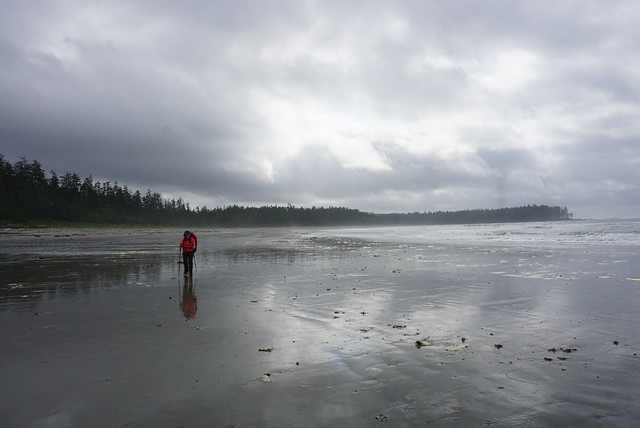
The beach was surprisingly busy for mid-April, but not overly crowded. San Josef Bay consists of two beaches that are only connected at low tide (although there is a forest trail connecting them). The first beach is very large, so there were a steady amount of hikers camped along the back of the beach, but everyone was spread out and it didn’t feel too crowded. I can only imagine how much busier it must be in the summertime. When I visited in June, the parking lot was much busier than in April.

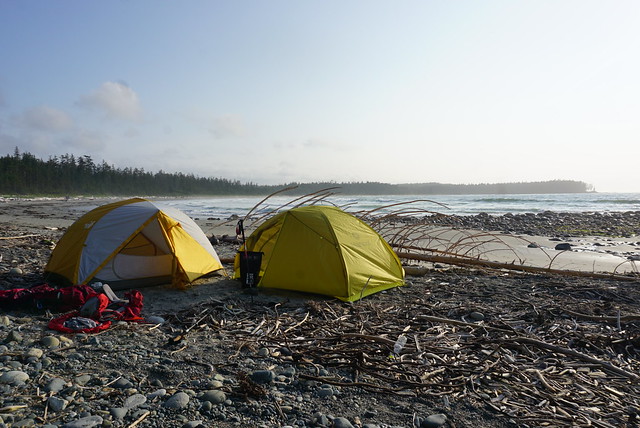
We set up on the main beach because we couldn’t get the wagon to the second beach. Most people were camping on the first beach and after visiting the second beach, I will say that there is much more limited camping space on that one. There’s more log jams at the back of the beach and the water comes closer to the forest at high tide, leaving limited space for tents. High tide is quite a way back from the forest on the first beach, so you can feel pretty safe camping there. 

20250418_211342
PSX_20250501_121930

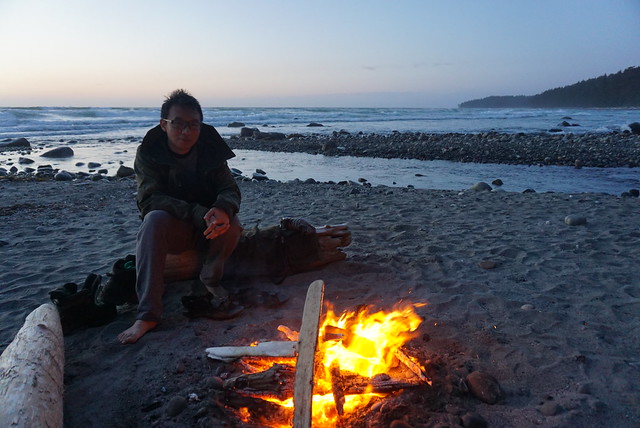
We were pretty late getting set up, so we enjoyed the sunset over the mountains while putting up our tents, and spent the rest of the evening enjoying a fire on the beach. We were able to collect firewood around the beach (never cut down live wood), but dead wood is in limited supply and I imagine it gets much harder to find later in the season. It rained earlier in the afternoon, so I definitely had my work cut out for me getting the fire started!

You never really get to sleep in when you go camping with a dog (they get up with the sun), but Sadie was more reserved than usual and let me sleep until our normal weekday wake-up time at least. It rained overnight, so my first order of business upon waking was to get a tarp set up. I put up one tarp and then Miranda put a second, so we had a nice tarp city ready for when the rain really started! 

20250419_171436
20250419_112349

If you’ve ever been to the north coast of Vancouver Island, you know the weather is super unreliable! The fog loves to hang around the coast and it’s normal for the weather to oscillate between sun, grey, and rain multiple times a day, sometimes within the hour! I didn’t get a lot of rain when I hiked the North Coast Trail, but I didn’t get a lot of sun either. While visiting San Jo Bay in April, we got a little bit of everything all at once. It didn’t rain for any extended periods of time, but there was a pretty reliable cycle switching from rain to sun and back again, all day long. 

It was dry during breakfast and we got ready to go for a beach walk, but then it started pouring, so we decided to wait it out. Low tide was at noon and the rain let up again around 11:30am, so we quickly got ready to go beachcombing. A lot of day hikers showed up around this time, presumably to explore the tidal areas. There’s a frontcountry rec site close to the parking lot, which I think is popular for campers that want to visit San Jo Bay, but don’t want to backpack. 

PSX_20250428_203804
20250419_120004

Exploring the beach during low tide is really the highlight of visiting, so definitely plan your trip around it! When the tide drops, you can walk along the sand to the second beach. The low tide exposes a number of sea stacks and caves along the shoreline and you can walk on several of the islands, looking at sea creatures in the tidepools along the edges. We saw lots of sea anemones, sea stars, and crabs along the tide pools, as well as many other marine organisms that only Seth was able to properly identify. We had a great time exploring and ended up walking the beach for several hours! 

Our companions took the wagon to the second beach, where firewood is much more plentiful, and me and Seth went in search of the freshwater source. The main consideration in camping on the first beach is that there’s no fresh water. My Gaia noted a water source on both ends of the second beach, but we opted for the source on the far west side. You do have to hike up into the woods for a few hundred metres and the trail is very muddy, but it’s a reasonably nice source – it’s just a little discoloured from the tannins, which I’m used to from Newfoundland. It was running pretty high because of the rain, so it might not be as nice in the dry season (if such a thing exists in this area). 

20250419_114853
20250419_122954

Overall, it was a pretty low key trip and we mostly relaxed for the rest of the afternoon as the rain continued on and off. The downside of going camping in April is that it was pretty damp and chilly. I spent some time in the tent to warm up, and then later in the afternoon, Seth and I walked down to the opposite end of first beach to the estuary. I’m not sure if you can drink this water when the tide is going out, but based on my experience at other estuaries on the NCT, it’s probably very brackish. Though you could likely drink it if you walked much further upstream.

We had a lot of firewood for night 2, which was good because it rained a lot more. We got the campfire going and kept it pretty big for warmth. It sprinkled on us several times, but it was always short lived, so we never got properly wet. We caught a glimpse of the starts on our first night, but it was completely clouded in on our second night.

PSX_20250422_190249
PSX_20250422_190138

The rest of our crew took off pretty early on Sunday morning because they had to drive all the way home. Seth and I had an extra day, so we took our time packing down our tent and were rewarded with a beautiful blue sky view of the beach on the way out. It didn’t last long and was soon raining on us as we trundled through the forest, but the sun made a reappearance near the end of the trail, turning the trees the most beautiful shade of green as the sun peeked through the canopy!

So I finally redeemed myself from my first trip and made it to San Josef Bay! I do think it is worth the hype and would be keen to see what’s it’s like in more reliable weather. But I’m thrilled I can finally check it off my bucket list. Tune in next week to learn what Seth and I did with our last day in the backcountry, because the adventure didn’t end with San Jo Bay!

20250420_085733

Cape Scott and North Coast Trail: Part IV

Check out Part 1, Part 2, and Part 3 to read about our full adventure on the trail.

We were both optimistic and apprehensive about Day 4. We’d had a great evening, but it was probably the worst night sleeping on the trail. The wind did eventually die down but it was super damp at Laura Creek. Everything in the tent that wasn’t in my sleeping bag with me felt somewhat damp and I had a hard time falling asleep because even my pillow felt wet and it kept sticking to my face. Eventually I did drift off, but I think Emily was up for most of the night. We got up to pee at one point and it was absolutely freezing out.

It warmed up around sunrise and it wasn’t too bad when we got up and walked back to the forest to retrieve our stuff from the bear cache. But it started raining lightly and we were feeling a little weary, so we decided to have a tent breakfast. We boiled water leaning out through the vestibule and had our oatmeal in the tent. I’m sure this isn’t the best practice and I wouldn’t do it for a fragrant dinner, but since we were just boiling water, we took the risk. Since we were carrying the tent on the outside of our packs anyways, we packed up from inside the tent and Emily tended to her feet. They were definitely getting worse – her pinky toes looked awful – she’d gotten blisters on both and they’d since popped, leaving an open wound between her toes and a lot of dead skin on the outside of her toe. She also had several other blisters and hot spots so we taped and moleskined as much as we could. She’s a real trooper, I never could have hiked so far with my feet looking like hers did.

HOP_4017

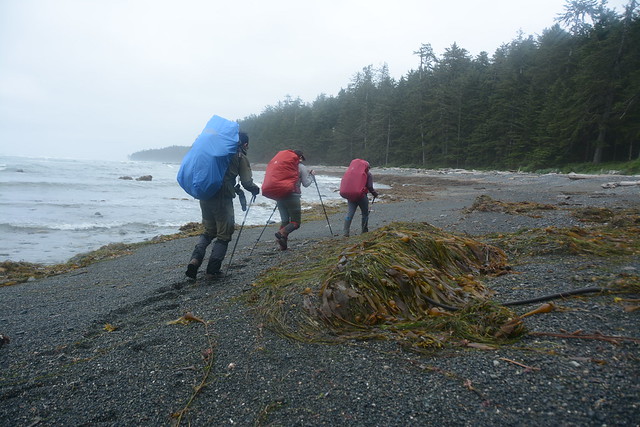
Fortunately the rain moved on when we were finally ready to go. Day 4 was going to be all about beach walking. You’d think that would be easier, but Emily in particular was dreading it because walking along the beach for extended periods of time really wears your feet down, especially if you have to do it for 12km. Walking along the fine sand is difficult because it’s such a hard surface and it’s rough on the soles of your feet, same with big boulders where you have to jump from rock to rock. Cobble has it’s own challenges too, the worst being the medium sized cobble that’s too small to walk from rock to rock, but too large to sink into it. The rocks create a lot of awkward angles on your feet and it gets really tiring. My preferred medium was black sand – it’s not as fine as the golden sand, so it’s a little easier on the feet. I think we encountered pretty much every type of beach surface on Day 4!

I did enjoy the start to the day. My feet were feeling refreshed and we saw lots of wolf tracks running along the beach. We hiked all morning up towards Christiansen Point. The whole time you’re able to look back towards the entire coastline to Cape Scott, which is rewarding when you’ve had the achievement of having hiked that entire distance. But Christiansen Point is the last view of Cape Scott and once you round the bend it’s a new landscape. I did find this to be a bit of a turning point with the waves as well. I guess the currents and winds are different on the other half of the trail and I found, with the exception maybe of Shuttleworth Bight, the waves were softer, particularly on Day 5.

DSC06245

We decided to stop at what we thought was Wolftrack Beach for lunch. Afterwards we realized it wasn’t actually Wolftrack Beach when we went one beach further and found the real Wolftrack Beach, so I guess we just stopped at some beach we didn’t know the name of. I do wish we’d stopped at the actual Wolftrack Beach, which was lovely and sheltered; where we did stop was a bit of a poor choice as we couldn’t find much respite from the wind and it was cold as we sheltered behind some logs at the back of the beach. We were treated to a little show though when a black bear wandered out on to the beach about halfway through our meal. Fortunately it was a positive bear experience. We could tell it was aware of us further down the beach and that it didn’t want to interact with us, so we just chilled and watched on the other side of the beach as we ate. Eventually it finished up on the beach and wandered back into the woods and we continued on our journey.

The weather improved as the day went on, but we started to hit a bit of a wall. As much as Emily thrived on Day 3, she suffered on Day 4. Our feet were all throbbing and our pace slowed down as we trudged across beach after beach. Between beaches we’d pop into the woods for 100 metres or so, but it was never for long and we always found ourselves at the start of a new beach. Emily slowed down as we continued and I found myself starting to become lethargic as well. Emily complained of being nauseous and I was starting to feel a bit lightheaded, which triggered the alarm bells in my head from many years of lifeguarding and first aid training that we were dehydrated. Though we’d been drinking lots of water, we had been hiking exposed on the beach for the entire day. The sun was mostly hiding behind the clouds, but the exposure had finally worn us down. I made us all stop and I mixed up a litre of electrolytes and forced me and Emily to drink a half litre each and we both ate some salty snacks.

DSC06259

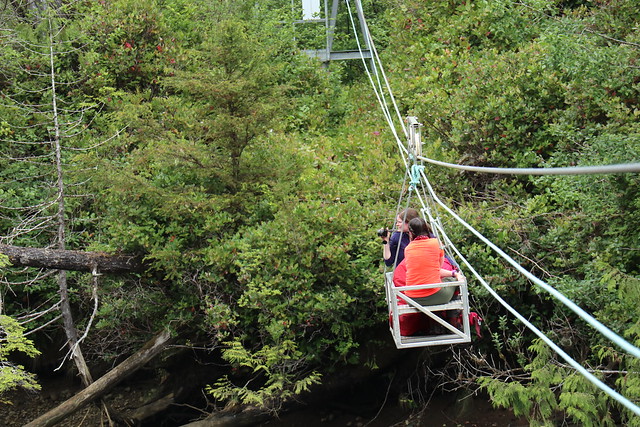
I did feel my energy start to bounce back pretty quickly after that. It took a bit longer for Emily, but fortunately we had finally reached a legitimate inland section. We didn’t know if it would be as challenging as the inland section from the day before, but it was only short, so we figured it would be a nice change. Fortunately it wasn’t as bad and we soon found ourselves at our first cable car. The North Coast Trail has 2 cable car crossings located at rivers that are too deep to ford. It’s a pretty simple design – the cable car is attached to a steel cable that it can roll back and forth across and it has a second simple rope pulley system running under that to pull yourself across the river. We had to climb up a big metal structure to get to the first one and then we pulled the cable car across from the other side.

Brandon was the only one with experience using a cable car before, so he instructed me and Emily to load up our backpacks and each take a seat in the car while he held it steady for us. It’s a tiny little metal frame box with two seats facing each other and just enough space for your bags in the middle (barely, say goodbye to any leg room). Brandon warned us to make sure our hands were inside the car when he left go and to always pull away from the pulley to avoid pinching any of our fingers. When he let go we rode off at a good clip to the center of the river and then had to pull ourselves to the other side. It wasn’t too challenging because Lien and Brandon were also pulling from their side, so there was 4 of us to share the load. We offloaded and sent the car back to the guys, holding it from our end while they loaded into the car. We did the same thing for them and helped pull them across once the car lost momentum. I just wish I’d taken the time to dig out my gloves because it is hard on the hands pulling the rope.

IMG_0498

With everyone safety across the river we had about 500 metres left to the beach. It was a pretty muddy section and we all collapsed in the sand when we finally reached Shuttleworth Bight (okay maybe just me). Of course the campsite was located on the total opposite side of the beach, so we had 1 more kilometre to walk across the beach. We’d passed a few people throughout the day that had camped at Irony Creek the previous night and were now heading all the way back to the San Jo parking lot. One family informed us to be careful where we camped because they’d been hit by the high tide the previous night and had gotten wet! We could see lots of campsites along the edge of the beach when we arrived, but we could also see that the high tide line went almost right up to them. I checked the tide charts and high tide was going to be at 10:30pm and would be higher than the previous night, so it didn’t look like a good place to camp.

Brandon went in search of another site and found a small bit of beach right next to the forest tent pads that looked just big enough to fit our tents. There was another camper who had been there the previous night and she came over to chat with us. There’d been 6 groups the previous night and they’d all camped on the beach. While only the one family had gotten wet, the tide had come up super close to all of them and she’d moved her tent to a forest pad for the night. She informed us the spot we were looking at tenting was probably the only beach site left that wouldn’t get wet, so we decided to take our chances since we would be up late enough to keep an eye on the tide and wait for it to change. The 5 guys from Laura Creek showed up a little after us and started setting up on the beach, but after talking to the same camper, decided to move to the forest tent pads as well. So every tent pad ended up being filled and we had the one beach site. Fortunately no one else showed up looking for a site because the rest of the beach sites did indeed get inundated by the tide.

DSC06277

Shuttleworth Bight is a huge white sand beach – Irony Creek is located on the very end and as the only water source, it’s obvious why the campsite was located there. I really liked Irony Creek – it wasn’t as windy and we had arrived before 5pm for once, so we had time to enjoy it properly. Again, we set up the tents and Brandon got a campfire going while I worked on dinner. It was my night and I had made and dehydrated a coconut curry. It didn’t rehydrate as well as I would have liked, but the flavour was really good and it was super filling. We finished dinner by 7pm, which was super early for us, so we had a really low key evening chilling by the fire. One of the guys came to talk to us because he was having nausea and heart pain and he didn’t know what to do about it, so we offered him some peptobismal because we thought it sounded like heartburn and he didn’t know what pepto was! Me and Emily sang him the symptom song and gave him some pepto chews and he said they did make him feel better. I literally never go anywhere without pepto (one time I got it confiscated by a bouncer at a Vegas club because “no pills allowed” lol), but it helps for so many symptoms, so it’s a great one to bring with you.

DSC06268

The main source of entertainment for the evening was watching the tide. It kept sneaking its way closer and closer to us. We were both on the same patch of sand, but Brandon’s tent was the one more at risk, so we built up a little barrier wall out of logs to protect against any rogue waves. There was more than 1 wave that splashed against the barrier, but fortunately the tent never did get hit. By the time the tide finally turned the wet sand line was only a foot away from the vestibule to the tent, so it was definitely the closest I’ve ever camped to a changing tide! We felt really lucky to be able to camp on the beach, but the one downside was the sea ticks. At Guise Beach we’d noticed that along the tide line at night all these gross little sea ticks come out to feast on sea debris. They look like little shrimps but they jump around on the sand. The closer the tide got to us, the closer the sea ticks moved. They were all over Brandon’s tent and they were creeping around in front of mine and Emily’s tent too. Fortunately none got inside the tent, but every time we would open the door we’d give the tent a big shake to dislodge any and then we’d jump in or out as fast as we could to avoid any ticks making their way inside. Once the tide moved back out they went with it, but it was peak tick time when we finally climbed inside the tents for bed.

So overall, despite the challenges with so much beach walking, it was still a good day. We really enjoyed our time at Irony Creek and we were still looking forward to the next two days. Little did we know the trail was about to get even more challenging – but more about that in Part V!

DSC06284

Cape Scott and North Coast Trail: Part III

The Saga continues – here’s Part 1 and Part 2 if you’re joining in the middle.

On Day 3 we finally started the North Coast Trail. As I mentioned before, most people start with the North Coast Trail and continue on to Cape Scott, but because of some conflicts with the water taxi dates due to Covid-19, we decided to do the trail backwards. So instead of starting with a water taxi from Port Hardy to Shushartie Bay, we had already hiked 37km and we still 43km to go. We hiked from Guise Bay to Nissen Bight before lunch and then continued from Nissen to Laura Creek, our first section on the North Coast Trail.

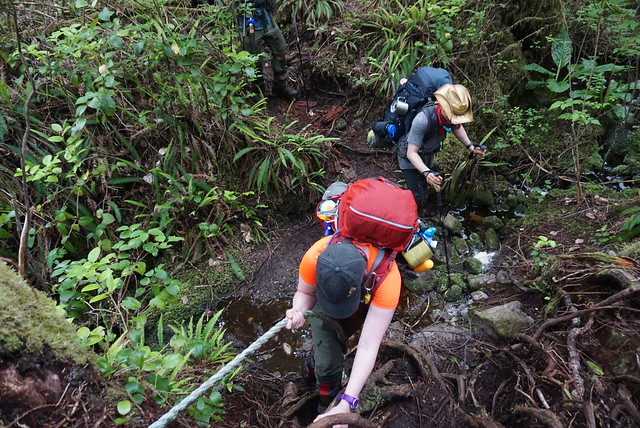
From the end of Nissen Bight, it’s about 5km in the woods, followed by another kilometre along the beach to reach the campsite. Our feet were already aching from pounding across so many beaches, so it actually felt like a bit of a relief to start climbing up into the woods. There was a noticeable change to the conditions of the trail as soon as we entered the forest. It started with a steep climb up towards Nahwitti Cone and then it was 5km of poorly maintained trail and mud.

DSC06187

The North Coast Trail is a pretty bare bones trail, besides keeping the brush at bay, it seems that the trail is left pretty wild and it makes for a very technical hike. There’s a lot of mud to navigate around as well as tons of obstacles from the trees. You’re constantly climbing up and over logs, under branches, and jumping your way around mud pits. The Juan de Fuca was a similar experience for me and Emily, so we didn’t come across anything unexpected, but we definitely forgot just how challenging and slow these kind of hikes can be.

At first the obstacles were a welcome distraction from our aching feet. When you put your brain to work navigating the obstacles, it does distract from your other pains, but the forest paths make for REALLY slow progress and eventually you just get frustrated at how long it takes to make any kind of progress. This was Lien’s first real challenge. He’d never been on a technical coastal trail before and so he really had no frame of reference for what it would be like. When we first switched our plans from Mount Assiniboine to the North Coast Trail, his first response was, “well at least it will be an easier trail!” We all laughed at him and informed him it would actually be a lot harder, but I can see where the misconception comes in and I have made the same assumption in the past. Mountain trails appear to be harder because of the large elevation gain, but coastal trails often still have a ton of elevation gain hidden among the relentless up and down along the coastline, as well as they’re usually a lot more technical.

HOP_3962

There was a marked difference on Day 3 though in that we barely saw any people. We’d started hiking Cape Scott on the weekend, so it had been crawling with people, but it was now Tuesday and so even on our hike to Nissen Bight we didn’t see many people. After Nissen the trail really emptied out. We saw one hiker just as we were starting the climb to Laura Creek – he was returning from an overnight at Irony Creek (that’s a 19km hike!). After that the only other people we saw was one group of guys who were camping at Nissen and had day hiked out to Laura Creek and back. In mine and Emily’s opinion, it’s a waste of time trying to avoid the mud on a trail like the NCT, so we were both pretty muddy and had wet feet by the end of the day. We had wet feet the entire 4 days we hiked the Juan de Fuca, so in our opinion keeping our feet dry until Day 3 had been a pretty big success. But when we passed the guys coming back from Laura Creek and saw their completely mudless legs and boots, we had to conclude that they were clearly witches to stay so dry.

Lien struggled along this section, mostly from the repetitive uphill sections. I started stronger along the wooded stretch, but eventually it really got to me too. I was tracking the hike along my GPS and every 30-60 minutes I’d check in to see how much progress we were making and it was always a mistake. Your location barely moves and it really only serves to de-motivate you. What was more depressing was that I’d read in the trail book that this was one of the easier wooded sections of the trail, so it made me really apprehensive about what was to come later. So much of making it through these long hikes is mental and often you just have to focus on making it through one part at a time.

DSC06214

Unlike the rest of us though, Day 3 was where Emily peaked. She had a rough Day 2, but she was in her element on this section. Despite her blistered feet, she was our cheerleader for the day and led us through the worst of it. One of the real saving graces of having 4 people in your group is that we didn’t all fall apart at the same time. There was always someone who was struggling, but when that happened, someone else would always step up to help motivate the group. The constant uphill was Lien’s mental block for the day, so we all cheered when we finally started heading downhill in earnest and could see the beach peaking out through the trees. We still had 1 more kilometre to go across the beach, which is it’s own kind of hell at the end of a long day, but at least you make a faster pace.

There was some confusion about where the water source was, so we spent a bit of time poking around for it at the end of the beach, before a closer read revealed that it was actually located right at the campsite. I’d read Laura Creek only had 4 tent pads, so despite seeing no one else on the trail, I was still a little concerned about availability. Me and Emily were anxious to get off our weary feet, so we took off towards the campsite. Fortunately there was only 1 other group of 5 guys at the campsite and they were only using 2 of the tent pads, so there were 2 more left for us.

DSC06213

I have to admit, as relieved as I was to sit down, the tent pads were a little gloomy after the beautiful campsite the previous night. The trees were extremely thick and didn’t let a lot of light in, plus everything felt damp. Fortunately Brandon is much more determined than me or Emily and when he showed up, he dropped off his backpack and declared there was no way we were camping in the woods and he would find us a spot on the beach.

There’s no where to camp on the beach near the tent pads because it’s a steep cobble beach, but if you continue another 200m to the water source, Laura Creek, there’s a small sandy beach with enough room for 3 tents. There was one couple set up there already and they kindly moved their tent to the side so that we could set up our two tents next to them. It was extremely windy, but a definite improvement over the wooded tent pads! So much thanks to Brandon for that!

We put up the tents as fast as we could and chucked all our gear inside to keep them from blowing away. We changed right away because it was cool with the wind in our sweaty clothes. Once I bundled up with a few layers though, I forgot about the wind and was thrilled when the sun finally came out for the first time since we’d started the trail!

DSC06225

The weather on these trails really is wild – it’d been overcast most of the day, but within a half hour the wind completely blew the clouds away and we found ourselves with a gorgeous sunny beach view – so that helped with the chill as well. It was somewhere around 7pm at this point. It ended up taking us about 4 hours to go the 6km from Nissen to Laura, so we knew we were in for some longer days.

By Day 3 we’d started to get into a bit of a routine. Lien got water from the creek to start filtering, Brandon started working on getting a fire going, and me and Emily started boiling water for hot drinks/soup and started making dinner. Emily was the chef for day 3 and served us a cheesy pasta that we’d made from a backpacking website. It was vegan so it used coconut milk powder and nutritional yeast to get the creamy cheesy flavour – it was my first time using either ingredient and it was actually pretty good.

The only downside to our beach campsite was that it was a 200m walk back to the outhouse and bear cache, but definitely still worth it and we ended up having a great night relaxing on the beach by our fire. Laura Creek definitely had the best sunset of the trip; when the clouds cleared out we had an excellent view of the sun as it dipped below the horizon and filled the sky with its orange-yellow glow. We were zonked from the long hike, but relieved that our biggest day was now behind us. Over the next 3 days we’d be averaging about 12km a day, so we were optimistic that though the hiking wouldn’t get easier, the days would at least get shorter. It was an incorrect assumption, but more on that in the next entry, Part IV!

DSC06239