San Josef Bay Backpacking Trip

If you’ve been following my blog for awhile, you might be aware that I first attempted to visit San Josef Bay in 2020. I backpacked both the Cape Scott Trail and the North Coast Trail in June 2020, but thanks to a series of misadventures at the start of my trip, I had to cut San Josef Bay from the itinerary. A few years ago I saw San Josef Bay ranked on a list of the “most beautiful beaches in the world” and it’s been haunting me ever since that I still haven’t been there!

So this was a bit of a redemption trip for me. Over the Easter long weekend in April, I decided it was finally time to tackle San Josef Bay. It’s located on the far eastern coast of Vancouver Island and it is a journey to get there. I left Vancouver on Thursday after work with my husband, Seth, and our anxious Australian Shepherd, Sadie. We had a reservation on the 6:30pm ferry, which was absolutely necessary because the ferry sailings were already completely sold for the whole day by the time we arrived at the ferry terminal. Unfortunately, our sailing was delayed by almost 2 hours, meaning we didn’t get to Nanaimo until almost 10pm.

PSX_20250421_193512
PSX_20250428_190807

I’m a hyper-planner when it comes to trips, but this was one of the rare times where I didn’t have a booking for the night. I’ve been trying to embrace the unknown a little bit more and take advantage of FCFS and rec sites. We’d been hoping to drive to Campbell River before finding a place to sleep, but given the late hour, we drove ~30 minutes to Little Qualicum Provincial Park in search of a site instead. We were able to secure the second last campsite and quickly put up the tent to catch some sleep before continuing the journey in the morning.

We were up early to finish the 1 hour drive to Campbell River, followed by 2.5 hours to Port Hardy. Our friend Victoria was also joining us with her friends from Victoria, so she walked on the first ferry on Friday morning and they picked her up on their way north. They were a little bit behind us, so we stopped for a nice lunch at Cafe Guido in Port Hardy. It was an excellent choice because they also have a bookstore and artisan craft shop in the same space! So we picked up some souvenirs before finally meeting our friends and their Australian Shepherd, Daisy, to continue the journey.

20250420_172213

We already had 4 hours of driving behind us, but we still had the most challenging part of the trip ahead – the Forest Service Road to San Josef Bay. Considering that Port Hardy is on the east coast of Vancouver Island and San Josef Bay is on the west coast, it’s pretty impressive that there’s a 65km gravel road extending the entire width of the island. Despite it being a gravel road, it’s not in terrible condition – you can do the entire drive in any vehicle, you don’t need 4WD or high clearance. That said, the road isn’t in great condition either! If you want to avoid the drive altogether, there is a shuttle that runs from Port Hardy.

The last time I did this road, Brandon was driving way too fast and got a flat tire 30 minutes in. This wouldn’t be the end of the world, but his mechanic had put the wrong lug nuts on his tires, so it left us entirely unable to change the tire. This devolved into a 24 hour expedition involving hitchhiking, sleeping on the FSR, and paying a mechanic to break all the lug nuts off. I really wanted to avoid any flat tires this time around, so we drove pretty slow. The first 30km of the road are in reasonable condition, but the last 35km have a continuous stream of potholes that make gaining any kind of speed risky. I’d say we averaged ~30km/h along the road, so it took us around 2.5 hours to get to the trailhead parking lot – with no flat tires!

PSX_20250428_190456
20250418_182550(0)

From the parking lot, it’s a 3km hike along a well-maintained trail to San Josef Bay. Me and Seth backpacked, but Victoria and her friends had a very special “Swagon Wagon”, which they used to transport some more luxurious camping equipment! The first 1km of the trail is a shared route into the park, after which there is a branch. If you go right, you can hike 23km to the Cape Scott Lighthouse, or 60km to the end of the North Coast Trail. This is the trip I did in 2020. But if you turn left, it’s another 2km along a leisurely trail to San Josef Bay, one of the most beautiful beaches in the world!

The trail itself is gorgeous. We had a pretty late start, around 6:30pm, but it only took us an hour (even with the wagon) to hike through the forest to the beach. Along the trail, I was reminded why the north coast of Vancouver Island is such a special place. Like most of BC, it’s second growth forest, but you can still see lots of old growth trees scattered throughout. Somehow, these trees have withstood the test of time and it’s truly humbling to stand beneath their gigantic trunks, so I really enjoyed the walk to the beach. Although my shoulders were hurting – I also took advantage of the short distance to pack a few of my own luxury items!

PSX_20250428_191003
20250418_201031

The beach was surprisingly busy for mid-April, but not overly crowded. San Josef Bay consists of two beaches that are only connected at low tide (although there is a forest trail connecting them). The first beach is very large, so there were a steady amount of hikers camped along the back of the beach, but everyone was spread out and it didn’t feel too crowded. I can only imagine how much busier it must be in the summertime. When I visited in June, the parking lot was much busier than in April.

We set up on the main beach because we couldn’t get the wagon to the second beach. Most people were camping on the first beach and after visiting the second beach, I will say that there is much more limited camping space on that one. There’s more log jams at the back of the beach and the water comes closer to the forest at high tide, leaving limited space for tents. High tide is quite a way back from the forest on the first beach, so you can feel pretty safe camping there. 

20250418_211342
PSX_20250501_121930

We were pretty late getting set up, so we enjoyed the sunset over the mountains while putting up our tents, and spent the rest of the evening enjoying a fire on the beach. We were able to collect firewood around the beach (never cut down live wood), but dead wood is in limited supply and I imagine it gets much harder to find later in the season. It rained earlier in the afternoon, so I definitely had my work cut out for me getting the fire started!

You never really get to sleep in when you go camping with a dog (they get up with the sun), but Sadie was more reserved than usual and let me sleep until our normal weekday wake-up time at least. It rained overnight, so my first order of business upon waking was to get a tarp set up. I put up one tarp and then Miranda put a second, so we had a nice tarp city ready for when the rain really started! 

20250419_171436
20250419_112349

If you’ve ever been to the north coast of Vancouver Island, you know the weather is super unreliable! The fog loves to hang around the coast and it’s normal for the weather to oscillate between sun, grey, and rain multiple times a day, sometimes within the hour! I didn’t get a lot of rain when I hiked the North Coast Trail, but I didn’t get a lot of sun either. While visiting San Jo Bay in April, we got a little bit of everything all at once. It didn’t rain for any extended periods of time, but there was a pretty reliable cycle switching from rain to sun and back again, all day long. 

It was dry during breakfast and we got ready to go for a beach walk, but then it started pouring, so we decided to wait it out. Low tide was at noon and the rain let up again around 11:30am, so we quickly got ready to go beachcombing. A lot of day hikers showed up around this time, presumably to explore the tidal areas. There’s a frontcountry rec site close to the parking lot, which I think is popular for campers that want to visit San Jo Bay, but don’t want to backpack. 

PSX_20250428_203804
20250419_120004

Exploring the beach during low tide is really the highlight of visiting, so definitely plan your trip around it! When the tide drops, you can walk along the sand to the second beach. The low tide exposes a number of sea stacks and caves along the shoreline and you can walk on several of the islands, looking at sea creatures in the tidepools along the edges. We saw lots of sea anemones, sea stars, and crabs along the tide pools, as well as many other marine organisms that only Seth was able to properly identify. We had a great time exploring and ended up walking the beach for several hours! 

Our companions took the wagon to the second beach, where firewood is much more plentiful, and me and Seth went in search of the freshwater source. The main consideration in camping on the first beach is that there’s no fresh water. My Gaia noted a water source on both ends of the second beach, but we opted for the source on the far west side. You do have to hike up into the woods for a few hundred metres and the trail is very muddy, but it’s a reasonably nice source – it’s just a little discoloured from the tannins, which I’m used to from Newfoundland. It was running pretty high because of the rain, so it might not be as nice in the dry season (if such a thing exists in this area). 

20250419_114853
20250419_122954

Overall, it was a pretty low key trip and we mostly relaxed for the rest of the afternoon as the rain continued on and off. The downside of going camping in April is that it was pretty damp and chilly. I spent some time in the tent to warm up, and then later in the afternoon, Seth and I walked down to the opposite end of first beach to the estuary. I’m not sure if you can drink this water when the tide is going out, but based on my experience at other estuaries on the NCT, it’s probably very brackish. Though you could likely drink it if you walked much further upstream.

We had a lot of firewood for night 2, which was good because it rained a lot more. We got the campfire going and kept it pretty big for warmth. It sprinkled on us several times, but it was always short lived, so we never got properly wet. We caught a glimpse of the starts on our first night, but it was completely clouded in on our second night.

PSX_20250422_190249
PSX_20250422_190138

The rest of our crew took off pretty early on Sunday morning because they had to drive all the way home. Seth and I had an extra day, so we took our time packing down our tent and were rewarded with a beautiful blue sky view of the beach on the way out. It didn’t last long and was soon raining on us as we trundled through the forest, but the sun made a reappearance near the end of the trail, turning the trees the most beautiful shade of green as the sun peeked through the canopy!

So I finally redeemed myself from my first trip and made it to San Josef Bay! I do think it is worth the hype and would be keen to see what’s it’s like in more reliable weather. But I’m thrilled I can finally check it off my bucket list. Tune in next week to learn what Seth and I did with our last day in the backcountry, because the adventure didn’t end with San Jo Bay!

20250420_085733

9 Spring Hikes near Vancouver

Spring is one of the most challenging seasons in the backcountry. It gets really nice in the city, which can trick hikers into thinking that it’s a good time to return to the mountains. Any time is a good time to be in the mountains, but you have to manage the risk accordingly. Snow will not melt at high elevations and in the alpine until the end of June and sometimes even as late as mid July. Spring is particularly dangerous because the rapid melt can create unseen hazards under the snow. What looks like a flat snowy trail may have creeks hidden under thin layers of snow that can easily collapse under your weight. So the safest approach is generally to stick to lower elevation hikes. Fortunately, there’s lots of those available in BC as well! Here’s a few of my favourites within close driving distance of the lower mainland.

Jug Island/Admiralty Point Trail

A photo of a yellow kayak resting on the beach in front of Jug Island on a sunny, blue sky day in Belcarra, BC.

Belcarra is a gorgeous coastal location for Spring hiking. If you park at the lot in Belcarra Regional Park, you can do a short, but scenic hike along either end of the peninsula. If you head south from the parking lot, you’ll follow the Admiralty Point Trail along the water, with lots of little viewpoints along the way. If you head north, you’ll hike inland along the Jug Island trail to a beach viewpoint. Both trails are approximately 5.5km long round trip, but Jug Island is more challenging because it hikes up over the headland and then down to the beach. Both trails can usually be hiked year-round.

Hunter Road

Three hikers and their dog pose at a viewpoint with the snow capped mountains and Stave Lake in the background at Hunter Road, near Mission, BC.

Hunter Road is an easy trail in Mission that can be done during most of the year. The trail starts from the end of Roach Street and is an easy hike along an old forestry road (Hunter Road). Eventually the trail loops back around on itself to climb up to the summit of a small overlook where you can enjoy views of Stave Lake and the surrounding backcountry. It’s a there and back trail, approximately 7.5km in length, 250m in elevation gain.

High Falls Creek

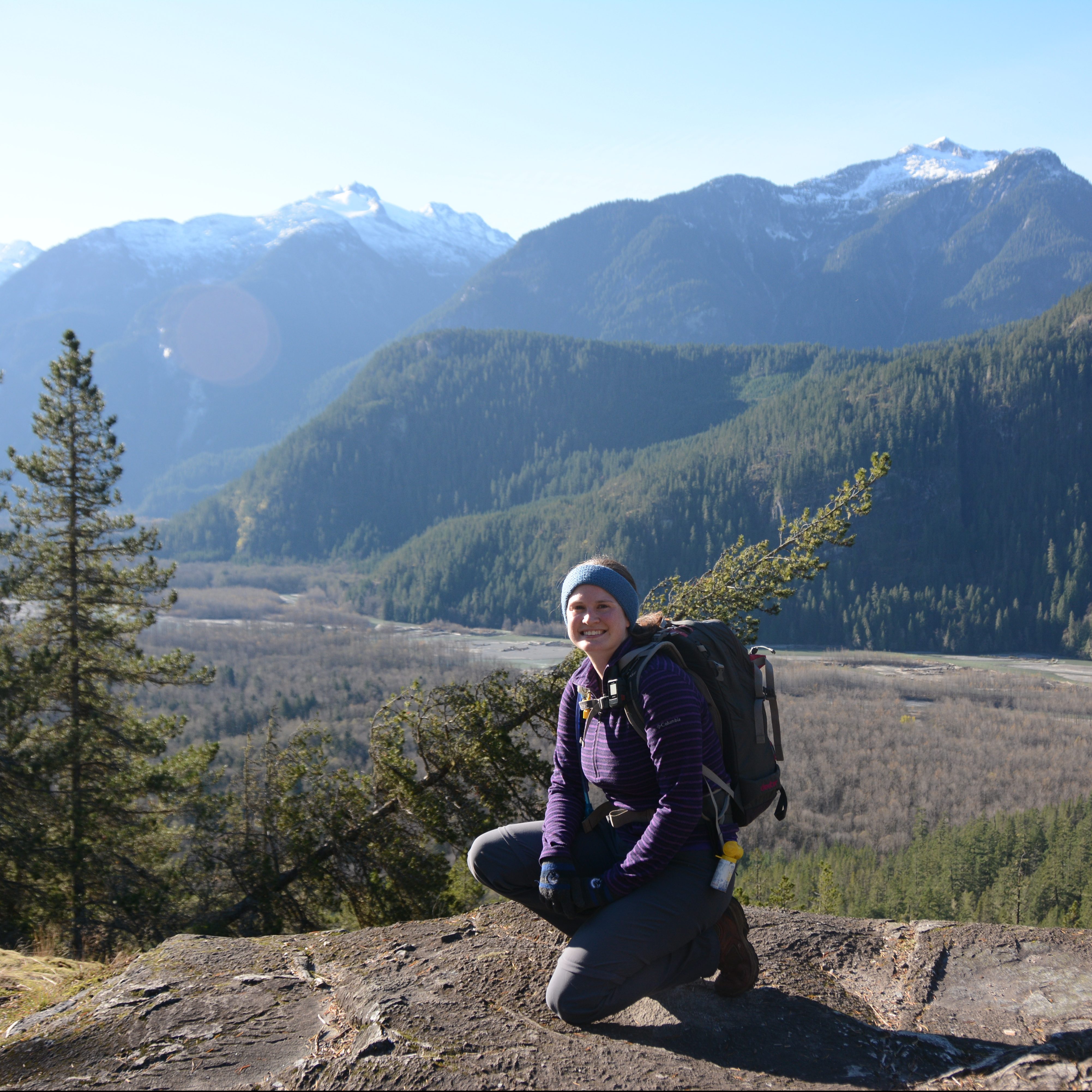
A female hiker nears and smiles at the camera from the High Creek Falls Trail with a view of the snow capped mountain peaks and forest of the Squamish Valley in the background, near Squamish, BC.

High Falls Creek is one of two hikes on this list that can be found along the Squamish River. It’s a more challenging hike than some of the others, but is great for Spring when the rivers are flowing at high capacity. The trailhead is located approximately 26km up Squamish Valley Road. The hike can be done as an out and back, but if you want to make it a bit longer, you can turn it into a loop hike by continuing up to Branch 200 FSR and hiking back along the road. The trail to High Falls is a bit technical, with some scrambling over rocky sections, so make sure to go on a dry day. It’s 1km each way to High Falls Creek, but if you do the loop, it’s 9km with 500m of elevation gain.

Crooked Falls

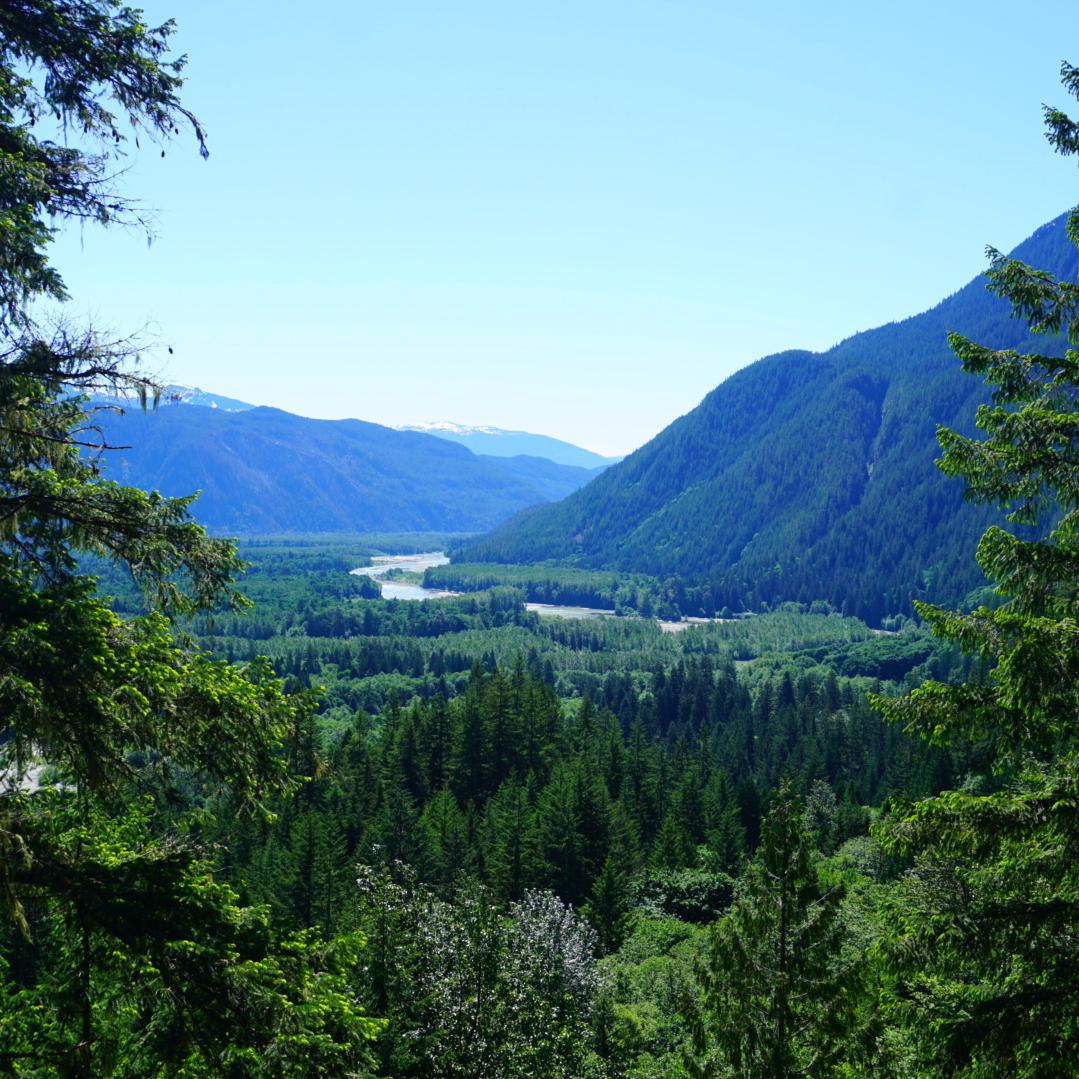
The view of Squamish Valley from a viewpoint on the trail to Crooked Falls that shows the forest, Squamish River, and mountains in the background on a beautiful blue sky day outside of Squamish, BC

Crooked Falls is the second hike along the Squamish River. It’s a similar distance from Squamish, but you take a left turn over the bridge off Squamish Valley Road and onto the Ashlu River FSR to get to the trailhead. The hike to Crooked Falls is approximately 5km round trip, with 400m of elevation rain. The waterfall is especially impressive in the Spring and makes for a fun day trip. If you want to extend the hike, you can continue along the Sigurd Creek trail to a small outcrop with a gorgeous view of the area. This hike is much harder and is approximately 12km round trip, with 900m of elevation gain. It may not be totally snow free in the Spring.

Woodland Walk/Sawblade Falls

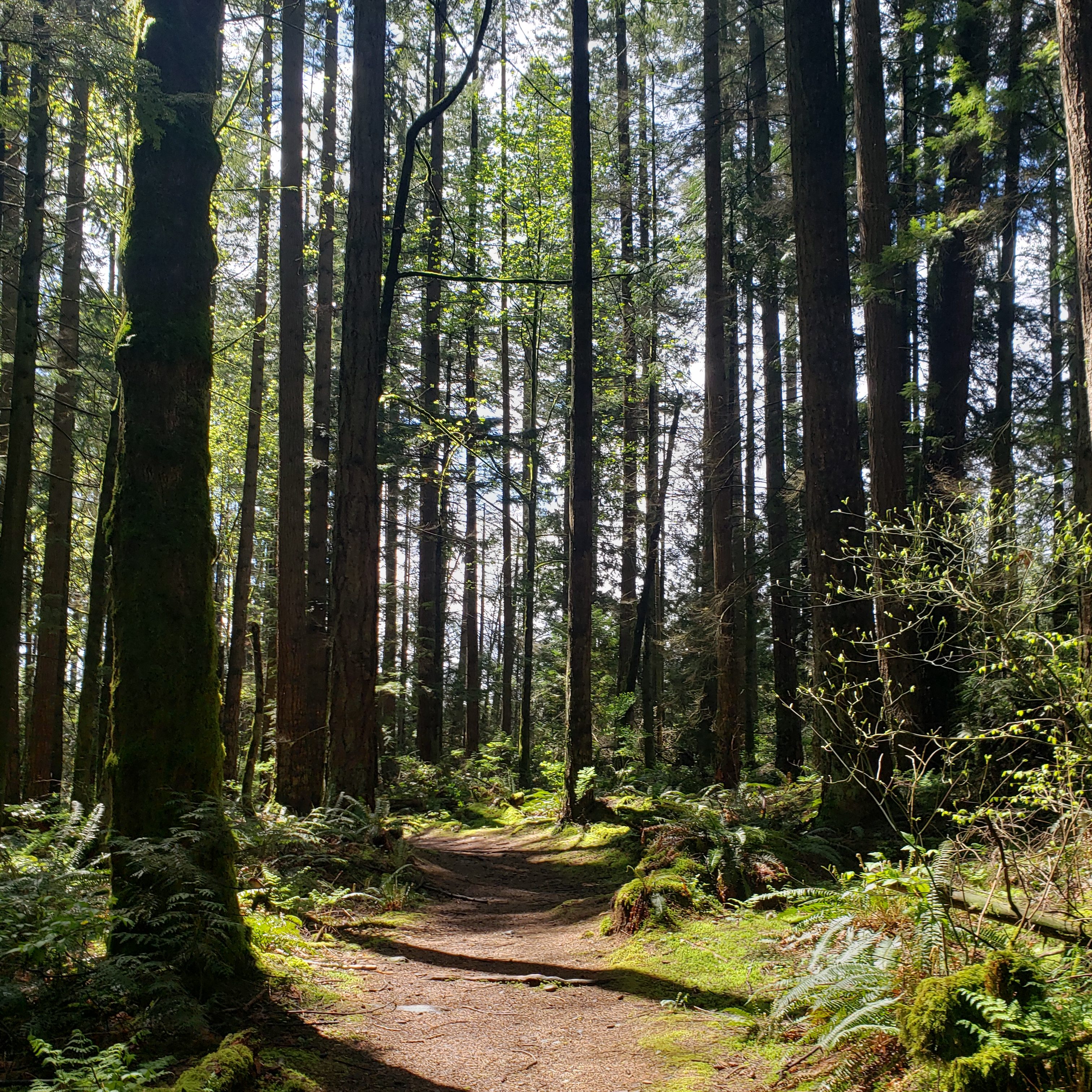
A photo of a forested trail in Pinecone Burke Provincial Park on a sunny day near Coquitlam, BC.

Woodland Walk and Sawblade Falls are two lesser known hikes in Pinecone Burke Provincial Park. They’re super easy to access from Harper Road in Coquitlam and I think they’re very underrated for how close they are to the city. Woodland Walk is a leisurely 7km loop walk through the woods and is great for a rainy day. It only has 200m of elevation gain and makes for a fun forest adventure. It’s easy to extend the loop to also include Sawblade Falls, which is approximately 9km in length. My advice is to be familiar with using GPS maps if you explore this park. There are so many trails through the forest, I usually go and just make my own adventure.

Big Cedar and Kennedy Falls

Two hikers flex their muscles in front of the big cedar tree on the Kennedy Falls trail in North Vancouver, BC.

It’s been a long time since I did this hike, but it sticks out in my mind as a great Spring hike on the North Shore. It’s a bit on the longer side at 10km, and it climbs up and down, so it has a surprising amount of elevation gain (500m). The trail leaves from the Mount Fromme trailhead and is great for variety as it hikes through the forest to a large big cedar tree, and then on to scenic Kennedy Falls. The trail is more technical, with lots of climbing over tree roots, so it’s a good option for more advanced hikers. 

Norvan Falls

Another option on the North Shore – Norvan Falls is a classic Vancouver hike. The trail leaves from the end of Lynn Valley Road and is the longest trail on the list at 15km round trip. The trail hikes along Lynn Creek and then through the forest along the Hanes Valley Trail to Norvan Falls. There’s 600m of elevation gain along the trail, but there is an option to do a little loop through the forest along the way to make the hike more interesting. This is a great option in the Spring when the rivers are running full. The waterfall drops to a trickle in the summer and can be less impressive after the Spring snowmelt.

Stawamus Chief

Two female hikers lie back and relax and smile from the top of the bare rock of The Chief's second peak, with Howe Sound and the Tantalus Mountain Range in the background near Squamish, British Columbia, Canada.

I’d be remiss if I left the Stawamus Chief off this list. The Chief was the first trail I ever hiked after moving to Vancouver and it draws crowds at any time of year. It’s a challenging trail, as it’s mostly a stairmaster to the top, with lots of sketchy sections with ropes, ladders, and scrambling. The full trail is 11km, but it consists of 3 peaks, so people rarely hike all 3 at once. I’ve done the first and second peak, but I still have yet to return for the third peak. I recommend the first peak, because it’s the easier option and has incredible views of Howe Sound. This is a real bucket list hike that is worth the hype, but don’t do it on a rainy day or if you’re afraid of heights.

Widgeon Falls

A hiker stands on the edge of a rock next to Widgeon Creek with the forest and mountains in the background on a sunny day

This hike is a little trickier because it includes paddling, but it’s such a fun adventure, I wanted to include it! In the Spring and Summer, you can rent canoes or kayaks to cross the Pitt River and paddle up Widgeon Creek to the Widgeon Falls trailhead. It takes approximately 1.5 hours each way to paddle to the trailhead at the Widgeon Creek Campsite. From there, you can do a 5km loop trail through the forest up to Widgeon Falls. It’s a beautiful trail and makes for a really unique experience. That said, navigating the Pitt River can be a challenge depending on wind and current conditions, so don’t attempt this adventure without the proper research and experience. I have a full blog post on my experience if you’re looking for more information.

Shuswap Lake and Adams River

In line with my previous post, while there are a lot of intense hikes and backpacking trips to do in BC, there are also lots of attractions that don’t require substantial physical fitness to visit and enjoy. In Fall 2022, my parents came to visit for several weeks and we decided to road trip out to Shuswap Lake for a few days and visit Adams River to learn more about the salmon run. It was my first time visiting Shuswap Lake and it was an abnormally warm Fall, so we had a great time exploring this part of the province.

For our trip, we stayed in a little airbnb located on the beach, just outside of Salmon Arm. It was a nice 2-bed cabin for me, Seth, and my parents, but October is maybe not the most ideal time to visit. The water level in the lake slowly subsides all summer, so it was extremely low when we visited, meaning it was quite mucky along the beach. This was also the year when the province got overrun by invasive stink bugs and we had to remove several dozen of them from the cabin. It was no fault of the owner, they were just rampant everywhere that year, so it was a bit gross trying to purge them all from the rooms.

Shuswap Lake Hotel

We only had 3 days and we spent the first day enjoying the drive out. We stopped outside of Kamloops and did a short hike up to a viewpoint at Dufferin Hill, plus we made a few ice cream stops for my mom and Seth along the way (any time Mom visits on her holiday we eat ice cream every day). It’s a 5 hour drive from the lower mainland to Salmon Arm, so it was a bit far for a 3 day trip, so we made the most of it. We enjoyed a nice walk around the parks near the Salmon Arm Wharf and had dinner at 1905 Kitchen, which was delicious!

Kamloops

Day 2 was our only full day without driving, so I’m impressed with how many activities we were able to cram into a single day. We started the morning with a visit to the Downtown Salmon Arm Farmer’s Market, which is open year round on Saturdays from 9am – 1pm. I was actually really impressed with the market. It was pretty substantial for such a small town and it was hard to pick between so many yummy sweets, plus lots of fruit and produce options. Plus it’s located right on one of the main streets and there are tons of quirky shops nearby.

I immediately made a beeline for The Book Nook, which is a used bookstore at the east end of the market. They had a pretty good selection and I picked up a few books. My other favourite was Sanctuary Games, which has a huge selection of board games and puzzles, plus a bubble tea cafe in store.

Salmon Arm Wharf
Bookingham Palace

Our next stop after the market was to head over to the local mall to visit Bookingham Palace. I just stumbled upon The Book Nook, but I couldn’t resist planning a visit to Bookingham Palace. It’s a more traditional bookstore and nothing too special, but they were having a big sale when we visited, so we all picked up some new books before heading out of Salmon Arm to explore some nearby attractions.

Next we hoped over to the other side of the lake to do a short hike. There’s a small park called Herald Provincial Park, with a short hike (~1km round trip) to Margaret Falls. The trail follows to river up through a canyon to a tall waterfall cascading down over the rock. It’s a nice roadside attraction when you’re in the area. Afterwards, we continued down the park road to the picnic area and hung out on the beach for a while eating some snacks.

Margaret Falls
Canyon Margaret Falls

My parents don’t drink alcohol, but they were willing to explore at least one winery with us while in the Okanagan, so we made an early afternoon booking at Sunnybrae Winery for lunch. There’s a really nice balcony looking out towards the lake, so we enjoyed a charcuterie board on the terrace on a weirdly hot day for October. Seth and I picked up a few bottles of wine to take with us before getting more ice cream for mom.

We decided to return to Salmon Arm, this time visiting Canoe Beach. It’s a huge sandy beach on the south side of the lake with a really nice swimming area. Like I said, it wasn’t the best swimming season because the lake level was so low, but by late afternoon, I couldn’t resist going in the water. It was actually really warm, so Dad joined me as well and we goofed around in the shallow water. We waded out until we finally reached deeper water and generally just felt unreasonably pleased with our good fortune to be able to swim in October (we both love swimming).

Winery in the Okanagan
Shuswap Lake

For dinner, we hit up the Barley Station Brewpub, which was more about me and Seth wanting to sample the local craft beer rather than the food. Then we finished off the evening with several hands of cards at the airbnb.

On our final day, we had to drive all the way back to Vancouver, but the primary reason for our trip was to visit Adams River for the Salute to the Sockeye. The salmon run has a dominant cycle every 4 years, and 2022 was a dominant year, so we were keen to see it. Unfortunately, a lot of salmon stocks were decimated in the flooding in 2021 because their spawning grounds were wrecked and the eggs completely washed downstream. The salmon should have been peaking when we visited, but unfortunately they were late, so while we did still see some of them in the river, they were not running in abundance.

Shuswap Lake

It was still a really nice side trip though. The Adams River Salmon Society and the Little Shuswap Lake Band run events in Tsutswecw Provincial Park, which features a welcome ceremony, artisan market, and food trucks. We enjoyed the festival for a few hours and walked along the nice trails before heading back to Vancouver.

Overall, it was a pretty chill trip with a bit more driving than I usually like. But it was fun to do something new with my parents (who have made quite a few visits to Vancouver over the years) and spend time as a family. I’d probably recommend the Shuswap area earlier in the summer, but it’s also at lot busier and accommodations are more expensive then. Fall is a nice time to visit if you’d like to see the salmon run or enjoy the lake with smaller crowds.

Adams River