Let’s Talk Feminism

Over the past few months I’ve been seeing more articles and blogs pop up about feminism and feminist issues. I’ve considered myself a feminist for a while now, but it’s only over the last few months that I’ve been exploring what the term actually means to me and trying to comprehend what it means to other people around me. There are a lot of questions I’ve been asking myself; what does true equality look like? How are my experiences, opportunities, and privileges different from those of my male counterparts? What is the end goal of the feminist movement? I can’t answer any of these questions of course, I’m no expert on feminism and I don’t have years of reading books or having deep discussions about it to back up my opinions. However, I think discussion and dialogue is incredibly important in the development and understanding of any issue, so I’ve decided to share my exploration in the hope of engaging you in conversation about it!

Feminism means something different to everyone and I’m sure we all have a different idea about what a truly equal society would like. There are many inequalities between the opportunities and privileges accessible to men, verses those that are accessible to women. Some inequalities are glaringly obvious, such as rape, and involve specific actions or consequences, while others are so ingrained into our culture and our way of thinking that they often go completely unnoticed. It can be easy to pass off a joke generalizing women as bad drivers or to ignore a catcall or remark about our appearance. It’s seen as acceptable that a father might work full time while the mother stays home to take of the children, but it would be pretty unconventional if the roles were reversed. We don’t often challenge these behaviours or perceptions and they have simply become a normal, acceptable part of our culture.

If the term “feminism” means something different to everyone, than associating oneself with the term “feminist” certainly does as well. Some people are perfectly happy to consider themselves feminists, while others want absolutely nothing to do with the label. Unfortunately, I think there’s a lot of negative connotations associated with the term “feminist” and with people who consider themselves one. Some people view feminists as a group of angry, bra-burning women, while others associate it as something that is just for women and not accessible to men. There’s the view that the feminist movement is a threat to men’s rights or that it somehow makes you less of a man to call yourself a feminist. Finally, some people just don’t like the use of terminology like ‘feminism’ and ‘feminist’, and feel that we should focus more on male and female rights together, rather than just on women.

This last opinion is the one that I find myself encountering most often. I know people that personally advocate for women’s rights and against issues such as the pay gap between men and women, yet are not comfortable associating with the term “feminist”. I think many people have a feeling that feminism is not inclusive of men and that as a result, it threatens their rights and liberties; that feminists are essentially sexist against men and that we should focus on promoting equal rights rather than improving women’s rights. I personally don’t agree with this viewpoint. I do want to see a world that provides equal opportunities and respect to both men and women, but in order to get there, I think we need to address the concept of male privilege. To realize that the way to equal rights is by talking about the disparities that exist between men and women and by identifying behaviours and social norms that perpetuate it.

Male privilege is a concept that is relatively new to me and I find it useful in comparing ways in which a man’s experience is likely different than a woman’s. To quote trusty old Wikipedia, “male privilege refers to the social theory which argues that men have unearned social, economic, and political advantages or rights that are granted to them solely on the basis of their sex, and which are usually denied to women.” I don’t really like the words ‘unearned’ and ‘denied’ in this definition because I don’t think this is always the case, but I do think that men often have an advantage over women or are favoured over women. The best thing I’ve read about male privilege is Peggy McIntosh’s “Male Privilege Checklist“, which goes through a list of examples in which a male might have an advantage or privilege a female wouldn’t have, such as the lower likelihood of experiencing sexual harassment in the workplace or the higher likelihood of being promoted to a senior position. You should really read it. You can also find a full discussion about male privilege here.

I find McIntosh’s list helpful in identifying cultural norms that bother me so that I can gain a better picture of what I think equality in the workplace or in the home might actually look like. There are different expectations of men and women and different standards for what is considered acceptable. Decisions and opinions are formed by comparing a woman against her male counterparts rather than on her personal merits. The defining element of male privilege (in my opinion anyways) is summed up by the final point on McIntosh’s checklist, “I have the privilege of being unaware of my male privilege.” Do many people consciously discriminate based on sex? I don’t think that they do. I’m sure that many men are selected for a job based on their competence and the fact that they were the best candidate. But I also can’t be sure that if a man is hired for a job over me, that it’s not because in the back of their mind, my employer is thinking that down the road I’m going to cost him maternity leave or that work is unlikely the be my top priority.

I took a women’s studies course last year in which we talked about how men and women face different issues and problems, making it okay to focus specifically on women’s rights, rather than on both male and female equality. Focusing on women’s rights doesn’t make men’s rights any less important, it just acknowledges that we’re different. For example, we discussed the benefits of having women-only health clinics to address health issues such as birth control, unwanted pregnancy, and abortion. Likewise, there is legislature about abortion and other women’s rights that, while it does affect men, only applies to women. The decision by a woman to get an abortion (or the decision not to) will have an impact on their counterpart, but the law surrounding the right to decide isn’t a law that will ever be exercised by a man. Therefore, when the legislature is formed, women should make up at least half, if not the majority of those that influence the decision. However, since men form the majority of elected roles, it is men who make many of the laws and decisions regarding women’s rights.

I just want to acknowledge that I realize much of my discussion revolves around feminism as it exists in the Western world. I think there is a large portion of people that are pretty indifferent to feminism; that are content with the status quo or oblivious to the divide that exists between men and women. Some see feminism as belonging to the era of women’s suffrage, when women fought for the right to vote, to work, and to earn a salary. Feminism has a very different meaning for me in 2013, but in many other countries, women are still not encouraged or permitted to work outside the home and are expected to fill traditional gender roles of homemaking and child-rearing. The opportunity to shape and influence their own future is not necessarily accessible to them.

Finally, there are those who are happy to associate with the feminist label. I’ve been seeing a lot more articles and posts lately from men who are entering the feminist discussion (see my friend Evan’s wonderful new blog and this article about being an ally to women) and I have to give them props for their sensitivity. I don’t really put that much thought into my opinions or how they are perceived because they are shaped mostly by my experiences growing up and by my experiences as a woman working in a male-dominated industry. Many of the male privileges in McIntosh’s list didn’t occur to me until the last few years and I can understand why they would be a blind spot for many men themselves. I’m sure it’s much harder to enter the feminist-sphere as a male when you don’t have the common female experiences of worrying about your body image, walking home alone at night, or being judged by your wardrobe. Either way, there are both men and women active in the fight against gender norms, I consider myself one of them and I hope you’ll join the discussion too!

Thanks for reading,
Maria

Disclaimer: this blog solely represents my own personal views. I choose to view it as a thought and learning experiment and I welcome your opinions, so long as they’re respectful.
Change is in the Air

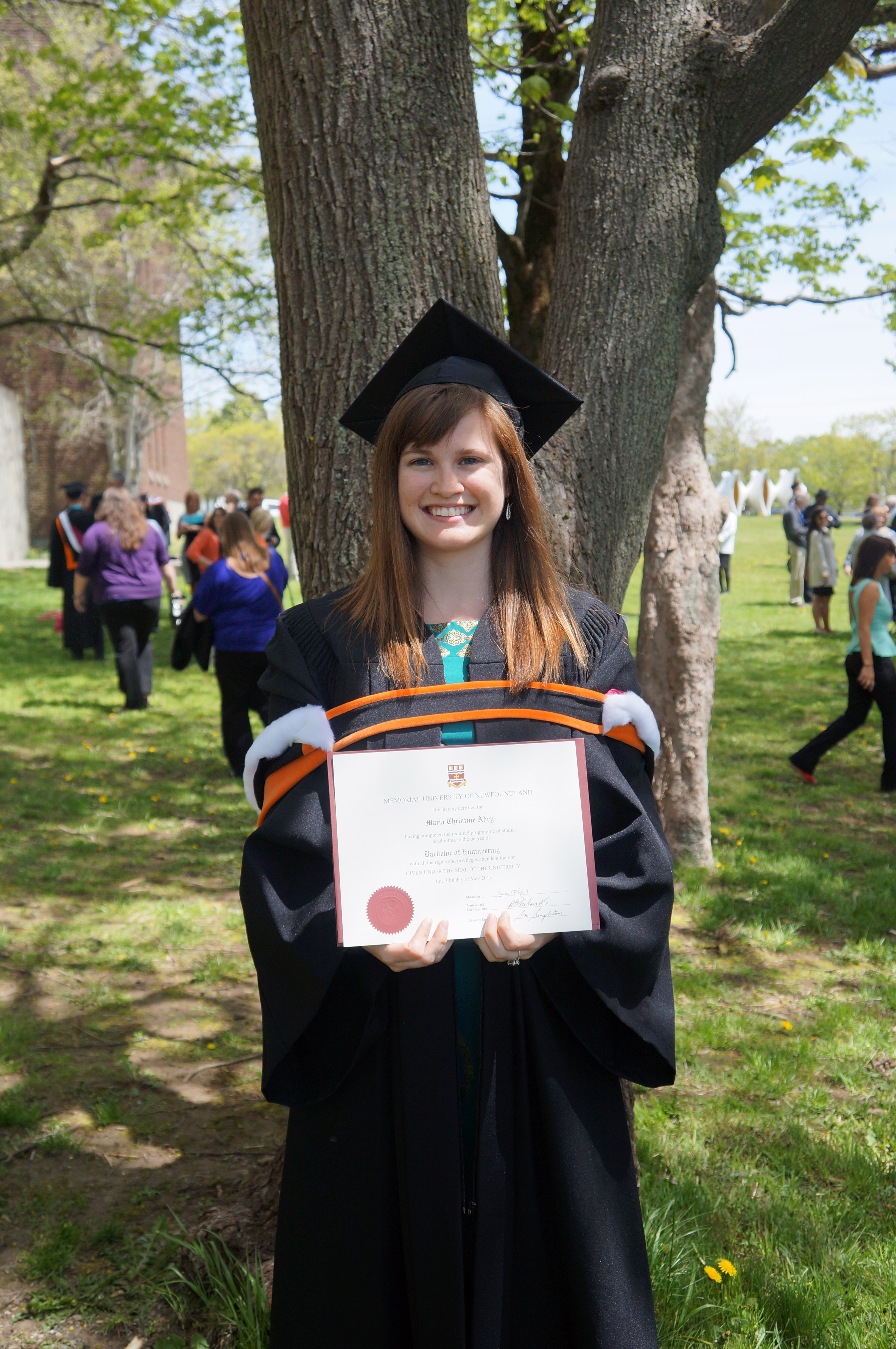
Change is in the air and as a result the last few weeks have been incredibly eventful. If you have me on facebook, you’ll probably know that I recently received my Bachelor of Engineering! I feel like it’s been a long time coming and it was exciting to finally get that last piece of paper. Since I came back from Peru, I’ve pretty much just been kicking around St. John’s, applying for the occasional job and hoping things would work out. My graduation week was pretty much the most incredible week ever. Seth and I both convoked this year, so between the two of us, it felt like I was always at some kind of convocation event or party. In the same week I got my degree, I also attended my engineering dinner and dance celebration, and hosted a convocation party at my house!

First of all, thank you to everyone who came to the party, called, or stopped by to wish me congratulations. I have felt very loved and supported over the past few weeks, as well as a little bit overwhelmed by everyone who took the time to come out and celebrate with me. I’m so thankful for all the support and prayers I’ve had over the last few years! My parents came to watch my 30 seconds of glory as I walked across the stage to receive my degree and my grandparents and relatives watched online. It’s so nice to know that no matter what I do or where I go, I have such an incredible support network!

Maria Adey, B.Eng

Maria Adey, B.Eng

So, like I said, change is in the air. You may be wondering what my plans are now that I’ve put University behind me; I am still not entirely sure what the future holds, but I do have one piece of the puzzle figured out. I’ve been incredibly lucky to get a job working with Nalcor Energy on the Lower Churchill Project for the summer! I was offered a job, on my convocation day nonetheless, and I started with Nalcor this past Monday, so I guess I’m a real person now with a real-person job! Oh, and the job is in St. John’s, so I’ll be around the city all summer!

In other news, you may have noticed that my blog now looks different! I changed a few things in what I called my ‘unemployment project’. The page theme is different and I’ve got a lovely new cover photo of me and my housemates hiking along the countryside in England (photo credit to the wonderful Mickael Freitas). I’ve also added some new content and a new browser at the top! I started writing some specific content for the different places I’ve visited, as I think it’s much easier to reference this way. You can read about it fully in “About My Blog” and feel free to check out some of the content in the drop-down menu. In addition, you might have noticed that I’ve now become the owner of my domain and my new url is mariaadey.com (no .wordpress anymore!). A little thank-you to WordPress for letting me blog for free the last 3.5 years!

I’ve been doing a decent amount of hiking along the East Coast Trail since I’ve been home and I’ve made a goal of trying out a different trail each week (or every other week at the very least). Seth and I hiked the Sugarloaf Trail a few weeks ago, which runs from the Marine Drive Sciences Centre to Quidi Vidi Village. I think it’s probably a nice trail, but it was really foggy on the day that we hiked it, so I really can’t be sure! We also hiked Cobbler Path with a few people from SASF. I loved the views on this one, parts of it are through the woods, but the majority is along the coast. The other day Seth and I also made a quick stop into Cuckolds Cove Trail to look for a bald eagle that’s nesting there with her chicks. The trail is located up on Signal Hill, but starts from Georges Pond rather than the top of the Hill. I would definitely recommend walking in (it’s only about a km); we had no trouble spotting the eagle!

Cobbler's Path

Cobbler Path

Anyways, I just wanted to post a quick update about the new and exciting changes in my life! I’m hoping to keep posting with regular content, although I suspect it won’t all be travel related. I might try out some new things, maybe some more opinion pieces or even a book review? Who knows, we’ll see what strikes my fancy! Let me know if you’d like to take up some hiking with me this summer!

Cheers,
Maria

On the Shores of Lake Titicaca

There’s one last blog that I want to write about Peru. The last big location that we visited was Lake Titicaca. I skipped writing about it in favour of Machu Picchu and the Amazon, but it was a pretty great place to visit as well! Lake Titicaca is located on the southwestern side of Peru and shares a border with Bolivia. Approximately 60% of the lake is in Peru and 40% in Bolivia. It’s the largest lake in the world that’s located at such a high altitude (3800 masl). The lake is really diverse and has some of the most interesting and traditional cultures that we discovered while in Peru.

We stayed in Puno City while we visited the lake, but we did take a 2 day trip out into the lake to visit several of the islands. The section of the lake near Puno is actually really shallow and a lot of reeds grow in the area. In most of the bay surrounding Puno, the water is only 7-8 metres deep! The first island that we visited was one of the Uros Islands, which are actually floating reed islands built by the people that live on them. The islands are formed of a floating base layer and the reeds are layered perpendicular to one another until they are high enough that they are out of the water. The islands are then anchored to the bottom of the lake and the Uros People have to make sure to always add new layers of reeds to the island.

Uros Floating Reed Island

Uros Floating Reed Island

It was incredibly unique and different than anything I’ve ever seen before. The people living on the islands survive mostly on tourism, so we took a boat ride in a reed boat around a few of the islands in order to support their livelihoods. There are still many people who live on the islands, however it is a lot of work to maintain the islands and more and more children are leaving when they grow up. It’s an interesting way to live and it was a bit bizarre to see a lot of modern technology on the island as well. Many of the reed houses had solar panels, which provided them with electricity, and satellite dishes. Although, many of the islands have also been completely abandoned in more recent years.

The second island that we visited was Amantani Island. Amantani is a completely natural island which also survives primarily on tourism. On Amantani, you will not find any hostels, hotels, or restaurants. Amantani is in the business of providing an authentic family experience to tourists. We stayed in Amantani overnight with a local family. Most families have an extra room in their homes for tourists and they cook all their meals. Our host family was really nice and had four children between the ages of 5 and 16. Their second eldest daughter took us around for most of the day since it was a saturday and she wasn’t in school.

Our host family

Our host family harvesting oka in Amantani

We ate a delicious lunch and supper with our host family and spent some time in the afternoon working with them as they harvested oka, a small vegetable that’s very common on the island. Our tour group also went on a short hike in the late afternoon to the top of the island to watch the sun set. It was actually a pretty large island and in order to get to the top we had ascend 400 metres in elevation. This was before our Salkantay hike, so I had a hard time with it of course, but I made it to the top in time to watch the sun set over the Lake!

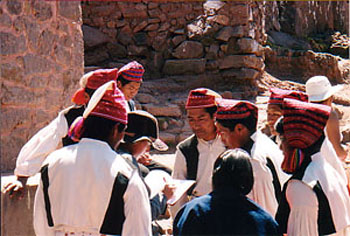
In the morning we left Amantani behind and visited our third and final island, Taquile. I didn’t find the scenery on Taquile much different than Amantani, but it had one of the most unique cultures. The people who live on Taquile Island are known to be the best weavers. Everyone learns to weave and it is essential to learn to be a good weaver. One of the most important possessions for men in Taquile is their hats. Every boy and man must weave a traditional hat for themselves. The hats all looked the same to me, red on the bottom with some detailed design around it, and pure white on the top with a large colourful tassle. The white part of the hat folds over and can hang down on either side of your head.

Taquille Island

Taquile Island

If you look more closely at the hats though, there’s a lot that you can learn from them. Each hat is actually different, the detailed design on the bottom of each hat tells the history of your family, so if you ever lose your hat, you don’t really need to worry about it because someone is bound to find it and know to return it to you. However, the reason it’s so important to be able to weave a good hat is that a good hat is a symbol of a good, hard worker, whereas a bad hat might indicate that you are not a dedicated or hard worker. So women are on the lookout for men with good hats. It was also interesting to learn that the way a boy or man wears his hat is also very important. Married men have different hats than unmarried men, but it’s important to wear your hat the right way if you’re unmarried. If you wear your hat with the pom in the back, it means you are happily single. If you wear it with the pom on your right, it means you’re in a relationship, whereas if you wear it with the pom on your left, it means you’re looking for love. Definitely an interesting way to share your relationship status….

Traditional hats

Traditional hats in Taquile

Women must also become good weavers as well; one of their most important tasks is weaving a belt for their husband before they are married. Everyone survives on agriculture and pretty much all labour is done manually, so it’s important to have a good belt to protect your back. A woman must weave the first work belt for her husband and it is common for part of the belt to actually be woven using some of her hair. There’s a lot of interesting dynamics with how men and women interact in Taquile and my first thought was that it was a bit dated. For example, women are expected to walk 5 paces behind their husbands if they’re out together. However, our guide talked about how traditional gender roles have been changing and how women have recently started getting involved in island politics and voting.

It was a very interesting culture to learn about, however, as with the Uros Islands, it’s a culture that is quickly dying. Teenagers have less of a desire to continue their parents way of life and are anxious to move to Puno to attend university. This change is only accelerated by tourism, which can be equal parts good and equal parts bad. Tourism certainly supports local livelihoods and provides families with more security and opportunity, but it also introduces a traditional culture to a different way of living. Children are exposed to cameras, ipods, tablets, and phones and are starting to desire a different life. I’m glad we got to learn a little bit about their culture though as I’m sure it will continue to change more and more.

Anyways, I hope you all enjoyed my little mini-series on Peru! I’m not sure what I’ll write about next, I’m hoping to do some traveling around Newfoundland over the summer and might be making a trip up to Ontario. Let me know if there’s anything you’d like to hear about. Hope to see you over the summer!

Maria