Happy New Year Fox Glacier

Our plan was to heli hike Fox Glacier on New Years Eve. There’s two glaciers open for tourism along the West Coast of the South Island: Fox Glacier and Franz Josef Glacier. Both are only accessible by helicopter and offer a wide range of tourist activities on the glacier. So we signed up for a half day hike on Fox Glacier. We had pretty mixed weather throughout the trip, but we got a few really nice warm days in Queenstown and the forecast indicated that would continue into the New Year, so we were optimistic about the hike. But the closer we got to Fox Glacier, the less sure we were that the hike would go ahead. It was quite nice looking out towards the ocean, but the clouds were all clinging to the mountains and you couldn’t see any of the peaks.

There was nothing we could do, so we settled into our hostel and crossed our fingers for the next day. Our flight was scheduled for 8am and it was really cloudy when we got up. We walked over to the tour center and they started explaining their refund policy, which really wasn’t a good sign. So we changed our tour to 1pm, hoping the clouds would clear our by then.

In the meantime, we decided to go for a little hike around Lake Matheson, which originally was our plan for the afternoon. The lake is famous because on a sunny day, you get great views of Mount Cook reflected in the lake. We couldn’t see any part of Mount Cook, but we anxiously kept checking the clouds, which didn’t seem to be lifting at all. When we returned for our afternoon flight, we were told that one was cancelled too. It was a huge disappointment because I’d really been looking forward to both the helicopter ride and the hike. We had to drive 6 hours the following day, so we didn’t really have time to spare, but we decided to make one more attempt for the 7am flight the next morning.

There’s not really anything else to do in Fox Glacier on a cloudy, drizzle day, so we drove a half hour to Franz Josef to go to the hot pools. Before we found them though, we stumbled upon a kiwi park and decided to visit. We ended up having a great time! Since kiwi’s are so endangered, there’s tons of eco-sanctuaries around the country and a lot of organizations seem to breed kiwi to boost the populations. Overall there are 5 different species of kiwi, the rarest of which is the Rowi. It’s a small kiwi that’s only found in one sanctuary in the nearby area, so the kiwi park was breeding the Rowi and had young kiwi in their enclosure.

Because kiwi’s are nocturnal, they have the whole enclosure reversed so that it’s night during the day so that visitors can see the kiwi. The enclosure is lit by red lights so you can see them snuffling around. Only one was out while we were visiting, but he was very active, feeding all over the enclosure, so we got a good look at him and watched him for ages. To boost up their attraction a bit, the kiwi park also has an exhibit about glaciers and a tuatara enclosure.

We moved on to the Franz Josef hot pools after that and had a relaxing afternoon lounging in the pools. I have to say, it was definitely one of my more boring New Year’s though. We didn’t want to stay up too late since we potentially had a 7am flight, so we played a game of giant chess at the hostel and went to bed pretty much right after midnight. We were really only interested in spending time together though, so it didn’t really matter.

And our first day of 2020 ended up being a real day to remember. We packed up the car at 6:30am and were dismayed to see a lot of clouds still hanging over the mountains. We knew the flight would be cancelled, but we still had to show up to get our money back. To our shock though, in the next 20 minutes the clouds totally moved out of the valley and we were told that the 6am flight hadn’t gone, but our 7am flight would be!

Things got a little hectic after that – staff gave us all the equipment we’d need for the hike, weighed us for the helicopter, and blasted through all wild risks associated with an activity like hiking a glacier. Then they gave us a tiny pack for the rest of our things and rushed us onto the bus to the chopper. It was a little overwhelming and I had to leave a bunch of my things behind because they wouldn’t fit in the helicopter bag. Our group had 3 tours of 11, so overall it took 6 helicopter rides to get us all on the glacier. It’s only a 5 minute ride and they cycle 2 helicopters through, so it does go pretty fast.

It may not be a long flight, but it is really cool to fly up the valley to the base of the glacier and then actually land on the ice. We ended up being in the first group, so we took off with our tour guide pretty quickly. Fox Glacier is a pretty rugged place. I’ve hiked to some other glaciers in BC, but I’ve never really been on them and the topography of Fox Glacier was really interesting. Up close all the ice looks a bright blue colour, but it never really translated that well to my photos. There’s a lot of interesting ice features, like mountains, caves, and waterfalls. We were all given crampons to wear and our guide had an ice axe to navigate a track for us. It was all pretty interesting to look at and though it was cold out, we were mostly moving around, so it wasn’t too bad. Admittedly it’s pretty slow going, but that’s because there’s no set path and you have to create a trail wherever you go.

We explored around the area for the better part of two hours and then things really started to go downhill. All of a sudden, we looked back at the path the chopper had flown up the valley and all we can see is this mountain of fog rolling up the valley. Everyone else was like, “Oh wow, look at that fog roll, that’s amazing”.

But I am a Newfoundlander, so when I saw the fog rolling, I was like, “we need to get the F out of here.”

New Zealanders are some of the nicest people and you have to admire their laid back approach to life, but during my time in New Zealand I learned that they also have a bit of a laid back approach to safety that I could never really get on board with. I’ll admit I started to lose my cool a bit when I saw the fog rolling in. I think I would have been a lot more chill if it had been a day earlier, but I’d watched that fog hang around the mountain the entire previous day and I had 6 hours of driving to do if we wanted to make our 3 day kayak trip the following day. So I wasn’t really in a patient, easy going place. Plus I’d left half of my warm gear back at the base camp in all the confusion of packing the helicopter bag.

Our guide started joking about us maybe having to spend the night on the ice, which apparently happens to tour groups on average ONCE A MONTH. I was like, “okay, so are the helicopters on their way to come get us?”, and he laughed and said, “no, they’re out on scenic flights, but they’re sending them down.” Apparently the fog had moved back into the valley while we’d been up on the glacier and while the scenic flights all landed, when we got back to the helicopter landing area, we were told they couldn’t come back for us right now.

And this horrible feeling of dread just settled right over me. It was only 11am, but I was convinced we were going to have to spend the rest of the day and the night on the glacier. There’s nothing you can do about it. I was worried and disappointed about the potential for us to miss the kayak trip, but I think mostly I was frustrated by my own lack of preparedness for such a situation. I pride myself on always having my 10 essentials and being prepared for scenarios like this. But I hadn’t brought a lunch that day and so much of my warm gear was sitting back in the lodge. It’s a really horrible feeling. The tour company does have a bunch of lock boxes up on the ice that are apparently filled with tents, sleeping bags, and dried food; but it wasn’t really a comfort to me as someone who has snow camped before because I knew it would only be survival gear.

Admittedly, I was one of the more concerned tourists. It seemed to be everyone else’s first day in Fox Glacier and I don’t think any of them thought we’d be there for long. This was probably a healthier attitude to adopt as I can be a bit of a worry wart. Although I won’t berate myself for it because I really don’t think the tour company communicated the risks to us adequately. They’d had cancelled flights for days and I think they made a poor decision to send a group up in questionable conditions. It’s the darker side of their laid back philosophy to life. Although our tour guide didn’t really help. In that moment I needed reassurance and distraction, not a 24 year old cracking jokes about sleeping on the ice.

Once you stop moving, it does start to get quite cold, so they had us all huddle under a tarp to trap our body heat. It was actually a lot warmer at first, but as the hours stretched on, people started getting bored and were coming and going from the tarp shelter a lot, which really reduced its effectiveness. I was getting pretty cold, but at least I had lots of food in my pack. It was discouraging though because the clouds kept moving in and totally filling the valley, leaving no visibility, then they’d start to clear again and give us some hope, only to cloud back in. I was convinced it was going to do that the whole day.

Eventually though, we got word that they had a “window” to come up the valley and they were sending the choppers. It’s all pre-numbered, so you have no control over what helicopter you’re on, but fortunately we were on the second one. I was afraid to hope, but eventually we heard the first helicopter coming up the valley. They loaded the first chopper and sent it off and when we saw ours coming up the valley and it was such a relief! I’ve never been so excited to get in a helicopter, but also so excited to get out of it.

20200101_133434

It didn’t actually look too bad coming down the valley, but as soon as you land on the ground it’s a lot easier to understand why the choppers couldn’t come and get us. The valley was totally filled with cloud and a literal window in the clouds had opened that looked up towards the glacier. They wanted to get everyone off the glacier as soon as possible, so they hurried us off and sent the helicopter back up immediately. While we were relieved to be back on the ground, the window was getting noticeably smaller and we really wanted the rest of our group to get out as well. I think they did get our whole group out, but the window did close up again and there was a second group up there that I don’t actually know if they were still stuck or not. We had a lot of driving to do, so we couldn’t stick around to find out.

If I hadn’t had the opportunity to do the hike, I would have been super disappointed about it, but the hike was really marred by the experience. At the end of it all, we only spent an extra 3 hours on the ice, but it really was the longest 3 hours of my life. It totally makes for a great story to tell now and I’m definitely able to laugh about it. But I also don’t think I could recommend it to other people. It’s a lot of driving to get there and the glacier is really the only attraction. So it sucks if you go all the way there and then miss it. And after my own experience, I’d say not to hedge your bets. Don’t go if the weather is at all questionable. The problem is, if the flight goes, they won’t reimburse you, so they are kind of forcing you to go in a way, which I don’t like in this kind of adventure activity. If it really is true that one group a month gets stuck up there, then I really think they need to rethink some of their policies, or at least how they communicate the risk.

So it was a rough start to the new year, but I’ll also take it as a sign that 2020 is going to be full of adventure – and I do love a good adventure!

Queenstown and Beyond

Well done if you made it through my last post! Apparently I had a lot to say about the Milford Track, so I’ll try and be less wordy on this post.

After our 4 day adventure on the track, we decided it was time for some well earned lazy days in Queenstown. We decided to shell out for a nice hotel in Queenstown (though it was still cheaper than our bunkbeds on the track) with a hot tub, BBQ, and gorgeous city views. We checked in with our families to wish them a belated Merry Christmas and caught up on our laundry. We wondered into Queenstown for a few hours and did a little bit of shopping along the waterfront then stopped into Speight’s Ale House for a flight.

We’ve gotten pretty into craft beer since moving to Vancouver and love trying out flights of different beers. But this was a lot harder in New Zealand. Domestic beer is definitely more expensive, but craft beer is just crazy expensive, selling for $10+ a can in stores and $12 for 350ml in bars! So we were shocked when our little flight came out to $25 (they usually go for ~$7 in Vancouver), but I guess that’s just the price you have to pay in New Zealand. We did still take the opportunity to drink local as much as possible.

Wine on the other hand is comparable or cheaper to BC and there’s a lot of great wine in New Zealand. We decided to book a biking wine tour out of Queenstown and spent a full day biking to the different wineries in the Gibbston Valley. It’s a self guided tour that starts in the historic town of Arrowtown, which is this cute little “wild west” style town. We biked along the river out of Arrowtown until we reached the Gibbston Valley, where we biked to as many wineries as we could!

Before we hit any of the wineries though, we had to stop along the Kawarau River for a little Lord of the Rings viewpoint. The scenes where the Fellowship is boating along the river after leaving Lothlorien were filmed in the Gibbston Valley, not too far from where we were biking, so we popped up to one of the river viewpoints for a little look. While we were checking out the landscape, a bus pulled up to the edge of the road and a bunch of people jumped out on what turned out to be a “Lord of the Rings film locations” tour!

They all crowded in front of our view, so we stuck around to hear some of the tour guides interesting tidbits of information about the location. Apparently they had to shrink the fellowship in their boats to make the river look bigger and the location where we were standing was actually where the two kings of Argonath had been digitally added in (although replicas were still constructed for the filming – not to size obviously). We also learned that apparently Peter Jackson wanted to have orcs shooting at the fellowship while they were in the water and have Legolas shoot back, hopping from boat to boat. But just before filming, the entire river flooded and they lost all the filming equipment, so they abandoned the shoot. Peter Jackson got the opportunity to try again though when he shot The Hobbit, if anyone remembers the scene with the dwarves in the barrels!

The wineries are all gorgeous and it was fun to cycle between them trying out different wines. What I found really interesting is that there was really only 4 wines you could get at any of the wineries because of the soil and weather conditions in that region. Pinot Noir is the only red wine you can really find and is by far the most popular; the other three are Pinot Gris, Reisling, and Rose. I’m a white wine drinker, so I had no complaints! My favourite wine of the day was Peregrine Wines Rastaburn Riesling and my favourite winery overall was probably Mt. Rosa. Mt. Rosa is the last winery we did and is located at the top of a hill. The hill really didn’t look like much, but it was really hot out and we were pretty wine-weary at this point, so it felt like quite the strenuous bike ride to reach the top! We did also stop at Cargo Brewery for a flight, which is located in this old converted church. It has a really nice vibe and you can sit outside on the lawn, but I did feel like a heathen buying beer from a church on a Sunday…

After our few days in Queenstown though, it was back on the road! Our plan was to drive from Queenstown to Fox Glacier, but we didn’t have much planned for in between. Probably for the best because it was another gorgeous drive. We drove over the Crown Road to get to Wanaka and were constantly pulling over to snap photos of the view looking back towards Queenstown. I also had the delight of discovering that there is such a thing as yellow lupins!

We stopped for lunch in Wanaka and went for a little walk to see the famous Wanaka tree (#thatwanakatree). Seth didn’t really believe me when I told him we were going to see a famous tree, but he had to admit I was right when he saw the crowd of people snapping photos of it down along the beach front. I’m a little bit sad we didn’t have time to do the Roy’s Peak hike in Wanaka. For some reason I seem to have missed that hike in my research, but upon discovering it I was really aching to climb it, but sometimes you just can’t fit everything in and we decided to skip it.

The drive through the Lake District after Wanaka was probably one of my favourite stretches of road on the trip. You leave Wanaka and drive along Lake Hawea, before returning back to Lake Wanaka again. Both lakes are incredibly scenic and make for the most gorgeous viewpoints as you drive along between them. The mountains get bigger as you approach Mount Aspiring National Park and we decided to do a short walk to the Blue Pools.

I’m not sure “blue pools” is the best name for the hike, it’s really just a blue river, but admittedly very pretty. There was a lot of people enjoying the beautiful weather there, so I decided to go for a swim, but it was all glacier and snow melt (just like the Milford Track) and freezing cold. In retrospect, most of the rivers are freezing and the ocean seems to be the warmest place we swam!

The highway continued on to Fox Glacier where we were planning to ring in the new year and go on a heli hike. It ended up being quite the adventure, so more on that in my next post!

Hiking the Milford Track

One of the first things that I added to my list when I started researching New Zealand is that I wanted to hike one of the Great Walks. New Zealand has 10 ” Great Walks” that are located all over the country and range in distance, difficulty of terrain, and campsite options. I think whoever did the marketing on the walks is brilliant because the idea of slowly working your way through all of the great walks is definitely alluring to someone like me who loves trekking. So I’m sure I’ll have to come back again some day to hike more of them.

Seth’s not quite as intense about trekking as me, but he agreed to do one of the great walks and left it to me to pick which one. Milford Sound and Fiordland National Park seem to be the most amped up and scenic places in New Zealand, and with 3 of the 10 great walks being located in the park, I knew it had to be one of those. I was really torn because I thought the Keplar Track looked just as awesome, but the Milford Track is really the most renowned of all the tracks and is often called the “greatest walk in the world”. So the marketing definitely got me on that one and I became enamoured with the idea of doing that walk specifically.


I shared some history about the track in my last post, so I’ll try not to repeat myself about the historical significance of the track and just encourage you to read that post instead. It’s a 53.5km long track and because of the temperamental nature of the weather in the park (and the inordinate amounts of rain), there are no tenting options and everyone is required to stay in the same 3 huts consecutively while completing the trail. Overall it takes 4 days and 3 nights and requires a boat to access both of the trailheads. The huts have a capacity ofn40 people, so only 40 independent hikers are permitted on the trail per day. Some people also visit the trail by doing a day hike to the first hut and back, or you can also do a guided hike, which stays in different huts and is for the most part totally separate from the independent hikers. But it’s a lot more expensive because the guider hikers also stay in mountain hotels and have all their meals catered. So a nice option if you’re not a trekker and you have some extra cash lying around, but we definitely preferred the independent option.


Like BC, trekking and camping are super popular here amongst both the locals and the foreign visitors, so scoring a hut pass is no easy feat. Fortunately after 6 years of living and camping in BC, I’m an expert at booking campsites. Similar to BC, there are specific days when they release the bookings, so all the way back in June of 2019 I had a reminder in my calendar to make a booking as soon as they released. I was ready with my preferred dates and made the booking right away. It took me about 3 minutes to secure a spot in the huts and by the time I refreshed after completing the reservation, the track was almost completely sold out for the entire season! So it is an insanely popular hike and I do feel very privileged that we got to participate in the experience, especially as visitors. Although you do pay a steep price as foreigners and pay double what the locals pay for a bunk. No complaints that they do it this way, but there’s also no sugarcoating that the Department of Conservation (DOC) charges a hefty price for the hike. Our hut bunks were actually the most expensive accommodation we stayed in throughout the entire 5 weeks of the trip.

But fortunately it was an awesome experience and I dont have any regrets. We had mixed weather on the hike, but the scenery was quite beautiful. I dont really buy that it’s the “greatest walk in the world” and I think any of the other great walks would have been just as scenic (and that I’ve done hikes that were just as scenic or more in BC too). But what I unexpectedly really enjoyed about the hike was the people. Because you have to stay in the 3 huts, all 40 independent hikers are doing the exact same thing for 4 days. This isnt the case for most of the other tracks, which have a combination of hut and tenting sites where you can kind of build your own adventure. But on the Milford Track, you’re all in it together. Couple that with the fact that we did the hike over Christmas, from Dec 24-27, I felt that we really built some nice relationships with the other hikers. Everyone on the track was super friendly and the full time rangers at each hut love to share all their knowledge with you. It really made for a warm and memorable experience.


So far as the trekking went, it’s one of the easier backpacking trips I’ve done. I’ve noticed that New Zealanders seem to have a bit of a penchant for hiking through the valleys and most of the hike is flat along the valley floor, except when you climb over the MacKinnon Pass on the 3rd day. This makes total sense from a historical perspective on the Milford Track since the whole point of the track was to find an easier overland route to the Sound. But to someone who’s used to hiking up BC mountains all day, it was a much easier hike. The distances were longer than I usually backpack, but the huts included mattresses and gas stoves, so without a thermarest or tent, our packs were definitely a lot lighter than I’m used to (which was lovely).

The first day is an easy one, you take an hour boat ride to the trailhead and then hike about 5km along the Clinton River to Clinton Hut. This was our best weather day on the track – it was a gorgeous, sunny, blue sky day – so we took our time and really enjoyed the beautiful river views. There’s a short wetland walk near the hut and we had lunch along the river. Since it was a beautiful hot day, I couldn’t resist going in the river. It was absolutely freezing cold, like the kind of cold that numbs your feet immediately and makes it hard to walk, but refreshing on the muscles.


Like I said, each hut has a full time ranger and the ranger at Clinton Hut took us on a little nature walk to teach us about some of the plants and animals in the area, as well as some of the work DOC is doing to protect the native wildlife in the area. I’ve talked in my other blogs about some of their efforts to create predator free spaces in New Zealand for native and endangered birdlife. Because NZ was historically just an island full of birds, protecting the birdlife is the number 1 priority.

I’ve never travelled to a country that is as enthusiastic about conservation as New Zealand. That enthusiasm extends to a savage desire to kill every introduced predator that threatens the lives of their endangered birdlife, which includes rats, ferrets, weasels, and undesirable no.1, the stoat. The stoat is particularly hated because it robs nests and kills birds, but not just to eat, but also just for fun, leaving piles of bird carcasses in its wake. The stoat threatens a lot of the bird life, particularly flightless birds like the kiwi, and of high importance on the track, the blue duck (or whio as it’s known by the Maori).


The Whio is an alpine duck that likes to hang out in white water rapids but has become very endangered. In an effort to increase their numbers, DOC has a number of different killing campaigns (my word choice, not theirs). I do totally support their efforts to wipe out the invasive predators, but they’re also pretty creative in their bloodlust to eliminate them. The most common trap we saw was a wooden spring trap, which are placed all over the trails in the woods. It has bait inside and a giant mouse trap to quickly and effectively kill the prey. But DOC regrets the maintenance of these traps as they can only kill up to 2 animals per trap and have to be checked and reset once a month, requiring a lot of people power. They also have more efficient killing machines, their A12s and A24s, which are essentially little guns that are attached to trees and shoot a bolt through the heads of the predators that set them off. As their name suggests, they can kill up to 12 or 24 predators before needing to be reset.

The last method (I learned about anyways) is by far the least popular, but sometimes used if they see an invasion of something like rats on a previously predator free island. It’s a poison bait drop where they essentially drop a ton of 1080 poison pills on entire areas, which the predators will then eat. It’s not popular because it’s a much crueler way to kill the predators (takes longer to die), some ground birds will also eat them and die, and the uneaten pellets are basically left all over the park. It’s pretty common actually to see warnings about them to not let children or pets ingest if you stumble upon the pellets.


So there you go, a long graphic description of all of DOCs killing methods as ferverrantly explained to us by our ranger at the Clinton Hut. So many New Zealanders espouse these ideas though and they’ve been explained to us so many times by conservationists that we do wholly support them, as barbaric as it might sound to the outsider. And they have had benefits. They caught something like 600 stoats the first year they placed the wooden bait traps in the park and the whio numbers have seen a dramatic boost, with more ducklings counted along the park rivers then ever before.

But we experienced a lot more on the trail then just predator control. Before we’d even heard about the whio success story Seth had decided that the blue duck was what he really wanted to see on the trail. So of course, despite the claims of all the whio, we didnt see any on our first two days. While day 1 was a short day on the track, we paid for it on days 2, 3, and 4. We hiked 16.5km on day 2, which was also Christmas Day! It was a much different Christmas than we’re used to, but we did get to help the ranger decorate one of the trees by the hut for the occasion. Christmas Day was also mostly in the valley, though we had much more dramatic peaks rising on both sides of us. It was an overcast day and the very tops of the mountains were lost in the clouds, but it didnt rain and overall it was pretty good weather for hiking. I decided to make a tradition of my river swim and went for another dip in the river when we made it to Mintaro Hut.


Mintaro Hut is almost halfway along the track and is located right at the base of the MacKinnon Pass. As such, it’s the most remote of the 3 huts and definitely the coldest. I was super warm at Clinton Hut because I’m used to sleeping in a tent and all my gear is too warm. But I was happy for it at Mintaro. It was probably my favourite of all the huts. The other 2 huts had multiple buildings and separate bunk rooms and cooking huts. Mintaro was just one big hut with the cooking area downstairs and most of the bunks in one bedroom upstairs. The bunk room had lovely ceiling windows that looked up at the steep MacKinnon pass atop us and had a real sleepaway camp type vibe with the one room.

Day 3 was probably the most disappointing part of the trip. Because a lot of the hike is in the valley, I was really looking forward to hiking up and over the pass because I’m a sucker for mountain views. But unfortunately I was to be denied and it was a rough weather start. The pass was pretty clouded in when we started hiking and it started to rain on the way up. Fortunately it wasnt heavy rain and our rain gear kept us nice and dry. We did get some nice views looking back at Mintaro and the valley we had hiked through the day before, but because of the way the wind was blowing the cloud in over the mountain on the other side, we couldn’t see any of the view or the mountains on the other side. So we trudged along the freezing trail and quickly pushed downhill to get out of the wind to the other side.


To give you a little more history on the trail. When they were searching for that overland route back in the late 1800’s, an explorer by the name of Donald Sutherland (yup) had created a trail that ran from the Sound to Sutherland Falls, but was unable to find a way to pass over the huge mountain saddle to connect to Lake Te Anau. Enter MacKinnon and Clinton, who pushed a track down along the Clinton River and MacKinnon went on to discover the pass in 1888, which he was then able to connect into Sutherlands Trail.

Of most interest to us in all of this was Sutherland Falls, which at 580m is the tallest waterfall in New Zealand. It cascades down from Quill Lake in the hanging valley above in 3 breathtaking waterfalls. It was a cold and tiring 14km hike up over the pass to our final hut, but almost everyone still did the 4km side trail to Sutherland Falls. It is pretty impressive from up close, mostly just because of the crazy power of the waterfall when it finally hits the ground. The rock floor was definitely taking a beating.


The group had a bit of adventure on the third day when about 30 minutes before the hut, one of the hikers unfortunately fell and hit his head, cutting it open and breaking a tooth. Another hiker patched him up and he was in pretty good spirits (the injured hiker that is), but he still had to be airlifted out so he could get stitches in Queenstown. The ranger at Dumpling hut had a bit of a runaround to secure the heli pad and then we all watched it land from the cooking shelter. Definitely enough adventure for one day.

It was the end of day 3, so by this time Seth was starting to despair about ever seeing his blue duck. I decided to make it a hat trick and swim in the river one last time. I was trying to convince Seth to come down to the river with me, so I lied and said I’d seen a blue duck down there. He didnt believe me of course, but came anyways and what do you know, when we round the corner there’s a blue duck sitting right in the water where I was planning to go swimming! So the curse was broken after that and he saw 2 more whio later that night and another half dozen the next day (including a duckling)!


The weather on the last day made us all a bit envious of our fallen comrade’s scenic heli ride out the previous day. It was a classic rainy, wet day on the track. To be honest, we’re lucky it only really rained one of four days based on how much rain the track gets. I do really feel that experiencing the rain was an authentic part of hiking the track and I’m actually kind of glad we got to experience it, but I’m also REALLY glad it was on the last day and I didnt have to worry about how I was going to dry out all that gear.

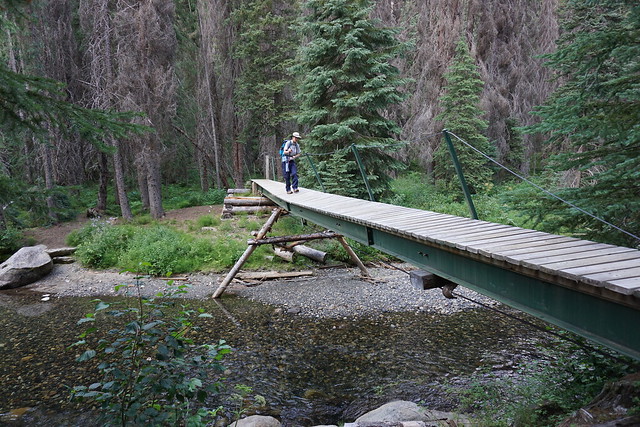
We had to hike 18km on the last day to Sandfly Point, where we’d be picked up for a short 5 min boat ride to the Sound. It was raining when we started, but again, it was the kind of rain that doesnt really ruin your day. Your rain gear keeps you dry and you can still take pictures. We crossed some cool suspension bridges and saw some nice waterfalls, but the longer we were out, the worse it got. There’s only one shelter between the hut and Sandfly Point and its located about 5km before the end, so we pushed through to that shelter with the intention of eating and changing there. Unfortunately it’s not a great shelter though and the sand flies were awful, so we just shoveled down a few snacks, but on some dry clothes, and decided to push forward to the end. Changing to dry clothes ended up being a waste of time because the rain became totally torrential during the last 5km.


I seriously dont think I’ve ever been so wet in my life – certainly not on a hike. I was soaked to the skin. It was raining so hard it beat right through my rain pants and rain jacket. I was so wet it inspired me to buy merino wool underwear when we got to Queenstown. The trail really is totally transformed in the rain. There’s just nowhere for the water to go. The drainage is horrible and some parts of the track (mostly on the day 2 sections I believe) become flooded up to waist height when the rivers come up. Fortunately we could still tramp through it all, but I gave up on avoiding puddles once my feet were so wet and actually starting taking pleasure in stomping right through the puddles. Once you’re wet enough it doesn’t really matter anymore.

We pounded through the last 5km and arrived at the shelter with lots of time to spare. Unfortunately though, we arrived to a written note saying that the boat was broken and the boat they were using instead was open top and to please keep your wet rain gear on. So there’s no rest (or dry clothes) for the weary (and soaked). But you know what, none of it mattered because we had done it! We traded laughs and congrats with the other hikers and boiled up some hot water for tea while we waited.


And you know what, we were rewarded! I hinted in my last post that Milford Sound is something to behold when it rains. And I got to experience that too because it was absolutely pouring on our ride out and it was beautiful! Because the mountains are so steep, there’s no drainage for the rain water, so it just cascades down the cliffs in thousands of waterfalls! It was quite literally breathtaking when we stepped out to board the boat and saw the waterfalls all around us. It was like being in Rivendell and honestly just as good a reward for the hike as sun.

And that’s pretty much where our journey ended. We’d already done the Sound so we immediately boarded a bus to take us back to our car in Te Anau and our group became scattered to the wind. It was only 4 days, but I already look back on them with fond memories for both the experiences on the track and the people. There was a huge mix of people on the track from all over the globe, but we all had the opportunity to share this one experience together and I was really uplifted by everyone’s kindness and positive attitudes on the track. A very different Christmas then we’re used to, but definitely one we’ll remember for a long time.