First Experiences

Well, my shoes are caked in red dirt, I’ve gone through most of the clothes I’ve brought, and I’ve got sunscreen everywhere! That’s right, I am finally writing to you from Malawi! I’ve been in the capital, Lilongwe, for about 3 days now and so far I really like it; Malawi is pretty chill place.

Getting here was a bit of a nightmare involving 5 days of travelling, a 16 hour flight, a night in Ethiopia, and me almost getting on the wrong plane to Nigeria, but I made it nonetheless. I’ve been spending the last few days with APS (African Program Staff) Mike and Owen getting caught up on the workplan for the water and sanitation (watsan from now on) team in Malawi and the Water Monitoring System which I am hopefully going to be kicking off in Thyolo. Speaking of which, I am heading down to Blantyre tomorrow and then on Tuesday morning to Thyolo to start work. I will be staying in the Boma, which is the capital of the district. I’ve got the impression that it’s not a big place, but a beautiful one. I’m going to be staying in a guest house for the first few week, but hopefully will be moving in with a family soon after.

To check in with you guys, I must say that physically, mentally, and emotionally I am pretty content. I still have lots of reading to do so that I can hopefully kick ass on water point monitoring (WPM) and I’m a little bit nervous about starting work, but mostly excited.

Just a couple short stories and observations for you:

– Malawians are really nice! There’s a reason Malawi is the warm heart of Africa.
– Malawi is really short on fuel right now, I realized this 10 minutes after arriving when my taxi broke down on the side of the road.
– Toilet paper comes in different colours, so far I have seen blue and pink!
– Cell phone units are really expensive! I’d love to hear from you (+256 991 764 034)
– The local currency is Kwacha, it’s really inflated. 135K = $1 CAD. It’s quite weird to pay 250K for breakfast and realize you’ve only spent $2.
– I played ultimate Frisbee today with Owen and a bunch of locals, it was awesome! I was exhausted 10 minutes into the first game, but I played all 4 anyways. It was wicked fun and I got a little bit better towards the end (not much though). – Thyolo is basically the banana capital of Malawi, if you know me, then you know I love bananas. I should have brought my banana case with me, haha. Also, mango season is coming up!!! I had one yesterday, it wasn’t quite ripe yet though so I didn’t get the full mango goodness.
– I experienced my first Malawi power outage my first night here. The power just goes off every now and then.
– Summer is just beginning here, so it is going to get HOT. The temperature now is perfect for me, but it’s going to get much hotter. Luckily Thyolo is a little cooler because it’s in the hills.
– I had a grand old chat with this nice Malawian man when I was having supper tonight and found out that his brother was a priest in St. John’s for 11 years! First Malawian I met who has heard of Newfoundland. He quite enjoyed my stories about snow and called his brother up while I was talking to him so he could tell him he’d met a Newfie. Quite funny!

Anyways, I’m excited for Blantyre tomorrow and even more excited for Thyolo. I’ll keep you posted on my first minibus experience (actually I kind of had one in Ethiopia, lots of people crammed into one tiny bus, suitcases thrown on the roof and everything) and I’ll give you more info on my work placement once I get started.

Tsalani bwino,
Maria
Malawi Bound

Thyolo District

After 10 months of preparation and excitement I am finally on my way to Malawi! I left St. John’s yesterday morning at 6 :10 and I am currently in the EWB house in Toronto. I am spending 2 nights in Toronto and then tomorrow I leave for Malawi. I am flying through Washington, on to Ethiopia, and then to Lilongwe. I know it’s been a while since I have posted, so I want to check in with you all. Physically I’m a little tired but healthy; mentally I am excited to get to Malawi and start learning; emotionally I was pretty sad yesterday to leave my family and friends behind and I was a little bit nervous about the unknown, but I am finally on my way, so I’m excited!

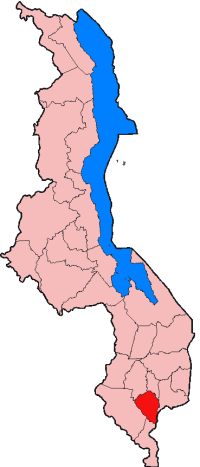
I finally have some information for you on what I am going to be doing in Malawi for the next few months! I will be working in the Thyolo district which is in the south of Malawi. The capital of the district is also called Thyolo and there is approximately 500 000 people living within the district. I will most likely be staying in a village shortly outside Thyolo. As a bonus, Thyolo has internet cafes, a good hospital, and it is about an hour from Blantyre.

So what am I going to be doing? I will be working with the District Water Office (DWO), which is a part of the Malawian government, on a water monitoring system for the district. Basically the two main issues Malawi is facing with its water infrastructure is that many water points (boreholes, pumps, etc) are not equally distributed throughout the district and that many water points are no longer functional. Mapping the location of water points and their functionality provides the District Water Office with important information for drilling new wells and fixing non-functional ones. The software that has been used in other districts for water point monitoring is  quite interesting as well, you can read a bit about it on APS Owen’s blog.

Anyways, that’s about it for now, I’ll try and post when I  arrive in Malawi. I leave you with some interesting facts about Thyolo. It has quite alot of tea plantations and it’s a pretty hilly region which makes in a little bit cooler than other regions. I like this fact because the hot and dry season is now commencing in Malawi, so it is going to be quite warm when I get there. The rainy season begins in mid-november, so I’ll get to experience a bit of that as well.

Love Maria

Pre-departure learning – Part Two

Working hard at pre-dep

One thing that most JF’s find themselves doing at some point throughout their placement is interviewing people who work in the field. In our workshop we discussed the importance of thinking about the questions you ask and framing them in the right way. If you ask too many leading questions, it is quite likely that you will simply receive the answer that you are looking for, but is maybe not the truth or entirely accurate. Finding the right open-ended questions to ask can give you a better idea of how things actually work in the field. To practice our questions we went around downtown Toronto for an hour to question people on the street on homelessness. It was a really interesting experience for me. Once I stepped a little bit outside of my comfort zone and talked to perfect strangers, I realized that most people were pretty willing to talk to me and had really interesting stories themselves! One of the most important things I noted was that people were usually more engaged in the conversation if I started the discussion with simply asking them about themselves and how their day was going. It was much easier to connect with someone once you know a little bit about them.

Ann mapping our case study on sorghum

We ended off the week with a case study on growing sorghum in Zambia. Sorghum is a cereal crop that grows really well in areas prone to drought. We started off by reading about an initiative that aimed to get farmers to diversify their crops by growing sorghum in addition to maize; we then had to evaluate the project, identify parts of the project that were essential to “get right” and parts of the project that were pretty risky. Then we had to interview farmers who had taken part in the project and evaluate what key things were hindering them from producing a grade A product instead of grade B. It was another opportunity to practice asking questions. While we learned a lot from the farmers and discovered some things that were not working, we still missed a lot of information from the farmers. Looking back on the experience I think we weren’t really listening hard enough to the farmers and what they had to say. After completing the case study and after talking to 2 or 3 of the farmers I think I had already decided in my mind what wasn’t working and why some farmers were only producing Grade B sorghum and I stopped listening to some extent. Discussing with the group after made me realize all the things I had missed and important questions I hadn’t asked. It definitely made me think about how to frame my questions better and to really focus on listening.

Finally, stay tuned, I should have some idea what I am going to be doing on my placement by the end of the month!

Love Maria