Ring Lake Backpacking Trip

Ring Lake was definitely one of the weirder backpacking trips I’ve been on over the years, but I look back on it now with very fond memories. It was August 2018, the smokiest summer I’ve ever experienced in the lower mainland. My Howe Sound Crest trip had been cancelled for the second year running because of the smoke, but I still wanted to go out exploring somewhere, so Brandon and I decided to head up towards Whistler in hopes that the smoke would thin.

If anything it was worse in Whistler, but we carried on towards Callaghan Lake, pulling over just before the lake at the Conflict Lake/Ring Lake trailhead. Callaghan is most well known for its cross country skiing, but you can explore there in the summer as well. It’s a gravel road that’s in pretty rough shape; I think it’s doable in a 2WD because there aren’t many water bars, but high clearance definitely make it easier.
DSC06704

The Conflict Lake trail is really popular in the winter because there’s a beautiful cabin you can ski into and explore the area from, but for some reason it’s not operating in the summer and we didn’t see a single person on the trail. It’s 5km to Conflict Lake along relatively flat terrain through the woods. I had a bit of an upset tummy, so we rushed along to the Lake, thinking there would be an outhouse near the cabin. But alas, it’s too swanky a cabin for that so I was forced to make use of my trowel.
DSC06631 (2)

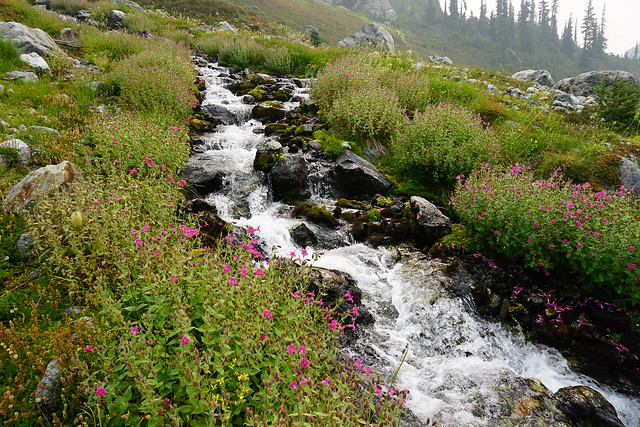
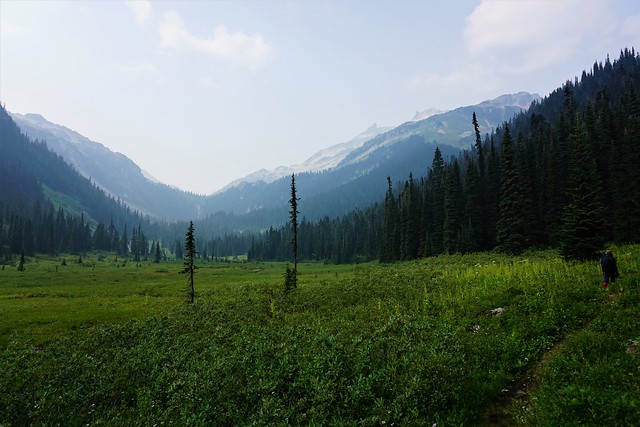
We had lunch at the lake before carrying on to Ring Lake, which is another 5km, but this time it’s all uphill. It’s about 500 metres in elevation gain, but since it was flat to Conflict Lake, all the elevation is in the second half of the trail. However, right after Conflict Lake there are some really beautiful meadows, and just our luck they were filled with wildflowers! The contrast of the green meadows and smoke filled valley made me feel like I was somewhere else entirely. Coupled with the fact that we had yet to see another soul on the trail, it was quite blissful.

DSC06622

It’s a tiring climb up from there though. The trail skirts the edge of the valley as you climb up towards the lake. It’s almost totally in the trees until you reach the top and pop out in the alpine. When I did Brew Lake it reminded me a lot of Ring Lake because both trails are almost completely forested until you reach the top, and both weirdly empty.

The challenge of Ring Lake is that about halfway between Conflict and Ring, you have to do a pretty dicey river crossing. Because of the terrain, the river cascades down over the rocks at a pretty steep angle, making it dangerous if you were to misstep and fall in. For this reason, the season during which you can hike to Ring Lake is short because you need to wait until the flows in the river goes down. I had a friend that tried to go in July once and had to turn around at the river crossing, so I’d really only recommend going in August. Fortunately for us (I guess), it was a super dry year, so we didn’t have too much trouble. I just opted to wear my full goretex boots for the trip and brought two hiking poles instead of the one I normally bring to make the crossing easier (although I ended up giving the second one to Brandon).

HOP_0198

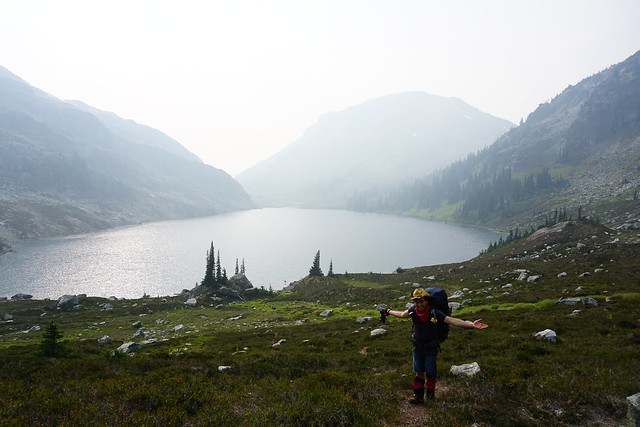
After the crossing the trail is still quite technical though, there are a few ladder and rope sections, but eventually you pop out of the trees to the most gorgeous mountain vista! Sadly though, with the smoke we could barely see across the lake, but the whole area is hemmed in by mountains and it looked like there was lots to explore nearby. When we arrived we saw one tent on the far side of the lake, so we went in the other direction to set up our camp. It’s a large lake, so by the time we found a place we liked, we couldn’t even see them anymore. They left before us the following morning and we didn’t see a single other person the whole weekend.
DSC06638

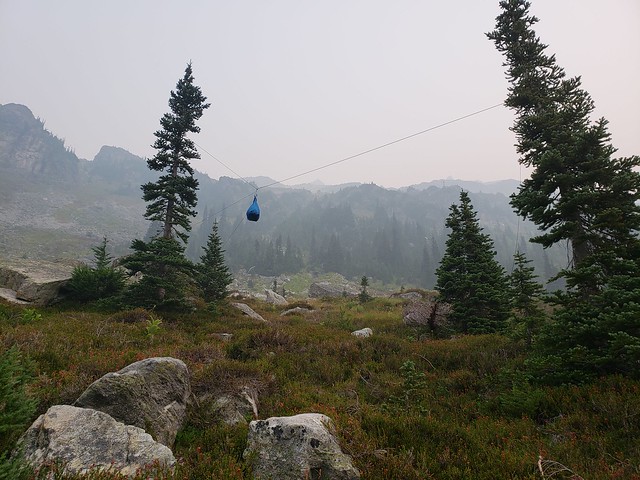
There’s only a handful of times when we’ve had such solitude at a campsite. I love it, but it does make you much more keenly aware of your presence in the wilderness. Ring Lake is in grizzly bear country, so caching our food was super important. Unfortunately though, it’s also an alpine environment and trees were very sparse. There are some around, but they’re the kind that go straight up with very few branches from which to hang a bear cache. After pitching the tent, we immediately got to work on our bear cache because we knew it would take some time. Looking back, I really have no idea how we managed to get the thing up – it took us about an hour, but somehow Cowboy Brandon managed to lasso to trees and we created a clothesline between them that we then hoisted our bags up. Most challenging was making sure not to tie the ropes in such a way that we wouldn’t be able to get them back, but in the end it all worked out. Definitely the most impressive bear cache I’ve ever fashioned. It was higher than it looks in the photo (because it was taken on a slope), but it did start to sag overnight.
20180819_080600

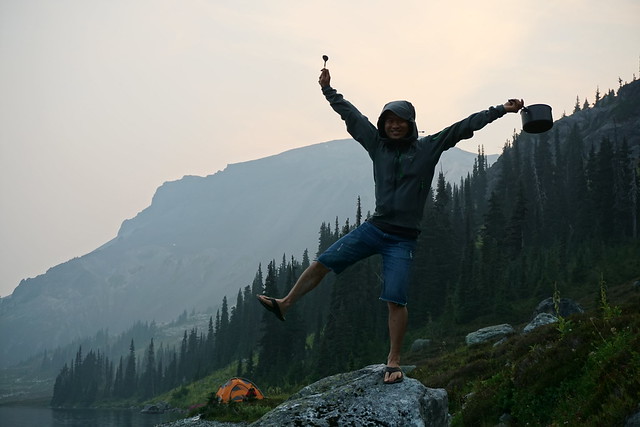
I’d also brought some bear bangers in case we saw a grizzly and I’d been thinking of setting one off before bed just to make sure the area was clear, but there is a small chance of fire with bangers and flares, so I opted not to with the forest so dry. Instead we just kept our bear horns nearby and we ended up sleeping with the fly off the tent, so we could easily see the surrounding area with the moonlight. I’m not really sure why we left the fly off, I think Brandon wanted to watch the stars, but with so much smoke, there wasn’t really much to see overnight. We did get a beautiful orange sunset over the lake though!

DSC06650

I think what makes this trip stick out in my mind so much was the rest of the evening. After we’d set up camp, we went downwind of our tent to make dinner. Brandon had brought his speaker so that we could play music to scare off the bears and we’d accidentally brought a pretty significant amount of fireball with us. So we ended up doing quite a few shots and having our own mountain dance party as we made dinner! There’s nothing so enjoyable as a watching the sun go down with Brandon’s backcountry thai chicken curry and a pleasant buzz. But mostly we just marveled in our good fortune in having such a beautiful place all to ourselves.
DSC06674

We both regret that we couldn’t explore the area further. There are lots of surrounding mountain peaks that would have made for a fun second day, but the smoke stole any hope of a view, so we decided to just head back down the following day, though we’re both keen to return again in the future.

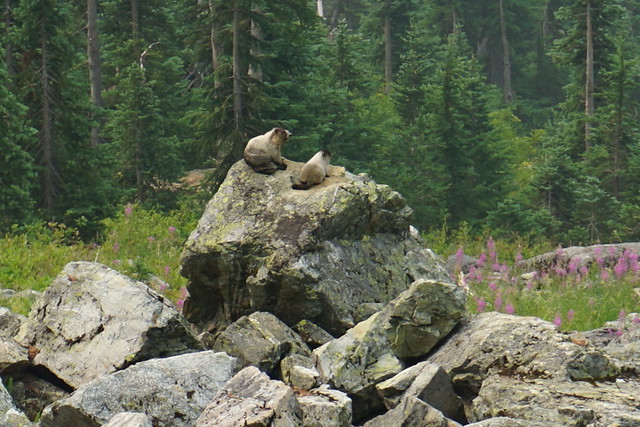
The trek down was a lot more enjoyable than the hike up. We did a small bit of exploring at the meadows at the top before heading back to Conflict Lake for lunch again. There’s a boulder field between Ring and Conflict Lake that is an excellent place to watch for marmots. We saw a few on the way up hanging out on the rocks. Then on the way back down I counted a record 7 marmots out sunning themselves! One was a family of 4 with two little pups that were super cute!
DSC06724

It’s only 10km each way, but it feels like a long 10km with big hiking packs. The hike from Conflict back to the car felt like it went on forever and we were relieved when we finally arrived back at the car and could shed our packs and smelly clothes. Like I said, I really would like to go back and visit Ring Lake again, but I would never do it in such conditions. Looking back, the smoke was great enough that we shouldn’t have gone hiking at all and I’m impressed I didn’t feel sick from it.

We had some really bad smoke in Sept. 2020 as well and again attempted to escape it by heading out of the city. We weren’t successful in escaping it, but on this occasion it gave me such a headache I quit the hike 3km in and went back to the car. When the smoke is so bad, it’s really not worth going out in it since it’s quite dangerous to your health. At the time though, we’d been cooped up for the better part of a month and were going a little stir crazy. It’s a difficult hike, don’t underestimate it – but in different conditions, I would gladly return!

HOP_0387
HOP_0324
DSC06633
DSC06655

Minnekhada Regional Park

The pandemic has obviously been draining and awful for everyone, but it’s definitely given me an appreciation for all the trails that are still within close driving distance to the city. I love getting away from the city and out into the wilderness, but there’s still a lot of wilderness right at our doorstep.

Metro Vancouver is lucky to have so many regional parks scattered throughout the lower mainland. Minnekhada is one I’ve spent a fair bit of time in over the past year, so I decided to write about it because it has definitely become one of my favourite local parks.

DSC08281

Minnekhada is wedged in the mountains between Coquitlam and PoCo and offers a nice escape from the city. It’s not that large of a park, but the reason I like it so much is for the diversity that you’ll find along the trails. The trail network consists of a figure 8 trail loop around two ponds that are just bursting with wildlife! There are several beaver lodges scattered throughout the ponds and it’s a great place for birdwatching. Metro Vancouver has a lodge at the south end of the park that used to run events pre-covid and has a bird-blind for watching the pond.

DSC08260

You can customize your trail length by either doing one or both of the pond loops. The trail crosses in the middle providing beautiful views of both ponds and the surrounding mountains (actually in reality this is one pond with a dam/causeway trail going across the middle). It seems like most people just do the southern loop, which is shorter, so we often take Sadie dog-walking around the northern loop because she’s still pretty nervous around dogs and strangers and we rarely see anyone there.

The highlight of the trail network though is the hike up to Low Knoll and High Knoll. Low knoll is a small branch off the southern loop to a forested viewpoint looking out over the ponds. High Knoll is known as the “Quarry Rock of Coquitlam” because it’s a steep hike to get up to the rocky outcrop that provides a scenic view of the tri-cities and Pitt-Addington Marsh. The view isn’t quite as stunning as Deep Cove, but in my opinion it’s a shorter and easier trail to the top.

DSC08301

The first time I did High Knoll was a few years ago when I took my parents up there, but more recently I went up on a foggy morning in early December and stumbled upon some of the best views I’ve seen in the park. It was a sunny day, but the fog from the Fraser River was hanging low and had drifted into Coquitlam. It made for some stunning foggy views around the lake, with the sun streaming through the trees in sunbeams. But when we got up to High Knoll, we were treated to the most beautiful inversion. We’d hiked up above the clouds and could see the fog hanging over the city with the skyscrapers just poking up through. Steve treated us to some hot tea while we enjoyed the views.

DSC08275

The shorter loop trail clocks in at around 3.5km, while doing both loops with High and Low Knoll side trails clocks in at around 8km. So you can really customize the trip however you want. However, Minnekhada is also well known for bears, so you should always practice bear safety when walking in the area. We went on an unfortunate hike in October where we ran into either 2 bears, or the same bear twice (we’re not sure). We first encountered it near the Low Knoll trail and it wondered off when we started making noise, but as we continued around the north loop trail, we encountered it again, but this time it did not leave us alone. It didn’t seem like an aggressive bear, but it was definitely curious about us and did not move on when we started making noise (nor was it deterred by our pre-emptive bear calls, which we’d been doing since the first encounter). We ended up abandoning the loop and backtracking and it didn’t follow us, but it did make me really nervous and I’d been arming myself with rocks in case in pursued us. There are bears all throughout the park, but we felt more vulnerable on the North loop because there are less people.

DSC08268

Anyways, don’t be deterred by the bears, just hike with a friend and bring a horn with you, especially in late fall when the bears are bulking up for hibernation. That’s the only time I’ve ever seen them and I’ve been there a half dozen times. Overall, I think it’s a beautiful, under-rated park and I’d definitely recommend checking it out!

Lightning Lakes Snow Camp

I know I said I was done with writing about Manning Park, but in addition to doing day snowshoe trips in the park, I have also snow camped there, so I want to share about that adventure too!

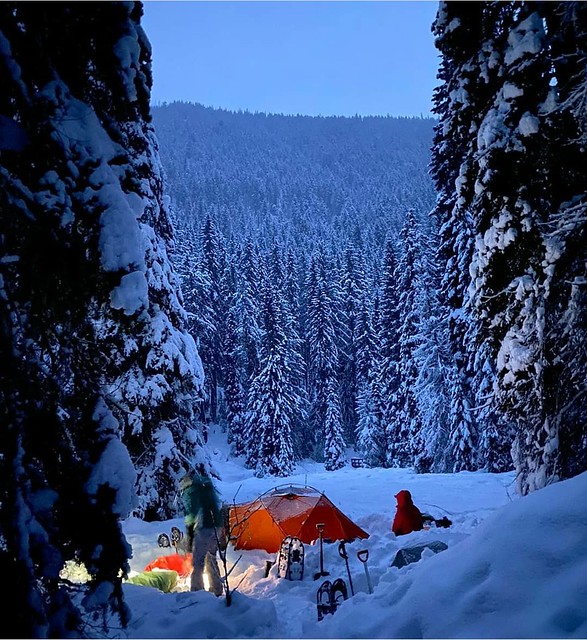
It’s been a challenging year for everyone with COVID-19 and our limited ability to travel and see friends. Fortunately the outdoors is a relatively safe space to spend time with friends, so we decided to go on our annual snow camping adventure. We made some notable changes – we all drove separately, prepared our own meals, and brought multiple tents. It wasn’t ideal because Brandon is the only one who owns a winter tent, but Carolyn decided to make do with her 3-season tent and we convinced Steve to join us this year! Steve did avalanche safety training with us this year, so he was interested in expanding his horizons.

DSC08721

Originally we wanted to do Zoa Peak, but the avalanche risk was particularly high the weekend we went, so we decided to do Lightning Lakes instead since there is very little avalanche terrain there. To be on the safe side, we still rented avalanche gear and practiced finding each other’s beacons to get more familiar and comfortable with the gear.

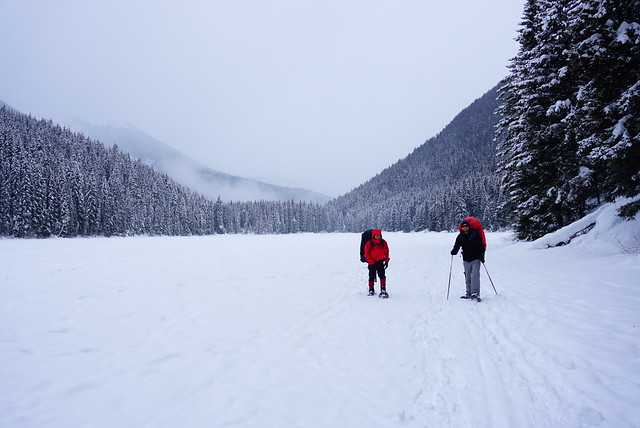
I won’t spend too much time on trail details as I just wrote a separate post about the Lightning Lakes trail. It was possible to hike on the lake, so we crossed once on the first lake and then followed the trail along the edge of the second lake to the back. I’ve never gone beyond the edge of the second lake, but it’s not too far to snowshoe to the next lake, which is Flash Lake, so we decided to check it out. We weren’t keen on camping on Lightning Lake since there’s a lot of foot traffic and we thought Flash Lake might be more secluded.

IMG-20210131-WA0002

We didn’t see anyone along the Flash Lake trail, but the creek between the two lakes was not frozen and the head of the lake looked very sketchy. If we’d continued further, it likely would have improved, but we decided to turn around and instead found a nice clearing in the woods between the two lakes to set up camp.

Surprisingly there wasn’t actually a huge base of snow at Manning this year, so we didn’t have to dig too deep. In other years we’ve shared shovels, which made digging a bit slower, but this year we each had our own shovel, so even though we had multiple tents to dig out holes for, it ended up being a bit quicker than normal (or maybe we’re just getting better at it?). We dug deeper for Carolyn’s tent since it’s not a winter tent and we made sure to pack in a lot of snow around the edges for extra insulation. Fortunately it was only about -7 degrees overnight and with two people in the tent, they didn’t have any trouble staying warm.

DSC08686

We all upgraded some of our gear this year, so Steve inherited some of Carolyn’s old snow camping gear and I got to test out my new -30 degree rated sleeping bag. It took me a bit longer than I anticipated to warm up in the bag (you’re only as warm as the heat you bring in with you), but after about an hour I finally got toasty and after that, quite warm. I ended up having to unzip a little bit and slept most of the night with one arm out of the bag, so I’m optimistic it will hold up in colder temperatures. There are very limited options for winter camping sleeping bags and even fewer are available in Canada. I still think some of the features of my bag could be improved, but I do think it was the best option available to me as a side sleeper.

Screenshot_20210217-111325_Instagram

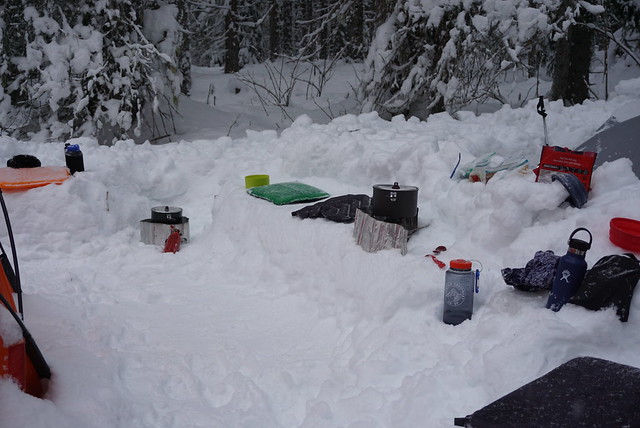
Like any snow camping trip, by the time you get to your destination, dig out your tents and make your snow kitchen, it’s more or less time to start getting ready for dinner before you lose daylight. We spent some time boiling water and enjoyed hanging out while we cooked our meals. I made the snow kitchen this year and I have to say I thought it turned out quite well! I made the counter/couch out of the pile of snow Carolyn shoveled out for her tent and then shoveled out a pit for one of the stoves. It snowed gently for most of the day and evening, but the clouds did clear a little bit and we got a glimpse of the stars before bed.

DSC08682

It was around 7pm when we crawled into our tents. I read until around 8pm when I finally got properly warm and then hit the sack. I woke up around midnight to pee and then slept the rest of the night until 8am – definitely one of the better nights sleep I’ve gotten snow camping!

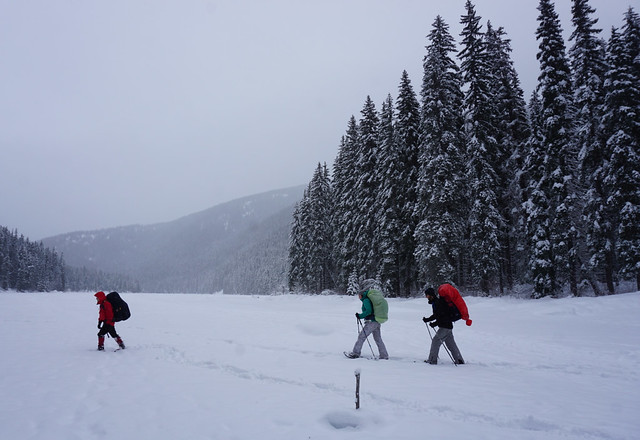
After breakfast we took down camp and then spent some time playing around with our avalanche gear before heading back out to the cars. It doesn’t take too long to hike back along the edge of the lake and we did a few photoshoots along the way. We all have a bit of an obsession with Gregory packs, so we take turns making attempts to get ourselves Gregory sponsorships – so far, no luck, but we still have fun!

DSC08725

So overall it was a great first snow camping trip in Manning Park. Manning is a bit intimidating because it can get really cold there overnight, but fortunately for us it was pretty comfortable when we visited. Definitely have plans to go back and try camping at some of the other winter trails!

DSC08673