This was the biggest day of backpacking I’ve ever done. My sweet spot for backpacking is probably around 15km per day (except for the North Coast Trail, where it’s 10). We had a good experience doing 16km the day before, but we had to do some big days to finish the trail, so we opted for a big day after Manzanita. At minimum we had to go 17km to Rieveley’s Pond Hut, but we were hoping to push for 24km to Big Sliammon Lake, also known as Kokanee Campsite.
We aimed for an earlier start and were hiking before 8am. It’s a steady downhill for the first kilometre until you come to a water source just past the junction for the Spire Trail. The next 2-3km were a bit tiring; it was humid and there was lots of up and down, but the trail evens out around km 20 and it was nice and easy forest walking for most of the morning.
We stumbled upon some trail magic around km 22 where the trail intersects with Malaspina Road. Someone had left a cooler full of cold drinking water! So we didn’t need to hold out until the next source and filled our bottles. We hit Fern Gully campsite at km 24, which was a very basic and rustic site. It was nice enough in the forest with lots of shade, but I think it might be a little creepy to stay there on your own.
There’s a steep uphill after Fern Gully, but it’s short lived and then the trail continued to be pretty easy. Our goal was to reach Plummer Creek Campsite by noon and we succeeded around 11:15am. Plummer Creek is located at km 26, so we’d already done 10km for the day. Plummer Creek itself is a great water source and I liked the campsite, which has lots of flat ground and a few picnic tables. The outhouse left a lot to be desired, but at least it had an outhouse! If you’re looking for a campsite between Manzanita and Rieveley’s, this is the one I would pick.
From there we decided to continue on to the next campsite before starting our lunch. It was 3km that took us through Tokenatch Forest, which was some of the nicest forest walking. There’s a lot of water and several small waterfalls in this section as the trail follows the Tokenatch River. The trail runs parallel to the road until you cross it at Homestead Rec Site, which consisted of lots of easy walking but a very disappointing site. It’s really just a gravel lot on the side of the road with a very dicey outhouse. It didn’t feel like a very safe site to me because of its proximity to the road (I’d rather take on bears than some people), so we stopped to eat some food and quickly continued on. We were sad to hear that Carolyn ended up staying at this site a day later, but she didn’t like it either.
After that it was 4.5km to Rieveley’s Pond Hut, which is located at km 39. This was one of the more challenging sections of trail for the day. There’s a pretty big climb up to Gibraltar Lookout, which was extremely hot and wore us out. Plus the most disappointing part was that Gibraltar Lookout is optional and after a brief discussion where we decided to slightly extend the hike by doing the lookout, we accidentally took the wrong trail and ended up not even getting the view as a reward. It was a bit disappointing, but neither of us was willing to go back for it.
We arrived at Rieveley’s Pond Hut around 2:30pm, clocking in 17.5km for the day already! We were feeling pretty tired, so we decided to take a proper break and stopped at the hut for an hour. Rieveley’s Hut was similar to Manzanita in that it was partially open. We’d seen a handful of day hikers in the morning and there was a group of Dutch tourists there when we arrived. The pond itself is pretty disappointing and neither of us were interested in swimming in it, so instead we finished our lunch in the shade of the hut and took off our hiking boots for a while. Emily was getting some hot spots and had a blister forming, so she put on some moleskin.
Rieveley’s isn’t the most exciting hut, but it had a nice relaxing vibe. We wouldn’t have minded staying there, but we felt it was too early in the day to quit. We needed to do a big day and if we didn’t push further, we’d just have to get up early again and do it tomorrow. We had 6.5km to Kokanee campsite and decided to go for it.
We departed shortly after 3:30pm. It was about 2km to Appleton Creek Rec Site, which we assumed would be dicey like Homestead, but this was actually a lovely site and I kind of regret not staying there. It’s in the forest, but it’s very bright and has a lovely fast-flowing river going through. There’s lots of room for tents in among the trees and there’s an outhouse and some benches. The only thing missing was a bear cache. From there the trail continues through Appleton Canyon for another 2km and I loved this section of the trail! You follow the river down through the canyon and though it’s all downhill (not our favourite), there are tons of beautiful waterfalls. I would have loved to swim in some of the pools, but it had been a long day and we were anxious to get to our campsite – though Carolyn told me after the water was very cold!
The Canyon ends when you cross Tomkinson Road and the last couple of kilometres to the campsite were pretty brutal. We were really tired and Emily’s feet had started hurting a lot. It was slow going and we were desperate to get there. It is a nice section of trail that goes past some other ponds, but we weren’t in the mood to really appreciate it. We finally rolled into the campsite shortly after 6pm, which is really quite reasonable, but we’d been hiking for 10.5 hours and 24km, so it felt like a very long day.
Unfortunately Emily’s feet had taken a turn for the worse and she got a lot of blisters in the last 6.5km. Kokanee Campsite is located on Big Sliammon Lake at km 40 and it a very spacious site in the trees. It’s a bit dark, but there’s a small creek running through and lake access. We decided a swim would improve our spirits and went for a skinny dip. The water was extremely warm and refreshing and we let all our sweaty clothes dry out while we basked on the rocks.
We hadn’t seen anyone since Rieveley’s and no one else showed up, so we were the only ones at the campsite. It was a little spooky, so we played music for the rest of the night. The site does have an outhouse and several picnic tables, so it was really only missing a bear cache. We tied our bear bags to a tree again and hit the sack pretty early. We only had 15km to do the following day and would be passing through Powell River to pick up our re-supply, so we decided to sleep an extra hour in the morning.
The Sunshine Coast Trail – I feel like this trail has been dominating my thoughts for the last 2 years. Every time I do a thru-hike I want to stretch the boundaries and the Sunshine Coast Trail is pretty much the pinnacle of thru-hiking in the lower mainland (in my opinion). I wanted to hike this trail in 2021, but I felt really burnt out after doing Assiniboine. I had some PTSD from the heat stroke incident and I was desperate to see my family because I hadn’t seen them in 2 years because of COVID. I had planned to do the SCT in late July, but I ended up going back to Newfoundland for 2 weeks instead.
So in 2022, I was really determined to do it. I wanted to do it with Carolyn and Emily and we did as much coordination as we could to make it happen. We decided on the first two weeks in August. Emily flew into Vancouver and we prepped for a few days before making a 10-night attempt at the trail. Carolyn didn’t have quite as much holiday time as us, so she was planning to do it in 8-nights and catch us halfway through. The Sunshine Coast Trail is 180km of “hut-to-hut hiking” on, you guessed it, the Sunshine Coast. Unlike the West Coast Trail and the North Coast Trail, it’s not really a coastal trail, but rather a mountain trail that takes its name from its location on the Sunshine Coast.
Things started off very promising. I spent several weeks in July dehydrating food to lighten our loads and we had a full dehydrated menu weighing in at 11 pounds for 10 days (this is actually incredibly lightweight – the average is 2lbs of food per day). We shared our gear among the two of us, with 3 days of food in our packs and the other 7 days in a dry bag for our resupply. There are 2 easy re-supply points at Powell River and Lang Bay. About a third of the way into the trail you pass through Shingle Mill Pub in Powell River, which will store your resupply for you. Two thirds into the trail you can store a second cache at the General Store in Lang Bay, but it’s 2.5km off trail each way, so we opted for just one re-supply. In total, my bag weighed 32lbs when we left, which included 3 days of food and 3L of water – definitely a lightweight record for me!
On Wed, Aug. 3rd, we departed for the trail. There are lots of options to get to Powell River and we opted for one of the cheapest, but longest routes. We couldn’t take my car because Seth needed it for work, so we opted to take public transit the entire way. If you catch the 9:50am ferry from Horseshoe Bay, there is a once-per-day shuttle that will pick you up in Langdale and drop you in Earl’s Cove for the subsequent ferry to Saltery Bay. It’s $55 per person, but allows you to only have to pay to walk on the ferries. This shuttle is the limiting factor if you transit to Powell River because it only goes once a day.
When we got to Saltery Bay, we took city buses the rest of the way. The No. 12 bus does a run from Saltery Bay to Powell River Town Centre, where we jumped on the No. 14 bus (to Lund) and got off at the Shingle Mill Pub. We dropped off our re-supply (and Carolyn’s), charged our devices, and had a delicious meal before the shuttle picked us up at 5:30pm.
Getting to the Sarah Point Trailhead, which is the far northern part of the trail, is the second tricky bit. The trailhead is only accessible by 4WD and high clearance vehicles, so even if you can drive all the way to Powell River, you may not be able to get to the trailhead in your own car. There’s a wonderful company called the Sunshine Coast Shuttle that will pretty much drop you anywhere (and offers resupplies) for a price. The tricky part is that there’s a 4 person base rate, so you can save a lot of money if you’re able to coordinate with other groups. For the longest time I thought it was just going to be me and Emily on the shuttle, but I managed to find two other women on the facebook group and another group of 2 women joined us, so we ended up with 6 of us on the shuttle.
It would have been a pretty uneventful ride to the trailhead, except that my cheesy pasta from the pub did not sit well once we started bumping around on the gravel roads. So it was a pretty stressful ride for me until I finally had the shuttle pull over so I could use the bathroom in the woods. TMI? Maybe, but I’m committed to honesty on this blog, plus I was none the worse for it in the end and now me and Emily just laugh about it. The highlight was that we saw a mama bear and 2 cubs and a deer on the drive in.
The lovely thing about the shuttle is that it drops you right at the trailhead and the first hut it also located right at the trailhead! Like I said, the Sunshine Coast Trail is advertised as a “hut-to-hut” hiking trail, which means you could theoretically stay in huts for the entire duration of the trail, meaning you could leave your tent at home! The only tricky bit is there’s a large gap between huts when you go through Powell River, so you’d likely want to stay in Powell River overnight. However, most people still bring a tent just in case it’s really busy at the huts (which I’ve heard it can be, but was not busy at all in 2022).
The first hut is the Sarah Point Hut at km 0. We were planning on staying either at Sarah Hut or the Feather Cove campsite at km 3, but it was an easy choice to stay at Sarah Point. It was 7pm when we got there and because of my… ahem… digestive distress, I didn’t have much interest in going further. Plus, it’s an absolutely gorgeous location!
Sarah Point is one of the few campsites actually located on the ocean coast and overlooks the Strait of Georgia out towards Cortes Island. In addition to the hut, there’s a composting outhouse, a bear cache, 4 tent pads, and several benches and picnic tables, as well as a small stream as a water source. It’s a really beautiful spot. Two of the women in our shuttle immediately took off on the trail, but the rest of us opted to stay. One women slept in the hut and the other set up on the covered porch under the hut. It was threatening rain on and off all day and her logic was, she wanted to sleep in her tent without it getting wet.
We opted to take the tent pad closest to the water. Because my tent is a single walled tent, it gets condensation on the inside, so it was going to be wet whether it rained or not and we both wanted to stay outside. It really was an amazing view.
We checked out Sarah Point and did a little bit of beach walking before playing Scat and 99 with some playing cards we found in the hut. It had rained a little on us earlier in the day, but the rain stayed away after that. It did rain again overnight, but it was over by the time we got up and we didn’t see any more rain on the trip. We packed the tent up wet, unpacking it at lunch where it quickly dried out in the sun.
Our first full day on the trail was really awesome. We had yet to hike any distance, so we were up and ready to go for 9am. Our goal for the day was to hike 16km to the hut at Manzanita Bluff. It wasn’t too hot when we started, but it was humid and the first 3km were a little more tiring than we anticipated. Our legs had to get used to the up-and-down nature of the trail and we were quickly sweating. The first point of interest on the trail is only 0.6km in when you reach the other Sarah Point campground. This Sarah Point is the real one, which is located in Desolation Sound Marine Park and used primarily by boaters (though I’m not sure how they access the camp because there is no beach). I’d definitely give the edge to the first Sarah Point campsite and we quickly continued on.
Our first break was at Feather Cove Campsite (km 3), which is also located in Desolation Sound Marine Park. Of the two in the park, I would definitely say Feather Cove is the nicer site. It has an easy beach to land on and has 9 tent pads spread out between the woods and the bluff. It also has a bear cache and an outhouse, so it would be a nice place to stay (Sarah Point 2 also had an outhouse, but no bear cache, and neither camp has a water source).
We had a few snacks and kept going. Fortunately, the trail got a lot easier after that. I’ve done the Juan de Fuca Trail and the North Coast Trail, both of which are challenging coastal trails. The Sunshine Coast Trail has a very different vibe and while it is still challenging in its own way, it’s not overly technical, so it’s easier to trek more distance per day. It’s fairly easy walking through the woods from Feather Cove to Hinder Lake and we were thankful for the shade. Hinder Lake is 100% a pond and not very nice, so I wouldn’t plan for a stop here.
The trail meanders a bit after Hinder Lake and you climb up to “the Knob”, which has a nice forested view of Okeover Arm. Then it’s a quick downhill to Bliss Portage Road and Bliss Landing Hut. There’s supposed to be a small seasonal stream at Bliss, but it was dry when we came through. To avoid mentioning every water source on the trail, I’ll just say that a lot of them were dry. The later you go in the summer, the more you’ll have to rely on ponds and lakes.
Somehow I didn’t know about Bliss Landing Hut. I believe it’s the newest hut, so it was a surprise when we stumbled upon it. It’s located at km 8 and has a composting outhouse, some picnic tables, a bear cache, and a few flat spots for tents. It was empty when we came through and we decided to stop for part 1 of our lunch. Our lunches were all cold soaks and a little on the large side. I don’t like feeling bloated when I have to hike, so we ate most of our lunches over two stops.
All of the huts are slightly different, but Sarah Point and Bliss were very similar. They were both fully enclosed huts with large covered porches. Some of the huts are open on the bottom and have picnic tables and counters for cooking. Most have covered sleeping lofts which can be accessed by a step-ladder. They’re all empty in the loft so that 6-12 people can sleep in them. Both were extremely clean and well take care of.
From Bliss Landing, it was another 4km to Wednesday Lake. The trail had lots of ups and downs, but wasn’t overly difficult. It was getting very hot though, so we were hoping to have a good swim at Wednesday Lake.
Wednesday Lake was not what I was expected, but was lovely nonetheless. There is a very poor outhouse in the woods there and enough space for maybe 2 tents, but otherwise it’s not much of a campsite and there’s no other facilities. The lake itself is lovely and it made for a great lunch break, but I’m glad we didn’t camp there. The trail stops at the lake and there’s a small knoll with a bench overlooking the lake. There’s no beach, so it’s not very easy to get in and you pretty much have to jump in off the rocks (they are not high though).
We hadn’t seen a single person since we left Sarah Point, so we opted for a swim in our birthday suits – the water was so warm and I took my first shower of the trip! It was the perfect way to cool down and we finished our lunch on the bench while the tent dried. Before leaving, we walked a few metres further to the outlet stream and filled up our water bladders. It’s the last water source until after Manzanita Bluff, so we needed enough water to see us through the next morning. We opted to take about 4.5L each, which is about 10lbs in weight, so not light! We probably could have taken less, but we’re both overly cautious after the time we almost ran out of water on the Howe Sound Crest Trail, so we always take extra!
We had 4km more to go to our campsite for the night at Manzanita. This was the most challenging part of the trail in that it was a steady uphill and it was hot, but it wasn’t technical, so we managed it in about an hour and a half, arriving at the bluffs just before 5pm.
Manzanita Bluffs is awesome! The main downside is that there’s no water source, but it’s totally worth it because the views are amazing! What I loved most about day 1 were all of the arbutus trees and Manzanita Hut is constructed right on the bluff, surrounded by arbutus trees and a beautiful view looking out to Vancouver Island, with Cortes and Savary Islands in the foreground. There were a few day hikers at the hut when we arrived, but otherwise we were the only campers there.
The Manzanita hut is a partially open hut, with no wall on the front and several picnic tables inside. There’s not much room for tents at Manzanita, maybe 2-3 good spots and a handful of okay ones. We were still in the mood to tent, so we took the best spot and starting soaking our supper while enjoying the view. Of our two companions from the night before, we knew one was planning to camp at Wednesday Lake, but we weren’t sure about the other one. She ended up showing up at Manzanita around 7pm and we had a lovely chat with her while watch the sunset over the bluff.
In addition to the hut, Manzanita has a composting outhouse and several picnic tables and benches, but no bear cache. Me and Emily had brought Ursack bear bags with Opsaks to store our food for the trip. We left them in the cache on the first night, but on this night we tied them to a tree away from our tent to stop a bear from walking off with them. Fortunately they weren’t tested.
Bear safety is a big subject on the SCT. Some people stick to the caches and others commit to doing bear hangs. However, handmade bear hangs are often pretty ineffective and not always possible, so most people bring some kind of bear can or bag. The bear can is definitely the most foolproof method and the one I’d recommend, but the cans do weigh about 2lbs empty. I couldn’t stomach that extra weight, so we brought Ursack bear bags, which weigh 0.5lbs. They’re made of kevlar, so bears can’t get into them, but they’re not as reliable as the cans. This is because with the sack, a bear can’t get your food, but could still carry it off or crush it. The can’s are designed so that they’re pretty much impossible for the bear to carry off and your food won’t get crushed. We took our chances with the sacks, but that’s why we always secured them to a tree (looping the rope around the trunk of the tree rather than hanging it).
I’ll end Part 1 there, but I have lots more to write about it Part 2!
Last week I said Tricouni Meadows might be my favourite hike of the season… then I did Skywalk North and now I can’t decide! After such a successful hike at Tricouni, I was enthusiastic to try another day hike. This time we decided on the Skywalk North Trail in Whistler – it doesn’t require any off-roading, but is a much longer trail with much more elevation gain.
I’ve heard of the Iceberg Lake hike, which is quite popular, but I hadn’t heard much about the Skywalk trails, which I found in the 105 Hikes book by Stephen Hui. There’s a ton of hiking trails in the area and many mountain bike paths – the Skywalk trails consist of 2 loops with a shared middle section. The South Trail leaves from Alpine Way and the North Trail leaves from Mountain View Drive (both in Whistler). The South Trail is a bit shorter, but if you want to visit Iceberg Lake, they’re both probably about the same length because it’s a branch to visit the lake on the South Trail, whereas the North Trail goes right past it.
So both trails are ~20km including the lake, though we tracked 22km on GPS, and over 1000m in elevation gain, so it is definitely a big hike and you should give yourself enough time to complete it. We started just before 10am and didn’t finish until just after 7pm. For the most part it’s not a very technical hike and it has a lot of flat sections, but this just means it does a lot of gain in a short distance, so it is steep.
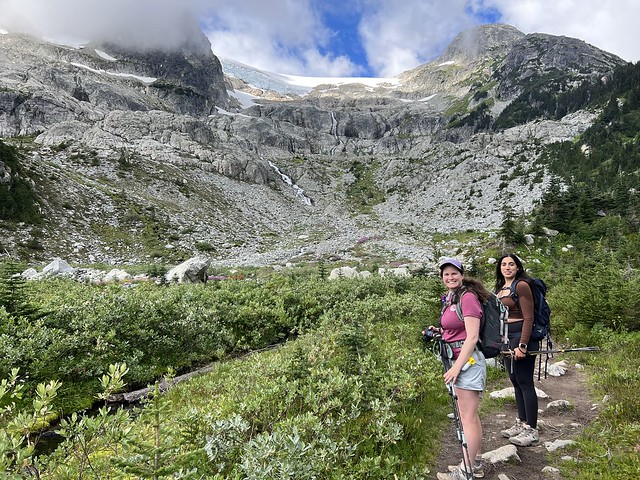
On VancouverTrails, it says it’s 7.5km to the lake, but my GPS tracked 9km and 900m of elevation gain, but I didn’t find this part of the trail difficult at all. The trail starts with a steep climb, then flattens as you walk through the trees along the river and past some waterfalls. Then you climb again up to the meadows where you meet the junction for the Skywalk South Trail. There’s an outhouse and a gorgeous view up to the glacier. It’s another 1km to the lake, which is the most technical part of the hike. You have to hike up through the boulder field to the base of the glacier. This was one of my favourite parts of the hike though because there were lots of wildflowers growing around the streams coming down from the glacier and it was very scenic!
It took us about 3 hours to get up to Iceberg Lake. We barely saw anyone on the hike up to the meadows and once we left the lake, but it was fairly busy from the meadows to the lake. It was strangely cold on the day we visited though. Vancouver had been nursing a steady heatwave since mid July, but on the weekend we went, we got a brief cold spell and we had to layer up with fleeces and windbreakers at the lake. But not before I went for a swim!
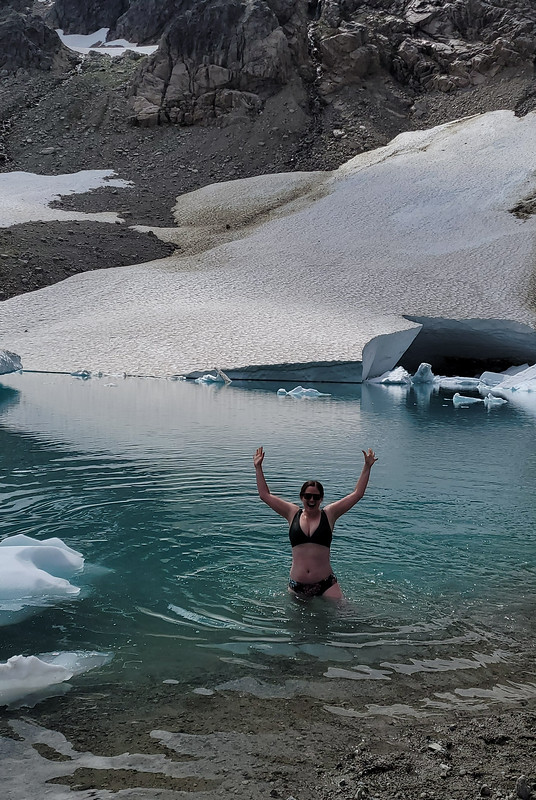
I pride myself on almost always going for a swim, no matter how cold the water is and this was no exception. I knew I was going to get cold fast once I stopped moving and my sweat cooled, so I stripped down to my swimsuit immediately. It was definitely some of the coldest water I’ve been in and I didn’t stay in for more than a minute. By the time I crawled out my body was already starting to go numb, but it was cool to briefly swim with all the bergy bits – that was a first for me!
We hung out at the lake for a bit before continuing on. If you’re doing the South trail, you’ll have to hike back to the meadows, but the North trail climbs up over the pass on the right side of the mountain to continue into the sub-alpine. Unless you’re doing the shortest route (up and back on the Iceberg Lake Trail), I’d really recommend Skywalk North (though I haven’t done the South Trail yet). The hike up the pass was my favourite part of the whole hike because you get to look down on the lake and the glacier, which is a cooler vantage point than looking up on it.
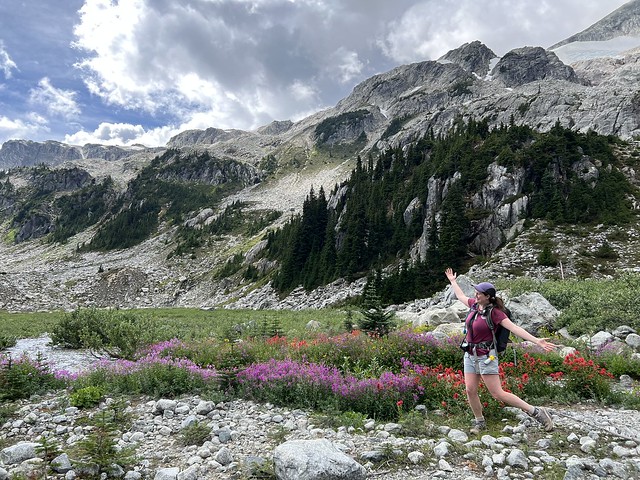
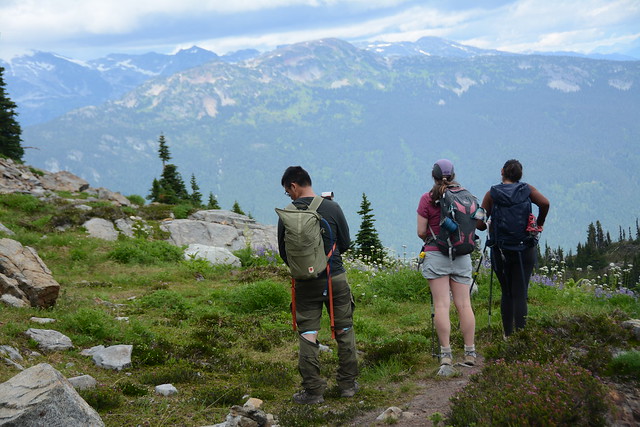
Once you get to the top of the pass, the trail flattens out again and you spend a lot of time hiking through meadow after meadow. We stopped at the top for a bit of a photoshoot and then took our time hiking down. What I liked about the North trail is that you get to spend a lot more time in the sub-alpine than if you just did the Iceberg Lake trail. There’s a great view looking out towards Whistler-Blackcomb, Wedgemount, and Pemberton and the alpine meadows were all in bloom with yellow arnica, purple lupins, white sitka valeria, and pink mountain heather. Plus by doing a loop you get to experience all new terrain!
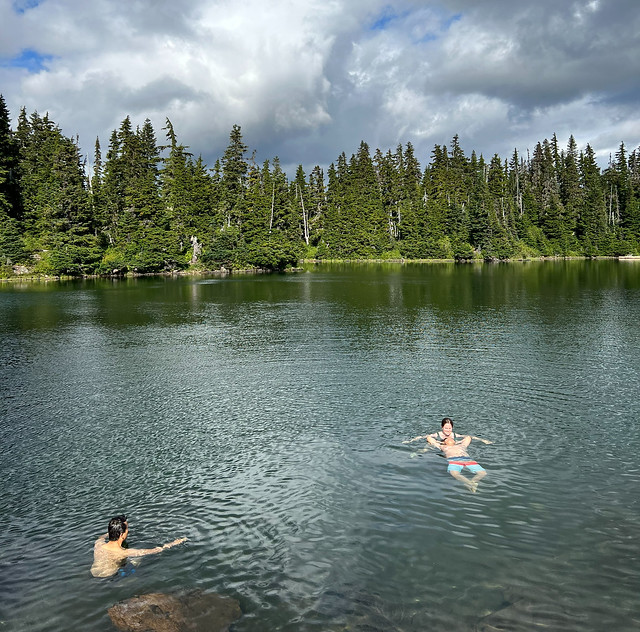
This part of the hike did take us a bit longer than anticipated. The down side to Berg Lake is that you eat your lunch when you haven’t done half of the trail, so it does make for a long afternoon. We hit Screaming Cat Lake around 4pm, which is a large lake before you start the downhill. I decided to go for a swim again and I was thrilled because Screaming Cat is not a glacial lake and is much warmer, so you can actually go for an enjoyable swim. It was still pretty cold, but once you got in, it was actually warmer in the water than out of it and we stayed in for a while, with both Lien and Brandon joining me.
The rest of the hike was pretty painful for me. It’s been a while since I’ve done so much elevation gain in one day and my knees were starting to bother me. After Cat Lake you have to do about 850m of downhill, which gets progressively steeper. It’s still a very nice hike – the trees aren’t tightly packed, so the forest had a very sunny feeling, but my knees were both killing me. I got slower and slower and pretty much crawled down the last 2km. We added a bit more distance to take the less steep routes where possible to save my knees. Even still, it was just after 7pm when we exited the trail, which I thought was pretty good all things considered!
We drove back to Squamish and had a delicious meal before heading back to Vancouver. I don’t think I got home until 11pm, so it was a very long day, but I really loved the hike! It’s a lot of work, but high reward and a lot of time spent in the alpine! Definitely recommend for those long summer days. Though I’d be wary of going on a really hot day – a lot of the hike is exposed and it’s a lot of climbing to do with no shade.







 The Road Goes Ever On