Granite Falls Kayak Trip

I feel like summer gets shorter every year that I live in Vancouver, but my bucket list of summer activities only gets longer. I love kayaking, but the alpine backpacking season is so short that I often forget to schedule in kayaking adventures. I always go kayaking with Seth, and we can’t take our dog with us, so it’s hard to find someone to look after her every time we want to go out. But we celebrated our 5 year wedding anniversary in August, and I was determined to go on an overnight trip!

We’ve done lots of kayaking in Indian Arm, more recently known as Say Nuth Khaw Yum Provincial Park or Selilwet, which is located right in the middle of the lower mainland and easily accessible from both the North Shore and Belcarra. Our favourite day trip is to launch from Belcarra and paddle up to Jug Island and Ferrar Cove, but we’ve never spent an overnight in the Arm. There’s 3 campsites scattered along the route and I’ve wanted to paddle up to the end for many years. Twin Islands is located at the southern end and is the most popular site. There are 2 more BC Parks sites at the northern end: Berg’s Landing and Granite Falls. We’ve paddled to Twin Islands a few times, but I really wanted to get to Granite Falls at the far end of Selilwet.

PSX_20240811_165833
20240810_093448

The first thing to be aware of is that this is an extremely popular trip. We planned it for a Saturday night, so we knew it would be busy with both kayakers and pleasure boaters (anything with a motor). If you’re able to go on a weeknight, I think it would be a much nicer experience. You can rent kayaks from either Deep Cove Kayaks or Takaya Tours in Cates Park. Deep Cove Kayaks seems to be the most popular option as they have a huge fleet and it’s a shorter paddling distance, but Takaya is also a great option to avoid crowded Deep Cove and support an indigenous owned company.

I wish we could start our trip out of Belcarra, which is the same paddling distance as Deep Cove and much closer to our home, but unfortunately there’s no overnight parking from Belcarra or Barnet Marine, so Deep Cove or Cates Park are the only options. Deep Cove gets insanely busy in the summer, so we got up really early on Saturday morning to beat the traffic. I dropped off Seth and the kayaks at the loading zone and then found parking. The nearby parking is 3 hours maximum, so it’s a bit of a walk, but it was relatively easy for me to find parking at 7:30am. It was insanely crowded when we returned the following day in the mid-afternoon, so definitely go early.

PSX_20241008_215256
PSX_20240826_112341

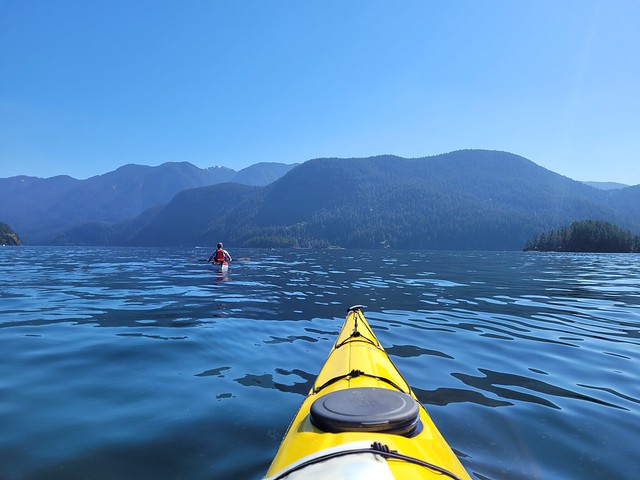
We were on the water around 8:30am and Seth dropped a crab trap at the mouth of Deep Cove. Selilwet is a beautiful place to paddle, but the second perk of getting up early is that the conditions are much better for paddling in the morning. The Arm gets a notoriously strong southerly wind in the afternoon and it can get quite choppy. We had a really enjoyable paddle out of Deep Cove and ended up paddling ~7.5km to Thywates Landing before taking a break. There were lots of kayakers on the water, but most of them weren’t going further than Twin Islands. 

Another option for paddling is to stop at Jug Island or the campsite at Twin Islands, but both options require an open water crossing, which I usually try and avoid having to do too many times, so it depends what route you prefer. The thing I don’t like about paddling in the Arm is that there aren’t a lot of public rest locations. When the tide is low there are some places you can stop, but a lot of the beaches seem to be attached to people’s properties. In most cases, you can’t own the beach (unless your property is really old and you’ve been grandfathered into old bylaws), so you can pretty much stop wherever you want, but I’m never really sure and try to stick to public spaces. 

20240810_101216
20240810_102633

Thywates Landing is a really great option on the west side of Selilwet. It’s a small beach, but it’s owned by Metro Vancouver Regional Parks, so it’s primarily meant as a stopping place for paddlers. There’s a short walk (100m) up to a little waterfall and pool, which is really nice. The water was still really flat by the time we got to Thywates Landing, so we only took a short break to take advantage of the optimal paddling conditions. We started seeing a few more paddlers heading up the Arm and the pleasure boaters increased throughout the day, stirring up wake.

We paddled another 7.5km to Berg’s Landing, which is the second campground owned by BC Parks. Along the way we passed Silver Falls, which is a real highlight going up the Arm. There’s lots of space at Berg’s Landing and there was only one other tent there when we arrived. I’m sure the campsite got busier later, but Granite Falls definitely seems to be the more popular of the two sites. We stopped at Berg’s Landing for lunch at noon, right around when the wind started to pick up. It’s another ~2km to Granite Falls (for 17km in total from Deep Cove). It was choppy for the last 30 minutes of paddling, but at least we had a tailwind!

PSX_20240822_113018
20240810_115251

Granite Falls was already quite busy when we arrived at 1pm, but there is a lot of space for tents and we didn’t have trouble finding a site. As a kayaker, you’re never going to beat the people in motorboats, so leave early enough that you don’t have to fight the waves on the way up. There’s always going to be a bunch of novice paddlers that show up much later in the afternoon and evening, so just do your best.

Berg’s Landing is mostly a big field with some campsites around the edges and a big beach. Granite Falls is more popular because it has a bunch of campsites along the coast and it has a large freshwater source in the form of the waterfall cascading down from the mountain. I have visited Granite Falls once before by zodiac in June and there is a big difference in the water flow in the Spring and late Summer. When I visited in June, the Falls were a violent, rushing cascade of water, versus in mid-August when it’s much more of a trickle. There’s a nice pool at the bottom that you can swim in and there were a lot of yachters visiting for the day. There used to be a public wharf, but it’s gone now, so it’s a bit trickier for the pleasure cruisers to access.

20240810_154653
20240810_151616

Granite Falls has 2 new outhouses and a bear cache. Unfortunately neither are really appropriate for this type of site. While Granite Falls attracts all kinds of campers, it’s a backcountry site that gets treated like a frontcountry site. By which I mean, it gets a lot of inexperienced campers and it’s not treated with the respect it deserves. I wanted to love the site – it’s very beautiful – but the other campers left me feeling frustrated. It’s a wilderness campsite that could easily be frequented by bears, but because it’s easy to access by motorized boat, it attracts a lot of party people and it gets treated like an urban picnic site. People bring in large coolers of food and beer and don’t bother to secure anything. I could easily see the public losing access to this campground in the future from misuse. 

For this reason, I didn’t think the facilities were appropriate. There are only 4 small bear bins and there were easily 50 people staying at the site on Saturday night. So even if people practiced bear safety, there still wouldn’t be enough space for everyone. Several groups were hauling in coolers of beer, which they left unattended all night. Hard shell coolers are not bear proof, so either leave them on your yacht or at home. We overheard another camper say to their friend, “We’re not worried about bears are we? There’s so many of us.” Please, it’s not about being worried about bears. Bear safety is about avoiding opportunities for bears to become food habituated, which almost always results in the death of the bear and sometimes, the closure of the site. 

PSX_20240818_162114
20240810_145657

The outhouses were actually really nice. They’re the urine diverting outhouses with the conveyor belt pump. Unfortunately, no one seemed to have any idea how to use them and people were not pumping the belt after using it, so they quickly became clogged. Bless Seth, he tried for the better part of 20 minutes to unclog the toilet using a stick, but had no success. I think they just need a bit more educational info in the stalls. But this technology might be too advanced for the party people. To be fair – a lot of the people at the site were very respectful, but a few large groups can really ruin it. 

So I did leave this trip feeling a bit annoyed, but overall, I enjoyed the experience. Because of the paddling conditions, we arrived at the site early in the day and had lots of time to relax. We spent some time exploring the waterfall and we went for a swim in the ocean, which is really warm at this time of year. Seth took a nap in the shade and I read my book. It’s easier to bring fresh food when kayaking, so we had tahini yam and halloumi tacos for supper, which I had made the evening before. We went for a short evening paddle before sunrise, which is always a highlight for me. It was super warm since we were at sea level, and we went to bed early to prepare for an early rise.

20240810_134733
20240810_181926

We had bad luck in that we got a surprise rain shower right when we were getting up at 6am. It didn’t rain a lot, but enough to make all our equipment wet while we were packing it up. We were on the water by 7:30am. It’s tiring to get up so early, but I do love having an early start!

We paddled on the west side of the Arm on the way in, so we decided to stick to the east side going back. There’s definitely more places to take a break on the west side, but the water was flat, so we were pretty fast and didn’t need a lot of breaks. We paddled 8km to Buntzen Bay and pulled out on a small rocky beach for a break. It’s not a public area, but the mountain gets really steep after that, so it was the last opportunity to pull out. You get to pass by two hydroelectric facilities, which are a neat feature of the Arm. The northern facility is still in use and draws water from Buntzen Lake via a large penstock. The southern facility is decommissioned, but is an interesting piece of architecture. It was 4.5km from Buntzen Bay to Twin Islands, where we stopped on the South Island for lunch.

The wind did start to pick up again after noon, but it was very manageable. We paddled to Raccoon Island and then crossed back to the west side to kayak into Deep Cove. I drank a lot of iced tea at lunch and it caught up with me at this point, so I had to do a hurried paddle into Deep Cove to use the washroom while Seth checked his crab trap. He got 6 crabs, but only 1 that he was able to keep. We’ve only caught dungeness crab in the past, so this was our first time catching rock crab. It was smaller, but still yummy! We paired it with some Newfoundland cod tongues at home, along with local corn and beets. 

We arrived in Deep Cove at 1pm. There were people everywhere and it was chaotic landing on the beach and moving our kayaks to the loading area. I had 3 cars fighting over my parking spot when I left and we had to load the kayaks really quickly (while also getting stopped every 3 minutes by people trying to take our spot, not realizing it was 15min parking). Overall, it was a fun trip and Selilwet is really beautiful, but I don’t think I’ll be in a rush to do it again. It’s one of the most accessible sea kayaking trips from Vancouver, but it’s a very different experience than, say, Desolation Sound or the Gulf Islands. Worth doing, but maybe only once.

20240810_114057

Twin Islands Kayaking Trip with Girl Guides

Last year my Girl Guide group did a backpacking series and we hiked to Viewpoint Beach, 3 Brothers Mountain, and Elfin Lakes. This year we decided to focus on a water series and selected 3 different activities to try: kayaking, rafting, and canoeing. The first activity in our water series was a 1 day paddling trip with Deep Cove Kayaks to Twin Islands in Indian Arm.

20230513_090622

Even though I’ve been to Twin Islands once before as a day trip, I always think of it as being pretty far away, when in reality, even a group of 10 girl guides can do the entire trip in just 5 hours. We arrived to Deep Cove Kayaks at 8:30am to prepare for our trip, which started with some on-land instruction about paddling. Most people are probably aware of Deep Cove Kayaks already as they’re incredibly popular, but I have to do a shout-out for their group activities as well, because their school program is absolutely fantastic. They were thrilled to take our group out on the water and they gave us an unbelievable discount as an educational group.

20230513_100031

We all got situated in our double kayaks and practiced some turns in the water before heading over to Jug Island. I frequent Jug Island a lot in my personal kayak, but I usually visit it from Belcarra. We played paddle roulette on the beach before departing again for Twin Islands. My favourite kayak trip is to paddle from Belcarra to Jug Island then over to the 8 corners tea room, but it’s not much further to paddle to Twin Islands via Racoon Island, so I think I may have to start doing it more.

The last time I visited Twin Islands it was absolutely packed with other kayakers – it was still busy on this visit, but no where near as bad. We landed on the south island to stop for our lunch. It was one of the girl’s birthdays, so we celebrated with none other than the infamous Honey’s Donuts from Deep Cove! I know Honey’s Donuts are pretty legendary, but I’d actually never had one before and I couldn’t get over how large they were! They’re very cakey (which is my favourite) and I had the maple dip donut (my other favourite), so it was the perfect kayaking snack!

20230513_105247

There was a race happening the same day we visited the island and people were racing from Deep Cove, around Twin Islands, and back, so we made sure to stay out of their way. We paddled back the same way we’d come, but at a bit of a reduced pace since it was getting windier. We got back to Deep Cove around 2pm – we stopped for about a half hour at Jug Island and 45 minutes at Twin Islands, so it was under 4 hours of paddling in total. The girls all did great and I could barely keep up with them!

So it’s a pretty short trip report, but I really think this makes for a great day trip if you have the time to commit to it. I’d recommend getting to Deep Cove early because parking is very intense, or alternatively, you could also paddle from Belcarra and rent from Takaya. Parking is challenging in Belcarra as well, but you don’t have to be quite as early as Deep Cove, which is the more popular of the two. But overall, a great trip to do with either friends or family! I highly recommend!

20230513_121643

Kayaking Twin Islands

Since we weren’t allowed to travel outside of our health region over the May Long weekend, options for camping were pretty slim in the lower mainland. We’ve been wanting to kayak up Indian Arm since before we bought our own kayaks, and we decided to do a short trip out to Twin Islands on Saturday night.

Carolyn and Steve have a sailboat that they dock at Lonsdale, so the plan was for them to spend the night in Bedford Bay, near Belcarra, we would camp on Twin Islands, and then we could explore around Indian Arm together on the sailboat.

20210522_101353

Me and Seth wanted to leave out of Belcarra, but there’s no overnight parking anywhere in Belcarra (they really need to do something about this, I’m fine to pay for it, but there’s literally no options), so we were forced to leave from Deep Cove instead. Usually we launch from Belcarra around 9am and have no problems with parking, so we figured that would be sufficient for Deep Cove as well. We offloaded the kayaks and all our gear at the main parking lot and then I went in search of street parking while Seth brought everything down to the beach.

I was not prepared for how busy Deep Cove was at 9am. It was completely crawling with other boaters and picnickers. I drove around for ages looking for street parking before finally giving up and parking way up in the bush and walking 15 minutes back to the beach. The boat loading zone has to be one of the worst designed loading zones I’ve ever seen. People were double parked all over the road and the beach in front of the kayak rental shop must have had about 2 dozen paddlers.

20210522_114717

We had offloaded further down the beach, so it was just us and a family of 4 who were loading up their canoe. It was a gorgeous hot, sunny day, so we put on sunscreen before launching into Deep Cove towards Twin Islands. Our plan was to go directly to the island to secure a campsite and then spend the rest of the day around Indian Arm. It was still really calm on the water when we left, so a lot of the paddlers charted a direct course across Indian Arm to Twin Islands. I don’t like paddling in the middle of a huge open body of water for extended periods of time, so we clung to the coast until we were parallel with Raccoon island before crossing Indian Arm.

As the name suggests, Twin Islands comprises two islands located very close together. When the tide is low, you can walk between the two, when the tide is high, you can paddle between them. The tide was pretty high when we arrived, so I paddled around to have a look at the two islands. The North Island has steep cliffs along the exterior and the only way to get on the island is from a dock on the north side. In contrast, there is a small beach on the South Island where you can land, so we decided to land there.

20210522_124226

Seth took a quick run around the island, it’s not very big and there were already several tents set up, but he found a nice spot looking north across the inlet. We dragged all our gear up to the site, but decided to relax and have lunch before setting up. Unfortunately, it was then that Carolyn called to tell us they weren’t going to be able to make it out for the day. They had loaded all their gear onto the sailboat and backed out of the marina, only to discover their throttle was broken. They could reverse, but they couldn’t get the boat to go forward! So they were going to have to commit the day to fixing the problem before they could do any sailing.

After we had lunch I heard some other paddlers talking to the people in the campsite next to us about how camping isn’t actually allowed on the south island and debating whether to camp there or not. This came as a surprise to me because I hadn’t read about it anywhere in my research and couldn’t see any signs. We did some quick research since we still had cell service and I was able to find one line on the parks webpage that says “south island is just for day use”. Then I did a walk around the entire island and did find a single sign in the middle with a no camping symbol. We didn’t notice it when we first came in because it’s not visible from the water and another group had literally set their tent up right in front of it.

20210522_114830

So we had a little bit of a dilemma. I hate breaking rules in the backcountry because they usually exist for a reason. In this case, I suspect it’s because there’s no outhouse on the south island. We had come prepared for this because I actually thought there was no outhouse on either island, but my conscience didn’t feel right to camp on the island once I knew you weren’t supposed to, even though clearly other people we’re doing it. To be frank, the entire island was a bit of a gong show. There were boats everywhere and tons of picnickers and campers.

We had wasted time on the south island offloading and eating our lunch and I knew sites were now going to be slim on the North Island as well. So we debated what to do for a while and eventually decided to pack everything back up and skip camping altogether. The day was mostly supposed to be about spending time with Steve and Carolyn and neither of us was excited about camping on a super crowded island. Instead, we decided to paddle around Indian Arm for the afternoon and then return to Deep Cove before dark. It was a little disappointing, but I know we made the right chose not to camp where it’s not permitted.

GOPR3769_1622747539844

At least we hadn’t set up any gear, so it didn’t take too long to repack the kayaks. A dozen people had abandoned their boats on the small beach and neglected to give any thought to the rising tide, so Seth rescued 2 kayaks and a canoe that had started to float away because they hadn’t been tied on. We were both incredulous at such a level of negligence that we weren’t sad to leave Twin Islands behind. I would have liked to check out the North Island at least, but the dock makes it very difficult because you have to carry your kayaks up the gangway and store them on the island, which neither of us wanted to do with fully loaded boats.

We had the current with us, so we decided to paddle up Indian Arm a little way to see the old Buntzen Lake powerhouse. It was a quick paddle along the coast to get to the powerhouse, but the water was getting pretty choppy so I was a little nervous. I read that Indian Arm is best paddled in the early morning or in the evening and that the wind tends to come up in the afternoon. This was our first time paddling in the afternoon and it definitely wasn’t the best conditions. There’s no where to land by the powerhouse so we decided to make our crossing and head over to Thwaytes Landing, a small section of beach that has been designated as a Regional Park.

20210522_135055_03

It was an uncomfortable paddle, especially when any motorized boats would pass us, throwing their wake up over the tops of our kayaks. Normally I don’t have a problem with power boats, but these were not being considerate of paddlers and would speed by very close to us. I know they have the right of way, but they’re a lot faster than me and if they decide to pass right next to me, there’s really nothing I can do about it. It was a choppy landing at Thwaytes, but we had the beach to ourselves. There’s no facilities and it’s one of the stranger regional parks I’ve visited, but it’s great that it exists because there aren’t many rest points for paddlers along the arm.

The waves did die down a little bit while we hung out on the beach, so we decided to re-launch while things were a bit calmer. We didn’t want to go any further up the arm, so we started back the same direction we’d come. The waves had gone down a little, but there was still a pretty strong headwind to paddle against. We definitely got a good work-out and took another break at Brighton Beach, which is across from Twin Islands. It’s not a public beach, but we figured we could break at the end because generally you can’t own the beach below the high tide line (although Seth did some research and there are homeowners that own the beach because they bought the land before this rule came into effect). Unlike the camping rules though, I don’t care so much about this one!

20210522_174131

We were interested in going back to Twin Islands to go for a swim, but we didn’t want to cross the arm again, so we decided to head back to Deep Cove instead. It was tiring and took longer than anticipated, but we managed okay and finally paddled into the cove around 5pm. The water was surprisingly warm, so I decided to go for a quick swim in Deep Cove. Pre-Covid I would always go on a May Long weekend camping trip with my friends and me and Carolyn would go swimming, so I always swim at the end of May and all I can say is the ocean is definitely warmer than the alpine lakes!

I hiked back up to the car and we re-loaded the kayaks and all our gear. I texted Carolyn to let her know we were back and she quickly gave me a call to see if we wanted to come join them for supper since we were still in North Van. So we ended up picking up take-away and eating our dinner on the sailboat sitting in the marina! Not quite the meal we’d planned for the day, but we laughed that at least we finally got to hang out on the boat! We’ll definitely try the trip again in the future, but next time we’ll try to paddle out Friday night instead of Saturday morning to hopefully beat some of the crowds. Or potentially even go on a weeknight because it’s just so busy on the weekends, it does take away from the experience.

So overall, not the trip we planned, but we made the best of it and had some lessons learned about paddling in Indian Arm. Fortunately, since we don’t have to rent kayaks, it’s relatively easy to try the trip again soon.

20210522_211336