Torres del Paine Backpacking Trip Part I

Torres del Paine National Park was the inspiration for our entire trip to Patagonia. I’m not sure when I first learned about this park, but it’s been on my bucket list for at least 5 years. There are 2 popular treks in the park: The W-trek and the O-trek. The O-trek is a loop trail that encircles the entire park, taking 8-10 days to complete. The W-trek is the southern half of the O-trek, taking 4-5 days to complete and generally done as a thru-hike.

I would have loved to do the O-trek, but we picked the W-trek for many reasons and I think it was the right choice for us. Seth is willing to backpack, but he definitely doesn’t love it the way I do, so the shorter hike was a good compromise. It freed up more time in our itinerary to visit El Chalten and Ushuaia, which we wouldn’t have been able to do if we’d spent 10 days of the trip in Torres del Paine alone. It was a much more well-rounded trip and I felt really satisfied with our choice when we finished the trek.

PSX_20240309_215150

But let’s start at the beginning! Our bus left Puerto Natales at 7am, so it was an early rise for us to walk to the bus depot. It’s a 2-hour drive to the Torres del Paine park entrance, where the bus stops for everyone to get their National Park Pass. If you’re doing the O-trek or just visiting for the day, you would start your adventure here. But we were starting our trek at the opposite end of the park, so we still had another 45-minute bus ride, followed by an hour long catamaran journey across Lago Pehoe to Paine Grande.

What’s interesting about Torres del Paine, is that you don’t actually have to do any camping if you don’t want to. Unlike the Sendero al Fitz Roy, Chile has sunk a lot of money and resources into developing the park into a tourist destination. The park is much more developed, but it’s also a lot better protected. You have to obtain a park pass to enter the park and get camping reservations to stay there overnight. There are rangers patrolling the park and they have very strict rules about going off trail. There are absolutely no fires or smoking permitted anywhere in the park, and all cooking must be done in the designated shelters.

20240229_110915
PSX_20240309_215505

There is a mixture of campgrounds and refugios spread throughout the park. The refugios are basically hostels, with shared bedrooms, washrooms, and a huge dining room. They are more expensive than your average hostel, but they’re very popular because they eliminate the need for a tent. We decided to avail of the refugios where possible and ended up booking rooms for our first two nights on the trail, followed by campsites for the last nights. However, to eliminate the need to bring our tent, we paid extra for pre-set tents and sleeping pads at our campsites. We still had to bring our sleeping bags, but we were able to lighten our packs by leaving our tent and thermarests at home.

Our trek started from Paine Grande, but our final destination was Refugio Grey at Grey Glacier, which is 11km away. As far as the terrain goes, it was a pretty easy day of hiking and in normal circumstances, I think it would have taken us less than 4 hours. Unfortunately, as I alluded to in my previous post, Seth got hit with a bout of traveler’s sickness from the ceviche he ate the night before, and it hit him on the catamaran to the trailhead. He spent most of the boat ride in the bathroom, followed by a visit to the refugio toilets, so we were some of the last people to start hiking for the day.

20240301_170609

Fortunately, he wasn’t totally incapacitated and did start to feel better as it left his system, but it definitely resulted in a slow pace on day 1.  Even so, Torres del Paine National Park is immediately a very striking place. There are several famous features in the park, one of which is known as “the horns”. It’s a set of sharp granite peaks on Cuernos del Paine mountain that can be seen throughout most of the park. We got our first glimpse of them on the catamaran, and there’s an incredible view from Paine Grande. The weather was fairly moody when we arrived, with dark clouds hanging over the horns, but it never rained and I thought it made for pretty scenic photos.

The trail to Grey Glacier starts with a gentle hike up through a small canyon, around the west side of Cerro Paine Grande. It’s a steady uphill, but not overly challenging. I decided to set Laguna los Patos as our first milestone; it’s only 3km away, but it felt like it took forever! In reality, it was only 90 minutes, but poor Seth was really struggling. We stopped for lunch when we finally arrived at the lake, but it wasn’t super restful because we got our first introduction to the infamous Patagonian wind!

PSX_20240313_194557
20240229_152952

Torres del Paine is super well known for its blustery conditions and it didn’t disappoint on our first 3 days. It was moderate wind on the first day, but it was forecasted to get much worse on the following two days (and it did). After our lunch break, we continued on, setting Mirador Lago Grey as our second milestone. It’s located just past the halfway mark and is the highest point on the trail for the first day. It has an incredible view of Lago Grey and the glacier, but it’s a steady uphill the whole way there, so our slow pace continued.

Fortunately, it was downhill after the mirador and our pace improved, but overall, it was a rough first day and I admit that I resented Seth a little. We arrived at the refugio shortly after 5pm, after 5+ hours of hiking, so you might be wondering what was the rush? The rush for me was that after Refugio Grey, there is a day hike to a series of suspensions bridges with a viewpoint, and I really wanted to do them. We were scheduled to go kayaking the following morning, and with rain in the forecast for later, I really wanted to hike to the viewpoint on Day 1.

20240301_140151

So I was silently cursed Seth for most of the afternoon because I’d been dreaming of this hike for so many years and I was determined to see every highlight. I’ve had several of my big hikes interrupted over the past few years due to other people or circumstances outside of my control. But all of those hikes were in British Columbia and easy to come back for in the future. I felt like I only had this one shot at Torres del Paine. I think I was pretty supportive earlier in the day, but the more the clock counted down the remaining daylight hours, the more impatient I got. I’m sure it was very annoying.

Fortunately, my resentment dissipated with our arrival at the refugio and it didn’t return for the rest of the trip. The refugio is very cool! Each one is different and Refugio Grey is basically a big log cabin, with toasty woodstoves to dry your clothes. The rooms vary in size, but ours had 2 bunkbeds, sleeping 4 people. It says online that you have to bring your own sleeping bag (which is the case at other refugios), but this one actually provided bedding, so it felt like a proper hotel. I really liked it and Seth was stoked to have access to flush toilets and a place to lie down.

I quickly re-arranged my pack and decided to make a go at hiking to the suspension bridges and viewpoint alone. I did hiking math on the trail and determined that, as long as I started the day hike by 6pm, I could make it back to the refugio before the 9pm sunset. Just in case, I took all my essentials, including my headlamp and inreach. Seth knew where I was going and we agreed on a set time to raise the alarm if I didn’t return. Check back next week to learn if I was successful or not in Part II!

20240229_151819
20240229_174343

From Argentina to Chile

We returned to El Calafate after an epic 3 days hiking the Sendero al Fitz Roy in El Chalten. We only had a two-day break before starting our second major hike – 5 days in Torres del Paine National Park. I must admit, these two days were a bit miserable for me. I had caught a cold a few days before and it peaked on our time off. Honestly, it was better than dealing with a cold on the trail, but I was a bit irritable in between. 

It’s a 1.5-hour drive from El Calafate to Perito Moreno glacier, which is one of the biggest attractions in the town. Interestingly, both the Sendero al Fitz Roy and Perito Moreno Glacier are located in Los Glaciares National Park, which extends along the border throughout the mountains. Both attractions are extremely popular destinations for tourists, but while Fitz Roy is free to camp and hike, Perito Moreno has a 10,000ARS ($10USD) entrance fee.

Perito Moreno is very well developed as a tourist attraction, with a large visitor centre and several kilometres of extremely well maintained boardwalk extending along the hillside to provide viewing balconies for the glacier. It really bothered me to pay for Perito Moreno and not Fitz Roy. The facilities on the Sendero al Fitz Roy are in terrible condition (I’m mostly talking about the outhouses), and I really wish the government would charge campers $10 a night to upgrade some of the park facilities along the trail. The environment really needs it! 

PSX_20240408_120027

20240227_121322

Our driver dropped us at the trailhead for the glacier balconies and we spent several hours walking the boardwalk and viewing the glacier. The weather was drizzling, but it wasn’t full on raining and it started and stopped a lot. The trail was quite empty when we arrived, which was surprising, but I think we were ahead of all the big tour buses, as it did get more crowded later, although it was never overwhelming. 

Perito Moreno glacier is unlike any glacier I’ve ever seen. It’s a massive ice sheet that comes down through the mountains from the larger Southern Patagonia Icefield. The glacier extends all the way to the lake, where it discharges into Lago Roca and Lago Argentino (which is right next to El Calafate). The ice extends almost to the walkways, so you’re incredibly close to it! Until 2020, the glacier had remained constant for 100 years, meaning it was neither growing or receding, but it has started to recede since 2020. It has a large impact on the water level in the lakes and can cause flooding in years where there is a high melt. 

We spent a few hours walking the boardwalks and watching icebergs calve off from the sheet. You can pay to take a boat out into the lake to get slightly closer to the ice, but you’re so close already, I don’t regret saving our money and lazing around at the balconies. There is a visitor centre with food, but there’s no food available along the boardwalk, so we had brought lunch with us and enjoyed it along some of the benches.

PSX_20240408_120248
20240227_114251

We spent about 3 hours at the balconies in total and then got picked up by our driver. I slept on the way back to town again, while Seth continued to count rhea and guanaco through the window. I decided that I wanted to eat guanaco before leaving the desert and Seth found us a “hip” restaurant with guanaco burgers that turned out to be a dingy pub. Unfortunately, the burger was very disappointing, but I blame the restaurant more than the animal. It was decidedly not hip, but at least I got to try something new on our final day in Argentina.  

The next day we had to take a 6-hour bus across the border to Chile. In classic Maria fashion, I didn’t sleep well because I was up all night worrying about missing our bus. This resulted in us getting up early and waiting around for a bus that obviously left late. I was a little bit nervous about crossing into Chile because I had read online that their border control is very strict. We’d dehydrated all our own food for the trip, which was a pleasure to eat on the trail, so I really didn’t want to get it confiscated at the border. Argentina didn’t care at all about what we brought in, but because Chile has a big agricultural industry, they ask you to declare all food. If you don’t, you may not get caught, but if you do, you could be facing large fines. So if in doubt, declare.

To make my dehydrated food look more legit, I actually heat sealed everything into those little foil lined bags used for loose leaf tea, and created fancy labels for each packet. The vibe I was going for was “farmer’s market, but commercially sealed”. It ended up being overkill as no one even bothered to look at it. I wonder if the border guards may have been interested if I entered through an airport, but they don’t even make you take your luggage off the bus when you cross by road.

20240227_114309

We did have to get off the bus and put all our day bags through screening, and a border agent inspected the inside of the bus, but no one checked any of the luggage (although the hold may have gotten a sniff test from a border dog). We still declared what we had, but when I said it was “dried hiking food”, they didn’t ask any more questions. I could have saved myself a ton of time on the packaging and just used Ziploc bags like I normally do. They seem to mostly be interested in confiscating any fresh fruit or vegetables. Several people did have fruit in their bag that they did not declare, which got taken, but no one on our bus got fined. It seemed like very normal border control to me, and not scary like what I’d read online.

We arrived in Puerto Natales in the late afternoon, which is the jumping off point for anyone visiting Torres del Paine National Park. It’s an interesting town. It was similar in size to El Calafate, but it had a much different vibe. El Calafate had the feel of a town that was built around tourism, whereas Puerto Natales felt like a town that tourism happened to. We selected our guesthouses based on proximity to the bus depot, so in both instances, it was a walk to get to town, but somehow it felt a lot further in Puerto Natales. The town didn’t feel quite as welcoming to me, although there were a lot less stray dogs (I’ve never seen more stray dogs anywhere than in El Calafate)!

20240228_130204

Our guesthouse in Puerto Natales was top notch and had the comfiest king sized bed! After dropping off our gear, we had a lot of errands to run. We’d eaten all of our food from Argentina (to avoid crossing the border with it), so we had to stock up on snacks and breakfast food for our Torres del Paine trek. I’d read online before the trip that it’s easy to find hiking food locally and to not bother bringing your own, but I’m so glad we did! It was so hard finding breakfast and snack food that was filling, enjoyable to eat, and lightweight; I was so glad I didn’t also have to find 5 days’ worth of lunches and suppers! We spent a long time at the grocery store trying to find enough snacks for our week long hike, and it was chaotic because we didn’t have a coin for the shopping cart, so we were forced to run around the store with armloads of food.

Eventually I piled enough food into Seth’s arms that I figured we wouldn’t starve on the trail (obviously we ended up buying way more than we needed) and we went in search of dinner. Everyone eats late in Argentina and Chile and a lot of the restaurants don’t open until 7pm. I wanted to be asleep by 9pm and we still had to re-pack, so we walked around until we found a nice little spot that was open. It was a good meal, but the staff didn’t speak any Spanish so I ended up with something very different than what I thought I’d ordered. I thought I was getting grilled white fish (which is a comfort food for me and I was still sick), but I ended up with the most ridiculous mixed seafood platter. On any other day, I would have been pumped to eat it, but it wasn’t really a “eat mystery seafood” kind of day for me. Fortunately, it was tasty and it ended up being fine.

Seth on the other hand, had ceviche. It was a delicious meal and he savoured every minute of it, but it was many a little too ambitious for his travelling stomach on the day before a major hike. He ended up regretting it the following day (if you catch my meaning). Fortunately, there was no issue that evening and we returned to our guesthouse to repack all our food and bags to start our 5-day trek on the W-circuit the following morning! Check back next week to read about the trek!

20240229_092829

Tierra del Fuego National Park

On our second day in Ushuaia, we were determined to visit Tierra del Fuego National Park. I was really tempted to check out some of the hiking trails in the area, but I felt that visiting the park was a unique experience that I didn’t want to miss, so we opted to do the much more touristy activity. We signed up for a tour and got picked up at our hostel in the morning to drive towards the park. The bus dropped us off at the train station and we had the opportunity to travel into the park by train instead. 

Tierra del Fuego is already an interesting geographic region at the end of the world, but it has an interesting history as well. We didn’t have the opportunity to learn very much about its indigenous history, except that there were a number of indigenous Fuegian groups living all over the coastal south region and the interior of the island. They had a very unique culture and were never colonized by the Incans (like many other parts of Argentina and Chile), but like many indigenous groups, they were devastated by the arrival of the Europeans and diseases like measles and smallpox.

Unfortunately, the park doesn’t really focus on this history. It’s a common theme we noticed in both Argentina and Chile, with the bypassing of indigenous history, save for our guide in Santiago, who shared more indigenous history with us on his 3 hour tour, than we learned on the rest of the entire trip. The National Park is heavily marketed to tourists, but they’ve decided to focus on the colonial history of Ushuaia and the surrounding area. 

PSX_20240228_111607
PSX_20240228_111949

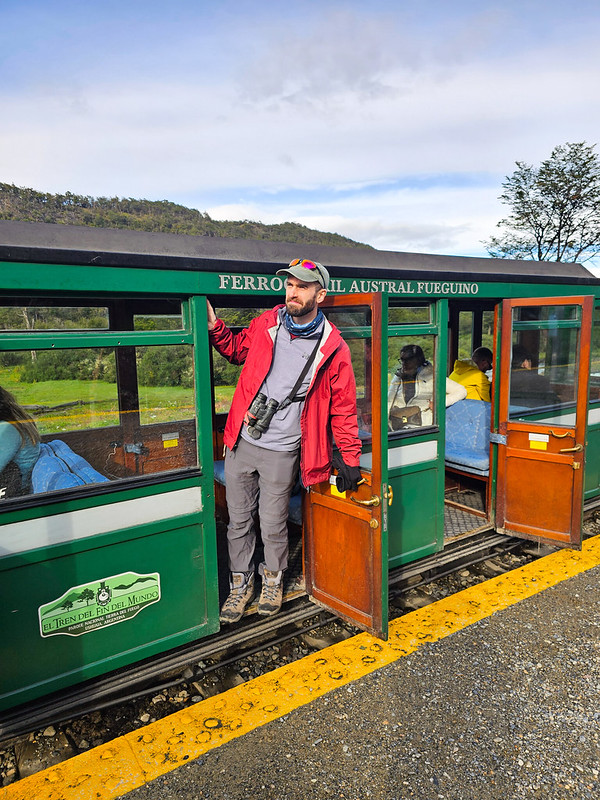
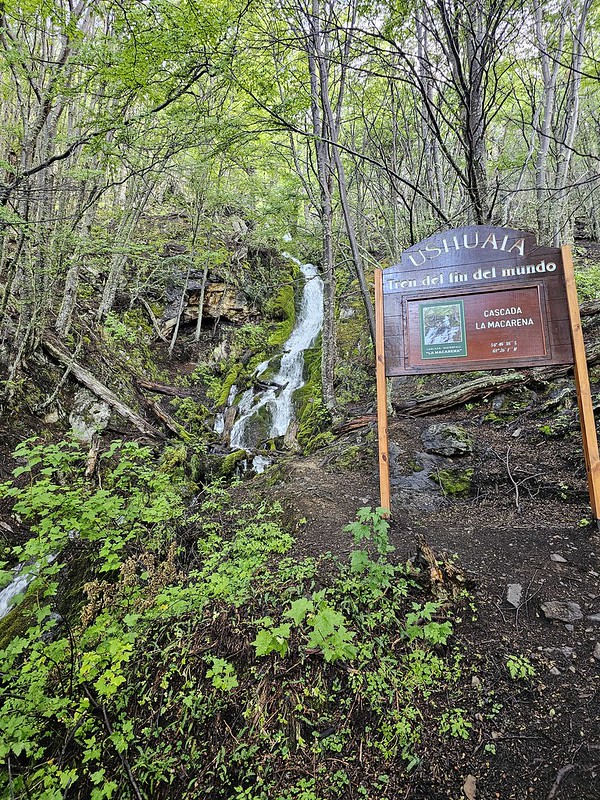
Ushuaia was initially founded as a penal colony in the early 1900’s and as it expanded, a railway was constructed to transport the prisoners into the forest to harvest timber to support the town’s growing needs. The train has been refurbished and is now known as “el tren del fin del mundo”. Today, it transports hundreds of tourists 7km into the park, showcasing gorgeous landscapes and educating visitors on the history of the railroad. It was a cool experience – it’s very picturesque and I enjoyed the opportunity to learn about the history – but I have to say, the entire experience is a bit tasteless. 

The train has a very dark history, as many of the prisoners were severely mistreated during this time period. I felt that the tour didn’t understand its intention, in that it didn’t think critically about the experiences of the prisoners or respect them. The audio tour starts off by talking about how progressive it was to offer the prisoners work, and that many of them loved the opportunity to get outside and enjoy nature. But then later in the tour it expands on how the prisoners were starved, beaten, and mistreated while working in what was essentially a labour camp. It’s not like they were given the choice to participate in labour, so it didn’t seem very progressive to me and felt rather tone-deaf. 

This is exacerbated by the fact that the Park also has paid actors running around everywhere dressed as goofy prisoners. They make you take a photo with them before boarding the train where they encourage you to pretend that you caught these naughty prisoners trying to escape (and then later try and sell you the photo of course). I found the entire production to be disrespectful and insulting to the people that suffered in this prison at the start of the century. It’s a good learning opportunity, but it was too commercialized and executed poorly.

PSX_20240228_112353
PSX_20240228_113310

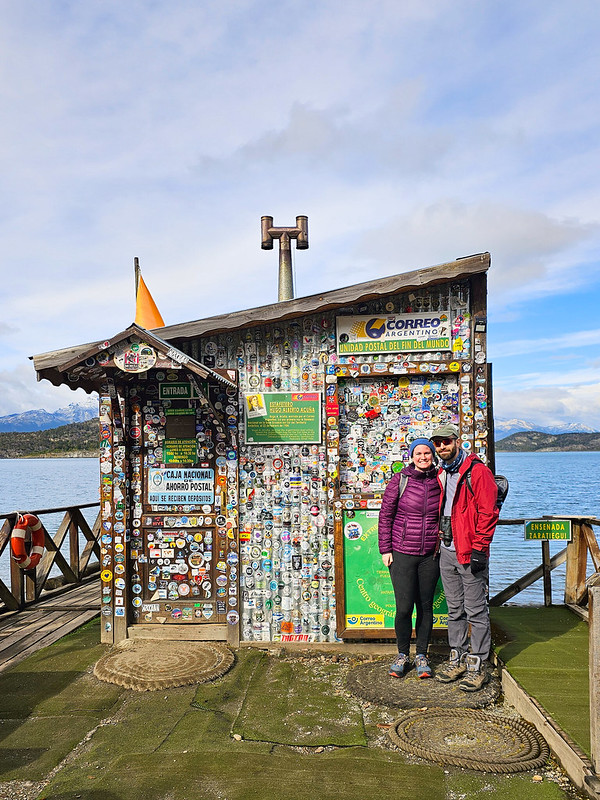
It’s a one-way train journey, so our tour bus picked us up at the end of the line and we spent the next several hours exploring around the park. This part of the tour, I really enjoyed. First we visited the post office. It’s not the most southerly post office in the world (that honour is reserved for the one in Antarctica), but it is known as the “end of the road”. The road in question is the Pan-American highway, which stretches 30,000km from Alaska to Ushuaia. The post office is located on a beautiful beach, so we sent ourselves a postcard (stamped with a penguin) and then enjoyed the views. 

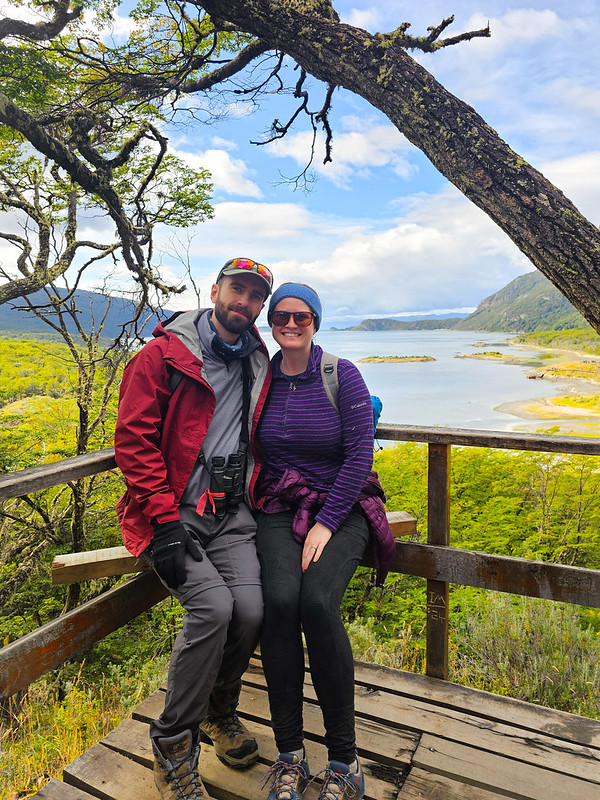
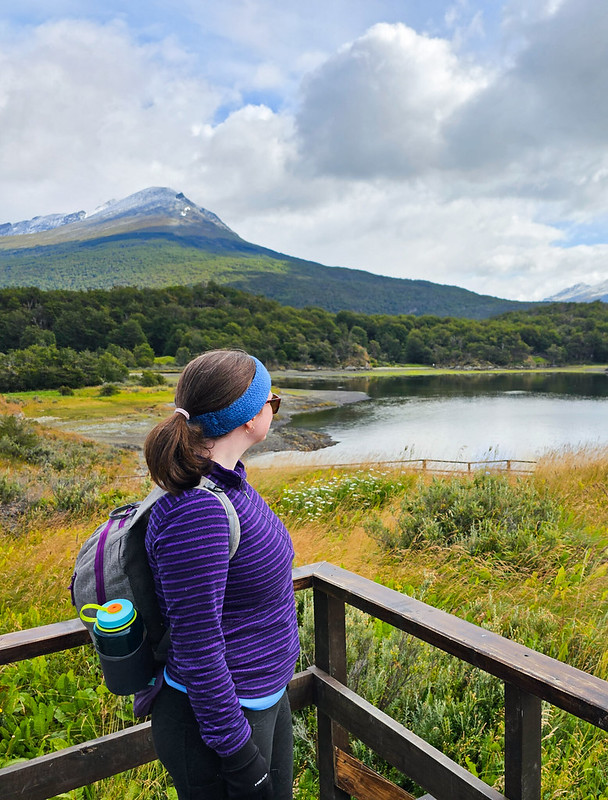
Our next stop was Lapataia, which is the real end of the road and has a beautiful mirador of the Beagle Channel. Our bus dropped us off 1km away from the parking lot and we did a short walk through the forest to Lapataia and then explored the viewpoints. It was a nice day – not super warm, but a mix of sun and clouds. I really liked the forest walk, which smelled amazing after rain from the previous night. Our last stop was to Lago Roca, which is a huge lake located on the border between Argentina and Chile. Our tour guides shared some local spirits with us at the end of the tour (which was actually delicious, a very caramelly whisky), before returning to Ushuaia.

PSX_20240228_113053
20240222_092847

We spent the rest of the afternoon shopping around the downtown area. Seth was determined to find a bird guide and we visited some of the outdoor stores, of which there is actually a large number due to the many expeditions leaving from Ushuaia. But our main goal for the rest of the day was to sample the king crab that Ushuaia is known for. Our tour guides all recommended the same restaurant, a small place called El Viejo Marino, but given how small it was and how often it’s recommended, we could not get a table. Seth did a bit of research and found a place called La Casa de Los Mariscos, which I would highly recommend!

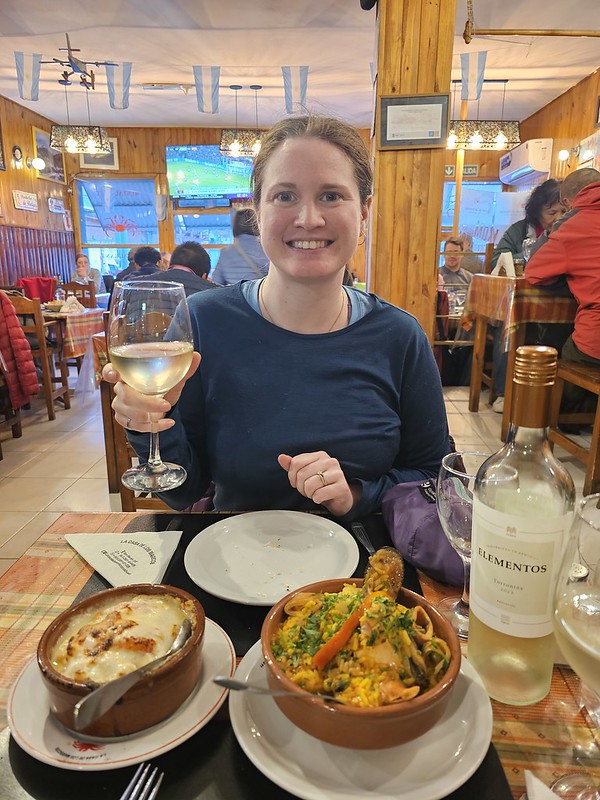
We got to the restaurant 15 minutes before it opened and were the first in line for the night, but a long line quickly developed behind us and by the time the doors opened, the entire restaurant was immediately filled. It was a great choice and one of the best meals I had on the entire trip! The popular dish is the parmesan king crab, which is basically a full crab baked with parmesan cheese. It was delicious and we ordered one to share with a seafood paella that came with squid, scallops, shrimp, clam, mussels, and white fish! We topped it off with a full bottle of wine for the low low price of $9. There was a guy performing life music throughout the night as well and the whole restaurant had a great vibe!

It was a wonderful way to end our time in Ushuaia. It was a very quick trip to the end of the world, we only really had two days there as we flew out to El Calafate early the next morning. I found our trip to be a bit airplane heavy on the front end with the excursion down to Ushuaia, but once we landed in El Calafate, we wouldn’t be flying anymore until the end of the trip, 

20240222_200131
20240223_190358

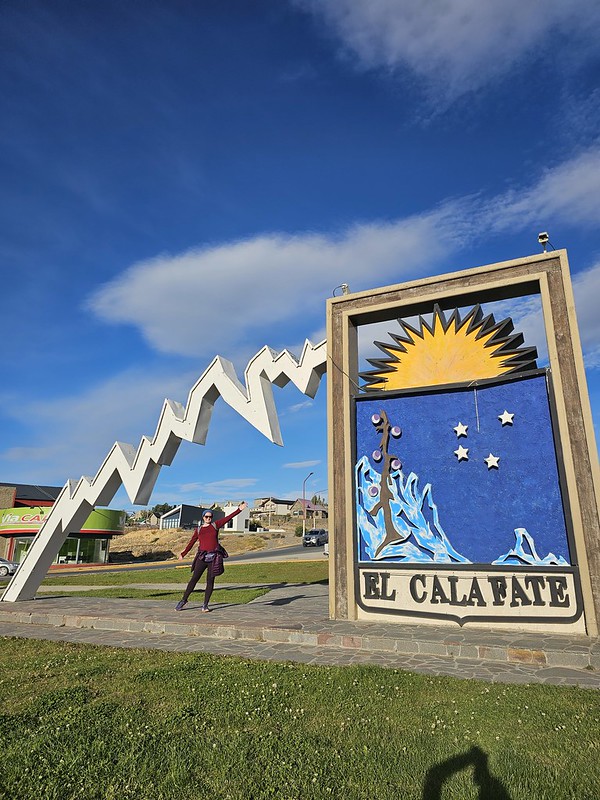
El Calafate is further north than Ushuaia (everything is), but is located squarely in the center of the Argentine Patagonia. It’s the jumping off place for anyone looking to explore Los Glaciares National Park. Like Ushuaia, it was not at all what I expected. I thought El Calafate would be smack dab in the middle of the mountains, but Patagonia is quite different from the other mountainous regions I’ve visited. Mostly in that it’s still true wilderness. There are not very many towns actually located in the mountains. The mountains are crowded around the Argentina-Chile border, but east of the border mountains, Argentina is pretty much all flatland desert. It’s very dry and barren. 

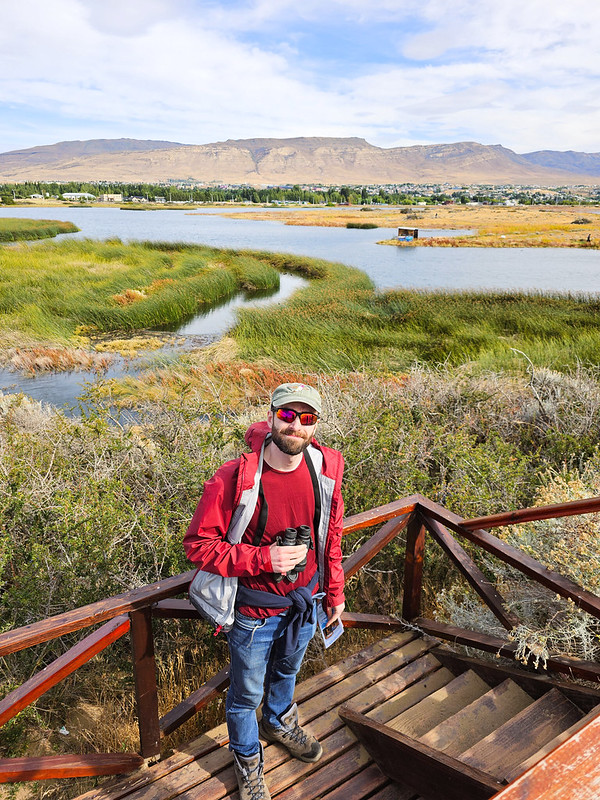
El Calafate is located right on the enormous Lago Argentino. It has a nice view of the mountains across the lake, but the town is characterized more by the desert than the mountains. We stayed in a nice little guesthouse, arriving around noon. We were starting our first trek the following day, so we spent the afternoon picking up some groceries for the trip and sourcing other things we couldn’t bring with us, like fuel for our stove. We enjoyed some beers at Patagonia Brewing and then spent the rest of the day birdwatching at Laguna Nimez, a reserve next to the lake. We saw lots of birds, but the most interesting was probably the Chilean Flamingo! There were dozens of them hanging out in the lagoon and they’re pretty goofy to watch. 

In the evening, we re-packed our bags, leaving a suitcase at the guesthouse and getting our backpacks ready for our first trek: 3 days on the Sendero Fitz Roy!

PSX_20240228_113538
20240223_152113