Berg Lake Trail Backpacking Guide

The Berg Lake Trail is one of the most iconic backpacking trails in the Canadian Rockies. It’s been on my bucket list for a long time, but it was closed for 3 years due to flooding that washed out portions of the trail in 2021. It finally re-opened in 2025 and I was super keen to visit the same summer. I spent 6 days hiking along the trail and it was easily the highlight of my summer! I’ve already published a 3-part trail report about my experience, which you can read starting here, but I had a lot of other learnings about the trail that I’d love to share. Reservations for the 2026 season are releasing at 7am on December 2, 2025. so here’s everything you need to know about the Berg Lake Trail!

The Trail

The Berg Lake Trail is a 42km there-and-back trail located in Mount Robson Provincial Park in BC. The trail starts at the parking lot north of the visitor centre and continues for 21km to the beach at the back of Berg Lake. There are 7 campgrounds in the park, with the most popular being the Berg Lake Campground.

There are a few options for how to hike this trail. If you’re not a backpacker, it is possible to day hike the entire thing, but you should give serious consideration to your fitness ability and previous hiking experience if you decide to attempt it. While the trail itself is not technical, it is a considerable distance and it covers almost 1000m in elevation gain. Approximately 500m of the gain is done in a 3km span, so it is a challenging and tiring hike. If you are not used to hiking long distance or you don’t have experience hiking in the mountains with significant elevation gain, I strongly recommend against attempting this as a day hike. If you do plan to day hike, I recommend starting before sunrise to give yourself lots of time, or consider biking as far as Kinney Lake. I found that the day hikers were primarily tourists who either don’t camp, or weren’t aware of the lead time required to secure permits.

If you are able to backpack it, I think this is a more enjoyable way to experience the trail. I did the trail over 5 nights, splitting the trail into 2 parts on the way up and down, and then camping 3 nights at Berg Lake to do day hikes. If you have more time to spend in the park, there’s lots to explore, but you can also enjoy this trail over a shorter period. I’d recommend a minimum of 2 nights. Most likely your itinerary will be limited by what permits you are able to obtain.

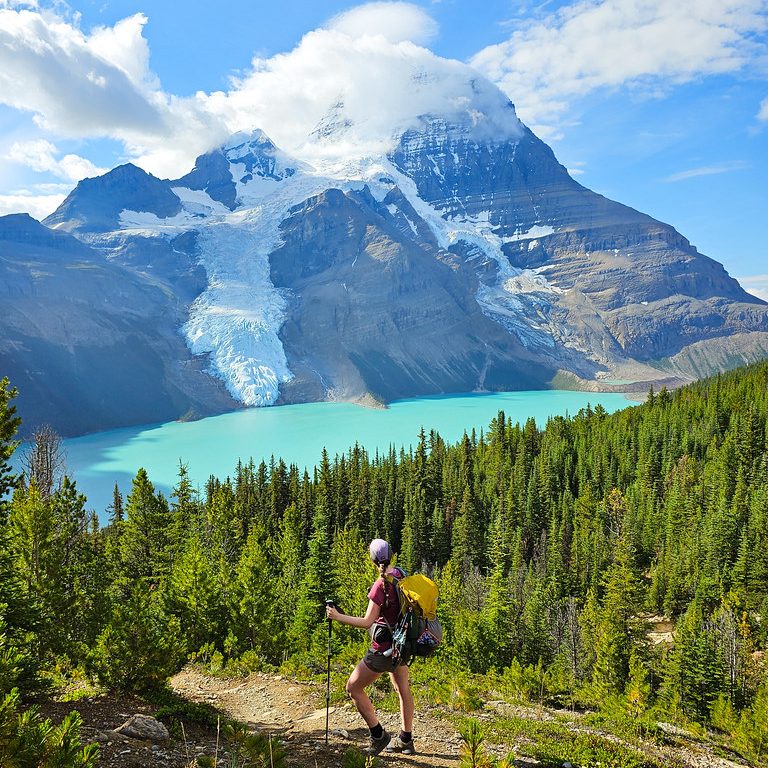
A photo of a female backpacker on a mountain overlooking Berg Lake and Mount Robson on a sunny day, on the Berg Lake Trail in Mount Robson Provincial Park in BC.

Time of Year

The best time of year to visit the Berg Lake Trail is pretty straight-forward. Mount Robson is the tallest mountain in the Canadian Rockies, so the trail is covered in snow for most of the year, limiting the core hiking season from late-June to mid-to-late September. You can visit year round, but you must be prepared for winter conditions and be aware of avalanche risk, which I won’t be discussing in this post.

I think there is slightly less traffic in September, as it gets cold quickly in the Rockies, but otherwise, avoiding the crowds isn’t really possible. If you go in late-June, be aware that there may still be snow on some of the trails; and if you go later in the summer, it’s more likely that your trip might be impacted by wildfires. Mid-to-late July might be the sweet spot, but I visited during the first week of August and lucked into great conditions. The mountains are always susceptible to storms, so be prepared for that.

Getting There

I think it may be possible to take a bus to Mount Robson Provincial Park from either Jasper or Kamloops in the summer, but it’s not a common route and I don’t know how reliably buses run. Similar to other popular Canadian parks, the easiest way to access is by driving. The park is located on Highway 16, which is a 5 hour drive from Edmonton, 7 hours from Calgary, and 7.5 hours from Vancouver (all without breaks). It’s not an easy park to access, but I promise it is worth your time. There is a very large parking lot at the trailhead, which is relatively secure, but never leave valuables in your vehicle.

Permits

Without a doubt, getting permits will be the hardest part of your trip to Berg Lake. This is a world-renowned hiking trail and attracts crowds of visitors every year. If you don’t get camping permits, then day hiking may be your only option to visit the park. If you want to try and get camping permits, then it’s important to mark your calendar with the permit release date. The permit release date for 2026 is Dec. 2, 2025. Unlike other BC parks, the permits for the Berg Lake Trail are released all on one day. The date is usually announced on the Mount Robson Provincial Park page, as well as on BC Park’s instagram. They usually don’t give a lot of notice (1-2 weeks), so you should be prepared to check in regularly at the end of the year until it is announced. The easiest way is to follow their social media.

Once released, you will have to book your permits on camping.bcparks.ca. Unlike Parks Canada, there is no random queue generator and you will have to login to your account, so there is no benefit to using multiple devices to try and get higher up the queue. However, if you have multiple people going on the trip, it is advantageous if you all login to your respective accounts to try for reservations (effectively giving you multiple chances to get your desired itinerary). I recommend creating an account in advance of release day (when the website will likely be slow due to traffic) and logging in before the sites release.

Once booking opens, select “backcountry reservations” and search for your start date. You will be forced to build your itinerary day by day, which can be a little frustrating. Once you get a date in your cart, you don’t need to worry about losing it, but it will become more challenging as the dates book up to continue building the itinerary. For example, by the time you get Whitehorn in your cart for your first night, Berg Lake may no longer be available for your second night. People are constantly adding and changing dates and campsites in the rush to get their itinerary, especially if you have multiple people from the same party trying to make 1 booking. So the trick is to frequently refresh. Just because you don’t see Berg Lake available right away, doesn’t mean it won’t show up if you keep refreshing.

My recommendation for booking a longer itinerary is to take what you can get and make changes later. If Berg Lake is not available, book Marmot or Rearguard and move on to the next day before those dates book up too. Once you have secured a booking for each of the dates in your itinerary, go back and look for cancellations. Keep refreshing until you see one, and then make a change to your booking to add it. This does cost more money as the change fee is $6, but I was able to get bookings for Berg Lake after the fact using this hack. When I made my first booking, I had 3 nights split between Marmot and Robson Pass campsites. I was able to change my reservation from Robson Pass to Berg Lake within the hour from people dropping sites, and I was able to get a cancellation later in the season and change my booking from Marmot to Berg Lake. So in the end, my starting itinerary (which had no nights at Berg Lake) ended up with 3 nights. You can track cancellations on Schnerp, which will notify you when a site opens up.

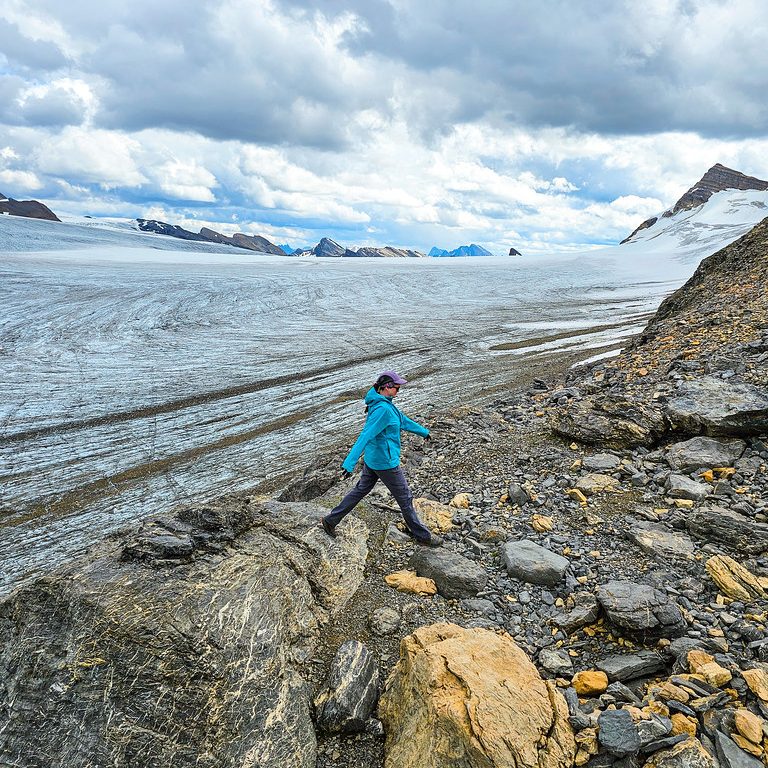
A female hiker walks in front of an epic glacier icefield at the top of Snowbird Pass in Mount Robson Provincial Park, off the Berg Lake Trail, in BC.

Campsites

There are 7 backcountry campsites in the park, so there are lots of options for where to stay and opportunities to customize your trip. The first 3 campsites are located along the trail to the lake, while the last 4 campsites are all located within 3.5km of one another around the lake. I’ll discuss itineraries below, but here’s an overview of the 7 campsites along the trail. All campsites include outhouses and bear lockers and as discussed above, require valid permits for the duration of your visit.

Kinney Lake – This is the first campground, located right on Kinney Lake at the 7km trail marker. It has 18 tent sites and a large open-air shelter. It’s a beautiful campground with several lakefront tent pads and a lovely view from the shelter. The trail to Kinney Lake is a gentle uphill, so this campsite is often overlooked because it is less than halfway to Berg Lake. But it’s a great option if you have a late start on your first day, as well as for families or those who want to experience Mount Robson’s backcountry, but have concerns about the strenuous hike up to Berg Lake. There are bike racks located at the back of Kinney Lake for those who bike up.

Whitehorn – This campground is located along the Robson River at the 11km trail marker. It has 22 tent sites and a large open-air shelter. This campground is ideal if you’re looking to split the hike to Berg Lake in half. It splits the elevation gain in half as well, though day 2 is slightly more strenuous. Some of the tent pads are along the river, while others are in the woods, but there’s a beautiful view of the valley and the backside of Mount Robson from the campground.

Emperor Falls – This campground is located just past the viewpoint for Emperor Falls at the 16km trail marker. It has 9 tent sites and some picnic tables, but it does not have a shelter. While the tent pads are located right next to the river, making for a nice view, the main downside to this campsite is that it’s located at the top of all of the elevation gain, so it leaves you with a big day if you’re hiking from the parking lot. I would probably avoid it on the way up, but it’s a good option to shorten your hike on the last day.

Marmot – This is the first of the upper campgrounds, any of which can be used as a base for day hikes. It’s located at the foot of Berg Lake at the 19km trail marker. It has 7 tent sites and a recently constructed semi-enclosed shelter (this one has windows, unlike the shelters at Kinney Lake and Whitehorn). Most of the tent pads are located in the woods, but 1-2 have a direct view of Mount Robson. While the view from Marmot is not quite as good as from Berg Lake, it is located right on the lake and would be my first choice if I couldn’t get a site at the Berg Lake Campground. Some people really like this campground because of how small it is, so you can avoid the crowds.

Berg Lake – This is the most popular campground on the trail. If you can score a permit for this campground, do not hesitate to book it. It’s located at the head of Berg Lake at the 21km trail marker. It has 26 tent sites and a fully enclosed cooking shelter with a large porch and view of the Berg Glacier. This is the most beautiful campsite on the trail, but it will be very busy as a result. Most of the tent sites are in the woods, though there is one premium tent pad with a lake view. A few of the sites at the back of the campground also have mountain views.

Rearguard – This campsite is located just past the Berg Lake Campground at the 22km trail marker. It has 6 tent sites and is a good option if you weren’t able to get a campsite at Berg Lake. It’s not located on the lake, but it does have nice views of Mount Robson and the river delta. The main downside is that there is no shelter, so if it rained, I’d prefer to be at Marmot.

Robson Pass – This is the last campsite in the park, located at the 23km trail marker. It has 15 tent sites. It’s located a little bit further away, but it can still be a great base if you’re planning to do some day hikes. You can access Snowbird Pass from this campsite, as well as you can hike up the backside of the Mumm Basin Trail – although be aware that this trail no longer connects to the Toboggan Falls trail due to a rockslide in recent years – but I’ve heard it still has a great view. Similar to Rearguard, the main downside of this campsite is that it doesn’t have a shelter.

Robson Hut – Another option to be aware of in the future is that the ACC is currently constructing a brand new mountain hut at Robson Pass, which should be open for the 2026 season. You will be able to book this hut through the ACC and it will be the swankiest accommodation available in the park. Please note that this is separate from the BC Parks booking system and it is not an open hut that you can visit. A booking will be required to use the hut.

Robson Meadows – Just to cover my bases, I want to mention that there is a frontcountry campground located off the highway near the visitor centre, which is a great option for camping the night before or after your backpacking trip.

A photo of Mount Robson on a sunny day with the Robson River in and trees in the foreground and the mountains and glacier in the background, on the Berg Lake Trail in Mount Robson Provincial Park, BC.

Itineraries

I’ll keep this fairly simple. It’s not easy to get permits, so it’s really a take what you can get scenario, but there are a few strategies you can employ.

Strategy 1: Hike all the way to Berg Lake in a day. The idea with this strategy is that you book as many nights as you want at the lake, prioritizing day hikes from the lake. The benefit is that you can immediately concentrate on getting bookings for Berg Lake before they fill up and maximize your time at the lake. The downside is that you need to be prepared to do the full 21km in a day, which is challenging, but allows you to spend more time at the lake if time is limited.

Strategy 2: Break up your hike to Berg Lake into 2 days, staying at one of the middle campgrounds on the way up, but planning to hike all the way back to the parking lot in a single day. Again, book as many nights as you want at Berg Lake after you arrive. This makes your hike in easier than strategy 1, but still gives you extra time at the lake, as the hike down is much easier than the hike up.

Strategy 3: Break up your hike to Berg Lake into 2 days on both the way up and down. If you have more time available, you can still book multiple nights at Berg Lake in the middle to do day hikes, but the benefit is it gives you a more relaxed hiking timeline, especially if you are worried about the challenging terrain.

Personally, I would only do strategy 1 if I only had 1 night. I used strategy 3 for my visit because I had lots of time, but I would have been comfortable with strategy 2 as well. It is more manageable to do the hike down in a single day. Here’s a couple of options based on the number of nights you have. (D=day, N=night)

Number of NightsFirst Choice CampgroundAlternate Campgrounds
2 days, 1 night (strategy 1)D1: Hike to Berg Lake
D2: Hike out
Marmot, Rearguard
3 days, 2 nights (strategy 1)D1: Hike to Berg Lake
D2: Day hike, stay at Berg Lake
D3: Hike out
Marmot, Rearguard
3 days, 2 nights (strategy 2)D1: Hike to Whitehorn
D2: Hike to Berg Lake
D3: Hike out
N1: Emperor, Kinney Lake
N2: Marmot, Rearguard
4 days, 3 nights (strategy 2)D1: Hike to Whitehorn
D2: Hike to Berg Lake
D3: Day hike, stay at Berg Lake
D4: Hike out
N1: Kinney Lake
N2: Marmot, Rearguard
N3: Marmot, Rearguard
4 days, 3 nights (strategy 3)D1: Hike to Whitehorn
D2: Hike to Berg Lake
D3: Hike to Whitehorn
D4: Hike out
N1: Kinney Lake
N2: Marmot, Rearguard
N3: Kinney Lake, Emperor
5 days or moreSame as 4 day options, but add multiple nights at Berg Lake

Day Hikes

There are several great options for day hiking along the Berg Lake Trail. I really think it’s worth it to try and fit in at least one day hike if you can get multiple nights at campsites near the lake, but if you can’t, it’s not the end of the world either. Berg Lake is a world-class trail on it’s own and the entire trail is stunning, whether you have time for side quests or not. If you do have time, here’s the trails I would recommend.

20250805_105047

Snowbird Pass – In my opinion, this is the best trail in the park. People like to prioritize the Berg Lake Viewpoint on the Toboggan Falls Trail, but this trail is the real gem. It’s a 20-km round trip hike from the Berg Lake Campground, so you definitely need a full day for it, but it features views of both the Robson Glacier and the Reef Icefield. It’s stunning from start to finish. If you don’t have enough time to do the whole trail, it’s still worth it to hike the 3km from Berg Lake to the lake at the base of Robson Glacier. I’ve written an entire blog post about this trail.

Toboggan Falls to Berg Lake Viewpoint – This is the most popular side trail in the park. From the Berg Lake Campsite, you can hike 1km up along the Toboggan Falls trail (enjoying the view of Toboggan Falls along the way), to a junction that takes you another ~1km up to the Berg Lake Viewpoint. From here, you can get the iconic photo of Berg Lake, the delta, and Berg Glacier. You don’t need a full day to do this hike, so if you’re short on time, you can probably knock it out in ~2 hours after you arrive at camp.

Hargreaves Lake Loop – If you have a full day, expand your hike up to the Berg Lake Viewpoint to also include the loop around to Hargreaves Lake via Marmot Campground. It’s approximately 7km round trip and in my opinion, Hargreaves Lake is really underrated. There’s a small viewpoint off the trail that takes you up to a lookout of Hargreaves Glacier and the Marmot branch of the Berg Glacier at the same time. I’d recommend a day if you’re doing the whole loop, but if you’re staying at Marmot, you could easily hike up to Hargreaves Viewpoint and back in an evening, as it’s only ~3km round trip.

Adolphus Lake – I haven’t done this trail myself, but if you have the time, you can hike out from Berg Lake to Robson Pass and then continue on to see Adolphus Lake. It’s ~2.5km from the Berg Lake Campground, but along completely flat ground. It’s a great option if you’re staying at Robson Pass.

20250805_114645

A Day in Belem

This marks my last post about my Europe Trip! After a week in Morocco, we flew back to Lisbon for 1 more day before returning to Canada. Our flight was delayed, so we didn’t arrive in Lisbon until really late at night and stayed in a hostel right outside Rossi Square. Overall, I felt like we didn’t really have enough time in Lisbon. I would have liked to do a food tour and spend some time exploring the Alfama neighbourhood, but we didn’t have time for everything.

On my first visit to Lisbon (12 years previous), I had regretted not going to Belem. I don’t really think Belem is any more special than any other part of Lisbon, but the Tower of Belem seems to show up on lots of travel bucket lists and I’ve always been a little disappointed I never did it. So we dedicated our last day in Lisbon to exploring the neighbourhood of Belem.

20240607_110132
20240607_122709

First we got up and had a nice brunch in Lisbon city centre, and then we caught the iconic 15E tram line that runs all the way from City Centre to Belem. It’s supposed to be one of the best routes for tourists and it gets really busy as a result. I didn’t find it too bad on the way there, but we forgot to top up our Metro cards and had a hard time getting tickets. The tram runs right through Belem and we got off at one of the last stops to walk over to the Tower. 

Emily had purchased tickets online in advance, but they are not timed entry. We thought the tickets would save us from the worst of the line-up, but talk about a scam! The line-up to buy tickets is really short, but the line-up to get in the tower is still really long. It made me mad because once you buy the ticket online, you’re committed to going. You’ve already spent the money and can’t opt not to go if the line is long (without losing your money). I don’t know why they don’t do timed entry like in Sintra. 

20240607_132050
20240607_141251

The line-up wait was forecasted at 2 hours, but it was moving pretty quickly and we ended up getting in after ~45 minutes of waiting. The downside was that it started to rain while we were waiting in line with no shelter. A few opportunistic vendors came by selling umbrellas, but we opted to wait it out in our rain jackets. 

Fortunately, the tower is really cool, and because they only let so many people in at a time, it’s not crowded. The tower is constructed on a rock formation on the beach and was built by the King as a military fortification in the early 1500’s. The structure has been expanded on over the years and it underwent a full restoration in the 1990’s, after which it was added to the list of the seven wonders of Portugal. Also on this list is Pena Palace, which we visited in Sintra, and Jeronimos Monastery, which is located just down the street.

20240607_134031
20240607_135940

We could have made it a double feature and visited the monastery as well, which in my opinion, was a much larger and more architecturally interesting building. But we wanted to actually relax on our last day of vacation and didn’t want to spend another hour waiting in line. Instead, we spent the afternoon walking along the waterfront, where we saw the Belem Lighthouse, the Padrao dos Descobrimentos (a monument to Portuguese navigators), and did a little bit of shopping at a local market. 

We walked along the main road to see the Jeronimos Monastery from the outside, and then decided to visit Pasteis de Belem, which is a famous pastry shop. It is absolutely massive, so we didn’t have trouble getting seated, but we also waited a long time to be served. We enjoyed tea and pastel de nata (Lisbon’s famous egg custard pastry), along with a mille feuille for me and chocolate cake for Em. It was all delicious!

20240607_143711
20240607_150755

We caught the bus back to Lisbon at rush hour, which was extremely chaotic, but also hilarious because I was seated in front of a Portuguese woman who was emphatically chastising her friend Maria for the entire journey. She said her name approximately 10 dozen times and I couldn’t help but feel I had let her down somehow. 

We finally made a trip to the local liquor store to stock up on wine to bring home. I ended up getting more bottles than the duty free allowance (which also happened to me in Patagonia), but like Patagonia, no one questioned me or made me pay duties on the extra wine, so definitely don’t be limited by the allowances when returning to Canada (yes, I did declare it)! We picked a nice restaurant in the City Centre and had a fantastic meal before preparing to return home. 

20240607_155309
20240607_192934

It was a long journey home. We flew through Montreal, where my absolutely massive flight to Vancouver got cancelled. Luckily, I got the notification on my way to the gate and I immediately took off running to customer service to be the second person in line. So I immediately got re-booked for the following morning and booked into a hotel. The bigger problem was that they did not release my luggage. I had (even more) duty free wine that I bought in the airport. It had to go in my checked luggage once I left the terminal, so I had to wait around for 3 hours while they tracked down everyone’s luggage. I seem to have inordinately bad luck flying, but I did get a $1200 Air Canada voucher out of it, which I immediately used on 2 flights to Newfoundland, so I guess it wasn’t the end of the world.

This was the first time me and Emily travelled internationally together since we went to Costa Rica in 2016, so we were long overdue for a sister trip and we had a great time! The Azores were my favourite part of the trip, but Morocco was also a very unique experience and unlike anywhere else I’ve been. The food was also a big highlight, with the seafood in the Azores and the flavours of Marrakesh being particularly memorable. And of course, seeing Taylor Swift in concert is worth every bit of the hype and an experience I hope to repeat one day soon!

Ouzoud Waterfall and Camel Riding

After a great day at Ait Benhaddou, we had planned a second excursion to Ouzoud Waterfalls. They are also located outside of Marrakech, but seemed to be slightly closer than Ait Benhaddou. For this tour, we went with a company called Marrakech Desert Trips. I definitely wouldn’t recommend them as much as I would Click Excursions. There was no dedicated tour guide, which was fine because you have a local guide once you arrive in Ouzoud, but more concerning, the bus did not have AC. It is so hot in Morocco and everyone in the bus was quite cranky as it felt like we were being forced into a baking tin can for several hours of driving.

The tour guide meets you right at the bus when you arrive in Ouzoud. It’s optional, but I recommend just taking advantage. They only ask you to pay $2 each for their services for the entire day, so please tip them a little more generously! Our guide shared some fun facts with us about the area, but mostly he just ushered us around the attractions. We started with a view of the falls from the top, where there we’re a ton of monkeys hanging around. They looked a lot more like baboons to us, but we did some research and confirmed that they are in fact, monkeys. You can buy peanuts to feed them from the local kids, but honestly, just take your photo and avoid feeding them. This kind of tourism is never good for the animals and I appreciated that our guide advised us as such.

20240605_123140
20240605_153720

We hiked down to the falls through some of the local Berber villages and learned that Morocco is one of the biggest exporters of olives and olive oil. There are olive trees everywhere that are tended and harvested by the Berber families. We stopped at a nice viewpoint for photos before finishing the walk to the base. At the base, there are several options. You can pay a few dollars to take a “boat” ride up to the falls, or you can just explore on your own. We were much more interested in swimming, so we decided to forego the boat ride and went for a little dive into the pool instead. The water is actually pretty cold, but not too cold for us Canadians!

The waterfall is quite beautiful. I wondered if going all the way to the waterfall was worth it for one view, but it was a pretty low key day and I actually ended up enjoying it quite a bit (aside from the bus ride). After a refreshing swim, we climbed partway up the cliffside to a restaurant with fabulous views of the waterfall to enjoy lunch. We finished by climbing back to the top and hitting a few more viewpoints (and getting some ice cream), and then we packed aboard the bus again to return to Marrakech.

PSX_20240622_214528
PSX_20240610_162710

On our last day in Marrakech, I really wanted to go camel riding. I know it’s a bit cliché, but I’ve never been anywhere that camels are native and I really wanted to cross it off my bucket list. Emily was much less enthusiastic (she has a fear of horses, which she has confirmed extends to camels), but fortunately she agreed to accompany me, while reminding me it was a one time thing!

Emily was more interested in visiting Jardin Majorelle, so we decided to do that in the morning and go for a short camel ride outside the city in the afternoon. Unfortunately, our planning wasn’t great. Jardin Majorelle is a major attraction in Marrakech and we didn’t realize it had timed entry. None of the other sites we visited had timed entry and we arrived at the park to realize that we wouldn’t be able to enter for several more hours, meaning we didn’t have enough time. So unfortunately, we had to skip the attraction, but learn from us if you ever go to Marrakech. It looked really cool and we were sad to miss it.

PSX_20240620_200448
PSX_20240629_092529

Emily confirmed that her fear of horses does extend to camels, but she was a trooper and I had a great time on the camel ride! We went 30 minutes outside the city with a small group for a 1 hour camel ride. Going in the afternoon wasn’t the best idea because it was really hot, but I still enjoyed the experience. There was only ~6 of us and we walked around the Palmerie. An hour was honestly a bit long and I was pretty bow legged afterwards, but it definitely ticked the box for the experience. My camel’s name was Scooby-Doo and Emily’s camel was Olivier. We were served cold water and biscuits afterwards before driving back to Marrakech and overall, I thought it was a nice experience.

But that pretty much concluded our time in Morocco. In hindsight, 5 days in Marrakech was a bit too long. I think I would have preferred to have more time, but to explore more of the country. I’m sad we didn’t have time to visit the Sahara, or other cities. I preferred to have a central base because I was a little bit nervous about traveling to Morocco, but I would feel more comfortable returning in the future. The busy-ness of the medina felt overwhelming at times and I didn’t like being out after dark, but otherwise, I never felt unsafe in Morocco. I would definitely love to return to tick sand dunes off my bucket list in the future, though if Emily is involved, I did promise no more camels!

20240605_131213