SCT Part IV: Powell River to Confederation Lake

Click here to start reading Part I.

When I got off the trail on August 6th, I felt like the disappointment of not finishing was going to swallow me whole. I’ve had to be pretty fluid with a lot of my trip planning through Covid (like everyone else); when my trip to Assiniboine was cancelled in 2020, I did the North Coast Trail; when Seth got a new job in 2021, we postponed our kayak trip to Desolation Sound; and when Jasper caught fire in 2022, Brandon and I relocated to Strathcona Park. But the SCT had been on my bucket list for several years and I had trained for it and prepared all my gear for this year and I really wanted to finish it.

So I did. Carolyn had been forced to do the entire thing solo when me and Emily got off the trail, so I’d like to think she gave me some confidence to return and finish the rest of the trail solo too. I already had time off in early September, so I finished work a little early on the Friday before the Labour Day long weekend and flew back to Powell River for another attempt. Seeing as I got off the trail at the Shingle Mill Pub, the float plane was the perfect way to return. The shuttle company dropped off some of the supplies I couldn’t fly with (bear spray and fuel) and I arrived at the pub around 5pm and was back on the trail within minutes of arriving!

20220902_165310

After leaving the pub, you cross the bridge towards Powell River and then you can immediately jump back on the trail. Emily and I had been planning to camp at Tony Point the night we got off trail, which is 5km from the pub (seen from the float plane in the photo above), so I just picked up my old itinerary and started walking. It’s about an hour to Mowat Bay, which is a popular recreation site on Powell Lake where I stopped for a quick snack, and then another hour to Tony Point, also located on the lake. I did modify my itinerary when I decided to go solo to stay mostly at huts, but given my late start time, I knew I would have to camp the first night.

20220902_180244

Tony Point is a lovely little site next to the water. It has a picnic table, a monument, flat space for ~2 tents, and not much else. I assumed I would be alone, but fortunately, there was another solo female hiker there as well! I was prepared to sleep alone, but was also thrilled to have someone to help ease into solo camping. We ended up crossing paths for several days and it was nice to trade stories.

I went for a quick swim when I arrived and then had supper before setting up my tent. I was feeling pretty confident, but the forest definitely changes when you’re alone at night. On this evening, it was windy, which created a lot of ominous sounds in the woods and the trees kept dropping leaves on my tent, so I was glad for a companion. I kept thinking a bear was walking into the site, so eventually I got up to have a look around. It was clear there was nothing there and that helped ease my mind and eventually I was able to fall asleep. I ended up sleeping in the huts every night after that, so it was a little annoying to carry my tent for another 130km for no reason, but still a good safety precaution.

PSX_20220929_122048

It was nice and sunny the following morning, so I set off before 8am. The other hiker was hoping to go all the way to Fiddlehead Hut, but I was only aiming for Confederation Lake Hut. It’s still a lofty 19km of hiking, but I really wanted to go the long route around Inland Lake, so I ended up clocking 24km. I was a little on edge hiking the first morning because I was very weary of bears. The trail continues around Powell Lake before going through the Haywire Bay Car Camping park. Shortly after Haywire Bay, I scared something large in the woods – I never saw it, only heard it running away from me – it was either a bear or a deer, so I was very diligent with my bear calls after that. I saw lots of evidence of bears (poop), but I never actually saw a bear, so I got a lot more comfortable walking around alone in the woods after a few days.

The trail continues around Lost Lake, which is pretty overgrown, before you come to Inland Lake, which I was really looking forward to. Inland Lake is a provincial park with some frontcountry sites, huts, and a huge loop around the lake. If you do the whole loop, it’s 12km, but on the SCT, you can either do the south end (4km) or the north end (8km). I was looking forward to this section because it follows the shoreline around the entire lake and as a result, it’s completely flat. I was determined to do the longer route because there’s a hut on the west side of the lake that can only be accessed on this route.

PSX_20220929_122808

I really wanted to visit every hut and take a selfie at each one, so I decided the extra kms were worth it. But I ended up really messing it up. I was having a great time walking around the lake – the kilometers were going by quickly and it was a gorgeous sunny day. I hadn’t yet seen any people, but I was enjoying walking along the lakeside. Such was my enjoyment, that I ended up walking right past the hut without realizing it!! I passed a small log building and picnic shelter that I thought was lovely, but I didn’t stop because according to my GPS (Gaia), the hut was still 2kms away. The paper map shows “Pier Hut” in this location, so I assumed that’s what it was and continued on towards “West Hut” as it’s called on the SCT website. As it turns out, Gaia is wrong about the hut location and West Hut and Pier Hut are in fact the same thing! I didn’t realize my error until 2kms later, so I ended up completely missing it.

PSX_20220929_122643

There are 2 huts on Inland Lake: “West/Pier Hut” and “Anthony Island Hut”. My guess is that these two huts were built and designed by BC Parks since they’re in the provincial park and are completely different than all the other huts on the trail. These huts were 1 story and could sleep ~3 people, whereas the rest are all 2 stories with a sleeping loft, so I’m not surprised I didn’t recognize it. I don’t have a photo with Pier Hut, but I don’t regret going the long way around the lake because it was a very beautiful trail that passed quickly. Plus I later learned that the south trail has a detour along most of it, so I was glad I got to spend so much time on the lake, as the south route mostly bypasses it with the detour.

I took a short break at the end of the lake to go for a swim and then continued to Anthony Island Hut for lunch. I finally saw a few people around the lake, but it was pretty empty. I passed a group of day hikers, a family bike riding, and a couple on their paddleboards. Otherwise I didn’t see anyone else on the trail all day! When I stopped for lunch before 1pm, I had already hiked 17km, so it was a big start for me and I was feeling good!

PSX_20220929_122941

I was able to maintain this pace since it was mostly flat, but after lunch it was all uphill to Confederation Lake. The trail does 600m of elevation gain in 5km through the forest, so I listened to my audiobook while I trekked up through the woods. It’s a pretty boring and steep trail up to the lake – I’d briefly flirted with the idea of going all the way to Fiddlehead to catch my companion from the night before, but 24km of hiking was definitely enough for me. The most annoying part of Confederation Lake is that when you finally get there, there’s still another 2km through the woods around the lake before you finally get to the hut. But I loved the hut!
20220903_162755

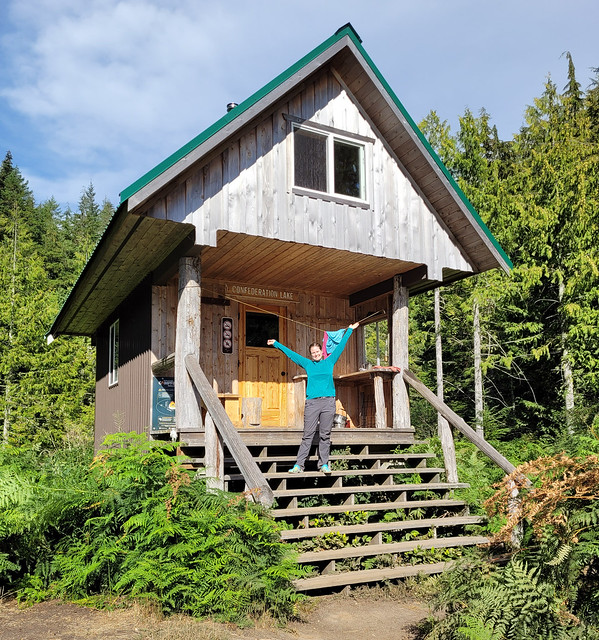
I haven’t heard a lot about Confederation Lake Hut, but it’s really nice! It’s located right on the lake and is fully enclosed, with enough room for a handful of tents. I arrived around 4pm and was the only person there. I took a bath in the lake and then settled in for a snack. I was expecting to be alone at the hut, but it felt nice and safe, so I was okay with it. So I was thrilled when I came back from filtering water and found a family of 4 had arrived for the night! It was an older couple with their grown daughter and her friend/partner. They were super nice and I enjoyed hanging out and chatting with them for the rest of the night after having been alone all day. I’m an extrovert, so I definitely relish the opportunity to chat with people after a day on my own. The theme of my trip was early nights and early mornings though, so I said goodnight as soon as the sun went down.

Continue reading Part V.

20220903_164244

Kayaking Sechelt Inlet

In the last year, along side all our other hobbies, Seth and I decided to start kayaking. We went on our first trip last year over the Canada Day weekend to Sechelt Inlet, and we’re planning a trip to Pender Island for the upcoming Labour Day weekend. I actually wrote this post last year after our trip to Sechelt, but for some reason I never actually got around to posting it (I admit, it takes me a really long time to upload photos and that’s what usually holds up my posts, not the writing). So here’s the post I wrote last year about that trip – hoping to follow it up with a post about our upcoming trip!

I don’t mind carrying a big backpack, but Seth hates it. He likes day hiking and camping, but as soon as you strap a pack on him he loses all interest. So we decided to try a kayaking trip so that we could get into the wilderness without Seth having to lug all his gear with him. I’ve heard Indian Arm is a great place for kayak trips, and it’s right next to Vancouver, but we decided to go a little farther away and started with a 2 night trip in Sechelt Inlet on the Sunshine Coast.

Before I tell you about the trip though, I have to recommend taking the beginner kayaking course from Paddle Canada before you attempt any kayak adventures. Seth and I have both been kayaking before, but I’m so glad we took the introductory course because we were going deep into the wilderness and I’m really glad we learned some basic paddling skills and how to save ourselves in an emergency. We did a 2 day course with West Beach Paddle in White Rock and I would highly recommend them. We’re thinking of going back next year to do the next level because they were so fabulous. We learned a ton of skills and how to rescue each other in the event that we tipped our kayaks. Safety first everyone!

Our first take-away from the course was that we wanted single kayaks. Doubles are so much cheaper, but they also involve a lot of coordination. Me and Seth are really different people and I have a bit of a control complex, so I’m glad we each had our own boat. I think it made for a much more enjoyable trip.

We took the ferry over to the Sunshine Coast early on Saturday morning and drove straight to Sechelt to get our kayak rentals. I was a little concerned about getting all our gear in the kayak, but those things are surprisingly large and we even had extra space in the compartments. It did take a little bit of coordination and jigsaw skills to make everything fit though, I’d recommend many small bags, instead of few big ones. The hardest thing to fit in was our 20L water jug because we brought all our water with us (although we didn’t even use half of the water we brought).

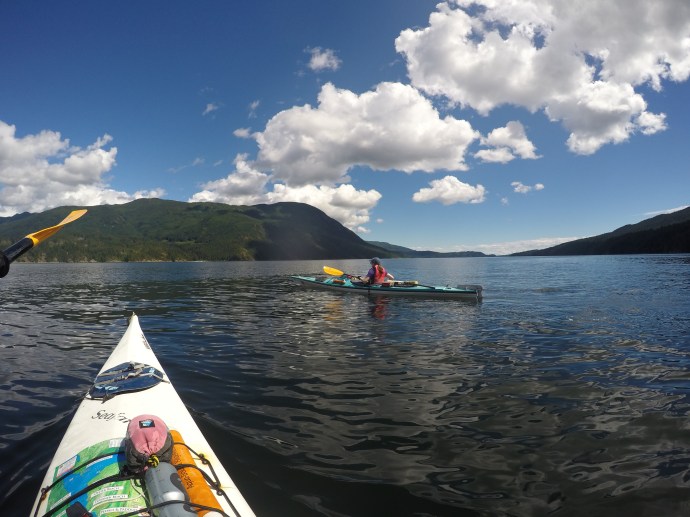
It was overcast and a little rainy when we started, but fortunately the wind was at our backs so we didn’t have too hard a go. Sechelt Inlet is really interesting because it’s only connected to the ocean through one small channel, so you’d think it would be pretty calm in there, but they can actually get some pretty strong headwinds up the channel. There’s also a ton of campsites in the inlet, but we didn’t want to push ourselves too far on our first trip, so we chose Nine Mile Beach as our camping destination since it was only about a 2 hour paddle.

We had a pretty leisurely trip out and stopped at Oyster Beach for our lunch. Nine Mile Beach is the biggest campsite I believe, which is why we picked it, but everyone else seemed to have the same idea and it was quite busy, so I’d maybe even recommend going for one of the smaller ones. I assumed they’d be full since they were so small, but they were actually empty. Halfway Beach is across the inlet from Nine Mile Beach and it is about the same size, but there were definitely less people staying there because it can be a lot of work crossing the inlet depending on the weather.

No fear though, we managed to get a great site at Nine Mile Beach! Most of the campsites are back in the woods, but we went down to the far end of the beach where there were less crowds and managed to find a small site at the very end just big enough for our tent and gear, with a great view of the beach. So we hauled our kayaks up above the high water line and set up camp.

The sun never really managed to come out on Saturday, but it did stop raining before we got to the beach and we spent the rest of the day chilling. I read about half a book and Seth (the biologist) had a great time exploring the low tide and flipping over rocks. I expected to see wildlife while we were out there, but I was surprised by just how much wildlife we saw! It was like a nature zoo! While we were eating dinner the birds gave us a great show. There were two seagulls that were hanging around digging up shellfish (cockles according to Seth) and they kept digging them out of the sand and then flying up high to drop them on the rocks to get to the meat inside. Plus, two black oyster catchers also showed up looking for mussels for supper, which thrilled Seth because they are the birds he is studying for his Masters and he doesn’t get that many opportunities to see them in the wild.

The highlight though didn’t come until nighttime. We heard some rumours you could see bio-luminescence in the water in Sechelt Inlet and our neighbour gave us a tip that you have to actually move to water to see it (we never would have figured this out ourselves). So we got up at 2am and fortunately the wind had totally died off and the water was very still, so we moved our paddles through the water and sure enough it totally lit up with glowing organisms! It was very cool! I was tempted to go swimming in it, but it was just too cold.

The weather cleared up a lot for us on Day 2 and the sun came out! There was still quite a bit of wind when we took off in the morning, but again, it was at our backs. Sechelt inlet has 2 side channels, Salmon Inlet and Narrows Inlet. Our main goal of the trip was to cross Salmon Inlet and visit Kunechin Islets and Kunechin Point. On a map it doesn’t look that intense, but it actually is a fair paddle to cross any of the inlets. It wasn’t bad on the way over with the wind at our backs, but I was a little nervous about coming back.

We wanted to visit Kunechin Islets because they are a protected seabird sanctuary and Seth wanted to see some seabirds. There weren’t actually that many birds around, but we definitely weren’t disappointed. We saw several eagles in and around the islet, as well as a half dozen oyster catchers (and lots of seagulls). We’re probably a bit partial to oyster catchers since Seth’s been studying them for years, but they really are precious! They sound like squeak toys and we enjoyed watching them.

The highlight for me though was the seal colony! Seth counted about 65 seals sunbathing on the rock when we approached. We tried to stay far enough away from the seals to not bother them, but most of them abandoned the rock into the water as soon as they saw us approaching (do feel a bit bad about this, but we really didn’t get that close). They were funny though because they all just watched us from the water with their little heads poking up. It was hilarious, but also a little foreboding because of the sheer number of them!

We had lunch on Kunechin point, which in my opinion had the best view and campsite. It’s located a little bit up on a hill and looks up both Salmon Inlet and Sechelt Inlet. It was empty when we were there, but there’s only 2 campsites there and some kayakers who were departing when we arrived informed us it had been totally full the previous night. I kind of wish we’d stayed there, but there’s very little beach at this campsite, so Seth preferred Nine Mile Beach.

Luckily for us, the wind dropped down entirely after lunch and we decided to paddle across Sechelt Inlet and visit Halfway Beach. The map of Sechelt Inlet is definitely deceiving and the crossing is a lot farther than it looks, but with the wind dropped down, it wasn’t a hard paddle. I really liked Halfway Beach – it has a lot of campsites and it’s brighter than the wooded campsites at Nine Mile Beach (and less busy), but again, Seth still thought that Nine Mile Beach was the best for wildlife. We collected some windfall branches in the forest to take back with us for a campfire (pre-fireban!) because Nine Mile Beach has pretty much been picked dry.

By the time we kayaked back across the inlet one more time it was about 3:30pm and we decided to take it easy for the rest of the evening. I had a really quick dip in the ocean, but I mostly just relaxed and did some reading while Seth did some more beachcombing. We were surprised just before dinner though by a mountain storm.

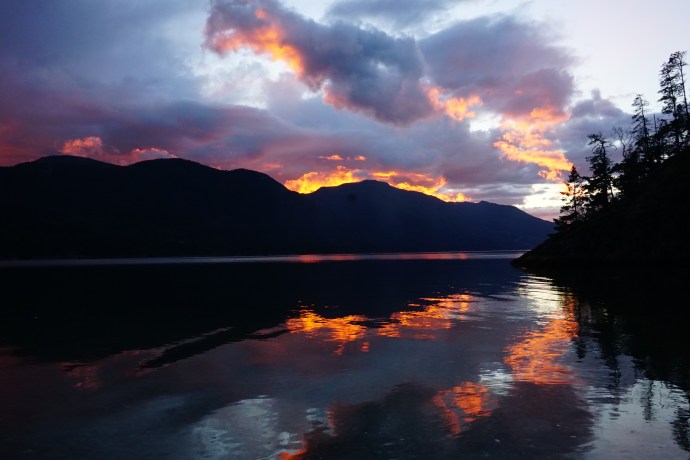
I feel like I’ve gotten a lot more experience with mountain storms this year. They kind of swing in out of nowhere and they don’t really last very long, but they can dump some pretty intense rain on you. We tried to wait it out in the tent, but we were pretty hungry, so we set up a tarp shelter and cooked our dinner while watching the rain clouds move up and down the inlet. We were concerned we weren’t going to get to have our campfire afterall, but the rain finally stopped after about 2 hours and Seth got a lovely campfire going for us while I watched one of the most intense sunsets over the mountains. It was so red it honestly kind of looked like the trees were on fire!

We finished the trip on Monday with a pretty leisurely paddle back to rental company. We got lucky again in that the water was dead calm when we started our kayak back. The wind did start to pick up a little in some sections on the way though and it was a great lesson in how much harder a little headwind can make a paddle. Overall though, nothing too strenuous.

So our first kayak trip was a huge success and I think it’s something we’ll definitely start doing a least once a year. Personally I’m still more of a fan of backpacking, but I really enjoyed getting on the water and trying something new! We definitely saw a lot more wildlife in the kayak and the bio-luminescence was one of the highlights for me!


This slideshow requires JavaScript.