I was hoping to explore several new trails this winter, but life and avalanche conditions got in the way of most of my plans. In a last ditch effort to enjoy the snow before it disappeared completely, I decided to snowshoe up to Black Mountain on Cypress. For such an easily accessible trail, I’m surprised I haven’t ventured up there before!
Seymour and Hollyburn appear to be the most popular trails for snowshoeing near Vancouver, but there are a handful of trails near Cypress Resort that seem to get overlooked by the masses. Don’t get me wrong, they’re still busy, but the crowds seem tiny in comparison to the highway of hikers going to Dog Mountain on any given winter day.
When visiting Cypress, your first stop needs to be the Black Mountain Lodge. This is the lodge located towards the back of the main parking lot, not the ski lodge. This lodge serves a variety of functions, but one of them is a self-registration point for hikers. Whenever you’re going into the Cypress backcountry, you need to stop here and pick up a free hiking pass to attach to your bag. In addition, it’s a really nice facility, with a heated picnic room and flush toilets.
The two most popular trails from Cypress are Bowen Island Lookout, which is a great beginner trail, and Black Mountain, which is more advanced, mostly because it’s longer and steeper. If you’re really adventurous, I think some people continue past Bowen Island Lookout up to St. Mark’s, but I don’t recommend this without adequate experience and avalanche safety training because it is adjacent to challenging and complex avalanche terrain.
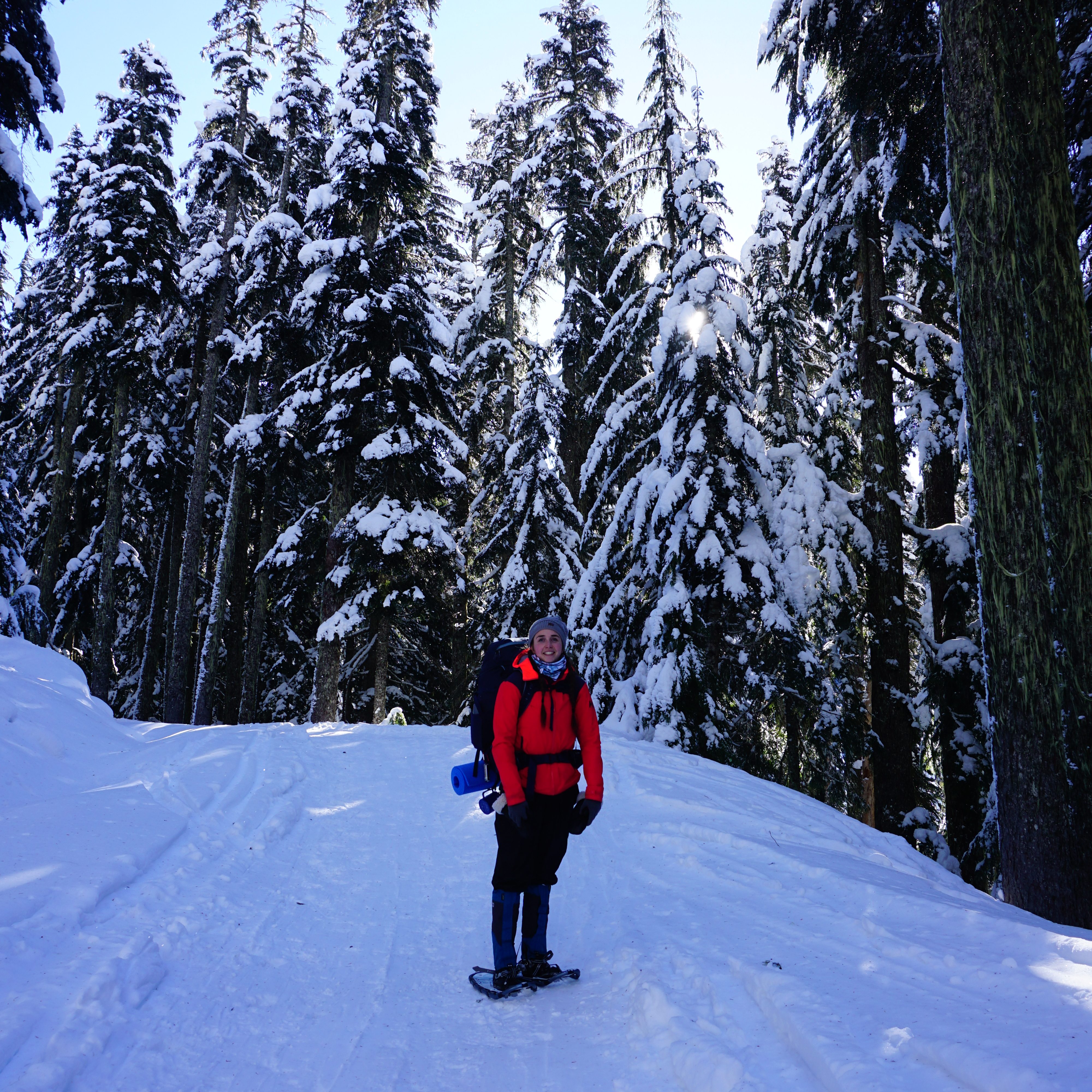
The Black Mountain trail follows the edge of the ski runs from Eagle Chair up to the top of the mountain. People do come up here on touring skis to ski down through the resort, but it’s fairly steep on the uphill, so be prepared for a slog. The snow was melting quite a lot when I snowshoed up there in early March, but it was a beautiful sunny day to be outside. It’s not an overly long trail – we tracked 6km round trip on my GPS, including a small loop at the top.
The trail is staked up to the top and it should be noted that the winter summit is different that the summer summit. If you continue around the loop at the top of the mountain, you’ll reach the winter summit. I was keen to also explore up to the summer summit, which branches off the main trail, but the snow was a bit slushy and we only had microspikes (not snowshoes). We started post-holing almost immediately and quickly abandoned the plan.
We stopped at the summit for a snack before finishing the loop. If you want to ski down, there is a side trail to the resort, but we didn’t check it out. You can also continue further to Eagle Bluffs, which is primarily in simple avalanche terrain, except for the summit. I haven’t done the Eagle Bluffs trail, so I’m not sure if that trail is also staked. We could see that it was not as frequently traveled as the Black Mountain trail and we would have been post-holing on that trail too without snowshoes.
Instead we just continued back downhill to the base after enjoying a nice day in the sun! It is a dog friendly trail, which was nice, so Sadie and Jasper joined us for the adventure. Overall, I don’t think I liked the trail as much as Bowen Island Lookout, Brockton Point, or Hollyburn, but it was definitely an easier trail than Hollyburn and comparable to Brockton Point in terms of difficulty. I would definitely pick Black Mountain over Dog Mountain though, as I find Dog Mountain too crowded.
In conclusion, it’s not as adventurous a trip as some of the plans I had to cancel, but it was really nice to get outside and hike somewhere new! We celebrated with a stop to The Shed on the way down the mountain to enjoy some delicious flatbread pizza and gorgeous views of the city!
Camping is one of my favourite things to do in the summer, so I would always be sad when the season ends and I’d have to wait a whole year to sleep in the backcountry. I quickly came to the conclusion that I didn’t need to wait and decided to get into snow camping!
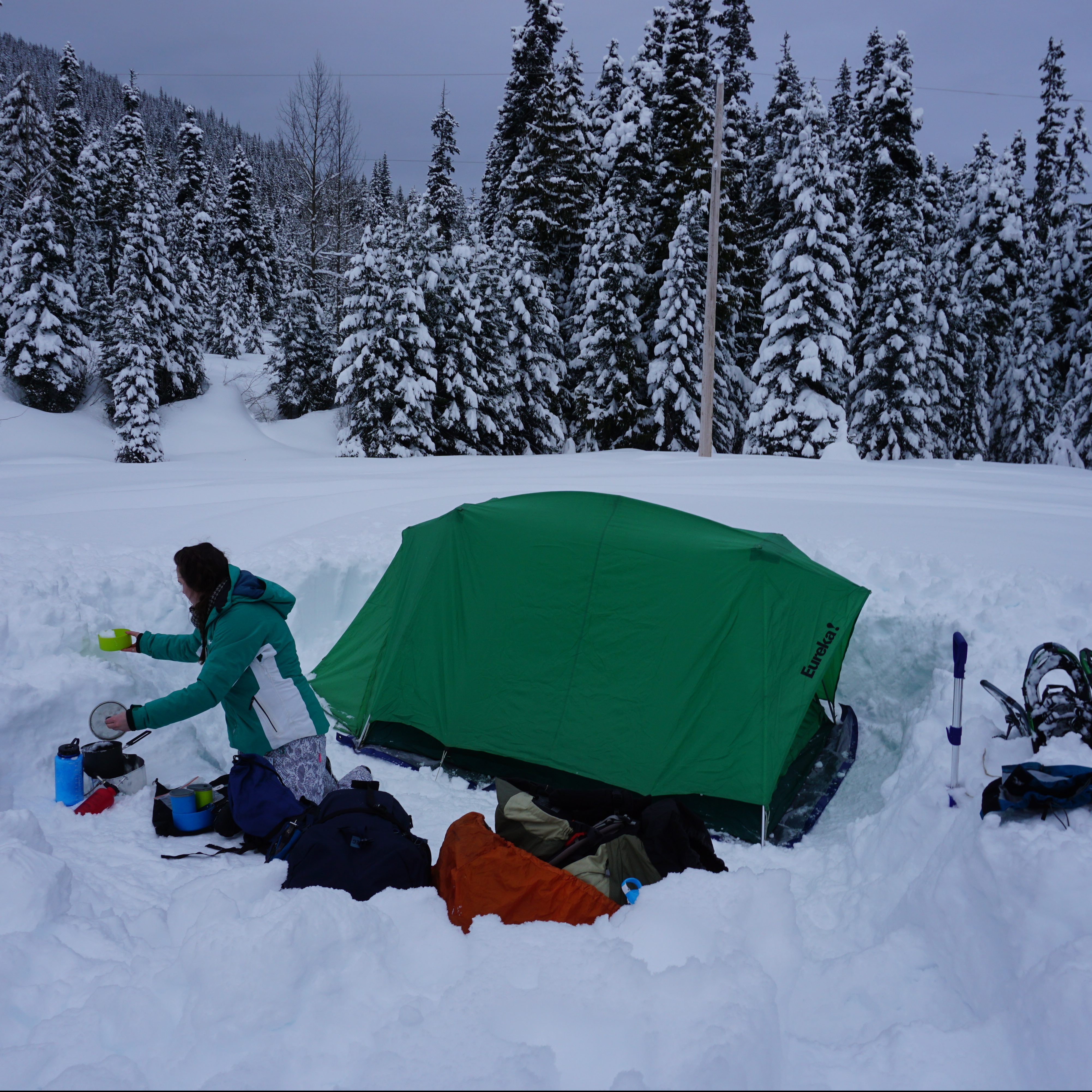
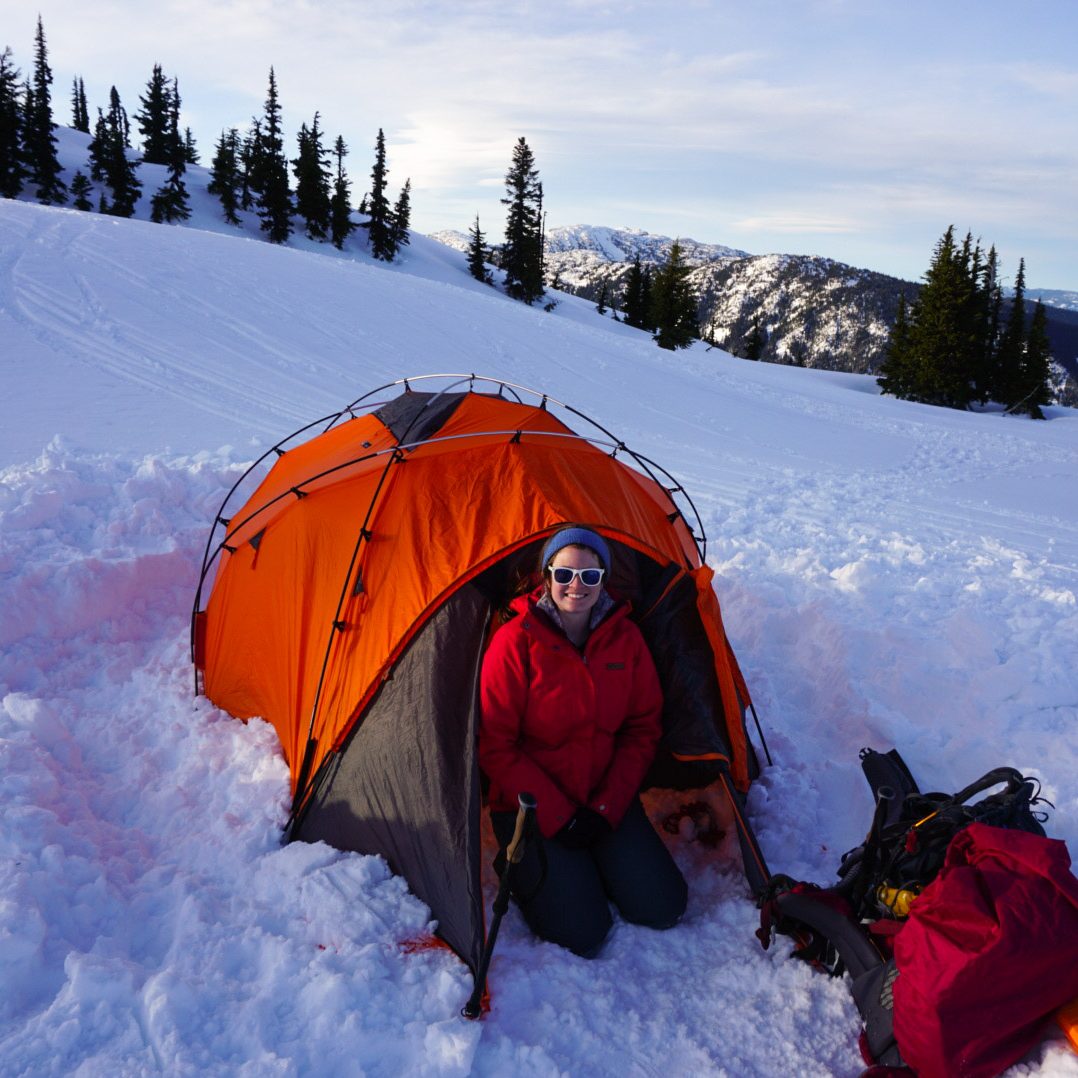
It’s definitely not for the faint of heart. It is much more intensive than camping in the summer and it is a lot of work to stay warm. Not to mention, quality 4-season camping equipment is not cheap. I’ve written an entire guide to winter camping and how to stay safe and warm. Once you’ve established you’re ready to try winter camping, the next dilemma is assessing where to go! First check out my guide to avalanche safety and then take a look at some of these recommendations.
This is my number one pick for snow camping if you’re brand new to it. The Lone Duck I Campsite is located in Manning Park and is a first-come-first-serve site through the winter. It has a field for tenting and a communal hut with a woodstove for eating and hanging out. You do need to bring your own firewood, but the benefit is that this campsite is only a couple hundred metres from your car. So if you don’t have the money to invest in quality winter camping equipment, you can just lug in a bunch of gear from your car and not have to worry about fitting everything in your backpack. The site is located right next to Lightning Lake and has immediate access to cross-country skiing and snowshoeing trails. Permits are available through camping.bcparks.ca
As the name suggests, this is a group campsite, so if you’d like to use it, please make sure you actually have a group. But if you do, this is one of the easiest and closest options to Vancouver for snow camping. Its located off Mount Seymour road, just below the ski resort. The site is a large field with a warming hut and outhouse, only 100 metres from the parking lot. Similar to Lone Duck, you can use the hut to keep warm and it’s easy to carry in lots of warm gear. Reservations are required and can be booked through camping.bcparks.ca
Falls Lake is my top pick for beginners that want to go backpacking because it’s only a short hike from your car. It gives the illusion of remoteness, but in a pinch, if you’re really cold in the middle of the night, it’s not too far to hike back out. Falls Lake is located off the Coquihalla Highway at the exit for Zoa Peak. In the summer, you can drive almost to the campsite, but the road isn’t plowed in the winter, so it’s a short ~2km hike to the lake along the unplowed road. There is an outhouse at the lake and reservations or permits are not required.
Lightning Lakes is another great option for snow camping when the lake is frozen. In the winter, the lake usually completely freezes except around the bridge between the first and second lake. Technically, there’s no official campground here, but there is some open forest area at the end of the second lake (~3km hike) where you can set up camp. I know some people will head as far as Flash Lake to get access to the summer campsites, but the trail to Flash Lake is adjacent to steep terrain where there could be overhead avalanche risk, so I haven’t gone past the end of the second lake. There is no outhouse, so only consider this location if you’re comfortable digging winter catholes. A permit is required from camping.bcparks.ca
Red Heather
Red Heather hut is located halfway to Elfin Lakes in Garibaldi Provincial Park. You can’t camp here in the summer, but snow camping is permitted in the winter. It’s a 5km hike up an old forestry road to get to the site. This hike is a bit longer than the other beginner options and is all uphill, but I include this in beginner backpacking because there is both a warming hut and an outhouse at this site. You cannot camp in the warming hut, you must set up somewhere in the meadow, but it’s a great option to have access to the hut. Chains are required to drive the last 2km to the trailhead (or you can park at the lower lot) and a backcountry permit is required from camping.bcparks.ca
Ottomite Peak is located off the Coquihalla Highway at the Zopkios Rest Stop. This trail is a bit longer than the beginner trails noted above and has uphill travel to the peak, but overall it’s not a challenging trail. It’s ~4.5km along an old forestry road and it passes through simple avalanche terrain only. There is no official campsite, but there’s a nice place to pitch a few tents at the top of Ottomite Peak. The area is more popular for ski touring, but I was the only one camping there where I visited. There’s no permits for this option, but also, no outhouse.
Zoa Subpeak is also located off the Coquihalla Highway and shares the same trailhead as Falls Lake. Park on the side of the road and hike in over the unplowed forestry road. Once you reach the summer parking lot, you can hike up along Pipeline Road until you hit the winter trail to Zoa Peak through the trees. The key with this trail in the winter is to only head as far as the subpeak, which is ~5km. The trail to the subpeak is a bit steep through the trees, but it’s all in simple avalanche terrain. The trail to the actual peak goes through challenging terrain, so I don’t recommend it. There’s lots of open space near the subpeak to camp for the night and I’ve heard it has better views than the actual peak. There’s no permit required, but again, no outhouse available either.
Poland Lake is located in Manning Provincial Park and has an actual campsite. The winter route to the campsite is a bit tricky because you can’t park at the ski resort overnight, so you have to park at Strawberry Flats. You can either walk along Gibson Pass Road, or you can take the trail that runs parallel to the road. However, it’s important to get off the trail partway to avoid going through the middle of the ski resort. You have to hike along the side of a beginner ski run to get up to the official trailhead. This trail is all in simple avalanche terrain, but I noticed a fair bit of overhead avalanche risk when I visited, so I think it’s better to have AST. The campsite is on the far side of the lake, but we opted not to hike across the lake, so I can’t confirm if there is actually an outhouse there. This trail is almost 8km, so it’s definitely a more challenging option due to length. A backcountry permit is required from camping.bcparks.ca
Elfin Lakes is a very popular campsite, which people can misconstrue to mean that it’s safe to go there. In the winter, you can opt to either book the hut (which is very popular and books early), or camp in the snow. At 11km, this is by far the most challenging trail on the list. 11km may not seem that long, but it can be very tiring in deep snow with a large pack. Plus, a lot of the trail is located along the ridge, which can be windy and have poor visibility. But the main thing to be aware of is that this trail passes through challenging avalanche terrain, so I don’t recommend it without AST. If you are comfortable in avalanche terrain, I highly recommend this campsite and trail, as both are very beautiful. Reservations are required for the hut and a permit is required for camping from camping.bcparks.ca
Pump Peak
I left Pump Peak for last because this trail and peak are both located in challenging avalanche terrain (whereas Elfin Lakes just passes through challenging terrain). Pump Peak is a super popular trail due to its proximity to the city and the incredible views. It definitely attracts a lot of people without AST, but I don’t recommend camping here without it. It’s a great option if you want to stay near the city, but I wouldn’t consider it a beginner trail. Once you feel comfortable in avalanche terrain and camping, check this one out. Permits are not required, but you do need a day pass in order to park at the base of the mountain, available at camping.bcparks.ca
Are you tired of reading about my trips to Elfin Lakes yet? I’ve visited Elfin Lakes more than any other trail, but I’m still not tired of writing about it because I feel like every time I go there I experience something new!
Despite having spent a lot of time at Elfin Lakes, this was only my second time going there in the middle of winter, and it was my first time actually staying in the hut! So it prompted me to kick off a new blog series about BC’s extensive hut system. Aside from the Sunshine Coast Trail, which has a 180km network of huts, and Tetrahedron, I believe this was my first time staying in a hut, especially in the winter. So it might take me a bit of time to build up some hut content, but we all start somewhere! After many years of thinking about it, I finally signed up to be a member of the Alpine Club of Canada, so I’m hoping there will be a few more hut trips in my future.
But let’s talk about Elfin Lakes! If you’re not familiar, it’s a very popular trail in Garibaldi Provincial Park. You can visit it any time of year as a day user, but you do need a reservation and permit to camp overnight in the park. These are fairly easy to get on weekdays, but if you want to visit on a weekend, make sure you book as soon as the reservations release, which is 4 months before your desired trip dates. My friend Victoria took care of the bookings for us and 4 of us planned to go up to the hut during the first weekend in January.
The parking lot for Elfin Lakes is called the Diamond Head Parking Lot, and from there it’s an 11km hike to the shelter. In the winter, snow tire chains are required to reach the parking lot. You can drive most of the way there with winter tires, but the last 2km are steep and chains are mandatory. If you don’t have them, you can park at the lower lot and add 2km to your trip. We drove in Brandon’s 4runner and made it all the way to the trailhead.
The first 5km of the trail is super easy. It follows an old logging road up to the Red Heather Hut. It’s a fairly wide trail through the trees. There was fresh snow when we visited, so it looked really scenic, but sometimes the snow does melt at the lower elevations, so while it’s a gentle incline up to Red Heather, there’s not always snow all the way from the parking lot. Red Heather Hut is a picnic hut for day use only (you can’t camp in it). It doesn’t see much use in the summer, but it is really popular in the winter. From December to April, you can get a backcountry permit to snow camp at Red Heather (or Elfin Lakes), and these usually don’t sell out. The permits for the Elfin Lakes shelter will sell out on weekends.
Red Heather is most popular for day users in the winter. From Red Heather Hut, it’s another ~1km to hike up to the top of Round Mountain, which is really popular among backcountry skiers and split-boarders. People put skins on the bottom of their skis to climb up to the top of Round Mountain, and then ski a few laps down to the hut, before returning to the parking lot. The last time I visited Elfin Lakes in the winter was in 2019. We snowshoed to the lake and snow camped outside the shelter. This time, I hiked up on touring skis! There were 4 of us in total, me and Victoria were on skis, while Brandon and Emma were on split-boards.
We stopped at Red Heather Hut for lunch and then continued our hike up to the top of Round Mountain. This is the steepest part of the journey and we were pretty tired by the top we reached the top. We didn’t do any skiing from Round Mountain because we had to continue another 5km to reach the Elfin Lakes shelter.
Because Elfin Lakes is so popular, it’s easy to think that means it’s a safe area. It is relatively safe. I don’t think the trail is in avalanche terrain at all up to Red Heather Hut, but after the hut, there is definitely some avalanche risk. The first time I snowshoed there, I didn’t have my AST training and was definitely taking a risk by hiking there. Now that I know better, I wouldn’t recommend it. Get your AST1 and avalanche safety equipment before attempting to visit Elfin Lakes. I’ve written a whole blog post on avalanche safety as part of my Let’s Talk safety series.
The avalanche risk was moderate on the day we visited. The two sections of trail where you need to exercise extra caution are: around the back of Round Mountain and around Paul’s Ridge. The section behind Round Mountain in particular goes through challenging avalanche terrain. We all had beacon, probe, and shovel, and once we hit this section, we put more distance between each other as we crossed through the more technical terrain. I was leading at the time, so I would go through a section, wait for Victoria to clear it, and then proceed to the next section while she waited for Emma. We did this section by section to ensure that if there was an avalanche, we wouldn’t all be buried.
We’re all relatively new to touring – it was their first season for Brandon, Victoria, and Emma. Brandon and Emma struggled on the way to Elfin because they are both boarders and still getting used to being on skis, so it was good to have the group split in half. Me and Victoria mostly looked out for each other, while Emma and Brandon did the same. The last 5km are easier than the first half of the trail, it’s more flat, with small uphill and downhill sections, but it took the boarders some time to adjust. That said, they improved really quickly and we made much faster time on the way back!
One thing to be wary of when visiting Elfin Lakes is that there is a different trail from Round Mountain to Elfin Lakes in the winter. BC Parks stakes the entire trail, so it’s very easy to follow, but if you’re relying on GPS, make sure you upload the winter trail and don’t try and follow the route for the summer trail. This section of trail is incredibly scenic and it was my favourite part of the day. Unfortunately, it was completely overcast on our way there, so we didn’t see any of the surrounding landscape, but it wasn’t windy, so the conditions were good. It was quite windy when I snowshoed there in 2019, which makes for a much more challenging traverse.
It’s a lot more fun crossing this section on skis. There’s a fair bit of downhill on the way to the shelter. Not enough to remove your skins and clip into your skis, but it made it a lot more fun to travel across the ridge. Everyone had a few wipeouts along the way! We dubbed our new ski club, “the turtles”, because you look/feel like a turtle whenever you wipe out due to the weight of your overnight packs pulling you backwards. Plus we were ecstatic to realize there were 4 of us and that we matched the 4 teenage mutant ninja turtles! (I’m Raphael)
It took us ~6.5 hours to get to the hut, including our lunch break, so we were traveling at a speed of ~2km/h. Once the split-boarders get a little more experienced, I think we could probably shave an hour off the time (every time you wipeout, it takes a while to unclip from your skis and get ready again, especially with the overnight pack). We arrived at the hut around 3:30pm in the afternoon and spent the rest of the evening relaxing! It’s a two story hut that can sleep ~30 people. There’s a bunch of picnic tables on the main floor, along with shared propane burners and a propane furnace. There are lots of large pots to use for melting snow and people mostly used the communal pots and burners as a shared resource for melting snow for drinking water. Generally, everyone could help themselves to the water and then just add some more snow to the pot. Most people had their own stoves for cooking food.
Emma brought a wheel of camembert cheese to share, along with bread and charcuterie! She baked the cheese wheel and it was a delicious afternoon snack! We took it easy for the rest of the evening, played some cards and ate dinner. Most people at the hut were on skis, but there were a few snowshoers there as well. Given that there were 30 people in the hut, I was expecting that there would be at least a few noisy partiers and was prepared to not sleep well. So I was thrilled when it turned out everyone at the hut were early-to-bed campers! The hut was completely silent with everyone in bed by 8:45pm!!! I still didn’t sleep well, but there were no really noisy snorers, so it was really the best sleeping conditions we could have hoped for.
As a result, everyone was also up early for a big day of touring. Some people continued to go skiing around the Saddle, but most people were heading back to the parking lot. We had a bit of a slow start after Victoria had a mishap with her breakfast. She frantically woke us up with the choice phrase of, “we’ve been robbed!”, which left us all a little confused as she tried to explain exactly what had happened.
She had brought a huge breakfast to share with Brandon and Emma (I declined on this occasion because I was trying to keep my pack light). She hung her food bag high on the porch to keep it cool overnight and unfortunately something walked off with the entire bag of food! We thought the only visitors would be mice, but there’s obviously some other animals prowling the area. My guess is it was either a bobcat or a lynx. We felt really bad about an animal getting access to human food and the plastic waste that will now be somewhere in the wilderness, but all Victoria was able to find were a few small scraps of her dry bag. So a lesson learned for us!
Fortunately, we all were prepared with extra food (especially Emma, who brought 3 extra sandwiches out of fear of excessive hunger), so it wasn’t hard to scrounge up a substitute breakfast. We ended up leaving the hut around 11am and the return trip was a lot faster. In contrast to the previous day, we had amazing conditions! It was a sunny, blue sky day and we could see the breathtaking views of the Garibaldi backcountry! There was a little bit of fog moving around throughout the day, but it honestly just made the views even more scenic. I loved skiing along the ridge back to Round Mountain.
Once we got around Round Mountain, we stopped to take off our skins and strap into our skis (and boards). From Round Mountain, it’s all downhill back to the parking lot, so we were able to properly ski. The section from Round Mountain to Red Heather is the most exciting, with lots of open area to explore. There was A LOT of powder. It might be the most powder I’ve ever skied, which sounds exciting, but was a new challenge to manage. Victoria and Emma blasted down to the hut, but I took my time. It was really fun in the powder, but it is a challenge to balance with the overnight pack. I did have one pretty spectacular wipeout where I picked up too much speed and my pack tipped me over when I tried to turn.
We ate lunch at Red Heather Hut again and it only took us about a half hour to ski the 5km back down the logging road to the car. The sun was definitely heating up the trails and it felt like spring skiing. There wasn’t as much snow as we approached the base and I had to avoid a few thin patches. But the lighting through the trees was gorgeous and we all had a great time despite the aching thighs!
I feel like this trip was very much the realization of a dream I’ve been working on for the past 3 years. I’ve always been intrigued about touring, but I was intimidated by it for a long time and didn’t want to invest in the equipment. When I decided to replace my downhill skis 3 years ago, I knew it was time to finally get a backcountry set-up. I loved pretty much everything about this trip!
The conditions were amazing, the company was fantastic, and the views were gorgeous! As fun as it is to go downhill, traversing the ridge ended up being my favourite part of the adventure. I felt a lot more confident on my touring skis and it was more fun than snowshoeing. Even though the ridge is fairly flat, it’s somehow way more fun on skis! I’ve always wanted to stay in the Elfin Hut and it was a great first overnight touring trip. I felt that we were all safe and made good decisions. I absolutely can’t wait to keep exploring on my skis, improve my skills, and have more adventures! Thanks for coming along for the ride!






 The Road Goes Ever On