Desolation Sound Kayak Trip Part II

Despite the name change in the blog title, this post is a continuation of my last post about Copeland Islands Marine Park, as I visited both parks in the same trip. Read Part 1 here.

I will admit that the wind gave me a lot of anxiety on this trip. I’m definitely a fair weather paddler, and while I’ve been out in less-than-favourable conditions, I’ve never paddled in outright dangerous conditions. It was surprisingly windy overnight, which made me a bit nervous for our second day of paddling, but the wind forecast wasn’t that high and it did calm down throughout the day. I’m used to the wind being calm in the morning and coming up in the afternoon, so that was an interesting change to have it reversed.

20230520_103252

We still got up reasonably early (7am) because we wanted to launch the boats while the tide was still high. Once the tide starts to go down, you lose the channel exit from our campsite and it adds a bit of extra paddling, plus you have to load the boats and gear further down the beach.

Fortunately, our timing was right on and we paddled out through the channel around 9am with just enough clearance to get over the newly forming beach. We crossed back over to the Malaspina Peninsula and said good-bye to the Copeland Islands as we made our way to Desolation Sound. There were some cool cliff features along the way, just past Bliss Landing, and we quickly arrived at Sarah Point, which marks the beginning of both Desolation Sound Marine Park and the Sunshine Coast Trail. It was a bit of a bittersweet moment for me as I have very fond memories of hiking the SCT last year and I loved seeing the Sarah Point hut again.

20230520_093410
20230520_095516

We had a quick break further along the beach at Sarah Point before continuing around the headland to Feather Cove, which is also on the SCT. It got a little windier as we rounded Sarah Point, but nothing to be concerned about. We spotted our second sea lion and then took in our first glimpse of the jaw-dropping beauty of Desolation Sound. I wasn’t able to successfully identify the mountains, but there are some gorgeous snow capped peaks in the distance as you first enter the Sound.

20230520_135657

We took another short break at Feather Cove before crossing Okeover Inlet to Zephine Head. The Inlet crossing was fine and the tide was rapidly dropping, so we were able to pull out at a beach just around the Head. At high tide, you might have to continue into Galley Bay for a pull-out though. We had our lunch there and since the conditions were favourable, we decided to do a direct crossing to Mink Island.

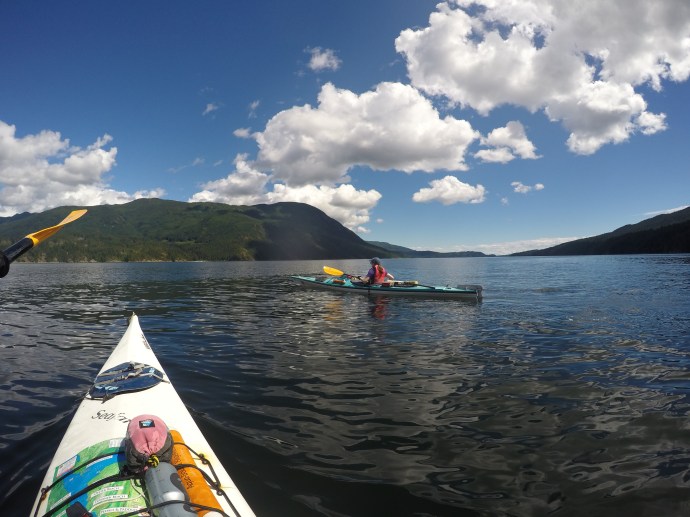
It’s about a 3km paddle from Zephine Head to Mink Island in open water. We tried to stay close to one another on the crossing, but the wind definitely picks up the further out you get, so I finally dropped my rudder and that helped me maintain my course a lot easier. Seth is pretty opposed to his rudder and never uses it, so he had some trouble staying on track. We managed to correct this the following day (which was windier), by both dropping our rudders and having Seth paddle directly behind me (since I’m the slower paddler) instead of trying to paddle side by side. Whenever we go side by side we tend to get separated, so this system worked better for us.

20230520_100200
20230520_130756

That said, it was still a pretty good crossing. The wind was low and we didn’t have any trouble making it over to Mink Island. Once we got to Mink Island, we had the wind working with us, so that was nice. Unfortunately, there weren’t a lot of good looking places to stop along the island, so we powered around the corner of the little arm on Mink Island (sorry I don’t know the name) and had a nice rest in the sheltered bay.

From there it’s not much further to the Curme Islands, which are the most popular attraction in the park, at least as far as I can tell. At the end of Mink Island, there are 3 small islands: South Curme, East Curme, and West Curme. The water was super calm at the end of Mink and around the Curme Islands, so we did a little paddle around each island. It was Seth’s turn to pick our site and he opted for East Curme Island, which I think was an excellent choice!

20230520_101046
20230520_134603

West Curme Island was really busy when we arrived, so I think that one might be the most popular. There was just one group on both East and South Curme, though a lot of people showed up to South Curme by motor boat later in the evening. But no one else joined us on East Curme, so it was just us and the other group (which is surprising considering it is the biggest of the 3 islands). We had a lovely site looking out to South Curme and Bold Head, and climbing up to the top of the island, another nice view looking down at West Curme.

The tide was very low when we arrived again, but in contrast to North Copeland Island, it was a more challenging landing. It wasn’t hard at low tide, but it’s a bit of a climb up to the island and at high tide, there’s no beach at all. There was just enough room for 4 kayaks between us and the other group, so I’m not sure where everyone stores their boats when the campsite is full.

20230521_064232

Instead of dragging the boats up the rocks, we opted to tie them on and let the tide slowly float them up to the landing. It worked really well and when the water reached high tide around sunset, we popped them up on the bank.

After unloading the boats, we were really warm, so we opted to go for a swim almost immediately. Like Copeland, the water was incredibly warm, though there was a lot of seaweed floating around with the low tide. Even Seth went for a swim and we were in the water for the better part of a half hour. We had landed on the island around 2:30pm, and after our swim, I spent the rest of the day doing absolutely nothing. Seth had a nap and I just enjoyed drinking my ice tea and watching the seals play while the tide came up.

20230520_154453
20230520_205122

Seth wasn’t as excited about a sunset paddle on this day, but I convinced him to go out for a half hour since you can’t really see the sunset from East Curme. The water was calm again and it was approaching high tide, so we paddled in and around all the islands before calling it a night. We slept with the fly off again and set our alarms for 6am to get an earlier start on the following day.

This was on account of those winds I mentioned earlier that were making me anxious. The wind was supposed to come up a lot on our 3rd day and I was nervous about the big open water crossing. We discussed it in the evening and decided we would take the long route back to our next campsite. There’s two benefits to this. The first is that you get to explore new terrain by circling Desolation Sound from the other side instead of doing the same crossing back along Mink Island. The second is that you avoid the big 3km open crossing, instead doing a 0.5km crossing from East Curme to Otter Island, and then a second 1km crossing across Tenedos Bay. The other benefit is that these two crossings are done at the start of your paddle, which would be early morning for us, resulting in less wind.

Here’s a screenshot of our 2 paddling routes for some context. I’ll cover the rest of the trip in the Part III!

Desolation Sound screen

Kayaking Sechelt Inlet

In the last year, along side all our other hobbies, Seth and I decided to start kayaking. We went on our first trip last year over the Canada Day weekend to Sechelt Inlet, and we’re planning a trip to Pender Island for the upcoming Labour Day weekend. I actually wrote this post last year after our trip to Sechelt, but for some reason I never actually got around to posting it (I admit, it takes me a really long time to upload photos and that’s what usually holds up my posts, not the writing). So here’s the post I wrote last year about that trip – hoping to follow it up with a post about our upcoming trip!

I don’t mind carrying a big backpack, but Seth hates it. He likes day hiking and camping, but as soon as you strap a pack on him he loses all interest. So we decided to try a kayaking trip so that we could get into the wilderness without Seth having to lug all his gear with him. I’ve heard Indian Arm is a great place for kayak trips, and it’s right next to Vancouver, but we decided to go a little farther away and started with a 2 night trip in Sechelt Inlet on the Sunshine Coast.

Before I tell you about the trip though, I have to recommend taking the beginner kayaking course from Paddle Canada before you attempt any kayak adventures. Seth and I have both been kayaking before, but I’m so glad we took the introductory course because we were going deep into the wilderness and I’m really glad we learned some basic paddling skills and how to save ourselves in an emergency. We did a 2 day course with West Beach Paddle in White Rock and I would highly recommend them. We’re thinking of going back next year to do the next level because they were so fabulous. We learned a ton of skills and how to rescue each other in the event that we tipped our kayaks. Safety first everyone!

Our first take-away from the course was that we wanted single kayaks. Doubles are so much cheaper, but they also involve a lot of coordination. Me and Seth are really different people and I have a bit of a control complex, so I’m glad we each had our own boat. I think it made for a much more enjoyable trip.

We took the ferry over to the Sunshine Coast early on Saturday morning and drove straight to Sechelt to get our kayak rentals. I was a little concerned about getting all our gear in the kayak, but those things are surprisingly large and we even had extra space in the compartments. It did take a little bit of coordination and jigsaw skills to make everything fit though, I’d recommend many small bags, instead of few big ones. The hardest thing to fit in was our 20L water jug because we brought all our water with us (although we didn’t even use half of the water we brought).

It was overcast and a little rainy when we started, but fortunately the wind was at our backs so we didn’t have too hard a go. Sechelt Inlet is really interesting because it’s only connected to the ocean through one small channel, so you’d think it would be pretty calm in there, but they can actually get some pretty strong headwinds up the channel. There’s also a ton of campsites in the inlet, but we didn’t want to push ourselves too far on our first trip, so we chose Nine Mile Beach as our camping destination since it was only about a 2 hour paddle.

We had a pretty leisurely trip out and stopped at Oyster Beach for our lunch. Nine Mile Beach is the biggest campsite I believe, which is why we picked it, but everyone else seemed to have the same idea and it was quite busy, so I’d maybe even recommend going for one of the smaller ones. I assumed they’d be full since they were so small, but they were actually empty. Halfway Beach is across the inlet from Nine Mile Beach and it is about the same size, but there were definitely less people staying there because it can be a lot of work crossing the inlet depending on the weather.

No fear though, we managed to get a great site at Nine Mile Beach! Most of the campsites are back in the woods, but we went down to the far end of the beach where there were less crowds and managed to find a small site at the very end just big enough for our tent and gear, with a great view of the beach. So we hauled our kayaks up above the high water line and set up camp.

The sun never really managed to come out on Saturday, but it did stop raining before we got to the beach and we spent the rest of the day chilling. I read about half a book and Seth (the biologist) had a great time exploring the low tide and flipping over rocks. I expected to see wildlife while we were out there, but I was surprised by just how much wildlife we saw! It was like a nature zoo! While we were eating dinner the birds gave us a great show. There were two seagulls that were hanging around digging up shellfish (cockles according to Seth) and they kept digging them out of the sand and then flying up high to drop them on the rocks to get to the meat inside. Plus, two black oyster catchers also showed up looking for mussels for supper, which thrilled Seth because they are the birds he is studying for his Masters and he doesn’t get that many opportunities to see them in the wild.

The highlight though didn’t come until nighttime. We heard some rumours you could see bio-luminescence in the water in Sechelt Inlet and our neighbour gave us a tip that you have to actually move to water to see it (we never would have figured this out ourselves). So we got up at 2am and fortunately the wind had totally died off and the water was very still, so we moved our paddles through the water and sure enough it totally lit up with glowing organisms! It was very cool! I was tempted to go swimming in it, but it was just too cold.

The weather cleared up a lot for us on Day 2 and the sun came out! There was still quite a bit of wind when we took off in the morning, but again, it was at our backs. Sechelt inlet has 2 side channels, Salmon Inlet and Narrows Inlet. Our main goal of the trip was to cross Salmon Inlet and visit Kunechin Islets and Kunechin Point. On a map it doesn’t look that intense, but it actually is a fair paddle to cross any of the inlets. It wasn’t bad on the way over with the wind at our backs, but I was a little nervous about coming back.

We wanted to visit Kunechin Islets because they are a protected seabird sanctuary and Seth wanted to see some seabirds. There weren’t actually that many birds around, but we definitely weren’t disappointed. We saw several eagles in and around the islet, as well as a half dozen oyster catchers (and lots of seagulls). We’re probably a bit partial to oyster catchers since Seth’s been studying them for years, but they really are precious! They sound like squeak toys and we enjoyed watching them.

The highlight for me though was the seal colony! Seth counted about 65 seals sunbathing on the rock when we approached. We tried to stay far enough away from the seals to not bother them, but most of them abandoned the rock into the water as soon as they saw us approaching (do feel a bit bad about this, but we really didn’t get that close). They were funny though because they all just watched us from the water with their little heads poking up. It was hilarious, but also a little foreboding because of the sheer number of them!

We had lunch on Kunechin point, which in my opinion had the best view and campsite. It’s located a little bit up on a hill and looks up both Salmon Inlet and Sechelt Inlet. It was empty when we were there, but there’s only 2 campsites there and some kayakers who were departing when we arrived informed us it had been totally full the previous night. I kind of wish we’d stayed there, but there’s very little beach at this campsite, so Seth preferred Nine Mile Beach.

Luckily for us, the wind dropped down entirely after lunch and we decided to paddle across Sechelt Inlet and visit Halfway Beach. The map of Sechelt Inlet is definitely deceiving and the crossing is a lot farther than it looks, but with the wind dropped down, it wasn’t a hard paddle. I really liked Halfway Beach – it has a lot of campsites and it’s brighter than the wooded campsites at Nine Mile Beach (and less busy), but again, Seth still thought that Nine Mile Beach was the best for wildlife. We collected some windfall branches in the forest to take back with us for a campfire (pre-fireban!) because Nine Mile Beach has pretty much been picked dry.

By the time we kayaked back across the inlet one more time it was about 3:30pm and we decided to take it easy for the rest of the evening. I had a really quick dip in the ocean, but I mostly just relaxed and did some reading while Seth did some more beachcombing. We were surprised just before dinner though by a mountain storm.

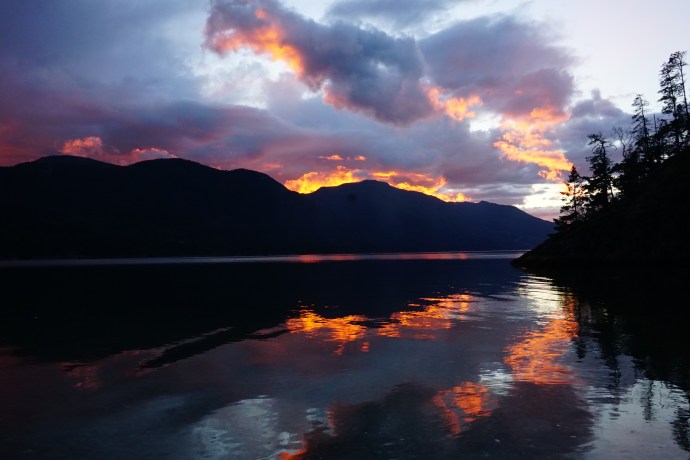
I feel like I’ve gotten a lot more experience with mountain storms this year. They kind of swing in out of nowhere and they don’t really last very long, but they can dump some pretty intense rain on you. We tried to wait it out in the tent, but we were pretty hungry, so we set up a tarp shelter and cooked our dinner while watching the rain clouds move up and down the inlet. We were concerned we weren’t going to get to have our campfire afterall, but the rain finally stopped after about 2 hours and Seth got a lovely campfire going for us while I watched one of the most intense sunsets over the mountains. It was so red it honestly kind of looked like the trees were on fire!

We finished the trip on Monday with a pretty leisurely paddle back to rental company. We got lucky again in that the water was dead calm when we started our kayak back. The wind did start to pick up a little in some sections on the way though and it was a great lesson in how much harder a little headwind can make a paddle. Overall though, nothing too strenuous.

So our first kayak trip was a huge success and I think it’s something we’ll definitely start doing a least once a year. Personally I’m still more of a fan of backpacking, but I really enjoyed getting on the water and trying something new! We definitely saw a lot more wildlife in the kayak and the bio-luminescence was one of the highlights for me!


This slideshow requires JavaScript.