Rockwall Trail Backpacking Guide

In the spirit of helping more people get hiking on some of western Canada’s most iconic trails, I decided to create a backpacking guide for the Rockwall Trail in Kootenay National Park. I hiked this trail over 3 nights in 2023 and had a fantastic time. I attribute most of the fun to my phenomenal hiking partners, but the beautiful scenery on the trail also made the experience unforgettable. I’ve already published a 2-part trail report, which you can read starting here, as well as a guide to Kootenay National Park. I’ve consolidated all of my Rockwall-specific knowledge here for those planning to hike the trail. Reservations for the 2026 season release at 7am PST on January 26, 2026 (8am MST).

The Trail

The Rockwall Trail is a 54km thru-hike located in Kootenay National Park in BC. You can hike the trail in either direction and there are several exit points that connect to the highway if you want to shorten your hike. The two main trailheads are located off Highway 93 at the Floe Lake and Paint Pots Trailheads. There are 5 campgrounds on the trail, with the most popular campsite at Floe Lake. Most people hike the trail over 3-5 days, depending on fitness level.

At 54km in length, the Rockwall Trail is not the longest trail in the Rockies, but there is a significant amount of elevation gain, so don’t underestimate it. The hike starts in the forest on both ends of the trail, climbing up towards the alpine, which runs between Helmet Falls and Floe Lake with 3 steep passes along the way. While Floe Lake is very popular, the trail takes its namesake from the large rock wall that runs between Helmet Falls and Tumbling Creek, which in my opinion, is the real highlight!

If you don’t like backpacking, you can visit Floe Lake as a day hike, but it is a 22km round trip hike, with 750m of elevation, so it’s a big day. I don’t recommend day hikes from any of the other trail entrances – unless you’re a trail runner – but the alternative trail entrances from Numa Creek and Tumbling Creek Trails offer the opportunity to shorten your backpacking trip.

PSX_20230903_210217

Time of Year

The best time of year to hike the Rockwall Trail is in the Summer or early Fall. If you go in late-June or early-July, be aware that there may still be snow on some of the trails. If you go later in the summer, it’s more likely that your trip might be impacted by wildfires. While most people prefer to backpack in the summer, late September is also popular due to the colourful larch trees near Floe Lake. However, you should be prepared for snow and cold conditions at this time of year. I hiked the trail at the very end of August and had great conditions.

Getting There

Unfortunately, this park is not accessible by public transit. Similar to other popular Canadian parks, the easiest way to access is by driving. The park is located on Highway 93, which is a 50 minute drive to the Floe Lake Trailhead from either Banff or Radium. The added challenge with the Rockwall Trail is that, because it’s a thru-hike, you will either need 2 cars, 1 at each trailhead, or plan to hitchhike between the two parking lots. I parked a car at each trailhead, which is the easiest option, but hitchhiking is not uncommon along this route and is relatively safe. I recommend making friends along the trail and looking for a ride from another hiker.

There is a large parking lot at the Paint Pots trailhead, but the Floe Lake trailhead is much smaller, so you may have to wait for a parking space to open up. I’ve also heard that break-ins are not uncommon at the Floe Lake trailhead, so make sure not to leave valuables in your vehicle.

20230829_123149

Permits

Like most popular hikes in the Rockies, securing your camping permits will likely be the hardest part of your trip. This is a popular trail and it attracts crowds every year. If you’re doing a day hike, you don’t need a permit for the trail, just the National Park Pass (discussed below). But if you want to try and get camping permits, then it’s important to mark your calendar with the permit release date.

The permit release date for 2026 is January 26, 2026 at 7am PST. Permits are $10 per person, per night (plus a booking fee) and they will disappear fast, so you need to be ready to book right when they release. I will try and update the release dates for permits every year, but they are usually announced by Parks Canada in late November or early December for the following year – so keep an eye on their page of release dates in future years. To make your bookings, visit https://reservation.pc.gc.ca/.

Once booking opens, select “backcountry” in the tabs along the top of the booking page, and then select “backcountry zone”. Next, select “Banff, Kootenay, and Yoho Backcountry” as your park and select your start date and access point. There are 3 options for access points along the Rockwall Trail: Floe Lake, Numa Falls, and Paint Pots. Numa Falls is only used if you’re doing a shorter version of the trail. If you want to hike south, select Paint Pots; if you want to hike north, select Floe Lake. If you have trouble getting your preferred itinerary, you can always try reversing direction or using different start dates.

Once you start your search, you will be forced to build your itinerary day by day. At the top of the page, you’ll see a dropdown menu where you can select your campsite and “add to stay”. Instead of building your itinerary this way, you can scroll down to the map and click on the “calendar” tab in the left sidebar to see a list of all available campsites per night. This is an easier way to see what’s available and build your itinerary. If you don’t see what you want, try refreshing or reversing your itinerary by updating your access point. People are constantly adding and changing dates and campsites in a rush to get their preferred itinerary, so the trick is to frequently refresh. Just because you don’t see a site available right away, doesn’t mean it won’t show up later if you keep refreshing.

My recommendation is to take what you can get and make changes later. If Floe Lake is not available, book Numa Creek and move on to the next day before those dates book up too. Once you have secured a booking for each of the dates in your itinerary, go back and look for cancellations. Keep refreshing until you see one, and then make a change to your booking to add it. This does cost more as you have to pay a small change fee, but it offers more flexibility in ensuring you at least get something. I wasn’t able to book Floe Lake when I made my original booking, but I was able to get a cancellation for it afterwards. You can track cancellations on Schnerp, which will notify you when a site opens up.

Here’s a few tips for getting your camping permits:

  • Get on the booking website 15 minutes early using as many devices as possible (computers, phones, ipads, etc). At release time, everyone on the website is entered into a random generator that assigns you a position in the queue. All of your devices will be assigned a place in line, then proceed to book your permits on whatever device has the shortest queue.
  • Once you get access, be flexible with both your starting date and itinerary. Use the “calendar” option to see available dates at each campsite. Consider shortening your itinerary by exiting on the Numa Creek or Tumbling Falls Trails.
  • If you don’t see any availability, keep refreshing for at least 15 minutes. With so many people trying to book campsites, dates are always disappearing and then becoming available again, so if you don’t see anything, keep refreshing.
  • Be prepared that you might not get what you want. Book alternative sites and sign up for cancellation notifications on Schnerp.
20230829_162446

National Park Pass

In addition to backpacking permits, which are specific to your campsite, you must also have a National Park Pass. These are much easier to obtain – there is no booking period and the number of passes are not restricted. The most common option is to purchase the discovery pass, which is available for $150 for a family, or $75 per person. It’s essentially an annual pass that covers everyone in your car. You leave it hanging in the car while you’re on the trail and it acts as a parking pass. If you have two cars, then you would need two passes. Alternatively, you can buy single adult day passes for everyone, which are $11 per person, per day. However, in 2025 and 2026, Canadians can obtain the Canada Strong Pass for free, which includes a free discovery pass and 25% off bookings! You can purchase passes online, in advance, or in person at the Kootenay and Banff park entrances.

Campsites

There are 5 backcountry campsites located along the trail, so there are multiple options for where to stay, which provides some flexibility when planning your itinerary and securing bookings. The campsites are pretty equally spaced along the trail, so it is easy to plan for a more relaxed itinerary, or you can plan your sites further apart if your itinerary is more aggressive. I’ll discuss itineraries below, but here’s an overview of the campsites running from north to south. They all include outhouses and bear lockers, and require valid permits for overnight use.

20230830_114825

Helmet-Ochre Junction – This is the most accessible campground on the trail, located 6km from the Paint Pots trailhead. It’s located along the river at a trail junction and has 6 tent sites. It’s a nice enough campground, but it’s often overlooked in favour of the more popular/scenic campsites. If you can’t get permits for Helmet Falls, this is a good alternative. It’s also a great option if you’re starting late in the day and don’t want to hike too far.

Helmet Falls – This is a beautiful campground located at the base of Helmet Falls, which cascades down the valley from Helmet Mountain. There are 18 tent sites and you can enjoy the view from the picnic area at the back of the campground. This is a great option to camp before or after you’ve hiked along the Rockwall.

Tumbling Creek – This campground is located at the bottom of the valley between Rockwall Pass and Tumbling Pass. There’s 18 tent sites and easy access to the river with nice views. This is a great option to camp before or after you’ve hiked along the Rockwall. You can also come direct to the campground along the Tumbling Creek Trail, which starts at the Paint Pots trailhead.

Numa Creek – This is the lowest elevation campground on the trail and is located between Tumbling Pass and Numa Pass. There’s 18 tent sites and easy river access. This is a great place to camp on your way to or from Floe Lake. You can also come direct to the campgound along the Numa Creek Trail, which starts at the Numa Falls trailhead.

Floe Lake – This is the most popular campground on the trail. If you can score a permit for this campground, do not hesitate to book it. The entire trail is very scenic, but Floe Lake is definitely the most scenic campground. It has 18 tent sites and is located 11km from the Floe Lake trailhead.

Itineraries

Planning this trail is pretty straight forward because it is a linear thru-hike. Your main decisions will be what direction to hike and over how many days. Here are a few recommendations based on how many nights you plan to spend on the trail. And here’s a useful trail graphic from Parks Canada, noting the distance between each campsite.
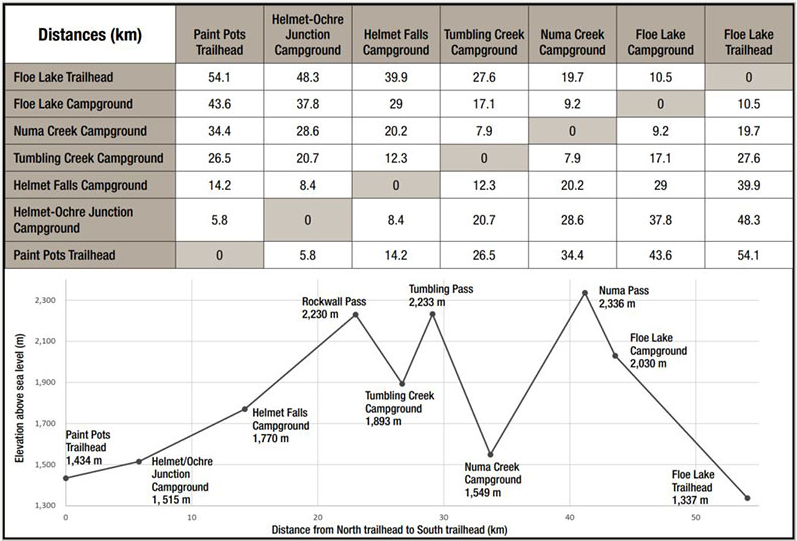
1-Night: Your best option if you only have 1 night is to camp at Floe Lake, hiking in and out from that trailhead. Add on 2km each way to hike up to the top of the nearby pass for a fantastic birds-eye view of Floe Lake. Alternatively, if you really want to see the Rockwall, you could spend 1 night at Helmet Falls and hike out via the Rockwall and Tumbling Creek Trail. You just have to be prepared for a big 20km day on day 2.

2-Night: 2 nights is probably the most awkward itinerary, because you can hike most of the trail, but it’s ambitious to do the whole thing. If you want to do the whole trail, I’d recommend camping at Helmet Falls and Numa Creek, which requires you to hike two 20km days back to back. If you don’t want to do the whole trail, hike north, camping at Floe Lake, followed by Tumbling Creek, and exit on the Tumbling Creek Trail. Or hike south, camping at Helmet Falls, followed by Numa Creek, and exit on the Numa Creek Trail. Hiking north allows you to visit Floe Lake, while hiking south allows you to hike the Rockwall. If you want to hit both, you have to do the whole trail.

3-Night: I did the trail in 3-nights, which I thought was a good length. Plan for your first and third nights at either Floe Lake or Helmet Falls (doesn’t matter which direction you go), and then your second night at either Tumbling Creek or Numa Creek. You will have one long day with this itinerary, but you can plan it around whether you’d like to have extra time at Floe Lake or on the Rockwall. I hiked south and camped at Numa Creek, meaning I had lots of time to relax at Floe Lake on my last night.

4-Night: This is the most relaxed itinerary. Do the trail in either direction and camp at Floe Lake, Numa Creek, Tumbling Creek, and Helmet Falls. You’ll have lots of time to enjoy Floe Lake, the Rockwall, and Helmet Falls.

20230829_150852

Kootenay National Park Guide

Let’s start off with a disclaimer – there’s a lot to do in Kootenay National Park – I’ve still only done a fraction of what there is in the park, but after spending a week there, I feel like I got a good idea of what a lot of the attractions are. There’s still lots for me to return and explore, but here’s some of my learnings after 1 week.

Getting There

Kootenay National Park is characterized by Highway 93. It runs through the entirety of the park and it’s from this highway that you access all the attractions. Put simply, you can either enter through BC or through Alberta. If you’re coming from Calgary (as we were), the obvious option is to drive Highway 1 through Banff and then take the exit for Highway 93. If you’re coming from BC, it’s the same distance from Golden to either park entrance, so it all depends on which direction you’d like to drive. You can access the park through Radium, which in my opinion is the nicer direction because that’s the official park entrance and you can get your park pass there. But there’s nothing wrong with entering through Banff National Park. Leave lots of time for your drive either way because there’s so much to see in the park!

20230902_142932

Where to Stay

Where to stay depends on what kind of sleeping experience you’re looking for. If you’d like to stay in a hotel, I’d recommend Radium. It’s right on the doorstep of the park and has lots of options for cheaper accommodations. You could also stay in Lake Louise or Banff, but be prepared to shell out a lot more money for these options.

If you’d like to camp, then there will be a lot more options available to you and you’ll be able to stay directly in the park. But you have to be prepared to book sites when they release around March because all of the National Parks are popular and they book up fast. See the next sections for more information on your camping options.

20230902_125850

Frontcountry Camping

If you’re new to camping, then frontcountry camping is what you’re looking for. These are drive in sites, so you can store lots of things in your car and they’re a bit easier to get to than backcountry sites. There are 3 frontcountry sites in Kootenay National Park – all can be booked through the Parks Canada reservation site, check early in the year for the date that sites will be released.

Redsteak Campground – This is the largest campground in the park and therefore the easiest to get into. it’s located very close to Radium. It has 242 sites and is usually open from late April to early October.

McLeod Meadows Campground – This site is located in the valley, along the banks of the river in the middle of the park. It has 88 sites and is usually open from early June to early September.

Marble Canyon Campground – Marble Canyon is a large attraction on its own and this site is located in the sub-alpine with nice mountain views. It has 60 sites and is usually open from late June to early September.

Full disclosure, I haven’t actually stayed at any of these sites, but I would like to try for McLeod or Marble one day!

20230902_135748

Backcountry Camping

Backcountry camping is my preferred method of camping, but it is a whole different beast than frontcountry. It revolves around hiking and you have to carry everything you need on your back, so you should only attempt backcountry if you’re aiming to complete a hike.

As far as backcountry camping goes, there are limited options in Kootenay. All of these sites are on the Rockwall Trail (a 54km hiking trail), with the exception of Verdant Creek (which is now closed). Though you don’t have to commit to doing the entire Rockwall Trail if you want to visit some of these sites, many have alternative entrances.

Helmet-Ochre Junction Campground – A small campground along Helmet Creek. It’s a 6km walk to the campsite. It’s a good stopping point along the Rockwall Trail or for a 1-nighter if you just want to visit Paint Pots or Helmet Falls. It’s pretty easy hiking to this site, good for beginners.

Helmet Falls Campground – A larger campground located at the base of Helmet Falls. It’s a 14km hike to the site and is most commonly used along the Rockwall Trail, though you could stop here for 1 night if you just want to visit the Falls. Alternatively, you could camp here for 2 nights and do a day hike up through the pass to the start of the Rockwall and back.

Tumbling Creek Campground – A larger campground located where Tumbling Creek meets the Rockwall. It’s a great place to stop on a thru hike of the Rockwall Trail, or you can do a 10km hike on the Tumbling Creek Trail. It’s a fairly gentle climb up to the campground. I haven’t done the Tumbling Creek Trail, but if I was to enter the Rockwall this way, I would plan to stay for 2 nights and day hike along the Rockwall.

Numa Creek Campground – A larger campground located on Numa Creek. It’s a great place to stop on a thru hike of the Rockwall Trail, or you can do a 6.5km hike on the Numa Creek Trail. It’s an easy trail to the campsite, but Tumbling Creek is closer to the Rockwall if you’re planning on day hiking there. As a thru hike, I recommend staying at Numa, but as a day hike, I’d recommend Tumbling.

Floe Lake Campground – The most popular campsite in the park. This campground is located right on beautiful Floe Lake. It’s a 10.5km hike up to Floe Lake with considerable elevation gain. It’s the most challenging hike on the list, but the most rewarding. A perfect end if you’re doing the entire Rockwall Trail.

Verdant Creek Campground – This site was extensively damaged in the 2017 wildfires and is no longer recommended. It was previously used as an alternative access to Egypt Lake in Banff National Park.

20230830_195556

Hiking

The Rockwall Trail – One of the biggest attractions in the park. This 54km trail is extremely popular and travels along gorgeous alpine terrain. Recommended as a 3-4 night thru hike.

Stanley Glacier – Another popular attraction in the park, this 11km trail can be done as a day hike and covers a lot of elevation gain. You can hike it on your own, or if you’re a fossil enthusiast, pay for a guided hike with Parks Canada!

Cobb Lakes Trail – A shorter trail on the west side of the park, day hike 5km and back to picturesque Cobb Lake for the day.

Dog Lake Trail – A fairly easy 7km trail that leaves from McLeod Meadows campground, with beautiful views of the surrounding valley.

Simpson River Trail – A flat and easy trail along the Simpson river, customized to your preferred length. The trail continues all the way to Mount Assiniboine if you’d like to hike 12km to Sunrise Creek Campground and continue on further.

Ball Pass Trail – I wouldn’t recommend this trail unless you’re backpacking and continuing on to Sunshine Village, in which case, this beautiful trail covers a lot of elevation gain and kilometres. Stay at the Ball Pass Campground or infamous Egypt Lake.

Arnica Lake – A very scenic trail that hikes down to Viewpoint Lake and then back up to Arnica Lake. It’s 10km in total and is very popular in the Fall when the larches turn yellow. (technically this trail is in Banff, but it’s so close to the border)

Boom Lake – Another trail in Banff, but Boom lake is a scenic 10km trail with moderate elevation gain to a gorgeous lake.

IMG-20230902-WA0004
20230902_135404

Roadside Attractions

Since I spent most of my time in Kootenay National Park on the Rockwall Trail, I was more keen to explore all the roadside attractions rather than do more hiking. We spent a full day driving the 100km of road between to the two park entrances and there were tons of attractions to keep us busy all day! Starting from Radium, here are my recommendations:

Sinclair Canyon – Towering canyon walls as you enter the park. Stop for some photos and walk along the pedestrian sidewalk through the canyon.

Radium Hot Springs – Gorgeous commercial hot spring and pool just within the park boundary. Perfect in the winter or on a cloudy day. Walkable from Redstreak Campground.

Olive Lake – Short walk to turquoise waters and a fish conservation area located in Sinclair Pass.

Kootenay Valley Viewpoint – Rest stop with panoramic views of the Kootenay Mountains and Kootenay River across the valley.

Kootenay River Day Use Area – Rest stop with a few picnic tables and an excellent view of the river.

Numa Falls – Short walk to a bridge under which the rushing Numa Falls are channeled to the Vermillion River.

Paint Pots – 1km walk each way to see the red ochre soil that makes up the traditional paint pots.

Marble Canyon – Go back in time along the 1.5km loop trail to see how Tokkum Creek has formed the canyon over thousands of years.

Continental Divide Rest Stop – Photo op where the Rockies collide, separating BC from Alberta, and the flow of water to the Atlantic and Pacific Oceans.

Vista Viewpoint – Technically in Banff National Park, but the last stop along Highway 93 with beautiful views of Arnica Lake.

20230902_143801
20230902_140847

National Park Pass

Before visiting, make sure you get your park pass either at the entrance in Radium, or when you drive through Banff National Park. You will need it to park everywhere inside the park. It’s $10 per person, per day, or you can get the family pass for the whole year for $145, which is applicable to all National Parks in Canada.

Rockwall Trail Backpacking Trip Part II

To read Part I, start here.

Day 3 very much felt like the second half of the journey to me. The total length of the trail is 54km (though we tracked 58km in total on my GPS). By the end of day 2, we had done 34km of 54km, so we had two much easier days ahead of us. Unfortunately, the weather was supposed to deteriorate on Day 3.

I checked a ton of weather forecasts before we left and they often contradict each other, so we weren’t sure what to expect. The original forecast had said a 60% chance of showers, but when I got a weather update from my inreach, the POP had increased, but wasn’t starting until 1pm. So we got up early to try and finish the 10km hike to Floe Lake before the rain started.

20230830_100836

It was overcast when we started hiking, but looking pretty good. It drizzled on us for a few minutes mid-morning and I put my backpack cover on, but then it didn’t bother us again for the rest of the hike. The trail from Numa Creek to Floe Lake ascends up through Numa Pass, with an elevation gain of ~800m. It was the biggest uphill of the trip, but similar to other parts of the trail, it was largely switchbacks, so it’s never overly steep. We made good time hiking up and decided to stop for a break at the top of the pass.

Coming up to the pass is very beautiful, with lots of larch trees. Before you get to the top of the pass, there’s a fantastic view looking back at the Rockwall and where you’ve come from, so that’s where we decided to stop. The downside is that it’s also the highest point of elevation across the entire trail at 2,336m, so it was quite cold up there. The rain was still holding off, but it’s very barren and nothing grows, it’s just a lot of rock, so it can get a bit windy.

20230830_114825

We continued on to the top of the pass, which is where you get your first view of Floe Lake! If you have the time, definitely linger in the pass for a while because it is incredibly beautiful in all directions. We took some photos with Floe Lake, but then continued on in an attempt to warm up.

While my plantar fasciitis was doing quite well, I was battling a second foot problem on Day 3. I’ve been wearing trail shoes for the past 2 years (meaning they’re short and have limited ankle support), so I switched to my mid-ankle hikers for the Rockwall Trail. They were fine for my injury, but I think I’ve been overcompensating with my left foot and my ankles got used to short shoes, so I ended up with a very large bruise on my left ankle from rubbing against the shoe. It was actually quite painful and resulted in a bit of a stabbing pain with each step on the downhill sections.

IMG_5442
IMG_5531

It’s all downhill to Floe Lake from the Pass, which is only a few kilometres, but it was quite painful on my ankle. I was really concerned about Day 4, which is all downhill for 11km, but after a bit of workshopping, I figured out it was less painful if I didn’t tie up my boots past my ankle and rolled my socks down to create a bit of a cushion. But I dumped the mid-ankle shoes after that and switched back to my short ones for the rest of my trip.

There’s no where to swim on the Rockwall Trail aside from Floe Lake, so me and Carolyn were pretty keen to swim there. The problem is that it was quite cold and we weren’t convinced it would be warm enough to strip down to our swimsuits. Fortunately, we worked up enough of a sweat on the way down that we decided to immediately make a swim attempt. We didn’t look for a campsite, but walked directly to the lake to immediately strip down and run in the water. Unfortunately, we didn’t pick the best swim spot, because it was very muddy and we sunk ankle deep into it, but we went in anyways and had a quick refresh before going to set up camp (obviously it was freezing).

IMG_5555
20230830_130306

Floe Lake is by far the most popular campsite on the trail and because it’s only 11km from the trailhead, lots of people visit as a day hike. That said, it was not at all busy when we were there. It was mid week and the weather was dicey, so it was a pretty quiet. The cooking area at Floe Lake is right by the lake and really nice. There’s 2 campsites with lake views, but the rest are way up in the woods, so we spent most of our time just chilling at the lake. The layout of the campsite is a bit odd and don’t rely on the site maps provided because they aren’t accurate. The outhouses are far up in the woods and there’s a few tent pad clusters around. The campground wasn’t full when we were there, but not too many empty sites.

Because I didn’t have to carry a tent on the trip (I shared Brandon’s), I decided to bring my tarp for Floe in case it rained. We caught up with our new friend, Jason, and set it up on the beach for lunch. It did drizzle on us a few more times, but later in the afternoon it actually started to clear up and we got a few glimpses of the sun poking out from behind some clouds. So we spent the rest of the afternoon just hanging out and doing a few photo shoots.

It was by far our most relaxing time on the trail and we hung out for several hours. Floe Lake is just another extension of the Rockwall, with lots of glaciers sitting up on the rock. They’re quite active and you can regularly hear and see bits of ice falling off the glacier. It was kind of nice to listen to it while you sleep, but at one point in the middle of the night it sounded like half the mountain had fallen off into the lake!

20230830_151718
IMG_5585

While relaxing we did spot a black bear on the other side of the lake. He was moving pretty quickly and we think he got scared by a few hikers that decided to hike around the lake. They never ended up seeing him at all though because he took off so fast and ran the entire length of the lake. We decided to start preparing our supper around 6pm, but our timing was bad because the wind picked up at the same time. It got really windy and it felt like the weather was getting ready to shift back to rain, so we ate and tidied up everything really quickly to get back to our tents before the it started.

We decided to all hang out in Brandon’s tent for the evening and I went there while Carolyn did a quick run to the outhouse. The rain never did materialize so I started doing a bit of journaling. But I was alone for a long time and I began to wonder where Carolyn and Brandon were. Eventually, Brandon showed up at the tent laughing to himself and started to gleefully tell me that Carolyn had a REALLY good story for me. He made it sound really ominous and I was convinced that she got cornered in the outhouse by a bear or something while I was obliviously writing in my journal. Brandon said they’d be back soon and I kept waiting for them with no sign of anything.

20230830_163046
PSX_20230915_194815

Eventually I gave up and went looking for them. I had to walk through the entire campground before I finally found them coming back from the lake with Jason. Carolyn looked mortified. It turns out, in her quick trip to the outhouse, she made a grave mistake. She keeps all her stuff for camp in a cross-body bag, including her toilet paper, and when she leaned down to close the toilet seat lid after using it, her inreach and kindle both slipped out of her open bag and fell in the outhouse!

I have to say, the outhouse at Floe Lake was particularly disgusting. It looked older and it was really dirty on the inside. She immediately had a panic attack after they fell in because she was alone and had to address the problem immediately lest someone else come along and poop on them. To her credit, Carolyn was more worried about the Leave No Trace aspect of her electronics in the outhouse than the actual monetary value of them. The outhouse wasn’t that deep (by which I mean, the gap between the seat and the waste wasn’t that far, maybe 5-6 feet). She managed to fish out her inreach fairly easily with a stick because the inreach has a carabiner and it was sitting on top of mostly toilet paper. She obviously sanitized it, but overall it wasn’t too dirty.

20230830_195556
20230830_204305

The kindle was another issue. You can imagine her relief when Brandon happened to show up at the outhouse with the intention of conducting his own business. Apparently her first instinct was to tell him to go and get me immediately, but then she reconsidered and said, “wait, no, Maria can’t help me. I need help now, you’ll have to help me!” For which I am grateful!

It took 3 tries, but the two of them were able to fish out the kindle using a pair of giant stick chopsticks, but Carolyn did have to go almost shoulder deep in the outhouse to reach it. They double bagged the kindle to deal with later, but she ended up washing it (and her jacket) in the lake because at the end of the day, she cared less about whether she would still be able to use the kindle and more about just not leaving it in the outhouse, even if she ultimately disposed of it.

So yes, it was incredibly gross and I think most people’s instinct would be to just leave it in the outhouse, but I do respect her for actually going in after it. It was mostly to assuage her guilt, but as Jason pointed out, “guilt fades, shame is forever”. That said, Carolyn claims that if she could go back in time, she would probably still do the same thing, but she’ll never be making that mistake again! However, we have stumbled upon a few articles since then about other people who have fallen into outhouses and got trapped while trying to retrieve items, and S&R recommends against this risk! So you do get a pass to just leave it if this happens to you. We spent the rest of the trip sizing up the depth of every outhouse we used to assess ease of retrieval!

PSX_20230831_203503
IMG_5681

After that the rest of the trip was somewhat uneventful. It didn’t rain all night, but then started to pour around 6:30am on Day 4. It rained for about an hour. We waited it out and then I got up as soon as it stopped to grab our stuff for a tent breakfast, but it didn’t rain again after that. We packed down our camp and readied for our final 11km descent back to the parking lot.

It’s pretty steep for the first 3km, but there’s still lots of switchbacks and it levels out a lot after that. It’s a decently nice hike back down through the valley with views across the mountain, but it’s all one massive burn zone, which puts a bit of a damper on the hike and is fairly exposed. It would be pretty rough on a hot day hiking uphill because there’s limited shade. The burn zone is from 2003, so it actually has 20 years of growth in it, but it’s still very obviously a burn zone because it takes years for the burned tree trunks to finally fall down. Knowing that the rest of the province was burning at the same time made for a somber hike.

IMG_7371

We only stopped once for a break on the way down and did the whole 11km in 3 hours. We loaded everything in Carolyn’s car and drove back to Paint Pots to get Brandon’s car. There’s a few picnic tables there, so Carolyn cooked us some ravioli for lunch and then we drove to our hotel in Radium to shower before going for a proper post-hike burger and ice cream in Radium.

So overall this was one of the most fun hikes I’ve been on in a long time. I don’t think it was as stunning as Mount Assiniboine, which I did in 2021, but I had a lot more fun on this trail and it is still incredibly beautiful. The Rockwall is a really unique feature and I loved hiking along it for 3 days. Even though this is a very popular hike and it’s hard to get permits, it doesn’t feel busy at all because it’s a long trail and the permit system greatly reduces the traffic on the trail. I could see it being busy at Floe Lake on a nice weekend, but mid-week really eliminates a lot of the crowds. I really think Kootenay National Park is underrated in the Rockies and we had a great time exploring the trail and the region! Definitely recommend!

IMG_5692
IMG_7427