Tenquille Lake is a lesser known trail in southwestern BC, located near Pemberton, but it was the first trail I ever did on an overnight trip! Before my visit to Tenquille lake, I had never been on a backpacking trip before. I’d done lots of camping and hiking growing up, and I even went on a 5 day hiking trip to Machu Picchu in 2013, but it was my first time being wholly self-sufficient and having to carry all of my gear with me (in Peru we had horses to take the bulk of our gear). Well… I mean… I was mostly self-sufficient. I definitely couldn’t have done it without Brandon’s expertise, but I still carried most of the gear I needed for the trip.
3 years later I’ve completely fallen in love with backcountry camping and I have gotten a lot better at it, so don’t be afraid to take that first trip if it’s something you want to try. It’s important to be as prepared as possible, but you can also learn by doing. As long as you practice “leave no trace” camping and take your “10 essentials”, everything else can be learned with time!

The ideal scenario for your first time camping is to have a Brandon, by which I mean, an enthusiastic friend who has more gear and knowledge than you and is willing to help you out while you learn and accumulate your own gear. Gear is a killer when you start off backpacking. It is really expensive and deciding what to purchase is intimidating because there are so many choices and you want to buy the right gear without bankrupting yourself. Fortunately my parents already had some backcountry gear that they loaned me, but it was all really old, so while it saved me a lot of money initially, it also weighed a lot and caused us a lot of grief to carry when we were just getting used to backpacking. So if you can find a friend who’s able to lend you a tent, sleeping pad, or stove, it will definitely alleviate some of the strain of having to buy all your gear at once.

Tenquille Lake is what I would like to credit as the birth of my really close friendship with both Brandon and Carolyn. We’d all hung out together before and gone on the occasional hike or ski trip, but backpacking really cements a friendship and because Seth doesn’t really like carrying a big backpack, I’ve spent most of my backcountry experiences with either Carolyn or Brandon or both. Brandon is a great person to have with you in the backcountry because he brings endless optimism and enthusiasm and he makes the best backcountry thai chicken curry you’ll ever have in your life… actually, forget the “backcountry” part, it’s the best thai chicken curry, period. And me and Carolyn just get each other. We operate on the same schedule, we get what the other likes and dislikes, and I will confide with her about pretty much anything and everything. We’re both on a secret mission to tell every woman about the miracle that is the divacup and how it changed our lives. Plus, she’s obsessed with fresh vegetables and nothing improves a backcountry meal like fresh stuff.

But back to Tenquille Lake. Since this was my first backcountry trip ever, I somehow convinced Seth to join me. I don’t think he had a very good time, but he still came. Brandon was our spirit guide for the trip and even though she hardly knew us, Carolyn was not deterred from joining us on a 3-day trip into the wilderness. I’m pretty sure we ended up at Tenquille Lake because it was one of the first trails listed in my hiking book and I basically looked at the first page and was like, “that looks great, let’s go there!” However, the trail in my hiking book was actually an 18km round trip hike with 1400 metres in elevation gain, which in retrospect, was totally BONKERS for a first hike.
Fortunately, Brandon, in his infinite wisdom, found out that there was a second trail that you could access with 4WD that was only 14km. I still don’t know what the elevation gain was on that trail, but having done a lot of hikes since then, I can guarantee it was WAY LESS than 1400 metres. Brandon lives for any trail with a 4WD access road so that he can play around in his Toyota 4-Runner, so he was thrilled to check out the shorter trail. For those interested in hiking either trail, the 18km trail is accessible by car from Lillooet Forest Service Road and the trailhead is located directly after you cross the Lillooet River. The second, shorter trail (which is the one we did) is located at the end of a 7km long forestry road that definitely requires 4WD. This is known as the Branch 12 entrance. Basically, you continue up Lillooet Forest Service Road and take the right fork up the hill onto Hurley River Forest Service Road until you reach Branch 12 on the right-hand side of the road (after the switchbacks).
We decided to do the trip on the Canada Day long weekend and drove out to Pemberton on Saturday morning with the intention of hiking to Tenquille Lake on Saturday night and Semaphore Lakes on Sunday night (I’ll write a separate post for the Semaphore Trip because otherwise this one will be way too long!). It was probably around 1 or 2pm by the time we reached the trailhead, so make sure you leave early if you’re planning to do this one as a day hike because even though the forestry road is only 7km, it really slows you down. I was rocking a pretty heavy backpack because me and Seth were using my parents old 10lb tent, but Brandon carried the stove and fuel and a fair bit of the food, so it definitely could have been worse. Carolyn was sharing a tent with Brandon, so I’m pretty sure she just had air in her pack because Brandon loves to share gear, but not carrying the weight.
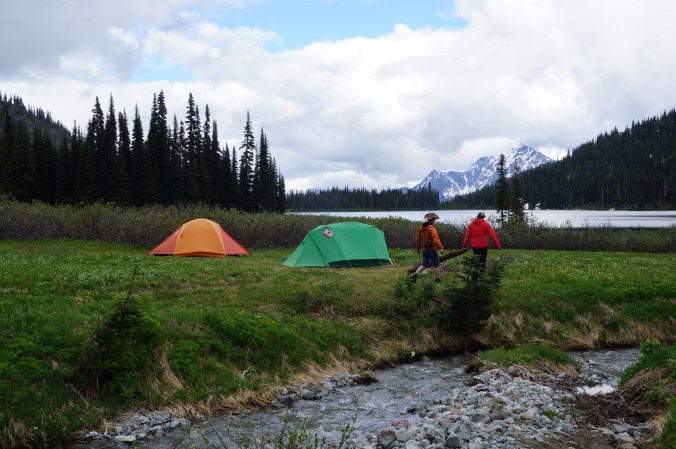
I’ll admit, I’m a little foggy on the details of the trail 3 years later, but I do remember a fair bit of uphill through the woods at the start of the hike that eventually transitioned into undulating meadows. We didn’t get great weather on the trip and it was pretty cold at the lake for July, but the rain stayed away, so we really couldn’t complain. It was overcast on our first day, which is probably why it felt so cold. One of the things I do remember though, is the mosquitoes (henceforth known as “skitties”). Oh boy, were they ever bad at Tenquille Lake. It would have been nice to take it easy on our first major backpacking trip, but every time you would stop on the trail, you would be completely swarmed by skitties, so we pretty much would only stop to put on more bug spray. It definitely got better when we made it out of the woods and to slightly higher elevations. I didn’t find it too bad at the lake, but Seth would likely disagree with me. They must not like my blood type that much or something, because they more or less left me alone at the lake, but Seth had no respite and Brandon let him borrow his bug hat to try and keep them away. We don’t know Seth’s blood type, but the skitties love it.

One of my main motivations for picking the trail (besides stumbling upon it and thinking it looked nice), was that I thought it was probably far enough away from Vancouver that there would be less people, and that combined with the 4WD access road, there wouldn’t be very many people camping.
I can really be a dummy sometimes. But hey, it was my first backcountry trip and I’d still only been living in BC for 2 years at this point and I didn’t realize just how crazy everyone is for the outdoors here! There ended up being probably about 60 people in a campsite that’s made for 30 because it was a long weekend and a single Meet-Up group of 30 PEOPLE decided to visit the lake that weekend. It was a little overwhelming for my first time in the backcountry, but because of the overflow of people (and our late start), we ended up getting, what in our opinion was, the best campsite at the lake!
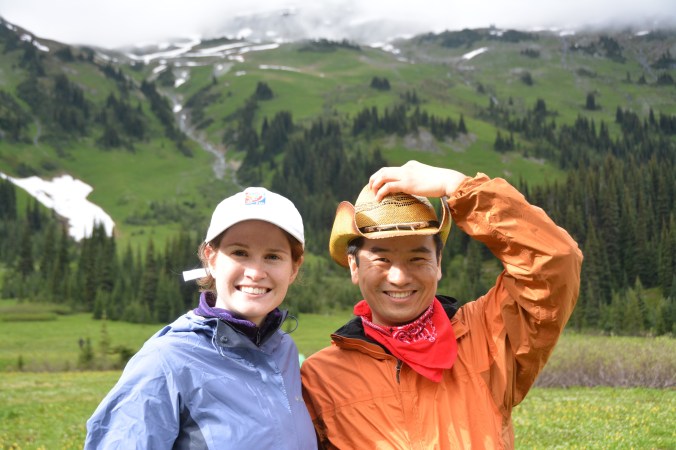
So I don’t condone this now that I’m a little more seasoned. When possible, you really should camp at the campsites or in a location that will cause the least harm to the surrounding area. At Tenquille, you’re not allowed to camp in the meadows because they are extremely sensitive, but because of the surplus of people in the actual campground, we were forced to find some overflow space, and yes, it was in the meadows. We avoided any untouched meadow and stayed only on the trail, but we did find an area that had obviously been used many times before for overflow camping and didn’t have any alpine vegetation anymore, so that’s where we camped. In the pictures it kind of looks like we’re in the middle of the meadow, but there was a trail there and about 4-5 campsites that are hard to see because of the surrounding vegetation. I’ve gotten a lot more sensitive about these things the more I backpack, so I always try and camp where I won’t have an impact on plant habitat.
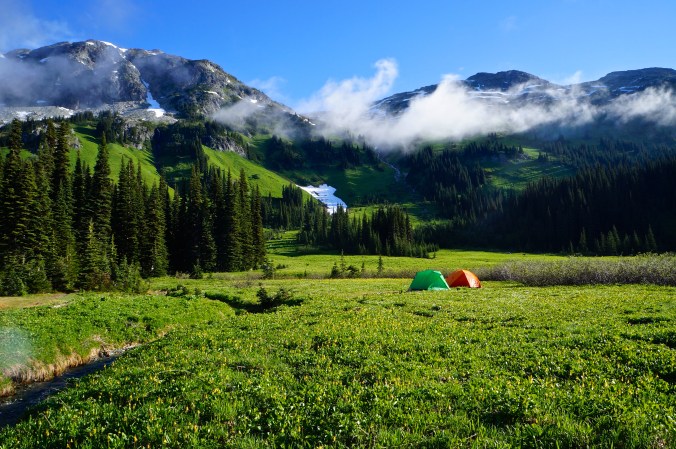
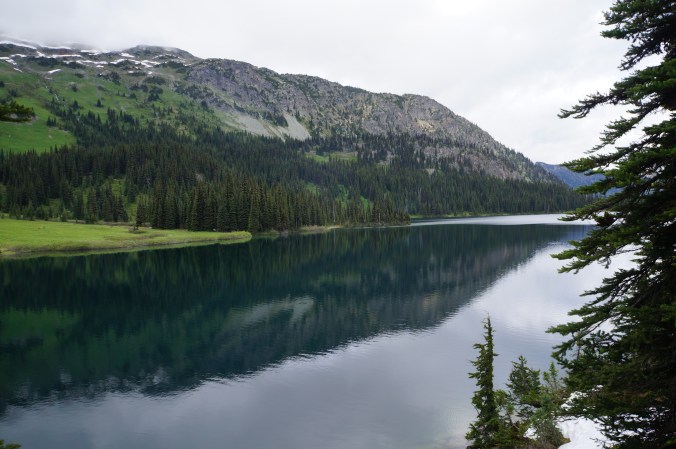
Despite the shoddy weather though, I absolutely loved Tenquille Lake. I’ve come to appreciate this trail more since I was first there because it really is the perfect mix of alpine lakes and alpine meadows. Alpine meadows have become pretty much my favourite backcountry scene, and Tenquille has both the lake, surrounded by mountains, and the alpine meadows next to the lake. This was also one of the rare backcountry hikes I’ve done since I moved here where we were actually permitted to have a campfire. Most provincial parks prohibit campfires in the wilderness and by early July, we’re usually into full fire ban, but this was one trip where we went early enough to have a campfire. I’m realizing now that Brandon must have carried an axe up there on top of all his other gear, so thanks again Brandon!

We definitely had to layer up at the lake because it was really cold, but I became totally enamoured with getting away from the city, eating with a kick-ass view of the lake, and waking up to see the sun just poking over the top of the mountains. We didn’t see the sun very much on this trip, but it did come out for about an hour both mornings, so I got up pretty early on that trip because I wanted to photograph our surroundings with the brief glimpse of sunshine and blue sky. Both days it clouded in by 9am, but we got a few hours of sunshine before the clouds snuck back into the mountains.
So all in all, it was a wonderful first trip into the wilderness. We did the somewhat strange choice of hiking back to the car and then doing another overnight hike to Semaphore Lakes (instead of just one 2 night hike), but more on that in a later post!