Rockwall Trail Backpacking Guide

In the spirit of helping more people get hiking on some of western Canada’s most iconic trails, I decided to create a backpacking guide for the Rockwall Trail in Kootenay National Park. I hiked this trail over 3 nights in 2023 and had a fantastic time. I attribute most of the fun to my phenomenal hiking partners, but the beautiful scenery on the trail also made the experience unforgettable. I’ve already published a 2-part trail report, which you can read starting here, as well as a guide to Kootenay National Park. I’ve consolidated all of my Rockwall-specific knowledge here for those planning to hike the trail. Reservations for the 2026 season release at 7am PST on January 26, 2026 (8am MST).

The Trail

The Rockwall Trail is a 54km thru-hike located in Kootenay National Park in BC. You can hike the trail in either direction and there are several exit points that connect to the highway if you want to shorten your hike. The two main trailheads are located off Highway 93 at the Floe Lake and Paint Pots Trailheads. There are 5 campgrounds on the trail, with the most popular campsite at Floe Lake. Most people hike the trail over 3-5 days, depending on fitness level.

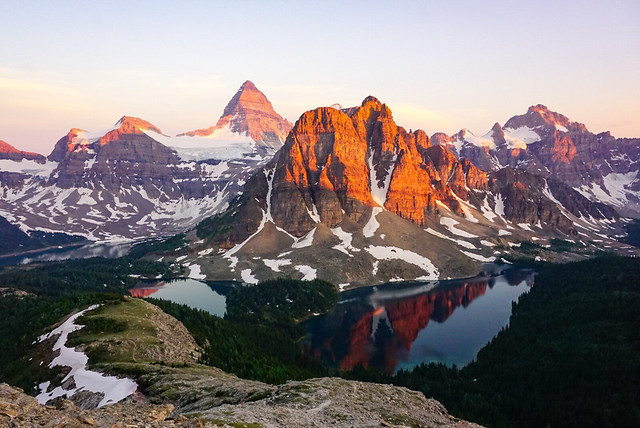
At 54km in length, the Rockwall Trail is not the longest trail in the Rockies, but there is a significant amount of elevation gain, so don’t underestimate it. The hike starts in the forest on both ends of the trail, climbing up towards the alpine, which runs between Helmet Falls and Floe Lake with 3 steep passes along the way. While Floe Lake is very popular, the trail takes its namesake from the large rock wall that runs between Helmet Falls and Tumbling Creek, which in my opinion, is the real highlight!

If you don’t like backpacking, you can visit Floe Lake as a day hike, but it is a 22km round trip hike, with 750m of elevation, so it’s a big day. I don’t recommend day hikes from any of the other trail entrances – unless you’re a trail runner – but the alternative trail entrances from Numa Creek and Tumbling Creek Trails offer the opportunity to shorten your backpacking trip.

PSX_20230903_210217

Time of Year

The best time of year to hike the Rockwall Trail is in the Summer or early Fall. If you go in late-June or early-July, be aware that there may still be snow on some of the trails. If you go later in the summer, it’s more likely that your trip might be impacted by wildfires. While most people prefer to backpack in the summer, late September is also popular due to the colourful larch trees near Floe Lake. However, you should be prepared for snow and cold conditions at this time of year. I hiked the trail at the very end of August and had great conditions.

Getting There

Unfortunately, this park is not accessible by public transit. Similar to other popular Canadian parks, the easiest way to access is by driving. The park is located on Highway 93, which is a 50 minute drive to the Floe Lake Trailhead from either Banff or Radium. The added challenge with the Rockwall Trail is that, because it’s a thru-hike, you will either need 2 cars, 1 at each trailhead, or plan to hitchhike between the two parking lots. I parked a car at each trailhead, which is the easiest option, but hitchhiking is not uncommon along this route and is relatively safe. I recommend making friends along the trail and looking for a ride from another hiker.

There is a large parking lot at the Paint Pots trailhead, but the Floe Lake trailhead is much smaller, so you may have to wait for a parking space to open up. I’ve also heard that break-ins are not uncommon at the Floe Lake trailhead, so make sure not to leave valuables in your vehicle.

20230829_123149

Permits

Like most popular hikes in the Rockies, securing your camping permits will likely be the hardest part of your trip. This is a popular trail and it attracts crowds every year. If you’re doing a day hike, you don’t need a permit for the trail, just the National Park Pass (discussed below). But if you want to try and get camping permits, then it’s important to mark your calendar with the permit release date.

The permit release date for 2026 is January 26, 2026 at 7am PST. Permits are $10 per person, per night (plus a booking fee) and they will disappear fast, so you need to be ready to book right when they release. I will try and update the release dates for permits every year, but they are usually announced by Parks Canada in late November or early December for the following year – so keep an eye on their page of release dates in future years. To make your bookings, visit https://reservation.pc.gc.ca/.

Once booking opens, select “backcountry” in the tabs along the top of the booking page, and then select “backcountry zone”. Next, select “Banff, Kootenay, and Yoho Backcountry” as your park and select your start date and access point. There are 3 options for access points along the Rockwall Trail: Floe Lake, Numa Falls, and Paint Pots. Numa Falls is only used if you’re doing a shorter version of the trail. If you want to hike south, select Paint Pots; if you want to hike north, select Floe Lake. If you have trouble getting your preferred itinerary, you can always try reversing direction or using different start dates.

Once you start your search, you will be forced to build your itinerary day by day. At the top of the page, you’ll see a dropdown menu where you can select your campsite and “add to stay”. Instead of building your itinerary this way, you can scroll down to the map and click on the “calendar” tab in the left sidebar to see a list of all available campsites per night. This is an easier way to see what’s available and build your itinerary. If you don’t see what you want, try refreshing or reversing your itinerary by updating your access point. People are constantly adding and changing dates and campsites in a rush to get their preferred itinerary, so the trick is to frequently refresh. Just because you don’t see a site available right away, doesn’t mean it won’t show up later if you keep refreshing.

My recommendation is to take what you can get and make changes later. If Floe Lake is not available, book Numa Creek and move on to the next day before those dates book up too. Once you have secured a booking for each of the dates in your itinerary, go back and look for cancellations. Keep refreshing until you see one, and then make a change to your booking to add it. This does cost more as you have to pay a small change fee, but it offers more flexibility in ensuring you at least get something. I wasn’t able to book Floe Lake when I made my original booking, but I was able to get a cancellation for it afterwards. You can track cancellations on Schnerp, which will notify you when a site opens up.
Here’s a few tips for getting your camping permits:

  • Get on the booking website 15 minutes early using as many devices as possible (computers, phones, ipads, etc). At release time, everyone on the website is entered into a random generator that assigns you a position in the queue. All of your devices will be assigned a place in line, then proceed to book your permits on whatever device has the shortest queue.
  • Once you get access, be flexible with both your starting date and itinerary. Use the “calendar” option to see available dates at each campsite. Consider shortening your itinerary by exiting on the Numa Creek or Tumbling Falls Trails.
  • If you don’t see any availability, keep refreshing for at least 15 minutes. With so many people trying to book campsites, dates are always disappearing and then becoming available again, so if you don’t see anything, keep refreshing.
  • Be prepared that you might not get what you want. Book alternative sites and sign up for cancellation notifications on Schnerp.
20230829_162446

National Park Pass

In addition to backpacking permits, which are specific to your campsite, you must also have a National Park Pass. These are much easier to obtain – there is no booking period and the number of passes are not restricted. The most common option is to purchase the discovery pass, which is available for $150 for a family, or $75 per person. It’s essentially an annual pass that covers everyone in your car. You leave it hanging in the car while you’re on the trail and it acts as a parking pass. If you have two cars, then you would need two passes. Alternatively, you can buy single adult day passes for everyone, which are $11 per person, per day. However, in 2025 and 2026, Canadians can obtain the Canada Strong Pass for free, which includes a free discovery pass and 25% off bookings! You can purchase passes online, in advance, or in person at the Kootenay and Banff park entrances.

Campsites

There are 5 backcountry campsites located along the trail, so there are multiple options for where to stay, which provides some flexibility when planning your itinerary and securing bookings. The campsites are pretty equally spaced along the trail, so it is easy to plan for a more relaxed itinerary, or you can plan your sites further apart if your itinerary is more aggressive. I’ll discuss itineraries below, but here’s an overview of the campsites running from north to south. They all include outhouses and bear lockers, and require valid permits for overnight use.

20230830_114825

Helmet-Ochre Junction – This is the most accessible campground on the trail, located 6km from the Paint Pots trailhead. It’s located along the river at a trail junction and has 6 tent sites. It’s a nice enough campground, but it’s often overlooked in favour of the more popular/scenic campsites. If you can’t get permits for Helmet Falls, this is a good alternative. It’s also a great option if you’re starting late in the day and don’t want to hike too far.

Helmet Falls – This is a beautiful campground located at the base of Helmet Falls, which cascades down the valley from Helmet Mountain. There are 18 tent sites and you can enjoy the view from the picnic area at the back of the campground. This is a great option to camp before or after you’ve hiked along the Rockwall.

Tumbling Creek – This campground is located at the bottom of the valley between Rockwall Pass and Tumbling Pass. There’s 18 tent sites and easy access to the river with nice views. This is a great option to camp before or after you’ve hiked along the Rockwall. You can also come direct to the campground along the Tumbling Creek Trail, which starts at the Paint Pots trailhead.

Numa Creek – This is the lowest elevation campground on the trail and is located between Tumbling Pass and Numa Pass. There’s 18 tent sites and easy river access. This is a great place to camp on your way to or from Floe Lake. You can also come direct to the campgound along the Numa Creek Trail, which starts at the Numa Falls trailhead.

Floe Lake – This is the most popular campground on the trail. If you can score a permit for this campground, do not hesitate to book it. The entire trail is very scenic, but Floe Lake is definitely the most scenic campground. It has 18 tent sites and is located 11km from the Floe Lake trailhead.

Itineraries

Planning this trail is pretty straight forward because it is a linear thru-hike. Your main decisions will be what direction to hike and over how many days. Here are a few recommendations based on how many nights you plan to spend on the trail. And here’s a useful trail graphic from Parks Canada, noting the distance between each campsite.

1-Night: Your best option if you only have 1 night is to camp at Floe Lake, hiking in and out from that trailhead. Add on 2km each way to hike up to the top of the nearby pass for a fantastic birds-eye view of Floe Lake. Alternatively, if you really want to see the Rockwall, you could spend 1 night at Helmet Falls and hike out via the Rockwall and Tumbling Creek Trail. You just have to be prepared for a big 20km day on day 2.

2-Night: 2 nights is probably the most awkward itinerary, because you can hike most of the trail, but it’s ambitious to do the whole thing. If you want to do the whole trail, I’d recommend camping at Helmet Falls and Numa Creek, which requires you to hike two 20km days back to back. If you don’t want to do the whole trail, hike north, camping at Floe Lake, followed by Tumbling Creek, and exit on the Tumbling Creek Trail. Or hike south, camping at Helmet Falls, followed by Numa Creek, and exit on the Numa Creek Trail. Hiking north allows you to visit Floe Lake, while hiking south allows you to hike the Rockwall. If you want to hit both, you have to do the whole trail.

3-Night: I did the trail in 3-nights, which I thought was a good length. Plan for your first and third nights at either Floe Lake or Helmet Falls (doesn’t matter which direction you go), and then your second night at either Tumbling Creek or Numa Creek. You will have one long day with this itinerary, but you can plan it around whether you’d like to have extra time at Floe Lake or on the Rockwall. I hiked south and camped at Numa Creek, meaning I had lots of time to relax at Floe Lake on my last night.

4-Night: This is the most relaxed itinerary. Do the trail in either direction and camp at Floe Lake, Numa Creek, Tumbling Creek, and Helmet Falls. You’ll have lots of time to enjoy Floe Lake, the Rockwall, and Helmet Falls.

20230829_150852

Hiking the Alta Via 1: Fanes to Averau

Welcome back to my trail report series on the week I spent hiking the Alta Via 1 in the Italian Dolomites. Last week I posted about the start of the trail and the first 20km of hiking between Lago di Braies and Rifugio Fanes. On Day 3, we left Fanes in the early morning to start our hike up to the top of Forcella dl Lech, one of the largest passes on the trail. This section of trail can sometimes be difficult to access if there’s poor weather due to exposure, but we had great condition and no concerns as we made our approach!

This was probably my favourite day on the trail. We were among the last hikers to leave the rifugio in the morning, but we only had 10km and 500m of elevation gain ahead of us, so we were feeling positive. It was quite chilly when we started off, but we started off with a short, but steep, climb up to the alpine plateau, which really warmed us up. The sun came out soon after and there were lots of horses grazing in the meadows, so Kristine spent some time with them, while I continued on to a small lake called Lago di Lemo. There’s no big lakes on the Alta Via 1, aside from Lago di Braies, so the opportunities for swimming were limited, but I was determined to swim in as many as possible.

PSX_20250922_161338
PSX_20250922_161202

There was no one around, so I hurried off to the lake and was able to get in a quick skinny dip before any other hikers showed up. A lot of the “lakes” are really just tarns, so some are quite shallow or don’t have the best water quality, but this one was really nice. We’d barely started hiking though, so we didn’t linger and continued on to a small cafe located in the valley. We debated stopping for a snack, but it was still quite early and neither of us were hungry, so we continued on through the valley.

There were lots of cows hanging out in the meadows, which Kristine loved, but we kept our distance because one of the mama’s was getting a bit worked up over her calf running off without her. For the most part, the livestock is harmless, but you should still respect them and maintain a safe distance. A man was trampled to death by a cow on a nearby hike previous to our trip, so accidents do happen.

PSX_20250922_161537
PSX_20250922_161753

Once we reached the end of the valley, the trail started to get a lot more crowded. The Pass is a popular day hike that can be done from the small town of Sciare, so we encountered a lot more hikers. When you reach the end of the valley, the trail starts to climb and you gain 400m of elevation over ~2.5km. At first it’s a more gentle ascent, but it gets steeper as you go. While we were hiking through the valley, we spotted the pass off in the distance and joked about what a brutal hike that would be. Then we started hiking up the mountainside and quickly realized it’s where we were headed!

PSX_20250922_161857
PSX_20250922_161959

Honestly, I loved this part of the hike. It was tiring, but the views were phenomenal! In my opinion, the trail up to the top of the pass had some of the best views of the trip. Plus, we really lucked out with the weather and it was a gorgeous sunny day. It made it a bit hot for hiking, but there was a nice breeze from the ridge. We stopped partway up for a snack and to enjoy the view, then continued on for another section of trail before stopping for lunch. I’d been planning to eat my sandwich at the top of the pass, but I got pretty hungry as we hiked and decided to just enjoy the view and eat it on the side of the mountain. There are no bad decisions on when to stop because the entire trail is stunning!

The last push to the top is quite steep and has lots of loose rock, but eventually you reach the gap in the mountain that forms the pass. The trail down the other side appears to disappear into nothing, so we hung out for a little bit, but didn’t stay too long because it was cold and windy at the top.

PSX_20250922_162206
PSX_20250922_162054

All I can really say about this pass is – thank goodness we were hiking this trail south! While the hike up the pass felt steep, it’s really nothing compared to the hike down. The downhill portion of the hike is almost vertical through engineered switchbacks that were built up into staircases at some point in the region’s history. I’d guess during one of the world wars, as there was lots of war infrastructure and tunnel systems around this part of the trail.

The backside of the pass involves hiking down 300m over less than a kilometre, making it twice as steep as the hike up. I was worried about my knees, which are sensitive to downhill, but the elevation loss is over such a short period of time, that they held up pretty well. Though we caught up with our American friend from Fanes and she was definitely struggling.

PSX_20250922_162347
PSX_20250922_163605

The views across to the other side of the trail were just as stunning as the hike up in the morning. From the pass, you can see straight across to Rifugio Lagazuoi, which is one of the most iconic Rifugios on the trail. We weren’t lucky enough to score reservations at Lagazuoi, which was disappointing, but a bit of a relief when we realized we didn’t have to hike up the other side that day.

The real reward of this part of the trail was that there’s another small lake at the base of the pass. Kristine doesn’t like cold water, so she didn’t participate in any of my swims, but there was no way I was hiking down that pass, staring at the lake the entire time, without swimming in it at the bottom! Especially because it was so warm in the afternoon. It was a really small water body and it wasn’t very deep, but it was still refreshing.

PSX_20250922_162613
PSX_20250923_202811

It was after my swim that we realized our next hut, Rifugio Scotoni, required hiking downhill another 150m. It doesn’t sound like a lot of elevation after everything else we’d already done, but it was disappointing because it was located off the trail, so we were going to have to start the next morning with a 150m climb uphill, before doing another 550m of uphill to Lagazuoi. At first, we were a bit disappointed with Rifugio Scotoni, mostly because we had wanted to be staying at the iconic Lagazuoi hut, but it grew on us. It was much less busy than Lagazuoi, and it had alpacas, which Kristine quickly befriended.

We were assigned a 4-bed dorm, which we shared with two German guys. We enjoyed the afternoon hanging out at the bar and soaking in the sun, although the experience was slightly ruined by a very loud French group, who we avoided all evening because one of the guys was wearing a shirt that said “51st State”, with the American flag inside a maple leaf. So we stewed and gave them mean glares like the non-confrontational Canadians we are (well, I am, Kristine can be pretty confrontational, lol, but there were at least 8 people in the group, so we were too intimidated to say anything).

PSX_20250922_162942
PSX_20250922_162821

It was super hot in the room overnight, so we didn’t sleep well, though it was freezing when we set off the next morning. We trudged our way back up the 150m to the trail junction, which Kristine was really not feeling, but the hike across the alpine to Lagazuoi was more enjoyable than expected. We were able to keep to the shade for a while, which was nice, because once the sun hits you, it’s really hot.

It was Day 4 for us and we’d yet to experience any bad weather, so we considered ourselves extremely lucky. In the summer, it’s very common for it to be hot in the morning, but then have a rainstorm roll in in the afternoon. We didn’t experience that at all. In fact, it was nice for 6 days straight, so I would say that from my experience, late September isn’t the worst time to visit.

PSX_20250924_103845
PSX_20250924_104228

It’s a little under 3km from the Scotoni junction to the Lagazuoi junction. Rifugio Lagazuoi is located off the main trail as well, so you don’t actually have to hike up there if you’re not staying at the hut. It’s another ~150m of gain over a little more than 1km, so you are adding a fair bit of elevation gain to hike to the top. I was determined to do it, with or without Kristine. Honestly, I thought she was going to skip it because she doesn’t like hiking uphill in the heat (who does?), but she was having a good morning, so she decided to hike up there with me. It helped that the sun was behind the mountain, so the hike up was mostly in the shade.

I’m really glad we did because there is so much history along the side of the mountain in this area. There’s all kinds of defensive infrastructure from the war, including a very extensive tunnel network. The tunnels are easy to visit on the way up to Lagazuoi, so we took our time and dipped in and out of the tunnels, which run along the ridge. So you can hike in from one side of the mountain, and then look out through windows down onto the other side of the mountain. It’s very cool!

PSX_20250924_104156
PSX_20250924_105723

You can take a gondola from the base all the way up to the top of Lagazoui, so there were a lot of people around when we reached the top at lunchtime. We stopped for a sweet treat and a drink and I finally tried kaiserschmarrn, which is a big German pancake. It looks a bit like a funnel cake, and it’s basically just scrambled pancakes covered in applesauce and icing sugar. It’s pretty tasty, but honestly, it could have used a bit of maple syrup (lol, I know). It was a cloudless day and the views from the top of the peak are absolutely stunning, so we enjoyed the experience, but were a bit apprehensive about our remaining mileage for the day.

PSX_20250924_104057
PSX_20250924_104353

We still only had 12km of hiking on day 4, but unlike the two previous days, we also had over 1000m of elevation gain. When we left Lagazuoi, we had to immediately hike down 600m to the highway, just to hike back up 350m on the other side of the road. I can’t lie, the hike downhill was rough. One of the biggest differences I noticed between Italian and Canadian trails was ease of terrain. Canadian trails usually try and take the path of least resistance to the top. If that involves switchbacking back and forth across the mountain, no problem. In Italy, switchbacks only seem to be used when absolutely necessary, like when coming down Forcella dl Lech, which is too steep for anything but switchbacks. The hike down Lagazuoi was brutal, mostly because the trail went straight down the mountain. It’s all lose rock and it’s hard to maintain your speed on the way down. It’s exhausting on the knees and our legs were like jelly by the time we finally made it to the bottom. It didn’t take too long because of the direct route, but no part of it was fun.

PSX_20250925_135727
PSX_20250924_104529

This area is called Passo Falzarego and we made a beeline to the local tourist shop and cafe for a bathroom break and another sweet treat. Kristine didn’t eat at the top of Lagazuoi, so she had her dessert, while I had a popsicle to cool down. It was pretty much just us and a bunch of biker dudes on the side of the highway, so we had a good laugh at ourselves while perched on the curb with burly men walking all around us.

We had ~4km of hiking left for the afternoon and we ended up splitting up for part of it. Kristine wanted to go direct to our hut at Rifugio Averau, but I was keen to fit in another swim, which involved a small detour. It was very hot, so Kristine continued on the main road, while I diverted to Lago di Limedes. From afar, this lake looks really cute, but it was probably one of the worst swims I had on the trail. At this point, I was trying to maintain a trend of swimming every day, so I wasn’t picky. Even up close, the lake looks nice, but it’s tiny and once you start to wade into it, you notice that it’s completely filled with slimy green algae that just floats around in the shallows. It was the warmest water of the trip, but I could easily understand why I was the only one swimming.

20250919_144348
PSX_20250924_104645

Kristine had a bit of a diabetic crash out while we were apart, so I ended up catching up to her again where she took a break to eat some sugar. Before you get to Averau, you have to hike to the top of Forcella Averau, which has more technical section that involves climbing up a chimney before you reach the top. Kristine was cursing at the chimney, but we both had to admit that the views were pretty stellar once we reached the top! You cross over the back of Mount Averau and then arrive at the Rifugio, which is nestled in the pass at the base of Mount Nuvolao.

Rifugio Nuvolao is the other iconic hut on the Alta Via 1. It’s the oldest hut on the trail and it’s serviced only by a cable car, so it’s pretty small. We didn’t score reservations at Nuvolao either because Mac’s Adventure Travels really let us down on the bookings, but I didn’t mind like I did with Scotoni, because the views from Averau were breathtaking! Overall, day 4 was my second favourite day on the trail (after day 3), but Rifugio Averau was my favourite hut of the trip.

PSX_20250924_104620
PSX_20250924_104919

This was the first day that we weren’t the first people to arrive to our dorm room – instead we were the last to arrive in our room of 6. It was one of the smallest rooms we stayed in, but our dormmates were all very nice and we be-friended two hikers from Singapore. We also had a balcony with an amazing view, which we marred by hanging all our sweaty clothes from it.

We spent the rest of the afternoon sitting out on the patio with a couple of beers, enjoying the view. As the sun went down, we got the most stunning sunset, which we enjoyed over supper. In my opinion, Averau had the best food on the trail and I couldn’t resist breaking my one-drink rule with a second glass of wine.

PSX_20250924_104945
PSX_20250924_105022

We sat next to a large group of older men, who were giggling over a photo of a phallic shaped rock that some other hikers had sent them. We saw it from across the table and started giggling too, much to their chagrin because they thought they’d offended our “young” sensibilities. We all ended up having a good laugh over it and learned that a bunch of them had recently travelled to Newfoundland, so we swapped a few stories.

We took in the stars while burning off a bit of energy after dinner to conclude what was really a perfect day on the trail. At this point, I felt like I was hitting my stride on the trail and I was honestly loving every second of it. It was unlike any trail I’ve ever hiked and the luxury of being able to hike with a light pack, eat a full meal every night, have a shower, and sleep in a real bed, were all such treats. More of the second half of the trail coming next week!

PSX_20250924_105239
PSX_20250924_105411

Hiking the Alta Via 1: Lago Braies to Fanes

The Alta Via 1 is a premier hut to hut hiking trail located in the Dolomite mountains in northern Italy. Europe is well known for its hut to hut hiking. Unlike Canada, the mountains in Europe are very developed, with lots of infrastructure and roads scattered throughout, making hiking trails extremely accessible. One of the most popular hut to hut hiking routes is the Tour du Mont Blanc, which hikes through the Alps in France, Switzerland, and Italy. The Alta Via 1 is located further east in Italy, and is one of a series of “Alta Via’s” or “high routes” that traverse the region from North to South. The most popular route is the Alta Via 1, which if hiked in full, extends 120km from Lago di Braies to the town of Belluno.

If I’m being honest, I’d never heard of the Alta Via 1 until my friend Kristine approached me about hiking it with her. I was keen on the opportunity to go hiking in Europe, so I said yes, even though me and Kristine didn’t know each other very well. We had only met once in real life when we decided to go to Italy together, but fortunately, I didn’t end up with any regrets about the trip!  

PSX_20250917_205115
PSX_20250917_205408

I flew into Venice in mid-September and we met in Cortina, spending 2 days together before starting the hike. Similar to Canada, bookings for popular hiking trails can be hard to get. Because the mountains are so developed, there are limited opportunities for camping along the Alta Via 1, meaning that most people stay in mountain rifugios. These are basically hostels, providing room and board for hikers, and they can book up far in advance. I’m familiar with my local booking platform, but it’s intimidating to try and tackle a whole new system (especially since the Alta Via 1 doesn’t have a consolidated platform and you have to book each hut separately), so we opted to use a third party. 

I’m sure there are some good third party sites out there, but we went through a company called Mac’s Adventures, and they were really terrible. I wouldn’t recommended them for a ton of reasons that I don’t really want to get into, but at a high level, they sold us an itinerary that they couldn’t deliver and then tried to cancel our trip rather than attempt to fix it. We ended up resolving the logistical challenges ourselves to stop the trip from being cancelled, for which we received no discount. I’m pretty good at logistics, so if I had my time back, I would have just done the work myself, because Mac’s demonstrated no critical thinking or problem solving skills and I ended up doing the work anyways.

PSX_20250917_204905
PSX_20250917_205754

The rifugios usually release early in the year, around January, so you should be prepared to book pretty early. There are lots of options, but if you want to stay in one of the really popular huts (like Rifugio Lagazuoi), then you need to book right away. The entire hike is 120km, but lots of people (us included) just hike a portion of the trail. We ended up hiking 100km, approximately 80km of which was on the traditional Alta Via 1 trail. In hindsight, I wish I’d done the whole thing, but I still had a great time on the section of trail we chose. 

Our base point for the trip was in Cortina, but the trail actually starts at Lago di Braies. We caught the 445 bus from Cortina to Dobbiaco in the early morning, followed by the 442 bus to Lago di Braies. Both are city buses that leave fairly frequently, but can get very busy. We were able to buy our ticket in advance for the 445, but since we started late in the season, we couldn’t buy it in advance for the 442. We managed to get on board, but it was very full and some people were denied entrance, so you should book this one in advance too, if possible.

PSX_20250917_205849
PSX_20250918_160956

As a Canadian, Lago di Braies reminded me a lot of Lake Louise. It’s a very popular lake, and there’s no hiking required to visit it. They run a very expensive boat rental if you want to canoe on the lake, which many people do, so it’s always very busy. I started my hike by grabbing a sandwich from one of the stalls for later and then we began our trek, walking around the eastern shore of the lake. It had poured while we were on the bus, but it stopped raining right when we arrived at the Lake, and we were surprised to see the sun come out so quickly. I was really keen to swim in as many lakes as possible, so I took a quick dip at the back of the lake. I did google whether this was allowed before I went, but I’ve heard since that you’re not supposed to swim in the lake, so I’m not sure if I was in the wrong. The water is quite cold, so it was a very short lived dip.

PSX_20250918_160819
PSX_20250918_162244

Once you get to the back of the lake, the trail starts a very long ascent up to the alpine. It feels as though you’re hiking straight uphill as you tackle ~1000m of elevation gain in just over 4.5km. Despite it being late September, it was quite warm and there was limited shade, so it was a bit of a struggle up to the top. The first part of the trail is more or less in a boulder field. There are a few benches along the way, but the trail feels like it just keeps getting steeper the further up you go. There is a small section with some ropes in the middle of the trail before you hit the alpine, but it’s not overly technical. 

After the rope section, you reach the alpine and there’s another uphill slog to the top of Forcella sora Forno, which was the highest point of elevation for us on our first day. From there, you can continue to hike up to Croda del Becco, which is a popular viewpoint looking down on Lago di Braies, but it’s another 400m of uphill and it’s a more technical scramble, so we opted to skip it. The views from the Forcella (pass) are beautiful though. You can look down on the first rifugio of the trail, Rifugio Biella. It wasn’t our final destination, but Kristine had a pretty rough ascent up the trail, so we were enthusiastic about stopping for a break. 

PSX_20250918_210428
PSX_20250918_212329

It was hot on the trail, but windy on the Forcella, so we quickly cooled down at Biella. We had our first sweet treat of the trek, a fruit encrusted cheesecake. We still had another 3.5km of hiking to get to our first rifugio, but it was easy walking in comparison to the climb up. The clouds moved back in and we had a gentle walk down a mountain road before crossing the barren alpine. It didn’t take us too long to arrive at Rifugio Sennes and Kristine was thrilled to see lots of cows hanging around the hotel (she’s a big livestock enthusiast). In total, we hiked 9.5km on day 1, which doesn’t sound like a lot, but it was paired with 950m of elevation gain, so it still felt like a big day.

We didn’t know it at the time, but Rifugio Sennes would be once of the fanciest huts on our trip! We lucked out with our assigned room, which slept 4, but never ended up filling up. So we had the room to ourselves and were able to get a hot shower before dinner. Supper and breakfast were included at all our rifugios and I had a very yummy meat stew for dinner, along with a glass of wine. I mentioned in my post about hiking Tre Cime that the Italian Dolomites are more German influenced than Italian, which was especially reflected in the food, but there was plenty of good Italian wine to go around!

20250916_184535
PSX_20250919_214143

We had very nice neighbours at Sennes and we quickly be-friended a guy from the UK who was starting what sounded like a pretty amazing gap year, as well as a newly married couple from Calgary! The British guy was hiking way faster than us, so we never saw him again after Sennes, but we caught up with our Calgarian friends again the next day for lunch. We also had the luxury of wifi at the huts, so we were able to check in with our families every evening.

On day 2, we’d be hiking a similar distance to day 1, 10.5km, but with half the elevation gain, so it felt much easier. It was cloudy and cool when we set off from the rifugio in the morning, but we enjoyed that the trail was much less busy than the previous day. We started by hiking through the forest to nearby Rifugio Fedaro Vedla, which is a great alternative option to Sennes. Since it was still early in the day, we didn’t stop for a break and instead continued hiking on to the next hut, Rifugio Pederu. 

PSX_20250919_214236
PSX_20250919_214320

The trail continues down over the mountain towards Pederu, which is accessible by car. The Alta Via 1 is an interesting experience because almost all of the huts are accessible by vehicle in some way or another (that’s how they transport supplies), it’s just that many of the roads are 4×4 or closed to the public. Pederu itself is accessible by bus and you can even pay to have your backpack shuttled between Sennes and Pederu. 

The hike down to Pederu runs along the gravel mountain road that connects Pederu to Fodara Vedla. It’s an easy trek if you’re hiking down, but I didn’t envy those who had to hike up it. We lost 300m of elevation in less than 2km, so it was quite steep! We had to redo that elevation loss after lunch, but fortunately it was a more gentle climb. We arrived at Pederu before the lunch service had started, so we had some snacks with our new friends. Kristine had her daily cappuccino and I had my homemade iced tea (since I don’t drink coffee). It became a bit of a ritual for us: coffee and iced tea in the morning, and then every evening Kristine would have a coke zero and I would have a glass of wine. Plus we both indulged in a sweet treat whenever available!

PSX_20250919_214404
PSX_20250919_214457

We started the afternoon with another climb, but we fared much better than the previous day. The nice thing about doing this hike in late September was that I’d already done over 400km of hiking earlier in the year, so I was feeling very strong. We also have the benefit of living in the mountains year-round, so we’re used to the elevation gain. Even so, we couldn’t keep up with the Europeans, who seem to be on another level of fitness entirely, running up and down hills like it’s nothing!

Some of the tourists from less mountainous parts of the world were definitely struggling. Hut to hut hiking may sound cushy (which it is compared to the wilderness style of backpacking I do in Canada), but the Alta Via 1 covers some serious elevation over the course of your trek. We rarely hiked along flat terrain and would sometimes do 2 or 3 passes in a single day. We passed a group from Ontario in the afternoon who were finding the constant uphill very challenging. My advice would be to still pack light on these hut to hut hikes. The weight of extra clothes and snacks can really add up, so keep your packing list simple. 

PSX_20250919_214759
PSX_20250919_215133

I really enjoyed the afternoon on Day 2. The sun came out and once we got over the initial climb, we meandered through the alpine with beautiful views of the surrounding mountains. We passed by a small cafe and stopped to admire the cows, before arriving at our destination, Rifugio Fanes, in the mid-afternoon. We didn’t get so lucky with our room assignment at Fanes, as we ended up in an 11-person dorm room, but we were the first people there, so we got first pick of the beds. Despite sharing the room with so many people, it was surprisingly quiet and I ended up enjoying the experience more than some of the smaller rooms we stayed in at other rifugios.

This was probably because it was still a very nice rifugio. It served one of the best meals we had on the trip (eclipsed only by Rifugio Averau) and Kristine was very enthused about the resident cat, Minka, that she was able to befriend. Kristine is a cat person and I am a dog person. I feel like this is reflected a little bit in our personalities, but we made it work!

PSX_20250919_215013
PSX_20250919_215027

Before dinner, we decided to visit neighbouring Rifugio Lavarella. Fanes and Lavarella are located less than 1km apart, near a small alpine lake. The sun came out in full, so I went for a quick dip in the lake, which was extremely cold, but refreshing, before we stopped by Lavarella for a beer. This is an important pit stop on the trail (whether you’re staying in one of the huts or not) because Lavarella is actually home to the highest altitude micro-brewery in Europe! We each enjoyed a beer before heading back to Fanes.

We made more new friends at Fanes, primarily Americans this time. There was a friendly female professor who was visiting for a conference, as well as several trail runners, who made us feel particularly slow by doubling our mileage every day. Overall, we had a really nice stay at Fanes and enjoyed using their patio telescope to spy on some alpine ibex on the nearby mountain meadows. Tune in next week for more on the trail!

PSX_20250920_162602
PSX_20250919_220512