It’s been over 12 years since I moved to BC. There’s so much to explore in this province and every year has been filled with new adventures, which I’ve loved sharing on this blog. I like encouraging others to explore the many attractions BC has to offer, so for this post I’m partnering with intrip to share my list of 100 unique experiences in BC.
Intrip is a discovery app for all BC wanderers. It’s a map-based social media platform where every post is linked to a real place. It helps you to discover real local tips and experiences, easily explore what’s around you, and connect with your community to love where you live. Join me on the intrip app to rediscover beautiful British Columbia! Download the app on Google Play or Apple Store.
This list skews towards those living in the lower mainland, as that’s where I’ve spent the majority of my time, but I like to think there’s a little something in here for everyone. Happy adventures!
Unforgettable Adventures
Ride the Sea to Sky gondola for unforgettable views of Howe Sound
Cross the Fraser Canyon at it’s narrowest point at Hell’s Gate
Bike from Sidney to Sooke along the Lochside and Galloping Goose trails
Explore underground at the Upana Caves near Gold River
Hike Frosty Mountain in the Fall to see the larch trees turn yellow (pictured)
Embrace “Ski to Sea” and end your ski day with a trip to the beach
Reminisce about the Beachcombers TV show at Molly’s Reach in Gibsons
Classic City Experiences
Climb the Grouse Grind and visit the resident grizzly bears
Walk across the suspension bridge at Lynn Canyon or Capilano
Bike along the seawall and stop to see the totem poles in Stanley Park
Take the ferry to Bowen Island for a classic day trip
Play beach volleyball or let it all hang out at Wreck Beach
If you’re at all familiar with backcountry huts in the Rockies, chances are you have heard of the Elizabeth Parker Hut. It’s an ACC hut located in Yoho National Park, approximately 0.5km from Lake O’Hara. Lake O’Hara is one of the most popular and exclusive places to visit in the summer because it is incredibly beautiful, offering access to the breathtaking Alpine Circuit. I’ve been to Lake O’Hara in the summer and I wrote an entire blog post about that trip and how to secure permits, so I won’t be getting into those details here.
Let’s talk about the Elizabeth Parker Hut. In the summer, access to the hut is managed through a paid lottery system. You pay a fee to enter the lottery and if you are successful, then you’re invited to book into the hut for a further fee. I entered the lottery once, with no luck, so I decided to abandon that strategy. I planned to visit in the winter instead. The hut is still busy on the weekends (and weekdays to an extent), but there’s no lottery, so as long as you are an ACC member and pay attention to the booking windows, you should be able to secure a booking. We decided to visit on a weekday in the winter, making the process even easier.
The challenge about visiting this hut in the winter is that there’s no shortcut to access it. In the summer, you can take the shuttle up the bus road, cutting out 11km of road-walking. In the winter, there’s no shortcut, you have to walk in the entire 11km road, plus the 0.5km trail to connect to the hut. This might not sound like a lot, but it is quite draining in the winter. It’s not a hard trail, but it is long and has a pretty steady uphill for most of it. The road does pass through a small section of avalanche run-out terrain in the first 5km, but for the most part, it’s a pretty safe trail. The one section goes through a run-out zone, rather than active avalanche terrain, so if the avalanche rating isn’t high, you don’t have too much to worry about.
There’s a few ways that you can get there. The most common way seems to be cross-country skiing, which surprised me a little bit because there is a lot of uphill on the way there. I’d recommend having skins, but it’s a wide trail and very manageable. The attraction of cross-country skiing is that the skis are so much lighter, so it makes for a faster journey along the 11km road. Another option is ski touring, which is what we did. This is great if you want to do some touring and skiing from the hut, but touring skis are a lot wider and heavier, so we did find it very tiring. The last option is snowshoeing. There was no one on snowshoes when we stayed at the hut, but there was a big group heading in on snowshoes when we were leaving. I wouldn’t recommend spikes unless you’re sure it’s hard packed with no fresh snow incoming.
If you’re planning to visit, give yourself ample time as there is limited daylight in the winter. We didn’t do a great job at this because we had stayed at the A.O. Wheeler Hut the previous night, which meant we had to hike out 1.5km in the morning, drive to Field, and then do the 11.5km hike to the Elizabeth Parker Hut. This was made worse by the fact that we transitioned from Pacific Time to Mountain Time and lost an hour.
We didn’t start hiking until almost 1pm. It was mid February, so we had ~5.5hours of daylight. It took us 5 hours, compared to some cross country skiers, who were able to do it in 4 hours. I was feeling pretty good when we started, I figured I’d probably skied around 2km when I came across the trail marker for 1km, and that’s when I had to stop myself from despairing, as I knew we were in for a long day. If we’d started earlier, we could have taken our time and lots of breaks, but because we had limited daylight, we pretty much pushed forward all afternoon. We took one lunch break at the 5km mark, but otherwise only stopped to pee or re-adjust layers and equipment.
The biggest challenge for me was temperature control. It was around -20 degrees celsius when we did the trail, which is extremely hard to manage when you are working out. Normally, I would ditch my warm layers and just wear a base layer so that I wouldn’t be sweating into everything, but the challenge was that I was quite a bit faster than Brandon, who uses a splitboard. So I was continually having to start and stop, and I would get cold whenever I had to wait, so I didn’t want to layer down.
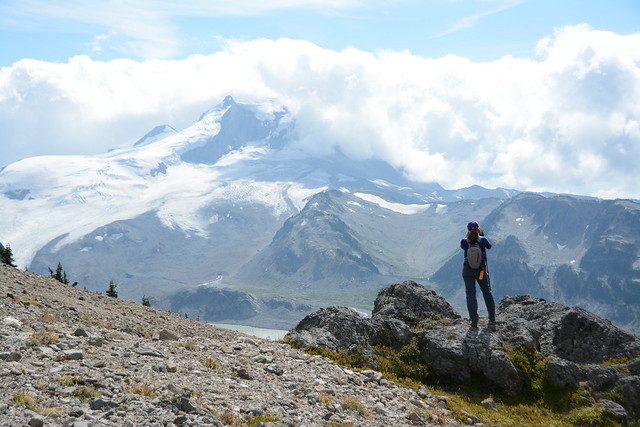
I managed well for the first half of the trail. There’s some picnic tables and a beautiful viewpoint at the 5km mark, so we stopped for a late lunch there. The weather was quite nice, mostly overcast, but there was some blue sky and we could see all the mountains, so it was very scenic. Around ~8km there’s a beautiful view of the glacier, so it was a nice hike, just very long. I definitely started crashing out around the 8km mark. I ate my snacks along the way, but our water bottles were becoming more and more frozen and I really needed an energy boost and a hot drink. Brandon put electrolyte powder in his water, which I wouldn’t recommend, because it turned the whole thing to slush. The trick is to store your water bottle upside down so that the lid doesn’t freeze on, and carry a thermos.
We finally made it to the hut around 6pm and I was so relieved to see the steam rising out of the chimney. There was a large group already inside the hut and I all but collapsed on the bench and started removing my boots, enjoying the toasty warm heat from the woodstove. The group consisted of 3 families and a lot of kids and they quickly encouraged us to move over to the Wiwaxy Cabin next door.
I didn’t realize there was a second sleeping cabin and their assumption that we would be more comfortable not sleeping with their big group was correct, but the group rubbed me the wrong way for most of the trip. It wasn’t appealing having to immediately go into another cold space and start a fire immediately after arriving. We managed fine, but the group was not respectful of the shared kitchen and dining facilities, spreading out and leaving a mess. Every time we tried to use the dining area I had to ask someone to move things so we could use a corner of the table. Although I will credit the dads for changing out one of the outhouse barrels while we were there.
But the Wiwaxy Cabin was very cozy. The main hut has a large bunk room that sleeps 16 people in the same room as the dining tables and woodstove. There are lots of racks to hang gear, but it definitely has more of a cluttered feeling than the Wheeler Hut, though that may have just been because the 3 families spread out everywhere. The Wiwaxy Cabin sleeps 8 on the bunks and has a small table and a woodstove, but no kitchen, so everyone has to use the main hut to cook. We quite liked the Wiwaxy Cabin, it was very cozy and we were the only ones in there on the first night, though we were joined by 3 more people on the second night. Once we got the fire going, it was quite warm. The woodstove was very efficient and it was pretty hot overnight, but we didn’t want the fire to die with -20 degrees outside, so we kept it going all night.
On our second day, there was less blue sky, but you could still see all of the mountains and it snowed pretty lightly throughout most of the day. We had breakfast and did our chores, namely restocking our woodpile (Brandon did a great job), before going out for a tour. It was the middle of the week, so we didn’t encounter any day users, it seemed to be just us and the family in the area. We didn’t have a lot of concrete plans of what to do for the day, and we debated between hiking up to Schaffer Lake or down to Lake O’Hara. Neither is very far, so we opted to hike up to Schaffer Lake to take a look at Mount Schaffer, which I’d read is popular for skiing.
There’s no trail markers to follow in the winter, but there is a pretty obvious route up through the trees. It’s only 1km from the hut, so it’s not a long way to go. We hiked up to the lake, which has a great view looking up on the base of Mount Schaffer. There was a lot of fresh snow and we could see a few lines coming down from previous visitors. We hadn’t actually planned to ski because I am pretty nervous in avalanche terrain, but the conditions were ideal when we were there. There was some fresh powder, but the avalanche rating was low to moderate and there were no slab problems. So we decided to hike up through the trees to ski down the main slope.
There were ski tracks coming down from quite high, but we only went about two thirds of the way up because we didn’t want to be in super steep terrain. So we hiked up and then picked a spot to transition. As with the previous day, the most challenging part of the trip was temperature management. It was still very cold, so it was challenging to transition and I added a lot of layers before skiing down. It was a short ski out, but probably one of the coolest lines I’ve ever done. It was my first time skiing in avalanche terrain, and I keep having second thoughts about it when I look back on the experience, but at the time I was feeling confident about the conditions and everything went according to plan, so I guess it was our first real touring line.
We just did one line since we’re pretty new to touring, but if I was to go back, I think I’d do a few more. My ski touring journey isn’t really driven by skiing epic lines, which sometimes makes me feel a bit at odds with other ski tourers I meet, as most seem very obsessed with skiing remote terrain. But maybe I’ll care more as I get more comfortable in avalanche terrain, but for right now, I like just being outside on skis, enjoying nature, and building up my experience.
We had a fun second night as we were joined by a couple that we had met at Wheeler Hut, as well as a single guy on holiday from Korea, who we were all impressed with as it was his first time skiing! They all came in on cross-country skis, which seems to be easier on a long access trail. We spent the evening playing cards and the couple shared a special moment the next morning and got engaged in front of the mountains!!
The sun came out to play on our last day and we woke up to a bluebird day in the mountains. It was still very cold, but at least we had the sun shining down to warm us up a little bit. We weren’t in a big rush to leave, but after packing everything up, we skied down to Lake O’Hara to enjoy the view before skiing out. Lake O’Hara is one of the most renowned views in the Canadian Rockies and it does not disappoint. It was very smoky when I visited in the summer of 2023, so dare I say, the winter view is even better? I felt like I was on another planet as we skied across the lake to get an incredible view of the surrounding mountains. Plus, we were the only people there, so it felt very special.
Usually the ski out is a lot more fun than the ski in, but the road is not a simple downhill the whole way, so it was still a lot of work to ski out. Ideally you would take off your skins and just ski down, but there are still lots of flat sections. I planned to just skin the whole way down, but there was still a lot of powder on the trail and it was really hard to pick up any speed on the downhill. So eventually we took our skins off and I was planning to just skate ski the flat sections, but it was too powdery for that too. However, because I was on skis, I was able to just put them back in touring mode without the skins in order to ski the flats and I did several kms that way. But Brandon was on a split board so he ended up carrying his snowboard through the flats.
It was still faster than the way in and we stopped again at the picnic tables for lunch, where there was a large group of women snowshoeing in. It’s 5km from the picnic tables and I put the skins back on for the first 3km, which are really flat. But the last 2km is the steepest part of the trail, so at that section, I was able to properly transition and ski out the final 2km pretty quickly. In total, it took us 5 hours on the way in and 3.5 hours on the way out.
Lake O’Hara is definitely a beautiful place to visit and we had a great time, but it is a slog on that road and I was really glad that we had planned to stay for two nights. It would have been a lot to ski in and out for only 1 night. If you’re dying to visit O’Hara and haven’t been able to secure summer permits, I definitely recommend checking out the hut in the winter. It’s much easier to reserve and in my opinion, the experience is even more special because there’s barely anyone around (at least on the weekdays). We had a great time!
Mount Assiniboine is located in Mount Assiniboine Provincial Park in BC and is one of the more iconic peaks in the Canadian Rockies. It’s been a few years since I hiked this trail, but there are a lot of options for how to do this trip, and I wanted to share my knowledge in the form of a backpacking guide to the trail. At the time that I hiked the trail in 2021, I wrote a 4-part trail report, which you can read starting here. Reservations for the 2026 season release at 7am PST, 3 months in advance of your planned start date.
The Park
Mount Assiniboine is located in the middle of Mount Assiniboine Provincial Park, but is surrounded by Banff and Kootenay National Parks, as well as Spray Lakes Provincial Park in Alberta. If you plan to hike there, you’ll have to go through one of the National Parks, with Banff being the more popular access point. There are two routes through Banff and one route through Kootenay, but they are all at least 25km long, so it is a big hike just to get into the park.
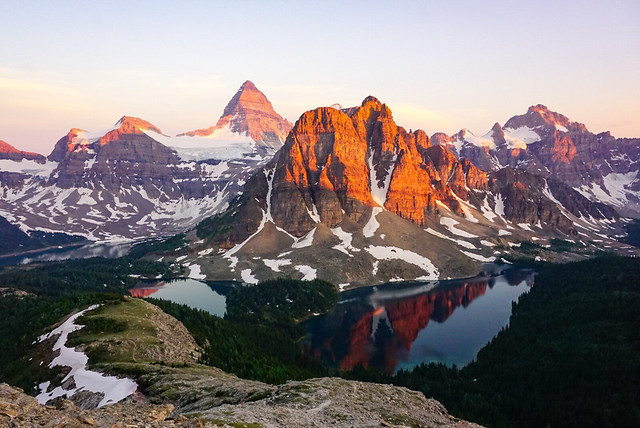
If you’re looking for a more direct approach to the park, it is possible to fly in from the Mount Shark trailhead via helicopter. This is a popular option if you want to maximize your time in the core area of the park. The core area of the park encompasses Magog Lake, Sunburst Lake, and Cerulean Lake, as well as the popular day hiking trail up to the Nub (or the Nublet/Niblet if you prefer a shorter option). The Nub is well known for its phenomenal sunset views of Mount Assiniboine, when the adjacent Sunburst Peak lights up orange as the sun goes down (see photo below).
There are limited options for where to stay in the park, which will likely be the restricting factor of your trip. The cheapest option is to stay at the Magog Lake Campground, if you can score permits. Otherwise you’ll have to pay more to stay in either the Naiset Huts or Assiniboine Lodge, both of which are privately owned and not cheap. The lodge is catered, but I’m not sure about the huts. There is another campground at Og Lake, but it’s approximately 5km away from the core area of the park, so it’s not ideal.
If you have limited time, I recommend flying into the park, but if you can spare a few extra days, you can do either a there-and-back trip or a thru hike. I opted to do a thru hike along the two access points in Banff National Park and it’s a very scenic hike. It’s best if you have 2 days each way (with a night spent halfway between), and then another 2 days to explore the core area of the park (6 days in total). Another option could be to fly in and then backpack out through Wonder or Assiniboine Pass, to experience the best of both options.
Sunburst Mountain and Mount Assiniboine at sunset from the Nublet
Time of Year
The best time of year to hike Assiniboine is in the Summer or early Fall. There may still be some snow on the trails if you go in late-June, but the later you go in the summer, the more likely that your trip might be impacted by wildfires. While most people prefer to backpack in the summer, late September is also popular due to the colourful larch trees through Wonder Pass. However, you should be prepared for snow and cold conditions at this time of year. I hiked the trail in late June and there was no snow, but it was during the early season heat wave of 2021, which melted remaining snow very quickly.
Getting There
There are 3 primary ways to access the park: the Mount Shark Trailhead, Sunshine Village, or the Simpson River Trailhead. Unfortunately, the park is not accessible by public transit. Similar to other popular Canadian parks, the easiest way to access is by driving. If you’re flying in, Calgary is the closest major airport.
Mount Shark: If you plan to fly into the park or hike in via Wonder or Assiniboine Pass, you will need to take Spray Lakes Road out of Canmore and drive to the trailhead at Mount Shark. There are two parking lots here, one for hikers accessing the trailhead, and another for those taking the helicopter. A National Parks Pass is not required to park here since the trailhead is technically in Spray Valley Provincial Park. However, you will need to pay for a Kananaskis Conservation Pass from Alberta Parks in order to park your car.
Sunshine Village: In my opinion, the Sunshine Village access is the easiest way to hike into the park. You can hike along the Citadel Pass Trail at the top of the Sunshine Village gondola. You park at the base of the ski resort, at the end of Sunshine Road off of Highway 1, and have the option of paying to the gondola to the top of the mountain. I highly recommend this as it will save you 5km of hiking and over 500m of elevation gain. A National Park Pass is required to park at the base as it is located in Banff National Park.
Simpson River: This is the least popular access point to the park as it’s the least maintained trail and the longest route to Magog Lake, as well as one of the lesser scenic routes. However, it is a great option if you’d like to avoid crowds or are unable to get permits to one of the halfway camps on the other routes. The trailhead is located off Highway 93 in Kootenay National Park, so a National Park Pass is required to park.
Using my thermarest to float on Sunburst Lake
Permits
Like most popular hikes in the Rockies, securing your camping permits will likely be the hardest part of your trip. This is a popular destination and while more people prefer to fly in rather than hike, it is challenging to get camping permits in the core area of the park. I’m not sure how difficult it is to book the lodge or the huts, but if you want to get camping permits, then it’s important to mark your calendar with the appropriate permit release dates. Unfortunately, because there are many different access points to the park, depending on your itinerary, you may have to obtain permits from both BC Parks and Parks Canada.
The permit release date for Mount Assiniboine Provincial Park is 7am PST, 3 months in advance of the start of your trip. They are released through BC Parks (camping.bcparks.ca) in a rolling window. These permits are considered “backcountry reservations” and they will likely sell out as soon as they release. So if you want a permit for July 1, you will need to be online at 7am on April 1 to make your reservation. Reservations are available for Magog Lake, Og Lake, and Porcupine Campsite. Bookings are $25 per person, per night (plus a booking fee).
If you are planning to hike in or out via Wonder or Assiniboine Pass, you may also want to make a reservation for one of the Parks Canada Sites (https://reservation.pc.gc.ca/), either Marvel Lake or McBride Camp. These campsites are all located in Banff National Park and the release date for 2026 was January 26, 2026 at 8am MST. Bookings are $15 per person, per night (plus a booking fee). Once booking opens, select “backcountry” in the tabs along the top of the booking page, and then select “backcountry zone”, followed by “Banff, Kootenay, and Yoho Backcountry”. The appropriate access point is “Bryant Creek Trailhead”. If you can’t get one of these sites, there are two more alternative sites, Big Springs or Allenby Junction Camp, though they are not located at the midpoint of the trail.
There are no reservations required if you are hiking via the Simpson River Trail in Kootenay National Park, but there are 3 potential campgrounds: Surprise Creek, Rock Lake, or Mitchell Meadows.
Here’s a few tips for getting your camping permits:
For permits from Parks Canada, get on the booking website 15 minutes early using as many devices as possible (computers, phones, ipads, etc). At release time, everyone on the website is entered into a random generator that assigns you a position in the queue. All of your devices will be assigned a place in line, then proceed to book your permits on whatever device has the shortest queue.
For permits from BC Parks, there is no queue, so there’s no benefit to using multiple devices. To save time, create and login to your account before 7am and check the system time at the top right corner of the page so that you click reserve right at 7am.
If you don’t see availability for your preferred date, keep refreshing for at least 15 minutes. With so many people trying to book campsites, dates are always disappearing and then becoming available again. Be flexible with dates.
If you can’t get the dates you want, you can track cancellations on Schnerp, which will notify you when a site opens up.
Mount Assiniboine and Magog Lake on the way down from Wonder Pass
Campsites
There are 3 backcountry campsites in Mount Assiniboine Provincial Park and 4 backcountry campsites along the Wonder/Assiniboine route in Banff National Park. There are 3 backcountry campsites in Kootenay National Park, but they do not require reservations. There is only 1 campsite in the core area of the park, Magog Lake, so this should be your priority booking. I’ll discuss itineraries below, but here’s an overview of the available campsites.
Magog Lake – This is the most centrally located campsite for your visit to the core area of Assiniboine Park. This should be your first priority for bookings and I recommend at least two nights at the campsite. It has 40 tent sites and a large open-air shelter, which you must use for all cooking. The campsite also has several outhouses and grey-water disposal, a water tap, and bear lockers next to the cooking shelter. Book this campsite through BC Parks, $25 per person, per night.
Og Lake – This campground is technically located in the core area of the park as well, but it is 5kms from Magog Lake and the Nub hike, so it’s not as ideal as the Magog Lake Campsite. It’s an alternative option if you can’t get into Magog Lake or a good stop on the way to Magog Lake via the Citadel Pass Trail from Sunshine Village. It has 10 tent sites, an outhouse, bear lockers, and grey-water disposal. There are picnic tables for cooking and water is available from the lake. Book this campsite through BC Parks, $25 per person, per night.
Porcupine – This campground is located near the midpoint of the Citadel Pass route between Magog Lake and Sunshine Village. This is the best option for camping if you are backpacking in or out of the park along this trail. It has 10 tent sites, an outhouse, bear lockers, and a cooking area. Book this campsite through BC Parks, $25 per person, per night.
Marvel Lake – This is one of 2 campgrounds located at the midpoint of the route into Mount Assiniboine from the Mount Shark trailhead, also sometimes called the Bryant Creek trailhead. This is the best campsite if you’re hiking in or out via Marvel Lake or Wonder Pass. Book this campsite through Parks Canada, $15 per person, per night.
McBride – This is one of 2 campgrounds located at the midpoint of the route into Mount Assiniboine from the Mount Shark trailhead, also sometimes called the Bryant Creek trailhead. This is the best campsite if you’re hiking in or out via Assiniboine Pass. Book this campsite through Parks Canada, $15 per person, per night.
Big Springs – If you can’t get a reservation at Marvel Lake or McBride, there are two alternative campgrounds. Big Springs is located at km 7 of the Bryant Creek Trail from the Mount Shark trailhead, also sometimes called the Bryant Creek trailhead. This is a good alternative camping option regardless of which route you’re taking (Wonder Pass or Assiniboine Pass), since it’s located before the trail junction. Book this campsite through Parks Canada, $15 per person, per night.
Allenby Junction – This campsite is located at km 17 of the Bryant Creek Trail from the Mount Shark trailhead, also sometimes called the Bryant Creek trailhead. It would be my last choice if I couldn’t get reservations at Marvel Lake or McBride. The campsite is located along the Assiniboine Pass route, so it can’t be used if you plan to hike via Wonder Pass. Book this campsite through Parks Canada, $15 per person, per night.
Surprise Creek, Rock Lake, and Mitchell Meadows – All 3 of these campsites are located along the Simpson River Trail in Kootenay National Park. I haven’t visited any of these campsites, but I’ve heard that Mitchell Meadows is the most popular. If you can’t get bookings at any of the other campgrounds, consider taking this route instead as there are no reservations required. However, the trail is not as well maintained as other options and I highly recommend doing further research to ensure it is an appropriate route for your party.
The view along the Citadel Pass Trail from Sunshine Village
Itineraries
With so many access points, there are many different ways to plan a trip to Mount Assiniboine. So I’ll try and keep this as simple as possible with a few different hiking strategies.
Helicopter Access: Helicopter into the core area of the park and spend as many days as desired camping at Magog Lake and exploring the core area of the park. Plan for a day hike up the Nub, as well as some time exploring around to the many lakes. If you have enough time, day hiking up to Wonder Pass is also incredibly scenic! (recommend 2-3 nights)
Half Thru Hike: If you want to experience backpacking, but don’t have enough time to commit to a full thru hike, plan to take the helicopter one way and backpack the other. This way you can experience the beauty of the backcountry, along with the core area of Assiniboine Park. My recommendation is to fly into the park from Mount Shark and then hike back via Wonder Pass. This works well because it’s a net elevation loss on the way out, your pack will be lighter after eating your food, and your car will already be parked at the Mount Shark Trailhead from taking the helicopter. (recommend 3-4 nights)
Full Thru Hike: If you have the time and access to two vehicles, it’s well worth it to commit to doing an entire thru-hike, enjoying a few days in the core area of the park in the middle of your trip. As discussed, there are 3 access points into the park, but my recommendation is to hike in via Sunshine Village along the Citadel Pass Trail and out via Mount Shark along the Wonder Pass/Bryant Creek Trail. Stay at Porcupine Camp on the way in and Marvel Lake Camp on the way out. This is the most ideal route because you can bypass a lot of elevation gain on the way up by taking the Sunshine Gondola, and it’s a net downhill hike through Wonder Pass. Hiking in through the Simpson River Trailhead is also an option, but it’s a lot of elevation gain and not as scenic as Citadel Pass. (recommend 5 nights)
Loop Trail: Another great option if you can’t afford the helicopter or don’t have access to two vehicles is to do a loop hike from the Mount Shark Trailhead. There are two ways to access Assiniboine along this route: Wonder Pass or Assiniboine Pass. Both trails share the Bryant Creek Trail for ~10kms and then branch into two different trails. The Wonder Pass trail goes along the edge of Marvel Lake and up over Wonder Pass, whereas the Assiniboine Pass Trail follows an easier route up through the valley. I haven’t done the Assiniboine Pass route, but would recommend hiking in along that trail since it has less elevation gain, and then hiking out through Wonder Pass. Just make sure to check for any trail closures as sometimes part of the Assiniboine Trail is closed for breeding and conservation. (recommend 5 nights)
Fast Packing: I have no experience with fast packing, but for those who travel ultralight or are experienced trail-runners, some people do visit the park by completing the entire backpacking access trail in a single day rather than over 2 days. In some instances, hikers have paid to have their backpack carried in by helicopter, enabling them to move faster and complete the hike with only a day pack. I don’t recommend this option unless you are experienced, but it is something you can consider. (recommend 3-4 nights)
Wonder Pass in early summer (2021)
Day Hikes
There are several great options for day hiking in Mount Assiniboine Provincial Park. At the very least, I think everyone should hike up to the Nub or the Nublet and explore around the lakes, but there are several other options if you have the time. Here’s the trails I would recommend:
The Nub – If you want to get a birds-eye view of the park, this is one of the best day hikes. There is quite a bit of elevation gain from Magog Lake, but it’s well worth it for the incredible views. From the campsite, it’s a ~9km roundtrip trail with 600m of elevation gain.
The Niblet/Nublet – I highly recommend this trail for sunset. If you’re hiking up to the Nub, you’ll have to hike over both the Niblet and the Nublet, but if the Nub is too ambitious for you, these are great alternatives. The view from all of these locations is phenomenal at sunset as Sunburst Mountain turns orange when the sun goes down, but it is a long way down in the dark from the Nub, which is why the Nublet or the Niblet are great alternatives. From the campsite, it’s a ~7km roundtrip trail with 375m of elevation gain.
Wonder Pass – If you fly into the park or hike via one of the other access points, I highly recommend taking the time to hike up to Wonder Pass as a day trip. It’s much easier coming from Magog Lake than from Mount Shark. It’s a ~9km roundtrip trail with only 275m of elevation gain, so technically one of the easier hikes on this list. At the right time in the summer, the trail will be filled with wildflowers, and if you visit in the Fall, the larches will be turning yellow on the way up to the pass. From the top of the Pass, there’s an add-on hike up to Wonder Peak, but it’s fairly steep and not recommended for beginners. Please do additional research if you decide to attempt it.
The Lakes – There are 5 lakes in the core area of the park, not including Og Lake. If you have time to visit them all, I’d definitely recommend it, but at the very least, you must visit Magog Lake, Sunburst Lake and Cerulean Lake. Gog Lake and Elizabeth Lake are nice add-ons if you have the time. I made it my goal to swim in every single lake and I was successful! In my opinion, Sunburst Lake is the most scenic.
Og Lake – If I flew into the park, I would prioritize the other day hikes on this list over Og Lake, but if you have the time and are not hiking past it already, it is a fairly easy hike to go out and back to Og Lake from Magog Camp. It’s a 12km roundtrip trail, making it one of the longer hikes on this list, but there’s almost no elevation gain and it’s all through open meadows, so it’s not challenging. In the middle of the summer, there should be lots of wildflowers along this route, but keep in mind that on a hot day, the trail is completely exposed. There’s also the option to branch off and visit O’Brien Meadows if preferred.
Mitchell Meadows – I haven’t done this hike, but it’s an ~11km roundtrip trail to Mitchell Meadows, with minimal elevation gain, so it could be a nice hike if you have the time.
Mountaineering Routes – There are several mountaineering objectives in the area, which I will not discuss because I don’t have mountaineering experience and they shouldn’t be attempted by those without proper equipment. But other options for further research include Sunburst Peak, Mount Cautley, Naiset Peak, Cave Mountain, or Og Mountain.
Hiking around Marvel Lake on the way through Wonder Pass







 The Road Goes Ever On