From Argentina to Chile

We returned to El Calafate after an epic 3 days hiking the Sendero al Fitz Roy in El Chalten. We only had a two-day break before starting our second major hike – 5 days in Torres del Paine National Park. I must admit, these two days were a bit miserable for me. I had caught a cold a few days before and it peaked on our time off. Honestly, it was better than dealing with a cold on the trail, but I was a bit irritable in between. 

It’s a 1.5-hour drive from El Calafate to Perito Moreno glacier, which is one of the biggest attractions in the town. Interestingly, both the Sendero al Fitz Roy and Perito Moreno Glacier are located in Los Glaciares National Park, which extends along the border throughout the mountains. Both attractions are extremely popular destinations for tourists, but while Fitz Roy is free to camp and hike, Perito Moreno has a 10,000ARS ($10USD) entrance fee.

Perito Moreno is very well developed as a tourist attraction, with a large visitor centre and several kilometres of extremely well maintained boardwalk extending along the hillside to provide viewing balconies for the glacier. It really bothered me to pay for Perito Moreno and not Fitz Roy. The facilities on the Sendero al Fitz Roy are in terrible condition (I’m mostly talking about the outhouses), and I really wish the government would charge campers $10 a night to upgrade some of the park facilities along the trail. The environment really needs it! 

PSX_20240408_120027

20240227_121322

Our driver dropped us at the trailhead for the glacier balconies and we spent several hours walking the boardwalk and viewing the glacier. The weather was drizzling, but it wasn’t full on raining and it started and stopped a lot. The trail was quite empty when we arrived, which was surprising, but I think we were ahead of all the big tour buses, as it did get more crowded later, although it was never overwhelming. 

Perito Moreno glacier is unlike any glacier I’ve ever seen. It’s a massive ice sheet that comes down through the mountains from the larger Southern Patagonia Icefield. The glacier extends all the way to the lake, where it discharges into Lago Roca and Lago Argentino (which is right next to El Calafate). The ice extends almost to the walkways, so you’re incredibly close to it! Until 2020, the glacier had remained constant for 100 years, meaning it was neither growing or receding, but it has started to recede since 2020. It has a large impact on the water level in the lakes and can cause flooding in years where there is a high melt. 

We spent a few hours walking the boardwalks and watching icebergs calve off from the sheet. You can pay to take a boat out into the lake to get slightly closer to the ice, but you’re so close already, I don’t regret saving our money and lazing around at the balconies. There is a visitor centre with food, but there’s no food available along the boardwalk, so we had brought lunch with us and enjoyed it along some of the benches.

PSX_20240408_120248
20240227_114251

We spent about 3 hours at the balconies in total and then got picked up by our driver. I slept on the way back to town again, while Seth continued to count rhea and guanaco through the window. I decided that I wanted to eat guanaco before leaving the desert and Seth found us a “hip” restaurant with guanaco burgers that turned out to be a dingy pub. Unfortunately, the burger was very disappointing, but I blame the restaurant more than the animal. It was decidedly not hip, but at least I got to try something new on our final day in Argentina.  

The next day we had to take a 6-hour bus across the border to Chile. In classic Maria fashion, I didn’t sleep well because I was up all night worrying about missing our bus. This resulted in us getting up early and waiting around for a bus that obviously left late. I was a little bit nervous about crossing into Chile because I had read online that their border control is very strict. We’d dehydrated all our own food for the trip, which was a pleasure to eat on the trail, so I really didn’t want to get it confiscated at the border. Argentina didn’t care at all about what we brought in, but because Chile has a big agricultural industry, they ask you to declare all food. If you don’t, you may not get caught, but if you do, you could be facing large fines. So if in doubt, declare.

To make my dehydrated food look more legit, I actually heat sealed everything into those little foil lined bags used for loose leaf tea, and created fancy labels for each packet. The vibe I was going for was “farmer’s market, but commercially sealed”. It ended up being overkill as no one even bothered to look at it. I wonder if the border guards may have been interested if I entered through an airport, but they don’t even make you take your luggage off the bus when you cross by road.

20240227_114309

We did have to get off the bus and put all our day bags through screening, and a border agent inspected the inside of the bus, but no one checked any of the luggage (although the hold may have gotten a sniff test from a border dog). We still declared what we had, but when I said it was “dried hiking food”, they didn’t ask any more questions. I could have saved myself a ton of time on the packaging and just used Ziploc bags like I normally do. They seem to mostly be interested in confiscating any fresh fruit or vegetables. Several people did have fruit in their bag that they did not declare, which got taken, but no one on our bus got fined. It seemed like very normal border control to me, and not scary like what I’d read online.

We arrived in Puerto Natales in the late afternoon, which is the jumping off point for anyone visiting Torres del Paine National Park. It’s an interesting town. It was similar in size to El Calafate, but it had a much different vibe. El Calafate had the feel of a town that was built around tourism, whereas Puerto Natales felt like a town that tourism happened to. We selected our guesthouses based on proximity to the bus depot, so in both instances, it was a walk to get to town, but somehow it felt a lot further in Puerto Natales. The town didn’t feel quite as welcoming to me, although there were a lot less stray dogs (I’ve never seen more stray dogs anywhere than in El Calafate)!

20240228_130204

Our guesthouse in Puerto Natales was top notch and had the comfiest king sized bed! After dropping off our gear, we had a lot of errands to run. We’d eaten all of our food from Argentina (to avoid crossing the border with it), so we had to stock up on snacks and breakfast food for our Torres del Paine trek. I’d read online before the trip that it’s easy to find hiking food locally and to not bother bringing your own, but I’m so glad we did! It was so hard finding breakfast and snack food that was filling, enjoyable to eat, and lightweight; I was so glad I didn’t also have to find 5 days’ worth of lunches and suppers! We spent a long time at the grocery store trying to find enough snacks for our week long hike, and it was chaotic because we didn’t have a coin for the shopping cart, so we were forced to run around the store with armloads of food.

Eventually I piled enough food into Seth’s arms that I figured we wouldn’t starve on the trail (obviously we ended up buying way more than we needed) and we went in search of dinner. Everyone eats late in Argentina and Chile and a lot of the restaurants don’t open until 7pm. I wanted to be asleep by 9pm and we still had to re-pack, so we walked around until we found a nice little spot that was open. It was a good meal, but the staff didn’t speak any Spanish so I ended up with something very different than what I thought I’d ordered. I thought I was getting grilled white fish (which is a comfort food for me and I was still sick), but I ended up with the most ridiculous mixed seafood platter. On any other day, I would have been pumped to eat it, but it wasn’t really a “eat mystery seafood” kind of day for me. Fortunately, it was tasty and it ended up being fine.

Seth on the other hand, had ceviche. It was a delicious meal and he savoured every minute of it, but it was many a little too ambitious for his travelling stomach on the day before a major hike. He ended up regretting it the following day (if you catch my meaning). Fortunately, there was no issue that evening and we returned to our guesthouse to repack all our food and bags to start our 5-day trek on the W-circuit the following morning! Check back next week to read about the trek!

20240229_092829

Garibaldi Lake Backpacking Trip: The Remix

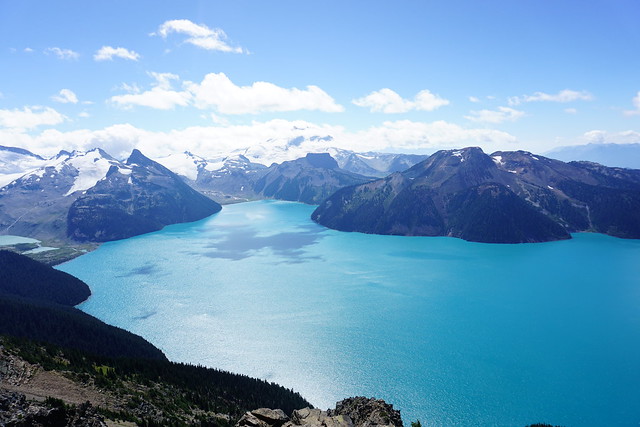
I’ve been to Garibaldi Lake 3 times. The first time was a day hike in 2015 and it was what inspired me to take up backpacking in the first place! So I followed up that hike with a 3 night trip the following year where I camped at the lake and day hiked to Panorama Ridge and Black Tusk. In 2018, Carolyn convinced me to return on another backpacking trip over the Labour Day weekend because she still hadn’t been to the lake at all.

DSC06958

Both trips took place over 3 nights and had identical starts, but the itinerary diverged after that. On both trips, I went to work on Thursday morning and then drove out to the Rubble Creek trailhead in the middle of the afternoon, starting the hike at around 5pm. The trail ascends 800m over 9km and is a bit of a slog, but it’s a very well maintained trail and isn’t that difficult, so it usually takes us about 3 hours to get to the lake, even with large backpacks. My first trip was with Seth and Emily, but on this occasion I went with Carolyn and Brandon.

It was September at this point, so we had less daylight than my previous trip, which had been in early August. We needed our headlamps for the last kilometre or so of the hike in the woods, but arrived at the campsite before it was completely dark. The 3 of us are a pretty well oiled machine at this point, so we quickly set up camp and hit the sack for the night.

HOP_0753

On both trips I left on Thursday and took Friday off. I really like this approach because the park is inundated with people on the weekend, so it allows you to beat the crowds on the way in and enjoy at least one day of hiking with less traffic. Fortunately, Garibaldi does have a reservation system, so you are guaranteed a campsite so long as you book far enough in advance to get one. Don’t even think about coming up and trying to camp without a reservation – Garibaldi Lake has a full time ranger and they won’t hesitate to send you packing.

DSC06761

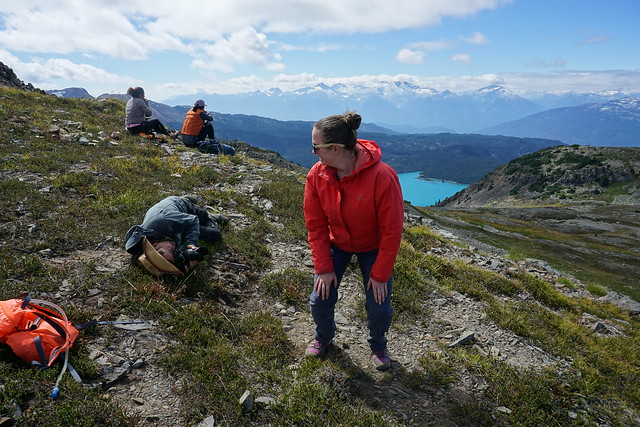
Since it was Carolyn’s first time at the Lake, she wanted to do both the Black Tusk and Panorama hikes. I love Panorama, but I vowed I was done with Black Tusk after the last time (it’s a scenic hike, but I’m not a fan of all the scree). We agreed in advance that we would split up on the first day. Carolyn would day hike up to Black Tusk and I wanted to try day hiking up to Mount Price. Brandon had already done Black Tusk as well, so he decided to join me. Since Black Tusk gets a lot of traffic and Mount Price doesn’t, it worked out pretty well safety wise, plus Carolyn ended up making some friends on her Black Tusk hike, so in the end we all had company!

The hike to Mount Price leaves in the opposite direction. Black Tusk and Panorama Ridge head back the way you came and then continue on the north side of the lake, but the Mount Price trail continues south around the lake. It’s not a well maintained trail as the crowds tend to gravitate towards the more popular trails, but wow, is Mount Price ever scenic!

DSC06789

We followed the trail through the trees along the edge of the lake where it heads further back into the woods. The first part of the hike isn’t too challenging and we made good time to the foot of Mount Price. There are nice views looking back at the lake and towards Black Tusk and we didn’t see any people on the way in. The benefit of this was that I got my first real sighting of a pika! I’ve since seen them a few other times, but this was the first time I saw one and we were very close to it, so I got a great view of this cute little furry creature.

DSC06783

We stopped at the base of the mountain for a snack and then continued on. From there, the trail get’s pretty difficult. It’s about 11km round trip from the lake (the same as Black Tusk), but I think this trail is more challenging. Once you start climbing up the mountain, it’s all a big boulder field and it is really easy to lose the trail (to be honest I’m not sure there’s even really a trail in this section). From the map, we could tell where we were headed – there’s Mount Price and Clinker Peak, with a smaller peak between the two. We more or less made our own path across the boulder field as we headed up towards the saddle between the peaks.

It is very steep and many sections have loose rock, so we took our time. Once you reach the saddle, it’s just one last push up the side of Mount Price. Mount Price is very definitive because it has a huge flat top. Once you reach the top, you can still easily spend an hour walking around the entire top of the peak taking photos, which is exactly what we did! Because the top is so large, you can’t really get a 360 degree view, so we made a wide loop.

DSC06832

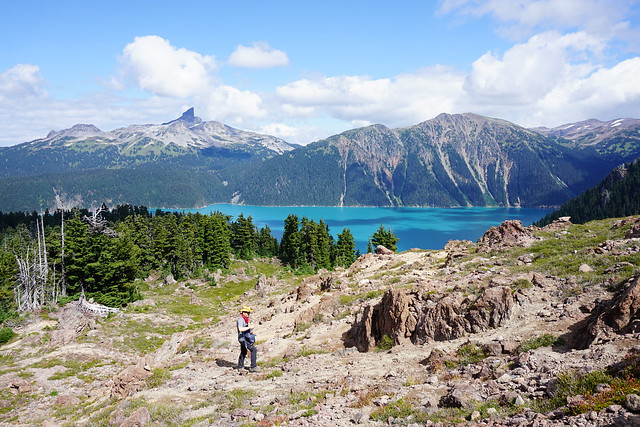
The back of the peak looks out towards the Elfin Lakes/Opal Cone area and there’s an awesome view of Garibaldi Mountain. then as you make your way towards the front, you get a view of the back end of Garibaldi Lake and all the glaciers. Finally, you can see Panorama Ridge and Black Tusk at the front of the mountain. The views from Mount Price are totally out of this world! Panorama Ridge and Black Tusk get all the glory, but honestly, I think Mount Price might be my favourite – the only view that might rival it is the view of Black Tusk from the top of Panorama. As far as lake views go, I think the view from Mount Price is just as good as from Panorama.

HOP_0538

We hung out on the top for ages and had our lunch looking down over the lake. It was pretty windy up there, so we found a nice sheltered viewpoint while we ate. We started to see some more people on our way back down the trail (some of which were day hiking 27km from Rubble Creek!), but we didn’t see anyone else while we were on top of the peak.

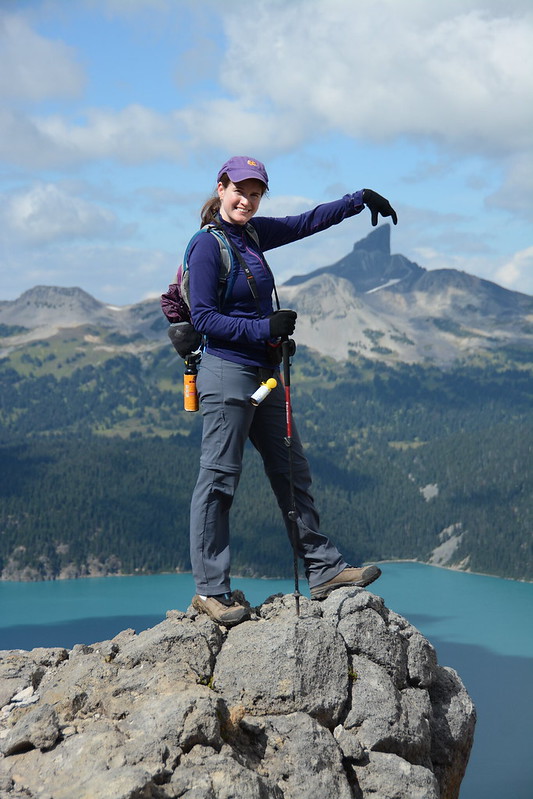
As usual, the hike down was worse than the hike up. I’d definitely recommend poles and take your time – it’s steep and there’s a lot of loose rocks. There was still a bit of snow up there and it was September, so you definitely want to be prepared for that earlier in the season as well. The best views of Black Tusk are actually from the saddle and we had a little photoshoot on the way down (one of our favourite activities).

DSC06889

Unsurprisingly, Carolyn beat us back to the campsite and was taking a nap in the tent when we returned. Normally we’d be anxious to take a swim in the lake, but it was September and quite chilly by the time we got back, so we opted not to and instead hung out on the dock by the lake while we made dinner. The Ranger was fishing off the dock when we arrived, so we ended up having a big chat with him. Apparently there are tons of fish in the lake since it was stocked in the past and now, because of it’s alpine location, there’s nothing to prey on the fish. So while he has a big canned food cache in the ranger cabin, he likes trying to get fresh fish.

DSC06828 (2)

We had a big chat with him about the reservation system as well, which is how I know you will get kicked out if you try and camp there without a permit. I accidentally ratted out a few backpackers we’d seen heading up towards Mount Price (you can get a wilderness permit for sections of the park, which I assumed they had, but apparently Price is not included in this permit). He indicated he’d already kicked 3 groups out of the campsite that day and that he wouldn’t be following the Mount Price campers, but if he saw them having a fire later, he would boot them out. Apparently you can see it all the way from the campsite and because he has a boat, he knows the secret quick trail up Mount Price that can only be accessed from the water. Anyways, trail reservations and camping restrictions exist for a reason people, please follow them.

After that we befriended a few Newfoundlanders that were also staying at the campsite! I was wearing a Newfoundland toque, so they asked me about it and then of course we discovered that Carolyn knew one of them and that we’d all studied engineering at MUN around the same time (classic occurrence TBH). So we had a fun night chatting as the sun went down over the lake while enjoying Brandon’s infamous thai chicken curry.

DSC06940

On Saturday morning we got up early and had breakfast at the lake before taking down camp. Carolyn still wanted to visit Panorama Ridge, but because I wanted to try and do something different than my previous trip, I had no trouble convincing her that we should make it a through-hike and end at Cheakamus Lake. So we lugged our packs with us away from the lake and back up towards the Panorama Ridge trail. The trail between Garibaldi Lake and Panorama is still one of my all time favourite trails. What I love about it is that pretty much the entire trail is incredibly scenic. You pass through the alpine meadows towards Black Tusk and then branch off and continue across the open plains towards the ridge.

DSC06974

The trail in this section is relatively flat, so it makes for a pretty easy hike until you hit the ridge. When we reached the branch that goes up towards Panorama, we ditched our packs in the woods and repacked our food and essentials into our day packs (if you’re caching your pack somewhere, take all your food so that bears won’t be attracted to it, and of course, always have the essentials). So we had lighter packs to climb up towards the ridge.

DSC06993

It’s not a long trail to get up to the ridge (1-2km I believe), but it’s definitely steep. This is one of my favourite parts of the trail though because it has the most stellar view looking back at Black Tusk! I love the view looking down at the lake too, but it’s always so windy and crowded up there that I somehow enjoy it less. We had a nice stop at the top though where we layered up and ate our lunches looking out over the lake and surrounding glaciers before heading back down.

HOP_0804

On the way back, we had our second photoshoot with Black Tusk. Carolyn decided she wanted to get a picture that looked like her sitting on Black Tusk, so Brandon spent forever trying to manipulate the picture to make it look like Carolyn’s throne with mixed results (it’s a lot harder than it seems!) so we just resorted to taking pictures of us crushing it instead.

Once we retrieved our packs again, we were into new territory and I was very excited about it. At the start of the hike, we met at the Cheakamus Lake trailhead and left Carolyn’s car there, driving Brandon’s back to the Rubble Creek trailhead. So instead of looping back to Garibaldi Lake, we would be continuing on to Helm Creek.

HOP_0839

From Panorama Ridge, the trail to Helm Creek looks like a bit of a barren wasteland, but I found it so interesting to explore! It’s pretty open, so I could see it being really hot in the summer, but it was September, so not bad when we visited. The weather forecast had been a little bit mixed before we left and we’d been anticipating rain, but to date we’d fortunately been spared. We continued past Helm Lake and followed the creek down through the wilderness. Traffic reduced significantly as soon as we left the ridge and we were back to having the trail to ourselves. After that all we saw were a few trail runners who were doing the entire pass in a day!

HOP_0851

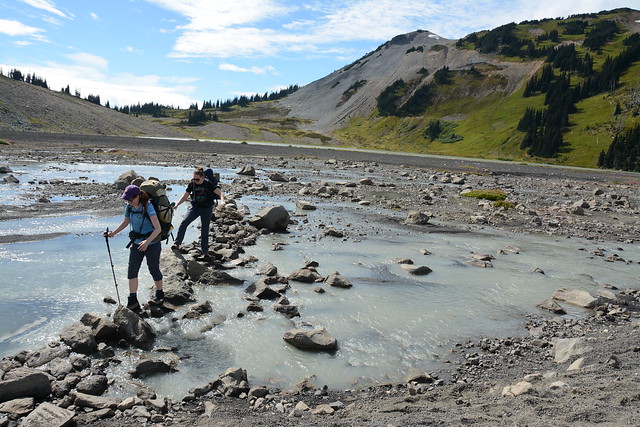
I had a lot of fun walking this section, we crossed the river several times and ended up having another photoshoot with Black Tusk as we continued around the back of it. Between this trip and some others I’ve done in the area, I think I’ve seen Black Tusk from every possible angle! Eventually though my feet started aching and the last few kilometres to the campsite were a bit rough. The vegetation increases as you head towards the Helm Creek campsite and the barren rocky outcrops turned back to meadows.

DSC07034

The campsites at the lake are all nestled along the trees and have decent privacy, but the Helm Creek Campsite is pretty much just a big open field with some tent pads. Unlike the lake, these don’t always sell out and there were a lot of empty tent pads, so if you really want to visit the park and can’t get a site, you could consider hiking in from Cheakamus Lake and staying at Helm Creek. I don’t like tent pads and prefer to set up on the ground, but tent pads are often constructed to protect the native vegetation, so we made sure to use it and always stick to the trails instead of stomping through the meadows.

Helm Creek isn’t as scenic as the lake campsite, but you can see right up to the back of Black Tusk from the meadow, so it’s still a gorgeous site. Being out in the open though, it was definitely the coldest night in the tent. We had dinner and then decided to go to bed pretty early as we were exhausted from all the hiking. Tent pads create a bit of a draught under the pad so it took us a while to warm up and fall asleep – I’m not sure if poor Carolyn warmed up at all. It rained a little bit overnight, but that ended up being the only rain on the trip, so we consider ourselves pretty lucky.

DSC07045

Sunday was our last day and the only order of business was to hike back towards the car. The trail goes back into the trees pretty much right after the campsite, so there’s not much to look at and we made good time on the trail. The trail length and elevation are pretty similar to the way in, but this trail has a long flat section along the Cheakamus River at the end, so overall it’s steeper. Once you get down the mountain, most of the elevation is done and you can either hike in towards Cheakamus Lake, or back towards the parking lot. Like most trips, we intended to go see the lake, but it was our 4th day and we were all pretty tired, so in the end we opted to skip it. We went back the following year and spent 3 days at Cheakamus Lake though, so no regrets!

And that concludes the trip! I haven’t been back to Garibaldi Lake since, but I have very fond memories from both of the trips I made there! I’ve explored most of the trails in this section of the park now, but it’s just so scenic I wouldn’t hesitate to go back again. I’m hoping my next trip there will be a snow camping trip as I’ve never seen the lake in the winter! I took an insane amount of photos on this trip, so here’s a few more to end the post.

DSC06835
HOP_0525
DSC06986
HOP_0636
HOP_0819
DSC06999
DSC07015
HOP_0829
HOP_0868
DSC07036
HOP_0897
DSC07053

Happy New Year Fox Glacier

Our plan was to heli hike Fox Glacier on New Years Eve. There’s two glaciers open for tourism along the West Coast of the South Island: Fox Glacier and Franz Josef Glacier. Both are only accessible by helicopter and offer a wide range of tourist activities on the glacier. So we signed up for a half day hike on Fox Glacier. We had pretty mixed weather throughout the trip, but we got a few really nice warm days in Queenstown and the forecast indicated that would continue into the New Year, so we were optimistic about the hike. But the closer we got to Fox Glacier, the less sure we were that the hike would go ahead. It was quite nice looking out towards the ocean, but the clouds were all clinging to the mountains and you couldn’t see any of the peaks.

There was nothing we could do, so we settled into our hostel and crossed our fingers for the next day. Our flight was scheduled for 8am and it was really cloudy when we got up. We walked over to the tour center and they started explaining their refund policy, which really wasn’t a good sign. So we changed our tour to 1pm, hoping the clouds would clear our by then.

In the meantime, we decided to go for a little hike around Lake Matheson, which originally was our plan for the afternoon. The lake is famous because on a sunny day, you get great views of Mount Cook reflected in the lake. We couldn’t see any part of Mount Cook, but we anxiously kept checking the clouds, which didn’t seem to be lifting at all. When we returned for our afternoon flight, we were told that one was cancelled too. It was a huge disappointment because I’d really been looking forward to both the helicopter ride and the hike. We had to drive 6 hours the following day, so we didn’t really have time to spare, but we decided to make one more attempt for the 7am flight the next morning.

There’s not really anything else to do in Fox Glacier on a cloudy, drizzle day, so we drove a half hour to Franz Josef to go to the hot pools. Before we found them though, we stumbled upon a kiwi park and decided to visit. We ended up having a great time! Since kiwi’s are so endangered, there’s tons of eco-sanctuaries around the country and a lot of organizations seem to breed kiwi to boost the populations. Overall there are 5 different species of kiwi, the rarest of which is the Rowi. It’s a small kiwi that’s only found in one sanctuary in the nearby area, so the kiwi park was breeding the Rowi and had young kiwi in their enclosure.

Because kiwi’s are nocturnal, they have the whole enclosure reversed so that it’s night during the day so that visitors can see the kiwi. The enclosure is lit by red lights so you can see them snuffling around. Only one was out while we were visiting, but he was very active, feeding all over the enclosure, so we got a good look at him and watched him for ages. To boost up their attraction a bit, the kiwi park also has an exhibit about glaciers and a tuatara enclosure.

We moved on to the Franz Josef hot pools after that and had a relaxing afternoon lounging in the pools. I have to say, it was definitely one of my more boring New Year’s though. We didn’t want to stay up too late since we potentially had a 7am flight, so we played a game of giant chess at the hostel and went to bed pretty much right after midnight. We were really only interested in spending time together though, so it didn’t really matter.

And our first day of 2020 ended up being a real day to remember. We packed up the car at 6:30am and were dismayed to see a lot of clouds still hanging over the mountains. We knew the flight would be cancelled, but we still had to show up to get our money back. To our shock though, in the next 20 minutes the clouds totally moved out of the valley and we were told that the 6am flight hadn’t gone, but our 7am flight would be!

Things got a little hectic after that – staff gave us all the equipment we’d need for the hike, weighed us for the helicopter, and blasted through all wild risks associated with an activity like hiking a glacier. Then they gave us a tiny pack for the rest of our things and rushed us onto the bus to the chopper. It was a little overwhelming and I had to leave a bunch of my things behind because they wouldn’t fit in the helicopter bag. Our group had 3 tours of 11, so overall it took 6 helicopter rides to get us all on the glacier. It’s only a 5 minute ride and they cycle 2 helicopters through, so it does go pretty fast.

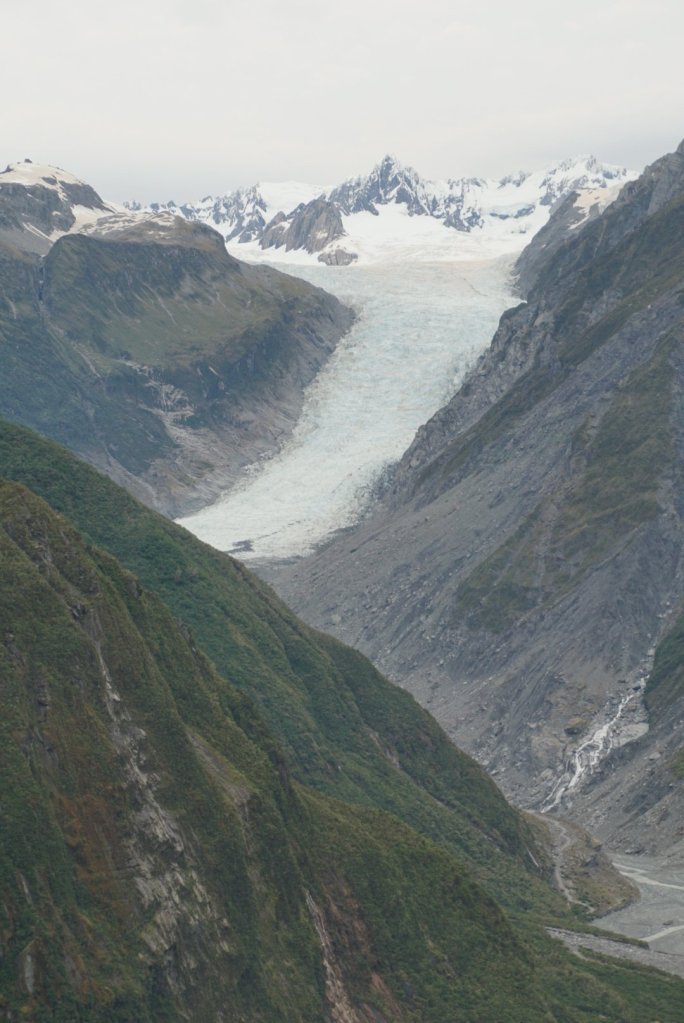
It may not be a long flight, but it is really cool to fly up the valley to the base of the glacier and then actually land on the ice. We ended up being in the first group, so we took off with our tour guide pretty quickly. Fox Glacier is a pretty rugged place. I’ve hiked to some other glaciers in BC, but I’ve never really been on them and the topography of Fox Glacier was really interesting. Up close all the ice looks a bright blue colour, but it never really translated that well to my photos. There’s a lot of interesting ice features, like mountains, caves, and waterfalls. We were all given crampons to wear and our guide had an ice axe to navigate a track for us. It was all pretty interesting to look at and though it was cold out, we were mostly moving around, so it wasn’t too bad. Admittedly it’s pretty slow going, but that’s because there’s no set path and you have to create a trail wherever you go.

We explored around the area for the better part of two hours and then things really started to go downhill. All of a sudden, we looked back at the path the chopper had flown up the valley and all we can see is this mountain of fog rolling up the valley. Everyone else was like, “Oh wow, look at that fog roll, that’s amazing”.

But I am a Newfoundlander, so when I saw the fog rolling, I was like, “we need to get the F out of here.”

New Zealanders are some of the nicest people and you have to admire their laid back approach to life, but during my time in New Zealand I learned that they also have a bit of a laid back approach to safety that I could never really get on board with. I’ll admit I started to lose my cool a bit when I saw the fog rolling in. I think I would have been a lot more chill if it had been a day earlier, but I’d watched that fog hang around the mountain the entire previous day and I had 6 hours of driving to do if we wanted to make our 3 day kayak trip the following day. So I wasn’t really in a patient, easy going place. Plus I’d left half of my warm gear back at the base camp in all the confusion of packing the helicopter bag.

Our guide started joking about us maybe having to spend the night on the ice, which apparently happens to tour groups on average ONCE A MONTH. I was like, “okay, so are the helicopters on their way to come get us?”, and he laughed and said, “no, they’re out on scenic flights, but they’re sending them down.” Apparently the fog had moved back into the valley while we’d been up on the glacier and while the scenic flights all landed, when we got back to the helicopter landing area, we were told they couldn’t come back for us right now.

And this horrible feeling of dread just settled right over me. It was only 11am, but I was convinced we were going to have to spend the rest of the day and the night on the glacier. There’s nothing you can do about it. I was worried and disappointed about the potential for us to miss the kayak trip, but I think mostly I was frustrated by my own lack of preparedness for such a situation. I pride myself on always having my 10 essentials and being prepared for scenarios like this. But I hadn’t brought a lunch that day and so much of my warm gear was sitting back in the lodge. It’s a really horrible feeling. The tour company does have a bunch of lock boxes up on the ice that are apparently filled with tents, sleeping bags, and dried food; but it wasn’t really a comfort to me as someone who has snow camped before because I knew it would only be survival gear.

Admittedly, I was one of the more concerned tourists. It seemed to be everyone else’s first day in Fox Glacier and I don’t think any of them thought we’d be there for long. This was probably a healthier attitude to adopt as I can be a bit of a worry wart. Although I won’t berate myself for it because I really don’t think the tour company communicated the risks to us adequately. They’d had cancelled flights for days and I think they made a poor decision to send a group up in questionable conditions. It’s the darker side of their laid back philosophy to life. Although our tour guide didn’t really help. In that moment I needed reassurance and distraction, not a 24 year old cracking jokes about sleeping on the ice.

Once you stop moving, it does start to get quite cold, so they had us all huddle under a tarp to trap our body heat. It was actually a lot warmer at first, but as the hours stretched on, people started getting bored and were coming and going from the tarp shelter a lot, which really reduced its effectiveness. I was getting pretty cold, but at least I had lots of food in my pack. It was discouraging though because the clouds kept moving in and totally filling the valley, leaving no visibility, then they’d start to clear again and give us some hope, only to cloud back in. I was convinced it was going to do that the whole day.

Eventually though, we got word that they had a “window” to come up the valley and they were sending the choppers. It’s all pre-numbered, so you have no control over what helicopter you’re on, but fortunately we were on the second one. I was afraid to hope, but eventually we heard the first helicopter coming up the valley. They loaded the first chopper and sent it off and when we saw ours coming up the valley and it was such a relief! I’ve never been so excited to get in a helicopter, but also so excited to get out of it.

20200101_133434

It didn’t actually look too bad coming down the valley, but as soon as you land on the ground it’s a lot easier to understand why the choppers couldn’t come and get us. The valley was totally filled with cloud and a literal window in the clouds had opened that looked up towards the glacier. They wanted to get everyone off the glacier as soon as possible, so they hurried us off and sent the helicopter back up immediately. While we were relieved to be back on the ground, the window was getting noticeably smaller and we really wanted the rest of our group to get out as well. I think they did get our whole group out, but the window did close up again and there was a second group up there that I don’t actually know if they were still stuck or not. We had a lot of driving to do, so we couldn’t stick around to find out.

If I hadn’t had the opportunity to do the hike, I would have been super disappointed about it, but the hike was really marred by the experience. At the end of it all, we only spent an extra 3 hours on the ice, but it really was the longest 3 hours of my life. It totally makes for a great story to tell now and I’m definitely able to laugh about it. But I also don’t think I could recommend it to other people. It’s a lot of driving to get there and the glacier is really the only attraction. So it sucks if you go all the way there and then miss it. And after my own experience, I’d say not to hedge your bets. Don’t go if the weather is at all questionable. The problem is, if the flight goes, they won’t reimburse you, so they are kind of forcing you to go in a way, which I don’t like in this kind of adventure activity. If it really is true that one group a month gets stuck up there, then I really think they need to rethink some of their policies, or at least how they communicate the risk.

So it was a rough start to the new year, but I’ll also take it as a sign that 2020 is going to be full of adventure – and I do love a good adventure!