Slesse Memorial Trail has been on my bucket list for a while, but the access road is a little bit dicey so we’ve been waiting for the right opportunity. In late September, me, Seth, and Brandon decided to make a go at it.
Slesse Memorial is a 12km out-and-back trail located off Chilliwack Lake Road. After having driven the access road, we wouldn’t say that you have to have 4WD to get to the trailhead, but high clearance would definitely be an asset. You won’t get there in a car, but potentially in an AWD SUV. Personally, I wouldn’t take my Hyundai Tucson out there because I’m not comfortable driving in terrain with water bars, but Brandon thought you could probably make it there in one if you wanted to try.
Either way, we had no trouble getting there in Brandon’s 4runner. The nice thing is it’s not a long access road. Cheam Peak is located in the same area and it took us about an hour to drive 9km on that road – the access to Slesse probably only took us around 15-20 minutes. There’s a small parking lot at the end and there are two branches from there. One branch continues on in the same direction as the road coming in, and the second branch is on the left and continues up a rocky narrow road. The second branch that goes up continues on to Mount Rexford and my GPS indicated that we needed to continue up that road about 600m and then take a right branch onto the old Slesse Memorial Trailhead. I say “old”, because Brandon’s GPS showed a second trail leaving on the straight branch out of the parking lot, which we later learned is the “new” trailhead.
I recommend taking the newer trailhead (the right of the two forks). Either will get you there and they do meet pretty early on the trail, but the newer trailhead is slightly shorter, easier, and more well maintained. We missed the old trailhead on our first pass and had to double back to find it tucked in the woods.
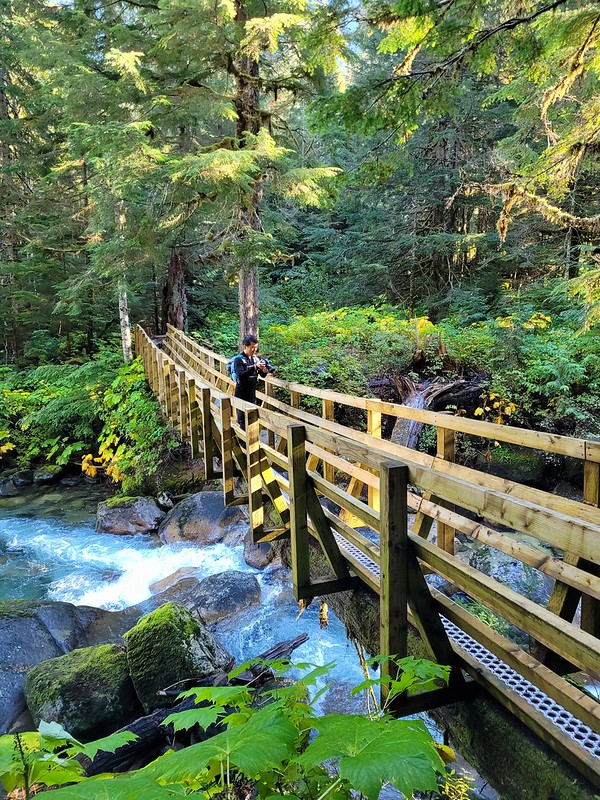
The first half of the trail meanders through the forest and isn’t very difficult. There are some tree roots to step over, but it’s not overly technical. Shortly before the memorial plaque, you pop in and out of the woods and get a few glimpses of Mount Rexford across the valley. We went in late September and the trees were just starting to change colour. We were a bit too early for full colours, so I’d recommend early October instead.
The memorial plaque is located around the halfpoint of the hike and has a beautiful view looking up towards Slesse Mountain. The trail is called Slesse Memorial Trail because a commercial jet crashed on the side of the mountain in Dec. 1956, killing 60+ passengers and crew. The plane was flying from Calgary to Vancouver when it disappeared and it wasn’t actually found until 5 months later when a climbing crew accidentally spotted it on the side of the mountain. Due to the challenging locating, the bodies were never recovered. You can’t see the crash along the trail (at least we didn’t), but some of the debris has been collected at the top of the trail. I’m not sure at what point this was done, but these days there are signs indicating not to do this.
We came for the view versus the memorial, but it was very interesting and we spent a lot of time thinking about it, making it a bit more of a somber hike. After the plaque, the trail gets a lot steeper. I thought we might need to do some way finding on the trail, but it’s easy to follow, just steep. There were a lot of old blueberries along the trail, so I could see it attracting bears, but on this occasion the berries only attracted Sadie. She discovered them growing there and wouldn’t stop picking and eating all the berries! It was very cute.
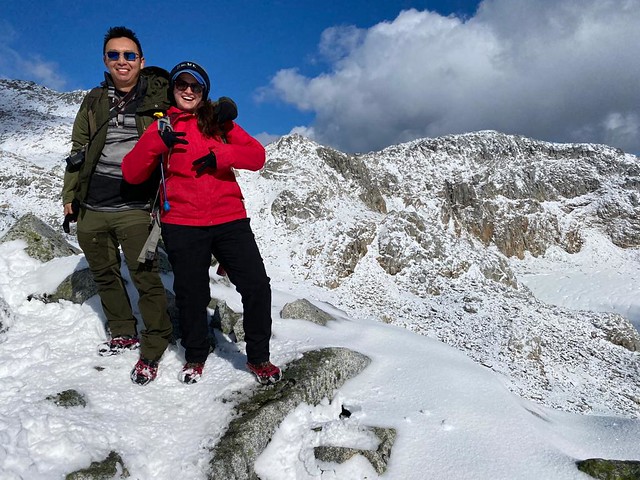
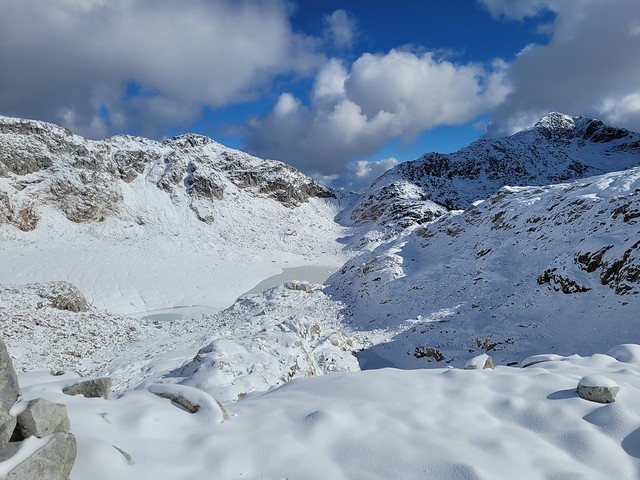
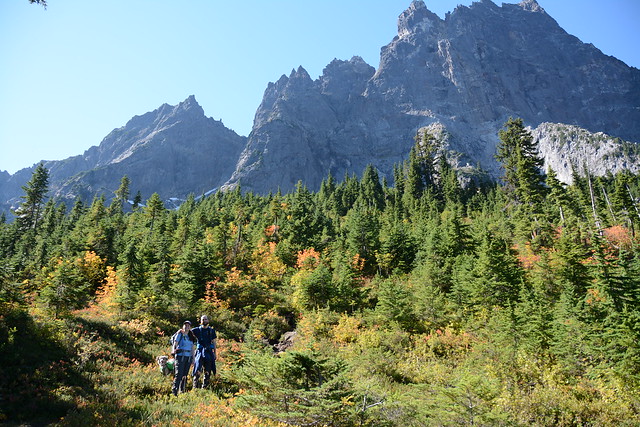
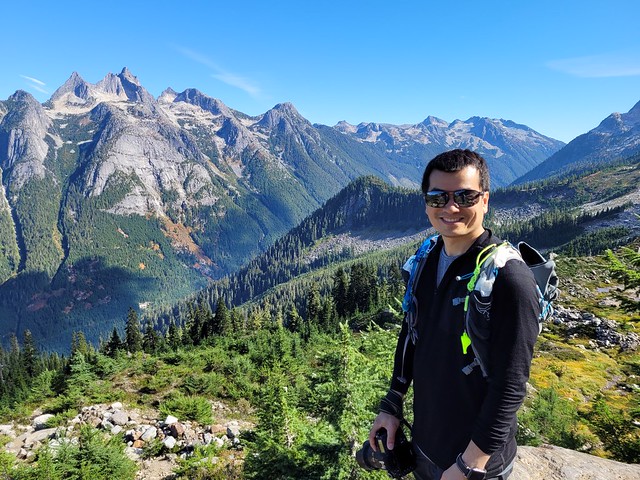
In all it took us just over 3 hours to get to the top. It’s an interesting trail because it doesn’t go to the top of the mountain, but rather the base of it. A lot of the mountains in this area are forested, but Slesse is sheer rock with no vegetation growing on it. It’s very steep, so I’m sure it attracts climbers, but for hikers, the trail ends at the base of the mountain. There’s a beautiful 360 degree view and you can climb up a bit further if you’re feeling adventurous. There’s a long flatter section of rock, with a glacier coming down one side and the sheer rock face at the back. I say “flatter” because the rock is still a lot steeper than it looks. Me and Brandon explored up a bit further, which has a gorgeous view looking back towards Rexford.
Be careful where you explore though, it was a surprisingly hot day for late September and the glacier was on the move while we were there. At one point there was a very loud rumbling and we watched as a big snow patch at the bottom of the glacier slid down part of the mountain. So we stayed away from that section and explored directly under Slesse, where there was still a bit of snow, but much less and not as steep.
The steep uphill section does make for a slow descent on the way back. We left around 2pm because we didn’t want to get stuck hiking in the dark. We inched our way down the top section, but were able to pick up the pace a bit once we got to the flatter bits. It’s a pretty narrow trail, so it can be a bit tricky passing people. We only saw 2 other people on the way up, but passed a handful of people on our way down.
Overall it was a nice hike. It was a lot more forested than I was anticipating, there’s a few peak-a-boo viewpoints, but not too many views until you reach the top. If you have the time to explore at the top though, there’s quite a bit of open terrain. We finished the hike around 5pm and still had lots of daylight left, but I’m glad we turned around when we did because the sun goes down over the mountains on this trail pretty early, so it was still quite dark hiking back through the trees at the bottom. I did really like the hike and would love to return and do more hikes in this area!
I’ve written about a lot of hikes, many of which are super popular. I found the time to write about Garibaldi Lake twice and I’ve written about Elfin Lakes a whopping 5 times, but somehow I’ve never found the time to write about one of Southwest BC’s most quintessential hikes: Joffre Lakes.
Joffre Lakes is a gem of a provincial park located about 30 minutes out of Pemberton on Duffey Lake Road. It’s a bit of a trek for a day hike from Vancouver, but every year swarms of people flock there to discover the brilliant blue glacial lakes for themselves. The park was closed through most of 2020 due to Covid-19 and re-opened in summer 2021 with a new day pass reservation system in place to manage crowds in the park. This is a free day pass that has been introduced in several of BC’s most popular parks to curb the flow of visitors. A lot of people are opposed to the day pass system and BC Parks has been widely criticized for it, but while I have many criticisms of BC Parks (mostly to do with their poor online system and cancellation policies), I have to admit I am a fan of the day passes. It keeps the crowds down and removes the stress of having to get up super early to ensure you find parking.
The first time I visited Joffre Lakes was in 2015 and while I was astounded at the beauty of the park, I had to admit that the swarms of people definitely took away from the experience. I visited on a beautiful Saturday in August, so I know there would likely be less people on a weekday, but the park only has one major trail and it’s only 11km round trip, so it’s not a lot of space for people to disburse along the trail, even on a less busy day. There were literal greyhound buses toting group tours of up to 50 people along the trail, so it was hard to get a moment to yourself anywhere on the hike. That said, a lot of people only hike to the second lake, or if they do hike to the third lake, they stop at the head of the lake. If you hike around the back of the third lake, where the campsite is, I did find it to be much less crowded.
When the park re-opened this summer, I thought it might be time to finally re-visit it since Canada is still mostly closed to international tourists. Emily and my parents visited during the first week of September and we decided to make the trek out there on a week day to hopefully find a bit of solitude on the trail. There’s no question that with the day pass, parking was much easier. I think they’ve added an overflow lot since my last visit and we had no trouble finding somewhere to park. It was still quite busy for a week day in September, but much less crowded than my first experience.
Like I mentioned, the trail is only 11km round trip if you go all the way to the campsite (which lots of people don’t), and has about 400m of elevation gain. It’s a very well maintained trail, so it is good for beginners. There are 3 beautiful lakes located in the park, making it easy to customize your trip. The first lake is only about 5 minutes in along the trail, so it makes for a good pit stop if you’re just passing through and want to stretch your legs. From there, the trail continues up through a boulder field (the trail is backfilled though, so easy walking) with beautiful views of the surrounding mountains. This is where most of the elevation gain is done along the hike and is the longest stretch between lakes.
Eventually you pop out of the woods along the edge of the second lake, which I would say is the most popular of the three. The water is a gorgeous green hue and Matier Glacier is framed through the trees at the end of the lake. I’ve visited the park 3 times in total and always opt to eat my lunch at the second lake to bask in the views. On this occasion, I convinced my mom to take a quick dip in the water with me. I’ve swam in a lot of alpine lakes over the years and Joffre is definitely one of the coldest! It is numbing, so if you opt to swim, be prepared for a quick dip in and out.
One of the other highlights of the second lake for me is that at the back of the lake there is a beautiful stepped waterfall cascading down from the third lake. It’s only a short hike between the second and third lakes, so I definitely recommend going up to the third lake, even if you opt not to hike around the lake to the campsite. The third lake has incredible views looking up at Matier Glacier.
On this trip, we ended at the base of the third lake (which is a round trip distance of 8km), but on my first visit Seth and I opted to hike the entire way around to the campsite. If you continue past the campsite you can hike up onto the big rock overlooking the lake, which is my second favourite view in the park after the second lake. From there, the surrounding mountains come into view on the opposite side of the lake, making for beautiful photos.
All in all, it took me about 5 hours return trip on both visits. It’s a beautiful park that’s 100% worth ticking off your bucket list, but I don’t think it would even rate top 10 on my list of trails overall. It’s just too crowded. If you choose to visit, please treat the area with respect – take all your garbage with you and make sure to leave no trace. Sadly the area often gets trashed due to its popularity and we want to preserve this beautiful park for generations to come!
The view from the back of the third lake – only photo from my 2015 visit
I’m starting to lose count of the number of times I’ve been up the Elfin Lakes trail, but every time has been a very different experience so I keep going back! I’ve day hiked it to the Gargoyles, backpacked up to Opal Cone, snow camped, and taken a group of girl guides up there in very marginal conditions. On the occasion I hiked up to Opal Cone, we’d actually been aiming for Mamquam Lake, but abandoned our pursuit because it was too hot, so I was really keen to make another attempt to get to Mamquam on this trip.
Karen and Grant planned this trip for mid August and invited me to accompany them. An overnight camping pass is required for one of the 35 tent pads, so I quickly booked up one for myself and easily convinced Brandon to join me. He’d been with me on the first failed trip, so it was only fitting. Me, Karen, and Grant took Friday off to hike up and Brandon joined us later in the evening after he got off work. Not something I’d recommend, but he’s very familiar with the trail and he’s a fast hiker.
I met Karen and Grant downtown and we drove together to the trailhead outside of Squamish. You only need 2WD to get up the road in the summer, but I was a bit surprised at the condition for such a popular hike – it’s seems to have deteriorated quite a bit in the last few years. Parks staff met us on the road on the way up to check our passes and warned us there were a lot of black bear sightings and even one grizzly sighting. There’s a lot of berries on the trail, so make sure to bring spray and a horn if you visit (not bangers though as they present a fire risk).
It was a really dicey forecast for the weekend, so we weren’t really sure what to expect. It had rained on and off on the drive up and it was looking pretty grey when we arrived. We made good time on the old road up to Red Heather hut, but it did start raining pretty early into the hike. It rained solid for about 15 minutes, but then fortunately it slowed down and mostly just drizzled on and off after that.
We stopped briefly at the hut for a snack and I picked a handful of blueberries before continuing on. The rain had mostly stopped, but the clouds were super low and we knew we weren’t going to get any view, so we took the bike path up. I thought the bike path was in better condition than the hiking path, which often gets muddy, but I learned on the way down it’s been completely redone with crushed rock, so I definitely recommend the hiking path!
We dried off pretty fast after that and made a good pace to the campsite, but unfortunately we didn’t see any views at all. We were clearly right in the cloud and it was super foggy, so there wasn’t much to take photos of on the way in. We didn’t mind though because we were just so happy to be able to put our tents up in dry weather! I had taken my new Gossamer Gear tent for the trip and thanks to Carolyn, executed what is quite possibly her best idea ever and most brilliant tent pad hack! Since my tent is only set up with hiking poles and relies on tension to keep it upright, it’s hard to set up on wooden pads because it relies on being staked. The solution was a pack of 8 tiny wood screws that you could hand screw right into the tent pad! It worked so great and I was thrilled with how easy it was to set up!
Side note: for those of you who care, I’m still testing out my Gossamer Gear tent and assessing whether the single-walled design and subsequent condensation build-up on the inside are something I can deal with. On the first morning the tent was absolutely drenched, but so was Karen and Grant’s normal tent, whereas the second night it held up very well in the wind and rain and had minimal condensation in the morning. So I guess it is super dependent on weather conditions and I’m slowly learning how to deal with it.
Overall it took us just over 3 hours to do the 11km hike up to the hut. It was after 5pm when we arrived so we went to the cookhut to make dinner after setting up our bedrolls. Because of the extreme high risk of wildfires, BC Parks is requiring all cooking to be done in the shelter. While I agree this is prudent, I’m a little annoyed that they closed the sleeping hut for the season because of covid. I get you don’t want people sleeping there, but eliminating access to it and then forcing everyone to cook inside one tiny cook hut while it is still a pandemic seems counterproductive. Anyways, how busy the hut was varied and fortunately it wasn’t busy on Friday night. Despite all the tent pads being sold out, only about half were actually in use, so I think BC Parks booking system and cancellation policy could use a little updating too.
Anyways, that’s my rant for this post. We had a real treat during dinner when the clouds finally started to break up and give us a view! At first we’d just get the odd glimpse of a mountain through a hole in the clouds, but eventually they broke up completely and we got the most beautiful cloud inversion down into the valley! We hung out and watched the sun set over the mountains before returning to Karen and Grant’s tent for a few rounds of cards while waiting for Brandon to show up. Fortunately he arrived shortly before 10pm and we quickly hit the sack in preparation for an early rise the next morning.
Day 2 was pretty unreal. Karen and Grant woke up at 6am and the sky was completely void of clouds and they were all sitting down in the valley. But when I got up at 7am the entire campsite was shrouded in fog. It cleared out again during our breakfast, but by the time we departed the campsite, it had rolled it once more. So we figured it was just going to be one of those days where you never know what you’re going to get and just have to hope for the best. At least we didn’t have to battle the heat!
Like I said, this was my second time on the trail to Opal Cone. Overall the entire trail from the parking lot to Mamquam isn’t particularly difficult. It’s not technical at all, but the trail has a lot of cobble sized rocks, so it does get tiring on the ankles and feet after a while. The trail meanders up and down for the first couple kilometres and then it drops down to the river at the base of Mount Garibaldi before climbing slowly back up the side of Opal Cone. There’s a lot of ascent, but it’s very gradual, so it’s not a bad trail for newer hikers. We couldn’t see Mount Garibaldi or Opal Cone on this hike, but we worked our way up the side of the mountain until we eventually reached the trail branch for the Opal Cone summit.
We’d planned to go up to the cone, but it was still very foggy and we could tell based on the elevation of the clouds that it would be cloudy at the top, so we decided to continue on and hope for the best on the way back. Karen and Grant had initially been thinking they might only go as far as Opal Cone (which is 6.5km one way), but everyone was feeling good, so we continued down into the glacial flat as a group. I don’t know if glacial flat is the correct term, but that’s what it looks like to me. There’s a big glacier behind Opal Cone that melts into a lake surrounded by rocky moraines from the historical glaciers. The whole area is really one big volcanic desert, with lots of dust and little vegetation, it can be brutal on a hot day.
The other side of the glacial lake was as far as Brandon and I made it on our last trip, so we were now moving into new territory. It was almost as if the weather knew it and as soon as we started making our way into the next valley, the clouds lifted and a few streaks of sun shone through. It never lifted off completely, but we were rewarded with some beautiful dusty views looking down the valley. There were several wash outs along the trail, 2 were before Opal Cone, but the most difficult one is on the way to Rampart Ponds (pictured below), which is the next campsite on the trail, located between Opal and Mamquam Lake.
My favourite part of this valley was the river that runs through the center. When you cross over it, the bridge is actually located at the merging of two rivers. The main river is incredibly chalky and silty, while the other is beautiful clear freshwater. So we stopped here to replenish our water bladders before climbing the last pass up to the campsite. You arrive at the campsite pretty much as soon as you crest the pass and there are several tent pads and ponds. I figured this would be my last trip to Elfin if I made it to Mamquam, but now me and Brandon are determined to return once more and stay at Rampart Ponds! Although I’d caution against it on a particularly hot day since there’s absolutely zero shade to be found.
From Rampart Ponds, you continue up another few minutes to the top of the pass, where you have the most incredible 360 degree view of Opal Cone and Mount Garibaldi on one side (on a clear day) and a view down to Mamquam Lake on the other. Rampart Ponds is 3.5km from Opal Cone and it’s a final 1.5km to Mamquam. The only problem is it’s a pretty big descent to get down to Mamquam, so even though it sounds short, it’s a big climb on the return trip.
Either way, we were so close we were determined to get there for lunch. We trundled on and I really enjoyed this section of the trail. It was still cloudy, but they had lifted up a bit and me and Karen both loved the terrain. Everything we’d hiked that morning had been desert, but the hike down to Mamquam is proper alpine greenery and meadows, so it made for a nice change of pace. We arrived shortly after 1pm to grumbling tummies.
As much as I wanted to eat my lunch, I’d been struck by the urge to swim and knew if I didn’t do it right away, I wouldn’t do it at all. It was not a warm day. I hiked in pants all day and while I only wore a t-shirt, it was chilly when you weren’t moving. So I stripped down to my swimsuit and went in. It’s a beautiful large lake with sloping mountain walls, but it’s very shallow at the foot of the lake. Fortunately, it’s also pretty sandy, so even though I had to walk out a fair way without shoes, it wasn’t painful. At first it felt cold, but I warmed up really quick because the water was actually warmer than the air. I convinced Grant and Brandon to join me and I ended up swimming for the better part of 15-20 minutes, which is substantially longer than I can usually stand to swim in alpine lakes. After I got out I got cold fast though. So I quickly bundled up in my puffy. Surprisingly the guys never got cold and it made for a funny contrast with me in my puffy while they ate their lunches shirtless.
We really enjoyed the lake, especially because we were the only people there. In general, we didn’t see a lot of people while hiking and Rampart Ponds had actually been completely empty when we hiked through. The slog back up out of the valley wasn’t as bad as I anticipated. The forest was filled will blueberries, so we all did some picking and snacking on the way up.
After that though it was a pretty long slog back. I didn’t mind the hike back to Opal Cone too much, me and Brandon mostly fantasized about where we would explore on our next trip, but the section from Opal back to Elfin was brutal. Opal was clouded in again on our return, so we skipped it, which I don’t regret. My feet were pounding by the time we got there, so we just did our best to get to Elfin. In total it was 22km of hiking, which is a lot to do in one day and the most I’ve done this season. We were all starving when we got back and happily settled in to have our supper.
We crammed ourselves into Karen and Grant’s tent for a few games of cards before bed, but we were all exhausted, so we called it shortly before 10pm. Unfortunately, it started pouring just as we finished. We didn’t know how long it would last, so we all ran around like banshees trying to do our nightly routines and get in our tents… only for the rain to stop about 10 minutes after we were done. If only we’d played one more round of cards we would have missed it.
Everything was wet in the morning, but the tents actually dried out pretty good before we packed them and nothing was too wet when we took down camp. It was a brisk morning and we all kept our rain jackets on for the return hike. In general the clouds were higher on the way back than the way in and we did catch a glimpse of some views. There’s more uphill on the way back than I remember, but nothing too bad. Once we reached the Red Heather Hut we totally powered down the last 5km and back to the car. We finished with pizza and beer at Backcountry Brewing, which is quickly becoming our new tradition!