Let’s Talk: First Aid

First aid is one of those things I always knew was important, but it took me a while to really learn just how useful it is. Being able to swim was something that was always really important to my Mom, so she put me in swimming lessons as a kid and later signed me up for lifeguarding courses when I turned 14. I did junior lifeguarding until I was 16, when I completed my National Lifeguard course and was certified for 4 years. First aid is a major component of this course and it is something that has served me well ever since. I’ve done several variations of first aid courses for work and guiding ever since and I think it is so worthwhile to invest time in learning basic first aid. Even if you don’t have a formal certification, being able to recognize symptoms and treat simple emergencies is a huge asset in the outdoors.

I was employed for 2 summers as a lifeguard at age 18, other than that I’ve never had any formal capacity as a first aider. Yet, since then I’ve treated a seizure, heat exhaustion, heat stroke, a broken arm, injured knees, and any number of cuts, scrapes, and blisters. I never leave my first aid kit at home, and I’ve been surprised by how often I’ve needed it. You can be resourceful in the wilderness, but I’ve never regretted carrying along a few extra first aid items (and you will definitely regret if you need them and don’t have it). I think the most important thing is knowing what to bring and how to recognize symptoms.

First Aid Training

Let’s start with training. The easiest way to learn is to do a formal course. There are 3 basic first aid courses: Emergency, Standard, and Wilderness First Aid. Having done them all at least once, I think Standard First Aid is the best bang for your buck. I don’t like Emergency First Aid, it’s only a 1 day course and it covers very little outside of CPR and AED. While these are good skills to have, I don’t think they are the most practical. I’m much less likely to need CPR and much more likely to need to bandage a broken wrist, so I find Standard First Aid more practical (plus you learn CPR/AED in all 3 courses).

Standard First Aid is generally a 2 day course and covers diagnosing and treating all different kinds of ailments, which is why I think it’s more useful. Treating heat stroke was the most life threatening thing I’ve ever done and I was able to diagnose it incredibly quickly, to the benefit of the individual (read about that experience here). Even for simple things, diagnosis can make a big difference. I was once 3 days into the wilderness and had a frightened hiker approach me with heartburn, I gave him pepto-bismal and it resolved in no time (somehow he’d never heard of heartburn – he described his symptoms and Emily immediately diagnosed it as heartburn since she gets it a lot, while I sang the pepto-bismal rhyme and he looked at us like we had 3 heads). So in my opinion, Standard First Aid is more practical than Emergency.

Wilderness First Aid sounds like it would be the most applicable for outdoor adventure (and it is), but it’s also the most expensive and has the biggest time commitment (2 long days or 3 shorter days). In my opinion, Wilderness First Aid is glorified Standard First Aid. It covers the same material, but from the perspective of someone in the wilderness with limited resources. So you practice splinting with sticks, homemade stretchers, and hypothermia wraps, but it’s not substantially different. Though once you have Wilderness First Aid, it’s half the work to re-certify it every 3 years (just a day), so I try and keep mine up to date. So if financial is a concern, I’d recommend Standard First Aid as the best course.

An idea of what “technical” means

Understanding Your Abilities

The second part of first aid is knowing what to bring with you and keeping a cool head in an emergency. If you panic, your patient will panic, so my approach has always been to be reassuring while asking lots of questions. Honestly, the presence of a first aid kit and care from someone who seems like they might be able to help is often reassurance enough for the patient. The other important thing is knowing when to call for help and doing so immediately. For example, you can probably handle small cuts and scrapes yourself, as well as mild dehydration. When my friend broke her wrist on a hike, I was able to wrap it for her to make her comfortable enough to walk back to the car on her own.

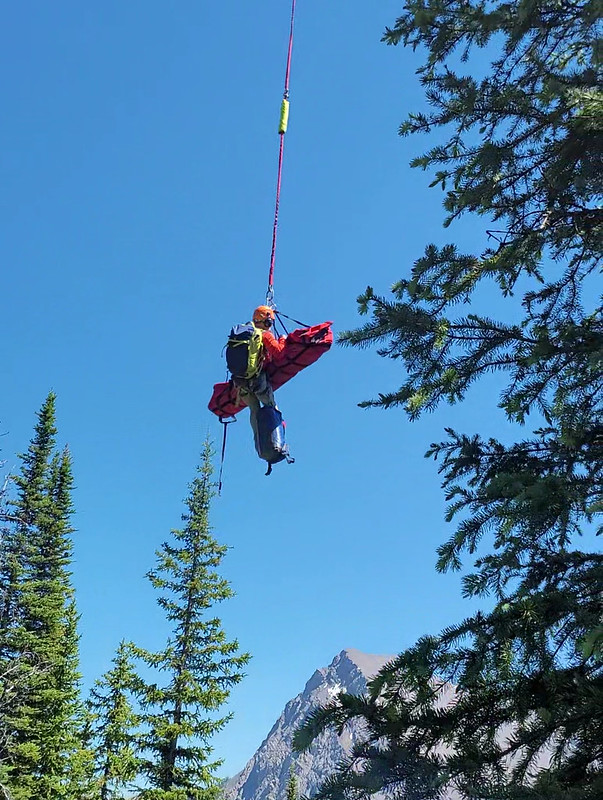
Dehydration is one of the more dangerous problems you can encounter, so being able to recognize it is important so that you can self treat. When I did the North Coast Trail, on the third day, me and Emily were both feeling really low and when Emily started to complain of an upset stomach, I immediately made the whole group stop hiking and we took a break while we both chugged a litre of electrolytes. While Emily’s energy remained low, our quick action prevented it from getting worse and we were able to finish the day in good spirits, with no injuries. In contrast, when my friend got heat stroke on the trail to Assiniboine, I didn’t know she was feeling bad until it was really too late. Her muscles started cramping, she couldn’t stand, and she even started losing feeling in her legs – all of these symptoms occurred within 15 minutes of her stopping to say she felt sick. In this case, I immediately made an SOS to emergency services on my inreach and spent 3 hours rehydrating her while waiting for help. Don’t try and be a hero; sometimes professionals and a quick extraction are needed and you are much wiser to make the call in those scenarios. Read my post on personal safety for more about communication devices and preparedness.

VideoCapture_20210707-104610

What to Bring

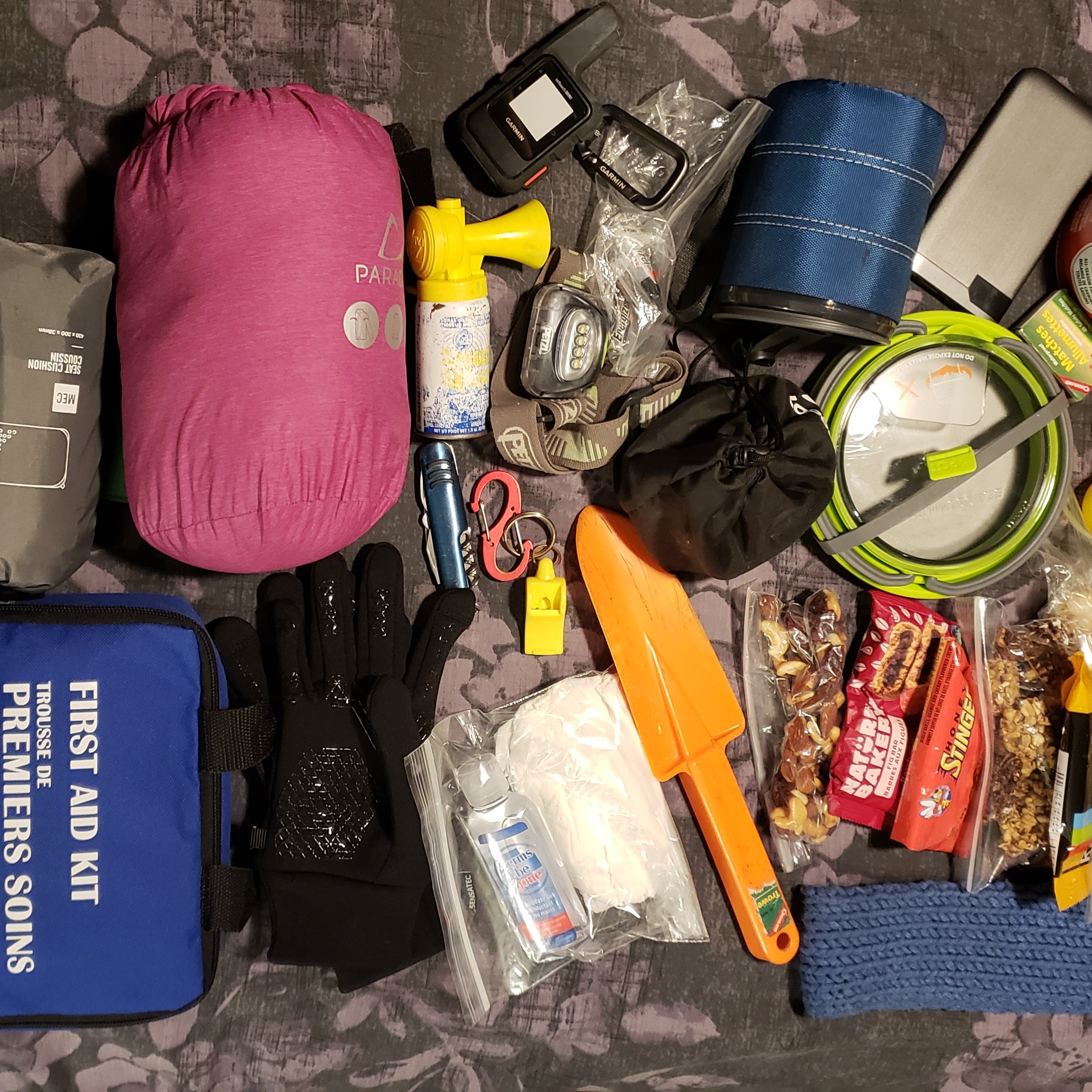
And the last thing I want to highlight is the more practical side of what to bring with you. Lots of places sell small first aid kits and most people opt for a tiny one to throw in their backpack. I wouldn’t say my first aid kit is large, but it is more sizable than what most people bring. Sometimes I lament the extra weight, but I always bring it. REI has a pretty comprehensive list of what to bring, which you can view here. Personally, I like to bring band-aids in varying sizes, a blister kit, sutures, antibacterial wipes, dressings, compression gauze, a tensile bandage, surgical scissors, triangle bandage, tweezers, safety pins, medical tape, polysporin, and latex gloves. I also bring electrolytes, advil or tylenol, pepto-bismal, and an emergency blanket and bivvy sack. Depending where I’m going, sometimes I throw in a small bottle of aloe and in the winter I will add hand warmers. One thing I don’t have is a sam splint, which I’ve been considering adding because it’s on a lot of first aid kit lists, but I’m not convinced I couldn’t just use a stick or a hiking pole in an emergency.

Your first aid kit is only meant to complement your 10 essentials, so make sure you also have extra clothes, food and water, as these can also help in a first aid emergency. If someone in your party is injured and it takes you longer to hike back – you don’t want to further endanger yourselves by not having other essentials, like a headlamp. I always remind myself to pack for the hike that goes wrong rather than the hike that goes right. I bring my insulated seat cushion on most hikes as well, because it can make a big difference to your comfort if you’re stuck sitting on the cold ground for hours waiting for help.

To conclude, my biggest recommendation is to get a first aid kit and learn what to do with it. Learning how to diagnose symptoms and how to treat them can make someone feel a lot more comfortable in an emergency, and may even save your life or the life of a friend. Stay safe out there!

DSC09384

Ski Resort Series: Cypress

Cypress is probably my most skied resort in BC after Whistler-Blackcomb, but I’ve never found the time to write about it because I rarely ski there in the day. When we first moved to Vancouver, we made a few trips up the mountain for Saturday skiing, but it’s such a popular place, it hardly seemed worth it. Since then, I’ve been up on the occasional weekend, but always for snowshoeing. Unless you get there super early, you will have to walk a long distance to get to the resort, so come prepared. I once did the whole walk from the lower lots in ski boots and my feet just about died, so bring a bag to pack your other shoes with you, it’s worth it.

20170210_201615

This might lead you to believe that I don’t really like Cypress, but in fact, I do actually really like skiing there. There are three resorts located in very close proximity to the city: Cypress, Grouse, and Seymour, of which Cypress is the largest. Cypress actually spreads across two mountains: Black Mountain and Mount Strachan, with the ski resort nestled in between the two. I like Cypress because even though it gets busy, it’s large enough to spread out the skiers and boarders, unlike the smaller mountains like Seymour, which can become very congested.

20170210_201711

Mount Strachan is the higher of the two mountains and has two key chairs: Lion’s Express and the Sky Chair. There are some smaller chairs that service the bunny hill, but Lions and Sky are the key lifts. Sky Chair is obviously popular because it goes up to a phenomenal viewpoint looking out towards both Howe Sound and the backcountry. It also has the added fun of being a rare 2-person chair, so it feels kind of vintage and is fun to board. It’s one of the best places to catch sunset on the mountain. I also like the Lion’s Express, which I find tends to have the shortest queues because it’s the fastest chair (although the queues often look very long, they just move quicker).

20190206_175203

Black Mountain also has two chairs, Eagle Express and Raven Ridge. I’m a little embarrassed to say I’ve never actually skied the Raven Ridge chair – it’s the last part of the mountain they usually open and it doesn’t have any lightning, so it’s not open for night skiing either. I can’t recall ever skiing Cypress when it was actually open. But I do really like the area accessible from Eagle Express. There are lots of intersecting runs from this part of the mountain. You can also ski the green run, Panorama, which has great views looking down into the city.

Screenshot_20220216-100749_Instagram

So why do I like Cypress so much, even though I’m loathe to go on the weekends? As my photos indicate, it’s mostly for the night skiing. Cypress is pretty expensive for a lift pass given its size, but it is one of the best value for money if you want to ski from dawn ’til dusk. A full day pass allows you to ski all the way until 10pm! Generally I will just get an evening pass, which starts at 5pm, and ski after work. Being able to hit the slopes when you finish work for the day is one of the coolest parts about living in Vancouver. Pre-pandemic, we would night ski and then grab a beer in the resort around 9pm before heading home for the night.

20190206_175411

The only downside to night skiing is the conditions are often not all that great. There’s no chance to groom the runs during the day, so they’ll either be pretty tore up, or they’ll be very slippery from heating up in the day and then freezing again overnight. But occasionally you get a visit where it’s either snowing while you’re there, or you get above the clouds and get a beautiful inversion down over the city. I love skiing there in March, when there’s enough daylight that you can catch sunset from the skychair on your first run.

20190206_174755

If you don’t have a car, Cypress is accessible by bus, but I think you might be limited to the daylight hours. I have taken the bus in the past, but it’s not a city bus, so it is rather expensive if you’re already shelling out for a full day of skiing. My preference has always been to carpool or take an evo or modo up the mountain. If you drive, just made sure you have snow tires or chains, which are required on Cypress Mountain Road in the winter.

So overall, despite the crowds, I do really like Cypress and try to ski there at least once a year. Definitely recommend it since it’s so close to the city and does have some truly beautiful views! Sorry for the low quality photos, they’re all a few years old and taken on crappy cell phones, one day maybe I’ll lug my night camera up there for sunset!

Cypress map

Snowshoeing Joffre Lakes

This post is a bit dated and has been a long time coming, but it was a fun trip and with Family Day coming up, it seemed like an appropriate time to write about it, so here we go! I’ve day hiked Joffre Lakes twice in the summer and I snowshoed it once in the winter of 2017 with Emily and Brandon during the Family Day Long weekend.

DSC03503

I’m not sure if Joffre Lakes is considered avalanche terrain or not as it’s not mapped on Avalanche Canada, but at the time I had read that it was pretty safe up to the second lake, so that’s where we decided to go. I’d read there was more risk going up to the third lake, so we decided against going that far and I would advise avalanche equipment and training if you go beyond second lake. Now that I’m a little wiser, I’d probably prefer to have avalanche safety equipment for the whole trail, but as I can’t remember the details of the terrain, make sure to do some additional research before visiting.

DSC03393

Fortunately we didn’t run into any problems in 2017 and were smart enough to check the avalanche bulletin before we visited. Emily wasn’t living in Vancouver at the time, but she came to visit me to go skiing and after a few days at Whistler, Brandon joined us for a little long weekend adventure around the Pemberton/Lillooet area. Our first stop was Joffre Lakes.

DSC03415

I don’t remember getting a particularly early start in the morning, but we had no trouble finding parking at the trailhead and the trail was relatively empty – some of the perks of visiting in the low season. We had a few false starts on the trail because Emily was trying to figure out what to wear and we ended up making a some adjustments. If you’re new to snowshoeing, which we were at the time, it can be a bit tricky because you want to stay warm without overheating. I like to pack my snow pants for when I stop to eat lunch, but I don’t like hiking in them. This means that you need to have a good pair of water resistant pants instead and wear high boots or gaiters to keep your legs from getting wet from the kickback of the snow on your snowshoes. These days I hike with long underwear, water resistant pants, and high boots.

DSC03404

One of the things I love about Joffre Lakes is that the first lake is only minutes from the parking lot, so you’re immediately rewarded with a gorgeous view! There’s less to see on the trail after that in the winter and I mostly remember being in the trees – although on the way down you get a beautiful view looking out over the surrounding mountains when you pass through the boulder field. There were quite a few people ski touring, so you just have to watch out for them as a snowshoer since they move so much faster (downhill anyways). While Joffre isn’t a particularly long or challenging hike in the summer, it is a bit steep in the winter, so I remember being pretty tired by the time we hit the second lake.

DSC03461

We had good weather when we visited, it was a bit overcast, but not so much that you couldn’t see the view. So we set up on the lake when we arrived to have our lunch. Unfortunately, it was a bitterly cold day, which was not improved by being out on the open lake. We got really cold, really fast. Even with snow pants, we had to bundle up immediately and Emily recalls it as being the coldest she’s ever been. I’m not sure if we were doing something wrong because I can’t ever recall being as cold in the snow as we were eating lunch at Joffre. It was particularly bad for Emily – I think she may not have had a sit-upon and been sitting right in the snow in her snow pants, so she did not want to stick around.

DSC03440

So unfortunately, we didn’t have long to enjoy the view before we were packing up again to keep moving. It was a good lesson in preparedness though. I don’t think we were overly underprepared, but it was a good reminder how inhospitable the wilderness can be. There’s no way we would have survived a night out there if something had gone wrong. So always bring lots of extra layers in the winter, as well as I’ve started hiking with a small stove and pot so that I’m able to make hot drinks to help stay warm. Items like a bivvy sack or an inreach can also save your life if you get stuck somewhere.

DSC03487

We warmed up again once we started moving and it was a quick hike back down to the bottom. We ended up spending the night in Lillooet (which has the most beautiful view of Seton Lake) and returned to Pemberton the following day. We’d been hoping to visit Keyhole hot springs, but a semi truck jack knifed on the road on the way to the springs, cutting off traffic in both directions, so we opted to cut our losses and did a bit of snowshoeing in the Pemberton area and Nairn Falls instead. Fortunately we weren’t stuck on the other side of the semi truck, in which case, make sure you have survival gear in your car as well because you never know how long you could be there!

20170212_081322