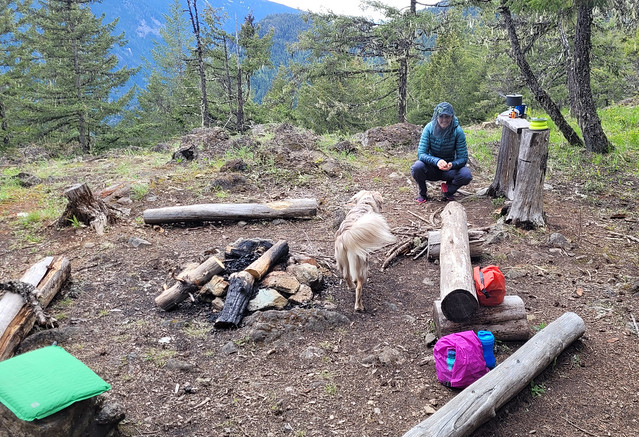
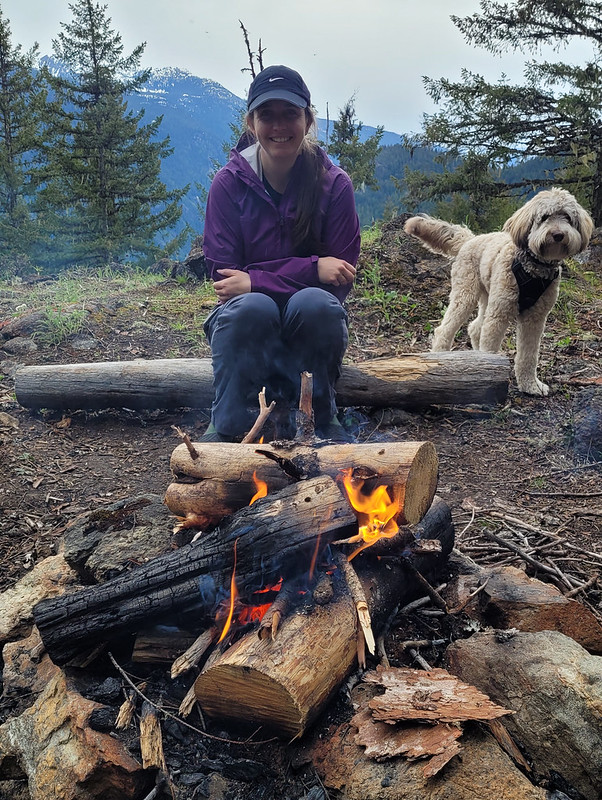
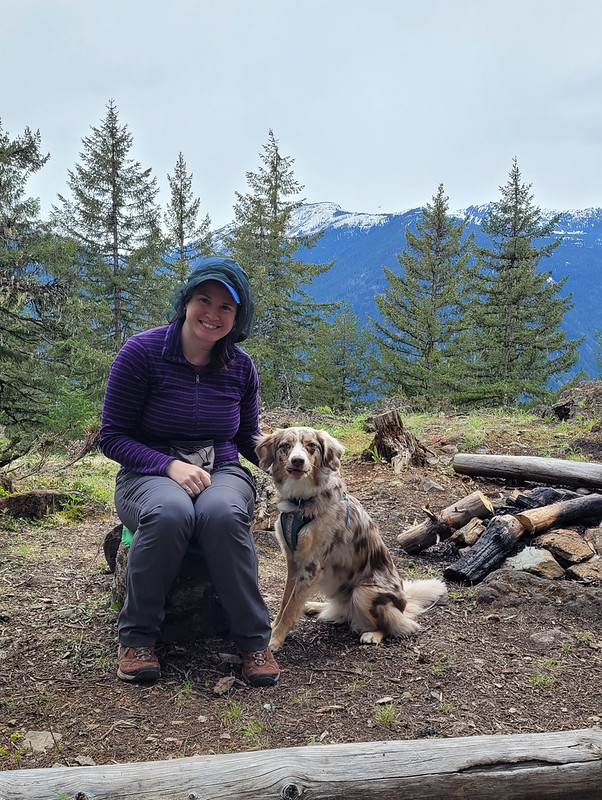
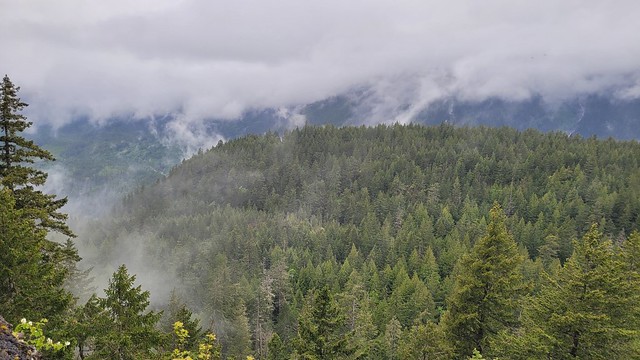
Viewpoint Beach Girl Guides Backpacking Trip

This is my third time writing about Viewpoint Beach in Golden Ears on this blog, but I did this trip with Girl Guides so I wanted to write about it again since I’m coming at it from a different angle. I started volunteering with Girl Guides shortly after I moved to Vancouver and have since done 3 years with a Brownie group (grades 2-3), 3 years with a Pathfinder group (grades 7-9) and most recently, my first year with a Trex unit (grades 7-12). Trex isn’t part of the core Guiding Program, but is a special ops group for members that just want to do adventure activities. Unlike the normal guiding program, which promotes learning and badge-work on everything from arts, to STEM, to activism, to camping; Trex doesn’t have any badges and just meets sporadically to plan adventure activities.

I’ve been wanting to do Trex pretty much since I discovered it existed, but there are limited units. Finally, last year I decided it was time to go for it and opened my own unit based out of New West (which is where I’ve been Guiding the past 7 years). We weren’t sure if we’d get enough members register to go ahead with the unit, but it ended up getting completely filled up and we’ve been working on developing adventure skills all year for when COVID finally died down enough to re-start overnight events. Our group was really keen to develop our backpacking skills this year and were thrilled to plan our first overnight trip for mid-May.

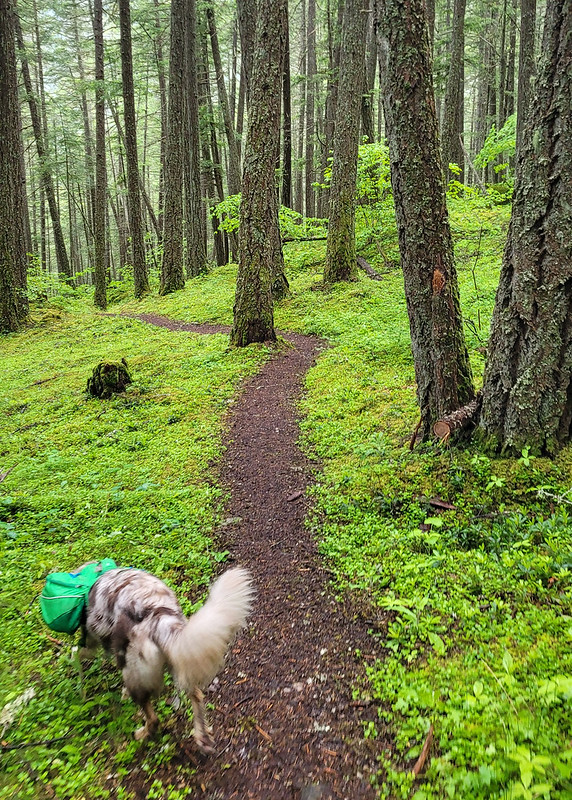
20220514_110757

Our original plan was to hike to Cheakamus Lake, which is a pretty flat trail before Whistler. I’d been once before in mid-May and had a great time and we reserved several campsites. Unfortunately, the weather this Spring has been terrible and the access road to Cheakamus lake was still half inundated with snow, so we decided to change our trip at the last minute to hike to Viewpoint Beach in Golden Ears instead. The goal was to do a shorter hike with only gentle inclines, which the Viewpoint Beach trail definitely delivers.

Unfortunately, the weather didn’t deliver. We met up a few days before the trip to go through everyone’s gear and pack our backpacks. Camping was only permitted with 2 people per tent thanks to COVID, so we had to carry a lot of tents with us. The nice thing about Girl Guides is that we can borrow most of the gear, so we shared around pot sets, tents, backpacks, and sleeping pads. The only thing we couldn’t borrow was sleeping bags, which proved to be a challenge because a lot of our members had older unrated bags and it was hard to tell how warm anyone would be (spoiler, not very warm).

20220514_151022

I’ve spent the last 6 years trying to reduce my pack weight and size by gradually upgrading my gear, so I was a little concerned that everyone was carrying big and heavy packs. What I didn’t take into consideration is that our group is made up of 13-16 years olds who have a lot more energy than their said Guide leaders. The weakest link on the hike in was definitely the adults!

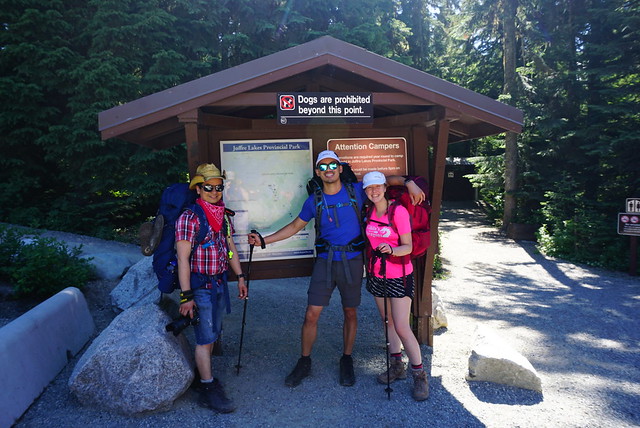
It’s ~4km to the campsite at Viewpoint Beach and the Guides had absolutely no problem hiking there, even with their large packs. They blew through the trail in just an hour and 20 minutes! It’s possible that it was the rain spurring them on though…

20220514_160209(0)

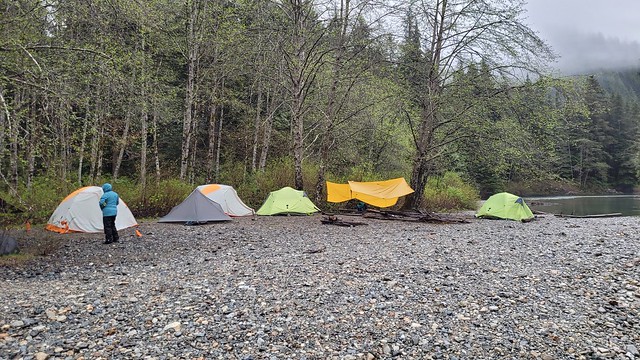
It was raining pretty heavily on our drive to the trailhead, but it stopped by the time we arrived. We got all ready with our backpacks and it started to rain again just as we started. Fortunately we were under the trees, so it wasn’t too bad, but we all layered up with our raincoats and pack covers to protect our gear. We arrived around 12:30pm and our timing was amazing, because it stopped raining long enough for us to put up our tents while it was dry before eating lunch. There was one other group on the beach when we got there, so we set up along the back by the trees and got a few tarps up. One more group showed up after us, but everyone else seemed to be continuing on to Halfmoon Beach instead. I’m not sure if our big group (11 people) was a deterrent, but there were empty sites left overnight, which is more than I can say for the last two times I went with a small group.

After lunch it started to genuinely pour, so we had a bit of a rest under the tarps and in tents. Since we had arrived early, we wanted to do a bit of exploring, so when the rain eased up we decided to hike back to the bridge to try and cross over to Hiker’s Beach, which is located just across the river from Viewpoint Beach. I have seen people ford Gold Creek to get to that beach on other trips, but the water is very cold and I definitely wasn’t going to attempt it with a group of teenagers!

20220514_150442

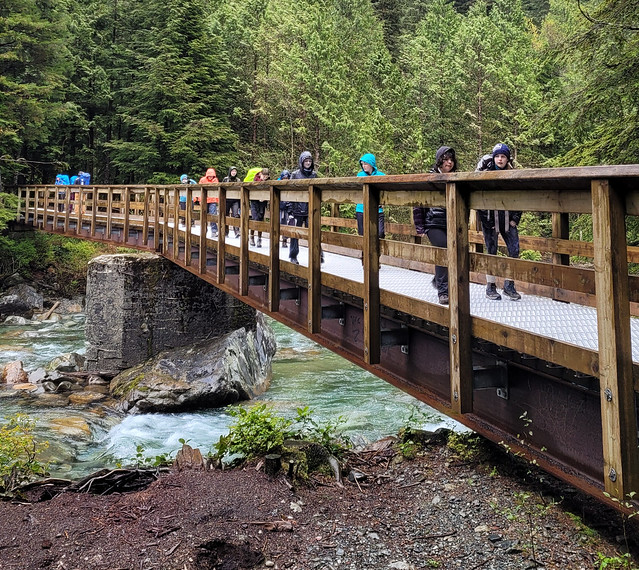
BC Parks has put a lot of effort into upgrading the trail as far as Viewpoint Beach in the past few years. The first time I hiked there was in 2014 and there was barely any infrastructure, since then they’ve added a really nice bridge to connect the East Canyon trail (the official trail name), to the West Canyon trail, which heads up towards Alder Flats and Golden Ears peak. It also connects to Hiker’s Beach to save you from having to ford the river.

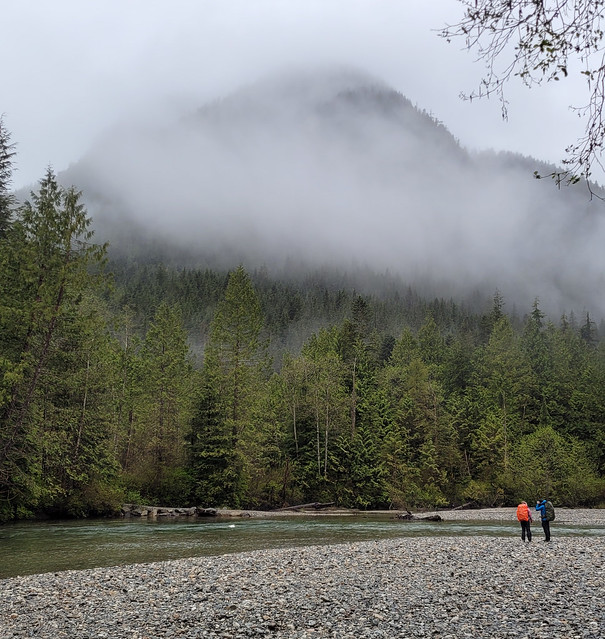
We hiked back across the bridge, but unfortunately, there’s a second river crossing just past the junction to Alder Flats that was impassable. We could tell from Viewpoint Beach that the trail entrance to Hiker’s Beach was partially flooded, so we knew it was possible we wouldn’t make it there, but we didn’t realize we also had to worry about crossing Alder Creek. If I’d been on my own or more adventurous, I might have explored around for a way across the creek, but again, with 8 teenagers, none of whom were using hiking poles, I wasn’t willing to risk it. So instead we hiked back to the beach and enjoyed hanging out along the river as the rain had finally stopped. We didn’t see anyone on Hiker’s Beach the whole day, so I guess no one else was willing to chance the crossing either!

20220514_161512

The rain stayed away for the rest of the evening, which made the trip a lot more enjoyable. We were able to spread out to cook dinner rather than to all huddle under the tarps. We did cold soak lunches on the trip and had coconut chickpea curry with rice for supper. It turns out there’s a big difference in how much teenagers can eat – the 16 year olds had no trouble eating their entire meal, but the 13 year olds only ate about half of theirs. We finished the evening with a chocolate pudding for mug-up. One of the Guides convinced me to try my pudding hot, which is how she loves to eat hers, but I will attest that it is not good, haha. Always go for cold pudding my friends, or if you’re lazy like I usually am, a chocolate bar.

So despite the weather, our first day was actually quite successful. Unfortunately, the rain didn’t cut us a break on Day 2. It started raining again in the middle of the night and only increased in intensity throughout the morning. We packed up what we could in our tents and then left the tarps up until the very end to try and stay as dry as possible. Unfortunately I got quite wet taking down the tarps and rolling them up, so it didn’t make for the most enjoyable hike back. Plus I think I was carrying several extra pounds in water weight from the soaked gear!

Despite the weather though, no one complained! One of our Guiders is also in Scouts and she informed us that the Scouts whine a lot more when the weather is bad, so we were really impressed with Trex. We were all satched when we arrived back at the vehicles and quickly stripped off our layers and loaded everyone up with snacks to boost morale. We stopped into Tim’s on the way back to have our lunch and get hot chocolate and donuts. I’m always worried that a bad trip might deter someone new from continuing to adventure, but our group are a real bunch of troopers and I still saw lots of smiles at the Tim’s!

received_1154885161973791

Hiking The Chief

There are lots of popular hikes in Southwest BC, but I would argue that The Chief in Squamish is one of the most iconic. I had experience hiking before I moved to BC, but my practical knowledge was very limited and has grown enormously since I moved here. The only trail I was aware of before moving across the country was the West Coast Trail and I thought it was similar to the East Coast Trail in that it extended down the entire West Coast and could be day hiked in sections like in Newfoundland. I was obviously very wrong and quickly learned that it is actually a remote hike that requires substantial backpacking skills over 7+ days.

20220501_095306

Similarly, somehow I heard about The Chief soon after moving here and decided it was a great trail on which to start my west coast hiking adventures. So one sunny day in early June 2014 when my Dad was visiting, we drove out to Squamish to tackle the beast. Looking back on the experience now, it’s a bit comical. We left Vancouver late in the morning and were amazed that we couldn’t find anywhere to park (not a problem in Newfoundland). We ended up finding a place at Shannon Falls (this was before the Sea-to-Sky gondola) and decided to hike up to the First Peak from there. It’s easy to judge people that head blindly into the backcountry with no experience, but that was also how I first started adventuring when I moved here, so I can relate. There’s a very different culture on the East Coast, and while I think East Coaster’s could be a little more prepared, the level of risk associated with hiking in the mountains is a great deal higher on the West Coast.

20220501_094634

So I don’t think tackling The Chief as my very first hike was a great idea, but fortunately we didn’t get into any trouble on this hike, or any future hikes, while I was building up my safety and adventure smart knowledge. I remember the hike being very strenuous and it taking us a long time to hike up all the stairs to the top. I remember the rope and chain sections, but I don’t remember ever feeling unsafe on the trail. I bring this up because I recently re-visited this trail in May (8 years after my first visit) to hike to the Second Peak and it brought back a lot of memories that caused me to reflect on this trail and my journey since that very first hike.

The Chief is a hard trail. As my knowledge has grown and I’ve had experiences that required better trip preparedness and wilderness first aid, I’ve become both more safety conscious and risk adverse. It’s easy to walk blindly into situations that we are unprepared for in the wilderness and I’m not surprised to find that The Chief is one of the most visited places by BC Search and Rescue. I can’t quite trust my memory, so perhaps the First Peak is easier than the Second Peak, but returning there this year I felt quite astounded at how challenging The Chief is for how many visitors it receives.

20220501_091507

There are many rope climbs, narrow sections with steep drops, a ladder, and steep scrambles over slippery rock. The challenges are exacerbated by the crowds, which create bottlenecks at critical junctions. I’m sure this creates a sense of impatience among hikers that could result in mistakes at challenging locations if people are trying to hurry. I felt like it would be hard to lose the trail (though this does happen), but easy to get an injury. We were able to mostly avoid this with a very early hiking start, but it did make for a slower hike back down on the way out.

20220501_095607

So I definitely don’t recommend this hike for everyone. I’d like to return some day for the Third Peak, but after my last visit I can’t say I’m in a huge rush to do it again. Like I said, I’m reluctant to trust my memory, but given my recent experience with the Second Peak, I’m inclined to say that it’s a bit easier going up the First Peak (which I have done twice in the past). All 3 trails start at the same trailhead and it’s an easy flat walk through the walk-in campsites before you hit the stairs. Once you hit the stairs, it’s all uphill for the rest of the hike. It starts with constructed wooden staircase (which on its own is even challenging because the steps are very shallow and steep), but it quickly transitions to stone steps for the rest of the hike.

PSX_20220513_125703

Approximately 1.1km into the trail, there is a right branch that you can take to get onto the Sea to Sky trail or the branch to Third Peak. I’ve also done the Sea to Sky trail which climbs up to the gondola (you take the gondola down). It’s a very steep trail, but doesn’t feel as perilous as The Chief. I haven’t taken the branch to the Third Peak, but you can access it either through here or continuing on from the Second Peak. The topography looks a bit gentler than the trails to First and Second Peak, so if I do return for this peak, I’ll take that trail instead.

If you continue on past this branch, you’ll hit the second branch to the First and Second Peaks around 1.8km. It’s a shorter hike up to the First Peak – some apps show a trail connected the First Peak to the Second Peak trail, but it’s a climbing route, so do not attempt! In terms of views, both the First and Second Peaks have incredible views. The First Peak is the closest to Howe Sound, so if you want to snag some photos of the vibrant blue water, I’d pick this one. The Second Peak is higher and looks down on the First Peak and provides more of a bird’s eye view of Squamish.

20220501_092706_01

My visit to the Second Peak was a little sentimental because I hiked with Karen and Grant. Karen is my oldest friend (27 years and counting) and they recently moved back to Newfoundland after also spending the last 8 years in Vancouver. The Chief was my first ever hike here and also the last one that I did with Karen and Grant. We’ve all grown a lot since then and even though the climb is still strenuous, the stairs didn’t have us as breathless and panting as they did when we first moved here.

PSX_20220511_220643

The Second Peak is quite exposed for the last section – there’s no marked trail, you just scramble up the rock until there’s no where higher to go. We had the summit mostly to ourselves due to our early start and we stayed up there for a while snacking and taking some photos before hiking back down to get beers and pizza at Backcountry Brewing. The climb is tiring, but I always find the hike down worse. Take your time and do the rope and ladder sections backwards. There’s one particularly challenging part before the ladder that me and Karen both struggled on because we are shorter. There were more people on the trail on the way back, which slowed us down, but we made sure not to rush on the top section and talked each other through it on the way back. My biggest word of advice would definitely be not to do this hike if it’s rainy as the rock will become a big slip’n’slide.

20220501_121541

So that is my assessment of The Chief. I feel really different about it now than I did 8 years ago and I think that comes from better understanding the risks. Sometimes a little knowledge is almost worse than no knowledge because you don’t understand the depth of your unknowns. If you’re new to hiking, I’d recommend taking the Sea-to-Sky gondola instead of hiking The Chief. It has just as incredible (if not better) views as The Chief, but has much easier and well-maintained trails. There’s no shame in doing the easier hike. I just want to present a bit of a different perspective on The Chief because I don’t want people to blindly walk into it the way that I did when I first moved here. I still think it’s a great hike, but something to work your way up to.

Let’s Talk: Campfires

There’s only really one thing that matters when it comes to having a campfire in the backcountry – if it’s not allowed, DON’T DO IT. I’ve camped in so many locations and there’s almost always one group breaking the campfire rule. Just because someone else is doing it does not make it okay for you to have a campfire too. Just because you see evidence of fires from past campers does not make it okay to have a campfire. Forgetting to check in advance if fires are allowed also does not give you the right to have a fire. Campfires are not an “ask for forgiveness, not permission” issue. Respect the backcountry and always check first.

DSC06085

If you want to have a campfire when you’re hiking, there’s two things you should check in advance:

  1. Whether campfires are permitted. Most Provincial Parks don’t allow fires in the backcountry, though there are definitely some that do. Fires are a risk in parks and they can be destructive to the natural environment, but I think the main reason why Parks don’t allow fires is because of the impact of firewood collection. People will cut down and destroy live trees and shrubs in their zeal for foraging firewood and even dead branches have a lot of value to the forest ecosystem, so usually, parks are better off left alone.
  2. If there’s a fire ban. Regardless of whether fires are permitted or not, if there’s a fire ban in the area that you are camping in, then you cannot have a fire. Hopefully I don’t have to explain the risk of this one given the wildfires spreading all over the Pacific Northwest the last couple of years. So I usually try and prioritize campfire friendly locations in Spring and Fall since the fire ban will likely prohibit any fires throughout the summer regardless of location.

However, there are some times when you will be able to have a fire! The coastal trails on Vancouver Island (above photo) are a great place if you’re looking to have a campfire because the damp environment keeps the wildfire risk low and there’s lots of driftwood to burn, which has lower ecological value. Often if you stick to trail networks that are outside of park systems, fires are generally permitted as well, though there are some parks that permit campfires. Finally, if there’s no fire ban, campfires are almost always permitted in frontcountry campsites! This is a great way to enjoy a campfire because you don’t have to forage for firewood and there are often firepits provided, creating a safer environment for fires.

But if you are lucky enough to find yourself at a backcountry location where fires are permitted, what should you keep in mind?

  1. Safety: pick a good location for your fire. It should be away from your tent and anything that could catch fire from flankers. If possible, build a fire ring out of rocks to help contain the fire, or dig a pit in the sand, and always have a source nearby to put out the fire. Carolyn’s trick is to fill all our pots with water and keep them next to the fire in case it spreads. Or if you’re on the beach have sand nearby to throw on the fire.
  2. Firewood: like I’ve discussed above, try and disturb the surrounding environment as little as possible. Beach campfires are great because it’s easier to find rocks to create a pit and driftwood makes for great firewood. Never take branches from living trees and avoid larger logs – these are generally wet and provide valuable habitat to many forest critters. Stick to smaller deadfall that will be easier to burn and has less ecological value.
  3. Put out your fire: never leave a fire burning after you’re done with it. Even if it’s just embers left, douse them with water or throw sand on top. A fire should never be left unattended.

Tips for starting your fire:

  1. Stack your wood, by which I mean, start with smaller dry materials, move up to twigs, then sticks, then logs. As the fire grows, start adding the bigger pieces of wood to keep it going. Collect enough wood in advance so that you don’t have to leave the fire unattended to look for more. Use a pocket knife to make wood shavings for kindling, or find some small twigs from the underbrush.
  2. Bring a firestarter to help speed things along. I like to use fluffed up tampons because they’re tiny and burn well, but Brandon dips pieces of paper towel in hot wax and brings them with him. If you don’t mind carrying something a little bulkier, the old dryer lint stuffed in an egg carton and dipped in wax works great too.
  3. Make sure your fire always has oxygen. Use a pot lid to blow some air into the fire when you’re getting started and have a fire poking stick to turn logs over and keep the fire fresh.

I’m not really a fire expert, so if you have any more tips to share or if I missed anything, please let me know and I’m happy to add! Just remember, only you can prevent forest fires!