Desolation Sound Kayak Trip Part III

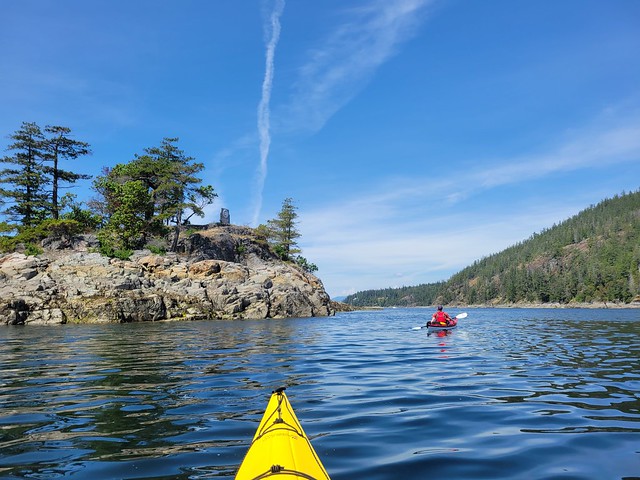
On day 3 of our paddling trip to Desolation Sound Marine Park, we got up at 6am to get ahead of the wind (as I explained in Part II). We packed up our campsite on East Curme Island and were on the water around 8am. It was flat water at this time, so we had a very leisurely paddle over to Otter Island and along the coast to Bold Head Campground.

I was really curious about Bold Head because I’d read it was a nice site. It’s backed right again the cliffside and there are several tent pads up at the head, but it was empty. I could understand why – as nice as it is, I’d still pick the Curme Islands when given the choice, so I suspect it may act primarily as overflow for the islands.

20230521_091954(0)

The campsites in the Park are all first-come-first-serve and according to BC Parks, if the tent pads are all taken, you should move on to another site. Though they do state that if moving on isn’t safe, find the least impactful spot (somewhere with no vegetation that looks like people have camped there before). Fortunately we didn’t have any issues with availability on the May Long weekend, but I could see it being an issue in the height of summer. The problem is, the islands are all very small, and while there’s 3 of them, there’s limited options for overflow camping since most of the sites are set on bedrock. Fortunately there are a lot of tent pads, and I assume that’s why.

But if you do find the islands full, head over to Bold Head – it’s not far and it is nice. The toilet situation is quite different though. The other campsites I visited all had an outhouse (sometimes two), but Bold Head just has a throne toilet and at the time of our visit, it had a wasp nest inside! There are bear caches at all the mainland sites, but none on the island sites. It is also a tricky landing on Bold Head, but manageable.

20230521_131900

Unfortunately our simple paddling was short lived as the wind came up suddenly while we were touring around Bold Head. It wasn’t too bad at first, but as soon as we started paddling across Tenedos Bay, it really caught us unaware and started hitting us broadside. It was still manageable, but definitely veering into uncomfortable territory for me as I could see some small white caps forming. It’s ~1km to cross, so we really powered it to the bay on the other side. I had put on my spray skirt, so I had no issue, but Seth didn’t have his on. This wouldn’t have been a problem, but I accidentally bumped him and almost put him in the water… oops! This was the closest anyone came to a capsize on the trip though, so all in all, it was fine.

20230521_121649

We continued up through Call Bight to Portage Cove. Seth took a quick break along the rocks to get his skirt on and we powered up to Portage. This turned out to be the most challenging part of the entire trip. It was definitely windy and while the waves weren’t bad along the shore, it was slow moving through the headwind. I was very excited to pull into Portage Cove and take a proper break, but we were disappointed to learn that Portage Cove is private property and not actually in the park (as we were informed by the numerous trespassing signs).

I know these properties long pre-date the park, but it was a low moment for me. There’s not a lot of pull-outs between Bold Head and Hare Point when you’re taking the southern route and I needed a proper break. Fortunately, the tide was coming down, so we pulled out on a tidal beach for a reset. This proved to be a good idea because I was getting a bit upset and stopping to have a snack and talk things through helped a lot.

20230521_154749

We decided to get properly suited up in our wetsuits and come up with a plan for the rest of the day. There’s a longer stretch between Portage Cove and Galley Bay with no beaches, so our plan was for me to lead (as the weaker paddler) and Seth to come right behind. This worked really well for us and we stayed close together throughout the paddle.

It was a bit rough coming out of Portage Cove, but then the wind either dropped down or was sheltered by Zephine Head. I think it was actually the former as it was gusting pretty strong at times, but overall, the sustained wind speed wasn’t too bad. We ended up actually having a nice paddle along the cliffside before stopping in Galley Bay for lunch.

Once we hit Galley Bay I felt much better because we would have the wind at our backs when we turned down Okeover Inlet. We’d started the trip from Lund, but we were planning to finish at the public wharf in Okeover instead to switch up the trip. In fact, we ended up not actually repeating any coastline, which made for a more diverse trip.

20230521_184506

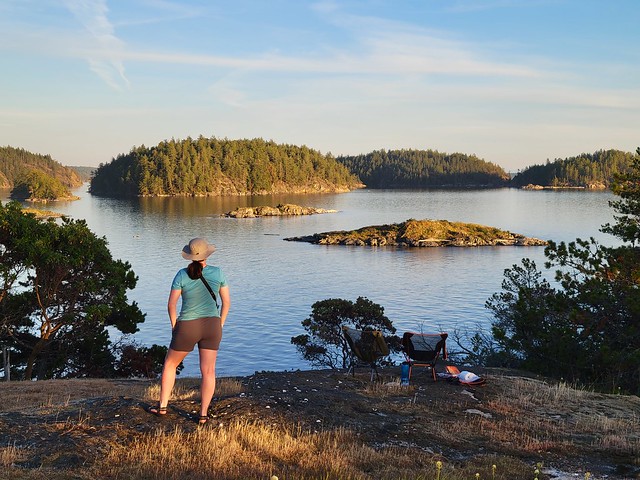
As soon as we got around Zephine Head, the wind pretty much died and we had a simple paddle down the inlet to Hare Point. There’s a huge campsite at Hare Point and we landed at the main beach to assess. There’s two key areas to the site, with a bunch of tent pads at the back of the beach and a bunch more along Hare Point. We were the only people there, so we decided on a site along the Point and then paddled back to land on the rocks instead. We kept the same strategy of tying the boats on and letting the tide bring them up for us.

We were joined later in the afternoon by another family of kayakers who camped in the other section of the tent pads, otherwise we didn’t see anyone else. I really liked our site at Hare Point, but the wind was unquestionably getting worse. To be fair, we were on a pretty exposed tent pad, but I ended up guy-lining the tent to the rock for peace of mind and it was the only night we used the fly.

20230521_194220

The wind was supposed to be even worse the next day, so we had to do a bit of risk management. I was reassured by the fact that it’s a lot calmer in Okeover Inlet than in the Sound, and that the wind would be at our backs. In case you’re wondering, I use both the Windy App and the weather network for wind information. I usually find Windy to be good, but on this trip the Weather Network was more reliable for wind speed (though the Windy app was still accurate for direction). We’d been planning to get weather updates on our marine radio and via inreach message from Carolyn (who had our trip plan), but there was cell service in pretty much the entire park, so I ended up just using my phone.

What arose as more of a concern as we watched the inlet from our campsite, was the currents. Okeover Inlet is huge, with lots of other inlets branching off it, so with up to 5m of difference between high and low tide, that’s a huge amount of water coming up and down the inlet twice daily. We arrived at Hare Point at slack tide, so we had no trouble getting there, but as the tide changed, the current got quicker and quicker, until it was really clipping down the inlet at a fast pace.

20230521_194716
20230521_180629

We’d already decided to get up at dawn the following morning to try and get ahead of the wind, and this decision became much more important when we realized that the tide would be switching again at 7:30am. It would be working with us until then and we didn’t want to have to battle it the whole morning.

It ended up working out really well. It was hard crawling out of bed so early, but we were on the water by 6:45am and with the wind at our backs and the current with us, we absolutely flew down the inlet! It was super fun! It’s 10km of paddling back to the public wharf, which would usually take us around 3 hours with breaks, but we ended up doing the whole thing in about 90 minutes. The wind looked pretty intense later in the morning when we returned to Powell River, but we managed to get ahead of it and actually had a very enjoyable paddle.

20230522_073103

Our ferry reservation out of Langdale wasn’t until 8pm, but since we’d finished so early, we decided to power back to try and get on an earlier ferry. Unfortunately this didn’t really pan out. BC Ferries was so busy over the long weekend that it actually crashed the website, so we couldn’t check the ferry times and ended up being way out of sync with them. We waited for the ferry at Saltery Bay for the better part of 2 hours. Then we rushed down to Langdale for 2pm, only to be told to keep our 8pm reservation because we probably wouldn’t get on any earlier than that anyways. So we ended up burning 6 hours in Gibsons instead. In hindsight, I would have preferred to spend some more time in Powell River, but you can never know that at the start of the day.

We had a nice time in Gibsons. We explored some shops and enjoyed a pint at Tapworks and a really nice meal at Buono Osteria. We finished with a nice walk along the waterfront. Overall it was a fantastic trip. Seth and I used to do a 3 day paddling trip every year, but we missed 2021 and 2022, so this one was long overdue and a good reminder of how much we enjoy the trips. We do lots of day paddles, but overnight trips definitely have a very different feel. I don’t think we’ll have time to do a second trip this summer (mostly because it’s hard finding someone to watch our dog), but I’m really desperate to do another trip, so we’ve already started brainstorming for next year!

There are lots of things to consider when visiting Desolation Sound, but May turned out to be good timing for us. We’re so lucky to live in a place with so many epic places to explore and I can’t wait until the next trip!

20230522_183628

Desolation Sound Kayak Trip Part II

Despite the name change in the blog title, this post is a continuation of my last post about Copeland Islands Marine Park, as I visited both parks in the same trip. Read Part 1 here.

I will admit that the wind gave me a lot of anxiety on this trip. I’m definitely a fair weather paddler, and while I’ve been out in less-than-favourable conditions, I’ve never paddled in outright dangerous conditions. It was surprisingly windy overnight, which made me a bit nervous for our second day of paddling, but the wind forecast wasn’t that high and it did calm down throughout the day. I’m used to the wind being calm in the morning and coming up in the afternoon, so that was an interesting change to have it reversed.

20230520_103252

We still got up reasonably early (7am) because we wanted to launch the boats while the tide was still high. Once the tide starts to go down, you lose the channel exit from our campsite and it adds a bit of extra paddling, plus you have to load the boats and gear further down the beach.

Fortunately, our timing was right on and we paddled out through the channel around 9am with just enough clearance to get over the newly forming beach. We crossed back over to the Malaspina Peninsula and said good-bye to the Copeland Islands as we made our way to Desolation Sound. There were some cool cliff features along the way, just past Bliss Landing, and we quickly arrived at Sarah Point, which marks the beginning of both Desolation Sound Marine Park and the Sunshine Coast Trail. It was a bit of a bittersweet moment for me as I have very fond memories of hiking the SCT last year and I loved seeing the Sarah Point hut again.

20230520_093410
20230520_095516

We had a quick break further along the beach at Sarah Point before continuing around the headland to Feather Cove, which is also on the SCT. It got a little windier as we rounded Sarah Point, but nothing to be concerned about. We spotted our second sea lion and then took in our first glimpse of the jaw-dropping beauty of Desolation Sound. I wasn’t able to successfully identify the mountains, but there are some gorgeous snow capped peaks in the distance as you first enter the Sound.

20230520_135657

We took another short break at Feather Cove before crossing Okeover Inlet to Zephine Head. The Inlet crossing was fine and the tide was rapidly dropping, so we were able to pull out at a beach just around the Head. At high tide, you might have to continue into Galley Bay for a pull-out though. We had our lunch there and since the conditions were favourable, we decided to do a direct crossing to Mink Island.

It’s about a 3km paddle from Zephine Head to Mink Island in open water. We tried to stay close to one another on the crossing, but the wind definitely picks up the further out you get, so I finally dropped my rudder and that helped me maintain my course a lot easier. Seth is pretty opposed to his rudder and never uses it, so he had some trouble staying on track. We managed to correct this the following day (which was windier), by both dropping our rudders and having Seth paddle directly behind me (since I’m the slower paddler) instead of trying to paddle side by side. Whenever we go side by side we tend to get separated, so this system worked better for us.

20230520_100200
20230520_130756

That said, it was still a pretty good crossing. The wind was low and we didn’t have any trouble making it over to Mink Island. Once we got to Mink Island, we had the wind working with us, so that was nice. Unfortunately, there weren’t a lot of good looking places to stop along the island, so we powered around the corner of the little arm on Mink Island (sorry I don’t know the name) and had a nice rest in the sheltered bay.

From there it’s not much further to the Curme Islands, which are the most popular attraction in the park, at least as far as I can tell. At the end of Mink Island, there are 3 small islands: South Curme, East Curme, and West Curme. The water was super calm at the end of Mink and around the Curme Islands, so we did a little paddle around each island. It was Seth’s turn to pick our site and he opted for East Curme Island, which I think was an excellent choice!

20230520_101046
20230520_134603

West Curme Island was really busy when we arrived, so I think that one might be the most popular. There was just one group on both East and South Curme, though a lot of people showed up to South Curme by motor boat later in the evening. But no one else joined us on East Curme, so it was just us and the other group (which is surprising considering it is the biggest of the 3 islands). We had a lovely site looking out to South Curme and Bold Head, and climbing up to the top of the island, another nice view looking down at West Curme.

The tide was very low when we arrived again, but in contrast to North Copeland Island, it was a more challenging landing. It wasn’t hard at low tide, but it’s a bit of a climb up to the island and at high tide, there’s no beach at all. There was just enough room for 4 kayaks between us and the other group, so I’m not sure where everyone stores their boats when the campsite is full.

20230521_064232

Instead of dragging the boats up the rocks, we opted to tie them on and let the tide slowly float them up to the landing. It worked really well and when the water reached high tide around sunset, we popped them up on the bank.

After unloading the boats, we were really warm, so we opted to go for a swim almost immediately. Like Copeland, the water was incredibly warm, though there was a lot of seaweed floating around with the low tide. Even Seth went for a swim and we were in the water for the better part of a half hour. We had landed on the island around 2:30pm, and after our swim, I spent the rest of the day doing absolutely nothing. Seth had a nap and I just enjoyed drinking my ice tea and watching the seals play while the tide came up.

20230520_154453
20230520_205122

Seth wasn’t as excited about a sunset paddle on this day, but I convinced him to go out for a half hour since you can’t really see the sunset from East Curme. The water was calm again and it was approaching high tide, so we paddled in and around all the islands before calling it a night. We slept with the fly off again and set our alarms for 6am to get an earlier start on the following day.

This was on account of those winds I mentioned earlier that were making me anxious. The wind was supposed to come up a lot on our 3rd day and I was nervous about the big open water crossing. We discussed it in the evening and decided we would take the long route back to our next campsite. There’s two benefits to this. The first is that you get to explore new terrain by circling Desolation Sound from the other side instead of doing the same crossing back along Mink Island. The second is that you avoid the big 3km open crossing, instead doing a 0.5km crossing from East Curme to Otter Island, and then a second 1km crossing across Tenedos Bay. The other benefit is that these two crossings are done at the start of your paddle, which would be early morning for us, resulting in less wind.

Here’s a screenshot of our 2 paddling routes for some context. I’ll cover the rest of the trip in the Part III!

Desolation Sound screen

Copeland Islands Kayak Trip Part I

I finally crossed off a major bucket list item! Seth and I have been dying to visit Desolation Sound Marine Park since we got our kayaks and have had to cancel the trip 3 times in the last 2 years. I feel like this has been a common theme with a lot of my planned trips since the pandemic, but we finally made it happen over the May Long weekend this year!

20230519_140012

For those who aren’t familiar, Desolation Sound is a marine park north of Powell River on the Sunshine Coast. It’s located at the tip of the Malaspina Peninsula, which is where the northern trailhead is for the Sunshine Coast Trail. So it was a familiar location for me after making 2 trips to Powell River last summer to complete the SCT.

Originally we were focused on visiting Desolation Sound, but as I did some more research, I discovered it’s really easy to tag a second marine park onto the trip and we added Copeland Islands Marine Park to our itinerary as well. Here’s a map of the area:

Desolation Sound

Doing both parks in one visit requires a bit more coordination, but it ended up being easier than I anticipated. Getting to Powell River is always a bit of a pain, but we caught the ferry out of Horseshoe Bay on Thursday evening before the long weekend, following by immediately driving up to Earls Cove to catch the second ferry to Saltery Bay. There’s a provincial campground at Saltery Bay and we stopped to sleep there for the night. We didn’t book in advance since it was still Thursday and we were able to just drive in, but I always recommend getting reservations where possible on the weekends.

20230519_121707

It’s a nice little campground at Mermaid Cove, but we didn’t stay for long and headed straight for Powell River instead. After a quick restock at Canadian Tire for some items we forgot, we drove north to Lund (~30 min drive). Lund is a tiny little community that is easily accessible in any type of vehicle, though once you go north from Lund, you should really have high clearance 4WD. We unloaded our kayaks in Lund and then I called Powell River Taxi for a transfer from Okeover Arm back to Lund. I was expecting to have to wait a while for a car to come up to Lund, but there happened to be a driver nearby, so I rushed the car over to Okeover Arm to park it for our return.

Okeover Arm is on the other side of the Malaspina Peninsula and less than a 10 minute drive from Lund. It’s also a paved road and easily accessible. There’s a public wharf with parking registration if you’re using the wharf (either with a power boat or self-propelled). If you drive a little further past the public wharf, you’ll arrive at Powell River Kayaks and you can rent kayaks from there.

20230519_130817

I didn’t have any trouble finding the parking lot at Okeover, but figuring out how to pay for parking was super confusing. Start by driving down to the dock and at the end of the wharf there is a little shed with parking registration, you take a ticket, leave your money in the envelope, and put it in the drop box. It’s not really that complicated, but I had to tear my car apart looking for a pen to fill out the parking slip, so make sure you bring a pen with you! Parking is only $5 a day, so it’s a very good deal! As for camping permits, they’re also $5 a night, per person, which you can get online, but they don’t start charging until June 1 (in 2023 at least).

But lets get to the fun part, kayaking!

20230519_181723

I returned to Lund around noon and Seth had the kayaks mostly packed. It’s a bit confusing where to launch from because kayaks aren’t allowed on the boat ramp, but there’s a small beach behind the grocery store and we launched from there. Tide was very low, so it was a bit tricky, but there was very little wind, which was lovely!

What I liked about this trip was that, once you launched, you were pretty much immediately in the wilderness. We saw a black oystercatcher within 5 minutes of paddling (special to us because Seth did his M.Sc thesis on them) and more exciting, we saw our first sea lion within 30 minutes of paddling!! We’ve never seen a sea lion from our kayaks before, so it was exciting and a little intimidating. They’re a lot bigger than seals, but fortunately this guy kept his distance. We can’t be sure, but Seth thinks it was a Steller Sea Lion. We ended up seeing 3 in total over the course of the weekend, though we heard them from some of our campsites as well.

20230519_182118

In general, my understanding is that the Copeland Islands are more susceptible to adverse weather conditions than the route that goes through Okeover Inlet because it’s not sheltered and can get a lot windier. Our experience with wind was that it’s definitely calmer in Okeover Inlet, but that Okeover can get some pretty strong currents depending which way the tide is flowing up the inlet. Timing is really important, so give special consideration to the tides and wind when selecting your route. If windy, I’d stick with Okeover, but leave when the tide is going out.

Fortunately there was very little wind along the Copeland Islands when we visited, so we had a really nice paddle through the marine park. We followed the coast until we hit the islands and then immediately crossed over to paddle along the islands. Our experience with the marine parks was that it’s really important to pay attention to the tides. At high tide, there’s not a lot of beaches to land on and some of the campsites can even be tricky to get to; but at low tide, there are a lot more beaches and potential places to explore. The difference between low and high tide on our trip was 4.5m! So the difference can be quite extreme.

20230519_161319

Because the tide was very low when we started paddling, we took a break pretty early after arriving at the islands to eat our lunch on one of the beaches. The beach was absolutely covered in oysters! You are allowed to harvest them with a fishing license, which would have been amazing, but there was a red tide warning in effect, which makes it very dangerous to eat any shellfish, so we just enjoyed with our eyes.

Low tide exposes a lot more islands and we had fun paddling up to the campsites. We were moving pretty slow on Day 1 because of all the provisions we had packed into our kayaks. There wouldn’t be any freshwater sources on our entire 4 day trip, so we had about 35L of water (or 70 pounds) between our two kayaks, plus food and camping equipment! So I definitely felt sluggish on the first day, but it encouraged us to drink a lot of water. It was very hot (high 20’s), so this was probably a good thing!

20230519_163821

The first campsite is Middle Copeland Island. This campground is pretty exposed and while it has several tent pads, there’s not a lot of shade. I’d read online that North Copeland Island was nicer, so that was our final destination for Day 1. I don’t think anyone camped at the Middle Island that night, but there were several groups at the North Island. Fortunately there’s a lot of tent pads, so it didn’t feel crowded at all.

We saw some kayaks landing at the south beach on the Island as we approached. There’s two access points, so we decided to go around to the north beach to land our kayaks. Unfortunately we didn’t realize that with the low tide, the cluster of islands around North Copeland all become one big island, so we had to paddle around all of them and weave our way into the beach. There’s 3 main sections to the island, with a cluster of tent pads on the south, a few on the north, and then a bunch more on the west head. I wanted to camp at the head, but after we landed, we couldn’t find any way to get over there and ended up camping on the north side. It was a great choice as we had more shade and an incredible view! Plus all the other kayaks camped on the south side, so we had it all to ourselves. A motorboat landed on the head later in the evening and dropped off a few families, so I think that’s the only real way to access that area unless you land your kayak on the rocks.

20230519_202255

Unloading at low tide was a bit of a pain in the ass though. The beach was huge, so it took us a few trips to move all our gear up to the island and then we found one small grassy landing to store our kayaks. But overall, I loved North Copeland Island! I think it may be my favourite site on the trip. We arrived around 2:30pm after ~10km of paddling, so we had lots of time to enjoy and explore the island. I set up my hammock and watched as the tide started to come in. Once it got high enough, I decided to go for a swim and was shocked by how warm the water was! It was still only May, but after 2 weeks of consistently hot weather, it was incredibly warm and very comfortable for swimming. It honestly felt like it was mid-summer! Since visiting, I did a bit more research and apparently Desolation Sound gets some of the warmest water north of Mexico! Not sure if I believe that or not, but the evidence pointed to yes.

PSX_20230525_214202

I’m honestly not sure how we passed so much time on this trip. I didn’t really do anything on the island besides swim and lounge around. I didn’t read at all, but I was totally content to just sit in my chair or lie in my hammock and watch nature. It’s weirdly compelling to slowly watch the tide come up and we had a friendly seal hanging around all day. Seth did some exploring on the beach and we generally just took it easy, which was lovely.

The island itself is pretty interesting. It’s a decent size, but a lot of it isn’t really accessible to explore. From our tent pad, we could climb up to the top of the island and we spent most of golden hour up there enjoying the view. Before sunset, we decided we would go for a sunset paddle and since the tide was now so high, we were able to easily launch the kayaks. It was the nicest sunset of the trip and the water was dead calm, so we enjoyed paddling around for a half hour before heading to bed. It stayed warm into the evening and because we were so low in elevation, we slept with the fly off the tent to enjoy the view and the stars. The wind picked up a bit overnight, but it was a great first day of the trip! Check back for Part II.

PSX_20230529_083038