Hiking Cirque Lake is a really unique experience located in the Callaghan Valley. I’ve never seen anything about this hike anywhere on social media, I literally stumbled across it while scrolling around GaiaGPS (something I do on a regular basis). So I wasn’t expecting it to be very busy, but other people are clearly aware of it because it was much more crowded than I anticipated.
What makes this hike unique is that you need to paddle across Callaghan Lake to access the trailhead. And in order to get to Callaghan Lake, you need some kind of slightly more rugged vehicle. Lots of information online says you should have 4WD and high clearance to access the lake, but that’s definitely overstating it. I have an AWD Hyundai Tucson SUV and I didn’t have any trouble. Callaghan Valley Road is paved, followed by an 8km drive along Callaghan Lake FSR, which is gravel. What makes it challenging is that there are water bars along the first half of the road, which is uphill. After that, it’s relatively flat and very drivable. The water bars aren’t so large that you need 4WD, although I do think AWD was helpful on one challenging water bar, but having slightly higher clearance is an asset. I wouldn’t take a sedan up to the lake (although I know people do), but I think any SUV could drive the FSR.

Once you make it to Callaghan Lake, there’s a FCFS campsite that is very popular. We arrived around 10am on a Sunday and there were lots of people camping, as well as a decent amount of day users. From the campsite, it’s a 2km paddle across Callaghan Lake to the Cirque Lake trailhead on the far side. Most people were using SUPs to access the trailhead, with the exception of me and Seth (we used our 16′ touring kayaks), and 1 or 2 canoers. There’s lots of room to store your boat at the trailhead and I’d guess there were 20 vessels piled up along the waterfront. So it was busier than I expected, but it didn’t feel crowded once you start hiking.
The thing about this hike is that it’s very short, but very steep because you’re hiking up to a hanging lake. It’s just over 1.5km each way, but it has 350m of elevation gain. I don’t think it’s a frequently maintained trail, so be prepared for a more technical hike. The biggest challenge I had was that when I got out of the kayak, I realized that I’d left my hiking socks in the car! I wore my water shoes in the kayak and had packed my hiking boots, but I didn’t remember to take my socks out of the trunk of the car.


If this trail had been any longer, I probably would have quit there rather than risk the blisters, but it was short enough that I decided to try anyways. I rooted around in my bag for something I could fashion into a pair of socks. I debated cutting up a buff, but landed on utilizing my first aid supplies. I made one sock out of a tensor bandage, and the other one out of a gauze roll. The gauze roll sock felt lighter and more comfortable at first, but became more scratchy the longer I was wearing it. The tensor bandage was bulkier, but mimicked sock material better. They held up, but I was definitely glad to take them off at the end of the hike!
The trail starts by hiking through the woods and quickly comes to a little stream that you have to cross. If you’re willing to get your feet wet, I recommend just walking through it, but that was the last thing I wanted while wearing band-aid socks. It’s a bit tricky to get across otherwise, it’s not fast moving, there’s just not a lot of great places to cross. We sized it up for a bit before using our poles to walk across a log.


After that, the trail continues uphill through the forest. It’s not too steep at first, but it quickly becomes technical as you climb up through the trees. There’s a rope section, although I didn’t find the rope particularly helpful and used the tree roots as handholds instead. Eventually, you pop out of the trees and have to climb up a boulder field. This is the most challenging part of the hike and I highly recommend poles. There’s some scree and loose rocks, so put some space between you and your hiking companions. But there are really nice views looking back towards Callaghan Lake and we could see more paddleboarders heading in as we climbed.
Once you get to the top of the boulder field, there’s still more uphill, but it gets a little less technical. You go back into the trees for a bit and then you climb up over the rocky headland. The trail can get confusing in this section as it branches off in a few places. There’s one place especially where the trail looks like it goes down towards the river flowing out of Cirque Lake, but it actually goes further uphill. I think either way will get you to the lake, but we followed the official trail up. This trail takes you to an overlook looking down on Cirque Lake that is really beautiful.

The worst part of this hike was probably the mosquitoes. Once we got a few photos from the viewpoint, we climbed down some more scree to get to the lakefront. There’s no real beach, but you can spread out along the rocks. This is where the flies got pretty bad. Fortunately, we had our thermacell and set it up right away. Then we went for a quick swim to get away from them while the thermacell worked its magic. The water was really cold, but so refreshing! The wind picked up after we went for a swim, and between that and the thermacell, we were able to tolerate the mosquitoes and ended up hanging out for about an hour while we had lunch.
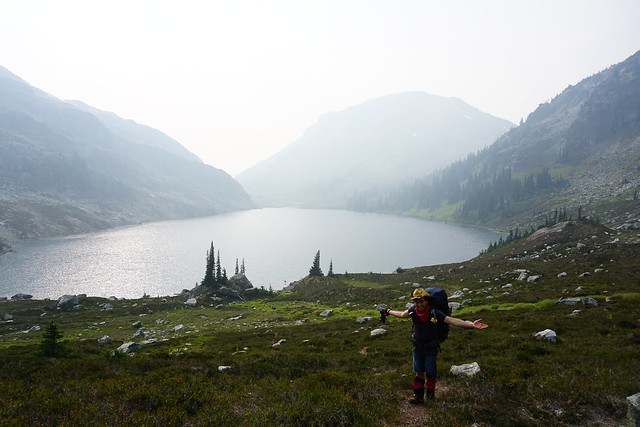
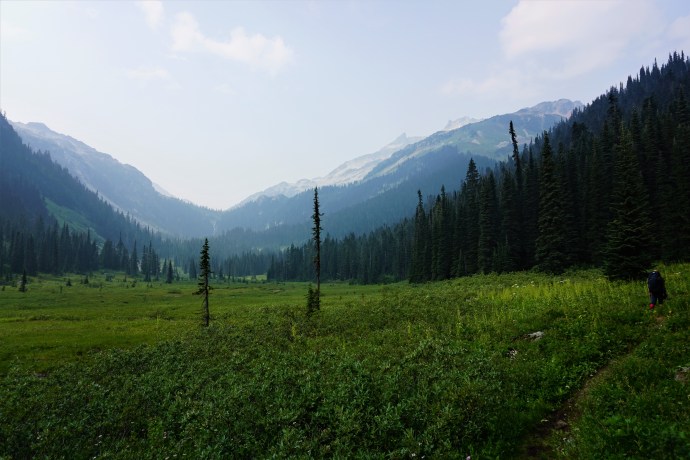
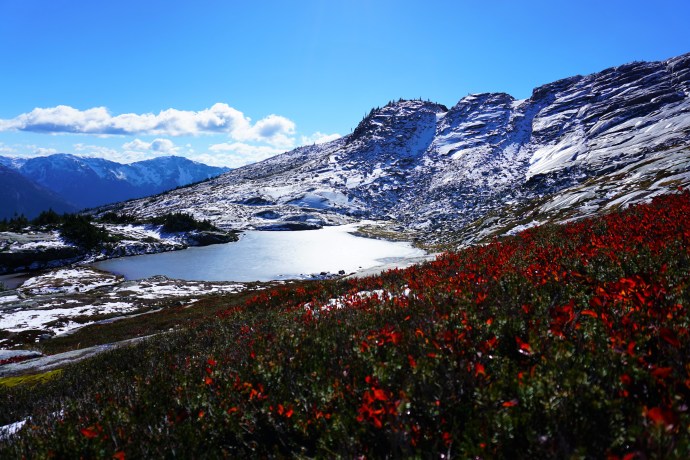
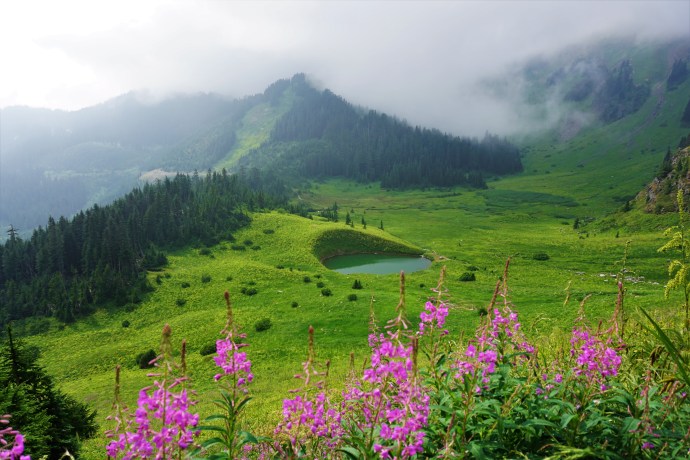
This is a really beautiful area. It’s located at the start of the alpine and you can just see some of the glaciers peaking over the mountain tops. The mountain tumbles down into the lake on the west side and the east side is carpeted in lush green meadows. You could explore further around the lake if you were inclined, but you have to navigate more boulder field and I didn’t want to trample the meadows. I had debated camping at this location, but because it’s still in Callaghan Lake Provincial Park, there were signs indicating that camping is not permitted, so it’s a great day trip option.


Hiking back down to Callaghan Lake definitely had its challenges along the steep terrain of the boulder field. There’s a fair bit of scree here and poles were really helpful. Our big kayaks had looked excessive as we paddled across flat water on the way to the trailhead, but going back in the afternoon wind, we were thrilled to have them. Typically, the wind always picks up on the water in the afternoon (at least, that’s always been my experience as a paddler). There was a headwind on the way back that we were easily able to counteract in the kayaks, but several of the SUPs were struggling. People tend to go straight across the lake since it’s a relatively short paddle, but if it’s windy, always take the longer route and stick to the shoreline.
Just because it’s a short paddle, it doesn’t remove the danger. Callaghan Lake is glacier fed, so it’s very cold – much colder than going overboard in the ocean. You’ll want to be able to get back in your boat relatively quickly if you fall in, so you should never forego a lifejacket. I didn’t see a single person other than me and Seth wearing a lifejacket. We saw two guys paddling a canoe backwards across the lake (they were sitting forwards, but didn’t realize the entire canoe was backwards), so it was obvious a lot of people weren’t avid paddlers and were just using any means necessary to access the trailhead. In my opinion, it’s not worth that risk. It’s not a hard paddle and most beginners will be fine, but at the very least, wear a lifejacket and understand that it may be much windier on the water if you come back in the afternoon.
But overall, I really enjoyed this hike. I was surprised to see it gaining so much popularity, but it’s definitely for good reason. It’s a beautiful place and it’s relatively low effort to access!










 The Road Goes Ever On