10 Epic Thru-Hikes in BC

If you’re an avid backpacker already and looking for an epic adventure, there are lots of multi-day trips in British Columbia to whet your appetite. I’ve only done a small sample of what BC has to offer, but these are some of my favourite thru hikes! If you’re a beginner, check out my Guide to Backpacking and Overnight Trips for Beginners posts, as well as my safety resources.

A thru-hike is basically a trip that starts and ends at different locations, allowing you not to repeat any trail. They can be somewhat harder to coordinate and plan because 2 vehicles are often needed and the trailheads may be several hours apart from one another. I don’t recommend any of these trails for true beginners as they are all multi-night trips, several of which are in more challenging or technical terrain. But if you’re an intermediate or experienced backpacker and looking to get outside for extended periods of time, check out some of these trails!

Howe Sound Crest Trail 

The Howe Sound Crest Trail (or HSCT), is the closest trail to Vancouver on this list, as well as one of the shortest. That might lead you to believe that it’s one of the easier trails, but that is not the case. I think a lot of people stumble onto this trail who are not quite prepared for the steep and technical terrain, so definitely proceed with caution. The trail is 30km long and runs from Cypress Mountain to Porteau Cove. It can be done as a 1 or 2 night hike and most people start from Cypress because then it’s a net downhill trail. There are no facilities, so be prepared to do a bear hang and dig cat holes for your waste.

I prefer to do this trail as a 2-nighter and camp at the Enchantments and Brunswick Lake, but there is no water on trail until the halfway point, so if you camp at the Enchantments, you need to do a large water carry. The trail crosses between the Lions and up and down through several small summits. The start and end to the trail are pretty straight forward, but the trail gets very technical in the middle. If you’d like to extend the trip, you can consider summiting Mount Harvey and Mount Brunswick along the way. It’s a gorgeous trail with unparalleled views of Howe Sound. 
Helm Creek Trail

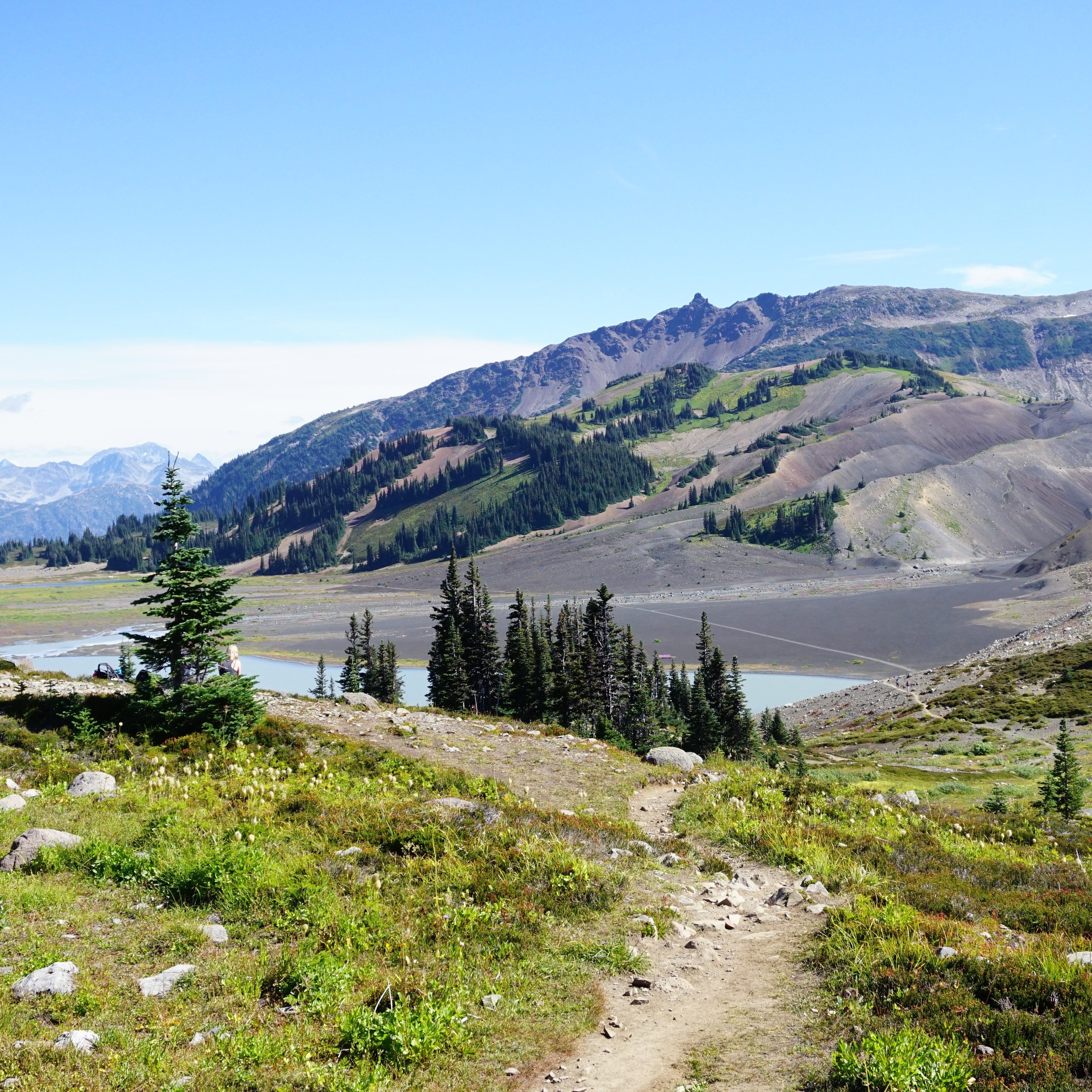
A hiking trail extends through the alpine of Garibaldi Provincial Park towards Helm Lake, with the forest and mountains in the background on a sunny day in British Columbia, Canada

This route doesn’t have a formal name, but extends from Rubble Creek to Cheakamus Lake in Garibaldi Provincial Park, near Whistler. If you’re on my website, most likely you’re familiar with this trail because of the popular trips to Garibaldi Lake, Black Tusk, and the iconic Panorama Ridge. Lots of people explore these trails as a day hike or a 1-nighter from Garibaldi Lake or Taylor Meadows. But I always recommend turning it into a multi-day trip by continuing on to Helm Creek. This trail is more appropriate for newer backpackers because of its substantial facilities. 

This hike can be customized to whatever length you prefer. Start at Rubble Creek and spend a few nights at Taylor Meadows or Garibaldi Lake and explore Black Tusk or Mount Price. When you’re ready to go to Panorama Ridge, pack up your camp and stop at the ridge on the way to the Helm Creek Campsite, which takes you through the gorgeous Helm Lake area. From there, you hike down towards the Cheakamus Lake parking lot. If you want to extend the trip further, make a detour to Cheakamus Lake or Singing Creek campsites. This hike requires camping reservations, which release 4 months in advance of your date from camping.bcparks.ca.

HBC Heritage Trail

A photo of Palmers Pond on a summer day, with the green meadows, forest, and mountains in the background, on the Hudson's Bay Company (HBC Trail) near Hope in British Columbia, Canada.

In my opinion, this is one of the most challenging trails on the list (except for maybe the North Coast Trail). HBC stands for Hudson Bay Company and is a historic trail that was originally used by the First Nations and later by the fur trade. The trail is 74km long and extends through the mountains from Hope to Tulameen. A lot of the trail is through the forest, but it has some gorgeous campsites and views along the way. It’s not an overly popular trail and you likely won’t see many people on it if you like solitude. 

What makes this trail challenging right now is the state of the trail. The trail has been revitalized in recent years and has a dedicated volunteer maintenance group, but the 2021 flood was particularly hard on this area. Volunteers have been working to clear the trail, but there is still quite a lot of blowdown in some sections and the trail does require fording at least 3 rivers. All of the campsites have nice facilities, so if you give yourself enough time to navigate the technical terrain, it is a beautiful trail.
Heather Trail

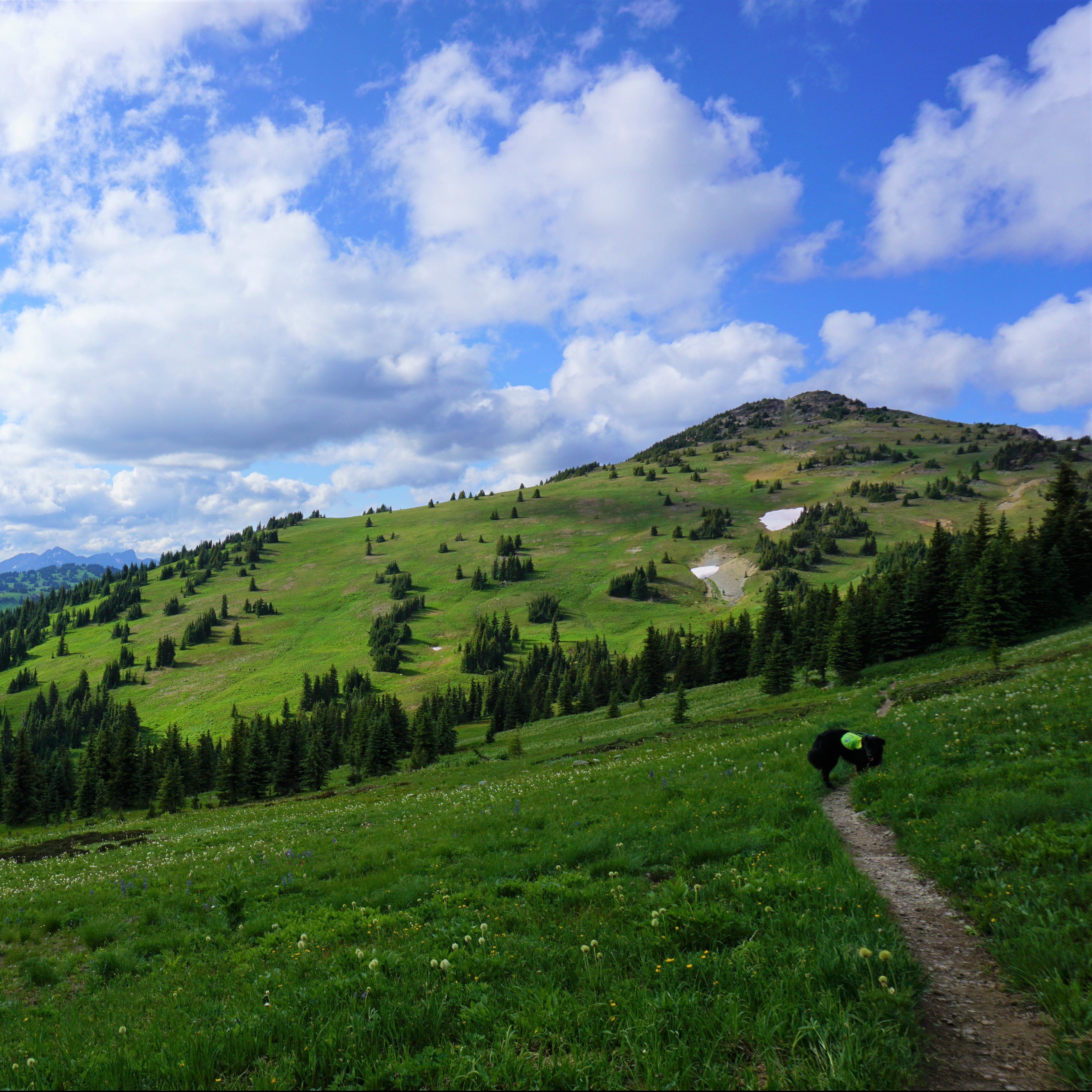
If you’re new to thru-hiking, the Heather Trail would be my recommendation. This is a relatively easy trail, with gorgeous views and brand new facilities. It’s located in E.C. Manning Park and can be done over 2-3 days. The trail starts at the top of Blackwall Road, which means most of the challenging elevation gain is done in the car. Technically, the Heather Trail is 21km, ending at Nicomen Lake and requiring an out-and-back trip. However, if you connect to the Grainger Creek and Hope Pass Trails from Nicomen Lake, you can turn this into a ~40km thru-hike, ending at Cayuse Flats.

Over 2 nights, I would camp at Kicking Horse and Nicomen Lake, or you could add a night at Buckhorn Campsite at the start of the trip and take your time. The trail is all in the trees after Nicomen Lake, and even though it’s 17km from Nicomen to Cayuse Flats, it’s a very easy trail, though there is another campsite option at Grainger Creek. You do need backcountry reservations to stay at these sites as of 2024, which can be obtained 4 months ahead of your trip at camping.bcparks.ca.

Skyline II Trail

I love Manning Park and the Skyline II Trail is one of my all time favourites. This trail is more difficult than the Heather Trail, but still a relatively easy trip. The trail is approximately 25 kilometres from Strawberry Flats in Manning Park to Whitworth Meadow in Skagit Valley Park. There is one campsite at the halfway mark, Mowich Camp. 

While this hike can be done in one night, I highly recommend doing 2 nights at Mowich Camp and making a detour to hike the 15km round trip trail along Hozomeen Ridge and back. This trail will take you to the border monument and a fantastic view of Hozomeen Mountain in the US. The trail itself is easy to follow and takes you through gorgeous alpine meadows. The campsite is pretty basic and the water source can run dry later in the summer. A backcountry permit is needed and can be obtained 2 weeks prior to your trip at camping.bcparks.ca.

Sunshine Coast Trail

Sunny view of the ocean and beach at Fairview Bay on the Sunshine Coast Trail in British Columbia, Canada

This is the longest trail on my list, but is hands down my favourite thru-hike ever! The Sunshine Coast Trail (or SCT) is 180km and extends through the entire upper Sunshine Coast, from Sarah Point on the Malaspina peninsula, to Powell River, and down to the ferry at Saltery Bay. The SCT is unique because it is a hut-to-hut hiking route, which means you can do the entire trail, staying in free mountain huts along the way. 

The trail can be a challenge to coordinate in terms of transportation and food carries, but it is incredibly well maintained by volunteers, with gorgeous facilities. You can do a section of the trail, or commit to the entire thing. The trail is primarily in the forest and tackles a lot of cumulative elevation gain. There are tons of lakes to enjoy a cool swim and some amazing viewpoints along the way. The trail can get busy, so if you plan to stay in the huts, you should still bring a tent with you as a back-up.

Juan de Fuca

The Juan de Fuca trail is often touted as a great beginner coastal trail. It is good in that it’s a lot easier than its more popular sister trail, the West Coast Trail, but it is still challenging in its own right. It’s a 47km trail on Vancouver Island between Port Renfrew and China Beach. There are several nice campsites located both in the forest and along the beaches, but like all the coastal trails on the island, it can be very technical and muddy.

It’s been several years since I did this trail and I have heard that some parts have received much needed maintenance since I did it, but it will still be quite muddy in early summer and there are several tidal points on the trail that require advance planning to cross. The nice thing about this trail is that there are several bailout points that connect to the highway if the trail is too challenging. Backcountry permits are required and can be obtained 2 weeks in advance from camping.bcparks.ca.
North Coast Trail

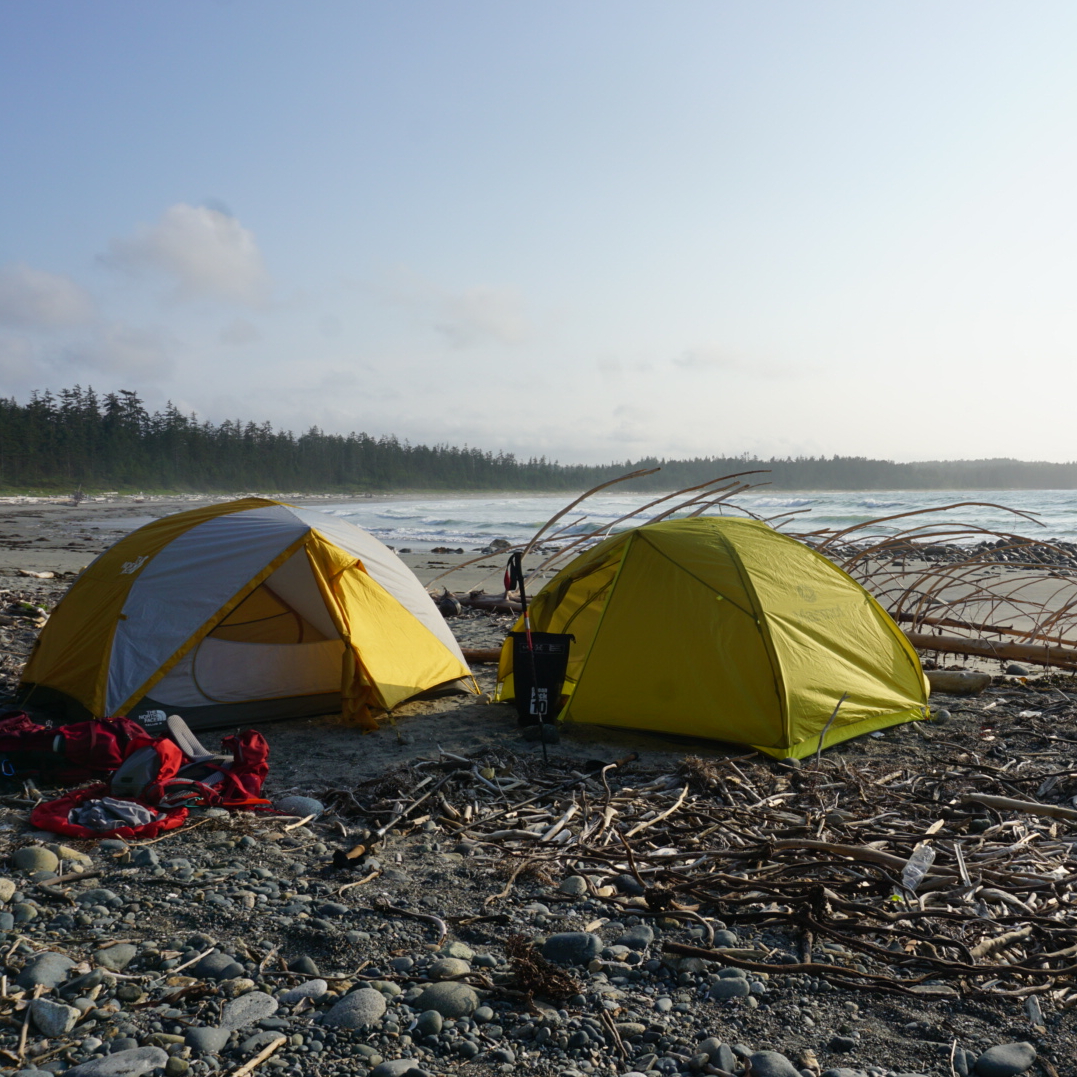
Two tents camping on a golden sand beach with drift wood and the forest and waves of the pacific ocean in the background at sunset on Irony Creek Beach in Shuttleworth Bight on the North Coast Trail on Vancouver Island in British Columbia, Canada.

The North Coast Trail (or NCT) is probably the hardest hike on this list. It’s much less popular than the West Coast Trail, but the traffic to this hike has definitely been growing. The NCT is a ~60km hike on the far north coast of Vancouver Island. It has a reputation for being extremely muddy and it doesn’t get very much maintenance. The NCT is only accessible by water taxi, so most people add on another ~25km of hiking to Cape Scott to finish this trail.

The Cape Scott Trail is accessible by dirt road and is better maintained than the NCT. The highlights of both trails are the gorgeous, remote beach campsites. There are several tidal points on the trail and you should be prepared for a very slow hiking pace through extremely technical terrain. But you’ll also likely get to view bears, eagles, and if you’re lucky, maybe even a wolf. Backcountry permits are required for this hike and can be obtained 2 weeks ahead of your trip at camping.bcparks.ca.

Mount Assiniboine

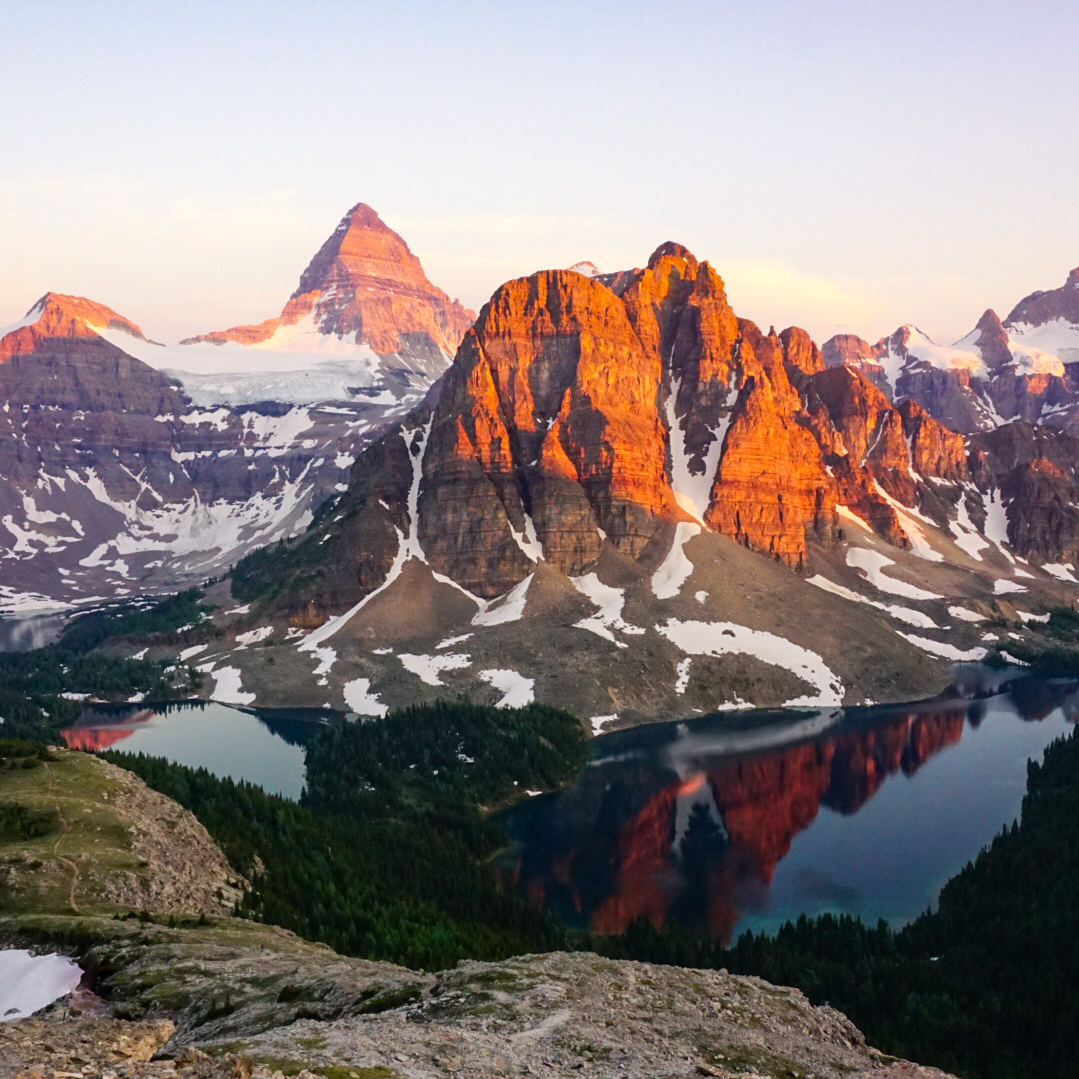
A photo of Mount Assiniboine and Sunburst Mountain and Cerulean Lake at sunset from the Nub in Assiniboine Provincial Park in British Columbia, Canada.

Mount Assiniboine can be accessed as a loop trail, thru hike, or by helicopter. Of course, I did the thru hike option. Mount Assiniboine is one of BC’s premier mountain campsites and there is a lot to explore from the core area of the park. We planned for 3 nights in the Magog Lake Campground, and 1 night on either end of the trip to hike in and out. While Assiniboine Park is located in BC, the hike is accessed through Banff National Park in Alberta.

Take the gondola up to Sunshine Village and hike through the alpine meadows to Porcupine Camp on night one, then continue to Assiniboine for several days in the park. Explore Magog Lake, Cerulean lake, and Sunburst Lake, as well as the iconic hike up to the Nub for sunset. On your way out, hike through beautiful Wonder Pass and camp at Wonder Lake before ending your hike at Mount Shark. You will need to coordinate 2 vehicles and book backcountry reservations for Assiniboine 4 months in advance at camping.bcparks.ca, as well as backcountry reservations for Wonder Lake at reservation.pc.gc.ca, which release sometime in March for the entire season. 

Rockwall Trail

The Rockwall on a sunny day with the mountains in the background and the forest in the foreground with blue sky in Kootenay National Park in British Columbia, Canada.

The Rockwall Trail is another extremely popular trail located in Kootenay National Park. It’s a 55km trail from Paint Pots to the trailhead for Floe Lake that is incredibly scenic. There are a number of campsites along the trail and it can be done in 3-4 nights. Floe Lake is the most popular campsite on the trail, but I also highly recommend staying at the Helmet Falls campsite. Along the way, you can stay at Tumbling Creek, Numa Creek, or both, they’re pretty similar sites. 

The trail is very well maintained and has lots of facilities. Campsites release for the entire season in March at reservation.pc.gc.ca, so make sure you watch for the release date, because the sites will sell out immediately. If you’re lucky enough to score permits, enjoy this beautiful trail through the Rocky Mountains and past the iconic Rockwall. 

Kayaking Widgeon Creek

Widgeon Creek has been on my bucket list for a long time! It’s a paddling route that leaves from Pitt Meadows, starting with a crossing of the Pitt River, and then meanders up Widgeon Creek through Widgeon Marsh and Pinecone Burke Provincial Park.

It’s only a half hour drive from my house, but the reason this sat on my bucket list for so long is because I was afraid of crossing the Pitt River. You have to cross the river at the entrance to Pitt Lake, which can get pretty windy, and the Pitt River is tidally influenced, meaning you can get some pretty fast currents coming in and out of the lake. Even though I know people cross the river all the time, in all manner of vessels (many of which are much less robust than my 16 foot sea kayak), I found the idea of crossing the Pitt River pretty intimidating. 

But I finally decided to go for it on a gorgeous day in early April. I didn’t want to go during freshet, when the flows increase from snow melt, and I didn’t want to go during the summer when it’s highly trafficked, so the conditions seemed to align in April. Now that I’ve done it, I’m kind of wondering what I was so afraid of! I know my risk aversion keeps me safe, but it was much less intimidating than I imagined. 

PSX_20240423_110130

We got up early on a Saturday morning to beat the crowds. Fortunately, the creek wasn’t very busy at this time of year and we had no trouble crossing the Pitt River. There was definitely a current when we crossed and a headwind when we returned, but it was very manageable in our kayaks. I’d probably be too nervous to cross the river on a SUP, but there were some people doing it in the afternoon. Although I find it shocking the number of people who go out without a PFD!

The water was very calm when we crossed and the creek was almost completely still. I’ve heard the creek can run dry or very low in some sections during the hot summer, but we crossed near high tide and had no issues in either direction. It was such an enjoyable paddle on the way up the creek that me and Seth kept remarking that we had to spend more time exploring the area in the future (our go-to trip is generally paddling to Jug Island). 

PSX_20240421_191721
PSX_20240517_172255

We didn’t see any other paddlers on our way up the creek since it was still pretty early in the morning. You paddle through Widgeon Marsh, which is a regional park, and eventually cross into Pinecone Burke Provincial Park. I think this is so cool because I love Pinecone Burke – it’s such a large and underrated park – and I’ve now explored it from 3 different entry points. The most common entry is from Harper Road in Coquitlam, but I’ve also entered the Park along the trail to Seed Peak (east of Squamish), and now via Widgeon Creek.

The final destination by kayak is the Widgeon Creek campsite. There were a few boaters here who had come in the previous day and were camping overnight. We hauled our kayaks up on the shore and then re-packed our bags for a little hike to Widgeon Falls. The paddle to the campsite takes about 75 minutes, and it’s a 6km round trip hike from the campsite, so it makes for a nice day trip with a variety of activities. You can hike to the Falls mostly along an old forestry road, which is faster, but we opted for the detour through the forest, which is much more scenic.

PSX_20240425_171014
PSX_20240421_193751

The Falls are really nice and we hung out for an hour enjoying our lunch. We were the only people there, although we passed some other hikers along the way. We took the road back to the campground and then paddled out from there. We encountered more paddlers on the way back and the wind definitely picked up in the early afternoon. The hardest part of the day was crossing the Pitt River because we had a headwind, but it was very manageable in our kayaks. I wouldn’t want to do it on a SUP, and I did wonder if the people crossing on SUP realized they would have a pretty substantial headwind on the way back.

But overall, I absolutely loved everything about this trip! I’m keen to go back and I don’t think I’ll be quite as hesitant in the future. Since it’s a short paddle, it’s easily doable on a Friday night, so maybe we’ll come back some day and stay at the campground. You can also continue the hike up to Widgeon Lake, though I’ve heard it’s a bit of a slog, as the trail is not well maintained and usually has snow on it until July. 

PSX_20240423_210453
PSX_20240424_231212

Definitely play it safe if you’re planning on doing this trip and plan around the wind and current conditions, but it was a much less intimidating trip overall than I thought it would be. In the summer, you can rent kayaks from the parking lot, so it’s pretty accessible if you want to check it out! I think parking can get challenging though because this is also the parking lot for people recreating at Pitt Lake, so I recommend going early because then you can easily find parking and take advantage of the early morning calm on the water!

A Beginner’s Guide to Backpacking

Would you like to get into backpacking, but don’t know where to start? Whether you’re new to hiking or an avid hiker, it can be challenging to make the transition to backpacking. It can be hard to know where to go, what to bring, and how to stay safe. This Guide is meant to be a high level support to link you to other resources, help you assess your skills, and safely plan for your first overnight hike.

The backcountry can be a dangerous place. It can be easy to become lost, injured, or susceptible to adverse weather, and without the proper preparedness, sometimes one mistake can unfortunately prove to be fatal. I don’t think we need to be afraid of the backcountry, but I do advocate for smart planning to mitigate as many risks as possible up front.

I am not an expert on backpacking. I have done a lot of backpacking near the lower mainland and I am a Outdoor Adventure Trip Lead with Girl Guides Canada, so I focus a lot of risk management and preparedness in the backcountry.

IMG_4814

Assessing Your Skills

Before heading into the backcountry, I think it’s important to understand what skills you have and what skills you may need to supplement. Are you an experienced hiker? Are you comfortable on more challenging terrain? Do you have any special training such as first aid or avalanche safety? Do you have access to all the essentials? Are you good at map and GPS reading? Do you know what to do if you run into trouble?

It’s important to have a good sense of awareness of your own body and to listen to it. It’s easy to get into trouble if you push your body too far or don’t recognize signs of stress. If you haven’t done much hiking, always start small to understand your limitations. Stop when you need a break, you are tired, the terrain looks dangerous, it’s too hot, etc. One of the most challenging decisions is accepting that you should turn around and not expose yourself to additional risk. Once you’ve started something, the inclination is always to push forward, because you’ve sunk time and energy into getting this far. But if the weather conditions are not right or your body is not feeling it, you should always feel empowered to stop for any reason.

Picking a Trail

Deciding where you want to go will help you plan appropriately for the rest of your trip. Once you’ve assessed your skills, you should have a better idea of what kind of trail you may want to do. Here’s some questions to ask yourself:

  • How far a distance do I want to hike?
  • Am I okay with hiking uphill, or do I prefer a flatter hike?
  • Do I want access to facilities like an outhouse, bear cache, tent pads, cooking shelter, etc?
  • How far am I willing to drive?
  • Can my vehicle safely access the trail?

For new backpackers, I recommend starting with shorter trails that aren’t too steep. AllTrails is a great resource to research hikes, so look for trails under ~6-10km and with elevation gain of no more than 200-400 metres. The shorter the hike and the greater the elevation gain, the steeper it will be. As a rule of thumb, keep the elevation gain under 10% grade (100m of gain over 1km). I also recommend selecting campgrounds that have outhouses and bear caches. Unless you already know how to dig a proper cathole, or you have a bear cannister, it’s much less stressful if you have access to these facilities. A cooking shelter can also be a great resource if the weather is not good because it will help you to stay dry without needing to set up a tarp. Do as much as possible to make your first trip easy because it can be overwhelming trying to learn too many new skills as once. Next week I’ll be posting some of my recommended hikes for beginners near Vancouver.

PSX_20220818_214003

Packing the Essentials

Backpacking is a balancing act between making sure you have everything you need to survive and trying to keep your pack light for physical comfort. It’s likely you will have a pretty heavy pack on your first trip because lightweight gear is expensive and you won’t have a good sense of what you really need versus what you can manage without. First time backpackers often bring way too much clothes, make sure you have warm and waterproof layers, but leave the extras at home. Embrace being smelly and just wear the same clothes for multiple days.

While there’s some things you can do without, you can’t compromise on your 10 essentials. I have a whole other blog post on Personal Safety and the 10 essentials and you can get more information from North Shore Rescue. Make sure you have all the essentials with you.

Safety

One of the most important things to do before heading into the wilderness is to leave a trip plan and have a plan for how you will manage problems on the trail. Your trip plan should include details on where you are going and when you are expected to return, and should be left with someone you trust to call 911 if you do not return. AdventureSmart is a great resource for creating a trip plan. Some other things to consider for safety:

  • Assess your first aid knowledge. Are you carrying a first aid kit and do you know what to do if you become injured?
  • Assess your navigation skills. Are you confident reading maps and GPS? Are you carrying an extra battery for your phone/GPS? Will your GPS app work offline?
  • Assess the ease of communication. Do you know if you will have service on this hike? Do you have a satellite device in case of emergency? If not, are you traveling with other people who can help in an emergency, or on a crowded trail where you can seek help from others?

If you become lost or injured, always stop right away and call 911. Don’t call a friend, partner, or parent. 911 calls will go through on any network available and are traceable. If cell service is unreliable, don’t waste what might be your only call on someone who can’t trace you or meaningfully help you. I have written extensively about trip plans, navigation, and communication in my blog post on Personal Safety, as well as I have a blog post dedicated to First Aid and preparation.

DSC09647

Camping Permits and Reservations

Now that we’ve talked about the scary safety preparedness implications, let’s talk about some of the more practical preparation you can do. Camping permits and reservations can be really confusing, but are necessary for most campsites. There is a lot of camping you can do on crown land, but I recommend parks where possible because they have more infrastructure dedicated to visitors. It’s important to respect the natural landscape in which we’re recreating. Everyone makes mistakes starting out, so it’s easier to limit your impact when camping in parks with access to toilets, grey water disposal, bear caches, etc.

If you’re camping in a provincial park, you will need a permit or reservation. Both can be booked online at camping.bcparks.ca. Reservations are only required in popular parks where they are trying to manage overcrowding. A reservation guarantees you a campsite, but not a specific site. For example, Elfin Lakes has 50 tent pads, so they release 50 reservations and you can pick any available tent pad when you arrive. Reservations are available for Garibaldi Park, Joffre Lakes, Manning Park, Berg Lake, and Assiniboine. They release 4 months in advance of your desired date, so if you want to camp on Aug. 15, you must reserve your campsite at 7am on Apr. 15. These typically cost $10 per person, per night, with a $6 reservation fee.

All other parks require only a backcountry permit. Permits are available 2 weeks before your desired date, but there is no limit on the number of permits sold, so you can wait until the evening before your trip to purchase it. There is no guarantee of a site with a backcountry permit, it’s simply first-come-first-serve at the campground when selecting a site. These typically cost $5 per person, per night.

Camping Equipment

Your essentials likely will only account for a portion of what you actually want to bring in your pack. Equipment can be really overwhelming when you first start backpacking because gear is really expensive. On your first trip, borrow as much as you can and accept that you’re not going to have all the best gear and that you will likely have a heavy pack. I have a gear guide dedicated to talking about camping equipment. My piece of advice would be to start with investing in a quality sleeping bag, something both warm and lightweight, and then move on to other gear later. I have also shared a packing list from the 10-day trip I did on the Sunshine Coast Trail.

HOP_6458

Food Planning

Food planning can be very stressful or very easy. If you want it to be easy on your first trip, just purchase backpacking meals at any outdoor store. They are expensive, but they are simple because they only require boiling water.

If you want to save money, I have written a 3-part series on cheap and easy meals to eat in the backcountry (no dehydration required):

If you want to get into the exciting world of dehydrating your own meals, of which I am a huge fan, I’ve written another 3-part series on easy dehydrated meals:

DSC08950

Leave No Trace

If you are recreating in the backcountry, you have a responsibility to leave it the same or better than you found it. This means, take all your garbage, including your toilet paper; stay on trails, even if it means walking through mud; filter your grey water to keep food waste out of the streams and lakes; don’t harm the natural environment scavenging for firewood or take anything natural back with you; respect wildlife and be considerate of other people. Check out Leave No Trace Canada for more information.

Other Considerations

A few other things to be aware of:

  • Practice bear safety. Cook away from your tent; keep everything that smells in a bear cache, including sunscreen and toiletries; pick up all crumbs; and make noise while hiking.
  • Protect your water sources. Filter or treat your drinking water and get water from moving sources, upstream of where people are swimming or washing dishes.
  • Always prepare for the weather. Mountain weather is unpredictable, always be prepared for rain and cold conditions. Turn back if necessary.

Check back next week for a list of recommended overnight hikes for beginners!

HOP_6069