Shuswap Lake and Adams River

In line with my previous post, while there are a lot of intense hikes and backpacking trips to do in BC, there are also lots of attractions that don’t require substantial physical fitness to visit and enjoy. In Fall 2022, my parents came to visit for several weeks and we decided to road trip out to Shuswap Lake for a few days and visit Adams River to learn more about the salmon run. It was my first time visiting Shuswap Lake and it was an abnormally warm Fall, so we had a great time exploring this part of the province.

For our trip, we stayed in a little airbnb located on the beach, just outside of Salmon Arm. It was a nice 2-bed cabin for me, Seth, and my parents, but October is maybe not the most ideal time to visit. The water level in the lake slowly subsides all summer, so it was extremely low when we visited, meaning it was quite mucky along the beach. This was also the year when the province got overrun by invasive stink bugs and we had to remove several dozen of them from the cabin. It was no fault of the owner, they were just rampant everywhere that year, so it was a bit gross trying to purge them all from the rooms.

Shuswap Lake Hotel

We only had 3 days and we spent the first day enjoying the drive out. We stopped outside of Kamloops and did a short hike up to a viewpoint at Dufferin Hill, plus we made a few ice cream stops for my mom and Seth along the way (any time Mom visits on her holiday we eat ice cream every day). It’s a 5 hour drive from the lower mainland to Salmon Arm, so it was a bit far for a 3 day trip, so we made the most of it. We enjoyed a nice walk around the parks near the Salmon Arm Wharf and had dinner at 1905 Kitchen, which was delicious!

Kamloops

Day 2 was our only full day without driving, so I’m impressed with how many activities we were able to cram into a single day. We started the morning with a visit to the Downtown Salmon Arm Farmer’s Market, which is open year round on Saturdays from 9am – 1pm. I was actually really impressed with the market. It was pretty substantial for such a small town and it was hard to pick between so many yummy sweets, plus lots of fruit and produce options. Plus it’s located right on one of the main streets and there are tons of quirky shops nearby.

I immediately made a beeline for The Book Nook, which is a used bookstore at the east end of the market. They had a pretty good selection and I picked up a few books. My other favourite was Sanctuary Games, which has a huge selection of board games and puzzles, plus a bubble tea cafe in store.

Salmon Arm Wharf
Bookingham Palace

Our next stop after the market was to head over to the local mall to visit Bookingham Palace. I just stumbled upon The Book Nook, but I couldn’t resist planning a visit to Bookingham Palace. It’s a more traditional bookstore and nothing too special, but they were having a big sale when we visited, so we all picked up some new books before heading out of Salmon Arm to explore some nearby attractions.

Next we hoped over to the other side of the lake to do a short hike. There’s a small park called Herald Provincial Park, with a short hike (~1km round trip) to Margaret Falls. The trail follows to river up through a canyon to a tall waterfall cascading down over the rock. It’s a nice roadside attraction when you’re in the area. Afterwards, we continued down the park road to the picnic area and hung out on the beach for a while eating some snacks.

Margaret Falls
Canyon Margaret Falls

My parents don’t drink alcohol, but they were willing to explore at least one winery with us while in the Okanagan, so we made an early afternoon booking at Sunnybrae Winery for lunch. There’s a really nice balcony looking out towards the lake, so we enjoyed a charcuterie board on the terrace on a weirdly hot day for October. Seth and I picked up a few bottles of wine to take with us before getting more ice cream for mom.

We decided to return to Salmon Arm, this time visiting Canoe Beach. It’s a huge sandy beach on the south side of the lake with a really nice swimming area. Like I said, it wasn’t the best swimming season because the lake level was so low, but by late afternoon, I couldn’t resist going in the water. It was actually really warm, so Dad joined me as well and we goofed around in the shallow water. We waded out until we finally reached deeper water and generally just felt unreasonably pleased with our good fortune to be able to swim in October (we both love swimming).

Winery in the Okanagan
Shuswap Lake

For dinner, we hit up the Barley Station Brewpub, which was more about me and Seth wanting to sample the local craft beer rather than the food. Then we finished off the evening with several hands of cards at the airbnb.

On our final day, we had to drive all the way back to Vancouver, but the primary reason for our trip was to visit Adams River for the Salute to the Sockeye. The salmon run has a dominant cycle every 4 years, and 2022 was a dominant year, so we were keen to see it. Unfortunately, a lot of salmon stocks were decimated in the flooding in 2021 because their spawning grounds were wrecked and the eggs completely washed downstream. The salmon should have been peaking when we visited, but unfortunately they were late, so while we did still see some of them in the river, they were not running in abundance.

Shuswap Lake

It was still a really nice side trip though. The Adams River Salmon Society and the Little Shuswap Lake Band run events in Tsutswecw Provincial Park, which features a welcome ceremony, artisan market, and food trucks. We enjoyed the festival for a few hours and walked along the nice trails before heading back to Vancouver.

Overall, it was a pretty chill trip with a bit more driving than I usually like. But it was fun to do something new with my parents (who have made quite a few visits to Vancouver over the years) and spend time as a family. I’d probably recommend the Shuswap area earlier in the summer, but it’s also at lot busier and accommodations are more expensive then. Fall is a nice time to visit if you’d like to see the salmon run or enjoy the lake with smaller crowds.

Adams River

Hell’s Gate and Alexandria Bridge Park

A few years ago, me and Carolyn did a 1-night backpacking trip on the Tikwalus Heritage Trail. It’s a ~12km loop train located off Highway 1 past Hope. It’s a nice trail and we had a good time exploring the area, but what was most notable for me was the realization that, in the 8 years I’d been living in BC at the time, I’d never actually driven on Highway 1 past Hope. All of my adventures either take me up the Sea-to-Sky or out the Coquihalla Highway towards Kamloops or Kelowna.

Hell's Gate

Past Hope, Highway 1 falls the Fraser River upstream to the Fraser Canyon. I’ve been wanting to travel there for several years to go whitewater rafting, but a lot of the rafting companies were impacted by the flooding in 2021. After doing the Tikwalus Heritage Trail, I was determined to spend some more time exploring the area. My timing was good, because my friend Gina works in the tourism industry and got 2 free tickets to Hell’s Gate for summer 2023. We decided to drag our husbands along and make a day of exploring along the canyon.

Hell’s Gate is a pretty cool tourist attraction. I had actually done it before when I visited BC as a teenager with my family, but I didn’t remember it very well, so I was happy to do it again. Hell’s Gate is named because it is the narrowest part of the Fraser Canyon, where the river comes rushing down from Lillooett and is forced through this narrow channel by the steep canyon walls. The canyon is only 35 metres wide at this section and has been an important location throughout history for many different reasons.

Hell's Gate Suspension Bridge
Hell's Gate

Traditionally, this part of the river was an important fishing ground for indigenous peoples in the region. During the gold rush, the canyon was frequented by miners trying to access the gold-rich bars upstream of the channel. Then, in the late 1800’s, the Canadian Pacific Railway constructed the first rail line against the bank of the channel. The railroad still passes through the canyon today, but it is much more easily accessible as a suspension bridge has been constructed at the base on the canyon, and an airtram transports hundreds of tourists from the highway down to the tourist centre.

It’s a cool site to visit, but it definitely has a dark history. A rockslide into the canyon in the early 1900’s, greatly impacted the fishery in the area by destroying salmon habitat. Today there are many fishways that have been constructed to assist in Salmon migration up to Adams Lake and there are several historical exhibits at the base of the river – including about the natural environment, the gold rush, and the many Chinese workers who perished constructing the railway.

Hell's Gate

So from a historical perspective, I think it’s a good place to visit, but it definitely needs some updating. The storyboards and information in the museums has clearly not be updated in years and I found it to be overly focused on colonial history and many of the terms and language used around the site are no longer politically correct. It might be a small criticism to some, but this is a site that a lot of tourists come through and I think it’s a bad look to be using updated terms and ideas in a place where people come to learn about local history.

As a natural phenomenon, the site is really cool and I loved the engineering aspect of it. There’s a beautiful view of the canyon from the tram and the bridge is a very cool structure. The bridge floor is just a grate, which means you can see all the way down to the river, so hold on to any lose items and hold on to your hat since it can get windy through the canyon!

Alexandra Bridge Park

We spent a few hours at Hell’s Gate and had lunch in the cafeteria. We decided to visit Alexandria Bridge Provincial Park, which is located nearby. It’s a very small park, but is the location of another suspension bridge. Like Hell’s Gate, this location on the Fraser River is also a traditional fishing ground for the local first nations and important for conservation. The bridge was first constructed in 1861 to connect the Anderson Brigade trail (according to BC Parks). I couldn’t find much information on this trail online, but I believe it is an extension of the Tikwalus Heritage Trail, which was used by the Hudson’s Bay Company as part of the fur trade in the mid 1800’s (but developed by the Nlaka’pamux).

It was cool to visit because I’ve now done the Tikwalus Heritage Trail, the HBC Heritage Trail (from Tulameen to Hope), and Alexandria Bridge. So there’s a lot of history and culture in this area and I’ve learned a lot over the past 2 years about the fur trade and the gold rush.

Alexandra Bridge Park
Fraser Canyon

For more information on the trail, this is definitely just a road-side stop (not a whole day affair). There’s a parking lot on the side of the highway and it’s ~1km each way to hike down over the bank to the suspension bridge. The trail ends at the end of the suspension bridge, where it enters Nlaka’pamux Tribal Council land. It’s an easy trail – there are some shortcuts through the woods, but you can just follow the road down and it’s easy walking, but still a good work-out thanks for the elevation gain on the way back.

Our final stop of the day is probably familiar to anyone who’s driven out to Hope – Bridal Veil Falls. The Falls cascade down from Cheam Peak all year round and there’s a nice picnic area and walk up to the viewpoint. It’s only ~1km round trip, so another good roadside stop on a day out.

There’s no shortage of places to explore in BC. I tend to gravitate to some of the “big view” trails, but it was really nice to have a lazier day and explore some of the roadside stops and smaller attractions in the area, plus learn more about the local history. Even better if your friend has free passes for the airtram!

Forest Walk
Bridal Veil Falls

10 Epic Thru-Hikes in BC

If you’re an avid backpacker already and looking for an epic adventure, there are lots of multi-day trips in British Columbia to whet your appetite. I’ve only done a small sample of what BC has to offer, but these are some of my favourite thru hikes! If you’re a beginner, check out my Guide to Backpacking and Overnight Trips for Beginners posts, as well as my safety resources.

A thru-hike is basically a trip that starts and ends at different locations, allowing you not to repeat any trail. They can be somewhat harder to coordinate and plan because 2 vehicles are often needed and the trailheads may be several hours apart from one another. I don’t recommend any of these trails for true beginners as they are all multi-night trips, several of which are in more challenging or technical terrain. But if you’re an intermediate or experienced backpacker and looking to get outside for extended periods of time, check out some of these trails!

Howe Sound Crest Trail 

The Howe Sound Crest Trail (or HSCT), is the closest trail to Vancouver on this list, as well as one of the shortest. That might lead you to believe that it’s one of the easier trails, but that is not the case. I think a lot of people stumble onto this trail who are not quite prepared for the steep and technical terrain, so definitely proceed with caution. The trail is 30km long and runs from Cypress Mountain to Porteau Cove. It can be done as a 1 or 2 night hike and most people start from Cypress because then it’s a net downhill trail. There are no facilities, so be prepared to do a bear hang and dig cat holes for your waste.

I prefer to do this trail as a 2-nighter and camp at the Enchantments and Brunswick Lake, but there is no water on trail until the halfway point, so if you camp at the Enchantments, you need to do a large water carry. The trail crosses between the Lions and up and down through several small summits. The start and end to the trail are pretty straight forward, but the trail gets very technical in the middle. If you’d like to extend the trip, you can consider summiting Mount Harvey and Mount Brunswick along the way. It’s a gorgeous trail with unparalleled views of Howe Sound. 

Helm Creek Trail

A hiking trail extends through the alpine of Garibaldi Provincial Park towards Helm Lake, with the forest and mountains in the background on a sunny day in British Columbia, Canada

This route doesn’t have a formal name, but extends from Rubble Creek to Cheakamus Lake in Garibaldi Provincial Park, near Whistler. If you’re on my website, most likely you’re familiar with this trail because of the popular trips to Garibaldi Lake, Black Tusk, and the iconic Panorama Ridge. Lots of people explore these trails as a day hike or a 1-nighter from Garibaldi Lake or Taylor Meadows. But I always recommend turning it into a multi-day trip by continuing on to Helm Creek. This trail is more appropriate for newer backpackers because of its substantial facilities. 

This hike can be customized to whatever length you prefer. Start at Rubble Creek and spend a few nights at Taylor Meadows or Garibaldi Lake and explore Black Tusk or Mount Price. When you’re ready to go to Panorama Ridge, pack up your camp and stop at the ridge on the way to the Helm Creek Campsite, which takes you through the gorgeous Helm Lake area. From there, you hike down towards the Cheakamus Lake parking lot. If you want to extend the trip further, make a detour to Cheakamus Lake or Singing Creek campsites. This hike requires camping reservations, which release 4 months in advance of your date from camping.bcparks.ca.

HBC Heritage Trail

A photo of Palmers Pond on a summer day, with the green meadows, forest, and mountains in the background, on the Hudson's Bay Company (HBC Trail) near Hope in British Columbia, Canada.

In my opinion, this is one of the most challenging trails on the list (except for maybe the North Coast Trail). HBC stands for Hudson Bay Company and is a historic trail that was originally used by the First Nations and later by the fur trade. The trail is 74km long and extends through the mountains from Hope to Tulameen. A lot of the trail is through the forest, but it has some gorgeous campsites and views along the way. It’s not an overly popular trail and you likely won’t see many people on it if you like solitude. 

What makes this trail challenging right now is the state of the trail. The trail has been revitalized in recent years and has a dedicated volunteer maintenance group, but the 2021 flood was particularly hard on this area. Volunteers have been working to clear the trail, but there is still quite a lot of blowdown in some sections and the trail does require fording at least 3 rivers. All of the campsites have nice facilities, so if you give yourself enough time to navigate the technical terrain, it is a beautiful trail.

Heather Trail

If you’re new to thru-hiking, the Heather Trail would be my recommendation. This is a relatively easy trail, with gorgeous views and brand new facilities. It’s located in E.C. Manning Park and can be done over 2-3 days. The trail starts at the top of Blackwall Road, which means most of the challenging elevation gain is done in the car. Technically, the Heather Trail is 21km, ending at Nicomen Lake and requiring an out-and-back trip. However, if you connect to the Grainger Creek and Hope Pass Trails from Nicomen Lake, you can turn this into a ~40km thru-hike, ending at Cayuse Flats.

Over 2 nights, I would camp at Kicking Horse and Nicomen Lake, or you could add a night at Buckhorn Campsite at the start of the trip and take your time. The trail is all in the trees after Nicomen Lake, and even though it’s 17km from Nicomen to Cayuse Flats, it’s a very easy trail, though there is another campsite option at Grainger Creek. You do need backcountry reservations to stay at these sites as of 2024, which can be obtained 4 months ahead of your trip at camping.bcparks.ca.

Skyline II Trail

I love Manning Park and the Skyline II Trail is one of my all time favourites. This trail is more difficult than the Heather Trail, but still a relatively easy trip. The trail is approximately 25 kilometres from Strawberry Flats in Manning Park to Whitworth Meadow in Skagit Valley Park. There is one campsite at the halfway mark, Mowich Camp. 

While this hike can be done in one night, I highly recommend doing 2 nights at Mowich Camp and making a detour to hike the 15km round trip trail along Hozomeen Ridge and back. This trail will take you to the border monument and a fantastic view of Hozomeen Mountain in the US. The trail itself is easy to follow and takes you through gorgeous alpine meadows. The campsite is pretty basic and the water source can run dry later in the summer. A backcountry permit is needed and can be obtained 2 weeks prior to your trip at camping.bcparks.ca.

Sunshine Coast Trail

Sunny view of the ocean and beach at Fairview Bay on the Sunshine Coast Trail in British Columbia, Canada

This is the longest trail on my list, but is hands down my favourite thru-hike ever! The Sunshine Coast Trail (or SCT) is 180km and extends through the entire upper Sunshine Coast, from Sarah Point on the Malaspina peninsula, to Powell River, and down to the ferry at Saltery Bay. The SCT is unique because it is a hut-to-hut hiking route, which means you can do the entire trail, staying in free mountain huts along the way. 

The trail can be a challenge to coordinate in terms of transportation and food carries, but it is incredibly well maintained by volunteers, with gorgeous facilities. You can do a section of the trail, or commit to the entire thing. The trail is primarily in the forest and tackles a lot of cumulative elevation gain. There are tons of lakes to enjoy a cool swim and some amazing viewpoints along the way. The trail can get busy, so if you plan to stay in the huts, you should still bring a tent with you as a back-up.

Juan de Fuca

The Juan de Fuca trail is often touted as a great beginner coastal trail. It is good in that it’s a lot easier than its more popular sister trail, the West Coast Trail, but it is still challenging in its own right. It’s a 47km trail on Vancouver Island between Port Renfrew and China Beach. There are several nice campsites located both in the forest and along the beaches, but like all the coastal trails on the island, it can be very technical and muddy.

It’s been several years since I did this trail and I have heard that some parts have received much needed maintenance since I did it, but it will still be quite muddy in early summer and there are several tidal points on the trail that require advance planning to cross. The nice thing about this trail is that there are several bailout points that connect to the highway if the trail is too challenging. Backcountry permits are required and can be obtained 2 weeks in advance from camping.bcparks.ca.

North Coast Trail

Two tents camping on a golden sand beach with drift wood and the forest and waves of the pacific ocean in the background at sunset on Irony Creek Beach in Shuttleworth Bight on the North Coast Trail on Vancouver Island in British Columbia, Canada.

The North Coast Trail (or NCT) is probably the hardest hike on this list. It’s much less popular than the West Coast Trail, but the traffic to this hike has definitely been growing. The NCT is a ~60km hike on the far north coast of Vancouver Island. It has a reputation for being extremely muddy and it doesn’t get very much maintenance. The NCT is only accessible by water taxi, so most people add on another ~25km of hiking to Cape Scott to finish this trail.

The Cape Scott Trail is accessible by dirt road and is better maintained than the NCT. The highlights of both trails are the gorgeous, remote beach campsites. There are several tidal points on the trail and you should be prepared for a very slow hiking pace through extremely technical terrain. But you’ll also likely get to view bears, eagles, and if you’re lucky, maybe even a wolf. Backcountry permits are required for this hike and can be obtained 2 weeks ahead of your trip at camping.bcparks.ca.

Mount Assiniboine

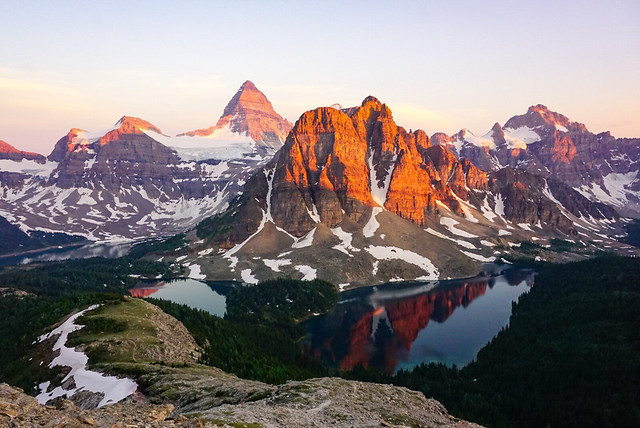
A photo of Mount Assiniboine and Sunburst Mountain and Cerulean Lake at sunset from the Nub in Assiniboine Provincial Park in British Columbia, Canada.

Mount Assiniboine can be accessed as a loop trail, thru hike, or by helicopter. Of course, I did the thru hike option. Mount Assiniboine is one of BC’s premier mountain campsites and there is a lot to explore from the core area of the park. We planned for 3 nights in the Magog Lake Campground, and 1 night on either end of the trip to hike in and out. While Assiniboine Park is located in BC, the hike is accessed through Banff National Park in Alberta.

Take the gondola up to Sunshine Village and hike through the alpine meadows to Porcupine Camp on night one, then continue to Assiniboine for several days in the park. Explore Magog Lake, Cerulean lake, and Sunburst Lake, as well as the iconic hike up to the Nub for sunset. On your way out, hike through beautiful Wonder Pass and camp at Wonder Lake before ending your hike at Mount Shark. You will need to coordinate 2 vehicles and book backcountry reservations for Assiniboine 4 months in advance at camping.bcparks.ca, as well as backcountry reservations for Wonder Lake at reservation.pc.gc.ca, which release sometime in March for the entire season. 

Rockwall Trail

The Rockwall on a sunny day with the mountains in the background and the forest in the foreground with blue sky in Kootenay National Park in British Columbia, Canada.

The Rockwall Trail is another extremely popular trail located in Kootenay National Park. It’s a 55km trail from Paint Pots to the trailhead for Floe Lake that is incredibly scenic. There are a number of campsites along the trail and it can be done in 3-4 nights. Floe Lake is the most popular campsite on the trail, but I also highly recommend staying at the Helmet Falls campsite. Along the way, you can stay at Tumbling Creek, Numa Creek, or both, they’re pretty similar sites. 

The trail is very well maintained and has lots of facilities. Campsites release for the entire season in March at reservation.pc.gc.ca, so make sure you watch for the release date, because the sites will sell out immediately. If you’re lucky enough to score permits, enjoy this beautiful trail through the Rocky Mountains and past the iconic Rockwall.