Maria’s Guide to the Bowron Lake Circuit

The Bowron Lake Circuit is a well known and popular paddling circuit in central BC, recognized for it’s remote setting and access to wildlife. The complete circuit is 117km long, including 11km of portaging and 106km of paddling across 12 lakes. It can be completed using a canoe or a kayak, but due it’s length and location, it does require a certain level of preparedness. The Circuit has been on my bucket list for a while and I finally completed it with my husband in our 16 foot Boreal Storm kayaks earlier this Spring. I have written several trip report blogs detailing my experience on the circuit, but I also wanted to create a guide to accompany those posts to help others plan and prepare for the experience. The first set of permits usually release in late October for the following summer; however, the release date for the 2026 season this year is Dec. 2, 2025.

Experience/Fitness Level

The first question to ask yourself is whether you have the experience and ability to paddle such a long and remote circuit. This was by far the longest paddling trip I’ve ever done. As a kayaker, most of my experience was sea kayaking, which has components that are more challenging than lake paddling, but the remoteness of the Bowron circuit is definitely an important planning consideration.

This isn’t like paddling at Deep Cove or Alouette Lake, where there are lots of other boaters and relatively simple conditions. I think it is absolutely required to have previous paddling experience before attempting the Bowron Circuit. Ideally, you should have at least a basic paddling course and know how to do partner rescues and self rescue. In addition, because of the remote setting, you should have experience backcountry camping and have a working knowledge of basic first aid. I recommend a Remote First Aid course, or at minimum, a Standard First Aid course. The circuit does have emergency radios located throughout, but I also recommend carrying an inreach or satellite device in case of emergency.

You should be prepared to paddle up to 5 or 6 hours per day (with breaks) and plan to be completely self sufficient. You should also be prepared for the challenges of portaging. While 11km may not seem like a lot, towing or carrying your boat is tiring (and the process of unloading and reloading your boat can be time consuming). Completing an overnight trip in advance of the circuit will help you get used to using the same muscles day after day, which can be exhausting. You can make the trip a bit easier by planning your visit during peak season. While it will be busier during that time, paddling and weather conditions will generally be more forgiving and easier to manage in the summer.

20250520_180509

The Circuit

As stated, the circuit is 117km long on paper, but it is a bit longer in practice. I measured 135km on my GPS by the time I finished the entire route. From your starting date, you have up to 14 days to complete the 117km circuit, so you can plan for a slower pace, but most people will complete it in 7 days. We regularly paddled between 15 and 25km per day and were on the water for 5-6 hours per day.

The trailhead is located ~90 minutes east of Quesnel, which is 7-8 hours north of Vancouver. Once you leave Quesnel, there’s no cell service anywhere in the park. There’s a bit of development around Bowron Lake, where the circuit starts. There’s a park registration centre located at the north end of Bowron Lake, which is where you start the circuit. It is a regulated trail, so you need a permit to complete it.

The trail starts with a portage and then progresses through the 12 lake circuit. Some transitions from lake to lake require portaging, while others are connected by rivers that can be paddled from one lake to the next. There are 54 campsites spread out around the circuit. You need to reserve a permit to complete the circuit, but the campsites themselves are first-come-first serve, with the exception of group sites, which are a separate permit.

The most notable lake on the circuit is Isaac lake, which is the largest lake, at ~35km long. Isaac Lake can be challenging because it can get strong headwinds in the afternoon. The end of Isaac Lake also marks the halfway point on the circuit with a notable water feature known as “the Chute”, which I’ll discuss further below, followed by the Cariboo River. After the Cariboo River, the paddling gets a bit easier and groups are generally more spread out. The last campsite is located at the head of the Bowron River, which is a great place for wildlife viewing, before finishing with paddle back up Bowron Lake to return to the start of the circuit.

PSX_20250601_210929

Permits

The Bowron Lake Circuit is located in Bowron Lake Provincial Park, which is managed by BC Parks. A permit is required to complete the circuit and there is a cap on how many people and boats are permitted on the circuit on any given day. There types of permits available are:

Full Circuit – The full circuit is what is discussed in this post. This is the 117km loop that starts and ends at Bowron Lake. With a full circuit permit, you have 14 days in which to complete the circuit.

West Circuit – If you don’t have enough time to do the whole circuit, you can get a permit for the west circuit, which is an out and back route down Bowron Lake. On this route, you can go as far as Unna Lake, after which you must turn around and return to Bowron Lake.

Group Booking – If you have 7 people or more in your group, you must make a group booking. The group booking is a bit different because you must stay at group sites, which means you will have a fixed itinerary. I believe the circuit itinerary is 8 days, but you can do either the full circuit or west circuit as a group.

In 2025, the circuit was open from May 17 to September 28 and permits can be hard to get depending on when you want to visit. Peak Season is late June to end of August. If you plan to paddle during this time, you should book a permit as soon as they release. BC Parks usually releases a series of permits in October, following by a second set of permits in March. The release date for 2026 is Dec. 2, 2025; I’m not sure if they’ll do two releases or just one. These can be obtained from camping.bcparks.ca

20250518_111140

Time of Year

Time of year can also play a large role in determining when to paddle the circuit. If you don’t like crowds, then you may want to avoid the summer months and paddle in the Spring or Fall. Summer can be very hot or smoky and the water level in some of the rivers can get pretty low. However, the benefit of paddling in the summer is that you’re likely to have less rain, calmer paddling, and warmer nights. It’s also better weather for swimming as the lakes will be warmer.

The benefits of paddling in the shoulder season is that there will be less people, less bugs, and less likelihood of smoke and fire bans. However, the weather can be significantly more challenging in the off-season. We paddled the circuit right after it opened in May. It was very warm in Vancouver leading up to our trip, but the circuit is located much further north, so it will stay cool later in the Spring and earlier in the Fall. The lakes only become ice free at the end of April, so the water will be quite cold in May. Our experience was that it was really cold overnight in May and we had to battle with frequent rain and higher winds. Rain is manageable, but high winds can be a show stopper on a trip like this.

If you’re more experienced in the backcountry, shoulder season is a good option, but if you’re a novice paddler or camper, I recommend just going in the busy season. The number of people on the circuit is controlled, so while it will be busier, you shouldn’t lose the remote feeling of the setting.

Getting There

Getting to Bowron Lake Provincial Park isn’t challenging, but it is remote. Unfortunately, there aren’t many options for transit, so I believe driving is the only option available, unless maybe if you book a guided tour. If you’re traveling from Vancouver, it’s ~700km to drive to Quesnel along the highways, followed by another ~110km inland to the park on highway 26. This highway is paved from Quesnel to Barkerville, but the final 30km is gravel road. It’s in good condition, but it will slow down your driving speed. We drove slower on the entire road because we saw a lot of wildlife along the way and didn’t want to hit a deer or a bear.

20250520_204237

Rentals

We had the benefit of using our own kayaks for this trip, but it’s easy to rent if you don’t have your own boat (most people don’t). The two most popular places to rent that we encountered was Bowron Lake Lodge and Becker’s Lodge. Rentals are surprisingly cheap and they will drop the boat off to the registration centre for you.

Canoe vs. Kayak

While I’ve been calling it the “Bowron Lake Circuit”, it is technically called the “Bowron Lake Canoe Circuit”. Traditionally, I think more people canoe this route than kayak it, but kayaking is definitely growing in popularity. The Portages are all in fairly good condition and the majority of people use a cart to tow their canoe or kayak. If you had to do an overhead carry on the portages, then canoeing would definitely be the way to go, but given that you can take either boat on a cart, I think there’s fundamentally no difference and that you should do whichever one you like more.

I don’t feel that the canoers had any advantage over us in our kayaks. There could be an argument made that it’s easier to portage a tandem canoe because you have 2 people and 1 boat, but I would counter that a good sea touring kayak is more appropriate to handle strong winds than a canoe and won’t make a mess of your gear if you accidentally capsize. You can make an argument for either option, which is why I think it personally doesn’t matter. There are lots of paddling routes that aren’t feasible with a kayak due to the need to overhead carry, so if you like kayaking, this is one of the limited circuits where you can actually bring a kayak.

What isn’t appropriate is a short kayak, a sit-upon kayak, or a stand-up paddleboard. If you’re going to take a kayak, it should really be a sea touring kayak.

PSX_20250617_112300

Portaging

This was my first time portaging my kayak and whether you go with a kayak or a canoe, there are some important considerations for portaging.

The portage trails are in relatively good condition and can be navigated with an expedition cart, but they are still fairly rugged. They all have hills as you portage from lake to lake, and some trails will get muddy, have significant potholes, or have rocks and roots you need to navigate. In order to protect the condition of the trails, BC Parks have set weight restrictions on your boat.

If you travel in a canoe, you will be required to weigh the gear that will sit in your canoe while portaging. You are not allowed to have more than 60lbs of gear in your canoe while portaging, everything else must be carried in a backpack. To accommodate this, most canoers will leave their paddles and safety gear in the canoe, along with maybe a food barrel or cooler. Everything else must be in a backpack that you wear while portaging.

Kayaks are a bit different. I thought our gear was also going to get weighed, but I guess kayaks are more restricted about how much gear can actually fit in the hatches, so they don’t get weighed. There was another group of kayakers while we were doing the circuit and they opted to portage their kayaks fully loaded, but Seth and I brought backpacks and portaged our kayaks partially empty. I don’t regret this choice. Pulling the kayak is really tiring and I don’t think I would have been able to do it if the boat was fully loaded, plus it puts a lot of strain on the boats (which we love and don’t want to damage).

Logistically, this was a bit more challenging because we had to strategically pack our kayaks to also fit a large backpack. We had everything in smaller dry bags and packed the empty backpack in our larger hatch. Then, at the portages, we would remove most of the dry bags and load them into our backpacks. The only gear we left in the kayaks was our paddling gear and our food bags, which were too bulky to easily fit in the backpack. It slowed us down on the portages because we had to unload and reload everything at every portage, but I personally believe it made the portaging less painful and I would do the same thing if I ever go back.

PSX_20250616_162507

River Paddling

The last thing I want to highlight before talking about itineraries is that there is a challenging section of river paddling on this trip that you should be aware of. At the end of Isaac Lake there’s a more challenging whitewater section of river, with two water features known as ‘the Chute’ and ‘the Rollercoaster’. These are not required water features – they’re about 1km in length and you do have the option to portage around them. We had originally planned to portage around them, but ended up paddling it instead.

The Chute is located right at the end of Isaac Lake and is easy to assess because it’s directly visible from the large campsite at the end of the lake (Camp #28). A lot of paddlers will spend the night at Camp #28 to assess the chute, watch a few others run it, and then decide whether to paddle it themselves or not. The chute is a bumpy section of water that is mostly made challenging by the fact that it’s surrounded by eddies and you have to make a 90 degree turn at the end to continue down the river. If you exit or turn too early, you can get sucked into an eddy, or get hit broadside by the waves, causing you to capsize. We ended up running it at the same time as a half dozen other paddlers and we all managed to navigate it safely without capsizing. The water level was very high, so the waves were also high, but we didn’t have to worry about hitting rocks, which is more of a challenge in the summer. My recommendation is to assess at the campsite and make your decision then.

The Rollercoaster is just a few sections of standing waves. I didn’t find it overly difficult, the only trick really is to watch for rocks so that you don’t hit anything accidentally. Once you finish the Chute and the Rollercoaster, there are 2 mandatory portages past other river features that are not navigable – the cascades and a waterfall. Instead, you’ll bypass these obstacles and get kicked out on McLeary Lake. However, there is one more obstacle left.

McLeary Lake is connected to Lanezi Lake by a 6km paddle on the Cariboo River. This is a beautiful and fun section of paddling, but there are several hazards you need to be aware of (and there’s no option to bypass the river). When the water is high, there are fewer sweepers and deadhead hazards as they are below the surface, but you still need to watch out for them in case they are just under the water. What was more concerning for us was the speed of the current. The river moves very fast, which is fun, but it could be easy to lose your boat if you capsized. When the water level is low, you need to be more cognizant of sweepers and deadhead so that you don’t hit anything with your boat, which could also result in a capsize. I did prefer having a kayak for these sections because risk of losing my gear if I capsized was pretty much non-existent in a kayak.

PSX_20250617_111042

Itinerary

The main consideration for your paddling itinerary is how many days you want to do the trip. There’s 54 campsites in the park and it will vary how busy each one is. I wouldn’t worry too much about which specific site you will stay at, rather focus on the average distance you will need to paddle every day and whether or not you will have any bonus days to rest or sit out bad weather.

The most common length of time to complete the circuit is 6-8 days. In my opinion, 6 is a bit ambitious, 7 is reasonable but doesn’t allow for setbacks, and 8 is comfortable. Beyond 8 days, you need to be prepared to bring quite a lot of food with you, but that’s not to say you can’t take that long if you have the time. I felt that we did the circuit at a pretty fast pace. We would get up really early every day to paddle flat water, and in many cases we were arriving at the campsites pretty early as well. It’s nice to arrive early at the campsite to get the one you want, but I wish we could have stopped a bit more along the way to enjoy other sites during the day. The reason we didn’t was that it was very cold in mid-May and when I wasn’t paddling, I wanted to be getting into warm, dry clothes, so we didn’t take long breaks. Paddling in the summer, I’d prefer to stop and swim more, so a longer itinerary would allow for that.

Below I’ve compiled a few suggested itineraries depending on different durations and objectives. The campsites are only suggestions, you need to be flexible with campsites and be prepared that if one is full when you arrive, you may have to paddle a few more kilometres to the next one. I know the text is a bit hard to read on my blog, so click the photo to view a higher resolution version on my flickr.

Bowron - 2

Campsites

Like I stated above, don’t worry too much about specific campsites. Before I went on the trip, I kept trying to google “nicest campsites on the Bowron Lake circuit” with no luck. The reason for that is that the campsites are all very similar. There’s not a lot to differentiate one from another. There are a few large sites that are nice, and some have slightly nicer lake views than others, but honestly, they’re all nice.

In the early season, which is when I went, the campsites with shelters were definitely more popular because it rained a lot and it was cold. The sites with shelters have woodstoves, so it was really nice to stay at them. Most of the sites with shelters are large, except for the few on the front end of the circuit, but there is definitely some overflow space. If you have a small group, I think it would be fairly easy to stay at any of the small sites, but if you’re a larger group, you may want to plan accordingly.

In my opinion, some of the stand-out sites are Camps #8, 15, 28, 31, 34, 37, 38, 39, 40, 44, 48, and 54. But be prepared to stay anywhere. The only one I really recommend prioritizing is Camp #28 if you’re planning to run the chute. It’s nice to have some time to study it and consider your approach! From my experience, Camp #54 can also get really busy because people are trying to reduce their distance on the last day. Camp #54 is a pretty site, but I kind of wish we’d stayed at #48 instead. I’ve included my breakdown of all the campsites and I rated each one as how I would prioritize where to stay. Again, take it with a grain of salt, there are no bad campsites.

Bowron - 1

Gear

As noted, this is a trickier trip to pack for because you have to fit everything in your boat, while also being prepared to carry a good portion of your gear when portaging. We managed this in the kayaks by packing everything in organized dry bags (1 for kitchen, 1 for food, 1 for sleeping gear, etc) and then choosing the best way to fit everything in the kayak and in the backpacks. We couldn’t fit our kayak wheels inside a hatch, so these were attached to the outer part of the kayak using bungy cords.

There is also a lot of safety gear required for a trip like this. If you’re renting boats, they will provide you with the accompanying boating gear, but you should still plan to bring all your personal safety items. Below is a copy of my kit list from this trip. It’s not perfect and everyone will want slightly different things depending on time of year, but this worked well for us!

Bowron - 3

Food

Food is one of my favourite topics when it comes to the backcountry. When backpacking, your food will likely be the heaviest thing in your bag, so it’s important to minimize the weight. When paddling, weight is less of a consideration, but because of the limits to how much weight you can carry in your boat, it is still something to consider. I’m really big into dehydrating my own food, so we decided to just bring all dehydrated meals. There wasn’t as much space for food in our kayaks as in a canoe, so we thought this was the easiest option. Some canoers will bring coolers, but keep in mind your icepacks will not last longer than a few days, so plan to eat all your perishable food by day 3. Glass is not permitted on the circuit.

Some people get really into calorie counting for these types of big trips. You should definitely plan to bring larger meals than you normally eat, because you will be doing a lot of physical activity, but my experience is that I don’t really start to get really hungry until at least day 3, so normally I’ll start packing extra snacks for the second half of the trip. On a remote trip like this, I’d plan to bring 2 extra days of food in case of emergency. You could easily get grounded by bad weather or high winds, so be prepared with food reserves. Check out my series on dehydrated food if you’re curious.

20250518_195822

Other Considerations

Water purification – One nice thing about the circuit is that you’re paddling on freshwater all day every day, so you don’t need to do any big water carries. That said, I recommend bringing a water filter with you. I used a gravity filter with a 4L reservoir that we could fill at the campsite every night.

Wind – Most paddlers are used to afternoon winds and the Bowron Circuit was no exception to this rule. Water conditions are generally calmest in the early morning or evening, so plan accordingly. There’s a lot of daylight through the summer, so our approach was to get up early. This meant we were usually first to arrive to campsites as well.

Wildlife – Due to its remote location, there is a lot of wildlife around the Bowron Circuit, and fortunately, the wildlife has not become habituated to people (yet). It is pretty likely that you could see a moose or a bear on the trip, along with smaller wildlife like marmots, beavers, and birds. Make sure to always practice bear safety, all the campsites have bear caches. Fishing is permitted with the proper permit.

Woodlots – There are woodlots scattered throughout the circuit. These are changed every year, so they are not marked on a map. Because I visited in May, there were no fire bans and we were able to have campfires every night. Since it was so early in the season, it was easy to collect deadfall around the campsites. It may be more challenging to find wood later in the season, in which case it might be a good idea to collect wood at the woodlots. Remember to never cut down live trees.

Have fun! This is an amazing experience!

Bowron Circuit Kayak Trip: The West Side

If you’re just joining, this is my final post on my experience on the Bowron Circuit in May 2025. Start with Part 1, Part 2, and Part 3, to read about the full trip. This post focuses on the West Circuit if you’re just planning a partial trip.

Leaving Unna Lake definitely felt a little like the beginning of the end of the trip. We still had a decent amount of distance to cover, but the end was in sight. We didn’t regret our decision to wait to do the hike to Cariboo Falls because the water was completely flat in the morning and we had a very leisurely paddle across the lake. It’s a nice trail to the waterfall. It’s not too long and it’s definitely worth it to do the hike, especially in the Spring!

There was A LOT of water cascading over the falls in May. The river had a very high flow and to some degree, most of what we could see of the waterfall was mist! Definitely exercise caution in this area because there are a few footpaths branching off that people have created that are not formal trails. It is possible to hike down towards the river, but we only went part way because the rock was really wet and slippery and a slip on the rocks could easily knock you into the raging river. We took a few photos before returning to our boats. What was particularly surprising was how dry the forest was. There were a lot of dead trees (probably from pine beetles) and they were looking really dry, so I won’t be surprised when this part of the province gets a fire ban.

PSX_20250611_224452
PSX_20250611_224224

Leaving Unna Lake, you have to paddle back upstream for a short distance to get to the portage to Babstock Lake. There’s a fancy ranger cabin and a short paddle along Babstock Creek. It seems that you used to be allowed to line your boat in the creek all the way to the lake, but this is no longer allowed in order to protect the environment, so you have to portage. We had 3 portages ahead of us, but fortunately, they were all pretty short.

The first portage is the longest one of the day to connect to Babstock Lake. It’s 1.3km long, but it’s along fairly flat terrain. It’s just annoying to have to unpack and repack the kayaks multiple times in a day. Fortunately, we had a really exciting encounter at the end of the portage. We finally saw our first moose! Growing up in Newfoundland, we’re definitely not strangers to moose, but it is still fun to see them, especially in wilderness settings (half the moose I’ve seen back home have just accidentally wandered into the city). It was a female moose and she was having a nice snack along the edge of the lake, so we were able to watch her while packing our kayaks and once launching into the lake. 

PSX_20250611_223243
PSX_20250611_223322

We got some photos, but tried to keep our distance so as not to bother her. Sadly, the wind came up shortly after launching, but it was a nice tailwind, so we had an extra push to help us across the lake! It was only a 3km paddle and then we were back to another portage. This portage was much shorter, measuring only 300m. I was tempted to pull the kayak heavy loaded, but Seth convinced me to unload it to protect my boat from unnecessary flex… I’m not sure it was worth it. 

Unloading the boats took much longer than the actual portage and in no time we had arrived at the inflow for the next lake, Skoi Lake. Skoi is by far the smallest lake on the circuit. You have to launch into the creek, which is pretty narrow, in some parts I could barely paddle because flow between the reeds was actually narrower than the length of my paddle! It’s 800m across the lake and then you arrive at your final portage. We were greeted by a family out for a day trip as we packed up our boats to do the final 200m portage. 

PSX_20250611_223421
PSX_20250611_224005

The portage ends at the south end of Spectacle Lakes. There’s a campsite there (Camp #44), which is actually quite nice. The family took off to return to their campsite and we decided to hang around, eat lunch, and go for another swim. The water felt a little colder, but the weather was properly warming up over the last 2-3 days, so it was still enjoyable. I will admit to putting this swimsuit on just for the photo 😉

On a map, Spectacle Lakes looks like one big lake, but I can understand why it’s called Spectacle Lakes. There are several sand bars at the narrower parts of the channel and at least twice I had to get out of my boat and pull it over the sandbar in order to keep paddling. So I’m assuming it gets shallower in the middle of summer. The sandbars do help in keeping the wind down though. It picked up once we got about a quarter of the way up the lake, but again, we had a tailwind, so we sailed up to the campsite at the end of the lake quite quickly. 

This is another large campsite called Pat Point (Camp #48). Our plan had been to spend the night at Pat Point and paddle the remaining 19km in the morning. The only people camping at Pat Point were the family and it was a really nice campsite with another big shelter and sandy beaches. It looks down Spectacle Lakes on the south side and up Swan Lake on the north side. We stopped for a snack break while debating our options.

PSX_20250611_223653
PSX_20250617_111017

The wind was definitely picking up, but it wasn’t unmanageable. We had already paddled quite a distance, but there was a fair amount of time left in the day. Part of me wanted to stay and enjoy the beautiful campsite, but another part of me wanted to shorten the journey the following day so that we could get a solid start on the drive home. We were booked into the frontcountry campsite the following night, but that meant having to do the entire 10-hour drive on Sunday, and I really wanted to get home a bit earlier.

So we decided to keep going and get closer to the end of the circuit. Swan Lake is 8km long, then there’s 4km on the Bowron River and 7km on Bowron Lake. The final campsite is at the end of Swan Lake, so I figured it was worth reducing our distance for the following day. I’m still not sure if we made the right decision or not. In some ways, it felt like the wrong decision because the campsites at the end of Swan Lake were extremely crowded. But it also felt like the right decision because it was so windy the following day that I was glad to have saved the time! But I’m getting ahead of myself.

PSX_20250617_111042

We opted to keep paddling, racking up a total of 26km for the day! We had a substantial tailwind, so we made good time coming down the lake. It was also really nice because we saw a lot of wildlife! All birds, but with Seth being an ornithologist, we get pretty excited about birds. There’s lots of marshland around the west edge of the lake, which is great habitat for them. 

There are 4 campsites at the end of the lake. We knew the Canoe Bros would be at one, but we thought they were the only ones. We did not take into account how busy the west side of the circuit could get on a Friday night. We wanted to stay at campsite #51, but when we arrived, it was full with a group of paddlers who had started a day ahead of us. Then we continued on to campsite #52 and that looked full too. We probably should have checked, but we’d been warned by the paddlers at Camp #51 that the people at #52 were not friendly and did not want to share, so we decided to continue on.

Campsite #53 and #54 are right at the end of the lake, before you start paddling the Bowron River. The Canoe Bros were at Camp #53, so that site was also full. It is connected to Camp #54, which fortunately had 1 tent pad left! Unfortunately, the people at Camp #54 weren’t very friendly either. They had taken over the shared shelter and left it a total mess, so we opted to eat our dinner on the other side of the campsite.

20250523_153506
20250523_160402

I can’t complain about it too much though because it was a really beautiful site. It looks over the Bowron River, which is supposed to be the best place for wildlife on the entire circuit, so we were able to do some spotting while we ate. There’s also this heritage cabin there. It’s 100 years old, so you’re not allowed to go inside, but it’s still a very cool relic of the park. It was constructed the same year that the park was established, so it felt special to get to paddle the circuit on its 100th birthday. 

The campsites all have only 1 shared campfire, so we opted to join the Canoe Bros at their campfire in the evening. I felt that we got a really good mix throughout the circuit of what the Bowron Circuit is meant to be. It’s a very remote and wild location, so it was nice to have so much time to ourselves to enjoy that. But it’s also very much a social activity. It’s fun to get to know the other paddlers on the circuit and I did enjoy the nights that we got to hang out with 5 Guys and the Canoe Bros. They definitely had some characters in their groups, but everyone really loved being out on the water and in the wilderness. I’m glad I got to experience a little bit of both. Although preferably with more women next time!

PSX_20250613_081758
PSX_20250613_082037

Our last day on the circuit did not disappoint. Our timing wasn’t that great because the weather improved a lot at the end of the trip and it was looking really nice for the next group of paddlers. But you win some, you lose some! We got up early in hopes of seeing some interesting wildlife along the river. At breakfast, we could see some kind of large animal along the shoreline that we thought might be a deer, but closer inspection with Seth’s binoculars revealed that it was actually a sandhill crane! They are really huge birds, so that was an exciting discovery.

The crane had moved on once we started paddling the river, but we did catch up with it later on the circuit. We saw lots of birds along the route and were excited to see a beaver swimming in the river as well. The river is really meandering. It’s not fast moving, but it could be easy to get lost among the channels. We did go down a few branches just for fun to see what we could find. What we really wanted to see was another moose and we were rewarded right at the end of the river! It was another female and she was also having a snack along the edge of the river. 

PSX_20250613_081907
PSX_20250613_081825

Considering it was only 9am when we exited the river, it was already pretty windy on Bowron Lake. Seth and I got along really well all week, but had a bit of a breakdown in communication at the edge of the lake. The way the wind was blowing, it would be a tailwind for the first half of the paddle, but then there’s a turn in the lake, and after that we would be getting hit broadside. I wanted to paddle down the east side of the lake so that the headland would protect us from some of the wind when we turned the corner. Seth didn’t look at the map and made his decision based on vibes, so he thought it would be better to go down the west side of the lake.

Ladies, you know when you take on the emotional labour of trip planning and decision making, sometimes you get decision fatigue and you want someone, anyone, to take on a little bit of that? I think that’s what I was feeling when I agreed to paddle down the west side of the lake, even though my gut was screaming at me to go down the east side. It’s a bit more of a paddle to get to the east side, which is why I think I gave in, but it was a mistake.

PSX_20250617_112300

It was fairly windy paddling down the first half, but manageable with the wind coming from behind us. Before the lake turned we did pull into the side of the lake to take a little break, which was definitely a good idea because we got fully assaulted by the wind after that. As we started to make the turn, we still had a tailwind, but it coming at us from a side angle that made the waves a bit scary. As we started getting hit broadside, I’m pretty sure I had a rage blackout and some inner monster took over my body and just brute-force paddled its way down the rest of the lake. I was super mad, but it was the kind of stew-in-it anger and we just paddled against the crashing waves in silence.

Honestly, the right thing to do would probably have been to pull over to the lakeshore and wait it out like we had done on Isaac Lake, but we were so close to the end and I was so cranky, I didn’t want to stop paddling. So I kept rage paddling with Seth hot on my tail. The anger took me almost to the end of the lake, then I got a little bit pummeled by waves and there was a moment of real fear that this might be the time I capsize. I think that’s when the rage finally left my body and I pushed through the last section of lake, taking the first opportunity to exit the water, which is the public boat launch. We pulled the boats up on the shore and jumped out of the kayaks for a big hug while both crying “I’m sorry!!”. And that was how our epic 7 day trip ended.

PSX_20250613_081946
PSX_20250613_082203

Technically, we weren’t at the end yet. The public boat launch is 2kms from the park centre, but neither of us had the desire to brave the waves for another 2km. We were just relieved to be back on shore. Instead, Seth unpacked the kayaks and I walked the last bit of the circuit along the road to sign out at the park centre and pick up the car. In total, we tracked 14km for the day, finishing before noon. Intuitively, I know we should have waited out the wind, but it was still racing up the lake when I returned with the car, so it was hard to regret the decision to keep going. There were a few paddlers trying to launch their canoes to start their paddle on the West Circuit, so I mostly felt relief to be done.

It felt like an anti-climactic end to the trip, but it was a really incredible experience. I feel like we went up against a lot of challenges due to the time of year that we paddled, but I also felt like we gained a lot. The reason I keep going on long multi-day backpacking trips is because I love the feeling of accomplishment – of really challenging myself – and the Bowron Circuit definitely delivered on that feeling. It was also really special because I did it with Seth. He doesn’t like backpacking that much, so a lot of my backpacking trips are with friends, which is also nice, but it’s special to have that kind of experience with my husband too. Within hours I’d already forgotten about all the challenges of the trip and would 100% do this circuit again in the future. 

Bowron Circuit Kayak Trip: Isaac Lake

My last blog post covered the basics of the Bowron Lake Circuit and a re-cap of our first day on the circuit. After a warm and cozy night on Indianpoint Lake, we were up early to continue our adventure to Isaac Lake. We packed up the boats and were on the water by 8am. Sadly, we only had a short 1km paddle to the end of Indianpoint Lake, followed by yet another portage. Fortunately, the portages keep getting shorter. This one was only 1.5km, and it would be our last portage for 2 days.

I’m really glad we opted to stay at Campsite #8 on Day 1 rather than pushing to Isaac Lake. I was exhausted after our second portage on Day 1, but I felt a lot more rested on Day 2. The portage was a bit annoying in that it had a lot of potholes and Seth’s kayak took a sideways tumble early in the portage. But overall, it was pretty flat and it felt like the easiest of the 3 portages to me.

PSX_20250529_081717
PSX_20250529_082124

I should note that Seth and I did not purchase or rent an expedition cart for this trip. We already owned small carts that we use to get our kayak from the car to the launch, and we opted to just use those. They have plastic wheels and are lower to the ground then the expedition carts, but honestly, they worked great! Everyone else was using expedition carts, which are a little higher, and everyone complained about them being really tippy. At first, I babied my cart, but by the end of the trip, I was just hauling it over every bump, root, and rock. It held up for the entire trip with no issue and very limited tipping. We did bring a spare wheel with us in case we blew out a tire (since they’re plastic), but we didn’t end up needing it.

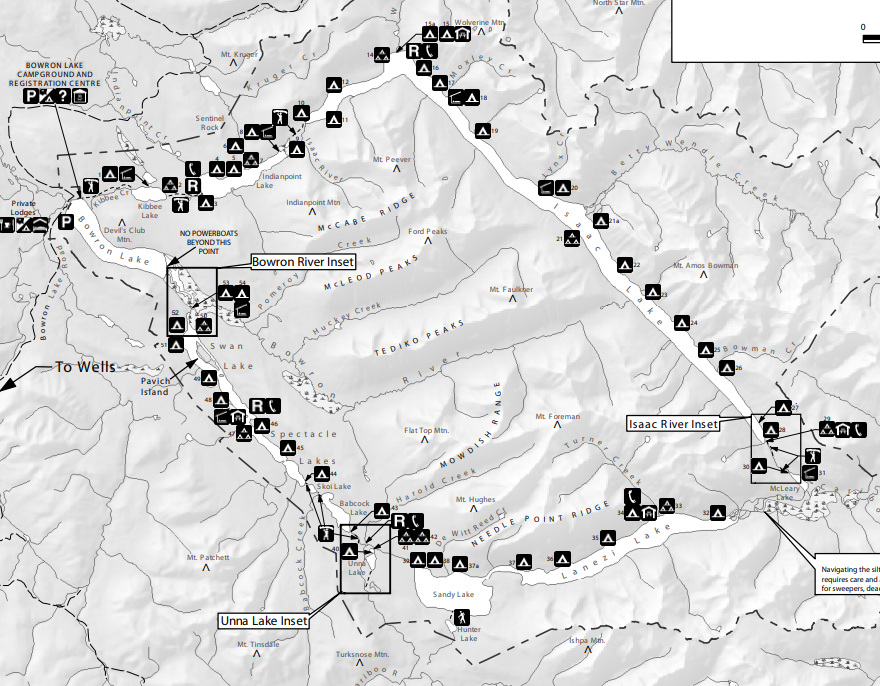
Eventually we arrived at Isaac Lake, the biggest lake on the circuit. I think it’s time to share a map of the circuit to give you an idea of the unique topography of this area. The circuit is very rectangular, with Isaac Lake having a notable corner in it. The west arm is ~7km long, while the main arm is ~31km long. We paddled Isaac Lake for 2 full days and it is definitely one of the more memorable lakes (both good and bad).

The water was really calm when we arrived and we could see a lot of the other groups still packing up along the shore from Campsites #11 and #12. I always live in fear of the afternoon headwind (which seems to be a thing everywhere we paddle), so our goal was to have early mornings and do as much paddling as possible before lunch. Since the water was so calm, we ended up paddling the entire 7km of the west arm in one go, over about an hour and a half. Overall, we paddled pretty fast on this trip, usually averaging around 4km an hour.

I should also mention that there are two kinds of campsites on the circuit: individual sites and group sites. If you have more than 7 people in your party, you have to make a group reservation. The benefit of the group reservation is that you have guaranteed campsites. Only 1 group leaves per day and only that group can stay at the group campsites. The downside is that you have to follow a fixed itinerary (I think it’s 8 days). There was no group on the circuit when we did it, so we were able to use group sites if desired. We made a stop at the group campsite (#14) at the end of the arm for a snack, and then continued our paddle down the main arm.

PSX_20250529_081836
PSX_20250529_082234

Isaac Lake is quite beautiful. It’s so long that you cannot see the entirety of the lake at any point and it is completely surrounded by mountains. The mountains were a bit coy when we paddled the lake because of the weather. It didn’t rain very much on Day 2, but it was overcast and the clouds hid a lot of the mountains. It did start to get a bit windy as we paddled down the main arm, so we stopped at Campsite #18 for lunch.

Campsite #18 is another campsite with a shelter. The wind really picked up while we were having lunch, so we strongly debated just having a short day and spending the night to take advantage of the shelter. But I knew there was another shelter 8km away at Campsite #20, so I was really on the fence. Our goal was to get to the end of Isaac Lake by the end of Day 3, and that would be a lot easier from Campsite #20. But the wind seemed to drop down after a while and we decided to make a go for it. We did have to fight with a headwind for a few kilometres, but the wind dropped off entirely before we got to Campsite #20 and it was almost flat water when we arrived. Thanks to the extra distance, it was one of our bigger days on the circuit and we travelled a total of 23km.

PSX_20250601_210929

We had to name the other groups we were sharing the circuit with to differentiate them from one another. There was a group of 5 kayakers that we creatively named 5 Guys (but apt because they were young burgers-and-beer kind of guys), and they were already settled in when we arrived at the campsite. They were very friendly and there was one tent pad left, so we took it and got to know their group a bit better around the campfire. We didn’t get any more rain for the rest of the night, so we ended up not needing the shelter. 5 Guys had a pretty raging campfire, so that kept us warm for the evening, and we had a good laugh as they regaled us with stories of accidentally capsizing in Kibbee Lake, 20 minutes into their trip!

On Day 3, we really got a bit of everything. We were up early and on the water by 8am again. When we paddle at home, the ocean is usually dead calm at 8am, and will often stay that way until at least 11am. I was surprised by some of the conditions on the Bowron circuit. I wouldn’t say it was windy in the mornings, but it was rarely flat water, even at 6am. The wind was never concerning in the mornings, but always a bit more breezy than I was anticipating.

PSX_20250529_082033
PSX_20250601_211113

We got in a few hours of easy paddling along the shoreline, but we had 21.5km to go to get to the end of Isaac Lake. Isaac Lake has a lot of little headlands along it, where the mountain meets the water and creates a small point. Around 11am, it started getting really windy. Usually it’s windier when you go around a headland, but once you make it to the other side, the wind dies down because you’re somewhat protected by the next headland. At 11am, we went around one headland where it felt like we were getting completely assaulted by the full strength of the wind across the lake. We could see really far down the lake and it felt like the wind was tunneling the whole way up it to hit us broadside. The way the wind was blowing, there was no shelter from the next headland and we had a very slow paddle through some nasty waves.

Eventually we reached the next headland and got a small break directly behind it. We were afraid to go around because we knew we’d be getting hit directly again on the other side, so we decided to wait it out for a little while. Like I said, the weather was all over the place on this trip and it was fairly normal for the rain and wind to storm up and down the lake, so conditions changed quickly and frequently. We figured if we waited even for 15 minutes, the wind could change, so we pulled our boats onto the very limited amount of available shoreline and settled in to wait.

PSX_20250601_211724
PSX_20250601_211806

Unfortunately, the wind only seemed to get worse and we could see whitecaps forming in the lake. After about a half hour, 5 Guys caught up with us and also opted to pull into the lakeside to wait. Shortly after they arrived, me and Seth decided to make an attempt at the headland, but the second we became exposed, we were getting hit by whitecaps, so we quickly did a 180 and returned to shelter. We ate our lunch while studying the waves for another 45 minutes or so. Eventually it looked like the wind was coming down a little bit, and we decided to go for it as a group. It was still pretty nasty, but definitely better than our first attempt and this time we made it through to the next section.

I think we were probably just at the windiest part of the lake and it did seem like the only way out was through. Once we made it through the next section, the wind definitely died down a lot and we all felt comfortable to keep going. Me and Seth took a short break at a real campsite, but then the rain showed up and we decided it was more comfortable to weather the rain in the boats.

PSX_20250601_211547
PSX_20250601_211444

One upside of the rain is that it does generally calm the wind and it can sometimes be windier on sunny days. The wind continued dropping and by the time we paddled through the rain, we seemed to have passed through one storm into another. The wind actually switched direction and we ended up getting a nice little tailwind for the rest of the day. The group of canoers that we nicknamed Canoe Bros, caught up with us later in the day and said that they had experienced the same thing. They described it as two storm fronts and they ended up catching a break for a while when they got caught in the calm between the two, and were able to ride it out for a few hours.

Fortunately that was the end of our wind woes for the day. 5 Guys branched off to do some fishing and Seth and I enjoyed the gentle tailwind propelling us the rest of the way to the campsite. Our goal for the day was Campsite #28, which is the last campsite on Isaac Lake. It’s a large site and I think it’s a popular spot for people to stop. It’s combined with a group site, but since there were no groups, we put it to good use between us, 5 Guys, and the Canoe Bros. It has a large shared shelter with a set of picnic tables and a woodstove, although the woodstove isn’t super useful because it’s an open-air shelter.

PSX_20250602_202718
PSX_20250602_202439

But the weather really cleared up in the afternoon and we actually got a couple of hours of sun! So we all lay out on the banks of the lake to soak in as much warmth as possible. The reason this site is so popular though, is because of it’s proximity to the most notorious water feature on the circuit, the Chute. It’s an optional paddling feature for those brave enough to try it, so people like to stop at the campsite for the night to assess the objective and hope to see someone else attempt it first!

It’s basically a line of standing waves, with an eddy on either side. What makes it tricky is that there’s a sharp turn at the end of the chute and if you exit to early, you can get caught in the eddy and then the waves will hit you broadside and quickly capsize your boat. No one attempted the chute in the evening, but we all spent hours discussing and sizing it up. Trying to figure out who was going to run it and whether we could wait around long enough to watch them attempt it first!

PSX_20250603_193526
PSX_20250602_202657

Seth was all for running the chute (mostly because he didn’t want to portage any extra distance). We assumed 5 Guys would all be down for the challenge, but they were having serious doubts after their capsize in Kibbee Lake. We caught an absolutely gorgeous sunset over the lake while debating it and Seth and I decided that since we had wetsuits, we would give it a try in the morning, but were really hoping to see someone else attempt it first.

Tune in next week to find out if we were successful in running the notorious Chute!

20250520_204237