Mount Assiniboine is located in Mount Assiniboine Provincial Park in BC and is one of the more iconic peaks in the Canadian Rockies. It’s been a few years since I hiked this trail, but there are a lot of options for how to do this trip, and I wanted to share my knowledge in the form of a backpacking guide to the trail. At the time that I hiked the trail in 2021, I wrote a 4-part trail report, which you can read starting here. Reservations for the 2026 season release at 7am PST, 3 months in advance of your planned start date.
The Park
Mount Assiniboine is located in the middle of Mount Assiniboine Provincial Park, but is surrounded by Banff and Kootenay National Parks, as well as Spray Lakes Provincial Park in Alberta. If you plan to hike there, you’ll have to go through one of the National Parks, with Banff being the more popular access point. There are two routes through Banff and one route through Kootenay, but they are all at least 25km long, so it is a big hike just to get into the park.
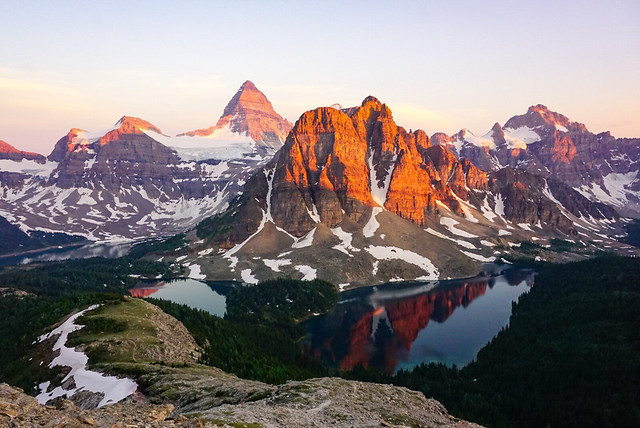
If you’re looking for a more direct approach to the park, it is possible to fly in from the Mount Shark trailhead via helicopter. This is a popular option if you want to maximize your time in the core area of the park. The core area of the park encompasses Magog Lake, Sunburst Lake, and Cerulean Lake, as well as the popular day hiking trail up to the Nub (or the Nublet/Niblet if you prefer a shorter option). The Nub is well known for its phenomenal sunset views of Mount Assiniboine, when the adjacent Sunburst Peak lights up orange as the sun goes down (see photo below).
There are limited options for where to stay in the park, which will likely be the restricting factor of your trip. The cheapest option is to stay at the Magog Lake Campground, if you can score permits. Otherwise you’ll have to pay more to stay in either the Naiset Huts or Assiniboine Lodge, both of which are privately owned and not cheap. The lodge is catered, but I’m not sure about the huts. There is another campground at Og Lake, but it’s approximately 5km away from the core area of the park, so it’s not ideal.
If you have limited time, I recommend flying into the park, but if you can spare a few extra days, you can do either a there-and-back trip or a thru hike. I opted to do a thru hike along the two access points in Banff National Park and it’s a very scenic hike. It’s best if you have 2 days each way (with a night spent halfway between), and then another 2 days to explore the core area of the park (6 days in total). Another option could be to fly in and then backpack out through Wonder or Assiniboine Pass, to experience the best of both options.
Time of Year
The best time of year to hike Assiniboine is in the Summer or early Fall. There may still be some snow on the trails if you go in late-June, but the later you go in the summer, the more likely that your trip might be impacted by wildfires. While most people prefer to backpack in the summer, late September is also popular due to the colourful larch trees through Wonder Pass. However, you should be prepared for snow and cold conditions at this time of year. I hiked the trail in late June and there was no snow, but it was during the early season heat wave of 2021, which melted remaining snow very quickly.
Getting There
There are 3 primary ways to access the park: the Mount Shark Trailhead, Sunshine Village, or the Simpson River Trailhead. Unfortunately, the park is not accessible by public transit. Similar to other popular Canadian parks, the easiest way to access is by driving. If you’re flying in, Calgary is the closest major airport.
Mount Shark: If you plan to fly into the park or hike in via Wonder or Assiniboine Pass, you will need to take Spray Lakes Road out of Canmore and drive to the trailhead at Mount Shark. There are two parking lots here, one for hikers accessing the trailhead, and another for those taking the helicopter. A National Parks Pass is not required to park here since the trailhead is technically in Spray Valley Provincial Park. However, you will need to pay for a Kananaskis Conservation Pass from Alberta Parks in order to park your car.
Sunshine Village: In my opinion, the Sunshine Village access is the easiest way to hike into the park. You can hike along the Citadel Pass Trail at the top of the Sunshine Village gondola. You park at the base of the ski resort, at the end of Sunshine Road off of Highway 1, and have the option of paying to the gondola to the top of the mountain. I highly recommend this as it will save you 5km of hiking and over 500m of elevation gain. A National Park Pass is required to park at the base as it is located in Banff National Park.
Simpson River: This is the least popular access point to the park as it’s the least maintained trail and the longest route to Magog Lake, as well as one of the lesser scenic routes. However, it is a great option if you’d like to avoid crowds or are unable to get permits to one of the halfway camps on the other routes. The trailhead is located off Highway 93 in Kootenay National Park, so a National Park Pass is required to park.

Permits
Like most popular hikes in the Rockies, securing your camping permits will likely be the hardest part of your trip. This is a popular destination and while more people prefer to fly in rather than hike, it is challenging to get camping permits in the core area of the park. I’m not sure how difficult it is to book the lodge or the huts, but if you want to get camping permits, then it’s important to mark your calendar with the appropriate permit release dates. Unfortunately, because there are many different access points to the park, depending on your itinerary, you may have to obtain permits from both BC Parks and Parks Canada.
The permit release date for Mount Assiniboine Provincial Park is 7am PST, 3 months in advance of the start of your trip. They are released through BC Parks (camping.bcparks.ca) in a rolling window. These permits are considered “backcountry reservations” and they will likely sell out as soon as they release. So if you want a permit for July 1, you will need to be online at 7am on April 1 to make your reservation. Reservations are available for Magog Lake, Og Lake, and Porcupine Campsite. Bookings are $25 per person, per night (plus a booking fee).
If you are planning to hike in or out via Wonder or Assiniboine Pass, you may also want to make a reservation for one of the Parks Canada Sites (https://reservation.pc.gc.ca/), either Marvel Lake or McBride Camp. These campsites are all located in Banff National Park and the release date for 2026 was January 26, 2026 at 8am MST. Bookings are $15 per person, per night (plus a booking fee). Once booking opens, select “backcountry” in the tabs along the top of the booking page, and then select “backcountry zone”, followed by “Banff, Kootenay, and Yoho Backcountry”. The appropriate access point is “Bryant Creek Trailhead”. If you can’t get one of these sites, there are two more alternative sites, Big Springs or Allenby Junction Camp, though they are not located at the midpoint of the trail.
There are no reservations required if you are hiking via the Simpson River Trail in Kootenay National Park, but there are 3 potential campgrounds: Surprise Creek, Rock Lake, or Mitchell Meadows.
Here’s a few tips for getting your camping permits:
- For permits from Parks Canada, get on the booking website 15 minutes early using as many devices as possible (computers, phones, ipads, etc). At release time, everyone on the website is entered into a random generator that assigns you a position in the queue. All of your devices will be assigned a place in line, then proceed to book your permits on whatever device has the shortest queue.
- For permits from BC Parks, there is no queue, so there’s no benefit to using multiple devices. To save time, create and login to your account before 7am and check the system time at the top right corner of the page so that you click reserve right at 7am.
- If you don’t see availability for your preferred date, keep refreshing for at least 15 minutes. With so many people trying to book campsites, dates are always disappearing and then becoming available again. Be flexible with dates.
- If you can’t get the dates you want, you can track cancellations on Schnerp, which will notify you when a site opens up.
Campsites
There are 3 backcountry campsites in Mount Assiniboine Provincial Park and 4 backcountry campsites along the Wonder/Assiniboine route in Banff National Park. There are 3 backcountry campsites in Kootenay National Park, but they do not require reservations. There is only 1 campsite in the core area of the park, Magog Lake, so this should be your priority booking. I’ll discuss itineraries below, but here’s an overview of the available campsites.
Magog Lake – This is the most centrally located campsite for your visit to the core area of Assiniboine Park. This should be your first priority for bookings and I recommend at least two nights at the campsite. It has 40 tent sites and a large open-air shelter, which you must use for all cooking. The campsite also has several outhouses and grey-water disposal, a water tap, and bear lockers next to the cooking shelter. Book this campsite through BC Parks, $25 per person, per night.
Og Lake – This campground is technically located in the core area of the park as well, but it is 5kms from Magog Lake and the Nub hike, so it’s not as ideal as the Magog Lake Campsite. It’s an alternative option if you can’t get into Magog Lake or a good stop on the way to Magog Lake via the Citadel Pass Trail from Sunshine Village. It has 10 tent sites, an outhouse, bear lockers, and grey-water disposal. There are picnic tables for cooking and water is available from the lake. Book this campsite through BC Parks, $25 per person, per night.
Porcupine – This campground is located near the midpoint of the Citadel Pass route between Magog Lake and Sunshine Village. This is the best option for camping if you are backpacking in or out of the park along this trail. It has 10 tent sites, an outhouse, bear lockers, and a cooking area. Book this campsite through BC Parks, $25 per person, per night.
Marvel Lake – This is one of 2 campgrounds located at the midpoint of the route into Mount Assiniboine from the Mount Shark trailhead, also sometimes called the Bryant Creek trailhead. This is the best campsite if you’re hiking in or out via Marvel Lake or Wonder Pass. Book this campsite through Parks Canada, $15 per person, per night.
McBride – This is one of 2 campgrounds located at the midpoint of the route into Mount Assiniboine from the Mount Shark trailhead, also sometimes called the Bryant Creek trailhead. This is the best campsite if you’re hiking in or out via Assiniboine Pass. Book this campsite through Parks Canada, $15 per person, per night.
Big Springs – If you can’t get a reservation at Marvel Lake or McBride, there are two alternative campgrounds. Big Springs is located at km 7 of the Bryant Creek Trail from the Mount Shark trailhead, also sometimes called the Bryant Creek trailhead. This is a good alternative camping option regardless of which route you’re taking (Wonder Pass or Assiniboine Pass), since it’s located before the trail junction. Book this campsite through Parks Canada, $15 per person, per night.
Allenby Junction – This campsite is located at km 17 of the Bryant Creek Trail from the Mount Shark trailhead, also sometimes called the Bryant Creek trailhead. It would be my last choice if I couldn’t get reservations at Marvel Lake or McBride. The campsite is located along the Assiniboine Pass route, so it can’t be used if you plan to hike via Wonder Pass. Book this campsite through Parks Canada, $15 per person, per night.
Surprise Creek, Rock Lake, and Mitchell Meadows – All 3 of these campsites are located along the Simpson River Trail in Kootenay National Park. I haven’t visited any of these campsites, but I’ve heard that Mitchell Meadows is the most popular. If you can’t get bookings at any of the other campgrounds, consider taking this route instead as there are no reservations required. However, the trail is not as well maintained as other options and I highly recommend doing further research to ensure it is an appropriate route for your party.
Itineraries
With so many access points, there are many different ways to plan a trip to Mount Assiniboine. So I’ll try and keep this as simple as possible with a few different hiking strategies.
Helicopter Access: Helicopter into the core area of the park and spend as many days as desired camping at Magog Lake and exploring the core area of the park. Plan for a day hike up the Nub, as well as some time exploring around to the many lakes. If you have enough time, day hiking up to Wonder Pass is also incredibly scenic! (recommend 2-3 nights)
Half Thru Hike: If you want to experience backpacking, but don’t have enough time to commit to a full thru hike, plan to take the helicopter one way and backpack the other. This way you can experience the beauty of the backcountry, along with the core area of Assiniboine Park. My recommendation is to fly into the park from Mount Shark and then hike back via Wonder Pass. This works well because it’s a net elevation loss on the way out, your pack will be lighter after eating your food, and your car will already be parked at the Mount Shark Trailhead from taking the helicopter. (recommend 3-4 nights)
Full Thru Hike: If you have the time and access to two vehicles, it’s well worth it to commit to doing an entire thru-hike, enjoying a few days in the core area of the park in the middle of your trip. As discussed, there are 3 access points into the park, but my recommendation is to hike in via Sunshine Village along the Citadel Pass Trail and out via Mount Shark along the Wonder Pass/Bryant Creek Trail. Stay at Porcupine Camp on the way in and Marvel Lake Camp on the way out. This is the most ideal route because you can bypass a lot of elevation gain on the way up by taking the Sunshine Gondola, and it’s a net downhill hike through Wonder Pass. Hiking in through the Simpson River Trailhead is also an option, but it’s a lot of elevation gain and not as scenic as Citadel Pass. (recommend 5 nights)
Loop Trail: Another great option if you can’t afford the helicopter or don’t have access to two vehicles is to do a loop hike from the Mount Shark Trailhead. There are two ways to access Assiniboine along this route: Wonder Pass or Assiniboine Pass. Both trails share the Bryant Creek Trail for ~10kms and then branch into two different trails. The Wonder Pass trail goes along the edge of Marvel Lake and up over Wonder Pass, whereas the Assiniboine Pass Trail follows an easier route up through the valley. I haven’t done the Assiniboine Pass route, but would recommend hiking in along that trail since it has less elevation gain, and then hiking out through Wonder Pass. Just make sure to check for any trail closures as sometimes part of the Assiniboine Trail is closed for breeding and conservation. (recommend 5 nights)
Fast Packing: I have no experience with fast packing, but for those who travel ultralight or are experienced trail-runners, some people do visit the park by completing the entire backpacking access trail in a single day rather than over 2 days. In some instances, hikers have paid to have their backpack carried in by helicopter, enabling them to move faster and complete the hike with only a day pack. I don’t recommend this option unless you are experienced, but it is something you can consider. (recommend 3-4 nights)

Day Hikes
There are several great options for day hiking in Mount Assiniboine Provincial Park. At the very least, I think everyone should hike up to the Nub or the Nublet and explore around the lakes, but there are several other options if you have the time. Here’s the trails I would recommend:
The Nub – If you want to get a birds-eye view of the park, this is one of the best day hikes. There is quite a bit of elevation gain from Magog Lake, but it’s well worth it for the incredible views. From the campsite, it’s a ~9km roundtrip trail with 600m of elevation gain.
The Niblet/Nublet – I highly recommend this trail for sunset. If you’re hiking up to the Nub, you’ll have to hike over both the Niblet and the Nublet, but if the Nub is too ambitious for you, these are great alternatives. The view from all of these locations is phenomenal at sunset as Sunburst Mountain turns orange when the sun goes down, but it is a long way down in the dark from the Nub, which is why the Nublet or the Niblet are great alternatives. From the campsite, it’s a ~7km roundtrip trail with 375m of elevation gain.
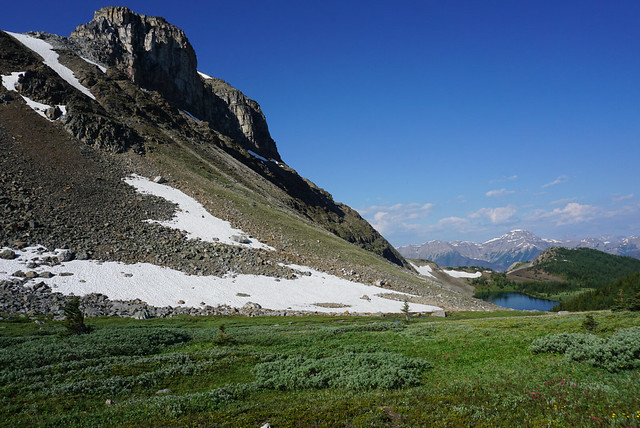
Wonder Pass – If you fly into the park or hike via one of the other access points, I highly recommend taking the time to hike up to Wonder Pass as a day trip. It’s much easier coming from Magog Lake than from Mount Shark. It’s a ~9km roundtrip trail with only 275m of elevation gain, so technically one of the easier hikes on this list. At the right time in the summer, the trail will be filled with wildflowers, and if you visit in the Fall, the larches will be turning yellow on the way up to the pass. From the top of the Pass, there’s an add-on hike up to Wonder Peak, but it’s fairly steep and not recommended for beginners. Please do additional research if you decide to attempt it.
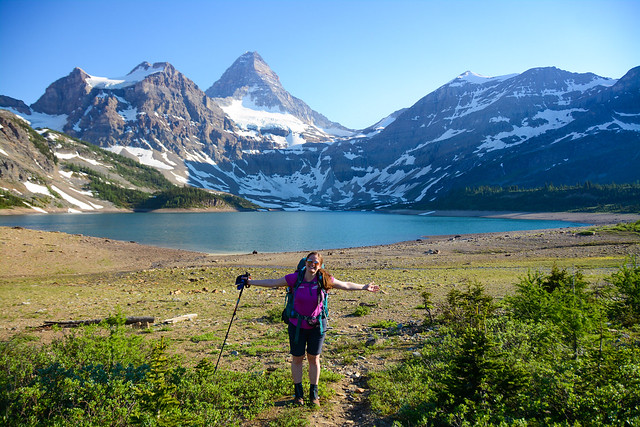
The Lakes – There are 5 lakes in the core area of the park, not including Og Lake. If you have time to visit them all, I’d definitely recommend it, but at the very least, you must visit Magog Lake, Sunburst Lake and Cerulean Lake. Gog Lake and Elizabeth Lake are nice add-ons if you have the time. I made it my goal to swim in every single lake and I was successful! In my opinion, Sunburst Lake is the most scenic.
Og Lake – If I flew into the park, I would prioritize the other day hikes on this list over Og Lake, but if you have the time and are not hiking past it already, it is a fairly easy hike to go out and back to Og Lake from Magog Camp. It’s a 12km roundtrip trail, making it one of the longer hikes on this list, but there’s almost no elevation gain and it’s all through open meadows, so it’s not challenging. In the middle of the summer, there should be lots of wildflowers along this route, but keep in mind that on a hot day, the trail is completely exposed. There’s also the option to branch off and visit O’Brien Meadows if preferred.
Mitchell Meadows – I haven’t done this hike, but it’s an ~11km roundtrip trail to Mitchell Meadows, with minimal elevation gain, so it could be a nice hike if you have the time.
Mountaineering Routes – There are several mountaineering objectives in the area, which I will not discuss because I don’t have mountaineering experience and they shouldn’t be attempted by those without proper equipment. But other options for further research include Sunburst Peak, Mount Cautley, Naiset Peak, Cave Mountain, or Og Mountain.




 The Road Goes Ever On