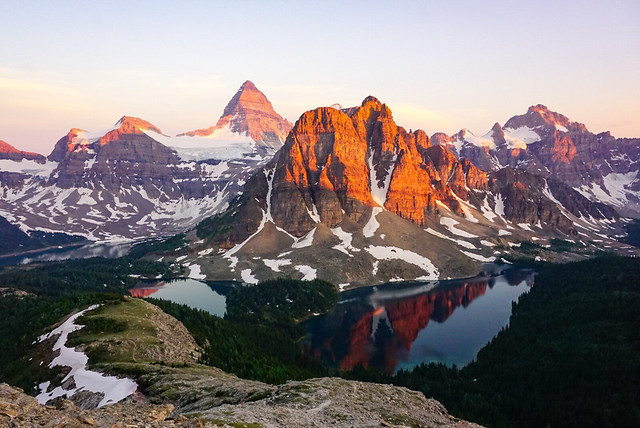
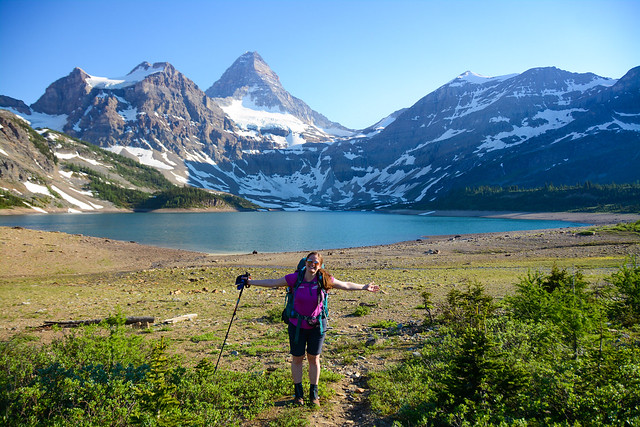
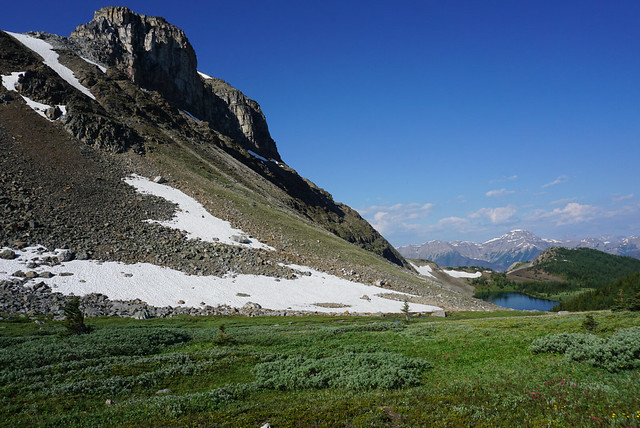
After an epic day exploring the Rim Trail and a better night’s sleep from repairing Carolyn’s sleeping pad, we were awoken by mountain goats snuffling around the campground near dawn. We both ignored them in our early morning stupor and decided to have a bit of a later start to the day. Since we’d already completed the Rim Trail, our only plan for the day was to visit the rest of the lakes in the core area of the park. We’d already swam in two of them and Carolyn was determined to bag all 5!
The rest of the campground had an earlier start and I assume most of them were hiking the Rim Trail. We left mid-morning and didn’t encounter anyone all day until we returned to the lake in the late afternoon. We decided to visit the lakes in a clockwise direction, with out first stop of the day at Lake-of-the-Woods. This is the smallest lake in the park, but it was quite nice. There used to be a campsite there and you could still see a lot of the remnants. Some of the tent pads seemed untouched, even though the trees were all burned down. One tent post even still had a backcountry permit attached to it!
While we wanted to swim in all 5 lakes, Carolyn’s real goal was to skinny dip in all 5 of the lakes. We’d been hoping to bag Quinescoe on the first day, but the lodge owners had been hanging out at the lake and we never got the chance. We’d already ticked Ladyslipper Lake off the list and Lake-of-the-Woods was our second success. We hoped no one would wander off the trail accidentally, and given we were the last people to leave the campground for the day, we were pretty confident we’d be alone. Lake-of-the-woods was probably the warmest of all the lakes, so I really enjoyed that one. It was sad though to look out at the ring of burned trees around the perimeter of the lake.
We hung out for a little while before continuing on to Pyramid Lake. In my opinion, Pyramid Lake was the worst of the casualties in the fire. Absolutely everything was burned and a lot of the trees had fallen down, leaving a mess of trunks everywhere. The old campground was located on the side of the lake, but it was so burned up, we couldn’t even find the trail. We did a little bit of bush-wacking around the edge of the lake until we found somewhere we could swim, but honestly, it was a real challenge! It’s not a good swimming lake, but we still managed to tick the 3rd lake off our skinny dipping challenge.
Our last objective was to hike up over the ridge to Glacier Lake. The start of the connector trail was burned, but as we approached the meadows around the lake, we left the burn zone behind us and there were still lots of untouched larch trees around the lake. We stumbled upon a few mountain goats in the meadow and then found a nice place to eat our lunch. We could see some hikers up along the ridge of the Rim Trail in the distance.
I mentioned in my last post that Ladyslipper Lake was Carolyn’s favourite lake in the park, but mine was Glacier Lake. Both are very nice, but Glacier lake felt more open with a big grassy meadow extending down to the edge of the lake. Plus, I liked that we could see the Rim Trail around the edge of the bowl. We checked swimming in Glacier Lake off our list and debated whether we might still be able to get Quinescoe Lake. We spent a bit of time playing in the meadow and filming some more of our tiktok dances before starting the hike back down to Quinescoe.
The trail pops out right in the campsite, but there is another trail that goes around to the back of the lake. There were people at the campsite, so we decided to continue on hiking until we found a big rock at the back of Quinescoe Lake. We ticked the last lake off our bucket list and then enjoyed sunbathing on the rocks for an hour before heading back to camp. It was a much more relaxed itinerary than the previous day, but we still managed to spend 5.5 hours hiking only 8km.
We decided to play a few games of crib next to the lake when we got back to camp and Carolyn made us popcorn for dessert. I’d made an apple crumble that we had for dessert after finishing the Rim Trail the previous day, so we definitely ate well on the trip! It was nice to camp at the same spot for 3 nights and not to have to pack up camp and lug around our heavy bags every day. It was a newer experience for Carolyn, as she tends to gravitate to thru hiking more than base camping. As we were lounging around, she did admit that it was pretty enjoyable to have it so easy!
The whole trip was a little bittersweet because I’m not sure when we’ll get to do a trip like this together again. Carolyn is moving back to Newfoundland at the end of the year. It’s a hard pill for me to swallow, even though I know it’s the right move for her and I think it will make her happy. But we’ve had 10 years of adventuring together in BC and I always call Carolyn my soul sister because I’ve never met anyone else who thinks so much like me. We are still very different people and we have different personalities, but we are almost always on the same page with how we approach problems. Sometimes I’m convinced we have a telepathic connection because we don’t even need to verbalize something to agree on a course of action. By the time I weigh all my options and decide what to do, Carolyn’s already arrived at the same conclusion.
I feel pretty confident we’ll continue hiking and backpacking together since I still call Newfoundland home and spend 2 weeks there every summer, but I know the opportunities won’t be as frequent in the future. No one else is as excited about making tiktoks with me in the backcountry, willing to be miserable together for days on end, or as tolerant of my (many) bathroom stories as Carolyn. When we hang out together, it feels exactly like what peak female friendship should be. This is getting to be more sentimental than I planned (I didn’t plan to talk about Carolyn leaving at all). The likelihood of her even reading this is pretty low – Carolyn, if you read this, comment “I cry a lot”.
After our last night in the backcountry, we got up early once again and had started hiking before anyone else had even gotten out of their tent. Like I said, we’re always on the same page, and 90% of the time that page says to get up early. We had 15km of hiking along the Lakeview Trail to get back to our car, followed by 5 hours of driving back to Vancouver. We filmed a few more tiktoks shortly after setting off, and then proved to ourselves that even though we were slow as cold molasses at hiking the Rim Trail, we have the capability to be fast when we want.
We ended up doing the entire 15km hike in 4.5 hours, including breaks. We barely stopped, except to film tiktoks, but it caught up with me after 12km and I stopped for a quick lunch break while Carolyn finished the last few kilometres to the car. I am glad that we did not hike in on the Lakeview Trail. It didn’t feel particularly steep on the downhill, but it’s long and it’s almost completely exposed. The Crater Creek fire burned all the trees along the trail, so while you get a good view towards the Rim Trail, it comes at the cost of total sun exposure. The trail crosses the road a few times before heading back into unburned forest before you reach the end. It would be a long slog to hike all the way up on that trail.
The trailhead is located right next to the Ashnola River, so we both took the opportunity to have a nice river bath before getting in the car. I didn’t have my pocket shower, but a good old fashioned cloth bath still does wonders in making you feel refreshed. Overall, I didn’t feel too stinky on this trip because of all the swimming. We made really quick time on the drive back to Vancouver, but of course, we had to stop for ice cream in Princeton, followed by McDonalds in Hope!
I’m not sure if and when I’ll make it back to Cathedral Park. I proud that we hiked in and out of the park, but I’m not super keen to do it again. I think I’d like to take advantage of the shuttle the next time I visit. While so much of the forest in the area did burn, there are still a handful of larch trees standing around the core area of the park, so I think I’d like to go back one day in the Fall to see the larches turn yellow. It is upsetting to see how much of the park was lost, but don’t let it stop you from making a trip there. All of the stone features are still standing, and we really felt that this was a special place. I’m glad I got to experience it, and it’s even more special that it was mine and Carolyn’s last backpacking trip, at least for a little while.
Cathedral Park has been on my bucket list for a long time. I was supposed to visit the park in 2018, but my trip was cancelled due to a nearby forest fire. Fortunately, the fire never did reach the park, but I missed out on the opportunity. Even more unfortunately, another forest fire in 2023 (the Crater Creek fire) did breach the boundary of the park, doing a lot more damage to the area. The fire tore up the valley along Ashnola Road, burning everything in its wake and then continuing up towards the core area of the park.
Fortunately, the fire was contained before it burned everything, but a good chunk of the east part of the park was decimated, including 2 campgrounds and the access road. Parts of the core area of the park were saved, including the lodge (honestly, I think we have the lodge to thank that it didn’t all burn down, as I suspect they water bombed it). The park has been closed, but it was partially re-opened this summer. There used to be 3 campgrounds, but Lake-of-the-Woods and Pyramid Lake both burned down, leaving only the Quinescoe Campground.
The lodge did not burn down, but it’s not open due to the loss of the access road bridge. The road closure had a big impact on park usage in 2025. While it is possible to hike into the park, the access trail is 15km long and climbs 1400m in elevation, so it’s a big hike. Historically, most people have paid to use the lodge shuttle to access the park, even if they were camping, in order to avoid the challenging access trail. It appears that the bridge repair is almost complete, so I suspect the road will re-open in 2026, but for 2025, hiking was the only way to access the park.
When I saw the re-opening announcement, I impulsively booked permits for the Labour Day long weekend. Carolyn and I has planned to spend the weekend together and I thought Cathedral would be a nice option. In the past, it’s been hard to get permits for Cathedral because of its popularity, but with the road closure in 2025, it wasn’t a problem. Carolyn wasn’t really sold on the idea, but when she learned park usage was low due to the closed road – and that there were 5 lakes in the core park area – she quickly got on board with the idea. We decided to meet at the trailhead on Thursday night before the long weekend to spend 3 nights camping at Quinescoe Lake.
If you’ve been following along my previous posts, you’ll know that I was already on a road trip with Seth, so we all met up at the Lakeview Trailhead on Thursday evening. Accessing the park is a bit tricky as it’s not close to any cities. From Vancouver, it’s a 5-hour drive through Manning Park until you reach Keremeos. From there, you take Ashnola Road to the Park entrance. Ashnola Road is a gravel road, so it’s a bit slow going, but it’s in good shape and you can drive it in any vehicle. It was humbling to see all the damage from the forest fire on the way. Everything along the road has burned down, leaving many rec sites exposed. It’s a very fresh burn scar and it’s honestly hard to witness.
Once you reach the park entrance, there are two rec sites along the road, one is at the Lakeview Trailhead, and the other is a few kilometres away, called Buckhorn. We camped at Lakeview since that’s where we were leaving Carolyn’s car, but it only has a single walk-in site and no outhouse, so I wouldn’t recommend it. We ended up camping in the parking lot since we were the only ones there. I didn’t drive down to Buckhorn, but from the map, it looks like a more traditional rec site and I would recommend that one if you’re doing a similar trip.
There are actually 3 trails that hike into the core area of the park, but the Ewart Creek trail on the east side of the park is still closed because it completely burned. The most common access to the park (for the limited number of people who actually hike in) is the Lakeview Trail, which runs parallel to the backcountry road. In any other scenario, we would have hiked in and out on that trail. But because Seth was still with us and heading back to Vancouver the next day, we had the unique opportunity to do a thru hike. There’s a third trail, the Centennial Trail, that you can access from the west side of the park. At 16.5km and 1200m gain, it’s slightly longer and has slightly less gain than the Lakeview Trail. It’s another hour of driving to get to the trailhead, but Seth was nice enough to drop us off. So we left Carolyn’s car at Lakeview, with the intent to finish the trail there.
It was calling for a very hot weekend, so we got an early start. It’s a pretty steady incline for the first 8km of the trail. You get a reprieve when you reach the alpine, followed by another climb up to the Rim Trail, before you head down to the Quinescoe Lake Campground. We kept a steady pace on the initial uphill hike, which was forested, but after a few kms, we entered a burn scar. Because we knew the lodge hadn’t burned down, we thought the damage from the Crater Creek fire had been limited to the east half of the park, so we were disappointed to see the burned trunk. It looked like the damage along the Centennial Trail may have been from another fire, because it didn’t seem as recent, but I couldn’t confirm online.
In any case, it was exposed and hot along the trail, with no tree cover. We were wrong in assuming we’d have shade in the morning, so we ended up slogging through the first 8kms. Eventually we reached a plateau and found a small section of unburned forest where we were able to enjoy lunch. We both brought our helinox camping chairs, so we had a really nice break in the shade before setting off again. Fortunately, it got cloudier in the afternoon, so we had some relief from the heat by the time we reached the alpine. We hiked through nice meadows before starting the ascent up to the top of the Rim Trail.
The Rim Trail is one of many defining features in the park. There’s a cluster of lakes that are surrounded by a towering alpine ridge. It’s a very rocky park and it’s aptly named “Cathedral” because of all the stone monuments found along the Rim Trail, which encircles the core area in a 16km loop. We had to hike up to the ridge to connect with the Rim Trail at Scout Mountain before heading down to the lakes. It’s very exposed along the ridge and some dark clouds rolled in while we were hiking up to the pass. We were a little bit concerned about possible thundershowers while we were exposed, but fortunately the rain held off until we got to camp.
As we started hiking down, we could see a few larch trees that hadn’t burned, but we very quickly entered a complete burn zone. It was very eerie and sad to experience. It felt like there was a heaviness over the park the entire time we were there to the extent that I felt like we were almost grieving with the park. There’s a thick layer of black ash over everything and it was really dusty to hike through the burn scar. There’s absolutely no shelter and the only sign of life was the fireweed that had started to pop up. I lament the fact that we’ll never get to experience the park pre-fire. There are still some sections of unburned larch forest that were beautiful to witness – I can only imagine what it was like before.
It was a Friday night, so we didn’t expect the campsite to be very busy, but we were surprised to discover that we were the only people there, leaving 29 campsites empty. 2 girls did show up just before dark, so a total of 2 groups at this once popular site. More groups showed up on Saturday, but I think there were probably a total of only ~8 sites in use the entire long weekend.
We enjoyed the solitude on our first evening and went for a swim in the lake before watching the sunset. It’s an interesting campsite because, while bears are always a concern, mountain goats seem to be the bigger issue. Signs advise not to leave anything out that might entice the goats, and to only pee in the outhouse, as they are attracted to salt (so they will lick your pee off the ground). There are cages where you can put things you don’t want the goats to get, and of course, still a traditional bear hang (don’t use the goat cages for food!). We did see a mama and baby goat hanging around the campsite, which made a reappearance every day that we were there, as well as a few deer.
Carolyn had a very rough first night in the tent. Immediately after lying down, she commented that her sleeping pad had a leak. She found it very quickly and patched it up with tenacious tape, only to lie down again and immediately put another hole in it. We found a very sharp rock under the tent that had clearly put both holes in her pad. She patched that one up with tape too, but it caused her trouble all night. She’d get an hour of sleep, only for the tape to give out. We dug out some duct tape to try and fix it up and she had so many layers of tape on it. We didn’t want to waste our patch kit on a mediocre fix in the dark, so she suffered through the night on minimal sleep. The next day we fixed it with the patch kit, and fortunately, that solved the problem.
We got up early again to hike the Rim Trail. There’s lot of ways to customize this hike as there are several connector trails that come down at each lake. But I recommend just doing the whole thing because the connector trails are very steep and exposed. The highlight of the park is seeing Smokey the Bear (pictured above) and the Giant Cleft (pictured below), so we decided to do the trail clockwise to hit these highlights first. We ended up hiking the entire day without seeing a single other person, so it was a pretty special experience.
We started by hiking to Pyramid Lake and then climbed up through the trees to Ladyslipper Lake. Everything is burned to Pyramid Lake, but there’s still a small larch forest between Pyramid and Ladyslipper. It was early when we arrived at Ladyslipper, but we wanted to swim in all 5 lakes, so we stopped for a quick skinny dip. Ladyslipper Lake is really beautiful and I recommend hiking there even if you’re not doing the Rim Trail. At the end of the trip, Carolyn decided Ladyslipper Lake was her favourite lake in the park, but it was second on my list.
Once you leave Ladyslipper, be prepared to be in exposed terrain for the rest of the day. There’s a big climb after you leave the lake and the trail is not easy to follow (though it’s still hard to get lost). It’s obvious where you’re headed and it’s open terrain, so it’s a bit of a choose your own adventure up to the first plateau. You get a great view of the Giant Cleft as you hike up, and eventually the trail levels out briefly before you start a second steep climb to the top. This was probably the worst part of the hike, it’s a narrow exposed trail with lots of scree, so choose your path carefully. You’ll know you’re at the top when you see the junction and the sign for stone city.
It is a big day to do the entire Rim Trail. It took us almost 10 hours, but one of mine and Carolyn’s favourite things to do in the wilderness is film tiktok dances, so we stopped a lot to eat, film, and dance! Some people will just hike up to see the stone city and Smokey the Bear, returning the way they came. We had a quick break in the shade at the junction and then decided to do the 1km detour to see the rock features before lunch. I’m not really sure about the geological history of the park and how all of these stone formations came to be, but they have made it a special place for indigenous peoples and modern day visitors.
The first highlight is the stone city, which is a compilation of large scattered rocks, after which you arrive at Smokey the Bear. You can climb up to the top of Smokey, which we did, and then continue onto the Giant Cleft. This is exactly what it sounds like – a big gap in the cliffside. More adventurous hikers will scramble up Grimface Mountain, but we opted to turn around after the Giant Cleft, returning to the junction to eat lunch.
The rest of the hike is pretty straightforward as you circle around the top of the rim, but it is still surprisingly challenging. Like any ridge walk, while the net gain around the rim is minimal, there is a lot of up and downhill from peak to peak. Our first ascent was up to the Devils Woodpile, next to Pyramid Mountain, which has a great view of Ladyslipper Lake. The terrain is still really interesting because there’s a lot of rock, but over time, its become arranged into what looks like big waves of rock. I don’t know how this happens, but guessed it might be related to snowmelt, creating riverlike features. If I have any geologist readers, I’d love an opinion!
Our next milestone was hiking down to a lookout over Glacier Lake, before hiking up to the top of Quinescoe Mountain. Like I said, the trail isn’t always easy to follow and we got off it a few times throughout the day, but it’s always very obvious where you’re going, so we didn’t worry. The climb up Quinescoe Mountain wasn’t too bad, but we had one more ascent left on Red Mountain. It looked like a shorter and easier climb than Quinescoe, so we weren’t too worried about it, but it ended up being the worst one of the day.
The trail was the hardest to follow as Red Mountain was one big boulder field. You have to hop your way around the giant rocks up to the top, and then once there, the descent is even worse. My GPS track looks like we more or less followed the trail back down the mountain, but it sure didn’t feel like it! It was very steep and I felt unsure of myself in several areas because the boulders were so large. I was concerned about taking a wrong step and kicking up loose rocks. Fortunately, we made it to the bottom almost without incident, except that Carolyn’s bottle of electrolytes opened in her bag and coated everything in sticky, sugary liquid. Not her finest moment!
Eventually we reconnected with the Centennial Trail to follow our path from yesterday. We saw a few more deer on the way down, but were happy when we finally stumbled back to the campsite. There were a few more groups when we arrived, but overall, not very busy. We went for another swim before making supper for the evening. Tune back in next week to hear about the second half of the trip!
The Berg Lake Trail is one of the most iconic backpacking trails in the Canadian Rockies. It’s been on my bucket list for a long time, but it was closed for 3 years due to flooding that washed out portions of the trail in 2021. It finally re-opened in 2025 and I was super keen to visit the same summer. I spent 6 days hiking along the trail and it was easily the highlight of my summer! I’ve already published a 3-part trail report about my experience, which you can read starting here, but I had a lot of other learnings about the trail that I’d love to share. Reservations for the 2026 season are releasing at 7am on December 2, 2025. so here’s everything you need to know about the Berg Lake Trail!
The Trail
The Berg Lake Trail is a 42km there-and-back trail located in Mount Robson Provincial Park in BC. The trail starts at the parking lot north of the visitor centre and continues for 21km to the beach at the back of Berg Lake. There are 7 campgrounds in the park, with the most popular being the Berg Lake Campground.
There are a few options for how to hike this trail. If you’re not a backpacker, it is possible to day hike the entire thing, but you should give serious consideration to your fitness ability and previous hiking experience if you decide to attempt it. While the trail itself is not technical, it is a considerable distance and it covers almost 1000m in elevation gain. Approximately 500m of the gain is done in a 3km span, so it is a challenging and tiring hike. If you are not used to hiking long distance or you don’t have experience hiking in the mountains with significant elevation gain, I strongly recommend against attempting this as a day hike. If you do plan to day hike, I recommend starting before sunrise to give yourself lots of time, or consider biking as far as Kinney Lake. I found that the day hikers were primarily tourists who either don’t camp, or weren’t aware of the lead time required to secure permits.
If you are able to backpack it, I think this is a more enjoyable way to experience the trail. I did the trail over 5 nights, splitting the trail into 2 parts on the way up and down, and then camping 3 nights at Berg Lake to do day hikes. If you have more time to spend in the park, there’s lots to explore, but you can also enjoy this trail over a shorter period. I’d recommend a minimum of 2 nights. Most likely your itinerary will be limited by what permits you are able to obtain.
Time of Year
The best time of year to visit the Berg Lake Trail is pretty straight-forward. Mount Robson is the tallest mountain in the Canadian Rockies, so the trail is covered in snow for most of the year, limiting the core hiking season from late-June to mid-to-late September. You can visit year round, but you must be prepared for winter conditions and be aware of avalanche risk, which I won’t be discussing in this post.
I think there is slightly less traffic in September, as it gets cold quickly in the Rockies, but otherwise, avoiding the crowds isn’t really possible. If you go in late-June, be aware that there may still be snow on some of the trails; and if you go later in the summer, it’s more likely that your trip might be impacted by wildfires. Mid-to-late July might be the sweet spot, but I visited during the first week of August and lucked into great conditions. The mountains are always susceptible to storms, so be prepared for that.
Getting There
I think it may be possible to take a bus to Mount Robson Provincial Park from either Jasper or Kamloops in the summer, but it’s not a common route and I don’t know how reliably buses run. Similar to other popular Canadian parks, the easiest way to access is by driving. The park is located on Highway 16, which is a 5 hour drive from Edmonton, 7 hours from Calgary, and 7.5 hours from Vancouver (all without breaks). It’s not an easy park to access, but I promise it is worth your time. There is a very large parking lot at the trailhead, which is relatively secure, but never leave valuables in your vehicle.
Without a doubt, getting permits will be the hardest part of your trip to Berg Lake. This is a world-renowned hiking trail and attracts crowds of visitors every year. If you don’t get camping permits, then day hiking may be your only option to visit the park. If you want to try and get camping permits, then it’s important to mark your calendar with the permit release date. The permit release date for 2026 is Dec. 2, 2025. Unlike other BC parks, the permits for the Berg Lake Trail are released all on one day. The date is usually announced on the Mount Robson Provincial Park page, as well as on BC Park’s instagram. They usually don’t give a lot of notice (1-2 weeks), so you should be prepared to check in regularly at the end of the year until it is announced. The easiest way is to follow their social media.
Once released, you will have to book your permits on camping.bcparks.ca. Unlike Parks Canada, there is no random queue generator and you will have to login to your account, so there is no benefit to using multiple devices to try and get higher up the queue. However, if you have multiple people going on the trip, it is advantageous if you all login to your respective accounts to try for reservations (effectively giving you multiple chances to get your desired itinerary). I recommend creating an account in advance of release day (when the website will likely be slow due to traffic) and logging in before the sites release.
Once booking opens, select “backcountry reservations” and search for your start date. You will be forced to build your itinerary day by day, which can be a little frustrating. Once you get a date in your cart, you don’t need to worry about losing it, but it will become more challenging as the dates book up to continue building the itinerary. For example, by the time you get Whitehorn in your cart for your first night, Berg Lake may no longer be available for your second night. People are constantly adding and changing dates and campsites in the rush to get their itinerary, especially if you have multiple people from the same party trying to make 1 booking. So the trick is to frequently refresh. Just because you don’t see Berg Lake available right away, doesn’t mean it won’t show up if you keep refreshing.
My recommendation for booking a longer itinerary is to take what you can get and make changes later. If Berg Lake is not available, book Marmot or Rearguard and move on to the next day before those dates book up too. Once you have secured a booking for each of the dates in your itinerary, go back and look for cancellations. Keep refreshing until you see one, and then make a change to your booking to add it. This does cost more money as the change fee is $6, but I was able to get bookings for Berg Lake after the fact using this hack. When I made my first booking, I had 3 nights split between Marmot and Robson Pass campsites. I was able to change my reservation from Robson Pass to Berg Lake within the hour from people dropping sites, and I was able to get a cancellation later in the season and change my booking from Marmot to Berg Lake. So in the end, my starting itinerary (which had no nights at Berg Lake) ended up with 3 nights. You can track cancellations on Schnerp, which will notify you when a site opens up.
Campsites
There are 7 backcountry campsites in the park, so there are lots of options for where to stay and opportunities to customize your trip. The first 3 campsites are located along the trail to the lake, while the last 4 campsites are all located within 3.5km of one another around the lake. I’ll discuss itineraries below, but here’s an overview of the 7 campsites along the trail. All campsites include outhouses and bear lockers and as discussed above, require valid permits for the duration of your visit.
Kinney Lake – This is the first campground, located right on Kinney Lake at the 7km trail marker. It has 18 tent sites and a large open-air shelter. It’s a beautiful campground with several lakefront tent pads and a lovely view from the shelter. The trail to Kinney Lake is a gentle uphill, so this campsite is often overlooked because it is less than halfway to Berg Lake. But it’s a great option if you have a late start on your first day, as well as for families or those who want to experience Mount Robson’s backcountry, but have concerns about the strenuous hike up to Berg Lake. There are bike racks located at the back of Kinney Lake for those who bike up.
Whitehorn – This campground is located along the Robson River at the 11km trail marker. It has 22 tent sites and a large open-air shelter. This campground is ideal if you’re looking to split the hike to Berg Lake in half. It splits the elevation gain in half as well, though day 2 is slightly more strenuous. Some of the tent pads are along the river, while others are in the woods, but there’s a beautiful view of the valley and the backside of Mount Robson from the campground.
Emperor Falls – This campground is located just past the viewpoint for Emperor Falls at the 16km trail marker. It has 9 tent sites and some picnic tables, but it does not have a shelter. While the tent pads are located right next to the river, making for a nice view, the main downside to this campsite is that it’s located at the top of all of the elevation gain, so it leaves you with a big day if you’re hiking from the parking lot. I would probably avoid it on the way up, but it’s a good option to shorten your hike on the last day.
Marmot – This is the first of the upper campgrounds, any of which can be used as a base for day hikes. It’s located at the foot of Berg Lake at the 19km trail marker. It has 7 tent sites and a recently constructed semi-enclosed shelter (this one has windows, unlike the shelters at Kinney Lake and Whitehorn). Most of the tent pads are located in the woods, but 1-2 have a direct view of Mount Robson. While the view from Marmot is not quite as good as from Berg Lake, it is located right on the lake and would be my first choice if I couldn’t get a site at the Berg Lake Campground. Some people really like this campground because of how small it is, so you can avoid the crowds.
Berg Lake – This is the most popular campground on the trail. If you can score a permit for this campground, do not hesitate to book it. It’s located at the head of Berg Lake at the 21km trail marker. It has 26 tent sites and a fully enclosed cooking shelter with a large porch and view of the Berg Glacier. This is the most beautiful campsite on the trail, but it will be very busy as a result. Most of the tent sites are in the woods, though there is one premium tent pad with a lake view. A few of the sites at the back of the campground also have mountain views.
Rearguard – This campsite is located just past the Berg Lake Campground at the 22km trail marker. It has 6 tent sites and is a good option if you weren’t able to get a campsite at Berg Lake. It’s not located on the lake, but it does have nice views of Mount Robson and the river delta. The main downside is that there is no shelter, so if it rained, I’d prefer to be at Marmot.
Robson Pass – This is the last campsite in the park, located at the 23km trail marker. It has 15 tent sites. It’s located a little bit further away, but it can still be a great base if you’re planning to do some day hikes. You can access Snowbird Pass from this campsite, as well as you can hike up the backside of the Mumm Basin Trail – although be aware that this trail no longer connects to the Toboggan Falls trail due to a rockslide in recent years – but I’ve heard it still has a great view. Similar to Rearguard, the main downside of this campsite is that it doesn’t have a shelter.
Robson Hut – Another option to be aware of in the future is that the ACC is currently constructing a brand new mountain hut at Robson Pass, which should be open for the 2026 season. You will be able to book this hut through the ACC and it will be the swankiest accommodation available in the park. Please note that this is separate from the BC Parks booking system and it is not an open hut that you can visit. A booking will be required to use the hut.
Robson Meadows – Just to cover my bases, I want to mention that there is a frontcountry campground located off the highway near the visitor centre, which is a great option for camping the night before or after your backpacking trip.
Itineraries
I’ll keep this fairly simple. It’s not easy to get permits, so it’s really a take what you can get scenario, but there are a few strategies you can employ.
Strategy 1: Hike all the way to Berg Lake in a day. The idea with this strategy is that you book as many nights as you want at the lake, prioritizing day hikes from the lake. The benefit is that you can immediately concentrate on getting bookings for Berg Lake before they fill up and maximize your time at the lake. The downside is that you need to be prepared to do the full 21km in a day, which is challenging, but allows you to spend more time at the lake if time is limited.
Strategy 2: Break up your hike to Berg Lake into 2 days, staying at one of the middle campgrounds on the way up, but planning to hike all the way back to the parking lot in a single day. Again, book as many nights as you want at Berg Lake after you arrive. This makes your hike in easier than strategy 1, but still gives you extra time at the lake, as the hike down is much easier than the hike up.
Strategy 3: Break up your hike to Berg Lake into 2 days on both the way up and down. If you have more time available, you can still book multiple nights at Berg Lake in the middle to do day hikes, but the benefit is it gives you a more relaxed hiking timeline, especially if you are worried about the challenging terrain.
Personally, I would only do strategy 1 if I only had 1 night. I used strategy 3 for my visit because I had lots of time, but I would have been comfortable with strategy 2 as well. It is more manageable to do the hike down in a single day. Here’s a couple of options based on the number of nights you have. (D=day, N=night)
Number of Nights
First Choice Campground
Alternate Campgrounds
2 days, 1 night (strategy 1)
D1: Hike to Berg Lake D2: Hike out
Marmot, Rearguard
3 days, 2 nights (strategy 1)
D1: Hike to Berg Lake D2: Day hike, stay at Berg Lake D3: Hike out
Marmot, Rearguard
3 days, 2 nights (strategy 2)
D1: Hike to Whitehorn D2: Hike to Berg Lake D3: Hike out
N1: Emperor, Kinney Lake N2: Marmot, Rearguard
4 days, 3 nights (strategy 2)
D1: Hike to Whitehorn D2: Hike to Berg Lake D3: Day hike, stay at Berg Lake D4: Hike out
N1: Kinney Lake N2: Marmot, Rearguard N3: Marmot, Rearguard
4 days, 3 nights (strategy 3)
D1: Hike to Whitehorn D2: Hike to Berg Lake D3: Hike to Whitehorn D4: Hike out
N1: Kinney Lake N2: Marmot, Rearguard N3: Kinney Lake, Emperor
5 days or more
Same as 4 day options, but add multiple nights at Berg Lake
Day Hikes
There are several great options for day hiking along the Berg Lake Trail. I really think it’s worth it to try and fit in at least one day hike if you can get multiple nights at campsites near the lake, but if you can’t, it’s not the end of the world either. Berg Lake is a world-class trail on it’s own and the entire trail is stunning, whether you have time for side quests or not. If you do have time, here’s the trails I would recommend.
Snowbird Pass – In my opinion, this is the best trail in the park. People like to prioritize the Berg Lake Viewpoint on the Toboggan Falls Trail, but this trail is the real gem. It’s a 20-km round trip hike from the Berg Lake Campground, so you definitely need a full day for it, but it features views of both the Robson Glacier and the Reef Icefield. It’s stunning from start to finish. If you don’t have enough time to do the whole trail, it’s still worth it to hike the 3km from Berg Lake to the lake at the base of Robson Glacier. I’ve written an entire blog post about this trail.
Toboggan Falls to Berg Lake Viewpoint – This is the most popular side trail in the park. From the Berg Lake Campsite, you can hike 1km up along the Toboggan Falls trail (enjoying the view of Toboggan Falls along the way), to a junction that takes you another ~1km up to the Berg Lake Viewpoint. From here, you can get the iconic photo of Berg Lake, the delta, and Berg Glacier. You don’t need a full day to do this hike, so if you’re short on time, you can probably knock it out in ~2 hours after you arrive at camp.
Hargreaves Lake Loop – If you have a full day, expand your hike up to the Berg Lake Viewpoint to also include the loop around to Hargreaves Lake via Marmot Campground. It’s approximately 7km round trip and in my opinion, Hargreaves Lake is really underrated. There’s a small viewpoint off the trail that takes you up to a lookout of Hargreaves Glacier and the Marmot branch of the Berg Glacier at the same time. I’d recommend a day if you’re doing the whole loop, but if you’re staying at Marmot, you could easily hike up to Hargreaves Viewpoint and back in an evening, as it’s only ~3km round trip.
Adolphus Lake – I haven’t done this trail myself, but if you have the time, you can hike out from Berg Lake to Robson Pass and then continue on to see Adolphus Lake. It’s ~2.5km from the Berg Lake Campground, but along completely flat ground. It’s a great option if you’re staying at Robson Pass.