A Beginner’s Guide to Backpacking

Would you like to get into backpacking, but don’t know where to start? Whether you’re new to hiking or an avid hiker, it can be challenging to make the transition to backpacking. It can be hard to know where to go, what to bring, and how to stay safe. This Guide is meant to be a high level support to link you to other resources, help you assess your skills, and safely plan for your first overnight hike.

The backcountry can be a dangerous place. It can be easy to become lost, injured, or susceptible to adverse weather, and without the proper preparedness, sometimes one mistake can unfortunately prove to be fatal. I don’t think we need to be afraid of the backcountry, but I do advocate for smart planning to mitigate as many risks as possible up front.

I am not an expert on backpacking. I have done a lot of backpacking near the lower mainland and I am a Outdoor Adventure Trip Lead with Girl Guides Canada, so I focus a lot of risk management and preparedness in the backcountry.

IMG_4814

Assessing Your Skills

Before heading into the backcountry, I think it’s important to understand what skills you have and what skills you may need to supplement. Are you an experienced hiker? Are you comfortable on more challenging terrain? Do you have any special training such as first aid or avalanche safety? Do you have access to all the essentials? Are you good at map and GPS reading? Do you know what to do if you run into trouble?

It’s important to have a good sense of awareness of your own body and to listen to it. It’s easy to get into trouble if you push your body too far or don’t recognize signs of stress. If you haven’t done much hiking, always start small to understand your limitations. Stop when you need a break, you are tired, the terrain looks dangerous, it’s too hot, etc. One of the most challenging decisions is accepting that you should turn around and not expose yourself to additional risk. Once you’ve started something, the inclination is always to push forward, because you’ve sunk time and energy into getting this far. But if the weather conditions are not right or your body is not feeling it, you should always feel empowered to stop for any reason.

Picking a Trail

Deciding where you want to go will help you plan appropriately for the rest of your trip. Once you’ve assessed your skills, you should have a better idea of what kind of trail you may want to do. Here’s some questions to ask yourself:

  • How far a distance do I want to hike?
  • Am I okay with hiking uphill, or do I prefer a flatter hike?
  • Do I want access to facilities like an outhouse, bear cache, tent pads, cooking shelter, etc?
  • How far am I willing to drive?
  • Can my vehicle safely access the trail?

For new backpackers, I recommend starting with shorter trails that aren’t too steep. AllTrails is a great resource to research hikes, so look for trails under ~6-10km and with elevation gain of no more than 200-400 metres. The shorter the hike and the greater the elevation gain, the steeper it will be. As a rule of thumb, keep the elevation gain under 10% grade (100m of gain over 1km). I also recommend selecting campgrounds that have outhouses and bear caches. Unless you already know how to dig a proper cathole, or you have a bear cannister, it’s much less stressful if you have access to these facilities. A cooking shelter can also be a great resource if the weather is not good because it will help you to stay dry without needing to set up a tarp. Do as much as possible to make your first trip easy because it can be overwhelming trying to learn too many new skills as once. Next week I’ll be posting some of my recommended hikes for beginners near Vancouver.

PSX_20220818_214003

Packing the Essentials

Backpacking is a balancing act between making sure you have everything you need to survive and trying to keep your pack light for physical comfort. It’s likely you will have a pretty heavy pack on your first trip because lightweight gear is expensive and you won’t have a good sense of what you really need versus what you can manage without. First time backpackers often bring way too much clothes, make sure you have warm and waterproof layers, but leave the extras at home. Embrace being smelly and just wear the same clothes for multiple days.

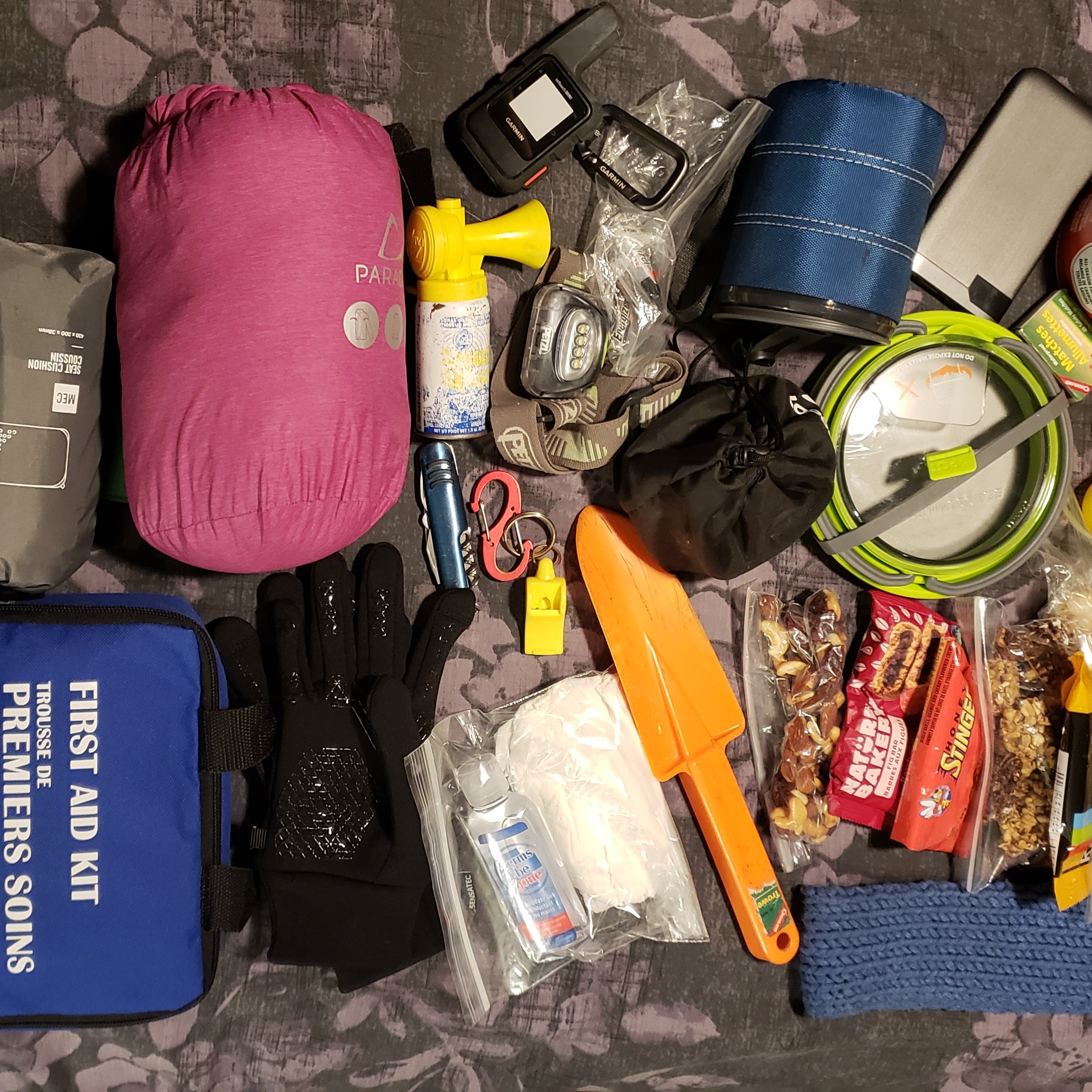
While there’s some things you can do without, you can’t compromise on your 10 essentials. I have a whole other blog post on Personal Safety and the 10 essentials and you can get more information from North Shore Rescue. Make sure you have all the essentials with you.

Safety

One of the most important things to do before heading into the wilderness is to leave a trip plan and have a plan for how you will manage problems on the trail. Your trip plan should include details on where you are going and when you are expected to return, and should be left with someone you trust to call 911 if you do not return. AdventureSmart is a great resource for creating a trip plan. Some other things to consider for safety:

  • Assess your first aid knowledge. Are you carrying a first aid kit and do you know what to do if you become injured?
  • Assess your navigation skills. Are you confident reading maps and GPS? Are you carrying an extra battery for your phone/GPS? Will your GPS app work offline?
  • Assess the ease of communication. Do you know if you will have service on this hike? Do you have a satellite device in case of emergency? If not, are you traveling with other people who can help in an emergency, or on a crowded trail where you can seek help from others?

If you become lost or injured, always stop right away and call 911. Don’t call a friend, partner, or parent. 911 calls will go through on any network available and are traceable. If cell service is unreliable, don’t waste what might be your only call on someone who can’t trace you or meaningfully help you. I have written extensively about trip plans, navigation, and communication in my blog post on Personal Safety, as well as I have a blog post dedicated to First Aid and preparation.
DSC09647

Camping Permits and Reservations

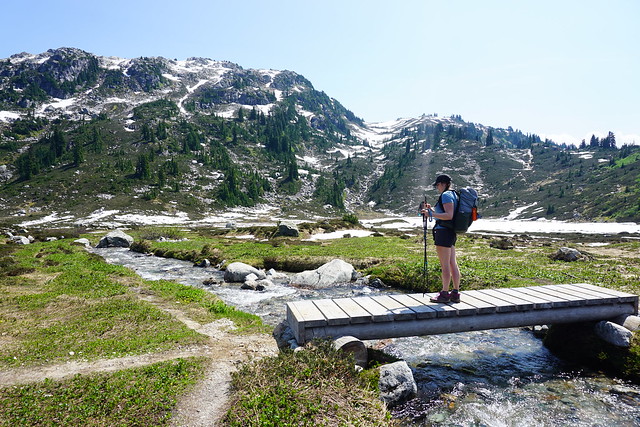
Now that we’ve talked about the scary safety preparedness implications, let’s talk about some of the more practical preparation you can do. Camping permits and reservations can be really confusing, but are necessary for most campsites. There is a lot of camping you can do on crown land, but I recommend parks where possible because they have more infrastructure dedicated to visitors. It’s important to respect the natural landscape in which we’re recreating. Everyone makes mistakes starting out, so it’s easier to limit your impact when camping in parks with access to toilets, grey water disposal, bear caches, etc.

If you’re camping in a provincial park, you will need a permit or reservation. Both can be booked online at camping.bcparks.ca. Reservations are only required in popular parks where they are trying to manage overcrowding. A reservation guarantees you a campsite, but not a specific site. For example, Elfin Lakes has 50 tent pads, so they release 50 reservations and you can pick any available tent pad when you arrive. Reservations are available for Garibaldi Park, Joffre Lakes, Manning Park, Berg Lake, and Assiniboine. They release 4 months in advance of your desired date, so if you want to camp on Aug. 15, you must reserve your campsite at 7am on Apr. 15. These typically cost $10 per person, per night, with a $6 reservation fee.

All other parks require only a backcountry permit. Permits are available 2 weeks before your desired date, but there is no limit on the number of permits sold, so you can wait until the evening before your trip to purchase it. There is no guarantee of a site with a backcountry permit, it’s simply first-come-first-serve at the campground when selecting a site. These typically cost $5 per person, per night.

Camping Equipment

Your essentials likely will only account for a portion of what you actually want to bring in your pack. Equipment can be really overwhelming when you first start backpacking because gear is really expensive. On your first trip, borrow as much as you can and accept that you’re not going to have all the best gear and that you will likely have a heavy pack. I have a gear guide dedicated to talking about camping equipment. My piece of advice would be to start with investing in a quality sleeping bag, something both warm and lightweight, and then move on to other gear later. I have also shared a packing list from the 10-day trip I did on the Sunshine Coast Trail.

HOP_6458

Food Planning

Food planning can be very stressful or very easy. If you want it to be easy on your first trip, just purchase backpacking meals at any outdoor store. They are expensive, but they are simple because they only require boiling water.

If you want to save money, I have written a 3-part series on cheap and easy meals to eat in the backcountry (no dehydration required):

If you want to get into the exciting world of dehydrating your own meals, of which I am a huge fan, I’ve written another 3-part series on easy dehydrated meals:

DSC08950

Leave No Trace

If you are recreating in the backcountry, you have a responsibility to leave it the same or better than you found it. This means, take all your garbage, including your toilet paper; stay on trails, even if it means walking through mud; filter your grey water to keep food waste out of the streams and lakes; don’t harm the natural environment scavenging for firewood or take anything natural back with you; respect wildlife and be considerate of other people. Check out Leave No Trace Canada for more information.

Other Considerations

A few other things to be aware of:

  • Practice bear safety. Cook away from your tent; keep everything that smells in a bear cache, including sunscreen and toiletries; pick up all crumbs; and make noise while hiking.
  • Protect your water sources. Filter or treat your drinking water and get water from moving sources, upstream of where people are swimming or washing dishes.
  • Always prepare for the weather. Mountain weather is unpredictable, always be prepared for rain and cold conditions. Turn back if necessary.

Check back next week for a list of recommended overnight hikes for beginners!
HOP_6069

Let’s Talk: First Aid

First aid is one of those things I always knew was important, but it took me a while to really learn just how useful it is. Being able to swim was something that was always really important to my Mom, so she put me in swimming lessons as a kid and later signed me up for lifeguarding courses when I turned 14. I did junior lifeguarding until I was 16, when I completed my National Lifeguard course and was certified for 4 years. First aid is a major component of this course and it is something that has served me well ever since. I’ve done several variations of first aid courses for work and guiding ever since and I think it is so worthwhile to invest time in learning basic first aid. Even if you don’t have a formal certification, being able to recognize symptoms and treat simple emergencies is a huge asset in the outdoors.

I was employed for 2 summers as a lifeguard at age 18, other than that I’ve never had any formal capacity as a first aider. Yet, since then I’ve treated a seizure, heat exhaustion, heat stroke, a broken arm, injured knees, and any number of cuts, scrapes, and blisters. I never leave my first aid kit at home, and I’ve been surprised by how often I’ve needed it. You can be resourceful in the wilderness, but I’ve never regretted carrying along a few extra first aid items (and you will definitely regret if you need them and don’t have it). I think the most important thing is knowing what to bring and how to recognize symptoms.

First Aid Training

Let’s start with training. The easiest way to learn is to do a formal course. There are 3 basic first aid courses: Emergency, Standard, and Wilderness First Aid. Having done them all at least once, I think Standard First Aid is the best bang for your buck. I don’t like Emergency First Aid, it’s only a 1 day course and it covers very little outside of CPR and AED. While these are good skills to have, I don’t think they are the most practical. I’m much less likely to need CPR and much more likely to need to bandage a broken wrist, so I find Standard First Aid more practical (plus you learn CPR/AED in all 3 courses).

Standard First Aid is generally a 2 day course and covers diagnosing and treating all different kinds of ailments, which is why I think it’s more useful. Treating heat stroke was the most life threatening thing I’ve ever done and I was able to diagnose it incredibly quickly, to the benefit of the individual (read about that experience here). Even for simple things, diagnosis can make a big difference. I was once 3 days into the wilderness and had a frightened hiker approach me with heartburn, I gave him pepto-bismal and it resolved in no time (somehow he’d never heard of heartburn – he described his symptoms and Emily immediately diagnosed it as heartburn since she gets it a lot, while I sang the pepto-bismal rhyme and he looked at us like we had 3 heads). So in my opinion, Standard First Aid is more practical than Emergency.

Wilderness First Aid sounds like it would be the most applicable for outdoor adventure (and it is), but it’s also the most expensive and has the biggest time commitment (2 long days or 3 shorter days). In my opinion, Wilderness First Aid is glorified Standard First Aid. It covers the same material, but from the perspective of someone in the wilderness with limited resources. So you practice splinting with sticks, homemade stretchers, and hypothermia wraps, but it’s not substantially different. Though once you have Wilderness First Aid, it’s half the work to re-certify it every 3 years (just a day), so I try and keep mine up to date. So if financial is a concern, I’d recommend Standard First Aid as the best course.

An idea of what “technical” means

Understanding Your Abilities

The second part of first aid is knowing what to bring with you and keeping a cool head in an emergency. If you panic, your patient will panic, so my approach has always been to be reassuring while asking lots of questions. Honestly, the presence of a first aid kit and care from someone who seems like they might be able to help is often reassurance enough for the patient. The other important thing is knowing when to call for help and doing so immediately. For example, you can probably handle small cuts and scrapes yourself, as well as mild dehydration. When my friend broke her wrist on a hike, I was able to wrap it for her to make her comfortable enough to walk back to the car on her own.

Dehydration is one of the more dangerous problems you can encounter, so being able to recognize it is important so that you can self treat. When I did the North Coast Trail, on the third day, me and Emily were both feeling really low and when Emily started to complain of an upset stomach, I immediately made the whole group stop hiking and we took a break while we both chugged a litre of electrolytes. While Emily’s energy remained low, our quick action prevented it from getting worse and we were able to finish the day in good spirits, with no injuries. In contrast, when my friend got heat stroke on the trail to Assiniboine, I didn’t know she was feeling bad until it was really too late. Her muscles started cramping, she couldn’t stand, and she even started losing feeling in her legs – all of these symptoms occurred within 15 minutes of her stopping to say she felt sick. In this case, I immediately made an SOS to emergency services on my inreach and spent 3 hours rehydrating her while waiting for help. Don’t try and be a hero; sometimes professionals and a quick extraction are needed and you are much wiser to make the call in those scenarios. Read my post on personal safety for more about communication devices and preparedness.

VideoCapture_20210707-104610

What to Bring

And the last thing I want to highlight is the more practical side of what to bring with you. Lots of places sell small first aid kits and most people opt for a tiny one to throw in their backpack. I wouldn’t say my first aid kit is large, but it is more sizable than what most people bring. Sometimes I lament the extra weight, but I always bring it. REI has a pretty comprehensive list of what to bring, which you can view here. Personally, I like to bring band-aids in varying sizes, a blister kit, sutures, antibacterial wipes, dressings, compression gauze, a tensile bandage, surgical scissors, triangle bandage, tweezers, safety pins, medical tape, polysporin, and latex gloves. I also bring electrolytes, advil or tylenol, pepto-bismal, and an emergency blanket and bivvy sack. Depending where I’m going, sometimes I throw in a small bottle of aloe and in the winter I will add hand warmers. One thing I don’t have is a sam splint, which I’ve been considering adding because it’s on a lot of first aid kit lists, but I’m not convinced I couldn’t just use a stick or a hiking pole in an emergency.

Your first aid kit is only meant to complement your 10 essentials, so make sure you also have extra clothes, food and water, as these can also help in a first aid emergency. If someone in your party is injured and it takes you longer to hike back – you don’t want to further endanger yourselves by not having other essentials, like a headlamp. I always remind myself to pack for the hike that goes wrong rather than the hike that goes right. I bring my insulated seat cushion on most hikes as well, because it can make a big difference to your comfort if you’re stuck sitting on the cold ground for hours waiting for help.

To conclude, my biggest recommendation is to get a first aid kit and learn what to do with it. Learning how to diagnose symptoms and how to treat them can make someone feel a lot more comfortable in an emergency, and may even save your life or the life of a friend. Stay safe out there!

DSC09384

Elsay Lake Backpacking Trip

Elsay Lake is the last trip in my backpacking archive! Once I write about this one I’ll be all caught up on backpacking trips. Don’t fret though, I have lots of trip plans in the works for this upcoming summer and I still have lots of day hikes and frontcountry trips to write about!

Elsay Lake is one of the more random trips I’ve done. I hiked it in July 2019 when my Howe Sound Crest trip was cancelled for the third year in a row (finally did it in 2020). Me, Emily, and Carolyn had planned to go do the trip together, but ended up having to cancel it because the last part of the trail is on private land and had been closed. Parks constructed a new trail entrance before 2020, but in 2019, you weren’t able to do the trail as a through hike.

20190714_132132

Carolyn decided to bail on an adventure altogether, but me and Emily still wanted to do something, so Carolyn agreed to drop us off at a local trail. I did a bit of quick research and we decided to try for the Elsay Lake trail, which leaves from the parking lot on Seymour Mountain.

In the summer, you can hike up the ski run to Brockton Point (the top of the chair), where you can continue into the Seymour Wilderness. Our plan was to try and hike up to Mount Seymour and do a loop trail that brings you back down towards Elsay Lake. This was a trip where my GPS app got me into a bit of trouble.

DSC09301

I use GaiaGPS to track my movements every time I go on the trail. I find the app to be a great resource, but you do still need to do research because the trails on the GPS are just based off of user data and are not always up to date. From Brockton Peak, the trail continues to a branch, where you can either go down the Elsay Lake trail, or up towards Pump Peak, Tim Jones Peak, and Mount Seymour. On my app, I noticed a trail shortcut to Pump Peak, so we decided to follow that. After hiking in for awhile, the trail became very steep and we lost it, so we decided to turn back. I later learned that it’s the old Pump Peak trail that has been closed, so you shouldn’t always put all your reliability in your GPS. However, deciding to stop and retrace our steps back was definitely the right decision and what you should do when you find yourself off trail. Don’t continue on because sometimes it’s possible to continue hiking up, but becomes impossible to turn around and hike back down (or vice versa) and you can find yourself stuck.

In any case, because of the lost time, we decided to ditch the Mount Seymour plan altogether and just took the Elsay Lake branch when we got back on the trail. This was definitely the right choice as the Elsay Lake trail ended up being super technically challenging and we needed to whole day to complete it.

20190714_132953

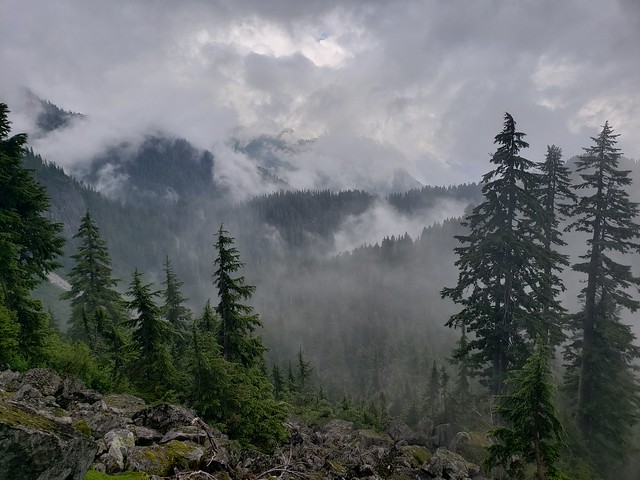
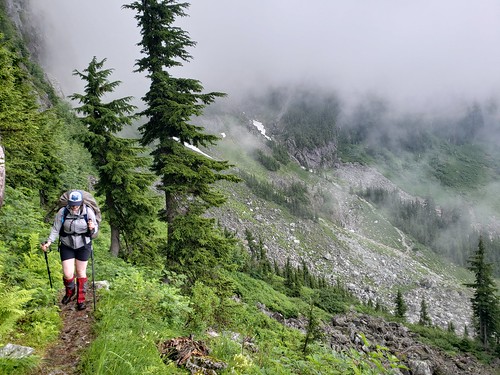
From the Elsay Lake trail branch, you descend down into the valley below Mount Seymour. It wasn’t raining, but it was a very foggy and overcast day when we did it, so at times it was poor visibility, but I also thought the valley looked so cool with the way the fog hung around the peaks. You hike down and down until you eventually come to a large boulder field. As we were hiking down into the valley, I would occasionally do my bear call as there were no other people around (most of the traffic is up on the Mount Seymour trail). After a while, we noticed that someone was starting to respond to our bear calls, and then they started yelling at us. We couldn’t understand what they were saying, but called back that we were on our way down.

When we reached the bottom of the valley, we ran into a slightly distressed couple. They asked us if we knew where we were, to which we responded, yes, and we asked if they were lost. They said they were – they’d been with a group of friends and they’d all hiked to the top of Seymour together. They’d been following their friend and gotten separated on the way down, so they’d hurried on towards the parking lot trying to catch their friend, but now they were confused and didn’t recognize anything.

20190714_130509

Because we were familiar with the area and using a GPS, we knew exactly where they’d gone wrong. On their way back from Mount Seymour, they’d taken the wrong branch and headed further into the wilderness towards Elsay Lake instead of back towards Brockton Point. They just kept going further down the valley thinking they were heading back to the parking lot. They were upset because they’d been entirely relying on their friend. We explained to them where they’d gone wrong, showed them the map, and explained they needed to climb back up the valley and take the proper turn to head back to their car. They weren’t happy to hear they would have to climb back up, but at least now they knew where they were and headed back the right direction.

This is a prime example of why it’s so important to always be prepared yourself. One of the common reasons people get into trouble is because of the “expert halo”. They rely on someone else to keep them safe. I’m absolutely a fan of mentoring in the backcountry, but there are definitely some basics you need to take responsibility for. If you get separated from your expert or the expert gets into trouble, do you know how to take care of yourself? It’s easy to get separated and easy to get lost. The Elsay Lake trail doesn’t get a lot of traffic and this couple were unknowingly going further and further into the wilderness. Even close to the city, it’s easy to get into trouble. Check out my post on personal safety in the backcountry and resources from organizations like Adventure Smart to learn more.

DSC09312

But getting back to the trip, Emily and I stopped for lunch in the valley around the halfway mark, before continuing on along the trail. You continue along the edge of the valley for a while, before eventually heading into the woods. This is where the trail started to get really hard, after you pass the branch that heads up towards Mount Seymour (our initial plan). Elsay Lake is one of those rare trails, where aside from the first part, most of the trail is downhill. ‘Technical’ is definitely the word to describe the trail.

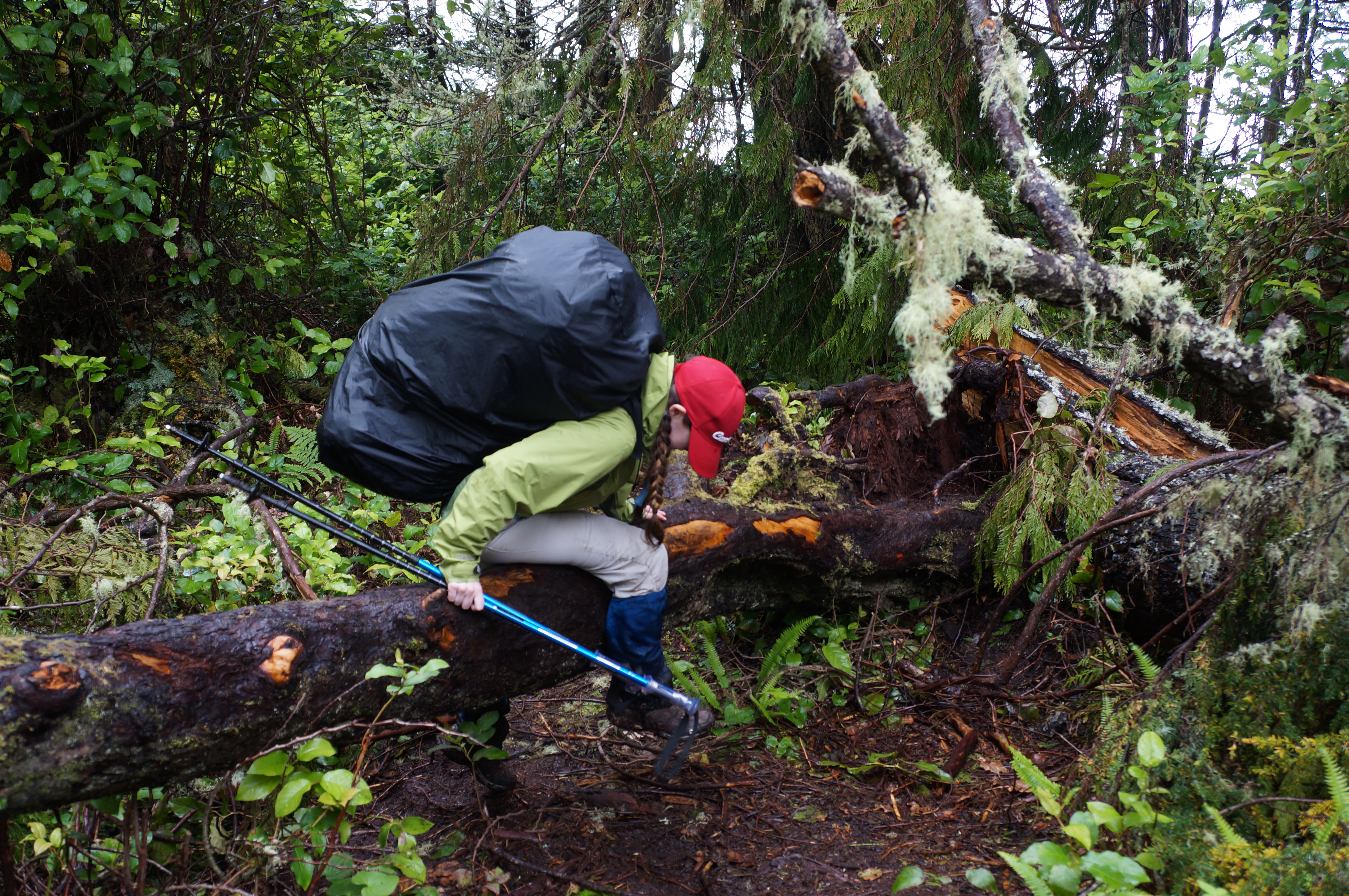
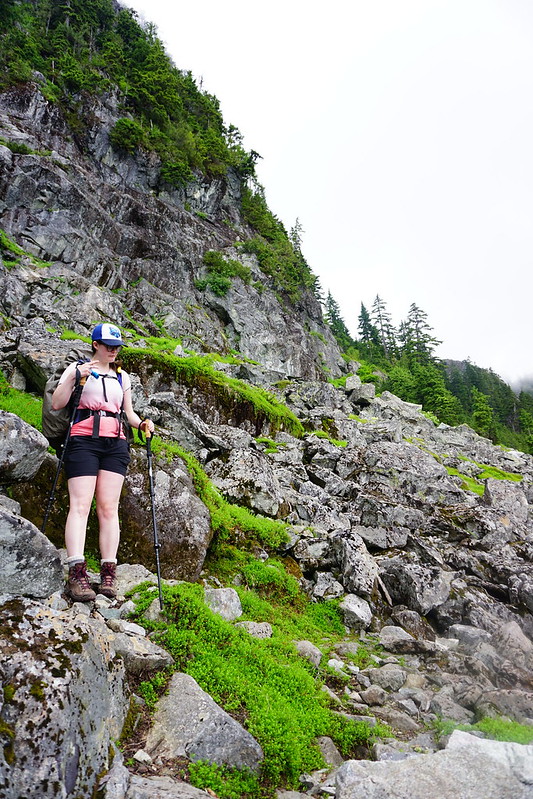
There’s lots of climbing over tree roots as you walk through the forest and several boulder fields scattered throughout. The challenge with the boulder fields is that they’re in the trees and the boulders are very large. So even though the fields are short, it’s difficult to cross them, especially if you’re short. There were several sections where we had to slide down rocks or support each other up over them because they were so large, not an easy feat when you’re both wearing large packs.

DSC09317

Then the trail continues down several steep sections through the forest that we had to take slowly so as not to trip or fall. Eventually you reach a flat section through the trees at the base that we did relatively quickly, until we came to a challenging river crossing. You have to ford the river, but we were trying really hard to keep our shoes dry, so we spent a long time trying to figure out a way across. We did manage to get across and stay dry, but it chewed up a lot of time. After that, you hike through some mucky areas before finally hitting the lake and hiking around the edge to the campsite.

DSC09324

It was only a 10km hike, but it ended up taking us about 8 hours by the time we reached the campsite. There is an emergency hut, and surprisingly, despite barely seeing anyone on the trail, the campsite was pretty busy. I mean overall there were only a few groups, but it’s not a big campsite and it took us a while to find a space big enough to pitch our tent. It was around 6pm when we arrived, so we went for a quick swim in the lake and then made dinner. There is an outhouse and we were able to store our food in the hut, so fortunately we didn’t have to mess around with a bear cache.

DSC09326

Our concern now was the hike back the next day. We were exhausted and we’d completely underestimated the time the hike would take. We had pre-arranged a pick up time with Carolyn that we didn’t think we’d be able to make (this was before I had an inreach), so we figured we’d just have to do our best and hope she didn’t have to wait too long for us.

We got up early the following morning to get an early start on the day. It was dry when we got up and we were able to pack up our gear pretty quickly, but shortly after we started hiking it started to pour. It was pretty demoralizing considering we were trying to go fast, but at least it was the last day. We didn’t waste time at the river this time and instead just walked right through it, getting our feet soaked. This sucked too, but it was already pouring and we didn’t want to waste time.

DSC09334

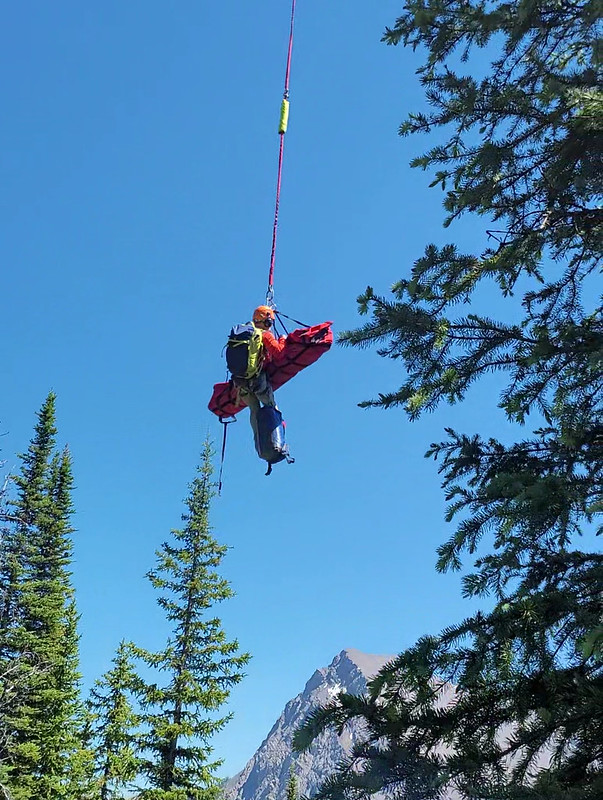
The trail is all uphill on the way back, which might be a downside to some, but we much prefer going uphill over going downhill, so things actually went a bit better than the previous day. We were still really slow going through the boulder fields, but persevered. As we were climbing up we came across a second couple that were struggling. The woman had injured her shoulder and her partner was now carrying both his and her packs! I can’t even imagine how difficult this was – in the boulder fields he would basically pass each pack up to her at each section and they would painstakingly carry them across. We stopped to talk to them and see if they needed any first aid. They didn’t, so we asked it they wanted us to contact Search and Rescue for them when we got cell service (since we would be ahead of them). Fortunately they had their own inreach, so they said they were going to continue on since it was still really early in the day, but would contact S&R if needed.

At the time I thought this was a reasonable approach, but after watching the S&R mini-series on the Knowledge Network, I would definitely advise just calling S&R from the beginning. There’s no fee for S&R and they won’t hold it against you for needing their help. This was an example of a couple that was actually well prepared; they had first aid supplies and a satellite device, but one of them had been injured, which is often outside your control. Don’t hesitate to call S&R if you need them. Time is the most important factor in S&R tasks and you want to give them as much time and daylight hours as possible to reach you. This was a rainy, cloudy day, so S&R likely wouldn’t be able to help this couple with a helicopter, which means they would need more time to get in the field. Perhaps this couple was totally fine, but I think S&R would probably just have encouraged them to seek help right away.

DSC09287

Once we got out of the boulder fields, our day improved a lot. It stopped raining and we took a break in the valley again for snacks and to change out of our wet clothes. I still had wet feet, but I was able to finish the hike in dry clothes at least. When we got back to the trail branch, I was able to get service and give Carolyn a call that we would likely be a little late. Surprisingly we’d actually made really good time and by the end of the trail, we were only 30 mins behind our original estimate.

When she heard about how challenging the trail was Carolyn seemed reassured in her decision to skip the trip, but then she went to soccer later that night and broke her ankle with an injury that takes 2.5 years to heal, so I’m not sure how she feels about the decision now! Either way, it was both a memorable and forgettable sister trip for me and Emily. The challenges were memorable, but overall I’d say the trip was forgettable and I definitely won’t be attempting the trail again. I would like to go back some day and hike up to Mount Seymour, but personally I’d give Elsay Lake a pass. I did like the trail down to the valley, but beyond that, the trail is miserable. It was a good lesson in trip preparedness though, given that we encountered two groups experiencing trouble and that we mistakenly took a wrong trail branch ourselves. The North Shore mountains are notorious for S&R tasks, so this was a good reminder to always be prepared!

DSC09307

Special shout out to Emily for taking ZERO pictures of me on this hike. So all you get is a million photos of her selfish butt.