Maria’s Updated Gear Guide

I’ve already written one gear guide, but it’s a bit outdated compared to what I currently use, so I decided it’s time for an update! These days I’m a lot more focused on ultralite gear, so my set-up is quite different. I’ll try and share a few options for each key part of my camping set-up, depending on your preference!

Backpack
PSX_20220917_112741

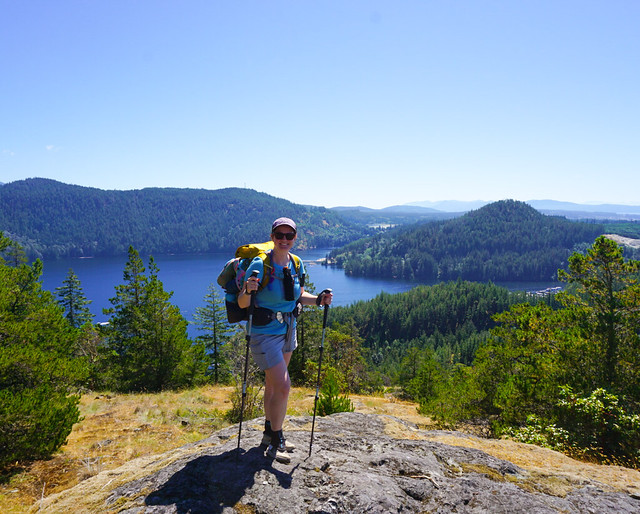
My opinion hasn’t changed that much from my last post – I still think Gregory has some of the best value backpacks on the market. They’re lightweight and cheaper than brands like Osprey, while still being super comfortable and well designed. I don’t think you can go wrong with a Gregory pack, especially if you’re a beginner. However, if you’re looking for something ultralite, I swear by Gossamer Gear, which I think are super light without compromising on comfort or utility. A lot of ultralite packs aren’t super comfortable because they either don’t have any internal frame, or only a very small one. Gossamer Gear has a small metal frame providing some structure, but more importantly, they have a removeable sit-light pad that provides more structure to the bag and can also be used as a sit-upon. I hiked 180km with the pack on the Sunshine Coast Trail and it was so comfortable.

Can you use an ultralite pack even if you’re a beginner? You sure can! But make sure you assess your other gear first. Ultralite packs can’t carry as heavy loads as traditional packs. So assess how much your other gear weighs before committing to one. Beginners tend to have heavier packs because it’s expensive to buy a lot of gear at once and you typically have to compromise on quality to afford everything you need or borrow it, plus beginners tend to take a lot of comfort items while they’re learning. There’s absolutely nothing wrong with this approach, but consider how heavy your gear realistically is before getting an ultralite pack. In addition, most outdoor stores don’t stock many ultralite options, so they often have to be ordered from the US. There are a lot of benefits to trying your backpack on first to make sure it’s comfortable, especially for beginners, which is why I like to also recommend Gregory packs. If you’re a beginner and starting from scratch, I would probably start with a 60L pack. If you have smaller gear, I personally prefer a 50L pack or smaller (I use the Gossamer Gear Gorilla 50).

If you’re shopping for a day pack, always look for a pack that has waist straps as this will make hiking so much more comfortable. Consider what you’ll be using the pack for, if it’s mostly for summer, a smaller pack may suit you better (though I don’t like anything smaller than 20L because I always take my essentials); but if you plan to use it in the winter, you may want a larger pack to house your cold weather gear, or consider a pack with snowshoe straps or space for avalanche gear.

Note: keep in mind that while the Gossamer Gear backpacks appear similarly priced to Gregory, these are listed in USD and you will have to pay both shipping (~CAD$50) and duties (~CAD$60).

Best Value / Best for Beginners: Gregory Jade 53/63 (women’s); Gregory Amber 55/65 (women’s); Gregory Stout 60 (men’s)

Best Ultralite: Gossamer Gear Gorilla 50 (unisex); Gossamer Gear Mariposa 60 (unisex)

Best Summer Daypack: Gregory Maya 20 (women’s); Gregory Juno 24 (women’s); Gregory Miko 20 (men’s); Gregory Citro 24 (men’s)

Best Winter Daypack: Deuter Freerider 28 (women’s); Deuter Freerider 30 (men’s); Gossamer Gear Kumo 36 (unisex)

Sleeping Bag
DSC04795

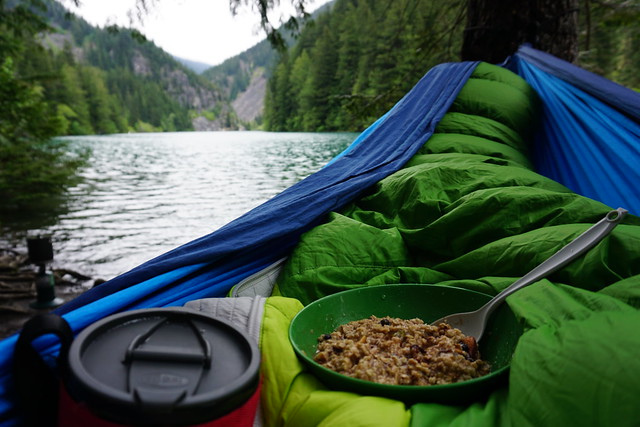
In my opinion, if there’s one item you’re going to splurge on, make it your sleeping bag. There’s no compromise for a comfortable night’s sleep and a really warm and lightweight bag will cost you money. Personally I prefer down bags for warmth, but pay close attention to the comfort and survival ratings when choosing your bag. My experience is that cheap bags typically have a larger gap between the comfort and survival rating. The closer the ratings are to one another, the more I generally trust the rating. Women’s bags typically run a bit warmer and fit better (less empty space for cold air to settle), so consider a women’s bag if you’re female.

It’s hard to recommend sleeping bags because everyone is different and where you live will really govern how warm it needs to be. Living in Canada, I would never buy a bag rated less than -5 degrees celsius. When picking a bag, it’s really a balance of weight to warmth to cost. Consider how much money you’re willing to spend and how much weight you’re willing to carry. If you’re a beginner, I recommend a standard mummy zip bag, but if you’ve been backpacking awhile, do yourself a favour and consider buying a quilt.

A quilt compromises on weight by acting more like a blanket that’s strapped to your sleeping pad. They generally have an enclosed footbox, but no back. The bottom of your sleeping bag doesn’t give you very much warmth – the warmth underneath you comes from your sleeping pad, which insulates you from the ground – so by cutting out the back of the bag, you can save on weight and still be able to stay warm. However, this only works with a quality sleeping pad, so don’t compromise one for the other. I bought my first quilt last year that’s rated to -6 degrees celsius and I am obsessed with it! My quilt is from UGQ Outdoors – I love this option because every quilt is custom; and my sleeping bag is from MEC, which I think make quality bags with a decent price tag.

If you’re looking for a winter sleeping bag, there are limited options on the market and they will cost you a lot of money. I have a -30 degree bag for snow camping that I paid a lot of money for, but it’s not my favourite because it’s a unisex bag and it’s too big for me. It does keep me warm, but it’s a bit of work for me to get warm in such a large bag. I have lots of thoughts on winter bags if you ever want to DM me, but I don’t want to recommend a bag I haven’t tested.

3- Season Sleeping Bag: MEC Delphinus -9 (women’s); MEC Draco -9 (men’s)

Quilt: UGQ Bandit -6/-12

Sleeping Pad

It’s so easy to overlook your sleeping pad, but it’s such an important part of your sleep system. You could have the warmest bag in the world, but if you go to sleep on a crappy sleeping pad, you will still be cold. Personally I think Thermarest has the best sleeping pads on the market. They are expensive, but they are so warm and comfortable (some people think they are crinkly and noisy, but it’s never been a problem for me). For backcountry, I swear by the Neoair line because they are both the lightest and smallest on the market. I use the Xlite for 3-season camping (rated R4.5) and I use the Xtherm for snow camping (rated R7). I’ve recommended a few cheaper sleeping pads if you’re on a budget; I don’t find them as comfortable, but there’s nothing wrong with them, just make sure the R-value is 3.5 or higher, especially if you’re in Canada.

If you’re snow camping on a budget, just put a foamy under your 3-season pad for extra insulation. Otherwise, commit to the Xtherm, trust me, it’s the best.

Best 3-season: Thermarest Neoair Xlite (R4.5)

Best 4-season: Thermarest Neoair Xtherm (R7)

Budget 3-season: MEC Reactor (R3.8)

Tent

PSX_20220929_122048

If you’re trying to lighten your pack, you’ll get the most bang for your buck with your tent. A standard 2p tent can weigh 5-6lbs, which you can easily lighten by going with an ultralight or non-freestanding version. If you’re a beginner, I recommend sticking with a freestanding tent, they’re much easier to set up and generally more comfortable. But if you’re a little more experienced and don’t mind dealing with condensation and a more nuanced set-up, you can lighten your pack a lot with a non-freestanding tent (usually doesn’t come with poles and is erected using your trekking poles and tension from the pegs).

For freestanding tents, a lot of people swear by the MSR Hubba Hubba, but I’ve never tried it. Personally, I like Marmot for an easy-to-use lightweight tent. For non-freestanding tents, which are popular among thru-hikers, an important thing to understand is that most of them are single walled, meaning they don’t have a separate fly. They work great in California, but if you live in Canada and hike in the alpine, it means the inside of your tent will generally be filled with a lot of condensation every morning. I use a single walled non-freestanding tent from Gossamer Gear, but I’ve had some growing pains with it because I don’t like dealing with the condensation. The people who prefer them generally learn to deal with it, or else they don’t hike in the Canadian alpine and therefore don’t have to. Fortunately, there is a double walled non-freestanding tent on the market and unsurprisingly, it’s made in Canada! It’s a bit heavier than a single walled, but Carolyn has one and she loves it. So I will begrudgingly link my Gossamer Gear tent, which I love for it’s size and how easy it is to set up, but be prepared to deal with condensation.

Standard 2p Tent: Marmot Tungsten

Lightweight 2p Tent: Marmot Tungsten Ultralight

Non-freestanding (single wall) 2p Tent: Gossamer Gear The Two

Non-freestanding (double wall) 2p Tent: Durston X-Mid

Kitchen

IMG_0347

I don’t have as many opinions on stoves and pot sets as I do for the “big 4” described above. But I have learned a few things over the years.

For stoves, I like to use an isobutane stove. The stoves are very straight forward to use and fuel is relatively lightweight and easy to find. You can get away with an isobutane stove for most of the year, but if you’re going to be snow camping, consider getting a white gas stove instead (any of the white gas stoves from MSR). Isobutane can freeze in cold temperatures and a white gas stove is the most reliable option. Another alternative is an alcohol stove, but I don’t personally recommend these. I have 2 isobutane stove recommendations because I think one is better for solo trips (when you have a small pot) and the other is better for when you’re cooking on a full size pot.

Isobutane stove (solo trips): BRS mini

Isobutane stove (2+ people): Primus stove

White gas stove: MSR Whisperlite, Dragonfly, or XGK

For pot sets, I don’t have strong opinions. I have a small pot that I use for solo trips that I absolutely adore and is well priced. I don’t personally see the point in spending a lot of money on a pot set, they’re generally going to get beat up over time, so don’t break the bank on it. The most important thing for me is a well-fitting pot lid. Some people really like the sets that come with dishes, but I just like something that easily fits my stove inside it. For multi pot sets, I prefer to have a lid for each pot rather than a shared lid (but I’ve yet to find a set that comes with 2 lids and no dishes).

Solo pot: GSI Halulite Minimalist

Other Gear

Sit-upon: I’ve been using the MEC Seat Cushion for years and I love it!

Pillow: I used to use my sit-upon as a pillow too, but I recently switched to the MEC Pillow and it’s a lot comfier

MugGSI Infinity Mug 

Microspikes: I think every hiker needs a good paid of microspikes, I use Kahtoola Microspikes 

Communication Device: A satellite device could save your life, I used one in 2021 when my friend had a serious medical emergency and highly recommend the Garmin InReach Mini 

Clothing

You don’t need a bunch of expensive clothing for hiking. I try to avoid cotton, but you can find pretty much everything you need at Costco, you just need to time your purchases for some of their featured items. They sell nice merino shirts from cloudveil once a year in the Fall and they sell lightweight puffy jackets every winter. They also stock merino wool socks in the winter and have base layer merino year round from paradox (though be aware, this brand is only about 15% merino, but still made with poly and appropriate for the backcountry). Other items I’ve found throughout the years include a lightweight pair of puffy slippers for winter camping and hiking shorts from Eddie Bauer.

The only thing I don’t really trust from Costco is a quality rain jacket, so I decided to spend a bit more money on this item. If you’re looking for a more environmentally sustainable company than Costco, I personally like Patagonia.

Skiing in Levi

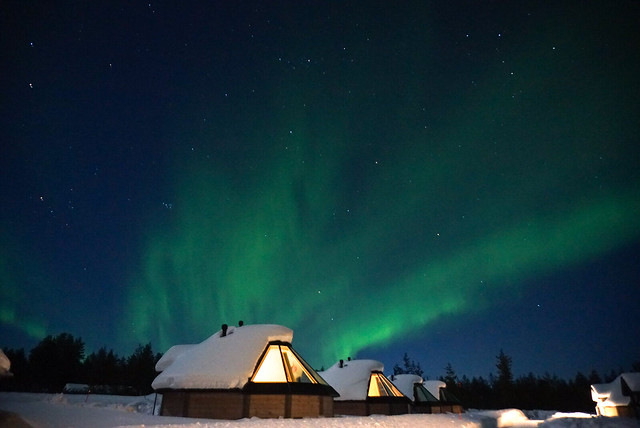
The last segment of our trip was to another small town in Lapland called Levi. It’s only about an hour from Yllas, so we drove there after our visit to the snow hotel. While I didn’t care to sleep in a snow hotel, I was keen to try out one of the glass huts. There are several different glass huts around the region and as the name suggests, they are basically glass roofed hotel rooms. Unsurprisingly, they are not cheap, so I shopped around a bit before deciding on the Northern Lights Huts in Levi, which are pretty new and the cheapest I could find in the region.

It was a great choice! It’s located on a reindeer farm about 20 minutes away from Levi town. There’s 10 glass huts on the property and we had one booked for 2 nights. The huts are very new and really nice on the inside, so it was nice to relax for a little bit after a busy day of dogsledding. We returned to town for supper, but otherwise had a chill evening.

PSX_20230402_213351

My primary motivation in booking the hut was as a last ditch attempt to make it easy to see the northern lights. Fortunately, we’d already seen them 4 nights in a row by then, so it removed a lot of the pressure. The geomagnetic storm was winding down and the KP was back around 2-3 for our last two nights, so I wasn’t sure if we would see them. On the first night it was pretty cloudy and we didn’t see anything before bed. The app said the clouds would clear around midnight, so I set an alarm and we woke up at midnight and could see them from our bed! So it ended up working out nicely because I definitely would not have trudged down to the lake in Akaslompolo at midnight, but it was nice to wake up and watch them inside for a bit and then go back to sleep.

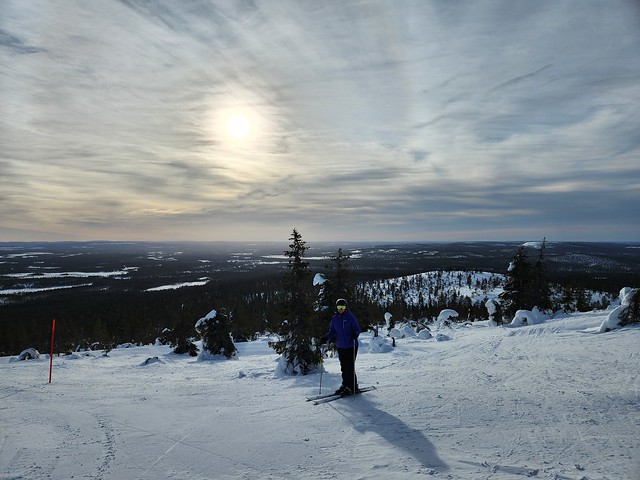
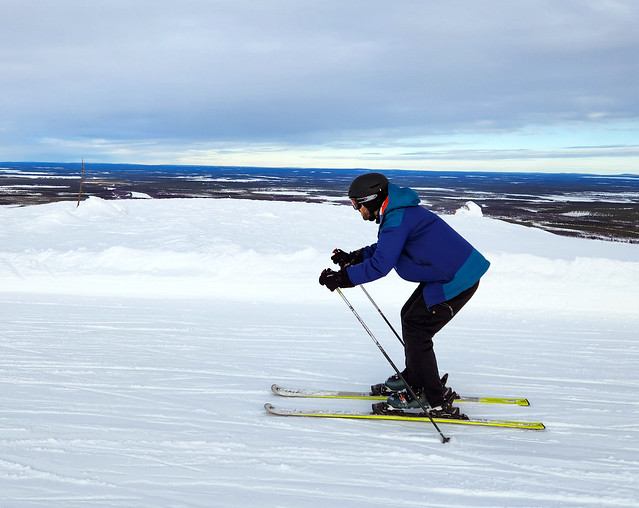
On our last full day in Lapland we had planned a second skiing day. Levi resort is bigger than Yllas and fortunately the wind storm had moved on and the entire resort was open! While Yllas only had two faces to access the mountain, Levi had at least 4. There are two main lifts, one from Levi town and one from the south face, which is where we opted to start. Levi was busier than Yllas, so it took a while to get our rentals, but after that there was a lot of terrain to choose from.

PSX_20230316_195159

I recall there being at least 3 chair lifts and 1 gondola, but pretty much all the other lifts were T-bars and there must have been at least a dozen of them! The mountain is completely bare on top, so you can pretty much ski down it in any direction. Each T-bar only services about 2-3 runs, so we slowly made our way around the mountain. The terrain was simple enough that we could ski any run on the mountain, so we just explored as much as we could. It’s a very different experience than skiing in Canada, but I enjoyed it more than Yllas.

We had lunch at a small restaurant on the east side of the mountain, but my favourite skiing terrain was on the west side. While the temperatures had been between -10 to -20 degrees celsius when we arrived in Rovaniemi, it had warmed up a lot over the week and it was around 0 degrees when we skied Levi. It felt much warmer and it even starting to feel a bit like Spring. There was no fresh powder on either mountain that we skied, but because it’s generally cold and dry in Lapland, neither mountain was icy.

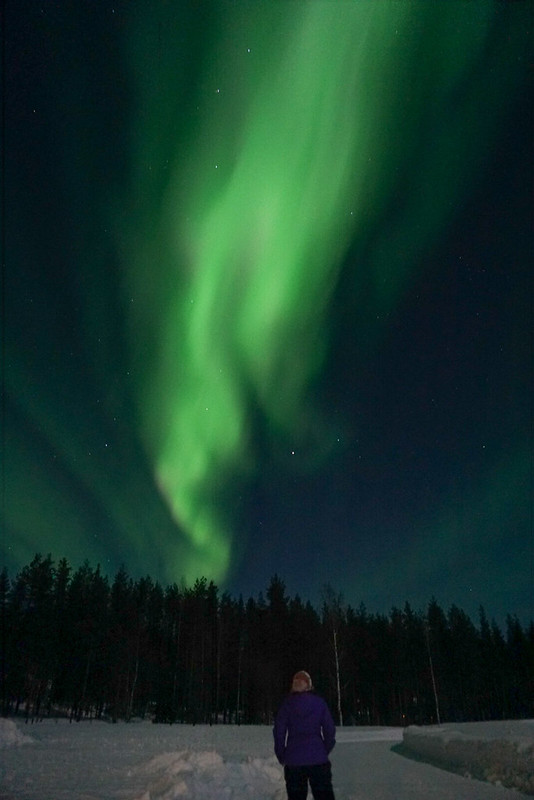
We discovered a pancake restaurant in Levi that I was excited to try for dinner on our last night. So we enjoyed some giant savoury pancakes before retiring to our hut for the evening. The KP was only 2 on the last night, so I wasn’t expecting much even though it was clear, but the aurora treated us a real show! I guess because we’re so far north, you can still get a very active sky, even with a low KP.

PSX_20230402_212918

At first the lights seemed pretty normal and similar to other nights, but around 9 or 10pm they got incredibly active and despite having the glass roof, I couldn’t resist going outside to photograph them. The lights were pulsing from horizon to horizon and we couldn’t catch the full scope of them from inside. It was probably the second best night we’d seen them and it was a real treat to witness them swirling across the sky one last time. Seth had kind of gotten over the allure by that point, but the northern lights captivated me every single night I saw them. I admit I got a little obsessed and since I returned home, I’ve been plotting when I can see them again.

The aurora goes through cycles throughout the night, but they also go through larger cycles throughout time. We’re currently heading into a period of increased geomagnetic activity for the next few years, so it should be easier to see them over the next 5 years, so if there’s ever been a time to plan an aurora trip, this is it!

PSX_20230324_234055

Our last day in Finland was pretty boring. We enjoyed our buffet breakfast at the hotel and then drove two hours back to Rovaniemi to catch our flight. One thing we learned is that the Finns all have a secret sweet tooth and eat a lot of candy and chocolate. Finnish chocolate is really creamy and delicious, so we stopped by the grocery store on the way back to stock up. We had an uneventful flight back to Helsinki and returned to Katie’s apartment for our last night.

Katie took us to a ramen restaurant for our last meal and we spent an hour walking around the city before returning to her place for one last sauna session. She’s scheduled to finish her degree before the end of the year, but she’s also planning to stay in Helsinki and look for work, so who knows, we might be back again in the future.

Finland is probably not the first place that comes to mind when you’re planning a holiday, much less a winter holiday, but I really loved it. The aurora certainly made it memorable, but even without the aurora, it’s a cool place and I liked a lot of their progressive policies. I would definitely come back in the winter to chase the aurora again – I’m not sure I’d visit Lapland in the summer, but I’d consider returning to Helsinki in the summer and maybe tack on a visit to Norway or Sweden to do some hiking. Overall we had a great trip and would definitely recommend!

Dog Sledding and Other Adventures

On our second day in Yllas we made another attempt at the ski hill. This time we drove around to the Yllas side since there are more chair lifts. It was still windy, so we were disappointed that the top half of the mountain remained closed, but we decided to go skiing anyways. It was mid-week, so fortunately it wasn’t too busy – we had to wait in line at most lifts, but given that half the mountain was closed, it could have been a lot worse.

Skiing in Finland is a very different experience from skiing in Canada. It’s not a very large mountain and it’s incredibly bare and exposed, so the skiing is not as adventurous. If you like groomed runs, it’s a decent mountain, but there’s almost no ungroomed terrain, so it can be a bit boring. The mountain is deceiving because it looks like there is un-skied powder between each exposed run, but because of the climate, the snow off-piste is very crunchy and bumpy – not fun for skiing.

20230228_125152

But the biggest difference is the lifts. Yllas had one high speed chair lift going half way up the mountain and one (closed) gondola going to the top. Besides that, it’s almost entirely T-bars. We also skied a second resort in Levi and it was the same. None of the terrain is very steep and because the mountain is so bare, you can ski down any face, so I guess it’s a lot cheaper to install a ton of T-bars, with each one only servicing a couple runs. It wasn’t that big a deal, but it does make for a tiring day when you don’t get to sit on the chairs because then you are constantly on your feet.

So it wasn’t my favourite mountain to ski, but it was definitely an experience! We skied all over the mountain in the morning, then after lunch we managed to find one glade run on the far side of the hill, which ended up being our favourite, so we skied that one a few times. There’s a lookout on the way back to Akaslompolo and we timed our departure to catch the sunset from the viewpoint. We didn’t see that many sunsets in Lapland, but the ones we did see were very beautiful. The sky turns purple and pink and reflects off the snow.

20230228_145127

On our last day in Yllas we opted to do a dog sledding tour. I was really on the fence about it because they’re not cheap and you can do them in Canada. But I went to Banff last winter and opted not to do one, so I figured now was the time and booked a half day tour with Rami’s Huskies.

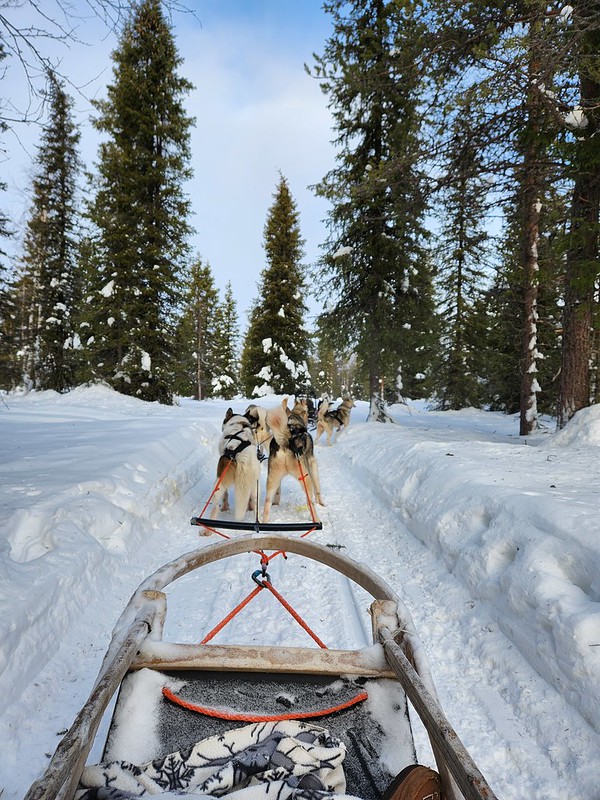
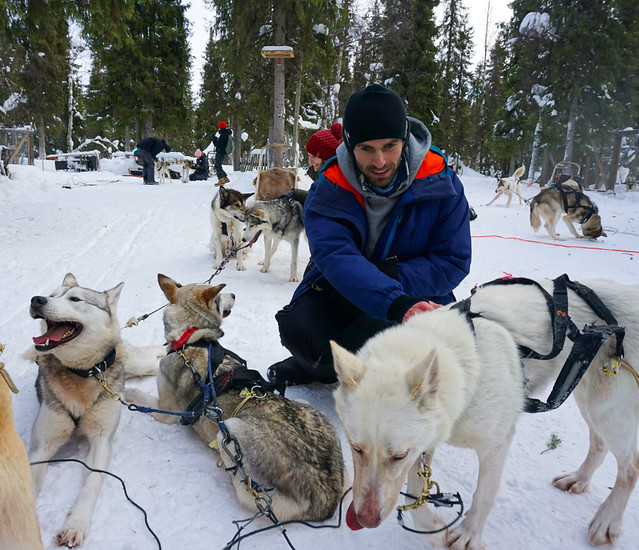
Rami’s is located just outside the National Park and we arrived to the predictable symphony of screeching huskies. We didn’t really know what to expect, but we were excited to learn we would sledding in pairs of two, which meant we would get to drive our own sleds! We got a quick lesson in the basics: hand signals, stopping, how to take turns, and when to slow down; and then we prepared for our 16km run in the National Park, with a lunch break at the half way point. The sled is just big enough for one person to sit in it and one person to stand at the back. The person on the back is the driver, so we decided Seth would steer first while I took photos from the sled.

20230301_102225
20230301_102416

There was about 10 of us on the tour, plus two guides. Each team had 6 dogs, so there was a whopping 42 dogs in our party! When you’re dog sledding in the wilderness, you direct the dogs verbally on where to go, but we were following a track the entire time, so the dogs pretty much just follow each other and the track, so it’s easy to drive. You just need to use the brake whenever the person ahead of you signals because you don’t want to run into the team in front of you.

It’s a bit of a slow start at first because the dogs are extremely excited to run and there’s a very sharp turn early on that the guides want everyone to take slowly. We had a few stop and starts, which are challenging because the dogs were very restless, but eventually we got into the groove and no one fell off their sled the entire trip, which is a bit of a rarity. Seth had his work cut out for him when we kept stopping because the team behind us had a very excitable lead dog named Ginny, and she would get too close to Seth whenever we’d stop and nip at his butt to try and get him to keep going. Our team was a bit slow, so eventually the guides swapped Ginny into our team and we went a lot faster after that!

PSX_20230307_185753
PSX_20230330_071823

We had so much fun on this trip! I wasn’t really sure what to expect, but we were thrilled to drive the sleds ourselves and what left the biggest impression on me was how much the dogs love to run. They are loud when you arrive because they are already hooked up to the sleds and they can’t wait to get going. Around the 8km mark we stopped for a break and the dogs mostly settled down for a rest, but as soon as we started getting ready to go again, they were up and eager to keep running.

We had what I can only call a boil-up for lunch, which is popular in Newfoundland (the similarities continue). We got a little fire going to make tea and the guides roasted sausages for us to snack on with some biscuits. We had the chance to question them on the dogs and learned a lot about the sledding industry. At Rami’s, the dogs will run about 32km a day, 5 days a week, at their peak age and health. They’ll either do two 16km rides (like ours), or a 16km ride in the morning, followed by a 10km ride in the afternoon, and a 5km ride in the evening. They regularly swap out which dogs are in which teams, but the dogs all have distinct personalities and some won’t run together, while others will only run with certain dogs, and some will only run as lead dogs.

PSX_20230330_071648

It takes about 2 years for dogs to mature, so they don’t work full time before then and are mostly in sled dog training. Once they get older, they reduce the number of kilometres they run per week, but they never fully retire the dogs for their mental health. Huskies are an eccentric breed and I can see how it would drive the dog nuts to not run at all after a lifetime of it. Rami’s doesn’t do dog sledding races, only tourism, and they have about 75 dogs in their kennel, which is considered small. Some kennels have up to 450 dogs!

So if you ever find yourself in Lapland, or even anywhere in Canada that offers dogsledding, I would highly recommend it! We really loved it and I wouldn’t hesitate to go again – now I just need to do some research on where I can go in BC!

20230301_135803
20230301_133756

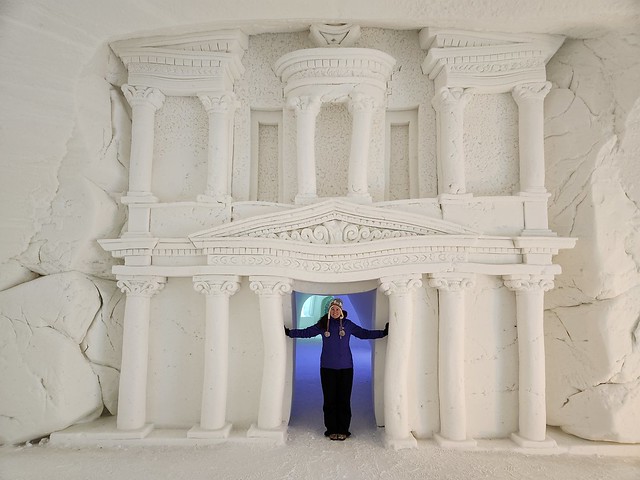
Rami’s is close to the Lapland Hotels Snow Village, so after we finished our tour we decided to drop by the hotel. It’s a hotel compound made entirely of snow, so it gets re-constructed every year. I think the layout remains the same year after year, but the village is filled with tons of snow sculptures and those change every year depending on the theme. It seems like their most popular year was when they did a game of thrones theme, but when we visited they had an around the world theme and had sculptures of iconic monuments from around the world.

The village comprises of a snow restaurant, a normal restaurant, an ice bar, and a hotel. During the day the hotel has a cover charge to view, so it operates primarily as more of a gallery. There’s about a dozen different themes rooms with varying numbers of beds. Since no one stays there during the day, we were a little bit confused about how it worked because the village is open to visitors from 10am to 10pm. But if you’d like to stay in one of the snow rooms, they are available purely for sleeping starting at 10pm. So basically you check in, sleep in the room, and get hurried out in the morning, so it wouldn’t be my choice, but to each their own! We enjoying viewing the sculptures and then hit the road for our next stop in Levi!

20230301_135016